REVIEW 6 major objections 6 minor 67 references
Uncertainty Quantification in Working Memory via Moment Neural Networks
T0 review · 6 major / 6 minor · reviewed 2026-08-12 · deepseek-v4-flash
Pith's one-line read A recurrent circuit trained to report a remembered feature in its mean firing rate spontaneously develops a firing-covariance readout that tracks its own memory error, about as well as human confidence reports do, and the signal transfers…
desk verdict Interesting idea, broken evaluation metric: the paper's claim of human-comparable UQ rests on an unnormalized covariance written as a correlation coefficient. read the letter →
The pith
A machine-rendered reading of the paper's core claim, the machinery that carries it, and where it could break.
The reading
What carries the argument
The central object is the moment neural network, a pair of coupled equations (Eq. (2)) for the mean firing rate $\mu$ and firing covariance $C$, with moment activations $\phi_\mu$ and $\phi_C$ (Eq. (4)) derived from the diffusion approximation of leaky integrate-and-fire neurons; these activations define how input-current statistics (mean $\bar{\mu} = W\mu + \mu_s$, covariance $\bar{C} = W C W^{\top} + \sigma_s^2 I$) map to output spike statistics. The training loss (Eq. (13)) supervises only $W_{\mathrm{out}}^{\top}\mu$ against the encoded feature, leaving $C$ unsupervised. Two auxiliary constructs carry the argument: the decoded covariance $\hat{C}_z = W_{\mathrm{out}}^{\top} C W_{\mathrm{out}}$, from which four entropy-based uncertainty metrics are computed, and the differential covariance ratio (DCR, Eq. (19)), which isolates the covariance component parallel to the tuning-curve derivative that shrinks coding information. The paper's supplementary theorems (Thm. S1, Thm. S2) use the backward uniqueness property of parabolic equations to show, in a simplified scalar system, that a mean-only loss can force the model to learn the ground-truth output variance, and that variance error is bounded by mean loss under higher training noise.
What would settle it
Simulate the full LIF spiking network with the transferred weights at $g=3$, $N=200$ across many trials, estimate spike-count covariance directly, and compare its leading eigenvectors and the decoded uncertainty-error correlation with the MNN's predictions; if the spiking covariance's informative component is much weaker or differently oriented than predicted, the uncertainty readout is an artifact of the moment closure. A complementary check is to decorrelate the recorded spike counts (clamp off-diagonal covariances to zero) and see whether the uncertainty-error correlation vanishes, as it does in the MNN's ablation.
Extended reading notes
Core claim
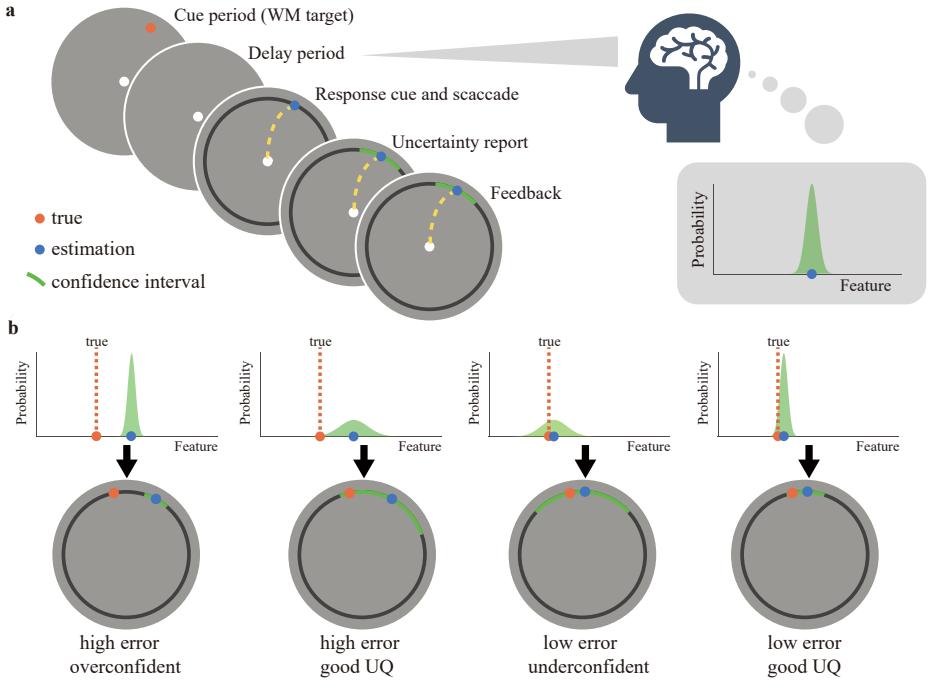
The central claim is that uncertainty quantification in working memory can be accomplished by firing covariance alone, without any supervised training signal for that covariance. After reservoir-computing training with the mean-only loss of Eq. (13), an MNN's fixed points show that trial-to-trial error in the decoded feature is positively correlated with uncertainty readouts computed from the decoded covariance $\hat{C}_z = W_{\mathrm{out}}^{\top} C W_{\mathrm{out}}$; the correlations are comparable to the 0.6–0.7 range reported for humans in ref. [14]. The mechanism proposed is that error arises from random drift of the bump, and this drift injects a differential covariance component into the neural covariance; a differential covariance ratio (DCR, Eq. (19)) constructed from the sign structure of the covariance tracks all four uncertainty metrics, and the bump width is simultaneously coupled to the covariance, linking probabilistic population coding to sampling-based coding. Clamping off-diagonal correlations to zero abolishes the uncertainty signal, showing that the correlations are causal. The same weights, run as a spiking LIF network, give qualitatively similar tuning, covariance patterns, error distributions, and uncertainty-error correlations, which the paper takes as evidence that the MNN is a faithful substitute for the SNN and that the UQ mechanism is spike-compatible.
Load-bearing premise
The load-bearing premise is that the moment-closure equations (Eq. (2) and Eq. (4)), derived from the diffusion approximation of LIF neurons, faithfully reproduce the trial-to-trial firing covariance of the full spiking network at the trained heterogeneous regime ($g=3$, $N=200$), a premise checked only qualitatively by the SNN transfer in Section 7.
Editorial extensions
If this is right
- A mean-only training objective is sufficient for a network to acquire a calibrated uncertainty readout: the covariance self-organizes through mean-covariance coupling rather than being fitted to an explicit variance loss.
- Correlated variability is causally necessary for UQ in this circuit: when pairwise correlations are clamped to zero, the correlation between uncertainty and error drops sharply.
- The mechanism is realizable in spike-based computation: weights trained in the differentiable MNN transfer to an LIF spiking network and preserve the uncertainty-error correlation, giving the paper's claimed first spike-based implementation of uncertainty quantification in working memory.
- Noise and heterogeneity are functionally beneficial: increasing training noise, population size, and, within a range, heterogeneity improves both coding precision and UQ, which yields testable predictions about how individual differences in neural heterogeneity relate to confidence calibration.
Reading between the lines
- Editorial inference: if covariance calibration emerges from mean-only error signals, then artificial systems could attach confidence to their outputs without ever supervising variance; the covariance of the last-layer activations after mean-squared-error training could be monitored as a free uncertainty signal.
- Editorial inference: the differential-covariance story implies that any perturbation that drifts the memory bump, such as a distractor stimulus or a brief current injection, should inflate the decoded uncertainty readout even when the mean bump looks unchanged; a direct perturbation experiment could test this causality.
- Editorial inference: the MNN-to-SNN transfer is qualitative, so a quantitative comparison of the spike-count covariance eigenvectors between the LIF simulation and the MNN's predicted covariance would sharpen the claim and could reveal the heterogeneity level at which the moment closure begins to break down.
Editorial analysis
A structured set of objections, weighed in public.
Referee Report
Summary. This paper trains moment neural networks (MNNs) on a continuous working memory task using a reservoir-computing/low-rank training scheme, with a loss that supervises only the decoded mean. The main claim is that, although covariance is not supervised, the MNN's firing covariance state is nevertheless positively related to trial-to-trial memory error, and that this relationship is comparable to human UQ performance. The paper also claims a mechanistic link between bump width (probabilistic population coding) and covariance-based uncertainty (sampling-based coding) through a differential covariance ratio (DCR), and transfers the trained MNN weights to an LIF spiking network to show that the UQ phenomenon persists. Supplementary theorems S1-S2 are intended to show that supervised mean training can, in an idealized scalar setting, also match or bound the output variance.
Significance. If the central empirical claim held as stated, the paper would be a valuable contribution: it offers a biologically motivated MNN framework in which a purely mean-supervised training loss yields an emergent, covariance-based uncertainty signal that transfers to a spiking implementation, plus falsifiable predictions about decorrelation, population size, noise, and heterogeneity. The use of a parametric moment closure derived from LIF neurons, rather than a hand-designed rate model, is a genuine strength, as is the explicit attempt to verify the MNN against an SNN by weight transfer. The theoretical supplement also attempts a nontrivial statement (variance error bounded by mean loss under noise) rather than merely asserting empirical success.
major comments (6)
- [Methods, Eq. (18)] Eq. (18) defines rho as (1/L) sum kappa_i e_i - (1/L^2)(sum kappa_i)(sum e_i). This is a sample covariance, not a correlation coefficient: it is not normalized by the standard deviations of kappa and e, is not dimensionless, and changes magnitude under any positive rescaling of the uncertainty indicators kappa_I through kappa_IV. The headline comparisons to "human correlation coefficients of 0.6-0.7" (Sections 3, 5, 9 and Fig. 3e) are therefore not valid as written, since the human benchmarks in Li et al. are Pearson correlations. All figures reporting "the correlation between uncertainty and error" or "correlation coefficient rho" (Figs. 3e, 4b, 4e, 5d-f, 6a,d,g, 7a,d,g, and the corresponding Supplementary figures) use Eq. (18). The authors should recompute all reported rho values with a normalized measure (e.g., Pearson or Spearman correlation) and either replace the human comparison or explicitly acknowledge that only the sign and relative ordering of the unnormalized quantity are being reported.
- [Methods, Eq. (19)] The differential covariance ratio in Eq. (19) is not well defined as written: the indices i, 2N - j, and 2N - i are inconsistent with C being an N x N matrix, and the term C_{i,2N-j} appears twice with no corresponding correct index pattern. Moreover, the claimed sign structure in Eq. (20) is stated as an axiom ("the differential covariance induced by the drift of the bump exhibits a distinct pattern") rather than derived from the trained dynamics. Since DCR is used as evidence for the proposed mechanism in Fig. 4e and Fig. 5f, the authors should correct the index definitions, verify the sign pattern empirically from the trained MNN/SNN covariances, and confirm that the reported DCR values are stable under the corrected definition.
- [S1, Theorem S2] The proof of Theorem S2 contains several inconsistencies that prevent the bound in Eq. (S17) from being checked as written: Eq. (S18) and the surrounding text use m* - y* where the intended argument appears to need m* - m, and the line "combine with Eq. (S19)" leading to Eq. (S22) does not follow from the stated Harnack inequality, which is applied at a single point and does not yield the claimed integral inequality. In addition, Theorem S2 is stated for a scalar output while the MNN's decoded uncertainty is a 2x2 covariance; the paper asserts without proof that the result extends to high dimensions. The authors should rewrite the proof with consistent notation, supply the missing justifications for the Harnack step and the extension to vector-valued outputs, or clearly mark this part as a heuristic argument rather than a proved theorem.
- [Section 5, Fig. 3e and ablation] The ablation that clamps all off-diagonal correlations to zero is reported as a "significant decrease" in rho, but with Eq. (18) as the metric, a decrease could be driven purely by a change in the marginal variance of the uncertainty indicators rather than by a change in the strength of association. The claim that "correlation between neural activities is crucial for UQ" (Section 5 and Discussion) therefore needs to be re-established with a normalized correlation measure, or with an explicit demonstration that the variance of kappa is not the dominant driver of the reported difference.
- [Section 7 and Methods (SNN verification)] The SNN verification is qualitative: Fig. 5 reports that the SNN reproduces the patterns of the MNN, but the paper does not provide quantitative agreement metrics (e.g., how close the SNN's steady-state mean/covariance are to the MNN's fixed points, or how the SNN's rho values and error levels compare numerically with the MNN's). Since the moment closure in Eq. (4) is the load-bearing bridge between the MNN and the LIF SNN, the authors should add quantitative comparisons (e.g., normalized covariance error, rho values, error distributions) or acknowledge more explicitly that the SNN verification only establishes qualitative consistency.
- [Section 6 and Supplementary S1] The claim that the theorems in the Supplement support the MNN's UQ mechanism is overstated. The theorems concern an abstract scalar system with input noise and do not involve recurrent dynamics, a ring manifold, a trained weight matrix, or the specific MNN moment closure. For example, the MNN's covariance is not a simple function of input noise; it is shaped by the recurrent structure. The authors should either connect the theorems to the MNN architecture explicitly, or soften the claims in Section 6 and Section 8 that these theorems explain the empirical UQ results.
minor comments (6)
- [Throughout] The paper reports all rho values only as qualitative statements ("strongly positively correlated", "comparable", "significant decrease") without error bars, confidence intervals, or numerical values in the main text. Given that each test is repeated 10 times, reporting the mean and standard deviation of rho (or a bootstrap CI) for the key figures would substantially strengthen the claims.
- [Section 2] The description of the human experiment in Li et al. states that participants "first being presented with a cue" and later "report the remembered feature and indicate their uncertainty by adjusting the length of an arc". It would be helpful to clarify that the human UQ measure is a confidence-interval report, not a confidence rating, and to state the exact human correlation value and its error bar as reported by Li et al.
- [Methods, Eq. (4)] The moment activation functions in Eq. (4) include the term (∂phi_mu/∂bar_mu)_{ii}(∂phi_mu/∂bar_mu)_{jj} for the off-diagonal covariance, but the notation is not fully defined: the partial derivative of phi_mu with respect to the vector bar_mu is a Jacobian, and the meaning of the double index is unclear. The authors should define this derivative explicitly.
- [Methods, Network inference] The inference step sets sigma_xi ~ Unif[0,1] independently per instance, but the paper does not state how this noise is incorporated into Eq. (14) (it appears only in the text as "adding external noise ... with sigma_xi"). The precise dependence of bar_mu on xi_t should be written out, since the uncertainty indicators are functions of the covariance only and the role of this input noise is otherwise unexplained.
- [Supplementary S1] Theorem S1 is stated for a loss that vanishes exactly (L = 0), but the paper later acknowledges that "minimizing the training loss to zero is impossible" and Theorem S2 provides the approximate version. The logical relationship between S1 and S2 should be stated more explicitly (S1 as an idealized exact case, S2 as the practical bound).
- [Section 5 and Fig. 3] The claim that "the precision of our model also reaches comparable level reported in [18, 40, 14]" is not supported by any numerical comparison of error distributions or psychophysical metrics. Either provide the quantitative comparison or soften the sentence.
Circularity Check
No significant circularity: the uncertainty signal is emergent from an unsupervised covariance, and the MNN premise is independently checked against an LIF spiking network.
full rationale
The paper's central claim is that an MNN trained with a loss that supervises only the mean firing rate develops a firing-covariance state that quantifies its own memory error. This is not circular: Methods Eq. (13) explicitly states "Note that the covariance is not contained in the loss function," so the positive correlation in Fig. 3e is not a fitted parameter renamed as a prediction. The covariance adapts through the MNN's mean-covariance coupling rather than through direct supervision. The MNN equations (Eqs. (2) and (4)) are cited to the authors' prior work [33,64], and differential covariance is also cited to the authors' [34]; however, these are not load-bearing in a circular way because the paper restates the moment-closure equations and independently validates the MNN against a full LIF SNN in Section 7 by transferring trained weights and observing "qualitatively similar patterns" and comparable UQ performance. Thus the main mechanism is checked by an external simulation in the same paper. The supplementary theorems (Thm. S1, Thm. S2) are close to mathematical identities — if the mean map matches under all noise levels, backward uniqueness yields f = f*, and hence output variances match — but they are proofs with stated assumptions, not assumptions of the target result; their idealization of zero loss is a limitation, not circularity. The DCR definition in Eq. (19) contains undefined indices and repeated terms, which is a reproducibility defect, but it is a proposed diagnostic metric rather than a circular reduction of the conclusion into the premise. The main quantitative weakness is that Eq. (18) defines the reported association as an unnormalized sample covariance rather than a Pearson correlation, so the comparison to human correlation coefficients is not meaningful as written; this is a correctness and metric-validity concern, not a circularity in the derivation chain. Overall, no step in the paper reduces by construction to its own input, and the core UQ result retains independent content.
Assumptions & free parameters
free parameters (9)
- heterogeneity g =
3 (default, varied 0.5 to 5)
- L2 regularization alpha =
5e-3 (default, varied in Fig. 6g-i)
- training noise variance sigma_s^2 =
1 (default, varied in Fig. 7a-c)
- inference noise variance sigma_s,2 =
varied in Fig. 7d-f; no explicit default stated
- training sample count M =
20 (default, varied in Fig. 6a-c)
- population size N =
200 (default, varied 100 to 1000)
- input amplitude A =
1.2
- cue noise sigma_xi =
sampled uniformly from [0,1] per test instance
- LIF parameters (u_th, u_res, T_ref, L, tau_s) =
20 mV, 0 mV, 5 ms, 0.05 ms^-1, 10 ms
assumptions (6)
- domain assumption Diffusion approximation for LIF neuron populations yields the moment activations phi_mu and phi_C of Eq. (4).
- domain assumption The low-rank reservoir structure W = Wfb Wout^T + gJ with fixed random J creates a ring-like manifold that stores the periodic feature.
- domain assumption Decoded covariance C_z = Wout^T C Wout is a valid proxy for behavioral uncertainty.
- domain assumption The covariance fixed point after the delay period corresponds to trial-to-trial variability, not just a deterministic moment.
- ad hoc to paper The random drift of the bump induces a differential covariance pattern with the sign relation in Eq. (20).
- standard math Backward uniqueness of parabolic operators (Wu and Zhang [66]) and Harnack's inequality (Evans [67]) apply to the heat-type equations used in Thm S1 and S2.
Cite this review
Pith. "Pith review of Uncertainty Quantification in Working Memory via Moment Neural Networks." pith.science (2026). https://pith.science/paper/K4BLP3RD
@misc{pith2026241114196,
  author       = {Pith},
  title        = {Pith review of: Uncertainty Quantification in Working Memory via Moment Neural Networks},
  year         = {2026},
  howpublished = {\url{https://pith.science/paper/K4BLP3RD}},
  note         = {Machine review of arXiv:2411.14196}
}
read the original abstract
Humans possess a finely tuned sense of uncertainty that helps anticipate potential errors, vital for adaptive behavior and survival. However, the underlying neural mechanisms remain unclear. This study applies moment neural networks (MNNs) to explore the neural mechanism of uncertainty quantification in working memory (WM). The MNN captures nonlinear coupling of the first two moments in spiking neural networks (SNNs), identifying firing covariance as a key indicator of uncertainty in encoded information. Trained on a WM task, the model demonstrates coding precision and uncertainty quantification comparable to human performance. Analysis reveals a link between the probabilistic and sampling-based coding for uncertainty representation. Transferring the MNN's weights to an SNN replicates these results. Furthermore, the study provides testable predictions demonstrating how noise and heterogeneity enhance WM performance, highlighting their beneficial role rather than being mere biological byproducts. These findings offer insights into how the brain effectively manages uncertainty with exceptional accuracy.
Figures


Figures from the paper (4 more)


Reference graph
Works this paper leans on
-
[1]
Probabilistic computation in human perception under variability in encoding precision
Shaiyan Keshvari, Ronald Van den Berg, and Wei Ji Ma. Probabilistic computation in human perception under variability in encoding precision. PLoS One, 7(6):e40216, 2012
work page 2012
-
[2]
Monkeys and humans take local uncertainty into account when localizing a change
Deepna Devkar, Anthony A Wright, and Wei Ji Ma. Monkeys and humans take local uncertainty into account when localizing a change. Journal of Vision, 17(11):4–4, 2017
work page 2017
-
[3]
Humans incorporate trial-to-trial working memory uncertainty into rewarded decisions
Maija Honig, Wei Ji Ma, and Daryl Fougnie. Humans incorporate trial-to-trial working memory uncertainty into rewarded decisions. Proceedings of the National Academy of Sciences, 117(15):8391–8397, 2020
work page 2020
-
[4]
Using a betting game to reveal the rich nature of visual working memories
Syaheed B Jabar, Kartik K Sreenivasan, Stergiani Lentzou, Anish Kanabar, Timothy F Brady, and Daryl Fougnie. Using a betting game to reveal the rich nature of visual working memories. BioRxiv, pages 2020–10, 2020
work page 2020
-
[5]
Uncertainty is maintained and used in working memory
Aspen H Yoo, Luigi Acerbi, and Wei Ji Ma. Uncertainty is maintained and used in working memory. Journal of vision, 21(8):13–13, 2021
work page 2021
-
[6]
A survey of uncertainty in deep neural networks
Jakob Gawlikowski, Cedrique Rovile Njieutcheu Tassi, Mohsin Ali, Jongseok Lee, Matthias Humt, Jianxiang Feng, Anna Kruspe, Rudolph Triebel, Peter Jung, Ribana Roscher, et al. A survey of uncertainty in deep neural networks. Artificial Intelligence Review, 56(Suppl 1):1513–1589, 2023
2023
-
[7]
Studying the neural representations of uncertainty
Edgar Y Walker, Stephan Pohl, Rachel N Denison, David L Barack, Jennifer Lee, Ned Block, Wei Ji Ma, and Florent Meyniel. Studying the neural representations of uncertainty. Nature neuroscience, 26(11):1857–1867, 2023. 15
work page 2023
-
[8]
Bridging the gap between explainable ai and uncertainty quantification to enhance trustability
Dominik Seuß. Bridging the gap between explainable ai and uncertainty quantification to enhance trustability. arXiv preprint, 2021
work page 2021
Show all 67 references
-
[9]
Lightweight probabilistic deep networks
Jochen Gast and Stefan Roth. Lightweight probabilistic deep networks. In Proceedings of the IEEE Conference on Computer Vision and Pattern Recognition, pages 3369–3378, 2018
2018
-
[10]
Sampling-free epistemic uncertainty estimation using approximated variance propagation
Janis Postels, Francesco Ferroni, Huseyin Coskun, Nassir Navab, and Federico Tombari. Sampling-free epistemic uncertainty estimation using approximated variance propagation. In Proceedings of the IEEE/CVF international conference on computer vision, pages 2931–2940, 2019
2019
-
[11]
Neural coding of uncertainty and probability
Wei Ji Ma and Mehrdad Jazayeri. Neural coding of uncertainty and probability. Annual review of neuroscience, 37(1):205–220, 2014
2014
-
[12]
Bayesian inference with probabilistic population codes
Wei Ji Ma, Jeffrey M Beck, Peter E Latham, and Alexandre Pouget. Bayesian inference with probabilistic population codes. Nature neuroscience, 9(11):1432–1438, 2006
2006
-
[13]
Neural variability and sampling-based probabilistic representations in the visual cortex
Gerg˝o Orbán, Pietro Berkes, József Fiser, and Máté Lengyel. Neural variability and sampling-based probabilistic representations in the visual cortex. Neuron, 92(2):530–543, 2016
2016
-
[14]
Joint representation of working memory and uncertainty in human cortex
Hsin-Hung Li, Thomas C Sprague, Aspen H Yoo, Wei Ji Ma, and Clayton E Curtis. Joint representation of working memory and uncertainty in human cortex. Neuron, 109(22):3699–3712, 2021
2021
-
[15]
Representation and computation in visual working memory
Paul M Bays, Sebastian Schneegans, Wei Ji Ma, and Timothy F Brady. Representation and computation in visual working memory. Nature Human Behaviour, pages 1–19, 2024
2024
-
[16]
Benchmarks for models of short-term and working memory
Klaus Oberauer, Stephan Lewandowsky, Edward Awh, Gordon DA Brown, Andrew Conway, Nelson Cowan, Christopher Donkin, Simon Farrell, Graham J Hitch, Mark J Hurlstone, et al. Benchmarks for models of short-term and working memory. Psychological bulletin, 144(9):885, 2018
2018
-
[17]
Variability in encoding precision accounts for visual short-term memory limitations
Ronald Van den Berg, Hongsup Shin, Wen-Chuang Chou, Ryan George, and Wei Ji Ma. Variability in encoding precision accounts for visual short-term memory limitations. Proceedings of the National Academy of Sciences, 109(22):8780–8785, 2012
2012
-
[18]
Introspective judgments predict the precision and likelihood of successful maintenance of visual working memory
Rosanne L Rademaker, Caroline H Tredway, and Frank Tong. Introspective judgments predict the precision and likelihood of successful maintenance of visual working memory. Journal of vision, 12(13):21–21, 2012
2012
-
[19]
Representation of visual uncertainty through neural gain variability
Olivier J Hénaff, Zoe M Boundy-Singer, Kristof Meding, Corey M Ziemba, and Robbe LT Goris. Representation of visual uncertainty through neural gain variability. Nature communications, 11(1):2513, 2020
2020
-
[20]
Bump attractor dynamics in prefrontal cortex explains behavioral precision in spatial working memory
Klaus Wimmer, Duane Q Nykamp, Christos Constantinidis, and Albert Compte. Bump attractor dynamics in prefrontal cortex explains behavioral precision in spatial working memory. Nature neuroscience, 17(3):431–439, 2014
2014
-
[21]
Ring attractor dynamics in the drosophila central brain
Sung Soo Kim, Hervé Rouault, Shaul Druckmann, and Vivek Jayaraman. Ring attractor dynamics in the drosophila central brain. Science, 356(6340):849–853, 2017
2017
-
[22]
The intrinsic attractor manifold and population dynamics of a canonical cognitive circuit across waking and sleep.Nature neuroscience, 22(9):1512– 1520, 2019
Rishidev Chaudhuri, Berk Gerçek, Biraj Pandey, Adrien Peyrache, and Ila Fiete. The intrinsic attractor manifold and population dynamics of a canonical cognitive circuit across waking and sleep.Nature neuroscience, 22(9):1512– 1520, 2019
2019
-
[23]
Attractor and integrator networks in the brain
Mikail Khona and Ila R Fiete. Attractor and integrator networks in the brain. Nature Reviews Neuroscience, 23(12):744–766, 2022
2022
-
[24]
Bayesian inference in ring attractor networks
Anna Kutschireiter, Melanie A Basnak, Rachel I Wilson, and Jan Drugowitsch. Bayesian inference in ring attractor networks. Proceedings of the National Academy of Sciences, 120(9):e2210622120, 2023
2023
-
[25]
Accurate path integration in continuous attractor network models of grid cells
Yoram Burak and Ila R Fiete. Accurate path integration in continuous attractor network models of grid cells. PLoS computational biology, 5(2):e1000291, 2009
2009
-
[26]
Continuous attractor neural networks: candidate of a canonical model for neural information representation
Si Wu, KY Michael Wong, CC Alan Fung, Yuanyuan Mi, and Wenhao Zhang. Continuous attractor neural networks: candidate of a canonical model for neural information representation. F1000Research, 5, 2016
2016
-
[27]
A modeling framework for deriving the structural and functional architecture of a short-term memory microcircuit
Dimitry Fisher, Itsaso Olasagasti, David W Tank, Emre RF Aksay, and Mark S Goldman. A modeling framework for deriving the structural and functional architecture of a short-term memory microcircuit. Neuron, 79(5):987– 1000, 2013
2013
-
[28]
Context-dependent computation by recurrent dynamics in prefrontal cortex
Valerio Mante, David Sussillo, Krishna V Shenoy, and William T Newsome. Context-dependent computation by recurrent dynamics in prefrontal cortex. nature, 503(7474):78–84, 2013
2013
-
[29]
Training excitatory-inhibitory recurrent neural networks for cognitive tasks: a simple and flexible framework
H Francis Song, Guangyu R Yang, and Xiao-Jing Wang. Training excitatory-inhibitory recurrent neural networks for cognitive tasks: a simple and flexible framework. PLoS computational biology, 12(2):e1004792, 2016
2016
-
[30]
A diverse range of factors affect the nature of neural representations underlying short-term memory
A Emin Orhan and Wei Ji Ma. A diverse range of factors affect the nature of neural representations underlying short-term memory. Nature neuroscience, 22(2):275–283, 2019. 16
2019
-
[31]
Learning to represent continuous variables in heterogeneous neural networks
Ran Darshan and Alexander Rivkind. Learning to represent continuous variables in heterogeneous neural networks. Cell Reports, 39(1), 2022
2022
-
[32]
Cortical-like dynamics in recurrent circuits optimized for sampling-based probabilistic inference
Rodrigo Echeveste, Laurence Aitchison, Guillaume Hennequin, and Máté Lengyel. Cortical-like dynamics in recurrent circuits optimized for sampling-based probabilistic inference. Nature neuroscience, 23(9):1138–1149, 2020
2020
-
[33]
On a gaussian neuronal field model
Wenlian Lu, Enrico Rossoni, and Jianfeng Feng. On a gaussian neuronal field model. NeuroImage, 52(3):913–933, 2010
2010
-
[34]
Self-organization of nonlinearly coupled neural fluctuations into synergistic population codes
Hengyuan Ma, Yang Qi, Pulin Gong, Jie Zhang, Wen-lian Lu, and Jianfeng Feng. Self-organization of nonlinearly coupled neural fluctuations into synergistic population codes. Neural Computation, 35(11):1820–1849, 2023
2023
-
[35]
Learning to integrate parts for whole through correlated neural variability
Zhichao Zhu, Yang Qi, Wenlian Lu, and Jianfeng Feng. Learning to integrate parts for whole through correlated neural variability. PLOS Computational Biology, 20(9):e1012401, 2024
2024
-
[36]
Towards free-response paradigm: a theory on decision-making in spiking neural networks
Zhichao Zhu, Yang Qi, Wenlian Lu, Zhigang Wang, Lu Cao, and Jianfeng Feng. Towards free-response paradigm: a theory on decision-making in spiking neural networks. arXiv preprint arXiv:2404.10599, 2024
2024
-
[37]
Access to information in working memory: exploring the focus of attention
Klaus Oberauer. Access to information in working memory: exploring the focus of attention. Journal of Experimental Psychology: Learning, Memory, and Cognition, 28(3):411, 2002
2002
-
[38]
Subdiffusive dynamics of bump attractors: mechanisms and functional roles
Yang Qi, Michael Breakspear, and Pulin Gong. Subdiffusive dynamics of bump attractors: mechanisms and functional roles. Neural computation, 27(2):255–280, 2015
2015
-
[39]
Fundamental limits on persistent activity in networks of noisy neurons
Yoram Burak and Ila R Fiete. Fundamental limits on persistent activity in networks of noisy neurons. Proceedings of the National Academy of Sciences, 109(43):17645–17650, 2012
2012
-
[40]
Variability in the quality of visual working memory
Daryl Fougnie, Jordan W Suchow, and George A Alvarez. Variability in the quality of visual working memory. Nature communications, 3(1):1229, 2012
2012
-
[41]
Variance as a signature of neural computations during decision making
Anne K Churchland, Roozbeh Kiani, Rishidev Chaudhuri, Xiao-Jing Wang, Alexandre Pouget, and Michael N Shadlen. Variance as a signature of neural computations during decision making. Neuron, 69(4):818–831, 2011
2011
-
[42]
Correlated neural variability in persistent state networks
Amber Polk, Ashok Litwin-Kumar, and Brent Doiron. Correlated neural variability in persistent state networks. Proceedings of the National Academy of Sciences, 109(16):6295–6300, 2012
2012
-
[43]
The correlation structure of local neuronal networks intrinsically results from recurrent dynamics
Moritz Helias, Tom Tetzlaff, and Markus Diesmann. The correlation structure of local neuronal networks intrinsically results from recurrent dynamics. PLoS computational biology, 10(1):e1003428, 2014
2014
-
[44]
Correlated fluctuations in strongly coupled binary networks beyond equilibrium
David Dahmen, Hannah Bos, and Moritz Helias. Correlated fluctuations in strongly coupled binary networks beyond equilibrium. Physical Review X, 6(3):031024, 2016
2016
-
[45]
Dynamics of pattern formation in lateral-inhibition type neural fields
Shun-ichi Amari. Dynamics of pattern formation in lateral-inhibition type neural fields. Biological cybernetics, 27(2):77–87, 1977
1977
-
[46]
Waves, bumps, and patterns in neural field theories
Stephen Coombes. Waves, bumps, and patterns in neural field theories. Biological cybernetics, 93:91–108, 2005
2005
-
[47]
Neural fields with sigmoidal firing rates: approximate solutions
Stephen Coombes and Helmut Schmidt. Neural fields with sigmoidal firing rates: approximate solutions. Discret. Contin. Dyn. Syst. Ser. A, 28:1369–1379, 2010
2010
-
[48]
Quantitative study of attractor neural network retrieving at low spike rates
Daniel J Amit and MV Tsodyks. Quantitative study of attractor neural network retrieving at low spike rates. i. substrate-spikes, rates and neuronal gain. Network: Computation in neural systems, 2(3):259, 1991
1991
-
[49]
Dynamics of a recurrent network of spiking neurons before and following learning
Daniel J Amit and Nicolas Brunel. Dynamics of a recurrent network of spiking neurons before and following learning. Network: Computation in Neural Systems, 8(4):373–404, 1997
1997
-
[50]
Robust spatial working memory through homeostatic synaptic scaling in heterogeneous cortical networks
Alfonso Renart, Pengcheng Song, and Xiao-Jing Wang. Robust spatial working memory through homeostatic synaptic scaling in heterogeneous cortical networks. Neuron, 38(3):473–485, 2003
2003
-
[51]
Stable population coding for working memory coexists with heterogeneous neural dynamics in prefrontal cortex
John D Murray, Alberto Bernacchia, Nicholas A Roy, Christos Constantinidis, Ranulfo Romo, and Xiao-Jing Wang. Stable population coding for working memory coexists with heterogeneous neural dynamics in prefrontal cortex. Proceedings of the National Academy of Sciences, 114(2):3...
2017
-
[52]
A unifying perspective on neural manifolds and circuits for cognition
Christopher Langdon, Mikhail Genkin, and Tatiana A Engel. A unifying perspective on neural manifolds and circuits for cognition. Nature Reviews Neuroscience, 24(6):363–377, 2023
2023
-
[53]
Optimizing working memory with heterogeneity of recurrent cortical excitation
Zachary P Kilpatrick, Bard Ermentrout, and Brent Doiron. Optimizing working memory with heterogeneity of recurrent cortical excitation. Journal of neuroscience, 33(48):18999–19011, 2013
2013
-
[54]
Weight uncertainty in neural network
Charles Blundell, Julien Cornebise, Koray Kavukcuoglu, and Daan Wierstra. Weight uncertainty in neural network. In International conference on machine learning, pages 1613–1622. PMLR, 2015. 17
2015
-
[55]
Deterministic variational inference for robust bayesian neural networks
Anqi Wu, Sebastian Nowozin, Edward Meeds, Richard E Turner, Jose Miguel Hernandez-Lobato, and Alexander L Gaunt. Deterministic variational inference for robust bayesian neural networks. In International Conference on Learning Representations, 2019
2019
-
[56]
Real-time computing without stable states: A new framework for neural computation based on perturbations
Wolfgang Maass, Thomas Natschläger, and Henry Markram. Real-time computing without stable states: A new framework for neural computation based on perturbations. Neural computation, 14(11):2531–2560, 2002
2002
-
[57]
Neural correlates of sparse coding and dimensionality reduction
Michael Beyeler, Emily L Rounds, Kristofor D Carlson, Nikil Dutt, and Jeffrey L Krichmar. Neural correlates of sparse coding and dimensionality reduction. PLoS computational biology, 15(6):e1006908, 2019
2019
-
[58]
Spontaneous cortical activity reveals hallmarks of an optimal internal model of the environment
Pietro Berkes, Gerg˝o Orbán, Máté Lengyel, and József Fiser. Spontaneous cortical activity reveals hallmarks of an optimal internal model of the environment. Science, 331(6013):83–87, 2011
2011
-
[59]
Marginalization in neural circuits with divisive normalization
Jeffrey M Beck, Peter E Latham, and Alexandre Pouget. Marginalization in neural circuits with divisive normalization. Journal of Neuroscience, 31(43):15310–15319, 2011
2011
-
[60]
Correlations and neuronal population information
Adam Kohn, Ruben Coen-Cagli, Ingmar Kanitscheider, and Alexandre Pouget. Correlations and neuronal population information. Annual review of neuroscience, 39(1):237–256, 2016
2016
-
[61]
The structures and functions of correlations in neural population codes
Stefano Panzeri, Monica Moroni, Houman Safaai, and Christopher D Harvey. The structures and functions of correlations in neural population codes. Nature Reviews Neuroscience, 23(9):551–567, 2022
2022
-
[62]
Neural correlations, population coding and computa- tion
Bruno B Averbeck, Peter E Latham, and Alexandre Pouget. Neural correlations, population coding and computa- tion. Nature reviews neuroscience, 7(5):358–366, 2006
2006
-
[63]
Synaptic plasticity as bayesian inference
Laurence Aitchison, Jannes Jegminat, Jorge Aurelio Menendez, Jean-Pascal Pfister, Alexandre Pouget, and Peter E Latham. Synaptic plasticity as bayesian inference. Nature neuroscience, 24(4):565–571, 2021
2021
-
[64]
Dynamics of moment neuronal networks
Jianfeng Feng, Yingchun Deng, and Enrico Rossoni. Dynamics of moment neuronal networks. Physical Review E—Statistical, Nonlinear, and Soft Matter Physics, 73(4):041906, 2006
2006
-
[65]
Moment neural network and an efficient numerical method for modeling irregular spiking activity
Yang Qi. Moment neural network and an efficient numerical method for modeling irregular spiking activity. Phys. Rev. E, 110:024310, Aug 2024
2024
-
[66]
Backward uniqueness for general parabolic operators in the whole space
Jie Wu and Liqun Zhang. Backward uniqueness for general parabolic operators in the whole space. Calculus of Variations and Partial Differential Equations, 58:1–19, 2019
2019
-
[67]
Partial differential equations, volume 19
Lawrence C Evans. Partial differential equations, volume 19. American Mathematical Society, 2022. 18 Supplementary Information: Uncertainty Quantification in Working Memory via Moment Neural Networks Hengyuan Ma1, Wenlian Lu1,2,3,4,5,6, Jianfeng Feng1,2,3,4,7∗ 1 Institute of S...
2022
Reviewed August 12, 2026 · model on record in the stance chip above.
Discussion (0). Continue with ORCID to comment.