REVIEW 3 major objections 5 minor 23 references
Generative Outpainting To Enhance the Memorability of Short-Form Videos
T0 review · 3 major / 5 minor · reviewed 2026-08-12 · deepseek-v4-flash
Pith's one-line read Generative outpainting can raise the predicted memorability of low-memorability short-form videos, while the same operation tends to lower memorability for videos that already score high.
desk verdict First application of generative outpainting to video memorability, but the central claim rests entirely on an unvalidated self-predictor; the paper is honest and exploratory but the evidence is not yet there. read the letter →
The pith
A machine-rendered reading of the paper's core claim, the machinery that carries it, and where it could break.
The reading
What carries the argument
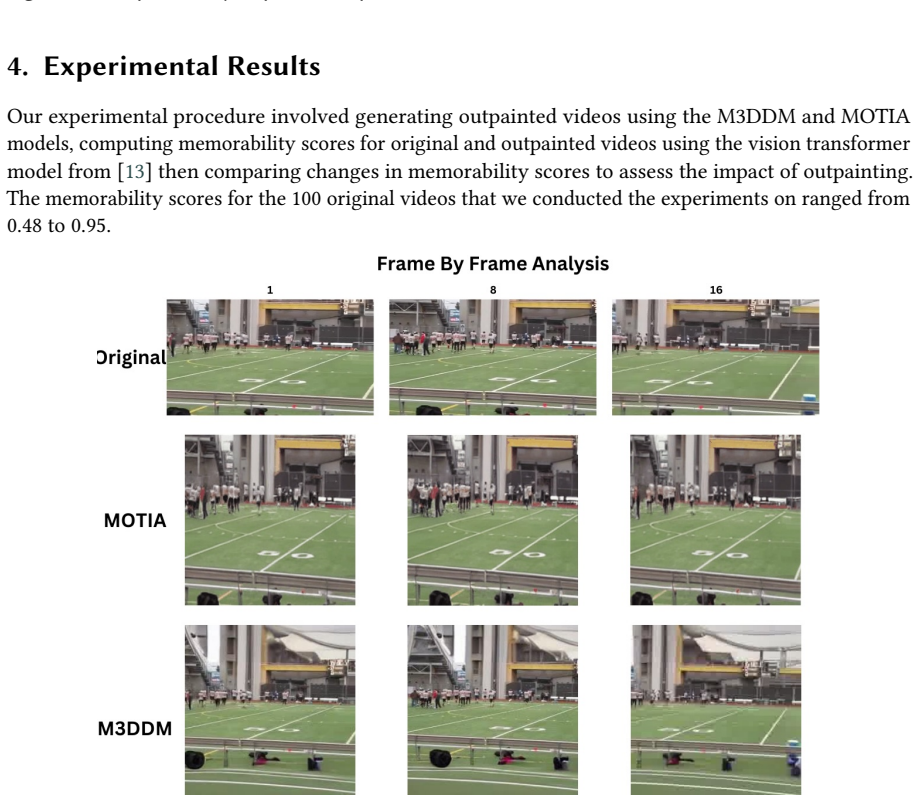
The machinery is a pair of generative outpainting models applied frame-by-frame to short videos: M3DDM, a masked 3D diffusion model that generates frames together for temporal consistency, and MOTIA, a two-phase model that learns input-specific patterns on the source video before outpainting with text guidance. The outcome variable is the change in memorability score computed by a fine-tuned Vision Transformer predictor, which is applied to original and outpainted versions of the same 100 Memento10k videos. To test saliency-aware outpainting, the authors compute per-frame saliency maps, divide them into four quadrants, identify the most salient quadrant, and prompt MOTIA with keywords describing the salient region so the added border content is drawn around it. The load-bearing operation is the delta between original and outpainted scores: a positive delta means outpainting helped, a negative delta means it hurt.
What would settle it
Run a human recognition-memory test on the same 100 Memento10k videos and their outpainted versions: if outpainting improves human recall for low-scoring videos and hurts recall for high-scoring ones, the predictor-based claim is supported; if human recall does not track the predictor's deltas, the central claim fails.
Extended reading notes
Core claim
The central finding is that generative outpainting generally improved the predicted memorability of videos with low initial memorability, while for videos with high original memorability outpainting tended to diminish it, and this pattern appeared with both M3DDM and MOTIA. The authors attribute the drop for memorable videos to added borders weakening saliency or spreading attention across a larger screen, and attribute MOTIA's marginal overall advantage to its input-specific adaptation and text conditioning. Saliency-guided outpainting produced a significant memorability increase when it moved the most salient content toward the center of the frame, but the gain was not uniform across videos. The work is presented as a new application of outpainting, evaluated not by human memory tests but by changes in an automated memorability predictor's scores.
Load-bearing premise
The evaluation assumes that the automated memorability predictor, trained on original videos, gives trustworthy scores for outpainted videos whose resolution, aspect ratio, and synthetic borders differ from anything it saw in training.
Editorial extensions
If this is right
- Creators of forgettable short-form ads or social clips can use outpainting as a post-production step to raise predicted memorability without reshooting or editing the original footage.
- Already memorable videos should be left unmodified, because expanding their borders tends to dilute the focus that made them score high.
- Between the two models tested, MOTIA is the preferable outpainting choice, though its advantage over M3DDM is marginal and inconsistent across individual videos.
- Saliency-guided outpainting is a viable refinement only when it succeeds in recentering the salient content; applying it uniformly is not supported by the results.
- The low-go-up, high-go-down pattern indicates that outpainting shifts visual attention rather than adding memorability in absolute terms.
Reading between the lines
- A direct check the paper does not run is binning the 100 videos by initial memorability score and regressing the memorability delta on it; the reported pattern predicts a clear negative slope that a reader could verify from the published dumbbell charts.
- Because the memorability predictor was trained on original videos, its scores on outpainted frames could carry a systematic bias from the new aspect ratio, resolution, and synthetic borders; a human recognition-memory study on the same 100 outpainted clips would show whether the predicted deltas reflect real memorability changes.
- The effect plausibly extends to image outpainting and to vertical 9:16 outpainting for mobile-first platforms, neither tested here, which would make memorability enhancement a routine step in automated ad production.
- Combining saliency-guided outpainting with previously demonstrated saliency-based cropping could both remove distracting borders and add context, potentially yielding larger memorability gains than either operation alone.
Editorial analysis
A structured set of objections, weighed in public.
Referee Report
Summary. The paper investigates whether generative video outpainting can improve the memorability of short-form videos. Using 100 videos sampled from Memento10k, the authors generate outpainted versions with two models (M3DDM and MOTIA), compute memorability scores with a fine-tuned vision transformer memorability predictor, and compare score changes between original and outpainted videos. They report that outpainting tends to improve the memorability of low-memorability videos, tends to diminish the memorability of high-memorability videos, that MOTIA marginally outperforms M3DDM, and that saliency-guided outpainting has an effect that is described inconsistently in the results and conclusions sections.
Significance. If the reported effects corresponded to genuine human memorability, the paper would be a useful empirical contribution to a relatively underexplored area, since it demonstrates a content-agnostic post-processing operation that shifts memorability in a predictable direction and compares two recent outpainting models. The use of a standard benchmark subset (Memento10k) and the inclusion of two modern generative outpainting methods are strengths, as is the attempt to incorporate saliency into the outpainting prompt. However, the claimed findings rest entirely on an automated memorability predictor that is never validated on outpainted content, so the significance of the results cannot be assessed from the current evidence.
major comments (3)
- [Section 3.3] The primary metric is the change in memorability scores output by a fine-tuned vision transformer memorability predictor, as stated in Section 3.3, but Figure 1 validates that predictor only against ground-truth scores for original Memento10k videos, not for outpainted videos. Because outpainting changes resolution (M3DDM downsamples to 256x256), aspect ratio, and adds synthetically generated borders, a predictor that responds to these artifacts rather than to human memorability would invalidate every reported improvement. The paper needs either a human memorability study on a subset of outpainted videos or a no-op control condition (e.g., letterboxing or resizing original videos without generative outpainting) to establish that the predictor is not biased by outpainting artifacts.
- [Section 4, Figures 6-7 and Section 5] The central finding that outpainting improves low-memorability videos and diminishes high-memorability videos is exactly the signature of regression to the mean when a noisy predictor is used to compute change from baseline. No significance tests, confidence intervals, or a control condition are reported, so the observed pattern may be an artifact of measurement noise rather than a genuine effect of outpainting. The authors should provide statistical tests and demonstrate that the pattern is not explained by regression to the mean, for example by including a comparison against videos that are re-encoded or resized without generative outpainting.
- [Section 4 vs. Section 5] The results section states that saliency-based outpainting "did not yield any significant difference in the memorability scores as compared to using MOTIA without saliency," while the conclusions state that "we found a significant increase in memorability when salient parts of the image were brought into the center of the frame." These statements are directly contradictory, and the stronger claim in Section 5 is not supported by any statistical evidence presented in Section 4. The contradiction must be resolved, and if the effect is not significant, the stronger claim should be removed.
minor comments (5)
- [Throughout] There are several typos and inconsistent model names: "basline" in Section 2.2, "divideded" in Section 3.3, "ide" in Section 5, "M3DMM" for M3DDM in the conclusions, "M2DDM" in the Figure 8 caption, and "inpainting models" in the conclusions where "outpainting models" is meant.
- [Figure 1] The axis labels are not defined; the caption should explicitly state which axis corresponds to the prediction model and which to ground truth, and clarify the sample of 100 videos.
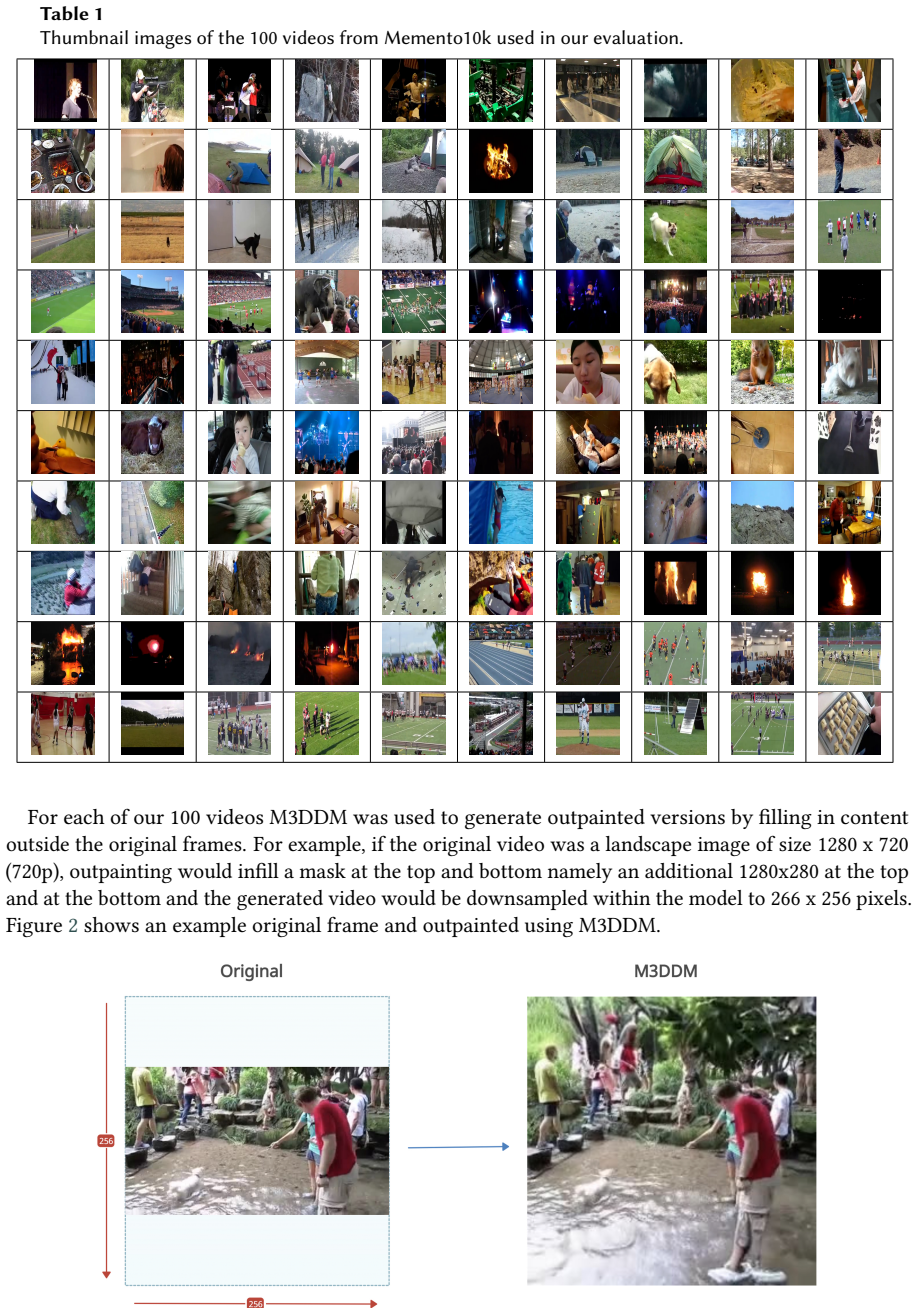
- [Table 1] The table contains thumbnail images that are not visible in the manuscript text; the authors should describe the selection criteria or provide the thumbnails in an appendix or supplementary material.
- [Section 2.4] The text says "very recent work reported in [16] compares their performance" but reference [16] is the M3DDM paper; it is unclear whether [16] or another source contains the comparison of three outpainting approaches, and this should be clarified.
- [References] Reference [16] has the malformed arXiv number "22309.02119" (likely 2309.02119), and reference [19] has "22009.01835" (likely 2009.01835); these should be corrected.
Circularity Check
Evaluation rests on a self-cited memorability predictor never validated on outpainted content; the central baseline-dependent pattern is also consistent with regression to the mean.
-
self citation load bearing
[Section 3.3 (Predicting Video Memorability and Evaluation); Section 5 (Conclusions)]
"To compute the memorability of an original and of outpainted videos, we used a vision transformer model fine-tuned specifically for video memorability prediction used in [8], with higher scores indicating higher memorability. Each video, both original and outpainted, was fed into the vision transformer model to obtain memorability scores. The primary metric used for evaluation of the effect of outpainting is the change in those memorability scores for each video."
The evaluation metric is a model from [8] and later identified as the model from [13], both works whose authors overlap with the present paper (Sweeney, Smeaton). The paper's headline findings — that outpainting raises memorability of low-memorability videos, lowers it for high-memorability videos, and that MOTIA marginally outperforms M3DDM — are statements about changes in this self-cited model's outputs. Figure 1 validates the model only against Memento10k ground truth for original videos; no ground-truth or human-subject validation is provided for resolution-changed, aspect-ratio-changed, synthetically bordered outpainted videos.
-
other
[Section 5 (Conclusions); Section 4 (Experimental Results)]
"we observed that outpainting generally improved memorability of videos that had low memorability but for videos with high original memorability, outpainting tended to diminish this which was observed using both inpainting models we used."
This conclusion is derived from the same predictor scores used both to define the baseline and to measure the post-outpainting outcome. When the baseline and the change are computed from one noisy fitted model, selecting videos by their baseline score mechanically produces the observed negative relation (low baselines tend to move up, high baselines tend to move down) even if outpainting has no true effect. The paper provides no no-op control such as re-encoding or letterboxing the original without generative outpainting, so the directionality of the central claim is not identified independently of the scoring model's noise.
full rationale
The paper is an empirical study rather than a derivation, so there is no equation-level circularity in the outpainting pipeline itself: M3DDM and MOTIA are external generative models, and the direct comparison between them is not circular. However, the evaluation loop is partially closed. Memorability scores are produced exclusively by a fine-tuned predictor from the authors' own previous work ([8], [13]), and the conclusive claims — especially the low-baseline-up/high-baseline-down pattern and the MOTIA-versus-M3DDM comparison — are changes in that predictor's outputs. The paper validates the predictor only against Memento10k ground truth for original videos; it does not validate it on outpainted videos, which differ in resolution, aspect ratio, and synthetic border content. A noisy predictor used both for baseline grouping and for change measurement would produce the reported baseline-dependent pattern by regression to the mean even without any true effect, and the absence of a no-op control prevents ruling this out. There is also an internal inconsistency between Section 4, which says saliency-based outpainting 'did not yield any significant difference,' and Section 5, which calls it 'a significant increase in memorability.' These are evaluation-validity and internal-consistency concerns rather than derivation-equals-input circularity, so the score is moderate rather than high. No evidence was found of the other circularity patterns such as renaming known results, imported uniqueness theorems, or ansatz smuggled in via citation.
Assumptions & free parameters
assumptions (4)
- domain assumption Memento10k memorability annotations and the prediction models from [8] and [13] are reliable proxies for human memorability, including on outpainted videos.
- domain assumption The outpainted videos preserve the original semantic content and only add plausible border content, so any score change is due to outpainting rather than artifacts.
- domain assumption Saliency maps accurately identify regions that drive memorability, and quadrant-based keyword prompting captures the salient content.
- domain assumption The 100 randomly selected videos are representative of short-form video content in Memento10k.
Cite this review
Pith. "Pith review of Generative Outpainting To Enhance the Memorability of Short-Form Videos." pith.science (2026). https://pith.science/paper/OVWJAOEI
@misc{pith2026241114213,
  author       = {Pith},
  title        = {Pith review of: Generative Outpainting To Enhance the Memorability of Short-Form Videos},
  year         = {2026},
  howpublished = {\url{https://pith.science/paper/OVWJAOEI}},
  note         = {Machine review of arXiv:2411.14213}
}
read the original abstract
With the expanding use of the short-form video format in advertising, social media, entertainment, education and more, there is a need for such media to both captivate and be remembered. Video memorability indicates to us how likely a video is to be remembered by a viewer who has no emotional or personal connection with its content. This paper presents the results of using generative outpainting to expand the screen size of a short-form video with a view to improving its memorability. Advances in machine learning and deep learning are compared and leveraged to understand how extending the borders of video screensizes can affect their memorability to viewers. Using quantitative evaluation we determine the best-performing model for outpainting and the impact of outpainting based on image saliency on video memorability scores
Figures


Figures from the paper (5 more)



Reference graph
Works this paper leans on
-
[1]
R. Cohendet, C.-H. Demarty, N. Q. K. Duong, M. Engilberge, Videomem: Constructing, analyzing, predicting short-term and long-term video memorability, in: Proceedings of the IEEE/CVF International Conference on Computer Vision (ICCV), 2019
work page 2019
-
[2]
Overview of The MediaEval 2022 Predicting Video Memorability Task
L. Sweeney, M. G. Constantin, C.-H. Demarty, C. Fosco, A. G. S. de Herrera, S. Halder, G. Healy, B. Ionescu, A. Matran-Fernandez, A. F. Smeaton, et al., Overview of the MediaEval 2022 predicting video memorability task, arXiv preprint arXiv:2212.06516 (2022)
work page Pith review arXiv 2022
-
[3]
Leveraging Audio Gestalt to Predict Media Memorability
L. Sweeney, G. Healy, A. F. Smeaton, Leveraging audio gestalt to predict media memorability, CoRR abs/2012.15635 (2020). URL: https://arxiv.org/abs/2012.15635. arXiv:2012.15635
work page Pith review arXiv 2020
-
[4]
W. A. Bainbridge, D. D. Dilks, A. Oliva, Memorability: A stimulus-driven perceptual neural signa- ture distinctive from memory, NeuroImage 149 (2017) 141–152. URL: https://www.sciencedirect. com/science/article/pii/S1053811917300861. doi:https://doi.org/10.1016/j.neuroimage. 2017.01.063
- [5]
-
[6]
B. H. Shekar, P. R. Shetty, S. S. Bhat, Complex gradient function based descriptor for iris biometrics and action recognition, Communications in Computer and Information Science (2021) 489–501. doi:10.1007/978-981-16-1092-9\_41
-
[7]
M. Wang, J. Konrad, P. Ishwar, K. Jing, H. Rowley, Image saliency: From intrinsic to extrinsic context, in: CVPR 2011, IEEE, 2011, pp. 417–424
work page 2011
-
[8]
S. Cummins, L. Sweeney, A. F. Smeaton, Analysing the Memorability of a Procedural Crime-Drama TV Series, CSI, in: Proceedings of the 19th International Conference on Content-based Multimedia Indexing, 2022, pp. 174–180
work page 2022
Show all 23 references
-
[9]
Guinaudeau, A
C. Guinaudeau, A. G. Xalabarder, Textual analysis for video memorability prediction, in: Working Notes Proceedings of the MediaEval 2022 Workshop, 2023
2022
-
[10]
Hachchane, A
I. Hachchane, A. Badri, A. Sahel, Y. Ruichek, Large-scale image-to-video face retrieval with convolutional neural network features, IAES International Journal of Artificial Intelligence (IJ-AI) 9 (2020) 40. doi:10.11591/ijai.v9.i1.pp40-45
2020 doi
-
[11]
Harini, S
S. Harini, S. Singh, Y. Kumar, A. Bhattacharyya, V. Baths, C. Chen, R. R. Shah, B. Krishnamurthy, Long-Term Ad Memorability: Understanding & Generating Memorable Ads, arXiv preprint arXiv:2309.00378 (2024)
2024 arXiv
-
[12]
Newman, C
A. Newman, C. Fosco, V. Casser, A. Lee, B. McNamara, A. Oliva, Multimodal memorability: Modeling effects of semantics and decay on video memorability, in: ECCV 2020: 16th European Conference on Computer Vision, Glasgow, UK, August 23–28, 2020, Proceedings, Part XVI 16, Springe...
2020
-
[13]
Sweeney, G
L. Sweeney, G. Healy, A. F. Smeaton, Predicting media memorability: comparing visual, textual and auditory features, In: MediaEval 2021 Multimedia Benchmark, arXiv preprint arXiv:2112.07969 (2021)
2021 arXiv
-
[14]
A. G. S. De Herrera, R. S. Kiziltepe, J. Chamberlain, M. G. Constantin, C.-H. Demarty, F. Doctor, B. Ionescu, A. F. Smeaton, Overview of MediaEval 2020 predicting media memorability task: What makes a video memorable?, arXiv preprint arXiv:2012.15650 (2020)
2020 arXiv
-
[15]
Mudgal, Q
V. Mudgal, Q. Wang, L. Sweeney, A. F. Smeaton, Using saliency and cropping to improve video memorability, in: International Conference on Multimedia Modeling, Springer, 2024, pp. 342–355
2024
-
[16]
F. Fan, C. Guo, L. Gong, B. Wang, T. Ge, Y. Jiang, C. Luo, J. Zhan, Hierarchical masked 3d diffusion model for video outpainting, arXiv preprint arXiv:22309.02119 (2024)
2024 arXiv
-
[17]
Dhariwal, A
P. Dhariwal, A. Nichol, Diffusion models beat gans on image synthesis, Advances in Neural Information Processing Systems 34 (2021) 8780–8794
2021
-
[18]
Tammineni, S
S. Tammineni, S. M. Rayavarapu, S. R. Gottapu, R. K. Goswami, Digital image restoration using SURF algorithm, Informatyka, Automatyka, Pomiary W Gospodarce I Ochronie Środowiska 14 (2024) 37–40. doi:10.35784/iapgos.5373
2024 doi
-
[19]
C. Gao, A. Saraf, J.-B. Huang, J. Kopf, Flow-edge guided video completion, arXiv preprint arXiv:22009.01835 (2020)
2020 arXiv
-
[20]
H. Li, L. Luo, D. Vlasic, P. Peers, J. Popović, M. Pauly, S. Rusinkiewicz, Temporally coherent completion of dynamic shapes, ACM Transactions on Graphics - TOG 31 (2012) 1–11. doi: 10. 1145/2077341.2077343
2012
-
[21]
F.-Y. Wang, X. Wu, Z. Huang, X. Shi, D. Shen, G. Song, Y. Liu, H. Li, Be-your-outpainter: Mastering video outpainting through input-specific adaptation, arXiv preprint arXiv:2403.13745 (2024)
2024 arXiv
-
[22]
N. Xu, L. Yang, Y. Fan, D. Yue, Y. Liang, J. Yang, T. Huang, YouTube-VOS: A large-scale video object segmentation benchmark, arXiv preprint arXiv:1809.03327 (2018)
2018 arXiv
-
[23]
Ullah, M
I. Ullah, M. Jian, S. Hussain, J. Guo, H. Yu, X. Wang, Y. Yin, A brief survey of visual saliency detection, Multimedia Tools and Applications 79 (2020) 34605–34645
2020
Reviewed August 12, 2026 · model on record in the stance chip above.
Discussion (0). Continue with ORCID to comment.