REVIEW 2 major objections 5 minor 84 references
Quantum illumination advantage in quantum Doppler radar
T0 review · 2 major / 5 minor · reviewed 2026-08-12 · deepseek-v4-flash
Pith's one-line read Entangled light gives Doppler radar a 3 dB precision edge under high noise and low signal power.
desk verdict First careful treatment of quantum Doppler radar in thermal noise; sound QFI derivation and a genuine 3 dB result, but the advantage leans entirely on ideal lossless idler storage, so treat the headline claim as conditional. read the letter →
The pith
A machine-rendered reading of the paper's core claim, the machinery that carries it, and where it could break.
The reading
What carries the argument
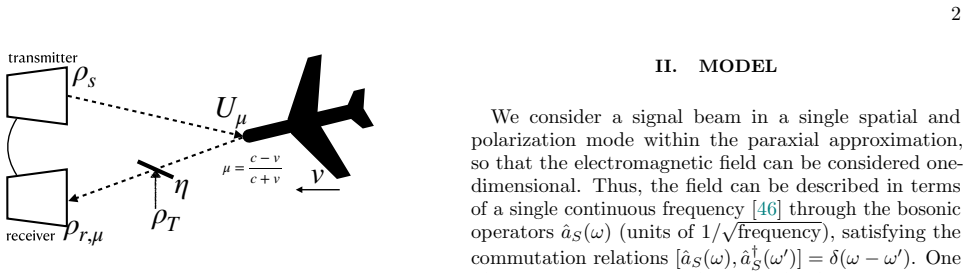
The load-bearing object is the quantum Fisher information $J[\rho_\mu]$ of the received state for the Doppler parameter $\mu$, defined by the mode-rescaling unitary $\hat{U}_\mu^\dagger \hat{a}_S(\omega) \hat{U}_\mu = -\mu^{1/2}\hat{a}_S(\mu\omega)$, with thermal noise modeled as a frequency-independent beam splitter of transmissivity $\eta$ mixing in a field with $N_B$ thermal photons. Both probe states are Gaussian, so the QFI is computed from first and second moments: the coherent state contributes through a displaced mean, while the SPDC state contributes through the covariance matrix of correlated twin-beam Schmidt modes. The computation uses the derivative modes $\Psi_2(\omega) \propto \frac{1}{2}f(\omega) + \omega f'(\omega)$ for the classical case and Hermite-Gauss derivative matrix elements for the quantum case, with equal energy $N_S$ and pulse duration $\Delta T$ enforced for a fair comparison.
What would settle it
Model the idler-storage step as a Gaussian channel with transmissivity $\eta_i < 1$ and added thermal photons $n_i$, recompute $J_q$ with the paper's covariance-matrix method, and check whether $J_q/J_c$ remains at or above 2 for realistic microwave storage values; if it drops below 2, the 3 dB advantage is an artifact of the ideal-storage assumption.
Extended reading notes
Core claim
The central claim is that a Doppler radar using SPDC-entangled light estimates the Doppler parameter $\mu = (c-v)/(c+v)$ with twice the quantum Fisher information of a coherent-state classical radar in the regime of small signal photon number $N_S \ll 1$ and large thermal photon number $N_B \gg 1$, for transmissivities spanning low values. In the noiseless, low-loss case the advantage is not limited to a constant factor and grows with photon number, but this Heisenberg-type scaling is destroyed by thermal noise and loss. What survives in the harsh regime is a constant 3 dB factor, analogous to the quantum illumination advantage for target detection. For strong signals the entangled radar shows essentially no advantage under high loss and high thermal noise; the advantage appears only for weak signals.
Load-bearing premise
The assumption that carries the whole result is that the idler beam is stored at the receiver with perfect fidelity: no loss, no added noise; any real storage, especially in the microwave band, will reduce the Fisher information and erode the 3 dB advantage.
Editorial extensions
If this is right
- The 3 dB QFI advantage is a constant factor, not a scaling improvement: in the high-noise regime the Heisenberg-like advantage of noiseless Doppler estimation does not survive.
- The advantage persists for low transmissivity, meaning a weakly reflecting or distant target does not erase the entangled protocol's edge as long as the signal is weak and the background is hot.
- For strong signals, the entangled protocol offers essentially no advantage under high loss and thermal noise, so the practical benefit is tied to low-power operation.
- Realizing the predicted precision requires a measurement that saturates the quantum Fisher information and near-ideal storage of the idler beam; the paper identifies both as open problems.
Reading between the lines
- If the idler-storage assumption is relaxed to include loss and added noise, the 3 dB advantage will shrink; locating the storage quality at which the ratio $J_q/J_c$ drops below 2 would quantify how demanding the protocol is in practice.
- Because the advantage sits in the received state itself, not in a particular measurement, it may survive the phase-randomization and range-uncertainty effects common in real radar, but confirming that requires a model that includes the discarded range phase.
- The same covariance-matrix method could be extended to joint range-velocity estimation; the Doppler parameter rescales frequencies while range adds a phase, so the two-parameter QFI may show a different advantage structure.
- A natural next calculation is a Gaussian channel bound on Doppler-estimation QFI, which would show whether SPDC is the optimal probe or only a sufficient one in this regime.
Editorial analysis
A structured set of objections, weighed in public.
Referee Report
Summary. The paper studies Doppler velocity estimation in a radar setting, comparing a classical protocol based on coherent states (CDR) with a quantum protocol based on SPDC-entangled signal-idler modes (QDR). The target is modeled as a moving mirror that rescales the field frequencies via the Doppler parameter µ, followed by a frequency-independent thermal-loss channel with transmissivity η. The authors use the quantum Fisher information (QFI) as the figure of merit. They derive a closed-form expression for the classical QFI, Eq. (22), and compute the quantum QFI numerically using Gaussian-state covariance matrices in a parameter-independent mode basis, exploiting the scale-invariance argument J[ρ_µ] = J[ρ_1]/µ^2. The main result is that in the regime N_S << 1 and N_B >> 1 the ratio J_q/J_c approaches about 2 (3 dB) for a range of transmissivities η, as shown in Figs. 2 and 3. The paper also discusses the dependence on pump bandwidth and the role of mode truncation.
Significance. If the result holds, it is a meaningful extension of quantum illumination from target detection to Doppler parameter estimation in the microwave regime, where thermal noise is significant. The technical derivation is largely sound: the classical QFI expression is explicit and correct, the quantum calculation uses the standard Gaussian QFI formalism in a parameter-independent basis, and the comparison is fair in that the two protocols are matched in signal photon number, pulse duration, and central frequency. The paper fits no free parameters to data and makes specific, falsifiable predictions about the parameter regime in which an advantage appears. The main caveat is the assumption of perfectly lossless, noiseless idler storage, which the authors acknowledge but do not model; this idealization is directly relevant to the practical reach of the claimed 3 dB advantage.
major comments (2)
- [Sec. III A and Eqs. (41)-(46)] The claimed 3 dB advantage is conditional on the idler beam being perfectly stored without additional loss or noise, as stated in Sec. III A. In the N_S << 1 regime that yields the advantage, the Doppler information in the quantum protocol resides predominantly in the signal-idler cross-correlations √η C_i in Eq. (41) and their derivatives in Eq. (46), not in the signal marginal alone. Since the maximum advantage ratio in Figs. 2 and 3 is only about 2 (3 dB), even modest attenuation of those cross terms from imperfect idler storage can reduce J_q/J_c below unity. The manuscript does not model such imperfections, so the practical claim is not yet fully supported. Please add a robustness analysis, for example by modeling idler storage as a thermal-loss channel with transmissivity η_i and added noise, and report the threshold η_i above which any advantage (or specifically the 3 dB advantage) persists.
- [Sec. V C 2 and Sec. III A] The quantum QFI is computed numerically after truncating the Schmidt decomposition to a finite number of modes, and the text states that '5 Schmidt modes suffice to calculate QFI numerically' without presenting convergence evidence. Since the central quantitative claim of a 3 dB advantage depends on this truncation, please report J_q as a function of the number of retained modes for representative parameters (for instance, the settings used in Fig. 3), or provide a quantitative bound on the truncation error.
minor comments (5)
- [Sec. V C 1] The text refers to 'Eq. (V C 1)' when presenting the coherent-state QFI; this should be Eq. (22).
- [Sec. III B] There are several typos, including 'dramin c' (should be 'dramatic'), 'see see' (should be 'see'), and 'paramter' (should be 'parameter').
- [Sec. V C 2] In the sentence 'These relations allow us to express the element ω d/dω ψ′_j(ω) in Eq. (37)', the prime on ψ′_j appears to be a typographical error and should be removed.
- [Sec. III A] Please clarify in Sec. III A that the numerical comparisons use the approximate expression Eq. (23) for J_c, and briefly justify its validity for all plotted parameter ranges, especially the largest pump bandwidths considered in Fig. 4.
- [Appendix B] The sentence 'From these values we compute NS and ΔT and put the corresponding values to evaluate Jc' is awkward and should be rephrased for clarity.
Circularity Check
No circularity: the 3 dB QFI advantage is a computed output of a parameter-free model, and self-citations are not load-bearing.
full rationale
The paper's central claim is the ratio Jq/Jc of quantum Fisher informations for an SPDC-based and a coherent-state Doppler radar. The QFI for the coherent state is derived in closed form (Eq. 22), and the QFI for the SPDC state is evaluated numerically from the Gaussian-state QFI formula (Eqs. 33-34), using the received covariance matrix (Eq. 41) and its parameter derivative (Eq. 46). No experimental data or fitted parameters enter the comparison: the values of NS, NB, eta, xi, sigma_p, epsilon, and omega_c are fixed physical inputs, and the matching of signal energy, pulse duration, and central frequency between the two protocols is an explicit fairness constraint rather than a way of imposing the result. The appearance of a roughly 3 dB advantage in the regime NS << 1, NB >> 1 is a numerical finding, not an assumed premise. The paper's self-citations, most notably Ref. [10] (Tan et al., which includes one of the present authors), are used for standard facts about two-mode squeezed vacuum states and quantum illumination; these facts are independently established and are not the load-bearing content of the new derivation. The acknowledged idealization of lossless, noiseless idler storage (Sec. III A) is a practical limitation that makes the quantitative claim conditional, but it does not make the derivation circular, because no quantity that is later reported as the advantage is used to define the model or the figure of merit. The derivation is self-contained given standard Gaussian quantum metrology formulas.
Assumptions & free parameters
free parameters (5)
- Squeezing parameter xi =
varied (e.g., xi = K for NS = 4.8)
- Phase-matching bandwidth ratio epsilon/sigma_p =
3 (K=1.667)
- Pump bandwidth sigma_p =
omega_p/100
- Mode truncation number M =
5
- Target speed v and wavelength lambda =
v=100 m/s, lambda=6*pi cm
assumptions (8)
- standard math Quantum Fisher information is the relevant figure of merit and is attainable in the asymptotic many-repetition limit.
- standard math Gaussian state QFI formulas (Eqs. (33)-(34)) are valid.
- domain assumption Doppler effect on the field is a unitary frequency rescaling (Eq. (2)), with the phase contribution neglected.
- domain assumption Thermal noise acts as a beam splitter with frequency-independent transmissivity eta and shadow-removal rescaling NB/(1-eta).
- domain assumption The narrowband approximation makes NB and eta constants and makes the thermal channel commute with the Doppler unitary.
- domain assumption The SPDC state is described by a double-Gaussian joint spectral amplitude with Schmidt decomposition (Eqs. (16)-(17)).
- domain assumption The idler beam is stored perfectly without additional loss or noise.
- ad hoc to paper The infinite mode basis can be truncated to M modes for the numerical QFI computation.
Cite this review
Pith. "Pith review of Quantum illumination advantage in quantum Doppler radar." pith.science (2026). https://pith.science/paper/U37FDQ5H
@misc{pith2026241114414,
  author       = {Pith},
  title        = {Pith review of: Quantum illumination advantage in quantum Doppler radar},
  year         = {2026},
  howpublished = {\url{https://pith.science/paper/U37FDQ5H}},
  note         = {Machine review of arXiv:2411.14414}
}
read the original abstract
A Doppler radar is a device that employs the Doppler effect to estimate the radial velocity of a moving target at a distance. Traditional radars are based on a classical description of the electromagnetic radiation, but in principle their performance can be improved employing entangled quantum probe states. For target detection, i.e. hypothesis testing, a quantum advantage exists even in the high-noise regime appropriate to describe microwave fields, a protocol known as quantum illumination. In this paper, we show a similar advantage also for a quantum Doppler radar operating in presence of thermal noise, whereas so far a quantum advantage was shown in the noiseless scenario or in lidars operating at optical frequencies with negligible thermal noise. Concretely, we quantify the radar performance in terms of the quantum Fisher information, which captures the ultimate precision allowed by quantum mechanics in the asymptotic regime. We compare a classical protocol based on coherent states with a quantum one that uses multimode states obtained from spontaneous parametric downconversion. To ensure a fair comparison we match the signal energy and pulse duration. We show that a 3dB advantage is possible in the regime of small number of signal photons and high thermal noise, even for low transmissivity.
Figures


Figures from the paper (1 more)

Reference graph
Works this paper leans on
-
[1]
Quantum advantage is only present under low loss ( η ≈ 1) and low thermal noise ( NB →
In panels (a) and (b) we show results for ξ > K, so that the average photon number of QDR is high NS ≫ 1. Quantum advantage is only present under low loss ( η ≈ 1) and low thermal noise ( NB →
-
[2]
However, under high loss and high thermal noise conditions, the QDR in this configuration exhibits essentially no advantage compared to the classical strategy
and in this low-noise regime, higher squeezing increases the quantum advantage. However, under high loss and high thermal noise conditions, the QDR in this configuration exhibits essentially no advantage compared to the classical strategy
-
[3]
In panel (c) we show results for ξ = K, correspond- ing to NS = 4 .8. Under these conditions, when the channel loss is low, the quantum advantage of QDR decreases with increasing thermal noise; in contrast, when the channel loss is high, the quan- tum advantage increases with increasing thermal noise. It can be seen that the QDR in this configura- tion ex...
-
[4]
In this regime of low signal intensity, the quantum advantage of QDR increases with increasing thermal noise loss
In panels (d), (e) and (f) we show results for ξ < K, corresponding to small values of NS. In this regime of low signal intensity, the quantum advantage of QDR increases with increasing thermal noise loss. Especially when ξ ≪ K, meaning NS ≪ 1, it can be observed from panels (e) and (f) that for strong thermal noise the quantum advantage can still reach 3...
-
[5]
Dependence of the QFI on the parameter value The fact that the QFI is a local quantity and it is invariant under parameter independent unitaries, leads to simplifications. More specifically, this symmetry of- ten allows one to compute the QFI for a single true value of the parameter and then obtain it for all the other values. For example, for a phase par...
-
[6]
Gaussian channels A Gaussian channel2 is defined in terms of two matrices X and Y , that act as follows on the first moments and covariance matrix [49, 75] ¯R 7→ X ¯R (31) σ 7→ XσX T + Y, (32) 2 Note that a quantum channel is a Schr¨ odinger picture description of the evolution of a quantum state given a fixed set of modes. However, practically speaking, ...
-
[7]
QFI of Gaussian states For a parametric family of Gaussian states ρG(θ) the QFI can be evaluated just in terms of the parametric derivatives (denoted with a dot) of the first and second moments [49, 55, 56] 3: J[ρG(θ)] = 2 ∂θ ¯R T σ−1 ∂θ ¯R (33) + 1 2 vec (∂θσ)T (σ ⊗ σ − Ω ⊗ Ω)−1 vec (∂θσ) . (34) Eq. (33) is the contribution from the first moments, and co...
-
[8]
Coherent state For a coherent state, we use a mode basis in which the first element is Ψ 1(ω) = f (ω), i.e. the function defining the trasmitted coherent state and the second mode of the basis is proportional to the parametric derivative d dµ µ−1/2f (ω/µ) |µ=1, which taking into account the normalization becomes Ψ2(ω) = 1√ N 1 2 f (ω) + ω d f(ω) dω , (39)...
Show all 84 references
-
[9]
For each pair of signal-idler Schmidt modes, the symplectic eigenvalues and transfor- mation are the same as in Ref
SPDC state Applying the thermal noise channel to the SPDC state gives a covariance matrix of the following form for the received state σspdc,r = MM i=1 Ai 0 √ηCi 0 0 ηAi 0 −√ηCi√ηCi 0 Si 0 0 −√ηCi 0 Si , (41) with Ai = 2ηNS,i + 2NB + 1. For each pair of signal-idler ...
-
[10]
Giovannetti, S
V. Giovannetti, S. Lloyd, and L. Maccone, Advances in quantum metrology, Nat. Photonics 5, 222 (2011)
2011
-
[11]
Polino, M
E. Polino, M. Valeri, N. Spagnolo, and F. Sciarrino, Pho- tonic quantum metrology, A VS Quantum Sci.2, 024703 (2020)
2020
-
[12]
Pirandola, B
S. Pirandola, B. R. Bardhan, T. Gehring, C. Weedbrook, and S. Lloyd, Advances in photonic quantum sensing, Nat. Photonics 12, 724 (2018)
2018
-
[13]
Demkowicz-Dobrza´ nski, M
R. Demkowicz-Dobrza´ nski, M. Jarzyna, and J. Ko lody´ nski, Quantum Limits in Optical Inter- ferometry, in Progress in Optics, Volume 60, edited by E. Wolf (Elsevier, Amsterdam, 2015) pp. 345–435, arXiv:1405.7703
2015 arXiv
-
[14]
K. E. Dorfman, F. Schlawin, and S. Mukamel, Nonlinear optical signals and spectroscopy with quantum light, Rev. Mod. Phys. 88, 045008 (2016)
2016
-
[15]
Tsang, Resolving starlight: A quantum perspective, Contemp
M. Tsang, Resolving starlight: A quantum perspective, Contemp. Phys. 60, 279 (2019)
2019
-
[16]
Genovese, Real applications of quantum imaging, J
M. Genovese, Real applications of quantum imaging, J. Opt. 18, 073002 (2016)
2016
-
[17]
Defienne, W
H. Defienne, W. P. Bowen, M. Chekhova, G. B. Lemos, D. Oron, S. Ramelow, N. Treps, and D. Faccio, Advances in quantum imaging, Nat. Photon. 18, 1024 (2024)
2024
-
[18]
Lloyd, Enhanced Sensitivity of Photodetection via Quantum Illumination, Science 321, 1463 (2008)
S. Lloyd, Enhanced Sensitivity of Photodetection via Quantum Illumination, Science 321, 1463 (2008)
2008
-
[19]
S.-H. Tan, B. I. Erkmen, V. Giovannetti, S. Guha, S. Lloyd, L. Maccone, S. Pirandola, and J. H. Shapiro, Quantum Illumination with Gaussian States, Phys. Rev. Lett. 101, 253601 (2008)
2008
-
[20]
J. H. Shapiro and S. Lloyd, Quantum illumination versus coherent-state target detection, New J. Phys. 11, 063045 (2009)
2009
-
[21]
Zhang, S
Z. Zhang, S. Mouradian, F. N. C. Wong, and J. H. Shapiro, Entanglement-Enhanced Sensing in a Lossy and Noisy Environment, Phys. Rev. Lett. 114, 110506 (2015)
2015
-
[22]
Xu, X.-M
F. Xu, X.-M. Zhang, L. Xu, T. Jiang, M.-H. Yung, and L. Zhang, Experimental Quantum Target Detection Ap- proaching the Fundamental Helstrom Limit, Phys. Rev. Lett. 127, 040504 (2021)
2021
-
[23]
S. Hao, H. Shi, C. N. Gagatsos, M. Mishra, B. Bash, I. Djordjevic, S. Guha, Q. Zhuang, and Z. Zhang, Demon- stration of Entanglement-Enhanced Covert Sensing, Phys. Rev. Lett. 129, 010501 (2022)
2022
-
[24]
Barzanjeh, S
S. Barzanjeh, S. Guha, C. Weedbrook, D. Vitali, J. H. 13 Shapiro, and S. Pirandola, Microwave Quantum Illumina- tion, Phys. Rev. Lett. 114, 080503 (2015)
2015
-
[25]
H. Shi, B. Zhang, J. H. Shapiro, Z. Zhang, and Q. Zhuang, Optimal entanglement-assisted electromagnetic sensing and communication in the presence of noise, Phys. Rev. Appl. 21, 034004 (2024)
2024
-
[26]
Angeletti, H
J. Angeletti, H. Shi, T. Lakshmanan, D. Vitali, and Q. Zhuang, Microwave Quantum Illumination with Correlation-To-Displacement Conversion, Phys. Rev. Appl. 20, 024030 (2023)
2023
-
[27]
Reichert, Q
M. Reichert, Q. Zhuang, J. H. Shapiro, and R. Di Candia, Quantum Illumination with a Hetero-Homodyne Receiver and Sequential Detection, Phys. Rev. Appl. 20, 014030 (2023)
2023
-
[28]
Luong, B
D. Luong, B. Balaji, C. W. Sandbo Chang, V. M. Anan- thapadmanabha Rao, and C. Wilson, Microwave Quan- tum Radar: An Experimental Validation, in 2018 Int. Carnahan Conf. Secur. Technol. ICCST(2018) pp. 1–5
2018
-
[29]
C. W. S. Chang, A. M. Vadiraj, J. Bourassa, B. Balaji, and C. M. Wilson, Quantum-enhanced noise radar, Appl. Phys. Lett. 114, 112601 (2019)
2019
-
[30]
Barzanjeh, S
S. Barzanjeh, S. Pirandola, D. Vitali, and J. M. Fink, Microwave quantum illumination using a digital receiver, Sci. Adv. 6, eabb0451 (2020)
2020
-
[31]
Assouly, R
R. Assouly, R. Dassonneville, T. Peronnin, A. Bienfait, and B. Huard, Quantum advantage in microwave quantum radar, Nat. Phys. 19, 1418 (2023)
2023
-
[32]
J. H. Shapiro, The Quantum Illumination Story, IEEE Aerosp. Electron. Syst. Mag. 35, 8 (2020)
2020
-
[33]
R. G. Torrom´ e, N. B. Bekhti-Winkel, and P. Knott, In- troduction to quantum radar (2021), arXiv:2006.14238
2021 arXiv
-
[34]
Sorelli, N
G. Sorelli, N. Treps, F. Grosshans, and F. Boust, Detect- ing a Target With Quantum Entanglement, IEEE Aerosp. Electron. Syst. Mag. 37, 68 (2022)
2022
-
[35]
Casariego, E
M. Casariego, E. Z. Cruzeiro, S. Gherardini, T. Gonzalez- Raya, R. Andr´ e, G. Fraz˜ ao, G. Catto, M. M¨ ott¨ onen, D. Datta, K. Viisanen, J. Govenius, M. Prunnila, K. Tuominen, M. Reichert, M. Renger, K. G. Fedorov, F. Deppe, H. van der Vliet, A. J. Matthews, Y. Fern´ andez, ...
2023
-
[36]
Karsa, A
A. Karsa, A. Fletcher, G. Spedalieri, and S. Piran- dola, Quantum illumination and quantum radar: A brief overview, Rep. Prog. Phys. 87, 094001 (2024)
2024
-
[37]
R. G. Torrom´ e and S. Barzanjeh, Advances in quantum radar and quantum LiDAR, Progress in Quantum Elec- tronics 93, 100497 (2024)
2024
-
[38]
Zhang, C
Z. Zhang, C. You, O. S. Maga˜ na-Loaiza, R. Fickler, R. d. J. Le´ on-Montiel, J. P. Torres, T. S. Humble, S. Liu, Y. Xia, and Q. Zhuang, Entanglement-based quantum informa- tion technology: A tutorial, Adv. Opt. Photon. 16, 60 (2024)
2024
-
[39]
Giovannetti, S
V. Giovannetti, S. Lloyd, and L. Maccone, Quantum- enhanced positioning and clock synchronization, Nature 412, 417 (2001)
2001
-
[40]
Giovannetti, S
V. Giovannetti, S. Lloyd, and L. Maccone, Positioning and clock synchronization through entanglement, Phys. Rev. A 65, 022309 (2002)
2002
-
[41]
J. H. Shapiro, Quantum pulse compression laser radar, in Noise Fluct. Photonics Quantum Opt. Commun., Vol. 6603 (SPIE, 2007) pp. 31–38
2007
-
[42]
Maccone and C
L. Maccone and C. Ren, Quantum Radar, Phys. Rev. Lett. 124, 200503 (2020)
2020
-
[43]
Reichert, R
M. Reichert, R. Di Candia, M. Z. Win, and M. Sanz, Quantum-enhanced Doppler lidar, npj Quantum Inf 8, 1 (2022)
2022
-
[44]
Zhuang, Z
Q. Zhuang, Z. Zhang, and J. H. Shapiro, Entanglement- enhanced lidars for simultaneous range and velocity mea- surements, Phys. Rev. A 96, 040304 (2017)
2017
-
[45]
Huang, C
Z. Huang, C. Lupo, and P. Kok, Quantum-Limited Esti- mation of Range and Velocity, PRX Quantum 2, 030303 (2021)
2021
-
[46]
Reichert, Q
M. Reichert, Q. Zhuang, and M. Sanz, Heisenberg-Limited Quantum Lidar for Joint Range and Velocity Estimation, Phys. Rev. Lett. 133, 130801 (2024)
2024
-
[47]
Demkowicz-Dobrza´ nski, J
R. Demkowicz-Dobrza´ nski, J. Ko lody´ nski, and M. Gut ¸˘ a, The elusive Heisenberg limit in quantum-enhanced metrol- ogy, Nat. Commun. 3, 1063 (2012)
2012
-
[48]
Kurdzia lek, W
S. Kurdzia lek, W. G´ orecki, F. Albarelli, and R. Demkowicz-Dobrza´ nski, Using Adaptiveness and Causal Superpositions Against Noise in Quantum Metrology, Phys. Rev. Lett. 131, 090801 (2023)
2023
-
[49]
Zhuang, Quantum Ranging with Gaussian Entangle- ment, Phys
Q. Zhuang, Quantum Ranging with Gaussian Entangle- ment, Phys. Rev. Lett. 126, 240501 (2021)
2021
-
[50]
Karsa and S
A. Karsa and S. Pirandola, Energetic Considerations in Quantum Target Ranging, in 2021 IEEE Radar Conf. RadarConf21 (2021) pp. 1–4
2021
-
[51]
Zhuang and J
Q. Zhuang and J. H. Shapiro, Ultimate Accuracy Limit of Quantum Pulse-Compression Ranging, Phys. Rev. Lett. 128, 010501 (2022)
2022
-
[52]
Cohen and M
L. Cohen and M. M. Wilde, Toward Optimal Quantum Ranging: Hypothesis Testing for an Unknown Return Signal, Phys. Rev. Applied 17, 044053 (2022)
2022
-
[53]
Gessner, N
M. Gessner, N. Treps, and C. Fabre, Estimation of a parameter encoded in the modal structure of a light beam: A quantum theory, Optica 10, 996 (2023)
2023
-
[54]
Sorelli, M
G. Sorelli, M. Gessner, N. Treps, and M. Walschaers, Gaussian quantum metrology for mode-encoded parame- ters, New J. Phys. 26, 073022 (2024)
2024
-
[55]
K. J. Blow, R. Loudon, S. J. D. Phoenix, and T. J. Shep- herd, Continuum fields in quantum optics, Phys. Rev. A 42, 4102 (1990)
1990
-
[56]
T. J. Volkoff, Not even 6 dB: Gaussian quantum illumi- nation in thermal background, J. Phys. A 57, 065301 (2024)
2024
-
[57]
P. P. Rohde, W. Mauerer, and C. Silberhorn, Spectral structure and decompositions of optical states, and their applications, New J. Phys. 9, 91 (2007)
2007
-
[58]
Serafini, Quantum Continuous Variables: A Primer of Theoretical Methods, second edition ed
A. Serafini, Quantum Continuous Variables: A Primer of Theoretical Methods, second edition ed. (CRC Press, Boca Raton, FL, 2023)
2023
-
[59]
W. P. Grice and I. A. Walmsley, Spectral information and distinguishability in type-II down-conversion with a broadband pump, Phys. Rev. A 56, 1627 (1997)
1997
-
[60]
Mauerer, M
W. Mauerer, M. Avenhaus, W. Helwig, and C. Silber- horn, How colors influence numbers: Photon statistics of parametric down-conversion, Phys. Rev. A 80, 053815 (2009)
2009
-
[61]
P. J. Mosley, A. Christ, A. Eckstein, and C. Silberhorn, Direct Measurement of the Spatial-Spectral Structure of Waveguided Parametric Down-Conversion, Phys. Rev. Lett. 103, 233901 (2009)
2009
-
[62]
Christ, K
A. Christ, K. Laiho, A. Eckstein, K. N. Cassemiro, and C. Silberhorn, Probing multimode squeezing with correla- tion functions, New J. Phys. 13, 033027 (2011)
2011
-
[63]
O. E. Barndorff-Nielsen and R. D. Gill, Fisher information 14 in quantum statistics, J. Phys. A 33, 4481 (2000)
2000
-
[64]
Monras, Phase space formalism for quantum estimation of Gaussian states (2013), arXiv:1303.3682
A. Monras, Phase space formalism for quantum estimation of Gaussian states (2013), arXiv:1303.3682
2013 arXiv
-
[65]
ˇSafr´ anek, Estimation of Gaussian quantum states, J
D. ˇSafr´ anek, Estimation of Gaussian quantum states, J. Phys. A 52, 035304 (2019)
2019
-
[66]
Rubio, Quantum scale estimation, Quantum Sci
J. Rubio, Quantum scale estimation, Quantum Sci. Tech- nol. 8, 015009 (2022)
2022
-
[67]
De Palma and J
G. De Palma and J. Borregaard, Minimum error proba- bility of quantum illumination, Phys. Rev. A 98, 012101 (2018)
2018
-
[68]
Bradshaw, L
M. Bradshaw, L. O. Conlon, S. Tserkis, M. Gu, P. K. Lam, and S. M. Assad, Optimal probes for continuous-variable quantum illumination, Phys. Rev. A 103, 062413 (2021)
2021
-
[69]
C. N. Gagatsos, B. A. Bash, S. Guha, and A. Datta, Bounding the quantum limits of precision for phase es- timation with loss and thermal noise, Phys. Rev. A 96, 062306 (2017)
2017
-
[70]
Pirandola and C
S. Pirandola and C. Lupo, Ultimate Precision of Adaptive Noise Estimation, Phys. Rev. Lett. 118, 100502 (2017)
2017
-
[71]
Nair, Quantum-Limited Loss Sensing: Multiparameter Estimation and Bures Distance between Loss Channels, Phys
R. Nair, Quantum-Limited Loss Sensing: Multiparameter Estimation and Bures Distance between Loss Channels, Phys. Rev. Lett. 121, 230801 (2018)
2018
-
[72]
Nair and M
R. Nair and M. Gu, Fundamental limits of quantum illumination, Optica 7, 771 (2020)
2020
-
[73]
Nair and M
R. Nair and M. Gu, Quantum sensing of phase-covariant optical channels (2023), arXiv:2306.15256
2023 arXiv
-
[74]
X. Zhao, Z. Zhang, and Q. Zhuang, Quantum illumination networks (2024), arXiv:2406.17178
2024 arXiv
-
[75]
M. Sanz, U. Las Heras, J. J. Garc ´ ıa-Ripoll, E. Solano, and R. Di Candia, Quantum Estimation Methods for Quantum Illumination, Phys. Rev. Lett. 118, 070803 (2017)
2017
-
[76]
C. Noh, C. Lee, and S.-Y. Lee, Quantum illumination with definite photon-number entangled states, J. Opt. Soc. Am. B 39, 1316 (2022)
2022
-
[77]
Zhong, W.-Y
W. Zhong, W.-Y. Zhu, Y. Li, L. Zhou, M.-M. Du, and Y.-B. Sheng, Relation between quantum illumination and quantum parameter estimation (2023), arXiv:2308.07150
2023 arXiv
-
[78]
J. J. Meyer, S. Khatri, D. S. Fran¸ ca, J. Eisert, and P. Faist, Quantum metrology in the finite-sample regime (2023), arXiv:2307.06370
2023 arXiv
-
[79]
M. G. A. Paris, Quantum estimation for quantum tech- nology, Int. J. Quantum Inf. 07, 125 (2009)
2009
-
[80]
C. W. Helstrom, Quantum Detection and Estimation The- ory (Academic Press, New York, 1976)
1976
-
[81]
A. S. Holevo, Probabilistic and Statistical Aspects of Quan- tum Theory, 2nd ed. (Edizioni della Normale, Pisa, 2011)
2011
-
[82]
Weedbrook, S
C. Weedbrook, S. Pirandola, R. Garc ´ ıa-Patr´ on, N. J. Cerf, T. C. Ralph, J. H. Shapiro, and S. Lloyd, Gaussian quantum information, Rev. Mod. Phys. 84, 621 (2012)
2012
-
[83]
Adesso, S
G. Adesso, S. Ragy, and A. R. Lee, Continuous Vari- able Quantum Information: Gaussian States and Beyond, Open Syst. Inf. Dyn. 21, 1440001 (2014)
2014
-
[84]
Caruso, J
F. Caruso, J. Eisert, V. Giovannetti, and A. S. Holevo, Multi-mode bosonic Gaussian channels, New J. Phys. 10, 083030 (2008)
2008
Reviewed August 12, 2026 · model on record in the stance chip above.
Discussion (0). Continue with ORCID to comment.