REVIEW 4 major objections 5 minor 37 references
Delta-NAS: Difference of Architecture Encoding for Predictor-based Evolutionary Neural Architecture Search
T0 review · 4 major / 5 minor · reviewed 2026-08-12 · deepseek-v4-flash
Pith's one-line read Delta-NAS claims that predicting accuracy differences between neighboring architectures cuts NAS search complexity from exponential to linear, with benchmark results supporting it.
desk verdict The difference-encoding idea is genuinely new and the cardinality theorems are correct, but the exponential-to-linear complexity claim does not follow from them, and the zero-cost proxy is never validated against true accuracies. read the letter →
The pith
A machine-rendered reading of the paper's core claim, the machinery that carries it, and where it could break.
The reading
What carries the argument
The load-bearing object is the difference-of-architecture encoding and its paired difference predictor. Each training example is a pair $(a_i, a_j)$ of architectures at edit distance $k$; the input is the sparse difference of their adjacency and operation representations, and the target is the difference in their predicted accuracies. Because close architectures cancel out most of their structure, the encoding lives in a space of size $|D_k| = r^k\binom{n}{k}$, and for the chosen $D_1$ the predictor sees only single-change differences. The same many-to-one encoding is also the mechanism behind the search: at every generation the evolutionary loop queries the predictor over one-edit neighbors and steps to the one with the largest predicted accuracy gain, repeating until convergence.
What would settle it
On NASBench201, compute the rank correlation between Zen-Score accuracy differences and true validated-accuracy differences over many one-edit neighbor pairs; if the correlation is not clearly positive on a substantial fraction of pairs, the predictor's training signal is misaligned and $\Delta$-NAS's reported search gains would not demonstrate improvement in true accuracy.
Extended reading notes
Core claim
The central claim is that accuracy-difference prediction, not accuracy prediction, is the right representation for scalable NAS. For a block-based space with $n$ nodes and $r$ choices per node, the architecture set has size $|A|=r^n$; for cell-based spaces with adjacency choices, $|A| = \frac{n(n-1)}{2} r^n$. When the predictor is restricted to one-edit neighbor pairs, the difference encoding has size $|D_1| = rn$, and in general $|D_k| = r^k \binom{n}{k}$, so the exponential dependence on depth is replaced by polynomial (in fact linear for $k=1$) growth. The paper further claims that the many-to-one nature of the encoding removes graph-isomorphism ambiguity and lets multiple samples per encoding compensate for the noise of the zero-cost proxy. The search algorithm greedily follows the predicted best neighbor, and the reported results position $\Delta$-NAS as the first method whose search cost scales linearly as the candidate count grows exponentially.
Load-bearing premise
The difference predictor is trained on accuracy differences estimated by the Zen-Score zero-cost proxy, and the paper does not check that proxy differences rank true trained-accuracy differences correctly on the benchmarks before letting them guide the search.
Editorial extensions
If this is right
- With $k=1$, the predictor's input space shrinks from $r^n$ (block-based) or $\frac{n(n-1)}{2}r^n$ (cell-based) to $rn$ encodings, so the number of distinct difference patterns grows linearly with network depth.
- Because the difference encoding is many-to-one, multiple architecture pairs can share one training example; the paper uses this to average the zero-cost proxy over several samples, reducing proxy noise without extra training.
- The evolutionary search needs no absolute-accuracy predictor: it only ranks one-edit neighbors, so the per-generation cost is the population size times the size of a one-edit neighborhood, which grows linearly with network size rather than with the whole search space.
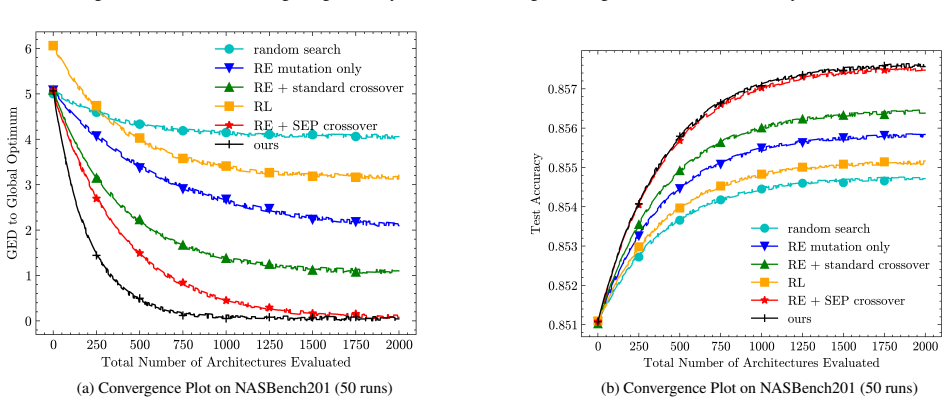
- On the benchmarks tested, the paper reports both higher Kendall's tau for the predictor and faster convergence to near-optimal architectures than regularized evolution with shortest edit path crossover, with the gap widening on larger search spaces.
Reading between the lines
- The complexity reduction is about the encoding space, not necessarily the runtime: the evolutionary loop still evaluates a neighborhood of neighbors per individual per generation, so the practical speedup depends on how cheaply the difference predictor can be evaluated and on the proxy being reliable.
- A direct test of the method's foundation would be to rerun the NASBench201 experiments using true validated-accuracy differences instead of Zen-Score differences as training targets; if search quality changes little, the difference encoding is robust to the proxy, and if it changes a lot, the reported gains are partly a property of the proxy rather than the encoding.
- The paper reports per-task TransNASBench results as available in an appendix, but the appendix reference is left as 'Appendix ??' in the manuscript, so those per-task numbers cannot currently be checked from the text.
- Because the difference predictor is trained per search space, a practical extension would be to test whether a predictor trained on one space transfers to another space with the same operation set; the paper does not report such transfer experiments.
Editorial analysis
A structured set of objections, weighed in public.
Referee Report
Summary. Delta-NAS proposes to perform neural architecture search by predicting the accuracy difference between pairs of nearby architectures, rather than predicting the absolute accuracy of an architecture. The paper contributes a set of cardinality theorems for 'difference of architecture' (DoA) encodings, a predictor trained on Zen-Score accuracy differences, and an evolutionary algorithm that repeatedly moves a population to the most promising one-edit neighbor according to the difference predictor. The authors claim that this difference projection reduces computational complexity 'from exponential down to linear' with respect to the size of the search space, and they report predictor correlation results (Table 1) and convergence plots (Figures 4-5) on NASBench101, NASBench201, TransNASBench, and NASBench301.
Significance. If the central claim were correct, Delta-NAS would be a substantial advance: it would make fine-grained search feasible on very large architecture spaces at an apparent low cost, and the difference encoding idea is a plausible way to exploit locality in NAS. The manuscript does contain a correct elementary analysis of the size of the one-edit difference encoding for block-based spaces (Theorem 4 and Theorem 5 are simple but valid under their definitions). However, the headline complexity claim is not established: the theorems count encoding types, not the query complexity of the search algorithm, and one of the baseline cardinality theorems is mathematically wrong. The empirical evaluation is also incomplete because the proxy-based training signal is never validated against true benchmark accuracies and the convergence plots are not accompanied by numeric final-accuracy tables. The contribution as presented is therefore not ready for publication.
major comments (4)
- [§3, Theorem 4 and Algorithm 2] The abstract and conclusion claim that Delta-NAS reduces computational complexity 'from exponential down to linear with respect to the size of the search space.' This does not follow from the theorems. Theorem 4 merely counts the number of one-edit difference types: |D1| = rn. It says nothing about how many predictor queries Algorithm 2 makes or how many generations T are needed to approach an optimal architecture. Algorithm 2 makes O(|P| * n * r) predictor queries per generation and is run for T generations; none of Theorems 1-5 bound T or the query complexity. Since n = log_r |A| for block-based spaces, a cost polynomial in n is logarithmic in |A|, not linear in |A| as stated. The paper also does not address the fact that a one-edit hill-climber can take exponentially many evaluations on an adversarial accuracy landscape, so the claimed 'exponential to linear' reduction is unsupported.
- [§3, Theorem 2] The claimed cardinality |A| = n(n-1)/2 * r^n for cell-based spaces is incorrect. The upper-triangular adjacency matrix contains n(n-1)/2 binary edge variables, so the number of distinct adjacency matrices is 2^{n(n-1)/2}; with r operations per node the correct cardinality is 2^{n(n-1)/2} r^n. The paper appears to confuse the dimension of the edge-encoding space with its cardinality. As a concrete check, for NASBench101 (5 nodes, 3 operations) the formula gives 10 * 3^5 = 2430 architectures, whereas the benchmark contains 423k architectures. This error invalidates the comparison with |D1| for cell-based spaces. In addition, the paper never specifies what a 'one edit' means in a cell-based space (operation change, edge toggle, or both), so |D1| = rn cannot be directly applied to cell-based search spaces without further clarification.
- [§4.1 and §5.2, Table 1] The DoA predictor is trained on accuracy differences computed with the zero-cost Zen-Score proxy, not on the ground-truth accuracies available in the tabular benchmarks. The paper never validates that Zen-Score differences correctly rank true accuracy differences on NASBench101, NASBench201, or TransNASBench. If the proxy's local differences do not match real accuracy differences, Algorithm 2 will be guided by a misleading score and the convergence improvements shown in Figures 4-5 would not reflect genuine NAS performance. In addition, Table 1 does not specify how Kendall's Tau is computed for a difference predictor: the DoA model outputs pairwise differences, not absolute accuracies, so the comparison with encodings trained for absolute-accuracy prediction (ADJ, Path, ZCP, Arch2Vec, CATE, FLAN) is ambiguous unless the evaluation protocol for pairwise ranking is stated explicitly.
- [§5.3, Figures 4-5] The central empirical claims--faster convergence and 'significantly higher sample efficiency' over SEP and other baselines--are supported only by convergence plots. No tabulated final test accuracies, standard deviations, or statistical significance measures are reported for any benchmark, and the text repeatedly asserts superiority without giving the reader numeric evidence. The broken reference to 'Appendix ??' for the TransNASBench results means those results are not available in the manuscript. To substantiate the stated claims, the paper needs tables of final accuracy (with runs, means, and variances) for each method and each benchmark, not only curves.
minor comments (5)
- [Throughout] The manuscript contains numerous typos and grammatical errors, including 'key roll' (abstract), 'dubed', 'carnality' (Section 4.1), 'imediately' (Section 5.1.2), 'evalutation' (Section 2), 'Graph Convoulional' (Section 2.1), 'cardinally' (Section 3), and 'hyperparammeter' (Section 5.1.2); a careful proofreading pass is needed.
- [Section 2.3, Reference [1]] The text cites 'FLAN [1]' and describes a 'flow attentive hybrid encoder', but reference [1] is Akhauri and Abdelfattah, 'Encodings for prediction-based neural architecture search', which does not appear to match the cited method; the reference should be checked and corrected.
- [Section 5.1.1 and Table 1] The text states that NASBench301 is 'the largest space we consider with 1021 architectures', which is inconsistent with Table 1's header reporting percentages of '9k samples'; the relationship between the search-space size and the number of samples should be clarified.
- [Section 4.1] The symbol n is overloaded: Definition 1 sets n as the number of nodes or depth of a network, but Section 4.1 also uses n for 'the number of samples for each difference encoding'; using a different symbol for the sample count would remove ambiguity.
- [Figure 3] The y-axis label 'predictor loss' is not defined in the text; the paper should state which loss function is plotted, on which dataset it is evaluated, and whether the loss is for the DoA predictor only.
Circularity Check
The headline exponential-to-linear complexity claim is a restatement of the definition of D1, not an analysis of the search algorithm.
-
self definitional
[Abstract; Section 3, Theorem 4 and Corollary 4.1; Section 4.2, Algorithm 2]
"This paradigm shift allows for reducing computational complexity from exponential down to linear with respect to the size of the search space. ... The single change can take place at one of n nodes and take one of r values, hence: Theorem 4. |D1| = rn"
The paper's central linear-complexity claim is not obtained by analyzing Algorithm 2; it is the defining property of D1. D1 is defined as the set of one-edit differences, so |D1| = rn (one of n nodes times one of r operation values) is true by construction of the encoding. The abstract and conclusion then present this definitional count as a proof that computational complexity drops from exponential to linear with respect to search-space size. Since |A| = r^n, rn is logarithmic in |A|, not linear in |A|, exposing the equivocation between depth n and search-space size.
full rationale
I find no load-bearing self-citation chain and no fitted-input-called-prediction circularity in the empirical sections: the difference predictor is trained on labels supplied by the external Zen-Score proxy, and the benchmark comparisons are against independent NAS benchmarks. The one genuinely circular step is the theoretical complexity claim. Theorem 4's |D1| = rn is true because D1 was defined to contain exactly those one-edit differences, and the paper then treats that definitional cardinality as proving the abstract's exponential-to-linear complexity reduction without ever analyzing the per-generation and per-generation-count query cost of Algorithm 2. This makes the central contribution partially circular: the headline 'prediction' reduces by construction to the definition of D1. Because the empirical sample-efficiency results have independent content and there is no self-citation smuggling, the score is 6 rather than higher.
Assumptions & free parameters
free parameters (4)
- edit distance k =
1
- samples per encoding n =
4
- population size =
256
- evolutionary iterations T =
96k
assumptions (4)
- domain assumption Zen-Score zero-cost proxy differences are a valid surrogate for true accuracy differences.
- domain assumption Greedily following the best single-edit neighbor leads to high-accuracy architectures.
- standard math Standard combinatorics: binomial coefficients and the size of the upper triangle of an adjacency matrix.
- ad hoc to paper The DoA encoding is well-defined and many-to-one as illustrated in Figure 1.
Cite this review
Pith. "Pith review of Delta-NAS: Difference of Architecture Encoding for Predictor-based Evolutionary Neural Architecture Search." pith.science (2026). https://pith.science/paper/RYLJTX4Z
@misc{pith2026241114498,
  author       = {Pith},
  title        = {Pith review of: Delta-NAS: Difference of Architecture Encoding for Predictor-based Evolutionary Neural Architecture Search},
  year         = {2026},
  howpublished = {\url{https://pith.science/paper/RYLJTX4Z}},
  note         = {Machine review of arXiv:2411.14498}
}
read the original abstract
Neural Architecture Search (NAS) continues to serve a key roll in the design and development of neural networks for task specific deployment. Modern NAS techniques struggle to deal with ever increasing search space complexity and compute cost constraints. Existing approaches can be categorized into two buckets: fine-grained computational expensive NAS and coarse-grained low cost NAS. Our objective is to craft an algorithm with the capability to perform fine-grain NAS at a low cost. We propose projecting the problem to a lower dimensional space through predicting the difference in accuracy of a pair of similar networks. This paradigm shift allows for reducing computational complexity from exponential down to linear with respect to the size of the search space. We present a strong mathematical foundation for our algorithm in addition to extensive experimental results across a host of common NAS Benchmarks. Our methods significantly out performs existing works achieving better performance coupled with a significantly higher sample efficiency.
Figures


Figures from the paper (2 more)

Reference graph
Works this paper leans on
-
[1]
Yash Akhauri and Mohamed S. Abdelfattah. Encodings for prediction-based neural architecture search, 2024. 3
work page 2024
-
[2]
Once for all: Train one network and specialize it for efficient deployment
Han Cai, Chuang Gan, and Song Han. Once for all: Train one network and specialize it for efficient deployment. CoRR, abs/1908.09791, 2019. 1
arXiv 1908
-
[3]
Evolving Search Space for Neural Architecture Search
Yuanzheng Ci, Chen Lin, Ming Sun, Boyu Chen, Hongwen Zhang, and Wanli Ouyang. Evolving search space for neural architecture search. CoRR, abs/2011.10904, 2020. 1
work page Pith review arXiv 2011
-
[4]
Co-Reyes, Yingjie Miao, Daiyi Peng, Esteban Real, Sergey Levine, Quoc V
John D. Co-Reyes, Yingjie Miao, Daiyi Peng, Esteban Real, Sergey Levine, Quoc V . Le, Honglak Lee, and Aleksandra Faust. Evolving reinforcement learning algorithms, 2022. 2
work page 2022
-
[5]
Cubuk, Barret Zoph, Dandelion Mane, Vijay Va- sudevan, and Quoc V
Ekin D. Cubuk, Barret Zoph, Dandelion Mane, Vijay Va- sudevan, and Quoc V . Le. Autoaugment: Learning augmen- tation policies from data, 2019. 10
work page 2019
-
[6]
Imagenet: A large-scale hierarchical image 8 database
Jia Deng, Wei Dong, Richard Socher, Li-Jia Li, Kai Li, and Li Fei-Fei. Imagenet: A large-scale hierarchical image 8 database. In 2009 IEEE Conference on Computer Vision and Pattern Recognition, pages 248–255, 2009. 6
work page 2009
-
[7]
Nas-bench-201: Extending the scope of reproducible neural architecture search, 2020
Xuanyi Dong and Yi Yang. Nas-bench-201: Extending the scope of reproducible neural architecture search, 2020. 6, 10
work page 2020
-
[8]
Lissnas: Locality- based iterative search space shrinkage for neural architecture search
Bhavna Gopal, Arjun Sridhar, and et al. Lissnas: Locality- based iterative search space shrinkage for neural architecture search. IJCAI’23, 2023. 1
work page 2023
Show all 37 references
-
[9]
Single path one-shot neural architec- ture search with uniform sampling
Zichao Guo and et al. Single path one-shot neural architec- ture search with uniform sampling. CoRR, abs/1904.00420,
1904 arXiv
-
[10]
Neu- ral architecture search survey: A computer vision perspec- tive
Jeon-Seong Kang, JinKyu Kang, Jung-Jun Kim, Kwang- Woo Jeon, Hyun-Joon Chung, and Byung-Hoon Park. Neu- ral architecture search survey: A computer vision perspec- tive. Sensors, 23(3), 2023. 1
2023
-
[11]
Learning multiple layers of features from tiny images, 2009
Alex Krizhevsky, Geoffrey Hinton, et al. Learning multiple layers of features from tiny images, 2009. 6
2009
-
[12]
Zen-nas: A zero-shot nas for high-performance deep image recognition, 2021
Ming Lin, Pichao Wang, Zhenhong Sun, Hesen Chen, Xiuyu Sun, Qi Qian, Hao Li, and Rong Jin. Zen-nas: A zero-shot nas for high-performance deep image recognition, 2021. 1, 5
2021
-
[13]
Lawrence Zitnick, and Piotr Doll ´ar
Tsung-Yi Lin, Michael Maire, Serge Belongie, Lubomir Bourdev, Ross Girshick, James Hays, Pietro Perona, Deva Ramanan, C. Lawrence Zitnick, and Piotr Doll ´ar. Microsoft coco: Common objects in context, 2015. 6
2015
-
[14]
DARTS: Differentiable architecture search
Hanxiao Liu, Karen Simonyan, and Yiming Yang. DARTS: Differentiable architecture search. In International Confer- ence on Learning Representations, 2019. 1
2019
-
[15]
Ta-gates: An encoding scheme for neu- ral network architectures
Xuefei Ning, Zixuan Zhou, Junbo Zhao, Tianchen Zhao, Yiping Deng, Changcheng Tang, Shuang Liang, Huazhong Yang, and Yu Wang. Ta-gates: An encoding scheme for neu- ral network architectures. Advances in Neural Information Processing Systems, 35:32325–32339, 2022. 2
2022
-
[16]
Efficient neural architecture search via parameters sharing
Hieu Pham, Melody Guan, Barret Zoph, Quoc Le, and Jeff Dean. Efficient neural architecture search via parameters sharing. In International conference on machine learning , pages 4095–4104. PMLR, 2018. 3
2018
-
[17]
Shortest edit path crossover: A theory-driven solution to the permutation prob- lem in evolutionary neural architecture search
Xin Qiu and Risto Miikkulainen. Shortest edit path crossover: A theory-driven solution to the permutation prob- lem in evolutionary neural architecture search. In Andreas Krause, Emma Brunskill, Kyunghyun Cho, Barbara Engel- hardt, Sivan Sabato, and Jonathan Scarlett, editors,...
2023
-
[18]
Regularized evolution for image classifier architecture search
Esteban Real, Alok Aggarwal, Yanping Huang, and Quoc V Le. Regularized evolution for image classifier architecture search. In Proceedings of the aaai conference on artificial intelligence, volume 33, pages 4780–4789, 2019. 2
2019
-
[19]
Large-scale evolution of image classifiers, 2017
Esteban Real, Sherry Moore, Andrew Selle, Saurabh Saxena, Yutaka Leon Suematsu, Jie Tan, Quoc Le, and Alex Kurakin. Large-scale evolution of image classifiers, 2017. 2, 3
2017
-
[20]
Naslib: A modular and flexible neu- ral architecture search library
Michael Ruchte, Arber Zela, Julien Siems, Josif Grabocka, and Frank Hutter. Naslib: A modular and flexible neu- ral architecture search library. https://github.com/ automl/NASLib, 2020. 6
2020
-
[21]
Kwok, and Tong Zhang
Han Shi, Renjie Pi, Hang Xu, Zhenguo Li, James T. Kwok, and Tong Zhang. Bridging the gap between sample-based and one-shot neural architecture search with bonas, 2020. 2
2020
-
[22]
Nas-bench-301 and the case for sur- rogate benchmarks for neural architecture search
Julien Siems and et al. Nas-bench-301 and the case for sur- rogate benchmarks for neural architecture search. CoRR, abs/2008.09777, 2020. 6, 10
2008 arXiv
-
[23]
So, Wojciech Ma ´nke, Hanxiao Liu, Zihang Dai, Noam Shazeer, and Quoc V
David R. So, Wojciech Ma ´nke, Hanxiao Liu, Zihang Dai, Noam Shazeer, and Quoc V . Le. Primer: Searching for effi- cient transformers for language modeling, 2022. 2
2022
-
[24]
Mingxing Tan, Bo Chen, Ruoming Pang, Vijay Vasudevan, and Quoc V . Le. Mnasnet: Platform-aware neural architec- ture search for mobile. CoRR, abs/1807.11626, 2018. 1, 3
2018 arXiv
-
[25]
Bananas: Bayesian optimization with neural architectures for neural architecture search, 2020
Colin White, Willie Neiswanger, and Yash Savani. Bananas: Bayesian optimization with neural architectures for neural architecture search, 2020. 1
2020
-
[26]
How powerful are performance predictors in neural architecture search?, 2021
Colin White, Arber Zela, Binxin Ru, Yang Liu, and Frank Hutter. How powerful are performance predictors in neural architecture search?, 2021. 2
2021
-
[27]
Weak NAS predictors are all you need
Junru Wu, Xiyang Dai, Dongdong Chen, Yinpeng Chen, Mengchen Liu, Ye Yu, Zhangyang Wang, Zicheng Liu, Mei Chen, and Lu Yuan. Weak NAS predictors are all you need. CoRR, abs/2102.10490, 2021. 1
2021 arXiv
-
[28]
Cate: Computation-aware neural architecture encoding with trans- formers, 2021
Shen Yan, Kaiqiang Song, Fei Liu, and Mi Zhang. Cate: Computation-aware neural architecture encoding with trans- formers, 2021. 3
2021
-
[29]
Does unsupervised architecture representation learning help neural architecture search?, 2020
Shen Yan, Yu Zheng, Wei Ao, Xiao Zeng, and Mi Zhang. Does unsupervised architecture representation learning help neural architecture search?, 2020. 3
2020
-
[30]
Nas-bench-101: Towards reproducible neural architecture search
Chris Ying and et al. Nas-bench-101: Towards reproducible neural architecture search. CoRR, abs/1902.09635, 2019. 6, 10
1902 arXiv
-
[31]
Taskonomy: Disentangling task transfer learning, 2018
Amir Zamir, Alexander Sax, William Shen, Leonidas Guibas, Jitendra Malik, and Silvio Savarese. Taskonomy: Disentangling task transfer learning, 2018. 6
2018
-
[32]
Surrogate nas bench- marks: Going beyond the limited search spaces of tabular nas benchmarks, 2022
Arber Zela, Julien Siems, Lucas Zimmer, Jovita Lukasik, Margret Keuper, and Frank Hutter. Surrogate nas bench- marks: Going beyond the limited search spaces of tabular nas benchmarks, 2022. 6, 10
2022
-
[33]
Few-shot neural architecture search,
Yiyang Zhao, Linnan Wang, Yuandong Tian, Rodrigo Fon- seca, and Tian Guo. Few-shot neural architecture search,
-
[34]
Places: A 10 million image database for scene recognition
Bolei Zhou, Agata Lapedriza, Aditya Khosla, Aude Oliva, and Antonio Torralba. Places: A 10 million image database for scene recognition. IEEE Transactions on Pattern Analy- sis and Machine Intelligence, 40(6):1452–1464, 2018. 6
2018
-
[35]
Neural architecture search with reinforcement learning
Barret Zoph and Quoc Le. Neural architecture search with reinforcement learning. In International Conference on Learning Representations, 2017. 2
2017
-
[36]
Abdelfattah, Royson Lee, Hyeji Kim, and Nicholas D
Łukasz Dudziak, Thomas Chau, Mohamed S. Abdelfattah, Royson Lee, Hyeji Kim, and Nicholas D. Lane. Brp-nas: Prediction-based nas using gcns, 2021. 2 9
2021
-
[37]
Experimental Setup Details We follow standard NAS practices when using bench- mark datasets
Appendix 7.1. Experimental Setup Details We follow standard NAS practices when using bench- mark datasets. Training info and creation of the bench- mark datasets can be found in the respective publications [7, 22, 30, 32]. Default common settings for image trans- formations ar...
Reviewed August 12, 2026 · model on record in the stance chip above.
Discussion (0). Continue with ORCID to comment.