REVIEW 5 major objections 4 minor 43 references
EdgeFlowNet: 100FPS@1W Dense Optical Flow For Tiny Mobile Robots
T0 review · 5 major / 4 minor · reviewed 2026-08-12 · deepseek-v4-flash
Pith's one-line read EdgeFlowNet claims dense optical flow at 100 FPS on a 1.08 W edge chip, enabling onboard reactive navigation for palm-sized quadrotors.
desk verdict Solid EdgeTPU optical-flow engineering with real flight demos, but the 100FPS@1W headline overstates the paper's own measured 93.6 FPS and unverified 1.08W. read the letter →
The pith
A machine-rendered reading of the paper's core claim, the machinery that carries it, and where it could break.
The reading
What carries the argument
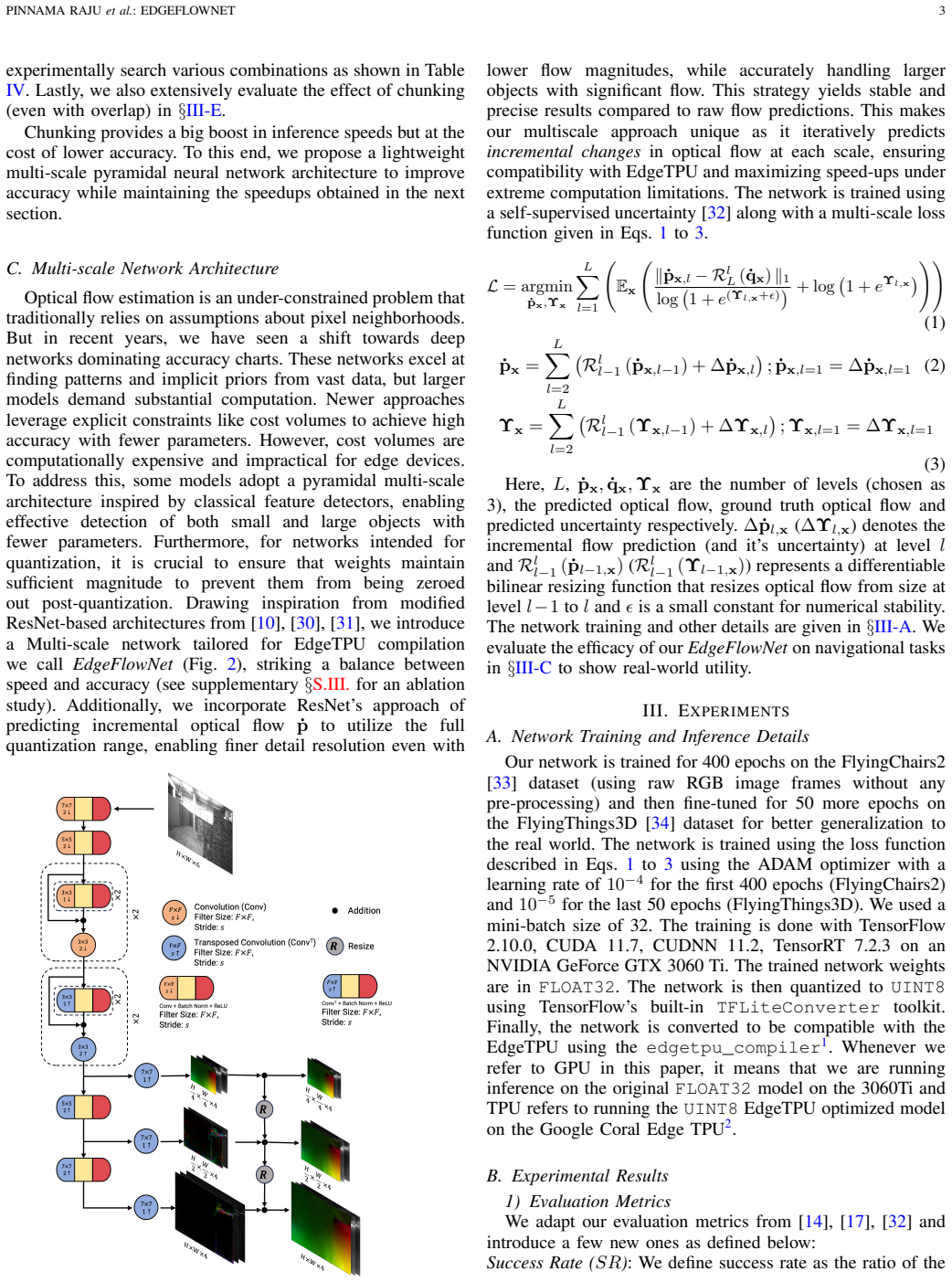
The load-bearing mechanism is image chunking along the batch dimension: the input pair of shape $B\times H\times W\times 2C$ is reshaped to $MNB\times \frac{H}{M}\times \frac{W}{N}\times 2C$, so the same pixels are processed as many smaller images in one batch. On the EdgeTPU this raises throughput from 22.8 to 93.4 FPS with the same total pixel count, because larger batches parallelize better across the chip's processing units and use cache more effectively; resizing the image to the same smaller resolution instead loses fine detail and increases endpoint error. The companion architecture, EdgeFlowNet, is a lightweight multi-scale ResNet-style encoder-decoder that predicts incremental flow at each pyramid scale, which keeps values inside the UINT8 quantization range and recovers most of the accuracy that naive chunking sacrifices. The training loss combines a multi-scale $L_1$ term with self-supervised uncertainty, and chunk overlap is available as a speed-accuracy dial.
What would settle it
Log timestamps from camera exposure to control output on the same quadrotor; if the end-to-end perception period is substantially above 10 ms, for example if the full loop runs at 30 Hz rather than 100 Hz, then the headline rate is an inference-only result and the closed-loop advantage is not realized.
Extended reading notes
Core claim
EdgeFlowNet's central claim is that dense optical flow can be estimated at about 100 FPS within a 1.08 W power budget on a Google Coral Edge TPU, and that this speed makes flow-based autonomy feasible on sub-2 W palm-sized robots. The paper reports roughly a 20x speedup over NanoFlowNet, the closest prior edge optical-flow work, together with over 20% accuracy improvement. The design is chip-aware: a ResNet-style multi-scale encoder-decoder predicts incremental optical flow at each scale so that unsigned 8-bit quantized values stay in range, trained with a self-supervised uncertainty loss, plus a chunking scheme that re-arranges the input as $4 \times 240 \times 176 \times 6$ to exploit the EdgeTPU's batch-level parallelism. On MPI Sintel, EdgeFlowNet reaches 6.31 px endpoint error without chunking and 5.66 px with chunking, at 93.6 FPS on the EdgeTPU; in simulation it beats relative-depth and many flow baselines on gap and dynamic-object detection while trading some accuracy against RAFT. The paper positions the result as enabling autonomy, not as a new navigation algorithm, and argues that the speed gain can offset the accuracy loss: in the authors' latency model, the faster, less accurate network supports a higher theoretical maximum flight speed than a slower, more accurate one.
Load-bearing premise
The 100 FPS number is the chip's inference speed measured without image acquisition, so the whole approach assumes that this speed survives the full onboard loop of grabbing frames, assembling chunks, and sending control commands; if those steps dominate, the real flight rate is lower.
Editorial extensions
If this is right
- Dense optical flow becomes an onboard perception modality for robots with under 2 W compute budgets, replacing or augmenting depth sensors for reactive navigation.
- The chunking speedup is architecture-agnostic on the EdgeTPU, so other vision networks compiled for this chip can adopt the same reshaping rule to gain throughput.
- Because the latency model shows faster perception can beat higher accuracy for a given sensing range, the optimization target shifts from endpoint error alone to end-to-end latency.
- The synthetic-to-real training recipe transfers to real flights, suggesting the approach can be retrained for other tiny-robot platforms.
- The same flow output can drive multiple behaviors, such as static obstacle avoidance, gap finding, and dynamic obstacle dodging, simplifying the onboard perception stack.
Reading between the lines
- If image acquisition and control overhead can be kept near the 9.8 ms inference time, the same chunking recipe may push other EdgeTPU vision tasks, such as depth or segmentation, toward real-time onboard rates; the paper only demonstrates optical flow, so this is an extrapolation.
- The measured speedups on GPUs shrank as VRAM size grew, so the chunking rule is not universal; a similar FPS-versus-chunk-count sweep on other edge accelerators would show whether the effect is an EdgeTPU-specific cache phenomenon or a general batch-parallelism one.
- The paper's own overlap experiments imply a tunable trade-off: objects near chunk boundaries lose context, so a controller that adjusts overlap based on detected object size or position could keep accuracy high at lower average speed cost.
- A direct closed-loop comparison, using the same robot and planner with EdgeFlowNet at 100 FPS versus a slower higher-accuracy flow network, would test whether the latency model's predicted speed advantage materializes in practice.
Editorial analysis
A structured set of objections, weighed in public.
Referee Report
Summary. The paper presents EdgeFlowNet, a lightweight multi-scale convolutional neural network for dense optical flow estimation that is designed to run on a Google Coral EdgeTPU, together with an image chunking strategy that substantially increases the achieved inference throughput on this low-power accelerator. The authors report that the network runs at about 100 FPS using 1.08 W, is about 20× faster and more than 20% more accurate than the prior NanoFlowNet approach, and demonstrate its use on a small quadrotor for static obstacle avoidance, unknown-gap traversal, and dynamic obstacle dodging in physical experiments. They also provide simulation-based comparisons on navigation metrics and optical flow benchmarks.
Significance. If the headline performance figures are correct, the paper makes a meaningful contribution to tiny-robot perception: it would be the first demonstration of dense optical flow at near-100 FPS on a sub-2 W edge device, with real-world navigation validation. The chunking idea is simple and potentially generalizable, and the release of code and data would benefit the community. The real-world trials are a genuine strength, and the evaluation covers both standard optical flow metrics and navigation outcomes. However, the paper's central quantitative claims are not fully supported by its own measurements: the deployed EdgeTPU configuration runs at 93.6 FPS, not 100 FPS; the accuracy improvement over NanoFlowNet for that configuration is about 18%, not 'over 20%'; and the 1.08 W power figure is not accompanied by any measurement description.
major comments (5)
- [Abstract; Conclusions (Section IV); Table III] The claim '100FPS using only 1.08W of power' is not supported by the paper's data. Table III reports 93.6 FPS for the deployed EdgeFlowNetChunking on the EdgeTPU, not 100 FPS. The 1.08 W figure appears to be derived from the FPS/Watt column (93.6/86.7 ≈ 1.08 W), but no power measurement procedure is described anywhere in the manuscript. The authors should either present a direct measurement of power consumption or clearly state the source of the figure, and they should correct the FPS claim to the measured 93.6 FPS.
- [Abstract; Introduction; Section III-E; Table III] The 'over 20% accuracy improvement' over NanoFlowNet is not consistent with the deployed model's results. On the MPI Sintel 'final' pass, NanoFlowNet has EPE 7.98 and EdgeFlowNetChunking has 6.53, which is an 18.2% improvement, not 'over 20%'. The 20.9% improvement holds only for the non-chunked EdgeFlowNetFull (6.31), which runs at 22.7 FPS on the EdgeTPU, not at the claimed high speed. Additionally, the text in Section III-E states that EdgeFlowNet is 'about 22% more accurate' than Ajna, but Table III shows EPE 7.32 for Ajna versus 6.31 for EdgeFlowNetFull, a 13.8% improvement.
- [Section III-B.1; Section III-C; Section III-F; Figure 6] The paper's speed and maximum-flight-speed arguments rely on perception latency, but the presented 'Run Time' metric explicitly excludes image acquisition, and the robot experiments do not report the end-to-end closed-loop perception-to-control rate. Section III-F uses τp in Equation (4) to bound the achievable flight speed, so the inference-only latency cannot be simply equated to the closed-loop control rate. The authors should measure and report the actual pipeline latency (including camera capture, chunk assembly, and control-command transmission) or clearly restrict their speed claims to the inference component.
- [Tables I and II; Section III-C] There is an internal inconsistency between the reported runtime of the EdgeTPU deployment and Table III. Tables I and II list 'GPU Time' of 9.8 ms for EdgeFlowNet(Ours, EdgeTPU Chunking), which corresponds to about 102 FPS, whereas Table III reports 93.6 FPS (about 10.68 ms) for the same configuration. The authors should reconcile these numbers or clarify what exactly is being measured.
- [Abstract; Section IV] The statement that EdgeFlowNet is 'about 20× faster' than previous state-of-the-art approaches is an overstatement when compared directly with the paper's own numbers: the 93.6 FPS on EdgeTPU versus NanoFlowNet's 5.6 FPS on the GAP8 gives a factor of about 16.7×, and comparisons against GPU-based methods are not 20×. The speedup claim should be qualified by the specific baseline and hardware, or the reported factors should be corrected.
minor comments (4)
- [Section III-C; Tables I-II] The column header 'GPU Time (ms)' is misleading for rows that run on the EdgeTPU; it should be renamed to 'Inference Time (ms)' with a clear footnote about the platform.
- [Section I; Section III-E] The phrase 'previous state-of-the-art approaches' is used in the abstract without naming the baseline; the comparisons in Table III are against multiple methods on different hardware, so the speedup factor should be stated relative to a specific baseline.
- [Appendix, Sections S-I and S-VI] Several references in the appendix remain as '[?]' placeholders (for example, in the discussion of related architectures and in Table SX). These should be resolved before publication.
- [Section III-B.1] The definition of 'Run Time' says it is the time 'for the perception stack to give a control command', but the procedure for measuring this time is not described; a short experimental description would improve reproducibility.
Circularity Check
No significant circularity: the central speed, accuracy, and power claims rest on external benchmarks and direct device measurements, not on self-referential definitions or fitted-input predictions.
full rationale
The paper's central quantitative claims are anchored to external measurements rather than to the paper's own definitions or fitted parameters. The EPE values in Table III are computed on the MPI Sintel benchmark against external and prior baselines (RAFT, SPyNet, PWCNet, NanoFlowNet, and the self-authored Ajna), and the navigation success rates in Section III-C are physical trial outcomes. The 93.6 FPS EdgeTPU throughput and the 1.08 W power figure are direct device measurements supported by the paper's own timing tables (Tables IV, V, and supplementary Tables SVI-SX), not quantities defined into existence. The chunking speed-up is an empirically characterized hardware phenomenon established by the paper's own measurements, not an ansatz imported solely from a citation. The self-authored prior works ([17], [14], [32]) supply control policies, uncertainty loss terminology, and simulator methodology, but they are not used as a substitute for the paper's reported results: Ajna is re-run as a baseline, and GapFlyt/Ajna-style control strategies are re-implemented and evaluated in the paper's own trials. No equation defines a predicted quantity in terms of a fitted input; Eqs. 1-3 define the training loss, and Eq. 4 is a theoretical max-speed bound using measured detection rates and latencies, not a circular prediction. The paper's own limitations appendix (Appendix A-C), the mismatch between the '100FPS' headline and Table III's 93.6 FPS EdgeTPU number, and the Run Time metric explicitly excluding image acquisition are measurement and reporting concerns, not circular reductions. Therefore no circularity is found.
Assumptions & free parameters
free parameters (4)
- Chunking configuration (M,N, overlap) =
4 chunks of 240x176, no overlap
- Number of pyramid levels L =
3
- Base input resolution =
480x352
- Trained network weights (2.0M parameters) =
Learned on FlyingChairs2 then fine-tuned on FlyingThings3D
assumptions (3)
- domain assumption Per-pixel EPE on the MPI Sintel train subset is a valid proxy for the optical flow quality needed in navigation.
- domain assumption A UINT8 quantized network using only EdgeTPU-supported layers can preserve enough accuracy for dense flow regression.
- domain assumption Optical flow alone is sufficient for the three navigation tasks, with no depth or semantic information.
Cite this review
Pith. "Pith review of EdgeFlowNet: 100FPS@1W Dense Optical Flow For Tiny Mobile Robots." pith.science (2026). https://pith.science/paper/4FU4773A
@misc{pith2026241114576,
  author       = {Pith},
  title        = {Pith review of: EdgeFlowNet: 100FPS@1W Dense Optical Flow For Tiny Mobile Robots},
  year         = {2026},
  howpublished = {\url{https://pith.science/paper/4FU4773A}},
  note         = {Machine review of arXiv:2411.14576}
}
read the original abstract
Optical flow estimation is a critical task for tiny mobile robotics to enable safe and accurate navigation, obstacle avoidance, and other functionalities. However, optical flow estimation on tiny robots is challenging due to limited onboard sensing and computation capabilities. In this paper, we propose EdgeFlowNet , a high-speed, low-latency dense optical flow approach for tiny autonomous mobile robots by harnessing the power of edge computing. We demonstrate the efficacy of our approach by deploying EdgeFlowNet on a tiny quadrotor to perform static obstacle avoidance, flight through unknown gaps and dynamic obstacle dodging. EdgeFlowNet is about 20 faster than the previous state-of-the-art approaches while improving accuracy by over 20% and using only 1.08W of power enabling advanced autonomy on palm-sized tiny mobile robots.
Figures


Figures from the paper (7 more)



Reference graph
Works this paper leans on
-
[1]
Science, technology and the future of small autonomous drones
D Floreano and RJ Wood. Science, technology and the future of small autonomous drones. Nature, 521(7553):460–466, 2015
work page 2015
-
[2]
Active Vision Based Embodied-AI Design for Nano-UAV Autonomy
Nitin Jagannatha Sanket. Active Vision Based Embodied-AI Design for Nano-UAV Autonomy. PhD thesis, 2021
work page 2021
-
[3]
Life signs detector using a drone in disaster zones
Ahmed Al-Naji, Adel G Perera, Suhad Lafta Mohammed, and Javaan Chahl. Life signs detector using a drone in disaster zones. Remote Sensing, 11(20):2441, 2019
work page 2019
-
[4]
Kevin McGuire, Guido De Croon, Christophe De Wagter, Karl Tuyls, and Hilbert Kappen. Efficient optical flow and stereo vision for velocity estimation and obstacle avoidance on an autonomous pocket drone.IEEE Robotics and Automation Letters , 2(2):1070–1076, 2017
work page 2017
-
[5]
Sungyoung Huh, David Hyunchul Shim, and Jihong Kim. Integrated navigation system using camera and gimbaled laser scanner for indoor and outdoor autonomous flight of uavs. In 2013 IEEE/RSJ International Conference on Intelligent Robots and Systems , pages 3158–3163. IEEE, 2013
work page 2013
-
[6]
Deepedgebench: Benchmarking deep neural networks on edge devices
Sven P Baller, Anurag Jindal, Mohit Chadha, and Michael Gerndt. Deepedgebench: Benchmarking deep neural networks on edge devices. In 2021 IEEE International Conference on Cloud Engineering (IC2E) , pages 20–30. IEEE, 2021
work page 2021
-
[7]
Changhong Fu, Adrian Carrio, and Pascual Campoy. Efficient visual odometry and mapping for unmanned aerial vehicle using arm-based stereo vision pre-processing system. In 2015 International Conference on Unmanned Aircraft Systems (ICUAS) , pages 957–962. IEEE, 2015
work page 2015
-
[8]
Amr Suleiman, Zhengdong Zhang, Luca Carlone, Sertac Karaman, and Vivienne Sze. Navion: A 2-mw fully integrated real-time visual-inertial odometry accelerator for autonomous navigation of nano drones. IEEE Journal of Solid-State Circuits , 54(4):1106–1119, 2019
work page 2019
Show all 43 references
-
[9]
Determining optical flow
Berthold K Horn and Brian G Schunck. Determining optical flow. Artificial Intelligence, 17(1-3):185–203, 1981
1981
-
[10]
Prgflow: Unified swap-aware deep global optical flow for aerial robot navigation
Nitin J Sanket, Chahat Deep Singh, Cornelia Fermüller, and Yiannis Aloimonos. Prgflow: Unified swap-aware deep global optical flow for aerial robot navigation. Electronics Letters, 57(16):614–617, 2021
2021
-
[11]
CUAHN-VIO: Content-and-Uncertainty-Aware Homography Network for Visual-Inertial Odometry
Yingfu Xu and Guido CHE de Croon. CUAHN-VIO: Content-and-Uncertainty-Aware Homography Network for Visual-Inertial Odometry. arXiv preprint arXiv:2208.13935 , 2022
2022 arXiv
-
[12]
Fast optical flow estimation and its application to real-time obstacle avoidance
Kuo-Tai Song and Jen-Hui Huang. Fast optical flow estimation and its application to real-time obstacle avoidance. In Proceedings 2001 ICRA. IEEE International Conference on Robotics and Automation (Cat. No. 01CH37164), volume 3, pages 2891–2896. IEEE, 2001
2001
-
[13]
Reactive obstacle avoidance for highly maneuverable vehicles based on a two-stage optical flow clustering
Alexander Schaub, Dominik Baumgartner, and Darius Burschka. Reactive obstacle avoidance for highly maneuverable vehicles based on a two-stage optical flow clustering. IEEE Transactions on Intelligent Transportation Systems, 18(8):2137–2152, 2016
2016
-
[14]
Evdodgenet: Deep dynamic obstacle dodging with event cameras
Nitin J Sanket et al. Evdodgenet: Deep dynamic obstacle dodging with event cameras. In 2020 IEEE International Conference on Robotics and Automation (ICRA), pages 10651–10657. IEEE, 2020
2020
-
[15]
On-board velocity estimation and closed-loop control of a quadrotor uav based on optical flow
V olker Grabe, Heinrich H Bülthoff, and Paolo Robuffo Giordano. On-board velocity estimation and closed-loop control of a quadrotor uav based on optical flow. In 2012 IEEE International Conference on Robotics and Automation , pages 491–497. IEEE, 2012
2012
-
[16]
Optical-flow based self-supervised learning of obstacle appearance applied to MA V landing.Robotics and Autonomous Systems, 100:78–94, 2018
Hann Woei Ho, Christophe De Wagter, BDW Remes, and Guido CHE de Croon. Optical-flow based self-supervised learning of obstacle appearance applied to MA V landing.Robotics and Autonomous Systems, 100:78–94, 2018
2018
-
[17]
Gapflyt: Active vision based minimalist structure-less gap detection for quadrotor flight
Nitin J Sanket et al. Gapflyt: Active vision based minimalist structure-less gap detection for quadrotor flight. IEEE Robotics and Automation Letters, 3(4):2799–2806, 2018
2018
-
[18]
The computation of optical flow
Steven S Beauchemin and Jonathan L Barron. The computation of optical flow. ACM computing surveys (CSUR) , 27(3):433–466, 1995
1995
-
[19]
Iterative image registration technique with an application to stereo vision
Bruce D Lucas and Takeo Kanade. Iterative image registration technique with an application to stereo vision. In Proceedings of the 7th International Joint Conference on Artificial Intelligence, pages 674–679, 1981
1981
-
[20]
Anurag Ranjan and Michael J. Black. Optical flow estimation using a spatial pyramid network. In Proceedings of the IEEE Conference on Computer Vision and Pattern Recognition , pages 2720–2729, 2017
2017
-
[21]
PWC-Net: CNNs for optical flow using pyramid, warping, and cost volume
Deqing Sun, Xiaodong Yang, Ming-Yu Liu, and Jan Kautz. PWC-Net: CNNs for optical flow using pyramid, warping, and cost volume. In Proceedings of the IEEE Conference on Computer Vision and Pattern Recognition, pages 8934–8943, 2017
2017
-
[22]
Raft: Recurrent all-pairs field transforms for optical flow (extended abstract)
Zachary Teed and Jia Deng. Raft: Recurrent all-pairs field transforms for optical flow (extended abstract). In European Conference on Computer Vision, pages 402–419, Aug 2020
2020
-
[23]
Flowformer++: Masked cost volume autoencoding for pretraining optical flow estimation
Xiaoyu Shi et al. Flowformer++: Masked cost volume autoencoding for pretraining optical flow estimation. In Proceedings of the IEEE/CVF conference on computer vision and pattern recognition, pages 1599–1610, 2023
2023
-
[24]
Skflow: Learning optical flow with super kernels
Shangkun Sun, Yuanqi Chen, Yu Zhu, Guodong Guo, and Ge Li. Skflow: Learning optical flow with super kernels. Advances in Neural Information Processing Systems , 35:11313–11326, 2022
2022
-
[25]
Accflow: Backward accumulation for long-range optical flow
Guangyang Wu et al. Accflow: Backward accumulation for long-range optical flow. In Proceedings of the IEEE/CVF International Conference on Computer Vision , pages 12119–12128, 2023
2023
-
[26]
A lightweight optical flow cnn —revisiting data fidelity and regularization
Tak-Wai Hui, Xiaoou Tang, and Chen Change Loy. A lightweight optical flow cnn —revisiting data fidelity and regularization. IEEE Transactions on Pattern Analysis and Machine Intelligence , 43(8):2555–2569, 2021
2021
-
[27]
Fdflownet: Fast optical flow estimation using a deep lightweight network
Lingtong Kong and Jie Yang. Fdflownet: Fast optical flow estimation using a deep lightweight network. In 2020 IEEE International Conference on Image Processing (ICIP) , pages 1501–1505, 2020
2020
-
[28]
Nanoflownet: Real-time dense optical flow on a nano quadcopter
Rik J Bouwmeester, Federico Paredes-Vallés, and Guido CHE De Croon. Nanoflownet: Real-time dense optical flow on a nano quadcopter. In 2023 IEEE International Conference on Robotics and Automation (ICRA), pages 1996–2003. IEEE, 2023
2023
-
[29]
An evaluation of edge tpu accelerators for convolutional neural networks
Kavya Seshadri, Berk Akin, James Laudon, Ravi Narayanaswami, and Alireza Yazdanbakhsh. An evaluation of edge tpu accelerators for convolutional neural networks. In 2022 IEEE International Symposium on Workload Characterization (IISWC) , pages 79–91. IEEE, 2022
2022
-
[30]
Evpropnet: Detecting drones by finding propellers for mid-air landing and following
Nitin J Sanket, Chahat Deep Singh, Chethan M Parameshwara, Cornelia Fermüller, Guido CHE de Croon, and Yiannis Aloimonos. Evpropnet: Detecting drones by finding propellers for mid-air landing and following. arXiv preprint arXiv:2106.15045 , 2021
2021 arXiv
-
[31]
Nudgeseg: Zero-shot object segmentation by repeated physical interaction
Chahat Deep Singh, Nitin J Sanket, Chethan M Parameshwara, Cornelia Fermüller, and Yiannis Aloimonos. Nudgeseg: Zero-shot object segmentation by repeated physical interaction. In 2021 IEEE/RSJ International Conference on Intelligent Robots and Systems (IROS) , pages 2714–2712....
2021
-
[32]
Ajna: Generalized deep uncertainty for minimal perception on parsimonious robots
Nitin J Sanket et al. Ajna: Generalized deep uncertainty for minimal perception on parsimonious robots. Science Robotics , 8(81):eadd5139, 2023
2023
-
[33]
E. Ilg, T. Saikia, M. Keuper, and T. Brox. Occlusions, motion and depth boundaries with a generic network for disparity, optical flow or scene flow estimation. In European Conference on Computer Vision (ECCV) , 2018
2018
-
[34]
Mayer, E
N. Mayer, E. Ilg, P. Häusser, P. Fischer, D. Cremers, A. Dosovitskiy, and T. Brox. A large dataset to train convolutional networks for disparity, optical flow, and scene flow estimation. In IEEE International Conference on Computer Vision and Pattern Recognition (CVPR), 2016. ...
2016 arXiv
-
[35]
Vision based forward sensitive reactive control for a quadrotor vtol
Jean-Luc Stevens and Robert Mahony. Vision based forward sensitive reactive control for a quadrotor vtol. In 2018 IEEE/RSJ International Conference on Intelligent Robots and Systems (IROS), pages 5232–5238. IEEE, 2018
2018
-
[36]
Morpheyes: Variable baseline stereo for quadrotor navigation
Nitin J Sanket, Chahat Deep Singh, Varun Asthana, Cornelia Fermüller, and Yiannis Aloimonos. Morpheyes: Variable baseline stereo for quadrotor navigation. In 2021 IEEE International Conference on Robotics and Automation (ICRA) , pages 413–419. IEEE, 2021
2021
-
[37]
Vision transformers for dense prediction
René Ranftl, Alexey Bochkovskiy, and Vladlen Koltun. Vision transformers for dense prediction. ICCV, 2021
2021
-
[38]
Realsense depth camera d435i
Intel. Realsense depth camera d435i. https://intelrealsense.com/ depth-camera-d435i/, Accessed: 2024
2024
-
[39]
0-mms: Zero-shot multi-motion segmentation with a monocular event camera
Chethan M Parameshwara et al. 0-mms: Zero-shot multi-motion segmentation with a monocular event camera. In 2021 IEEE International Conference on Robotics and Automation (ICRA) , pages 9594–9600. IEEE, 2021
2021
-
[40]
Ranjan and Michael J
A. Ranjan and Michael J. Black. Optical flow estimation using a spatial pyramid network. In IEEE Conference on Computer Vision and Pattern Recognition, 2017
2017
-
[41]
How fast is too fast? the role of perception latency in high-speed sense and avoid
Davide Falanga, Suseong Kim, and Davide Scaramuzza. How fast is too fast? the role of perception latency in high-speed sense and avoid. IEEE Robotics and Automation Letters , 4(2):1884–1891, 2019. PINNAMA RAJU et al.: EDGEFLOWNET 9
2019
-
[42]
Opportunities and challenges with autonomous micro aerial vehicles
Vijay Kumar and Nathan Michael. Opportunities and challenges with autonomous micro aerial vehicles. The International Journal of Robotics Research, 31(11):1279–1291, 2012
2012
-
[43]
Maskflownet: Asymmetric feature matching with learnable occlusion mask
Shengxin Zhao, Yilun Sheng, Yinpeng Dong, Edward I Chang, and Yi Xu. Maskflownet: Asymmetric feature matching with learnable occlusion mask. In Proceedings of the IEEE Computer Society Conference on Computer Vision and Pattern Recognition , pages 6277–6286, Mar 2020. APPENDIX ...
2020
Reviewed August 12, 2026 · model on record in the stance chip above.
Discussion (0). Continue with ORCID to comment.