REVIEW 5 major objections 5 minor 33 references
Active Learning-Based Optimization of Hydroelectric Turbine Startup to Minimize Fatigue Damage
T0 review · 5 major / 5 minor · reviewed 2026-08-12 · deepseek-v4-flash
Pith's one-line read Active learning finds a Francis-turbine startup that cuts peak strain by 42% using only seven measured runs.
desk verdict A real on-site active-learning optimization with a measured 42% strain reduction, but the load-bearing statistical assumption remains unvalidated and the evidence is a single success. read the letter →
The pith
A machine-rendered reading of the paper's core claim, the machinery that carries it, and where it could break.
The reading
What carries the argument
The load-bearing mechanism is the virtual strain sensor combined with a nested active-learning and optimization loop. The sensor is a feed-forward neural network that takes instantaneous normalized rotational speed and guide-vane opening and outputs the parameters of two conditional normal distributions for the upper and lower bounds of the strain envelope. The optimizer's cost function treats the mean-plus-one-standard-deviation as the likely extrema of the envelope, and an ensemble of five networks supplies epistemic uncertainty; during the active-learning phase the evaluator subtracts twice the epistemic standard deviation from the upper envelope and adds it to the lower envelope, an upper-confidence-bound-style exploration term. This machinery lets the system rank candidate startup sequences entirely from simulation without requiring new measurements until the next outer-loop iteration.
What would settle it
Repeat the optimized startup many times on the same turbine and record the empirical distribution of the largest strain cycle; if the observed largest cycle exceeds the predicted mean-plus-one-standard-deviation bound in substantially more than about 16% of runs, or if a nonparametric envelope model selects a different startup with a measurably lower observed largest cycle, the claim that the proxy ranks correctly would be falsified.
Extended reading notes
Core claim
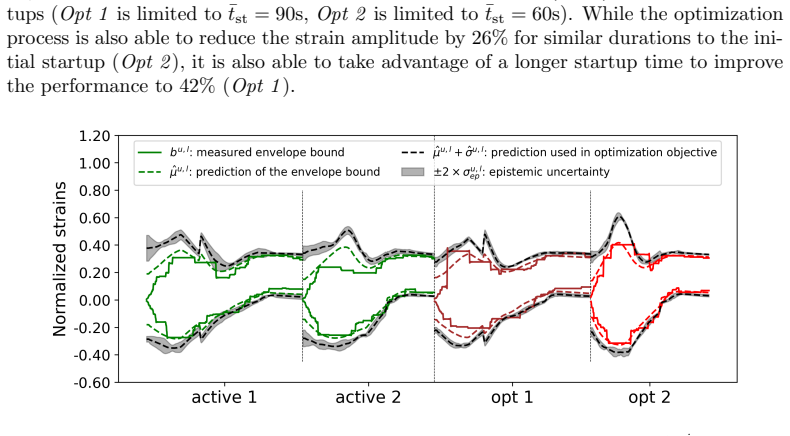
On the paper's own terms, the central claim is that an active-learning optimizer can identify a near-optimal startup parameter set using a budget of only seven measured startup trajectories on a full-scale Francis turbine. The measured largest strain cycle fell from 0.98 for the standard startup to 0.57 for the optimized startup, a 42% reduction, and a second constrained run achieved 0.73 under a shorter 60-second time limit. The discovery is that a learned probabilistic model of the strain envelope, conditioned only on instantaneous rotational speed and guide-vane opening, is sufficient inside an active-learning loop to guide the optimization toward parameter regions that genuinely reduce the largest strain cycle, and that the measured strains confirm the predictions without relying on the model for final performance.
Load-bearing premise
The load-bearing premise is that the strain envelope's distribution at any operating point is a conditional normal whose mean plus one standard deviation captures the likely extreme strain, so if that distribution is skewed or heavy-tailed, the optimizer can misrank startups.
Editorial extensions
If this is right
- Hydropower utilities can optimize startup parameters during a short, dedicated measurement campaign of about seven startups, rather than through trial-and-error over a full commissioning period.
- The same active-learning loop can be applied to shutdown and load-variation transients, which also contribute to runner fatigue, using the same virtual-sensor and envelope-loss formulation.
- The learned virtual sensor's envelope predictions can serve as a fast surrogate for fatigue-relevant strain in future optimization, reducing the need for additional strain-gauge campaigns.
- A shorter time-to-synchronous-speed constraint still yields a 26% strain-cycle reduction at equal startup time, suggesting the method can trade startup speed against fatigue damage in a principled way.
- The final optimization trajectory is measured on the turbine, so the optimized parameters' performance is validated by real strain data rather than only by model predictions.
Reading between the lines
- The paper optimizes strain at a single gauge; a natural extension is to optimize over all instrumented gauges simultaneously, since minimizing one location's strain could shift damage to another if the strain field is not monotonic in the startup parameters.
- The normal-distribution envelope assumption is the key unvalidated proxy; a testable extension would compare the selected parameters against a quantile-regression or extreme-value envelope model to see whether the ranking of candidate startups changes.
- The paper's hypothesis that low-strain parameters generalize across water heads remains untested; a multi-head measurement campaign could confirm or refute it and would be the natural next industrial trial.
- The active-learning phase's benefit may depend on landscape smoothness; on a rougher landscape with multiple local optima, the exploration budget of two active sequences would likely need to be larger.
Editorial analysis
A structured set of objections, weighed in public.
Referee Report
Summary. The paper presents an automated, active-learning-based framework for optimizing the startup sequence of a hydroelectric turbine to minimize fatigue damage. The startup trajectory is parameterized by four governor settings θ = {ro, oini, ωtrigger, otrigger}. The method combines a quasi-static HGU dynamics simulator, a virtual strain sensor (a feedforward neural network that models the upper and lower strain envelopes as conditionally normal distributions), and the NOMAD black-box optimizer, embedded in an active learning loop that sequentially selects startup parameters to test on the instrumented turbine. In an on-site campaign on a full-scale Francis turbine, the algorithm selected parameters that reduced the largest measured strain cycle from 0.98 (standard startup) to 0.57, a claimed 42% reduction, using eight measured sequences (the abstract says seven). A second, shorter-duration optimized startup achieved a 26% reduction. The paper is a real-world demonstration of a closed-loop optimization pipeline on a prototype machine with a very limited measurement budget.
Significance. If the result holds, the paper provides an industrially relevant method for reducing turbine fatigue during startups with only a handful of prototype measurements. The main strength is that the headline 42% improvement is a measured physical quantity on a full-scale turbine, not a simulation, and the paper demonstrates an integrated pipeline (simulator + virtual sensor + derivative-free optimization + active learning) operating in real time during a measurement campaign. The work is of practical interest to hydropower utilities. However, the quantitative claim rests on a single measured pair with no repetitions of the optimal sequence, and the cost function used by the optimizer relies on an explicitly unvalidated normality assumption and a likely sign inconsistency in the lower-bound term. These issues make the reported improvement less robust than stated, though they are addressable with additional validation and more careful statistical framing.
major comments (5)
- [Section 3.4, Eq. (18)] The lower-bound term in the strain cost, min_n(μ̂l_n + σ̂l_n), is not conservative and is likely a sign error. Since sl is the lower envelope defined in Eq. (10), the extreme low value should be estimated as μ̂l_n − σ̂l_n (or some lower quantile), not μ̂l_n + σ̂l_n. Adding σ̂l_n to μ̂l_n raises the lower envelope and therefore reduces the cycle amplitude cs(θ); the claim in the text that this 'ensures that the expected maximum strain cycle is not underestimated' is contradicted by the formula. Please verify the sign on actual data; if the lower envelope is negative, this underestimation can misrank candidate startups.
- [Section 3.3, Eqs. (12)–(13)] The optimization objective (Eq. 18) assumes that the upper and lower envelope bounds are conditionally normal and that μ̂+σ̂ represents their likely extrema. The paper explicitly states this assumption was not validated. Because the envelope is a 10-s windowed maximum/minimum (Eqs. 9–10), the appropriate distributions are of extreme-value type, and μ̂+σ̂ is not a consistent quantile of the expected extreme. This is load-bearing: the NOMAD optimizer selects θ by minimizing cs(θ), so any systematic misranking of candidate startups invalidates the claim that the selected θ minimizes L(τM). I recommend adding a validation of the ranking: use the already-measured startups to compare the ordering of cs(θ) with the ordering of measured L(τM), e.g., by leave-one-out cross-validation.
- [Section 4.2, Table 2] The reported 42% reduction is based on a single comparison between Optimal 1 (largest cycle 0.57) and Initial 5 (0.98), with no repetition of the optimal sequence. The two standard startups, Initial 1 and Initial 5, already differ by 11% (1.09 vs 0.98), which indicates substantial run-to-run variability. Without repeated measurements of the selected parameters or a statistical uncertainty interval, the 42% figure should be presented as a single-case demonstration rather than a robust performance guarantee. At minimum, the stochastic spread of the standard startup should be propagated into the claimed reduction.
- [Section 3.5 and Section 5] The paper does not demonstrate that the active learning phase improves over the plain black-box optimization. The Discussion states that 'the epistemic uncertainty values were low, and the active learning phase ... was not significantly different from the optimization phase.' To substantiate the active-learning contribution, run NOMAD from the initial Ninit trajectories alone and compare the resulting θ and cost with those obtained via the full active loop. If the results are identical, the active-learning novelty should be reframed or supported with an experiment where the initial data are less informative.
- [Section 3.1, Figure 4] The HGU dynamics simulator is validated visually against only two startups, with no quantitative error measure (e.g., maximum speed deviation or startup-time error). Since the optimizer evaluates hundreds of candidate trajectories, many of which lie outside the two validated cases, a quantitative validation on the available measured trajectories is needed to establish that the simulator does not introduce systematic bias into the cost function.
minor comments (5)
- [Abstract and Section 4.1] The abstract says 'seven measured sequences,' but Section 4.1 specifies Ninit = 5, Nact = 2, Nopt = 1, totaling eight measured sequences (and Table 2 lists eight rows, excluding the extra Optimal 2 run). Please correct the count.
- [Section 4.2, Table 2] For Initial 1, tst is reported as N/A because recording was delayed for the first few seconds. Since the largest cycle is computed from the recorded portion only, the reported value 1.09 may be a lower bound on the true cycle; this caveat should be stated.
- [Section 4.1] The envelope window w = 10 s and the sampling frequencies (fM = 500 Hz, fe = 10 Hz) are chosen without a sensitivity analysis; please state whether the results depend materially on these choices.
- [Section 3.3] The neural network hyperparameters (two hidden layers of 32 units, three epochs, learning rate 0.001, ensemble size 5) are given without justification or sensitivity study; at least cite a reference or include a brief ablation.
- [Figure 13] The text 'induces an significant standard deviation' contains a grammatical error; 'an' should be 'a'.
Circularity Check
No circularity: the headline 42% reduction is a measured, out-of-sample turbine result; the virtual sensor self-citation [24] is re-validated on this campaign's own data.
full rationale
The claimed derivation is self-contained and non-circular. The key result—a 42% reduction in the largest measured strain cycle (Optimal 1: 0.57 vs standard: 0.98, Table 2)—is a physical measurement taken from the instrumented turbine after the optimization, so it does not reduce to any fitted quantity. The optimizer's cost c(θ) (Eq. 18) is a model-based proxy built from the virtual sensor, but the selected θ is then executed and measured; no fitted parameter is renamed as a prediction. The virtual sensor approach is attributed to the authors' prior work [24], but Section 3.3 estimates m_ϕ from the current campaign's measured trajectories and Figure 13 compares its predictions to the measured envelopes on the selected optimal trajectories, providing independent in-paper support for the model. The statement 'This assumption was not validated in the current study' (Section 3.3, Eqs. 12-13) exposes a real correctness risk in using μ+σ as the expected extremum, but an unvalidated modeling assumption is not a circular reduction. Finally, the abstract's 'seven measured sequences' is inconsistent with Section 4's N_init=5, N_act=2, N_opt=1 plus a ninth 60-s run in Table 2; this is a factual reporting error, not an instance of circularity.
Assumptions & free parameters
free parameters (6)
- alpha_d normalization factor =
inverse of strain range in dataset D
- time-constraint cost coefficients =
0.5, 0.05, 0.2 in Eq. (19)
- UCB exploration coefficient =
2 in Eq. (20)
- neural network hyperparameters =
hidden size 32, 2 layers, 3 epochs, batch 32, learning rate 0.001, ensemble of 5
- envelope window and sampling frequencies =
w = 10 s, fM = 500 Hz, fe = 10 Hz, fD = 10 Hz
- quasi-static torque surface grid =
not reported
assumptions (6)
- domain assumption HGU dynamics are deterministic for a fixed parameter set theta
- domain assumption Quasi-static torque from steady-state simulations approximates transient torque
- domain assumption Strain envelope bounds are conditionally normal given (omega, o)
- domain assumption Largest strain cycle amplitude is an adequate proxy for fatigue damage
- domain assumption A virtual sensor trained on a few trajectories generalizes across the startup parameter space
- domain assumption Nominal constant head and negligible bearing friction
Cite this review
Pith. "Pith review of Active Learning-Based Optimization of Hydroelectric Turbine Startup to Minimize Fatigue Damage." pith.science (2026). https://pith.science/paper/3635654V
@misc{pith2026241114618,
  author       = {Pith},
  title        = {Pith review of: Active Learning-Based Optimization of Hydroelectric Turbine Startup to Minimize Fatigue Damage},
  year         = {2026},
  howpublished = {\url{https://pith.science/paper/3635654V}},
  note         = {Machine review of arXiv:2411.14618}
}
read the original abstract
Hydro-generating units (HGUs) play a crucial role in integrating intermittent renewable energy sources into the power grid due to their flexible operational capabilities. This evolving role has led to an increase in transient events, such as startups, which impose significant stresses on turbines, leading to increased turbine fatigue and a reduced operational lifespan. Consequently, optimizing startup sequences to minimize stresses is vital for hydropower utilities. However, this task is challenging, as stress measurements on prototypes can be expensive and time-consuming. To tackle this challenge, we propose an innovative automated approach to optimize the startup parameters of HGUs with a limited budget of measured startup sequences. Our method combines active learning and black-box optimization techniques, utilizing virtual strain sensors and dynamic simulations of HGUs. This approach was tested in real-time during an on-site measurement campaign on an instrumented Francis turbine prototype. The results demonstrate that our algorithm successfully identified an optimal startup sequence using only seven measured sequences. It achieves a remarkable 42% reduction in the maximum strain cycle amplitude compared to the standard startup sequence. This study paves the way for more efficient HGU startup optimization, potentially extending their operational lifespans.
Figures


Figures from the paper (10 more)


Reference graph
Works this paper leans on
-
[1]
E. Vagnoni, D. Gezer, I. Anagnostopoulos, G. Cavazzini, E. Doujak, M. Hoˇ cevar, and P. Rudolf, “The new role of sustainable hydropower in flexible energy systems and its technical evolution through innovation and digitalization,” Renewable Energy, vol. 230, p. 120832, 2024
work page 2024
-
[2]
Effect of transients on Fran- cis turbine runner life: a review,
M. Trivedi, B. Gandhi, and M. Cervantes, “Effect of transients on Fran- cis turbine runner life: a review,” Journal of Hydraulic Research, vol. 51, no. 2, p. 121–132, 2013
work page 2013
-
[3]
A review on fatigue damage mechanism in hydro turbines,
X. Liu, Y. Luo, and Z. Wang, “A review on fatigue damage mechanism in hydro turbines,” Renewable and Sustainable Energy Reviews, vol. 54, p. 1–14, 2016
work page 2016
-
[4]
Analysis of the part load helical vortex rope of a Francis turbine using on-board sensors,
F. Duparchy, A. Favrel, P.-Y. Lowys, C. Landry, A. M¨ uller, K. Ya- mamoto, and F. Avellan, “Analysis of the part load helical vortex rope of a Francis turbine using on-board sensors,” Journal of Physics: Con- ference Series, vol. 656, p. 012061, nov 2015
work page 2015
-
[5]
A. Favrel, J. Gomes Pereira Junior, A. M¨ uller, C. Landry, K. Yamamoto, and F. Avellan, “Swirl number based transposition of flow-induced me- 24 chanical stresses from reduced scale to full-size Francis turbine runners,” Journal of Fluids and Structures, vol. 94, p. 102956, 2020
work page 2020
-
[6]
Q. H. Pham, M. Gagnon, J. Antoni, A. Tahan, and C. Monette, “Rainflow-counting matrix interpolation over different operating condi- tions for hydroelectric turbine fatigue assessment,” Renewable Energy, vol. 172, p. 465–476, Jul 2021
work page 2021
-
[7]
Transient CFD simula- tion of a Francis turbine startup,
J. Nicolle, J.-F. Morissette, and A.-M. Giroux, “Transient CFD simula- tion of a Francis turbine startup,” IOP Conference Series: Earth and Environmental Science, vol. 15, pp. 2014–, 11 2012
work page 2014
-
[8]
On the stochastic simulation of hydroelectric turbine blades transient response,
M. Gagnon, A. Tahan, P. Bocher, and D. Thibault, “On the stochastic simulation of hydroelectric turbine blades transient response,” Mechan- ical Systems and Signal Processing, vol. 32, pp. 178–187, 2012. Uncer- tainties in Structural Dynamics
work page 2012
Show all 33 references
-
[9]
Fluid-structure simulations of the stochastic behaviour of a medium head Francis turbine during startup,
J.-F. Morissette and J. Nicolle, “Fluid-structure simulations of the stochastic behaviour of a medium head Francis turbine during startup,” IOP Conference Series: Earth and Environmental Science, vol. 240, p. 022026, 03 2019
2019
-
[10]
Impact of startup scheme on Francis runner life expectancy,
M. Gagnon, S. A. Tahan, P. Bocher, and D. Thibault, “Impact of startup scheme on Francis runner life expectancy,” 25th IAHR Symposium on Hydraulic Machinery and Systems, 20-24 September, 2010, no. 1, 2010
2010
-
[11]
Start and stop costs for hydro power plants: a critical literature re- view,
O. Savin, C. Badina, J. Baroth, S. Charbonnier, and C. B´ erenguer, “Start and stop costs for hydro power plants: a critical literature re- view,” in Proceedings of the 30th European Safety and Reliability Con- ference and 15th Probabilistic Safety Assessment and Management Co...
2020
-
[12]
Cracking of Francis runners during transient operation,
J. Gummer and S. Etter, “Cracking of Francis runners during transient operation,” Hydropower & Dams, vol. 15, p. 81–85, Jan 2008
2008
-
[13]
Hydro unit start-up costs and their impact on the short term scheduling strategies of Swedish power producers,
O. Nilsson and D. Sjelvgren, “Hydro unit start-up costs and their impact on the short term scheduling strategies of Swedish power producers,” IEEE Transactions on Power Systems, vol. 12, no. 1, p. 38–44, 1997. 25
1997
-
[14]
On the expected monetary value of hydroelectric turbine start-up protocol optimisation,
M. Gagnon, D. Thibault, and M. Blain, “On the expected monetary value of hydroelectric turbine start-up protocol optimisation,” in Engi- neering Assets and Public Infrastructures in the Age of Digitalization (J. P. Liyanage, J. Amadi-Echendu, and J. Mathew, eds.), (Cham), pp. ...
2020
-
[15]
Optimization of francis turbine start up procedure in order to extend runner lifetime,
Z. ˇCepa, G. Aliˇ c, and D. Dolenc, “Optimization of francis turbine start up procedure in order to extend runner lifetime,” inHYDRO 2018, 2018
2018
-
[16]
Measurement of dynamic stress and optimized start-up method for prototype Francis turbine,
T. Mukai, R. Shima, M. Nakazono, and K. Tezuka, “Measurement of dynamic stress and optimized start-up method for prototype Francis turbine,” in Journal of Physics: Conference Series, vol. 2217, p. 012065, IOP Publishing, 2022
2022
-
[17]
IEC 61362:2024 - Guide- lines to specification of hydraulic turbine governing systems,
International Electrotechnical Commission, “IEC 61362:2024 - Guide- lines to specification of hydraulic turbine governing systems,” 2024. Re- places the second edition published in 2012. Covers specification of hy- draulic turbine governing systems
2024
-
[18]
On the pre- diction of the induced damage by the start-up sequence of Francis turbines: On operational resilience framework,
M. Seydoux, E. Vagnoni, C. Nicolet, and M. Paolone, “On the pre- diction of the induced damage by the start-up sequence of Francis turbines: On operational resilience framework,” Renewable Energy, vol. 228, p. 120587, 2024
2024
-
[19]
Fa- tigue damage reduction in hydropower startups with machine learning,
T. Muser, E. Krymova, A. Morabito, M. Seydoux, and E. Vagnoni, “Fa- tigue damage reduction in hydropower startups with machine learning,” Nature Communications, vol. 16, 03 2025
2025
-
[20]
Experi- mental and numerical study of a prototype Francis turbine startup,
J. Unterluggauer, V. Sulzgruber, E. Doujak, and C. Bauer, “Experi- mental and numerical study of a prototype Francis turbine startup,” Renewable Energy, vol. 157, pp. 1212–1221, 2020
2020
-
[21]
Optimization of turbine start-up sequence of a full size fre- quency converter variable speed pump-turbine,
J. Schmid, S. Allign´ e, D. Biner, C. M¨ unch-Allign´ e, N. Hugo, and C. Nicolet, “Optimization of turbine start-up sequence of a full size fre- quency converter variable speed pump-turbine,” IOP Conference Series: Earth and Environmental Science, vol. 1079, p. 012109, sep 2022
2022
-
[22]
Optimization of turbine startup: Some experimental results from a propeller runner,
M. Gagnon, N. Jobidon, M. Lawrence, and D. Larouche, “Optimization of turbine startup: Some experimental results from a propeller runner,” in IOP Conference Series: Earth and Environmental Science, vol. 22, p. 032022, IOP Publishing, 2014. 26
2014
-
[23]
A look at Francis runner blades response during transients,
M. Gagnon, J. Nicolle, J.-F. Morissette, and M. Lawrence, “A look at Francis runner blades response during transients,” IOP Conference Series: Earth and Environmental Science, vol. 49, p. 052005, nov 2016
2016
-
[24]
Virtual sensors for indirect strain measurement during Francis turbine startup,
M. Gagnon, Q. H. Pham, V. Mai, and A. Favrel, “Virtual sensors for indirect strain measurement during Francis turbine startup,” in Pro- ceedings of the 9th IAHR Meeting of the Workgroup on Cavitation and Dynamic Problems in Hydraulic Machinery and Systems, (Timisoara, Romania)...
2023
-
[25]
Response spectra and expected fatigue reliability: A look at hydroelectric turbines behavior,
M. Gagnon and D. Thibault, “Response spectra and expected fatigue reliability: A look at hydroelectric turbines behavior,” Procedia Engi- neering, vol. 133, p. 613–621, 2015
2015
-
[26]
Nicolet, Hydroacoustic modelling and numerical simulation of un- steady operation of hydroelectric systems
C. Nicolet, Hydroacoustic modelling and numerical simulation of un- steady operation of hydroelectric systems. PhD thesis, EPFL, 2007
2007
-
[27]
Batch normalization: Accelerating deep network training by reducing internal covariate shift,
S. Ioffe and C. Szegedy, “Batch normalization: Accelerating deep network training by reducing internal covariate shift,” Mar 2015. arXiv:1502.03167
2015 arXiv
-
[28]
On the pitfalls of heteroscedastic uncertainty estimation with probabilistic neural net- works,
M. Seitzer, A. Tavakoli, D. Antic, and G. Martius, “On the pitfalls of heteroscedastic uncertainty estimation with probabilistic neural net- works,” Apr 2022. arXiv:2203.09168 [cs, stat]
2022 arXiv
-
[29]
Algorithm 1027: NOMAD version 4: nonlinear optimization with the MADS algo- rithm,
C. Audet, S. Le Digabel, V. R. Montplaisir, and C. Tribes, “Algorithm 1027: NOMAD version 4: nonlinear optimization with the MADS algo- rithm,” ACM Transactions on Mathematical Software, vol. 48, p. 1–22, Sep 2022
2022
-
[30]
Finite-time analysis of the multiarmed bandit problem,
P. Auer, N. Cesa-Bianchi, and P. Fischer, “Finite-time analysis of the multiarmed bandit problem,” Machine Learning, vol. 47, no. 2/3, p. 235–256, 2002
2002
-
[31]
Obtaining stress measurements on runners as a key contribution to reducing their degradation and improv- ing the reliability of hydroelectric production units,
L. Marcouiller and D. Thibault, “Obtaining stress measurements on runners as a key contribution to reducing their degradation and improv- ing the reliability of hydroelectric production units,” in HYDRO 2015, (Bordeaux, France), Oct. 2015. 27
2015
-
[32]
Fatigue strength analysis of a prototype fran- cis turbine in a multilevel lifetime assessment procedure part ii: Method application and numerical investigation,
E. Doujak, J. Unterluggauer, G. Fillinger, A. Nocker, F. Haller, M. Maier, and S. Stadler, “Fatigue strength analysis of a prototype fran- cis turbine in a multilevel lifetime assessment procedure part ii: Method application and numerical investigation,” Energies, vol. 15, 02 2022
2022
-
[33]
Parallel space decomposi- tion of the mesh adaptive direct search algorithm,
C. Audet, J. E. Dennis, and S. L. Digabel, “Parallel space decomposi- tion of the mesh adaptive direct search algorithm,” SIAM Journal on Optimization, vol. 19, p. 1150–1170, Jan 2008. 28 Appendix A. Notation table HGU dynamics n Time step ωn Turbine rotation speed on Guide va...
2008
Reviewed August 12, 2026 · model on record in the stance chip above.
Discussion (0). Continue with ORCID to comment.