REVIEW 3 major objections 4 minor 55 references
Ionization chemistry in the inner disc: a combined treatment of ionic and thermionic emission and arbitrary grain size distributions
T0 review · 3 major / 4 minor · reviewed 2026-08-12 · deepseek-v4-flash
Pith's one-line read Grain charging, computed across all dust sizes with ionic and thermionic emission, can freeze the inner disc's grain population.
desk verdict First combined treatment of ionic/thermionic emission and arbitrary grain-size distributions; solid validation, but the freeze-in conclusion needs sensitivity tests on the collision kernel. read the letter →
The pith
A machine-rendered reading of the paper's core claim, the machinery that carries it, and where it could break.
The reading
What carries the argument
The central object is the equilibrium reaction network of equations (14*)–(17*), a nonlinear system in the per-size grain charges $Z_i$, electron, molecular ion and alkali ion densities, closed by charge conservation. The load-bearing simplification is the 'reduced temperature' $\tau \equiv akT/e^2$: because the Draine–Sutin focusing factors and the Saha–Langmuir ion-emission fraction $f_+$ depend on charge only through $Z/\tau$, the most probable charge on every size bin is $Z_i = \psi \tau_i$ with a single constant $\psi$ set by one transcendental equation (Appendix C). This reduces an $N$-dimensional problem to a root-finding problem and is why the paper can handle arbitrary size distributions. The analysis of grain collisions relies on the limiting collision kernels of Okuzumi et al. (2011a) for Coulomb-interacting grains, used in the truncated form of Akimkin et al. (2023): the kernel is set to zero when the drift kinetic energy falls below the Coulomb barrier $U(a_i+a_j)$, which is precisely the assumption that produces the long freeze-in collision time-scales.
What would settle it
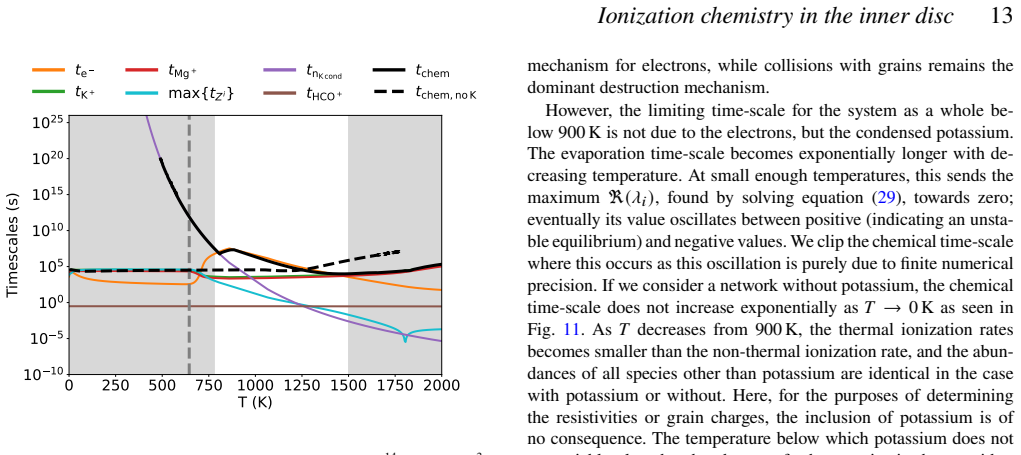
Evaluate the full collision integral of Eq. (34)—including the Maxwellian tail at $\Delta v_{ij}^{D} < \Delta v_{ij}^{Br}$—with the same grain charges and disc conditions as in Fig. 13, and ask whether the shortest grain–grain collision time-scale ever drops below the dynamical time in the unshaded 800–1500 K region; a drop would falsify the freeze-in conclusion. A complementary check is to recompute collision time-scales using a distribution of charges per grain size (rather than a single charge) and a dipole-inclusive cross-section, since both are omitted in the paper.
Extended reading notes
Core claim
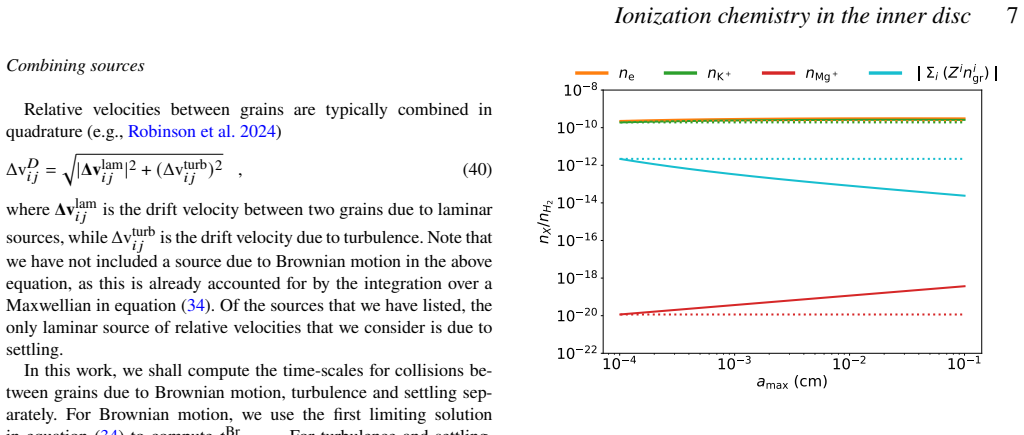
The paper's central claim is that a chemical network that includes ionic and thermionic emission from grains and a full, arbitrary grain size distribution—solved exactly in equilibrium—yields results that differ materially from prior treatments. Specifically, the paper shows that approximating the grain population by a single size with an 'effective dust-to-gas ratio,' as in earlier work, reproduces the dominant gas-phase ionization fractions (and hence resistivities) but gives significantly erroneous grain charges, particularly for flatter size distributions. It further shows that grain charging, which becomes severe once grain-surface ion emission and thermionic emission set in above roughly 500–600 K, lengthens grain–grain collision time-scales by many orders of magnitude relative to the dynamical time at the disc mid-plane near 1 au, implying that the grain size distribution can be frozen in while grains traverse the inner disc. Along the way the authors establish that the mean grain charge remains proportional to grain size, $Z \propto a$ (equivalently a constant $\psi \equiv Z/\tau$ with reduced temperature $\tau = akT/e^2$), even when ionic and thermionic emission are active, so that a single root-finding exercise fixes the charge on every size bin.
Load-bearing premise
The collision-rate results rest on setting the grain–grain collision kernel to zero whenever the drift kinetic energy is below the Coulomb repulsion barrier, even though a finite contribution from Brownian (Maxwellian) relative motion always remains; if that residual kernel keeps collisions frequent, the claimed freeze-in of the size distribution would be weaker than stated.
Editorial extensions
If this is right
- The effective dust-to-gas-ratio method with $p=1.5$ remains adequate for gas-phase charge densities and thus for resistivities at $T \gtrsim 1000$ K, but it is not safe for any calculation that depends on the charge of individual grains.
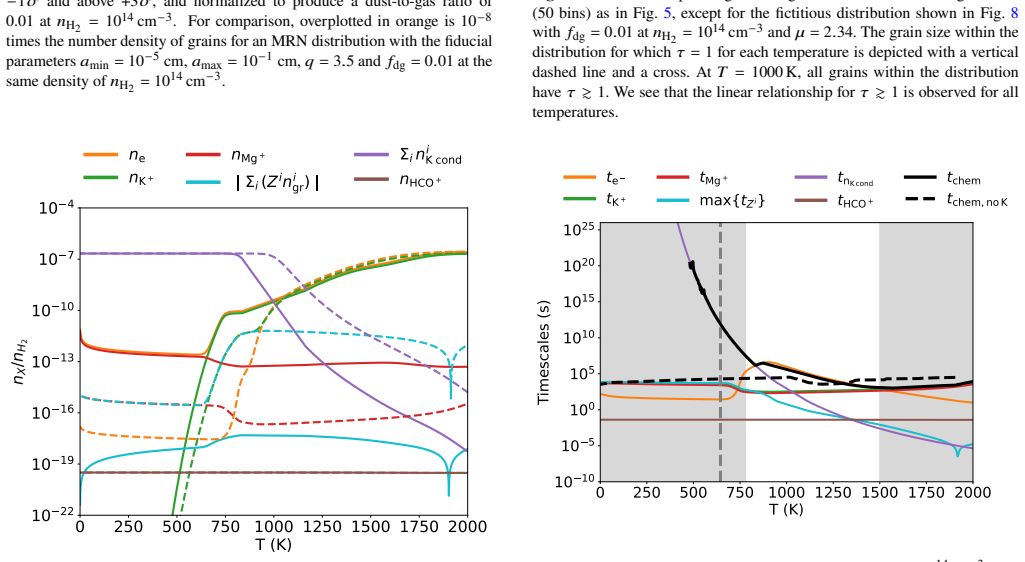
- At the 1 au mid-plane, charged-grain collision time-scales exceed the dynamical time by many orders of magnitude over most of the 800–1500 K range, so an inner-disc grain size distribution can be frozen in unless it collided on the way in.
- Grain charge is proportional to grain size, $Z \propto a$, for all temperatures considered, extending the Draine–Sutin linear law to the regime where ionic and thermionic emission are active.
- Chemical equilibrium is a good approximation in the inner disc: the chemical time-scale is shorter than the dynamical, thermal and grain-collision time-scales in the region of interest, with the no-potassium network setting the relevant time-scale below ~900 K.
- Ohmic, Hall and ambipolar resistivities can now be computed from a network that includes emission and a full size distribution; the sign of the Hall term flips when grains replace electrons as the dominant negative charge carriers.
Reading between the lines
- If the freeze-in result survives a full collision kernel, large grains that form outside the inner disc could pass through the 1 au region without being eroded by fragmentation, changing the opacity and the location of the dead-zone edge; this is an inference, since the paper does not evolve the size distribution.
- The single-charge-per-size simplification is justified by near-Gaussian charge distributions, but the collision kernel truncation and the neglect of dipole interactions are exactly the places where a distribution of charges could reopen collisions; a direct Monte Carlo or full-kernel test would bound the freeze-in effect.
- The $\psi$-scaling implies a charge-to-mass ratio that grows with grain size, which could affect settling and drift signatures: small grains carry little charge per mass, large grains much more; this is not explored in the paper.
- The method's structure—one root equation fixing all grain charges—should extend naturally to multi-alkali networks (the paper demonstrates sodium alongside potassium) and to any disc model that supplies $T$, $n_{\rm H2}$ and a grain size distribution, so it is a candidate drop-in module for coagulation–chemistry co-evolution codes; that application is left implicit.
Editorial analysis
A structured set of objections, weighed in public.
Referee Report
Summary. This manuscript presents an equilibrium chemical network for the inner protoplanetary disc that combines non-thermal and thermal ionization, gas-phase recombination and charge transfer, and grain charging with ionic and thermionic emission for an arbitrary grain size distribution. The authors solve the nonlinear system with a successive-over-relaxation plus Powell hybrid method, validate against Desch & Turner (2015) in the single-size limit and against Marchand et al. (2022) with emission switched off, and use the resulting abundances to compute resistivities and grain-grain collision time-scales. They report that the effective dust-to-gas ratio approximation yields inaccurate grain charges, that grain charge is proportional to size across distributions, and that electrostatic repulsion can make grain collision time-scales far exceed the dynamical time, potentially freezing the size distribution in the inner disc.
Significance. If the results hold, the paper fills a real gap: it is the first to combine arbitrary grain size distributions with ionic and thermionic emission in an equilibrium inner-disc network, and it provides a widely usable numerical method. The validation against two prior codes is a substantial strength, as is the analytic Appendix C derivation of the Gaussian charge distribution and the Z-proportional-to-a scaling. The effective-dust-to-gas-ratio comparison and the resistivity calculations give the community practical tools. However, the quantitative freeze-in conclusion is currently tied to a deliberately truncated collision kernel and to mean-charge evaluation; those points must be fortified before the headline claim can be fully trusted.
major comments (3)
- [Section 2.4.2, Eqs. (35a)-(35b); Figs 13-14] The freeze-in conclusion is computed with K_ij set to zero whenever KE_D_ij < U(a_i+a_j), even though the text acknowledges that a nonzero Brownian contribution always persists. This makes the reported collision time-scales upper limits, and the statement in Section 3.6 that the size distribution 'may be frozen in' is exactly as strong as the unquantified tail of the relative-velocity distribution. Please provide a quantitative estimate or a bounding argument for the omitted contribution, particularly for pairs whose drift energy is only slightly below the Coulomb barrier and for temperatures near the charge-sign transition. A related approximation is that Eq. (35b), formally valid only for KE_D_ij much larger than U(a_i+a_j), is used over the entire range KE_D_ij > U; the sign and rough magnitude of the error this introduces should also be stated. If the neglected tail contributes non-negligible collision rates, the magnitude of the claimed effect must be revised.
- [Section 2.3 and Appendix C] The single-charge-per-grain-size approximation is validated only for the mean charge and the Gaussian width. Since the collision kernel is exponentially sensitive to Z_i Z_j, evaluating the kernel at the mean charge is not equivalent to averaging over the charge distribution. Please add a sensitivity estimate, using the Appendix C distributions, of the collision rate averaged over the charge distribution, e.g., <exp(-Z_i Z_j e^2/[(a_i+a_j) kT])>, versus the same quantity evaluated at the mean charges for representative pairs. This is directly load-bearing for the claimed order-of-magnitude changes in collision time-scales.
- [Appendix D, Fig. D1] The claim that the effective dust-to-gas ratio method yields 'significantly inaccurate grain charges' is supported by a visual comparison of nine panels, but no fractional error is quantified. Since this is one of the two headline claims in the abstract, please add a quantitative error measure, such as the maximum or rms fractional error in Z_i as a function of temperature and grain size, for the cases shown in Fig. D1.
minor comments (4)
- [Eq. (7)] The normalization integral appears to have the same upper limit a_max in both terms of the denominator; presumably the second term should involve a_min. Please correct this typo.
- [Section 2.2 and Eq. (37)] The number density is written as 'nH2 = 1014gcm^-3' and should be cm^-3; likewise the collision cross-section in Eq. (37) is written as cm^-2 and should be cm^2.
- [Section 3.1.1] The comparison with Desch & Turner (2015) uses a non-thermal rate zeta = 1.4e-22 s^-1, whereas the fiducial runs use 7.6e-19 s^-1; the text explains the historical origin but a sentence clarifying why the comparison value is not used elsewhere would help.
- [Figs 13 and 14] The captions mention a plotted plateau of 10^40 s, but this value is not apparent from the axis ranges shown in the main text; consider an inset or an explicit annotation so the truncation is clear.
Circularity Check
No significant circularity; the network solution, Z∝ a scaling, and comparisons against effective dust-to-gas methods are genuine outputs under stated assumptions.
full rationale
The central derivation chain is self-contained. The network parameters (rate constants, work functions, abundances, grain properties) are taken from prior literature or computed by the stated chemistry, and none are fitted to the paper's own headline outputs. The Z ∝ a result is derived in Appendix C from the detailed-balance recurrence (C1): solving W(Z_i, τ_i) = 0 yields Z_i^0 = ψ τ_i because the only size-dependent combination entering W is Z_i/τ_i, so the scaling is an analytic consequence rather than an input. The critique of the effective dust-to-gas-ratio method (Appendix D) is also a genuine output: the approximate method's p = 1.5 was calibrated to gas-phase electron densities in earlier work, whereas the paper's criticism concerns grain charges, so the discrepancy is not built in by construction. The grain collision time-scale calculations use the limiting kernels (35a)–(35b) and, following Akimkin et al. (2023), set K_ij = 0 when KE_D < U; Section 2.4.2 explicitly acknowledges that a nonzero Brownian contribution persists. This makes the quantitative 'frozen in' statement dependent on a stated approximation, and the paper itself flags the truncation at 10^40 s, but this is a model-assumption limitation rather than a circular reduction: the claimed effect is computed from the kernel rather than being equivalent to it by definition. No load-bearing self-citation chain, imported uniqueness theorem, or ansatz disguised as a prediction appears in the argument. The result is therefore not circular.
Assumptions & free parameters
free parameters (5)
- Electron sticking coefficient S_e =
0.6
- Ion and neutral sticking coefficients S_ions, S_neutrals =
1.0
- Grain work function W =
5.0 eV
- Alkali activation energy E_a =
3.25 eV
- Richardson constant lambda_R =
1/2
assumptions (6)
- domain assumption The inner disc mid-plane chemical network can be reduced to electrons, one molecular ion (HCO+), one non-alkali metal ion (Mg+), and one alkali (K), with other species unimportant.
- domain assumption Chemical equilibrium is a valid approximation for the conditions studied.
- domain assumption Grains are spherical and have a single charge per size bin equal to the most probable charge.
- domain assumption The collision kernel for like-charged grains uses limiting forms from Okuzumi et al. (2011a), with K_ij set to zero when kinetic energy is below the Coulomb barrier, neglecting the Brownian contribution.
- domain assumption Relative velocities from radial and azimuthal drift and from ambipolar drift are neglected in the inner disc.
- domain assumption Non-thermal ionization rate is constant zeta = 7.6e-19 per second, with cosmic rays and X-rays fully shielded.
Cite this review
Pith. "Pith review of Ionization chemistry in the inner disc: a combined treatment of ionic and thermionic emission and arbitrary grain size distributions." pith.science (2026). https://pith.science/paper/3MPN6KVV
@misc{pith2026241114640,
  author       = {Pith},
  title        = {Pith review of: Ionization chemistry in the inner disc: a combined treatment of ionic and thermionic emission and arbitrary grain size distributions},
  year         = {2026},
  howpublished = {\url{https://pith.science/paper/3MPN6KVV}},
  note         = {Machine review of arXiv:2411.14640}
}
read the original abstract
In the inner regions of protoplanetary discs, ionization chemistry controls the fluid viscosity, and is thus key to understanding various accretion, outflow and planet formation processes. The ionization is driven by thermal and non-thermal processes in the gas-phase, as well as by dust-gas interactions that lead to grain charging and ionic and thermionic emission from grain surfaces. The latter dust-gas interactions are moreover a strong function of the grain size distribution. However, analyses of chemical networks that include ionic/thermionic emission have so far only considered grains of a single size (or only approximately treated the effects of a size distribution), while analyses that include a distribution of grain sizes have ignored ionic/thermionic emission. Here, we: (1) investigate a general chemical network, widely applicable in inner disc regions, that includes gas-phase reactions, ionic and thermionic emission, and an arbitrary grain size distribution; (2) present a numerical method to solve this network in equilibrium; and (3) elucidate a general method to estimate the chemical time-scale. We show that: (a) approximating a grain size distribution by an "effective dust-to-gas ratio" (as done in previous work) can predict significantly inaccurate grain charges; and (b) grain charging significantly alters grain collisional time-scales in the inner disc. For conditions generally found in the inner disc, this work facilitates: (i) calculation of fluid resistivities and viscosity; and (ii) inclusion of the effect of grain charging on grain fragmentation and coagulation (a critical effect that is often ignored).
Figures


Figures from the paper (9 more)




Reference graph
Works this paper leans on
-
[1]
write newline
" write newline "" before.all 'output.state := FUNCTION fin.entry write newline FUNCTION new.block output.state before.all = 'skip after.block 'output.state := if FUNCTION new.sentence output.state after.block = 'skip output.state before.all = 'skip after.sentence 'output.state := if if FUNCTION not #0 #1 if FUNCTION and 'skip pop #0 if FUNCTION or pop #1...
-
[2]
Akimkin V. V., Ivlev A. V., Caselli P., 2020, @doi [ ] 10.3847/1538-4357/ab6299 , https://ui.adsabs.harvard.edu/abs/2020ApJ...889...64A 889, 64
-
[3]
Akimkin V., Ivlev A. V., Caselli P., Gong M., Silsbee K., 2023, @doi [ ] 10.3847/1538-4357/ace2c5 , https://ui.adsabs.harvard.edu/abs/2023ApJ...953...72A 953, 72
-
[4]
Ashton A., Hayhurst A., 1973, @doi [Combustion and Flame] https://doi.org/10.1016/0010-2180(73)90008-4 , 21, 69
-
[5]
Asplund M., Grevesse N., Sauval A. J., Scott P., 2009, @doi [ ] 10.1146/annurev.astro.46.060407.145222 , https://ui.adsabs.harvard.edu/abs/2009ARA&A..47..481A 47, 481
arXiv 2009
-
[6]
Bai X.-N., 2011, @doi [ ] 10.1088/0004-637X/739/1/50 , https://ui.adsabs.harvard.edu/abs/2011ApJ...739...50B 739, 50
-
[7]
Bai X.-N., Goodman J., 2009, @doi [ ] 10.1088/0004-637X/701/1/737 , https://ui.adsabs.harvard.edu/abs/2009ApJ...701..737B 701, 737
-
[8]
Bai X.-N., Stone J. M., 2011, @doi [ ] 10.1088/0004-637X/736/2/144 , https://ui.adsabs.harvard.edu/abs/2011ApJ...736..144B 736, 144
Show all 55 references
-
[9]
A., Hawley J
Balbus S. A., Hawley J. F., 1991, @doi [ ] 10.1086/170270 , https://ui.adsabs.harvard.edu/abs/1991ApJ...376..214B 376, 214
1991 doi
-
[10]
G., Thi W
Balduin T., Woitke P., J rgensen U. G., Thi W. F., Narita Y., 2023, @doi [ ] 10.1051/0004-6361/202346442 , https://ui.adsabs.harvard.edu/abs/2023A&A...678A.192B 678, A192
2023 doi
-
[11]
D., Payne D
Blandford R. D., Payne D. G., 1982, @doi [ ] 10.1093/mnras/199.4.883 , https://ui.adsabs.harvard.edu/abs/1982MNRAS.199..883B 199, 883
1982 doi
-
[12]
R., 1965, @doi [Solid State Electronics] 10.1016/0038-1101(65)90116-4 , https://ui.adsabs.harvard.edu/abs/1965SSEle...8..395C 8, 395
Crowell C. R., 1965, @doi [Solid State Electronics] 10.1016/0038-1101(65)90116-4 , https://ui.adsabs.harvard.edu/abs/1965SSEle...8..395C 8, 395
1965 doi
-
[13]
J., Turner N
Desch S. J., Turner N. J., 2015, @doi [ ] 10.1088/0004-637X/811/2/156 , https://ui.adsabs.harvard.edu/abs/2015ApJ...811..156D 811, 156
2015 doi
-
[14]
T., 2016, @doi [ ] 10.3847/0004-637X/831/1/109 , https://ui.adsabs.harvard.edu/abs/2016ApJ...831..109D 831, 109
Draine B. T., 2016, @doi [ ] 10.3847/0004-637X/831/1/109 , https://ui.adsabs.harvard.edu/abs/2016ApJ...831..109D 831, 109
2016 doi
-
[15]
T., Sutin B., 1987, @doi [ ] 10.1086/165596 , https://ui.adsabs.harvard.edu/abs/1987ApJ...320..803D 320, 803
Draine B. T., Sutin B., 1987, @doi [ ] 10.1086/165596 , https://ui.adsabs.harvard.edu/abs/1987ApJ...320..803D 320, 803
1987 doi
-
[16]
J., Henning T., Kley W., 2013, @doi [ ] 10.1088/0004-637X/765/2/114 , https://ui.adsabs.harvard.edu/abs/2013ApJ...765..114D 765, 114
Dzyurkevich N., Turner N. J., Henning T., Kley W., 2013, @doi [ ] 10.1088/0004-637X/765/2/114 , https://ui.adsabs.harvard.edu/abs/2013ApJ...765..114D 765, 114
2013 doi
-
[17]
P., Stone J
Fleming T. P., Stone J. M., Hawley J. F., 2000, @doi [ ] 10.1086/308338 , https://ui.adsabs.harvard.edu/abs/2000ApJ...530..464F 530, 464
2000 doi
-
[18]
I., Okuzumi S., Inutsuka S.-i., 2011, @doi [ ] 10.1088/0004-637X/743/1/53 , https://ui.adsabs.harvard.edu/abs/2011ApJ...743...53F 743, 53
Fujii Y. I., Okuzumi S., Inutsuka S.-i., 2011, @doi [ ] 10.1088/0004-637X/743/1/53 , https://ui.adsabs.harvard.edu/abs/2011ApJ...743...53F 743, 53
2011 doi
-
[19]
Network Theory Ltd
Galassi M., Davies J., Theiler J., Gough B., Jungman G., Booth M., Rossi F., 2009, GNU scientific library reference manual. Network Theory Ltd
2009
-
[20]
F., 1996, @doi [ ] 10.1086/176735 , https://ui.adsabs.harvard.edu/abs/1996ApJ...457..355G 457, 355
Gammie C. F., 1996, @doi [ ] 10.1086/176735 , https://ui.adsabs.harvard.edu/abs/1996ApJ...457..355G 457, 355
1996 doi
-
[21]
Guillet V., Hennebelle P., Pineau des For \^e ts G., Marcowith A., Commer c on B., Marchand P., 2020, @doi [ ] 10.1051/0004-6361/201937387 , https://ui.adsabs.harvard.edu/abs/2020A&A...643A..17G 643, A17
2020 doi
-
[22]
Hagström M., Engvall K., Pettersson J. B. C., 2000, @doi [J. Phys. Chem. B] 10.1021/jp000311w , 104, 4457
2000 doi
-
[23]
Hayashi C., 1981, @doi [Prog. Theor. Phys. Suppl.] 10.1143/PTPS.70.35 , https://ui.adsabs.harvard.edu/abs/1981PThPS..70...35H 70, 35
1981 doi
-
[24]
P., 2006, @doi [ ] 10.1051/0004-6361:20053678 , https://ui.adsabs.harvard.edu/abs/2006A&A...445..205I 445, 205
Ilgner M., Nelson R. P., 2006, @doi [ ] 10.1051/0004-6361:20053678 , https://ui.adsabs.harvard.edu/abs/2006A&A...445..205I 445, 205
2006 doi
-
[25]
V., Akimkin V
Ivlev A. V., Akimkin V. V., Caselli P., 2016, @doi [ ] 10.3847/1538-4357/833/1/92 , https://ui.adsabs.harvard.edu/abs/2016ApJ...833...92I 833, 92
2016 doi
-
[26]
R., Owen J
Jankovic M. R., Owen J. E., Mohanty S., Tan J. C., 2021, @doi [ ] 10.1093/mnras/stab920 , https://ui.adsabs.harvard.edu/abs/2021MNRAS.504..280J 504, 280
2021 doi
-
[27]
Jin L., 1996, @doi [ ] 10.1086/176774 , https://ui.adsabs.harvard.edu/abs/1996ApJ...457..798J 457, 798
1996 doi
-
[28]
M., 2021, @doi [ ] 10.1051/0004-6361/202040077 , https://ui.adsabs.harvard.edu/abs/2021A&A...649A..50M 649, A50
Marchand P., Guillet V., Lebreuilly U., Mac Low M. M., 2021, @doi [ ] 10.1051/0004-6361/202040077 , https://ui.adsabs.harvard.edu/abs/2021A&A...649A..50M 649, A50
2021 doi
-
[29]
M., 2022, @doi [ ] 10.1051/0004-6361/202142551 , https://ui.adsabs.harvard.edu/abs/2022A&A...666A..27M 666, A27
Marchand P., Guillet V., Lebreuilly U., Mac Low M. M., 2022, @doi [ ] 10.1051/0004-6361/202142551 , https://ui.adsabs.harvard.edu/abs/2022A&A...666A..27M 666, A27
2022 doi
-
[30]
S., Rumpl W., Nordsieck K
Mathis J. S., Rumpl W., Nordsieck K. H., 1977, @doi [ ] 10.1086/155591 , https://ui.adsabs.harvard.edu/abs/1977ApJ...217..425M 217, 425
1977 doi
-
[31]
J., Walsh C., Van de Sande M., Markwick A
Millar T. J., Walsh C., Van de Sande M., Markwick A. J., 2024, @doi [ ] 10.1051/0004-6361/202346908 , https://ui.adsabs.harvard.edu/abs/2024A&A...682A.109M 682, A109
2024 doi
-
[32]
J., 2013, @doi [ ] 10.1088/0004-637X/764/1/65 , https://ui.adsabs.harvard.edu/abs/2013ApJ...764...65M 764, 65
Mohanty S., Ercolano B., Turner N. J., 2013, @doi [ ] 10.1088/0004-637X/764/1/65 , https://ui.adsabs.harvard.edu/abs/2013ApJ...764...65M 764, 65
2013 doi
-
[33]
R., Tan J
Mohanty S., Jankovic M. R., Tan J. C., Owen J. E., 2018, @doi [ ] 10.3847/1538-4357/aabcd0 , https://ui.adsabs.harvard.edu/abs/2018ApJ...861..144M 861, 144
2018 doi
-
[34]
J., Sorensen D
Mor \'e J. J., Sorensen D. C., Hillstrom K. E., Garbow B. S., 1984, in Cowell W. R., ed., , Vol. 25, Sources and Development of Mathematical Software. Prentice-Hall, Inc., USA, pp 88--111
1984
-
[35]
Mori S., Okuzumi S., 2016, @doi [ ] 10.3847/0004-637X/817/1/52 , https://ui.adsabs.harvard.edu/abs/2016ApJ...817...52M 817, 52
2016 doi
-
[36]
Okuzumi S., 2009, @doi [ ] 10.1088/0004-637X/698/2/1122 , https://ui.adsabs.harvard.edu/abs/2009ApJ...698.1122O 698, 1122
2009 doi
-
[37]
Okuzumi S., Tanaka H., Takeuchi T., Sakagami M.-a., 2011a, @doi [ ] 10.1088/0004-637X/731/2/95 , https://ui.adsabs.harvard.edu/abs/2011ApJ...731...95O 731, 95
-
[38]
Okuzumi S., Tanaka H., Takeuchi T., Sakagami M.-a., 2011b, @doi [ ] 10.1088/0004-637X/731/2/96 , https://ui.adsabs.harvard.edu/abs/2011ApJ...731...96O 731, 96
-
[39]
Oppenheimer M., Dalgarno A., 1974, @doi [ ] 10.1086/153030 , https://ui.adsabs.harvard.edu/abs/1974ApJ...192...29O 192, 29
1974 doi
-
[40]
W., Cuzzi J
Ormel C. W., Cuzzi J. N., 2007, @doi [ ] 10.1051/0004-6361:20066899 , https://ui.adsabs.harvard.edu/abs/2007A&A...466..413O 466, 413
2007 doi
-
[41]
M., Rheinboldt W
Ortega J. M., Rheinboldt W. C., 2000, Iterative Solution of Nonlinear Equations in Several Variables. SIAM, Philadelphia PA, @doi 10.1137/1.9780898719468
2000 doi
-
[42]
W., Mitchell T
Pneuman G. W., Mitchell T. P., 1965, @doi [ ] 10.1016/0019-1035(65)90026-6 , https://ui.adsabs.harvard.edu/abs/1965Icar....4..494P 4, 494
1965 doi
-
[43]
Powell M. J. D., 1970, in Robinowitz P., ed., , Numerical Methods for Nonlinear Algebraic Equations. Gordon and Breach, London, UK, pp 87--161
1970
-
[44]
A., Owen J
Robinson A., Booth R. A., Owen J. E., 2024, @doi [ ] 10.1093/mnras/stae624 , https://ui.adsabs.harvard.edu/abs/2024MNRAS.529.1524R 529, 1524
2024 doi
-
[45]
Salmeron R., Wardle M., 2008, @doi [ ] 10.1111/j.1365-2966.2008.13430.x , https://ui.adsabs.harvard.edu/abs/2008MNRAS.388.1223S 388, 1223
2008
-
[46]
M., 2002, @doi [ ] 10.1086/342172 , https://ui.adsabs.harvard.edu/abs/2002ApJ...577..534S 577, 534
Sano T., Stone J. M., 2002, @doi [ ] 10.1086/342172 , https://ui.adsabs.harvard.edu/abs/2002ApJ...577..534S 577, 534
2002 doi
-
[47]
M., Umebayashi T., Nakano T., 2000, @doi [ ] 10.1086/317075 , 543, 486
Sano T., Miyama S. M., Umebayashi T., Nakano T., 2000, @doi [ ] 10.1086/317075 , 543, 486
2000 doi
-
[48]
J., Stone J
Sano T., Inutsuka S.-i., Turner N. J., Stone J. M., 2004, @doi [ ] 10.1086/382184 , https://ui.adsabs.harvard.edu/abs/2004ApJ...605..321S 605, 321
2004 doi
-
[49]
F., Lesur G., Woitke P., Kamp I., Rab C., Carmona A., 2019, @doi [ ] 10.1051/0004-6361/201732187 , https://ui.adsabs.harvard.edu/abs/2019A&A...632A..44T 632, A44
Thi W. F., Lesur G., Woitke P., Kamp I., Rab C., Carmona A., 2019, @doi [ ] 10.1051/0004-6361/201732187 , https://ui.adsabs.harvard.edu/abs/2019A&A...632A..44T 632, A44
2019 doi
-
[50]
Umebayashi T., Nakano T., 2009, @doi [ ] 10.1088/0004-637X/690/1/69 , https://ui.adsabs.harvard.edu/abs/2009ApJ...690...69U 690, 69
2009 doi
-
[51]
Wardle M., 2007, @doi [ ] 10.1007/s10509-007-9575-8 , https://ui.adsabs.harvard.edu/abs/2007Ap&SS.311...35W 311, 35
2007 doi
-
[52]
Wardle M., Ng C., 1999, @doi [ ] 10.1046/j.1365-8711.1999.02211.x , https://ui.adsabs.harvard.edu/abs/1999MNRAS.303..239W 303, 239
1999
-
[53]
J., 1977, @doi [ ] 10.1093/mnras/180.2.57 , https://ui.adsabs.harvard.edu/abs/1977MNRAS.180...57W 180, 57
Weidenschilling S. J., 1977, @doi [ ] 10.1093/mnras/180.2.57 , https://ui.adsabs.harvard.edu/abs/1977MNRAS.180...57W 180, 57
1977 doi
-
[54]
J., 1980, @doi [ ] 10.1016/0019-1035(80)90064-0 , https://ui.adsabs.harvard.edu/abs/1980Icar...44..172W 44, 172
Weidenschilling S. J., 1980, @doi [ ] 10.1016/0019-1035(80)90064-0 , https://ui.adsabs.harvard.edu/abs/1980Icar...44..172W 44, 172
1980 doi
-
[55]
Wurm G., Blum J., 1998, @doi [ ] 10.1006/icar.1998.5891 , https://ui.adsabs.harvard.edu/abs/1998Icar..132..125W 132, 125
1998
Reviewed August 12, 2026 · model on record in the stance chip above.
Discussion (0). Continue with ORCID to comment.