REVIEW 4 major objections 6 minor 20 references
Brain-Computer Interfaces for Emotional Regulation in Patients with Various Disorders
T0 review · 4 major / 6 minor · reviewed 2026-08-12 · deepseek-v4-flash
Pith's one-line read The paper claims that a four-electrode EEG headset can classify positive versus negative emotion with roughly 96% accuracy even after Gaussian noise is added to simulate disorder-affected brain activity, and that this is fast and cheap…
desk verdict A cleanly executed but unvalidated student project: Gaussian noise added to healthy EEG does not simulate disorders, so the clinical claim is unsupported. read the letter →
The pith
A machine-rendered reading of the paper's core claim, the machinery that carries it, and where it could break.
The reading
What carries the argument
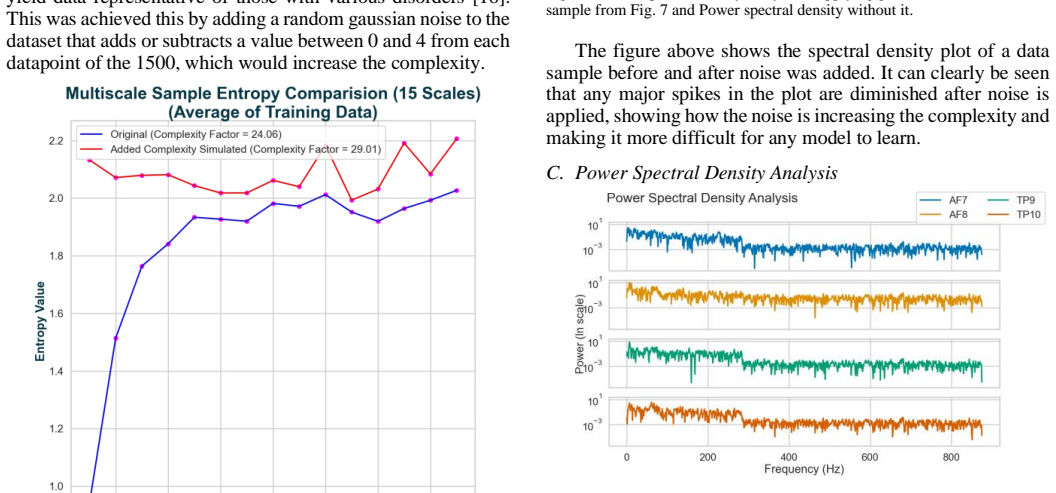
The load-bearing mechanism is a two-stage approximation. First, multiscale sample entropy is used to measure time-series complexity, and the paper assumes that higher complexity corresponds to neurological or physiological disorders, citing prior findings. Second, adding random Gaussian noise (values between 0 and 4 to each of 1500 data points) raises the complexity index and is treated as simulating disorder-affected brain patterns. On top of this stands the classification pipeline: the four Muse channels are band-pass filtered at 50 Hz, standardised, balanced with SMOTE, and converted to power-spectral-density images of size (128, 128), which are then fed to transfer-learned CNNs (ResNet50-v2, Inception-v3, MobileNet-v2) trained for 400 epochs with early stopping.
What would settle it
Record real EEG from patients diagnosed with one of the disorders named in the paper (for example ASD or ADHD) using the same four Muse channels and the same emotional stimuli, then test a classifier trained only on Gaussian-noise-augmented healthy data: if its accuracy on the real patients is near chance, or if the multiscale-entropy distribution of the real patient data does not overlap the noise-augmented data, the central claim is refuted.
Extended reading notes
Core claim
The central claim is that EEG-based emotion classification survives the added complexity used to mimic disordered neural activity, so a practical real-time brain-computer interface is feasible. In the authors' own terms, the data analysis shows the algorithm can successfully classify emotional states with a high degree of accuracy after Gaussian noise was added (the complexity index rising from 24.06 to 29.01), and therefore EEG-based BCIs have potential as a tool for helping individuals with disorders recognise and regulate their emotions. The strongest concrete result is that ResNet50-v2 and Inception-v3 reach validation binary accuracies of 96.4% and 96.7% respectively on the altered data, using an image-based power-spectral-density feature representation and transfer learning. The paper frames this as proof of feasibility for real-world use, though the claim that the noise-augmented data represents patients with disorders rests on a prior about multiscale entropy.
Load-bearing premise
The entire bridge from healthy-subject classification to clinical applicability rests on assuming that adding random Gaussian noise (values between 0 and 4) to healthy EEG signals produces data representative of patients with neurological and physiological disorders; no actual patient data is used to verify this.
Editorial extensions
If this is right
- If the claim is right, a $250 four-electrode headset plus software under $300 can provide real-time positive-versus-negative emotion classification at roughly 96% accuracy, making home-based emotional-regulation aids economically plausible.
- The reported speed of 54 to 201 milliseconds per batch suggests classification is fast enough to trigger immediate interventions such as calming music, lighting changes, or guided breathing.
- The proposed intervention loop, which detects a negative emotion and automatically presents a stimulus, could work without a clinician in the loop, a meaningful difference from talk-based therapies.
- The paper identifies an ensemble of GRU or LSTM units and self-attention as natural extensions for improving accuracy while staying within real-time processing budgets.
Reading between the lines
- A crucial unvalidated step is the mapping from Gaussian noise to disorder; a fair test would train on real EEG from patients with ASD, ADHD, or PTSD and see whether the noise-augmented model transfers.
- The valence-only split into positive, neutral, and negative categories may not capture the distinct emotional-dysregulation profiles of different disorders, so even if classification works, the intervention strategy may need disorder-specific tuning.
- Because the simulation assumes complexity alone captures disorder, it leaves out known disorder-specific spectral and connectivity signatures; future work could test whether other augmentations, such as targeted band changes, produce better transfer to real patient data.
Editorial analysis
A structured set of objections, weighed in public.
Referee Report
Summary. The manuscript proposes an EEG-based brain-computer interface for emotional regulation in patients with neurological and physiological disorders. The authors use the OpenNeuro DENS dataset (ds003751), extract the four Muse-headband electrode channels, preprocess with a Butterworth filter and standardization, and add Gaussian noise (values between 0 and 4) to each data point of healthy-subject EEG in order to 'simulate' the brain patterns of patients with disorders. They then build power-spectral-density images and fine-tune three pretrained CNNs (ResNet50-v2, Inception-v3, MobileNet-v2) for binary and categorical emotion classification. The reported results are high binary accuracies (about 95-97%) but much lower categorical accuracies (57-64%). The paper also describes hypothetical real-time interventions such as calming stimuli and breathing exercises. The central claim is that the high classification accuracy on artificially noised healthy EEG data demonstrates the potential of EEG-based BCIs for aiding patients with emotional dysregulation.
Significance. If the central claim were valid, a low-cost four-channel EEG BCI for real-time emotional regulation would be clinically significant and would extend existing EEG-based emotion recognition toward applications for patient populations. The paper has some praiseworthy elements: it uses a public, naturalistic-stimulus dataset; it evaluates multiple modern CNN architectures; it reports computational speed, which matters for real-time use; and it explicitly acknowledges the absence of patient data as a limitation. However, the significance is currently not established because the bridge from healthy-subject classification to clinical applicability rests entirely on an unvalidated noise-injection procedure. The paper does not provide machine-checked proofs, reproducible code, parameter-free derivations, or falsifiable predictions about any specific disorder; the main positive result is an empirical classification accuracy on artificially altered data whose relation to real patient EEG is asserted rather than demonstrated.
major comments (4)
- [III.B] The load-bearing assumption of the paper is that adding random Gaussian noise with values between 0 and 4 to each data point of healthy EEG 'would yield data representative of those with various disorders' and that this 'simulat[es] the brain patterns of patients with neurological disorders.' No evidence is provided that a single noise amplitude reproduces the spectral, connectivity, or entropy changes observed in any specific disorder; indeed, some disorders are associated with reduced rather than increased EEG complexity. The cited references [15] and [16] support the use of multiscale entropy as a complexity measure, but they do not validate the specific transformation used here. Because all results in Table I are obtained on this artificially altered healthy dataset and no real patient EEG is used anywhere, the central clinical claim collapses if this assumption fails.
- [Table I / Abstract] The abstract claims that 'the algorithm is able to successfully classify emotional states with a high degree of accuracy,' but the binary accuracy (96.4% for ResNet50-v2) is a two-class positive/negative distinction, not the full emotion-classification task. The categorical accuracy, which is the more relevant metric for recognizing multiple emotional states, is at most 64.5% and as low as 57.4%. The paper does not report confusion matrices or per-class performance, and the categorical accuracies are modest relative to a three-class baseline. The presentation in the abstract and conclusion therefore overstates the system's ability to recognize emotions.
- [IV.C] Section IV.C states that 'the real-time interventions designed based on classified emotional states showcased promising efficacy in regulating and modulating emotions,' but no intervention was implemented, no stimulus was delivered, and no outcome measure of emotional regulation was collected. The subsection is a list of proposed automated strategies (calming stimuli, breathing exercises, positive affirmations) with no experimental support. This claim is not supported by any data in the manuscript and should be removed or explicitly labeled as speculative.
- [III.A / III.E] The training and evaluation protocol is insufficiently specified to support the claim that the reported accuracies reflect generalization. The paper does not describe how the data were split into training, validation, and test sets, whether the split was subject-independent, or whether SMOTE was applied before the split (which could cause data leakage between training and test samples). The statement that data was 'split into batches of 32' does not clarify the train/test partition. Without this information, the 'unseen testing set' evaluation cannot be independently assessed.
minor comments (6)
- [IV.A] The text says 'the 4 models trained' and later refers to 'each of the 4 models,' but Table I lists only three models (ResNet50, Inception-v3, MobileNet-v2). Please correct the count or include the fourth model.
- [VI] The conclusion refers to 'the exceptional accuracy demonstrated by the GRU model,' but no GRU model was trained in the reported experiments; the models are ResNet50-v2, Inception-v3, and MobileNet-v2. This inconsistency should be fixed.
- [III.B] Figure 7 caption says 'same sample from Fig. 7' when it should refer to Fig. 6. Also, the figure numbering is otherwise muddled; please renumber figures consistently.
- [III.A] Equation (1) is presented as a general Butterworth filter magnitude response, but the text says a 50 Hz bandpass filter was applied without specifying the filter order or the low and high cutoff frequencies. Please provide the exact filter parameters.
- [Abstract] There are several typos and grammatical errors, for example 'The data analysis is reveals promising results' and 'whilst showing emotional change.' A careful proofreading pass is needed.
- [IV.A] The text states that Inception-v3 had 'a processing time per batch of 78 milliseconds,' but Table I reports 201 ms for Inception-v3. Please reconcile the numbers.
Circularity Check
No circularity: the emotion classifier is evaluated on held-out modified data, and the disorder-simulation premise rests on external references rather than on the paper's own outputs.
full rationale
The paper's derivation chain is not circular by construction. The central empirical result, binary emotion classification accuracy of roughly 95-97%, is measured on a held-out testing set drawn from the same modified healthy EEG dataset, so the accuracy is a real out-of-sample result for that dataset and not a fitted value renamed as a prediction. The bridge from healthy EEG to disorder representation is an assumption supported by external citations [15][16] ('Previous studies have found that higher levels of complexity associate with a disorder being present'), not by the paper's own fitted parameters or by self-citation. The author is not citing their own prior work as a load-bearing premise, and no uniqueness theorem or internally sourced ansatz forces the conclusion. The weak logical step is the sentence 'This proves that adding noise in will make it significantly harder for a neural network to learn underlying patterns in the data, therefore simulating the brain patterns of patients with neurological disorders' (Section III.B): this is an invalid inference from increased entropy to clinical representativeness, but invalidity is a correctness or validity concern, not circularity. The paper's own limitations section (V.D) and abstract concede that dataset diversity is constrained and that 'data collection on patients with neurological disorders should be done to improve overall sample diversity,' which explicitly acknowledges the absence of real patient data. Likewise, Section IV.C describes real-time interventions that were not actually tested in the experiment, but this is a missing empirical test rather than a circular derivation. Because no equation or fitted parameter is reused as its own evidence, the circularity score is 0.
Assumptions & free parameters
free parameters (4)
- Gaussian noise amplitude range =
0 to 4
- PSD frequency threshold =
128 Hz
- SMOTE sampling strategy
- Train/validation/test split
assumptions (3)
- domain assumption Neurological and physiological disorders are characterized by increased EEG complexity, as measured by multiscale entropy.
- ad hoc to paper Adding Gaussian noise is a valid way to emulate the increased complexity of disordered EEG signals.
- domain assumption Pretrained ImageNet CNN models can transfer to single-channel spectral images of EEG and retain discriminative information.
Cite this review
Pith. "Pith review of Brain-Computer Interfaces for Emotional Regulation in Patients with Various Disorders." pith.science (2026). https://pith.science/paper/IUDBHN2G
@misc{pith2026241114666,
  author       = {Pith},
  title        = {Pith review of: Brain-Computer Interfaces for Emotional Regulation in Patients with Various Disorders},
  year         = {2026},
  howpublished = {\url{https://pith.science/paper/IUDBHN2G}},
  note         = {Machine review of arXiv:2411.14666}
}
read the original abstract
Neurological and Physiological Disorders that impact emotional regulation each have their own unique characteristics which are important to understand in order to create a generalized solution to all of them. The purpose of this experiment is to explore the potential applications of EEG-based Brain-Computer Interfaces (BCIs) in enhancing emotional regulation for individuals with neurological and physiological disorders. The research focuses on the development of a novel neural network algorithm for understanding EEG data, with a particular emphasis on recognizing and regulating emotional states. The procedure involves the collection of EEG-based emotion data from open-Neuro. Using novel data modification techniques, information from the dataset can be altered to create a dataset that has neural patterns of patients with disorders whilst showing emotional change. The data analysis reveals promising results, as the algorithm is able to successfully classify emotional states with a high degree of accuracy. This suggests that EEG-based BCIs have the potential to be a valuable tool in aiding individuals with a range of neurological and physiological disorders in recognizing and regulating their emotions. To improve upon this work, data collection on patients with neurological disorders should be done to improve overall sample diversity.
Figures


Figures from the paper (3 more)


Reference graph
Works this paper leans on
-
[15]
Atypical EEG complexity in autism spectrum conditions: A multiscale entropy analysis,
A. Catarino, O. Churches, S. Baron ‐Cohen, A. Andrade, and H. Ring, “Atypical EEG complexity in autism spectrum conditions: A multiscale entropy analysis,” Clinical Neurophysiology, vol. 122, no. 12, pp. 2375– 2383, Dec. 2011, doi: https://doi.org/10.1016/j.clinph.2011.05.004
-
[16]
Multiscale Entropy Approaches and Their Applications,
A. Humeau -Heurtier, “Multiscale Entropy Approaches and Their Applications,” Entropy, vol. 22, no. 6, pp. 644 –644, Jun. 2020, doi: https://doi.org/10.3390/e22060644
-
[1]
Processing of Emotion in Functional Neurological Disorder,
P. Sojka, M. Bareš, Tomáš Kašpárek, and Miroslav Světlák, “Processing of Emotion in Functional Neurological Disorder,” Frontiers in Psychiatry, vol. 9, Oct. 2018, doi: https://doi.org/10.3389/fpsyt.2018.00479
arXiv 2018
-
[2]
Deep learning: systematic review, models, challenges, and research directions,
Tala Talaei Khoei, Hadjar Ould Slimane, and Naima Kaabouch, “Deep learning: systematic review, models, challenges, and research directions,” Neural Computing and Applications, vol. 35, no. 31, pp. 23103 –23124, Sep. 2023, doi: https://doi.org/10.1007/s00521-023-08957-4
-
[3]
What is emotional dysregulation?,
Z. Sherrell, “What is emotional dysregulation?,” Medicalnewstoday.com, Apr. 07, 2022. https://www.medicalnewstoday.com/articles/dysregulation#Emotional- dysregulation-in-children (accessed Dec. 10, 2023)
work page 2022
-
[4]
Cognitive behavioral therapy - Mayo Clinic,
“Cognitive behavioral therapy - Mayo Clinic,” Mayoclinic.org, 2019. https://www.mayoclinic.org/tests-procedures/cognitive-behavioral- therapy/about/pac-20384610 (accessed Dec. 10, 2023)
work page 2019
-
[5]
Pharmacological interventions,
A. UK, “Pharmacological interventions,” Nih.gov, Sep. 2016. https://www.ncbi.nlm.nih.gov/books/NBK401795/ (accessed Dec. 10, 2023)
work page 2016
-
[6]
Past, Present, and Future of EEG -Based BCI Applications,
Kaido Värbu, N. Muhammad, and Y. Muhammad, “Past, Present, and Future of EEG -Based BCI Applications,” Sensors, vol. 22, no. 9, pp. 3331–3331, Apr. 2022, doi: https://doi.org/10.3390/s22093331
Show all 20 references
-
[7]
EEG-Based BCI Emotion Recognition: A Survey,
P. Torres, E. A. Torres, M. Hernández -Álvarez, and Sang Guun Yoo, “EEG-Based BCI Emotion Recognition: A Survey,” Sensors, vol. 20, no. 18, pp. 5083–5083, Sep. 2020, doi: https://doi.org/10.3390/s20185083
2020 doi
-
[8]
Combining EEG signal processing with supervised methods for Alzheimer’s patients classification,
Giulia Fiscon et al., “Combining EEG signal processing with supervised methods for Alzheimer’s patients classification,” BMC Medical Informatics and Decision Making, vol. 18, no. 1, May 2018, doi: https://doi.org/10.1186/s12911-018-0613-y
2018 doi
-
[9]
A new three -dimensional model for emotions and monoamine neurotransmitters,
H. Lövheim, “A new three -dimensional model for emotions and monoamine neurotransmitters,” Medical Hypotheses, vol. 78, no. 2, pp. 341–348, Feb. 2012, doi: https://doi.org/10.1016/j.mehy.2011.11.016
2012 doi
-
[10]
Choosing MUSE: Validation of a Low -Cost, Portable EEG System for ERP Research,
O. E. Krigolson, C. C. Williams, A. Norton, C. D. Hassall, and F. L. Colino, “Choosing MUSE: Validation of a Low -Cost, Portable EEG System for ERP Research,” Frontiers in Neuroscience, vol. 11, Mar. 2017, doi: https://doi.org/10.3389/fnins.2017.00109
2017
-
[11]
Deep learning- based EEG emotion recognition: Current trends and future perspectives,
X. Wang, Y. Ren, Z. Luo, W. He, J. Hong, and Y. Huang, “Deep learning- based EEG emotion recognition: Current trends and future perspectives,” Frontiers in Psychology, vol. 14, Feb. 2023, doi: https://doi.org/10.3389/fpsyg.2023.1126994
2023
-
[12]
Dataset on Emotion with Naturalistic Stimuli (DENS) - OpenNeuro,
S. Mishra, Md. Asif, U. Shanker Tiwary, and N. Srinivasan, “Dataset on Emotion with Naturalistic Stimuli (DENS) - OpenNeuro,” openneuro.org, Jul. 08, 2023. https://openneuro.org/datasets/ds003751/versions/1.0.6 (accessed Dec. 10, 2023)
2023
-
[13]
A BUTTERWORTH -FILTER COOKBOOK,
“A BUTTERWORTH -FILTER COOKBOOK,” Stanford.edu, 2023. https://sepwww.stanford.edu/sep/prof/pvi/spec/paper_html/node14.html (accessed Dec. 10, 2023)
2023
-
[14]
SMOTE: Synthetic Minority Over -sampling Technique,
N. V. Chawla, K. W. Bowyer, L. O. Hall, and W. Philip Kegelmeyer, “ SMOTE: Synthetic Minority Over -sampling Technique, ” Journal of Artificial Intelligence Research, vol. 16, pp. 321 –357, Jun. 2002, doi: https://doi.org/10.1613/jair.953
2002 doi
-
[17]
Binary indices of time series complexity measures and entropy plane,
B. Shang and P. Shang, “Binary indices of time series complexity measures and entropy plane,” Physica A: Statistical Mechanics and its Applications, vol. 558, pp. 125003 –125003, Nov. 2020, doi: https://doi.org/10.1016/j.physa.2020.125003
2020
-
[18]
Deep Residual Learning for Image Recognition,
K. He, X. Zhang, S. Ren, and J. Sun, “Deep Residual Learning for Image Recognition,” Dec. 2015. Available: https://arxiv.org/pdf/1512.03385.pdf
2015 arXiv
-
[19]
Rethinking the Inception Architecture for Computer Vision,
C. Szegedy, V. Vanhoucke, S. Ioffe, and J. Shlens, “Rethinking the Inception Architecture for Computer Vision,” Dec. 2015. Available: https://arxiv.org/pdf/1512.00567.pdf
2015 arXiv
-
[20]
Identification, Evaluation, and Management of Children With Autism Spectrum Disorder,
Hyman, S. E. Levy, and S. M. Myers, “Identification, Evaluation, and Management of Children With Autism Spectrum Disorder,” Pediatrics, vol. 145, no. 1, Jan. 2020, doi: https://doi.org/10.1542/peds.2019-344
2020 doi
Reviewed August 12, 2026 · model on record in the stance chip above.
Discussion (0). Continue with ORCID to comment.