REVIEW 5 major objections 5 minor 82 references
Surface topological quantum criticality: Conformal manifolds and Discrete Strong Coupling Fixed Points
T0 review · 5 major / 5 minor · reviewed 2026-08-12 · deepseek-v4-flash
Pith's one-line read The quantum critical surface of a topological insulator is governed by a ring and two spheres of fixed points.
desk verdict A careful one-loop RG classification of N=2,3 surface topological criticality, with real substance, but the conformal-manifold universality claim is not protected beyond one loop and the paper's own two-loop field renormalization already breaks the ring. read the letter →
The pith
A machine-rendered reading of the paper's core claim, the machinery that carries it, and where it could break.
The reading
What carries the argument
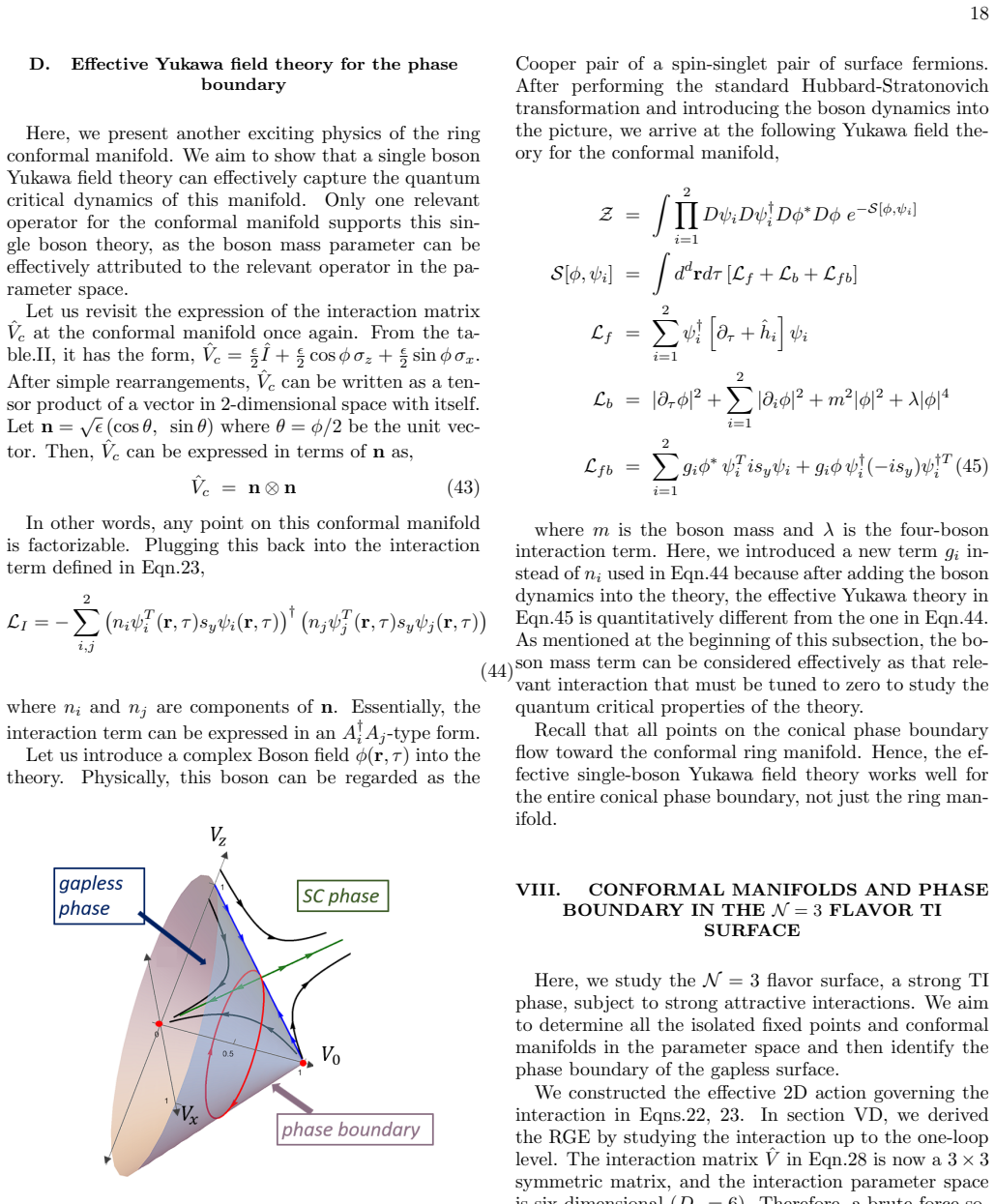
The central object is the one-loop renormalization-group equation for the interaction matrix, $d\hat{V}/dl = -\epsilon \hat{V} + \hat{V}^2$, written for an $N\times N$ real symmetric coupling matrix $\hat{V}$ in $D=2+\epsilon$ spacetime dimensions. Its emergent $SO(N)$ flavor-rotation symmetry, combined with the invariant subgroup $H$ of a fixed-point matrix, produces continuous fixed-point manifolds as coset spaces $SO(N)/H$; the number of exactly marginal operators at a point equals the dimension of the tangent space and fixes the manifold's co-dimension in the $D_p=N(N+1)/2$-dimensional interaction parameter space.
What would settle it
Evaluate the two-loop $\beta$ function in Eq. (69) on the one-loop ring: if any continuous arc of points remains exactly fixed rather than flowing to the four discrete fixed points, the claimed splitting of the conformal manifold is incorrect. Equivalently, compute the scaling dimension of the candidate marginal operator in Eq. (37) at order $\epsilon^2$; any nonzero correction away from $D$ removes exact marginality and would mean the manifold is only approximately conformal.
Extended reading notes
Core claim
The central claim is that, in the one-loop approximation, surface topological quantum criticality of an attractively interacting topological-insulator surface is captured by conformal manifolds of fixed points rather than by isolated fixed points. The renormalization-group equation $d\hat{V}/dl = -\epsilon \hat{V} + \hat{V}^2$ for the $N\times N$ interaction matrix has an emergent $SO(N)$ symmetry, and any fixed point invariant under a subgroup $H$ generates a manifold of fixed points shaped as the coset space $SO(N)/H$. For $N=2$ this gives a ring of fixed points sitting on the conical phase boundary in the three-dimensional parameter space; for $N=3$ it gives two 2-spheres in the six-dimensional parameter space. The number of exactly marginal operators equals the dimension of the manifold, and the scaling dimensions of the operators near the manifold are position-independent, so the whole manifold carries a single universality class. The paper further shows that certain higher-loop one-particle-irreducible effects only distort these manifolds, while fermion field renormalization can break them down into discrete fixed points.
Load-bearing premise
Everything important follows from the one-loop $\beta$ function $d\hat{V}/dl = -\epsilon \hat{V} + \hat{V}^2$ and its emergent $SO(N)$ symmetry; the paper assumes this one-loop fixed-point structure, solved at order $\epsilon$ and then extrapolated to $\epsilon=1$, identifies the generic surface criticality, even though its own two-loop field-renormalization calculation breaks $SO(N)$ and splits the ring into isolated fixed points.
Editorial extensions
If this is right
- For $N=2$, the phase boundary is a two-dimensional cone in a three-dimensional parameter space, and its universality is set by the ring manifold; for $N=3$, a five-dimensional boundary in a six-dimensional space is governed by the infrared-stable 2-sphere manifold with one relevant, three irrelevant, and two marginal operators.
- The infrared-stable conformal manifolds support exactly marginal operators with scaling dimension $D$, so their correlation functions obey $\langle O_M(x)O_M(0)\rangle \sim |x|^{-2D}$; observing such power laws would be direct evidence for a conformal manifold.
- Isolated strong-coupling fixed points such as $\hat{V}_c = \epsilon \hat{I}$ have only relevant directions, so they describe multi-critical surface topological quantum critical points rather than generic ones.
- Near the conformal manifolds the four-fermion interaction is factorizable, so the infrared physics of the phase boundary is captured by an emergent single-complex-boson Yukawa field theory with two or three flavors of surface fermions, with the boson mass playing the role of the single relevant direction.
- The number of surface Dirac cones is stable under local symmetric perturbations, because connecting surfaces with different $N$ for the same bulk topological invariant requires non-local unitaries that break crystal symmetries and introduce infinite-range hopping.
Reading between the lines
- If the conformal-manifold picture survives beyond the one-loop approximation, analogous fixed-point manifolds should appear for other $N$ and for other symmetry-protected boundary transitions, with the coset rule $SO(N)/H$ predicting their shape and co-dimension from the emergent symmetry alone.
- The two-loop splitting of the ring into discrete fixed points suggests a general mechanism: when exact marginality is broken, a continuous universality class softens into a slow flow along the former manifold, so intermediate-energy experiments might see approximate power laws before a crossover to the discrete fixed points.
- Because the marginal operators have scaling dimension exactly equal to the spacetime dimension, they are natural candidates to appear as non-decaying soft modes in surface transport or noise spectroscopy, which could test the distinction between conformal manifolds and isolated critical points.
- The paper's separation of generic criticality (continuous manifolds) from multi-criticality (isolated strong-coupling fixed points) may apply more broadly to interacting gapless boundaries, not just topological-insulator surfaces with attractive interactions.
Editorial analysis
A structured set of objections, weighed in public.
Referee Report
Summary. The paper studies attractive four-fermion interactions on the surface of a 3D topological insulator with N half-Dirac cones, focusing on N=2 and N=3. The authors derive a one-loop RG equation in 2+ε dimensions (Eq. 28) that possesses an emergent SO(N) symmetry, and they find that its interacting fixed points form conformal manifolds: a ring for N=2 and two rank-one projector manifolds (labeled "2-spheres") for N=3. They argue that these manifolds, together with their irrelevant directions, form the D_p−1 dimensional phase boundary separating the gapless surface from superconducting states, and that the infrared-stable manifold dictates the universality of generic surface topological quantum critical points. The paper also analyzes higher-loop symmetry-breaking effects, finding that a certain three-loop one-particle-irreducible term only distorts the ring, while a two-loop field-renormalization term breaks the ring into four isolated fixed points.
Significance. If the one-loop conformal-manifold picture survived at physical dimension, this would be a substantial contribution: it would provide a geometric, coset-space classification of surface topological quantum criticality, with explicit marginal operators, scaling dimensions, and an emergent single-boson Yukawa description. The derivation of the one-loop beta function in Appendix C and the fixed-point stability analysis are internally consistent, and the coset-space intuition (Section VI) is attractive and partially explanatory. However, the paper's own partial two-loop calculation destroys the central conformal manifolds, and the complete two-loop beta function is not computed. The physical-universality claim is therefore not established beyond the one-loop ϵ-expansion, and the manuscript's conclusions overstate what is proven.
major comments (5)
- [Section IXB, Eqs. (69)–(71), Table V] This section shows that including the two-loop field-renormalization term (Eq. C19) induces a flow dθ/dl = −2a V_0^2 sin 2θ around the N=2 ring, collapsing it into four isolated fixed points (Table V), with the formerly marginal operators acquiring scaling dimensions D ± aε^2 (Appendix E). At physical dimension ε=1 these splittings are of order one, so no exactly marginal operators remain. This directly contradicts the conclusion in Section X(B) that the conformal manifolds "dictate all the universal properties of generic surface topological critical points"; at face value, the paper's own calculation shows the one-loop manifolds are not stable beyond O(ε). The central claim therefore needs either a complete two-loop calculation or a substantial qualification that the conformal-manifold universality is only a leading-order ϵ-expansion statement.
- [Appendix C, Eq. (C19)] Eq. (C19) is not the complete two-loop beta function. It combines the one-loop vertex renormalization with the two-loop self-energy term (η_i+η_j)V_ij, but it omits two-loop vertex diagrams with three interaction vertices, which are present in any four-fermion theory in 2+ε dimensions. Consequently, the paper does not actually settle the fate of the conformal manifolds at O(ε^2): the breakdown reported in Section IXB is established only within a partial two-loop truncation, and the alternative that the complete two-loop beta function leaves a deformed manifold or restores some marginal directions remains open. Since the physical-dimension universality claim is the paper's main result, this omission is load-bearing.
- [Table IV, Eqs. (50)–(57), Section VIIIB] The fixed-point manifolds V_c = ε e_3⊗e_3 and V_c = ε I − ε e_3⊗e_3 are sets of rank-one projectors in R^3. Since n⊗n = (−n)⊗(−n), the manifold is the real projective plane RP^2, not the 2-sphere S^2. Correspondingly, the stabilizer of a rank-one projector in SO(3) is O(2) (embedded with determinant +1), not SO(2), so the coset is SO(3)/O(2) = RP^2 rather than SO(3)/SO(2) = S^2. The dimension and the local stability counts (2 marginal, 3 irrelevant, 1 relevant) are unchanged, but the geometry stated in Table III, Table IV, and the text following Eq. (57) is incorrect and should be corrected.
- [Section IXA, after Eq. (66)] The statement that a distorted co-dimension-two manifold persists for all higher-loop one-particle-irreducible effects of Type A (N_L = 4,5,6,...) is not proven; only a single three-loop term is solved explicitly. The phrase "one can show" is not backed by an explicit argument or by a general theorem, so the robustness conclusion for this class is overstated and should be either proven or clearly labeled as a conjecture.
- [Section X(D) and Section IXB] The two-loop field-renormalization analysis is carried out explicitly only for N=2. The conclusion that the N=3 two-sphere/RP^2 manifolds also break into isolated fixed points under Type B effects is asserted without an analogous calculation. Given that the N=3 manifolds are a central result, this missing analysis is a gap; at minimum the paper should state that the N=3 fate is inferred by analogy, or provide the calculation.
minor comments (5)
- [Section VIID, after Eq. (43)] The text says "Let n = √ε (cos θ, sin θ) ... be the unit vector," but n has norm √ε, not 1; this is a typo.
- [Section VIIIE, first paragraph] The sentence "the phase boundary is a 2-dimensional surface in the 3-dimensional parameter space, meaning a D_p = 1 manifold" should read "a D_p−1 = 2 dimensional manifold."
- [Eq. (37) and Eq. (58)] The N=2 marginal operator in Eq. (37) is written without an explicit h.c. term, unlike the analogous N=3 expressions in Eq. (58); please harmonize the notation.
- [Table III and Table IV] The entries labeled "2-sphere" should be labeled "RP^2" (see major comment); the parenthetical "S2" in Section VIIIB should be updated accordingly.
- [Figs. 7 and 9] The axes in the flow diagrams should be labeled directly in the figure panels (V0, Vx, Vz), and the blue/green lines indicating irrelevant and relevant directions should be identified in the figure rather than only in the caption.
Circularity Check
No significant circularity: one-loop conformal manifolds are solved from the paper's own RGE, with higher-loop breakdown disclosed.
full rationale
The central derivation chain is self-contained: Appendix A derives the effective 2D four-fermion interaction from a 3D lattice/domain-wall model; Appendix C computes the one-loop vertex renormalization and obtains the RGE dV/dl = -epsilon V + V^2 (Eqs. 27-28) with emergent SO(N) symmetry; Sections VII-VIII solve the fixed-point equation -epsilon V + V^2 = 0 and obtain the ring (Eqs. 35-36) and two-sphere (Eq. 57) manifolds, with operator scaling dimensions computed in Appendix D. None of these steps is fitted to data, and none is imported from prior work as a substitute for derivation. The self-citations [51-53] and [64] are used as background or for a previously established dimension-reduction technique; the fixed-point manifolds and their stability are re-derived in the present paper. Section IX then explicitly includes a two-loop field-renormalization term (Eq. C19, Eqs. 69-71) that breaks the emergent SO(2) symmetry and splits the ring into isolated fixed points, so the one-loop scope of the conformal-manifold claim is disclosed rather than hidden. The statement that the number of marginal operators equals the manifold dimension is definitional in Section III, but the existence of these manifolds is not derived from that definition. The skeptical concern that the manifolds are not protected beyond O(epsilon) is a correctness/robustness issue, not a circularity: no claimed result reduces to its own input by construction.
Assumptions & free parameters
assumptions (3)
- domain assumption The surface effective theory is determined by the singlet Cooper-pair interaction channel only (Eq. 23).
- ad hoc to paper The 2+epsilon expansion and one-loop truncation (Eq. 28) correctly capture the universal fixed-point structure at physical dimension.
- standard math The coset-space argument (G/H) gives the correct dimension and geometry of the fixed point manifolds.
Cite this review
Pith. "Pith review of Surface topological quantum criticality: Conformal manifolds and Discrete Strong Coupling Fixed Points." pith.science (2026). https://pith.science/paper/YBU2DW47
@misc{pith2026241114682,
  author       = {Pith},
  title        = {Pith review of: Surface topological quantum criticality: Conformal manifolds and Discrete Strong Coupling Fixed Points},
  year         = {2026},
  howpublished = {\url{https://pith.science/paper/YBU2DW47}},
  note         = {Machine review of arXiv:2411.14682}
}
abstract
In this article, we study quantum critical phenomena in surfaces of symmetry-protected topological matter, i.e. surface topological quantum criticality. A generic phase boundary of gapless surfaces in a symmetry-protected state shall be a co-dimension one manifold in an interaction parameter space of dimension $D_p$ (where $p$ refers to the parameter space) where the value of $D_p$ further depends on bulk topologies. In the context of fermionic topological insulators that we focus on, $D_p$ depends on the number of half-Dirac cones $\mathcal{N}$. We construct such manifolds explicitly for a few interaction parameter spaces with various $D_p$ values. Most importantly, we further illustrate that in cases with $D_p=3$ and $6$, there are sub-manifolds of fixed points that dictate the universalities of surface topological quantum criticality. These infrared stable manifolds are associated with emergent symmetries in the renormalization-group-equation flow naturally appearing in the loop expansion. Unlike in the usual order-disorder quantum critical phenomena, typically governed by an isolated Wilson-Fisher fixed point, we find in the one-loop approximation surface topological quantum criticalities are naturally captured by conformal manifolds where the number of marginal operators uniquely determines their co-dimensions. Isolated strong coupling fixed points also appear, usually as the endpoints in the phase boundary of surface topological quantum phases. However, their extreme infrared instabilities along multiple directions suggest that they shall be related to multi-critical surface topological quantum critical phenomena rather than generic surface topological quantum criticality. We also discuss and classify higher-loop symmetry-breaking effects, which can either distort the conformal manifolds or further break the conformal manifolds down to a few distinct fixed points.
Figures


Figures from the paper (10 more)




Reference graph
Works this paper leans on
-
[1]
This is the one with the trace equal to unity shown in table.III
Conformal manifold ˆV c = ϵ ˜e3 θ,ϕ ⊗ ˜e3 θ,ϕ Let us study the conformal manifold defined by ˆV c = ϵ ˜e3 θ,ϕ ⊗ ˜e3 θ,ϕ. This is the one with the trace equal to unity shown in table.III. The eigenvalues at any point on the 2-sphere are ( λ1, λ2, λ3) = (0 , 0, ϵ) and independent of both θ and ϕ. So the fixed point shown in the table.III is a point on this ...
-
[2]
Conformal manifold ˆV c = ϵ ˆI − ϵ ˜e3 θ,ϕ ⊗ ˜e3 θ,ϕ The conformal manifold defined by ˆV c = ϵ ˆI − ϵ ˜e3 θ,ϕ ⊗ ˜e3 θ,ϕ correspond to the one with trace equal to 2 ϵ in the table.III. The eigenvalues remain the same throughout the manifold, and they are given by (λ1, λ2, λ3) = (ϵ, ϵ,0). Interestingly, we notice here that the functional form of the two ma...
-
[3]
We repeat the procedure used for the N = 2 flavor surface
Tr[ ˆVc] subgroup H coset space (0, 0, 0) 0 SO(3) point (0, 0, ϵ)∗ ϵ SO (2) 2-sphere (ϵ, ϵ,0)∗ 2ϵ SO (2) 2-sphere (ϵ, ϵ, ϵ) 3 ϵ SO (3) point fixed points listed in Table III. We repeat the procedure used for the N = 2 flavor surface. There, we identi- fied the invariant subgroup H of the fixed point matrix (see section.VIIC). Then, the conformal manifold ...
-
[4]
The fate of the conformal manifolds The sign of a determines how the RGE flow can be induced by the symmetry-breaking field renormalization effect in the conformal manifold (or around the ring in this case) and how the smooth manifold can break down into a few discrete, strong coupling fixed points. FIG. 10. RG flows of the N = 2 flavor interacting TI sur...
-
[5]
Phase boundary Let us study the effects of fermion field renormaliza- tion on the phase boundary of the gapless surface. At the one-loop level, it was conical in shape with the uni- versality class determined by the conformal ring mani- fold. Once we include the field renormalization effect, we see that the phase boundary is still two-dimensional but slig...
work page 2020
-
[6]
Domain wall model In this section, we develop an effective low-energy con- tinuum model for the surface states. We show the deriva- tion explicitly for a specific case of an isotropic cubic lat- tice with a single Dirac cone surface and then argue that the results can be extended to more general cases of TI surfaces with N flavors of surface fermions. Con...
-
[7]
We follow closely the path outlined in Ref.[64]
Effective 2D interacting theory In this section, we use the dimension reduction method to derive the surface Hamiltonian starting with a bulk in- teraction theory. We follow closely the path outlined in Ref.[64]. Let us begin with a general interaction Hamil- tonian for the 3D TI, HI = −V X k,q,p NX j=1 c† k,zj sy ⊗ ˆIc † q−k,zj c−p,zj sy ⊗ ˆIc q+p,zj (A4...
-
[8]
V ertex renormalization The one-loop diagram shown in Fig.6(a) contributes to the vertex renormalization factor Z V ij . The bare four- point scattering amplitude at one-loop order reads, Γ(4) ij (q, ˜V 0 ij) = − ˜V 0 ijµ−ϵ (C8) −8µ−2ϵ X l ˜V 0 il ˜V 0 lj Z dDp (2π)D Tr Gl(p)syGT l (q − p)sy Here q = k1 + k2 = k3 + k4, where k1, k2 and k1, k4 are the inco...
Show all 82 references
-
[9]
The bare 2-point correlation function reads, Γ(2) i (k, ˜V 0 ij) = −ik0 + ⃗ s.⃗k + Σi(k) (C12) where Σ i(k) is the self-energy of the surface fermion of flavor i
Field strength renormalization The field strength renormalization effects start appear- ing at the two-loop level (see Fig.6(c)). The bare 2-point correlation function reads, Γ(2) i (k, ˜V 0 ij) = −ik0 + ⃗ s.⃗k + Σi(k) (C12) where Σ i(k) is the self-energy of the surface fermi...
-
[10]
˜V 0 ij is then expanded in pow- ers of ˜V R ij to the third order
Renormalization group equation Plugging these results back to Eqn.C3, we obtain the bare coupling constant ˜V 0 ij as a function of the renormal- ized coupling constant ˜V R ij . ˜V 0 ij is then expanded in pow- ers of ˜V R ij to the third order. Then, we take the derivative w...
-
[11]
Irrelevant, marginal and relevant operators at a point (V c 0 , Vc z , Vc x ) = ( ϵ 2 , ϵ 2 cos ϕ, ϵ 2 sin ϕ) on the ring manifold
N = 2 TI surface TABLE VI. Irrelevant, marginal and relevant operators at a point (V c 0 , Vc z , Vc x ) = ( ϵ 2 , ϵ 2 cos ϕ, ϵ 2 sin ϕ) on the ring manifold. Here, D is the spacetime dimensions. Operator Scaling dimension Irrelevant operators (cos ϕ − 1) Φ† 1Φ1 + sin ϕ Φ† 1Φ2...
-
[12]
The eigenstates of the lin- earized beta function for arbitrary values of θ and ϕ are complex expressions
N = 3 TI surface For the N = 3 case, we have two conformal mani- folds as shown in table.IV. The eigenstates of the lin- earized beta function for arbitrary values of θ and ϕ are complex expressions. Therefore, we will select two random points on the conformal manifolds and de...
-
[13]
A. Kitaev, Periodic table for topological insulators and superconductors, AIP Conference Proceedings 1134, 22 (2009), https://pubs.aip.org/aip/acp/article- pdf/1134/1/22/11584243/22 1 online.pdf
2009
-
[14]
Gu and X.-G
Z.-C. Gu and X.-G. Wen, Tensor-entanglement-filtering renormalization approach and symmetry-protected topo- logical order, Phys. Rev. B 80, 155131 (2009)
2009
-
[15]
S. Ryu, A. P. Schnyder, A. Furusaki, and A. W. W. Lud- wig, Topological insulators and superconductors: tenfold way and dimensional hierarchy, New Journal of Physics 12, 065010 (2010)
2010
-
[16]
C. L. Kane and E. J. Mele, Z2 topological order and the quantum spin hall effect, Phys. Rev. Lett. 95, 146802 (2005)
2005
-
[17]
B. A. Bernevig and S.-C. Zhang, Quantum spin hall ef- fect, Phys. Rev. Lett. 96, 106802 (2006)
2006
-
[18]
B. A. Bernevig, T. L. Hughes, and S.-C. Zhang, Quantum spin hall effect and topological phase transi- tion in hgte quantum wells, Science 314, 1757 (2006), https://www.science.org/doi/pdf/10.1126/science.1133734
2006 doi
-
[19]
L. Fu, C. L. Kane, and E. J. Mele, Topological insulators in three dimensions, Phys. Rev. Lett. 98, 106803 (2007)
2007
-
[20]
J. E. Moore and L. Balents, Topological invariants of time-reversal-invariant band structures, Phys. Rev. B75, 121306 (2007)
2007
-
[21]
M. Z. Hasan and C. L. Kane, Colloquium: Topological insulators, Rev. Mod. Phys. 82, 3045 (2010)
2010
-
[22]
Qi and S.-C
X.-L. Qi and S.-C. Zhang, Topological insulators and su- perconductors, Rev. Mod. Phys. 83, 1057 (2011)
2011
-
[23]
B. A. Bernevig and T. L. Hughes, Topological insulators and topological superconductors, stu - student ed. (Prince- ton University Press, Princeton, 2013)
2013
-
[24]
X.-L. Qi, T. L. Hughes, and S.-C. Zhang, Topological field theory of time-reversal invariant insulators, Phys. Rev. B 78, 195424 (2008)
2008
-
[25]
Fu and C
L. Fu and C. L. Kane, Superconducting proximity effect and majorana fermions at the surface of a topological insulator, Phys. Rev. Lett. 100, 096407 (2008)
2008
-
[26]
Liu, C.-X
Q. Liu, C.-X. Liu, C. Xu, X.-L. Qi, and S.-C. Zhang, Magnetic impurities on the surface of a topological insu- lator, Phys. Rev. Lett. 102, 156603 (2009)
2009
-
[27]
Santos, T
L. Santos, T. Neupert, C. Chamon, and C. Mudry, Super- conductivity on the surface of topological insulators and in two-dimensional noncentrosymmetric materials, Phys. Rev. B 81, 184502 (2010)
2010
-
[28]
Y. Ito, Y. Yamaji, and M. Imada, Stability of unconven- tional superconductivity on surfaces of topological insula- tors, Journal of the Physical Society of Japan 80, 063704 (2011), https://doi.org/10.1143/JPSJ.80.063704
2011 doi
-
[29]
Y. Ito, Y. Yamaji, and M. Imada, Impurity effects on superconductivity on surfaces of topological insulators, Journal of the Physical Society of Japan 81, 084707 (2012), https://doi.org/10.1143/JPSJ.81.084707
2012 doi
-
[30]
Nandkishore, J
R. Nandkishore, J. Maciejko, D. A. Huse, and S. L. Sondhi, Superconductivity of disordered dirac fermions, Phys. Rev. B 87, 174511 (2013)
2013
-
[31]
B. Roy, V. Juriˇ ci´ c, and I. F. Herbut, Quantum supercon- ducting criticality in graphene and topological insulators, Phys. Rev. B 87, 041401 (2013)
2013
-
[32]
Das Sarma and Q
S. Das Sarma and Q. Li, Many-body effects and pos- sible superconductivity in the two-dimensional metallic surface states of three-dimensional topological insulators, Phys. Rev. B 88, 081404 (2013)
2013
-
[33]
Ponte and S.-S
P. Ponte and S.-S. Lee, Emergence of supersymmetry on the surface of three-dimensional topological insulators, New Journal of Physics 16, 013044 (2014)
2014
-
[34]
Grover, D
T. Grover, D. N. Sheng, and A. Vishwanath, Emergent space-time supersymmetry at the boundary of a topolog- ical phase, Science 344, 280 (2014)
2014
-
[35]
Neupert, S
T. Neupert, S. Rachel, R. Thomale, and M. Greiter, In- teracting surface states of three-dimensional topological insulators, Phys. Rev. Lett. 115, 017001 (2015)
2015
-
[36]
Zerf, C.-H
N. Zerf, C.-H. Lin, and J. Maciejko, Superconducting quantum criticality of topological surface states at three loops, Phys. Rev. B 94, 205106 (2016)
2016
-
[37]
Boyack, H
R. Boyack, H. Yerzhakov, and J. Maciejko, Quan- tum phase transitions in Dirac fermion systems, Euro- pean Physical Journal Special Topics 230, 979 (2021), arXiv:2004.09414 [cond-mat.str-el]
2021 arXiv
-
[38]
Xu, Time-reversal symmetry breaking at the edge states of a three-dimensional topological band insulator, Phys
C. Xu, Time-reversal symmetry breaking at the edge states of a three-dimensional topological band insulator, Phys. Rev. B 81, 020411 (2010)
2010
-
[39]
Xu, Quantum critical points of helical fermi liquids, Phys
C. Xu, Quantum critical points of helical fermi liquids, Phys. Rev. B 81, 054403 (2010)
2010
-
[40]
Kim and T
K.-S. Kim and T. Takimoto, Nambu-eliashberg theory for multiscale quantum criticality: Application to fer- romagnetic quantum criticality in the surface of three- dimensional topological insulators, Phys. Rev. B 83, 245138 (2011). 35
2011
-
[41]
Baum and A
Y. Baum and A. Stern, Magnetic instability on the sur- face of topological insulators, Phys. Rev. B 85, 121105 (2012)
2012
-
[42]
D. J. J. Marchand and M. Franz, Lattice model for the surface states of a topological insulator with applications to magnetic and exciton instabilities, Phys. Rev. B 86, 155146 (2012)
2012
-
[43]
Sitte, A
M. Sitte, A. Rosch, and L. Fritz, Interaction effects on almost flat surface bands in topological insulators, Phys. Rev. B 88, 205107 (2013)
2013
-
[44]
Bahri and A
Y. Bahri and A. C. Potter, Stable non-fermi-liquid phase of itinerant spin-orbit coupled ferromagnets, Phys. Rev. B 92, 035131 (2015)
2015
-
[45]
Wang and T
C. Wang and T. Senthil, Dual dirac liquid on the sur- face of the electron topological insulator, Phys. Rev. X 5, 041031 (2015)
2015
-
[46]
Fidkowski and A
L. Fidkowski and A. Kitaev, Effects of interactions on the topological classification of free fermion systems, Phys. Rev. B 81, 134509 (2010)
2010
-
[47]
Fidkowski and A
L. Fidkowski and A. Kitaev, Topological phases of fermions in one dimension, Phys. Rev. B 83, 075103 (2011)
2011
-
[48]
Fidkowski, X
L. Fidkowski, X. Chen, and A. Vishwanath, Non-abelian topological order on the surface of a 3d topological su- perconductor from an exactly solved model, Phys. Rev. X 3, 041016 (2013)
2013
-
[49]
M. A. Metlitski, C. L. Kane, and M. P. A. Fisher, Symmetry-respecting topologically ordered surface phase of three-dimensional electron topological insulators, Phys. Rev. B 92, 125111 (2015)
2015
-
[50]
Song, S.-J
H. Song, S.-J. Huang, L. Fu, and M. Hermele, Topological phases protected by point group symmetry, Phys. Rev. X 7, 011020 (2017)
2017
-
[51]
T. D. Stanescu, J. D. Sau, R. M. Lutchyn, and S. Das Sarma, Proximity effect at the superconductor– topological insulator interface, Phys. Rev. B 81, 241310 (2010)
2010
-
[52]
Wen, Classifying gauge anomalies through symmetry-protected trivial orders and classifying gravi- tational anomalies through topological orders, Phys
X.-G. Wen, Classifying gauge anomalies through symmetry-protected trivial orders and classifying gravi- tational anomalies through topological orders, Phys. Rev. D 88, 045013 (2013)
2013
-
[53]
Vishwanath and T
A. Vishwanath and T. Senthil, Physics of three- dimensional bosonic topological insulators: Surface- deconfined criticality and quantized magnetoelectric ef- fect, Phys. Rev. X 3, 011016 (2013)
2013
-
[54]
Nielsen and M
H. Nielsen and M. Ninomiya, Absence of neutrinos on a lattice: (i). proof by homotopy theory, Nuclear Physics B 185, 20 (1981)
1981
-
[55]
Nielsen and M
H. Nielsen and M. Ninomiya, Absence of neutrinos on a lattice: (ii). intuitive topological proof, Nuclear Physics B 193, 173 (1981)
1981
-
[56]
’t Hooft, Computation of the quantum effects due to a four-dimensional pseudoparticle, Phys
G. ’t Hooft, Computation of the quantum effects due to a four-dimensional pseudoparticle, Phys. Rev. D 14, 3432 (1976)
1976
-
[57]
S. L. Adler, Axial-vector vertex in spinor electrodynam- ics, Phys. Rev. 177, 2426 (1969)
1969
-
[58]
J. S. Bell and R. Jackiw, A PCAC puzzle: π0→γγ in the σ-model, Nuovo Cimento A Serie 60, 47 (1969)
1969
-
[59]
Jian, C.-H
S.-K. Jian, C.-H. Lin, J. Maciejko, and H. Yao, Emergence of supersymmetric quantum electrodynamics, Phys. Rev. Lett. 118, 166802 (2017)
2017
-
[60]
Li, Y.-F
Z.-X. Li, Y.-F. Jiang, and H. Yao, Edge quantum critical- ity and emergent supersymmetry in topological phases, Phys. Rev. Lett. 119, 107202 (2017)
2017
-
[61]
Z.-X. Li, A. Vaezi, C. B. Mendl, and H. Yao, Numeri- cal observation of emergent spacetime supersymmetry at quantum criticality, Science advances4, eaau1463 (2018)
2018
-
[62]
Lee, Emergence of supersymmetry at a critical point of a lattice model, Phys
S.-S. Lee, Emergence of supersymmetry at a critical point of a lattice model, Phys. Rev. B 76, 075103 (2007)
2007
-
[63]
Zhou, Topological quantum critical points in strong coupling limits: Global symmetries and strongly interact- ing majorana fermions, Phys
F. Zhou, Topological quantum critical points in strong coupling limits: Global symmetries and strongly interact- ing majorana fermions, Phys. Rev. B 105, 014503 (2022)
2022
-
[64]
Zhou, Emergent u(1) symmetries in gapless fermionic superfluids and superconductors, Phys
F. Zhou, Emergent u(1) symmetries in gapless fermionic superfluids and superconductors, Phys. Rev. B 107, 134517 (2023)
2023
-
[65]
Zhou, Emergent symmetries and interactions in high dimensions: An isolated fixed point versus a manifold of strongly interacting fixed points, Phys
F. Zhou, Emergent symmetries and interactions in high dimensions: An isolated fixed point versus a manifold of strongly interacting fixed points, Phys. Rev. B 109, 184503 (2024)
2024
-
[66]
Bi and T
Z. Bi and T. Senthil, Adventure in topological phase tran- sitions in 3 + 1-d: Non-abelian deconfined quantum crit- icalities and a possible duality, Phys. Rev. X 9, 021034 (2019)
2019
-
[67]
Seiberg, Supersymmetry and non-perturbative beta functions, Physics Letters B 206, 75 (1988)
N. Seiberg, Supersymmetry and non-perturbative beta functions, Physics Letters B 206, 75 (1988)
1988
-
[68]
Seiberg and E
N. Seiberg and E. Witten, Electric-magnetic duality, monopole condensation, and confinement in n=2 super- symmetric yang-mills theory, Nuclear Physics B 426, 19 (1994)
1994
-
[69]
A. B. Zamolodchikov, Irreversibility of the Flux of the Renormalization Group in a 2D Field Theory, JETP Lett. 43, 730 (1986)
1986
-
[70]
Shen, Topological Insulators: Dirac Equation in Con- densed Matters , Springer Series in Solid-State Sciences (Springer Berlin Heidelberg, 2013)
S. Shen, Topological Insulators: Dirac Equation in Con- densed Matters , Springer Series in Solid-State Sciences (Springer Berlin Heidelberg, 2013)
2013
-
[71]
Fu and C
L. Fu and C. L. Kane, Topological insulators with inver- sion symmetry, Phys. Rev. B 76, 045302 (2007)
2007
-
[72]
Fradkin, E
E. Fradkin, E. Dagotto, and D. Boyanovsky, Physical realization of the parity anomaly in condensed matter physics, Phys. Rev. Lett. 57, 2967 (1986)
1986
-
[73]
Boyanovsky, E
D. Boyanovsky, E. Dagotto, and E. Fradkin, Anomalous currents, induced charge and bound states on a domain wall of a semiconductor, Nuclear Physics B 285, 340 (1987)
1987
-
[74]
D. B. Kaplan, A method for simulating chiral fermions on the lattice, Physics Letters B 288, 342 (1992)
1992
-
[75]
Jansen, Domain wall fermions and chiral gauge theo- ries, Physics Reports 273, 1 (1996)
K. Jansen, Domain wall fermions and chiral gauge theo- ries, Physics Reports 273, 1 (1996)
1996
-
[76]
Vijayan and F
S. Vijayan and F. Zhou, Interaction bulk-boundary rela- tion and its applications towards symmetry breaking and beyond, Phys. Rev. B 106, 165118 (2022)
2022
-
[77]
N. B. Kopnin and E. B. Sonin, Bcs superconductivity of dirac electrons in graphene layers, Phys. Rev. Lett. 100, 246808 (2008)
2008
-
[78]
bcs super- conductivity of dirac electrons in graphene layers
B. Uchoa and A. H. C. Neto, Comment on “bcs super- conductivity of dirac electrons in graphene layers”, Phys. Rev. Lett. 102, 109701 (2009)
2009
-
[79]
Strack, S
P. Strack, S. Takei, and W. Metzner, Anomalous scaling of fermions and order parameter fluctuations at quantum criticality, Phys. Rev. B 81, 125103 (2010)
2010
-
[80]
Shankar, Quantum Field Theory and Condensed Matter: An Introduction (Cambridge University Press, 2017)
R. Shankar, Quantum Field Theory and Condensed Matter: An Introduction (Cambridge University Press, 2017)
2017
-
[81]
Zinn-Justin, Quantum Field Theory and Critical Phe- nomena (Oxford University Press, 2002)
J. Zinn-Justin, Quantum Field Theory and Critical Phe- nomena (Oxford University Press, 2002)
2002
-
[82]
Fradkin, Quantum Field Theory
E. Fradkin, Quantum Field Theory. An Integrated Ap- proach (2019)
2019
Reviewed August 12, 2026 · model on record in the stance chip above.
Discussion (0). Continue with ORCID to comment.