REVIEW 4 major objections 6 minor 61 references
The Moon-forming Impact as a Constraint for the Inner Solar System's Formation
T0 review · 4 major / 6 minor · reviewed 2026-08-12 · deepseek-v4-flash
Pith's one-line read The Moon-forming impact is so rare and so thoroughly mixing under pebble accretion that the model cannot explain the Earth-Moon system.
desk verdict A credible and novel test of the pebble-accretion scenario via the Moon-forming impact, but the headline probability rests on an unmodeled prior and the strong conclusion needs to be reined in. read the letter →
The pith
A machine-rendered reading of the paper's core claim, the machinery that carries it, and where it could break.
The reading
What carries the argument
The discriminator is the Moon-forming giant impact between proto-Earth (about 0.6 Earth masses) and Theia (about 0.4 Earth masses), which in the pebble accretion model is the only way to make the Moon. The quantitative machinery is a pair of simulations: N-body integrations that track whether the two bodies collide, when, and with what impact parameters, and global giant-impact simulations that follow the mixing of target and impactor material through the proto-lunar disk. A key intermediate is the Hill-radius separation Δ between the two bodies, which controls whether collisions occur quickly (Δ < 2√3) or are delayed (Δ between 2√3 and 16 Hill radii). The paper uses this separation to convert collision frequencies into probability statements about the Moon-forming event.
What would settle it
Compute the orbital separation distribution of proto-Earth and Theia from a full pebble-accretion growth simulation; if a substantial fraction of such pairs evolve into the window for delayed collisions (2√3 to 16 Hill radii), the quoted sub-per-mille collision probability would not hold.
Extended reading notes
Core claim
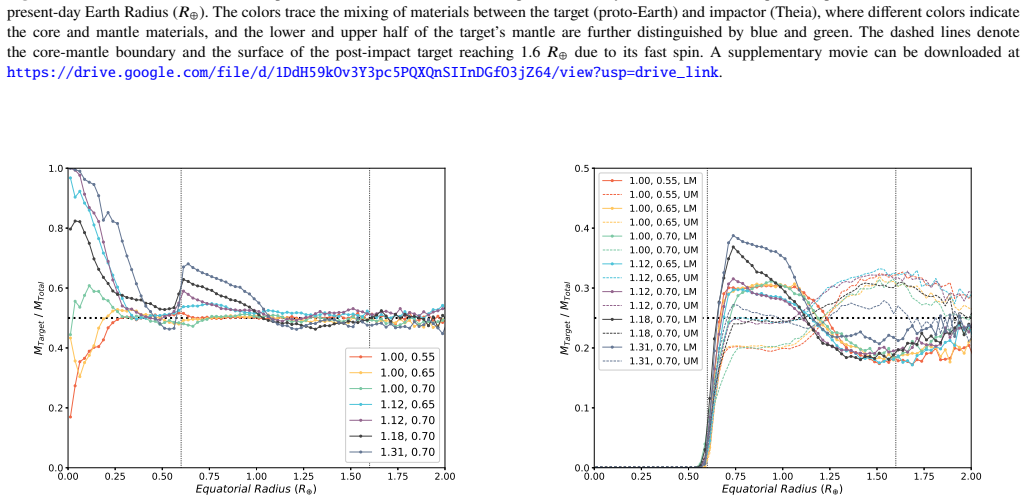
The central claim is that the pebble accretion paradigm for terrestrial planet formation is strongly disfavored because it cannot reproduce the Moon-forming impact. In 2900 N-body simulations initialized with proto-Earth and Theia separated by 1 to 30 mutual Hill radii, collisions between the two half-Earths are common only when the separation is less than 2√3 Hill radii, in which case they occur within 1 Myr; for wider separations the collision probability drops to 1.5%, and only four simulations produce a giant impact within the 70–120 Myr window inferred for the Moon's formation. When such delayed impacts do occur, high-resolution hydrodynamic simulations show that the target and impactor mix almost completely, with 48–55% of the protolunar disk coming from Theia, erasing any primordial mantle reservoirs and forcing an initial oxygen isotope difference between proto-Earth and Theia far larger than expected for bodies with nearly identical accretion histories. The paper's conclusion is that the Moon's origin favours the classical collisional-growth scenario over pebble accretion.
Load-bearing premise
The results assume that the initial orbital separations between proto-Earth and Theia are distributed uniformly from 1 to 30 mutual Hill radii, a distribution that is adopted rather than derived from the pebble accretion model.
Editorial extensions
If this is right
- Under pebble accretion, the probability of a Moon-forming impact at the right timing and angle is below one per mille, so the model requires extreme fine-tuning to explain the Earth-Moon system.
- A successful half-Earth impact produces a protolunar disk with 48–55% of its material from Theia and a thoroughly mixed mantle, so any primordial Earth mantle heterogeneity would not survive.
- To match the observed 22 ppm oxygen isotope offset after such mixing, proto-Earth and Theia would need an initial isotopic difference of about 695 ppm, even larger than the Earth-Mars difference, which is implausible for close siblings formed by pebble accretion.
- Delayed Moon-forming impacts in the 70–120 Myr window occur only for initial separations between 2√3 and 16 Hill radii, and the collision probability in that range is below three per mille.
Reading between the lines
- A natural extension is that if pebble accretion is disfavored for the terrestrial planets, Earth's formation timescale would revert to tens of millions of years, bringing into question pebble-accretion-based interpretations of early isotopic chronometers.
- The same half-Earth mixing argument could be applied to any proposed giant impact on Venus or Mars, predicting that such impacts, if they occurred, would also erase primordial heterogeneities in those bodies.
- The statistical test could be sharpened by simulating the full pebble-accretion assembly of proto-Earth and Theia to derive a self-consistent initial orbital separation distribution instead of sampling it uniformly.
Editorial analysis
A structured set of objections, weighed in public.
Referee Report
Summary. This paper tests the pebble-accretion scenario for terrestrial-planet formation against the Moon-forming impact. It initializes 2900 N-body simulations of proto-Earth–Theia pairs on the Johansen et al. (2021) mass-growth track, samples initial separations uniformly in Hill radii, and counts collisions by timing and angle; it then runs GIZMO/MFM giant-impact simulations for representative collisions and quantifies mixing of target and impactor material in the post-impact planet and protolunar disk. The central claims are that a Moon-forming impact in this scenario has probability below 1 per mille of occurring at the right timing (70–120 Myr) and configuration, and that, if it does occur, perfect mixing leaves no room for primordial mantle heterogeneities or the observed small Earth–Moon isotopic difference. On this basis the authors conclude that pebble accretion is less favorable than chaotic collisional growth for the inner solar system.
Significance. The paper addresses a real and timely question and uses a plausible falsification strategy: the Moon is a sensitive, rarely considered constraint on pebble accretion. It deserves credit for combining N-body statistics with state-of-the-art MFM giant-impact simulations, for testing a range of disk, Jupiter, and migration variants, and for making an explicit falsifiable prediction about isotopic mixing in the protolunar disk. If the statistical claims were robust, this would be a significant argument against fast pebble-accretion formation of the terrestrial planets. However, the headline probability is conditional on an ad hoc uniform prior over initial separations and on a very small number of right-timing events, so the conclusion currently overstates the model-disfavoring power.
major comments (4)
- [Section 2.1 and Section 3.1] The quoted "<1 per mille" probability is computed by counting outcomes over a hand-chosen uniform sampling of initial separations Δ in [1,30] Hill radii (2300 runs over [1,21] and 600 over (21,31]). The pebble-accretion model is not used to derive this distribution; the simulation starts at t=5 Myr with mass growth turned off. The probability of a delayed collision is therefore a conditional frequency given the adopted prior, not a prediction of the pebble-accretion scenario. The authors' own conclusion in Section 4 (“Let alone the uncertainty in how they get there”) concedes this limitation. Please derive the Δ distribution from a self-consistent pebble-accretion calculation or clearly report all probabilities as conditional on Δ and test a range of physically motivated priors; without this, the headline probability is not a robust constraint.
- [Section 3.1] The right-timing count is 4 of 2900 simulations, yet the paper quotes "probability <1 per mille" in the abstract and Section 3.1 without statistical uncertainty. Under Poisson statistics, 4 events in 2900 trials gives a 95% confidence interval of roughly 1–10 events, i.e., about 0.3–3.5 per mille of trials, so the upper bound exceeds the quoted <1 per mille threshold. The small count also makes the subsequent "1/3 angle selection" factor fragile. Please report the count with a confidence interval and either increase the simulation count or soften the <1 per mille claim to match the statistical precision.
- [Section 3.2 and Table 1] The "right configuration" criterion is not fully specified. Table 1 lists many successful runs with initial or final angular momentum greater than 2 L_EM, and the authors themselves note that “it is controversial whether this excessive angular momentum can be removed (Rufu & Canup 2020).” If the Moon-forming requirement is tightened to avoid this uncertainty, the "1/3 of delayed collisions" factor and hence the <1 per mille estimate change; if it is not tightened, the mixing and disk-mass analysis may not correspond to the actual lunar-forming subset. Please specify the success criterion used to classify runs as Moon-forming in terms of disk mass, iron fraction, angular momentum, and angular-momentum-removal assumptions, and propagate its uncertainty into the probability estimate.
- [Section 3.2] The geochemical argument assumes, without model derivation, that proto-Earth and Theia in the pebble-accretion scenario have a smaller initial Δ17O difference than the Earth–aubrites difference of 22 ppm. The 695 ppm initial-difference calculation for run 20 is an illustrative estimate, but the claim that the observed 22 ppm Earth–Moon difference is incompatible depends on this unmodeled compositional prior. If proto-Earth and Theia can acquire a larger initial isotopic difference through heterogeneous pebble accretion, the mixing implied by the simulations may not be in tension with the observations. Please either derive the expected proto-Earth–Theia composition difference from the pebble-accretion model or present the geochemical conclusion as a conditional statement.
minor comments (6)
- [Section 2.1] The five groups of test simulations and the three migrating-giant setups are described in prose; a summary table of the disk, eccentricity, and Jupiter parameters for each group would improve reproducibility.
- [Section 2.2] There is a typo in the phrase “ANEOSequation ofstate”; it should read “ANEOS equation of state.”
- [Figure 2b] The text states that impact angles are almost uniformly distributed, but the definition of impact angle and its relation to the impact parameter b used in Table 1 should be stated explicitly so the reader can connect Fig. 2b to the giant-impact runs.
- [Section 3.1 and Figure 3] The statement that the collision probability for pairs with Δ>10 is “always minimal” is vague; please report the underlying counts for each test group so the reader can assess the strength of that conclusion.
- [Section 4] The phrase “Let alone the uncertainty in how they get there” undermines the strength of the conclusion as written; consider moving this caveat into the methods or quantifying its effect on the probability estimate.
- [Data Availability] The statement that data files “will be made available upon reasonable request” is weaker than the standard for a numerical study of this kind; depositing initial conditions and processed outputs in a public repository would increase confidence in the results.
Circularity Check
No significant circularity: the Moon-forming impact is used as an external benchmark against the pebble-accretion model, and the probability and mixing claims are simulation outputs rather than fitted inputs.
full rationale
The paper derives two central claims: (i) in the pebble-accretion setup of Johansen et al. (2021), a Moon-forming collision occurs with probability below 1 permille at the right time and configuration; and (ii) half-Earth impacts mix proto-Earth and Theia material almost completely. Neither claim is equivalent to an input. Claim (i) is a Monte Carlo output of N-body integrations (REBOUND/Mercurius) over a uniform prior in mutual Hill separation, Delta in [1,30], with masses tied to Eq. (1) from Johansen et al. (2021). The uniform Delta prior is a modeling assumption, not a parameter fitted to Moon data and not defined in terms of the Moon-forming outcome; the resulting probability is conditional on that prior, but it is not circular. Claim (ii) is an output of GIZMO/MFM hydrodynamical impact simulations; the mixing fractions in Table 1 and Figs. 5-6 are measured from the simulations, not imposed. The authors cite their own Deng et al. (2019a,b) for code behavior and validation, but they also benchmark against SPH simulations at 100x resolution (Yuan et al. 2023) and use the independent Canup (2012) empirical Moon-mass formula as a diagnostic; these are external anchors. No equation in the paper defines the target result in terms of the input, and no parameter is fitted to the Moon data used for the final comparison. The geochemical argument compares simulated disk mixing with the observed Delta-17O Earth-Moon difference and with the pebble-accretion expectation of compositional similarity; that is an external falsification loop, not a self-referential one. The manuscript itself acknowledges the main weakness, 'uncertainty in how they get there' (Section 4), and also notes that 'the vapor-dominated disk may not form the Moon at all'; these are prior/uncertainty limitations, not evidence of circularity. The only self-citations are methodological and do not carry the argument, so the circularity score is low.
Assumptions & free parameters
free parameters (5)
- mass growth track parameters (r0, Mmax, zeta) =
r0=1.6 AU, Mmax=1.74 M_earth, zeta=3/7
- gas disk parameters (Sigma0, tau, h) =
Sigma0=610 g/cm2, tau=1.5 Myr, h=0.024 r^(2/7)
- type I migration coefficient k_mig =
3.708
- initial separation distribution =
uniform in delta in [1,30] Hill radii
- initial eccentricity and Jupiter parameters =
e=0.01 (proto-Earth/Theia), eJ=0.05, aJ=5 AU
assumptions (5)
- domain assumption The physical Moon-forming impact must occur 70-120 Myr after CAIs, per Halliday & Canup (2023).
- domain assumption The Earth-Moon system forms by one giant impact between proto-Earth and Theia whose masses sum to M_earth.
- domain assumption Disk mass predicts lunar mass via the empirical Canup (2012) formula.
- domain assumption Primordial mantle heterogeneities predate the Moon-forming impact and survive until today.
- domain assumption MFM resolves post-impact mixing more faithfully than SPH at comparable resolution.
Cite this review
Pith. "Pith review of The Moon-forming Impact as a Constraint for the Inner Solar System's Formation." pith.science (2026). https://pith.science/paper/6KRZANCM
@misc{pith2026241114709,
  author       = {Pith},
  title        = {Pith review of: The Moon-forming Impact as a Constraint for the Inner Solar System's Formation},
  year         = {2026},
  howpublished = {\url{https://pith.science/paper/6KRZANCM}},
  note         = {Machine review of arXiv:2411.14709}
}
abstract
The solar system planets are benchmarks for the planet formation theory. Yet two paradigms coexist for the four terrestrial planets: the prolonged collisional growth among planetesimals lasting $>100$ million years (Myr) and the fast formation via planetesimals accreting pebbles within 10 Myr. Despite their dramatic difference, we can hardly tell which theory is more relevant to the true history of the terrestrial planets' formation. Here, we show that the Moon's origin puts stringent constraints on the pebble accretion scenario, rendering it less favourable. In the pebble accretion model, the one-off giant impact between proto-Earth and Theia rarely (probability $<$ 1\textperthousand) occurs at the right timing and configuration for the Moon formation. Even if a potential impact happens by chance, giant impact simulations reveal perfect mixing between proto-Earth and Theia, leaving no room for the observed primordial Earth mantle heterogeneity and the compositional difference, though small, between Earth and the Moon. Thus, the Earth-Moon system along other terrestrial planets should preferably form from chaotic collisional growth in the inner solar system.
Figures


Figures from the paper (2 more)

Reference graph
Works this paper leans on
-
[1]
B., Lin D., 2012, The Astrophysical Journal, 745, 143
Agnor C. B., Lin D., 2012, The Astrophysical Journal, 745, 143
work page 2012
-
[2]
F., 2009, Astronomy & Astrophysics, 507, 1053
Brasser R., Morbidelli A., Gomes R., Tsiganis K., Levison H. F., 2009, Astronomy & Astrophysics, 507, 1053
work page 2009
-
[3]
Burkhardt C., Spitzer F., Morbidelli A., Budde G., Render J. H., Kruijer T. S., Kleine T., 2021, Science advances, 7, eabj7601
work page 2021
- [4]
- [5]
-
[6]
M., Asphaug E., 2001, Nature, 412, 708
Canup R. M., Asphaug E., 2001, Nature, 412, 708
work page 2001
- [7]
-
[8]
E., 2004, Earth and Planetary Science Letters, 223, 241
Chambers J. E., 2004, Earth and Planetary Science Letters, 223, 241
work page 2004
Show all 61 references
-
[9]
R., Hofmann A
Christensen U. R., Hofmann A. W., 1994, Journal of Geophysical Research: Solid Earth, 99, 19867
1994
-
[10]
S., Kaib N
Clement M. S., Kaib N. A., Raymond S. N., Walsh K. J., 2018, Icarus, 311, 340
2018
-
[11]
S., Kaib N
Clement M. S., Kaib N. A., Raymond S. N., Chambers J. E., Walsh K. J., 2019, Icarus, 321, 778
2019
-
[12]
P., 2008, Astronomy & Astrophysics, 482, 677
Cresswell P., Nelson R. P., 2008, Astronomy & Astrophysics, 482, 677
2008
-
[13]
H., 2010, The Astrophysical Journal, 724, 730
D'Angelo G., Lubow S. H., 2010, The Astrophysical Journal, 724, 730
2010
-
[14]
Deng H., 2020, @doi [ ] 10.3847/2041-8213/ab6084 , https://ui.adsabs.harvard.edu/abs/2020ApJ...888L...1D 888, L1
2020 doi
-
[15]
Deng J., Du Z., 2023, Nature Geoscience, 16, 541
2023
-
[16]
C., 2019a, The Astrophysical Journal, 870, 127
Deng H., Reinhardt C., Benitez F., Mayer L., Stadel J., Barr A. C., 2019a, The Astrophysical Journal, 870, 127
-
[17]
D., Reinhardt C., Meier M
Deng H., Ballmer M. D., Reinhardt C., Meier M. M., Mayer L., Stadel J., Benitez F., 2019b, The Astrophysical Journal, 887, 211
-
[18]
Fang T., Deng H., 2020, Monthly Notices of the Royal Astronomical Society, 496, 3781
2020
-
[19]
Fang T., Zhang H., Liu S., Liu B., Deng H., 2023, The Astrophysical Journal, 948, 98
2023
-
[20]
Gladman B., 1993, @doi [Icarus] 10.1006/icar.1993.1169 , https://ui.adsabs.harvard.edu/abs/1993Icar..106..247G 106, 247
1993
-
[21]
C., Barrat J.-A., Miller M
Greenwood R. C., Barrat J.-A., Miller M. F., Anand M., Dauphas N., Franchi I. A., Sillard P., Starkey N. A., 2018, Science advances, 4, eaao5928
2018
-
[22]
N., Canup R
Halliday A. N., Canup R. M., 2023, Nature Reviews Earth & Environment, 4, 19
2023
-
[23]
M., 2009, The Astrophysical Journal, 703, 1131
Hansen B. M., 2009, The Astrophysical Journal, 703, 1131
2009
-
[24]
F., 2015, Monthly Notices of the Royal Astronomical Society, 450, 53
Hopkins P. F., 2015, Monthly Notices of the Royal Astronomical Society, 450, 53
2015
-
[25]
A., Morbidelli A., Raymond S
Jacobson S. A., Morbidelli A., Raymond S. N., O'Brien D. P., Walsh K. J., Rubie D. C., 2014, Nature, 508, 84
2014
-
[26]
Johansen A., Dorn C., 2022, Astronomy & Astrophysics, 662, A19
2022
-
[27]
Johansen A., Lambrechts M., 2017, Annual Review of Earth and Planetary Sciences, 45, 359
2017
-
[28]
Johansen A., Ida S., Brasser R., 2019, Astronomy & Astrophysics, 622, A202
2019
-
[29]
Johansen A., Ronnet T., Bizzarro M., Schiller M., Lambrechts M., Nordlund ., Lammer H., 2021, Science Advances, 7, eabc0444
2021
-
[30]
Kegerreis J., Eke V., Gonnet P., Korycansky D., Massey R., Schaller M., Teodoro L., 2019, Monthly Notices of the Royal Astronomical Society, 487, 5029
2019
-
[31]
Kleine T., et al., 2009, Geochimica et Cosmochimica Acta, 73, 5150
2009
-
[32]
Kokubo E., Ida S., 2000, Icarus, 143, 15
2000
-
[33]
Labrosse S., Hernlund J., Coltice N., 2007, Nature, 450, 866
2007
-
[34]
Lambrechts M., Johansen A., 2012, Astronomy & Astrophysics, 544, A32
2012
-
[35]
A., Luffi P., H \"o ink T., Li J., Dasgupta R., Hernlund J., 2010, Nature, 463, 930
Lee C.-T. A., Luffi P., H \"o ink T., Li J., Dasgupta R., Hernlund J., 2010, Nature, 463, 930
2010
-
[36]
Meier T., Reinhardt C., Timpe M., Stadel J., Moore B., 2024, arXiv preprint arXiv:2409.02746
2024 arXiv
-
[37]
F., 2009, Astronomy & Astrophysics, 507, 1041
Morbidelli A., Brasser R., Tsiganis K., Gomes R., Levison H. F., 2009, Astronomy & Astrophysics, 507, 1041
2009
-
[38]
Mukhopadhyay S., 2012, Nature, 486, 101
2012
-
[39]
J., 2015, Earth and Planetary Science Letters, 427, 286
Nakajima M., Stevenson D. J., 2015, Earth and Planetary Science Letters, 427, 286
2015
-
[40]
Nakajima M., Genda H., Asphaug E., Ida S., 2022, Nature Communications, 13, 568
2022
-
[41]
B., Quillen A
Nakajima M., Atkins J., Simon J. B., Quillen A. C., 2024, arXiv preprint arXiv:2404.18145
2024 arXiv
-
[42]
N., Simon J
Nesvorn \`y D., Li R., Youdin A. N., Simon J. B., Grundy W. M., 2019, Nature Astronomy, 3, 808
2019
-
[43]
J., Schiller M., Makhatadze G
Onyett I. J., Schiller M., Makhatadze G. V., Deng Z., Johansen A., Bizzarro M., 2023, Nature, pp 1--6
2023
-
[44]
V., Barclay T., Borucki W
Quintana E. V., Barclay T., Borucki W. J., Rowe J. F., Chambers J. E., 2016, The Astrophysical Journal, 821, 126
2016
-
[45]
N., O’Brien D
Raymond S. N., O’Brien D. P., Morbidelli A., Kaib N. A., 2009, Icarus, 203, 644
2009
-
[46]
Rein H., Liu S.-F., 2012, Astronomy & Astrophysics, 537, A128
2012
-
[47]
Rein H., et al., 2019, Monthly Notices of the Royal Astronomical Society, 485, 5490
2019
-
[48]
J., Carlson R
Rizo H., Walker R. J., Carlson R. W., Horan M. F., Mukhopadhyay S., Manthos V., Francis D., Jackson M. G., 2016, Science, 352, 809
2016
-
[49]
Rizo H., et al., 2019, Geochemical Perspectives Letters, 11, 6
2019
-
[50]
M., 2020, Journal of Geophysical Research: Planets, 125, e2019JE006312
Rufu R., Canup R. M., 2020, Journal of Geophysical Research: Planets, 125, e2019JE006312
2020
-
[51]
Stewart S., et al., 2020, in AIP conference proceedings
2020
-
[52]
M., 2020, Monthly Notices of the Royal Astronomical Society, 491, 2885
Tamayo D., Rein H., Shi P., Hernandez D. M., 2020, Monthly Notices of the Royal Astronomical Society, 491, 2885
2020
-
[53]
Sandia Labs
Thompson S., Lauson H., 1974, Technical report, Improvements in the Chart D radiation-hydrodynamic CODE III: Revised analytic equations of state. Sandia Labs
1974
-
[54]
Timpe M., Reinhardt C., Meier T., Stadel J., Moore B., 2023, The Astrophysical Journal, 959, 38
2023
-
[55]
S., Walker R
Touboul M., Puchtel I. S., Walker R. J., 2012, science, 335, 1065
2012
-
[56]
Yin Q., Jacobsen S., Yamashita K., Blichert-Toft J., T \'e louk P., Albarede F., 2002, Nature, 418, 949
2002
-
[57]
D., Kohl I
Young E. D., Kohl I. E., Warren P. H., Rubie D. C., Jacobson S. A., Morbidelli A., 2016, Science, 351, 493
2016
-
[58]
B., 2011, Proceedings of the National Academy of Sciences, 108, 17604
Yu G., Jacobsen S. B., 2011, Proceedings of the National Academy of Sciences, 108, 17604
2011
-
[59]
Yuan Q., et al., 2023, Nature, 623, 95
2023
-
[60]
D., Li Y., 2024, Geophysical Research Letters, 51, e2023GL106723
Yuan Q., Gurnis M., Asimow P. D., Li Y., 2024, Geophysical Research Letters, 51, e2023GL106723
2024
-
[61]
E., Zhang M., Reinhardt C., Meier T., 2024, Journal of Geophysical Research: Planets, 129, e2023JE008163
Zhou Y., Driscoll P. E., Zhang M., Reinhardt C., Meier T., 2024, Journal of Geophysical Research: Planets, 129, e2023JE008163
2024
Reviewed August 12, 2026 · model on record in the stance chip above.
Discussion (0). Continue with ORCID to comment.