Diffusiophoretic transport of colloids in porous media
Pith reviewed 2026-05-23 16:50 UTC · model grok-4.3
The pith
Diffusiophoresis drives cross-streamline colloid migration that alters transit time and dispersion in porous media by an order of magnitude.
A machine-rendered reading of the paper's core claim, the machinery that carries it, and where it could break.
Core claim
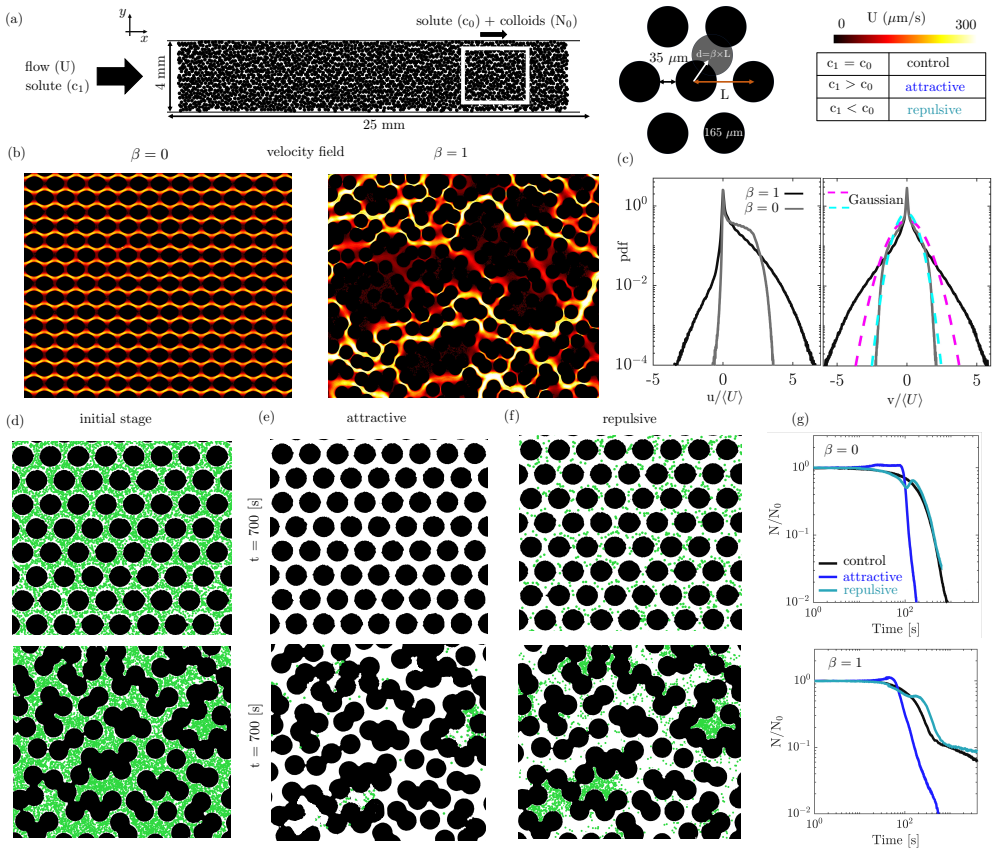
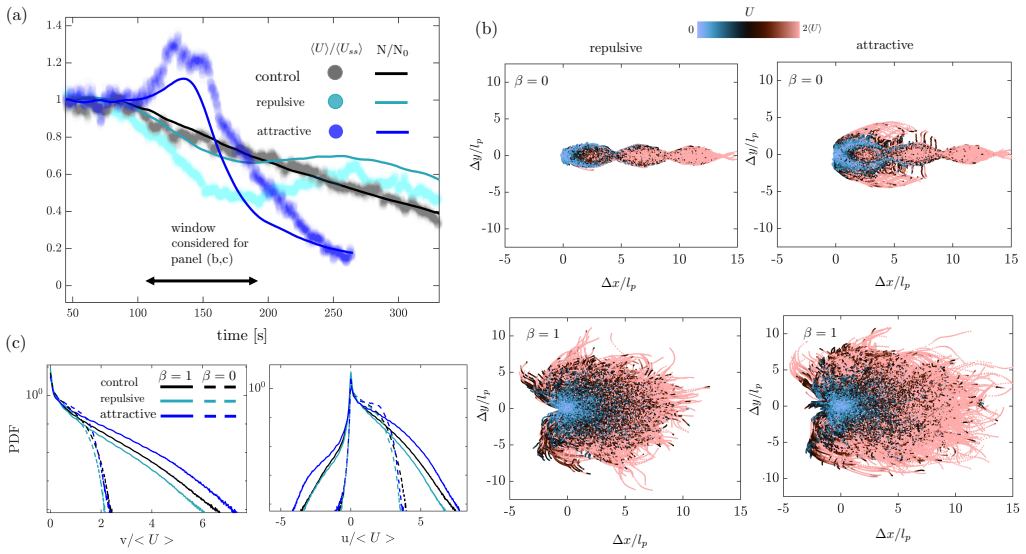
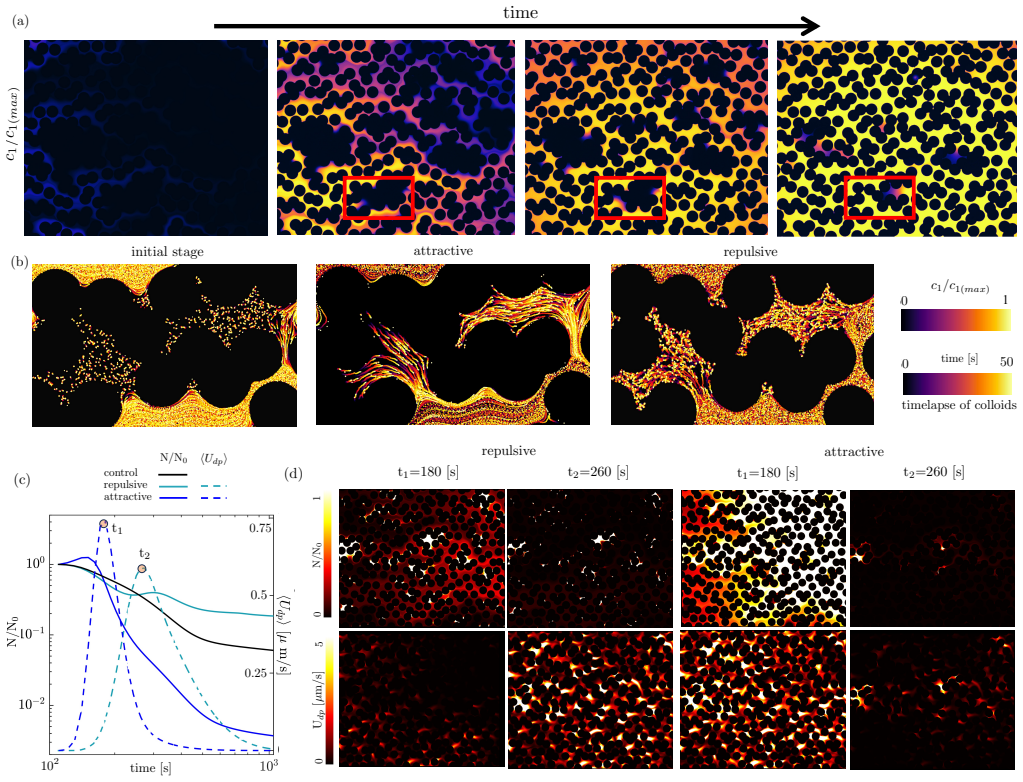
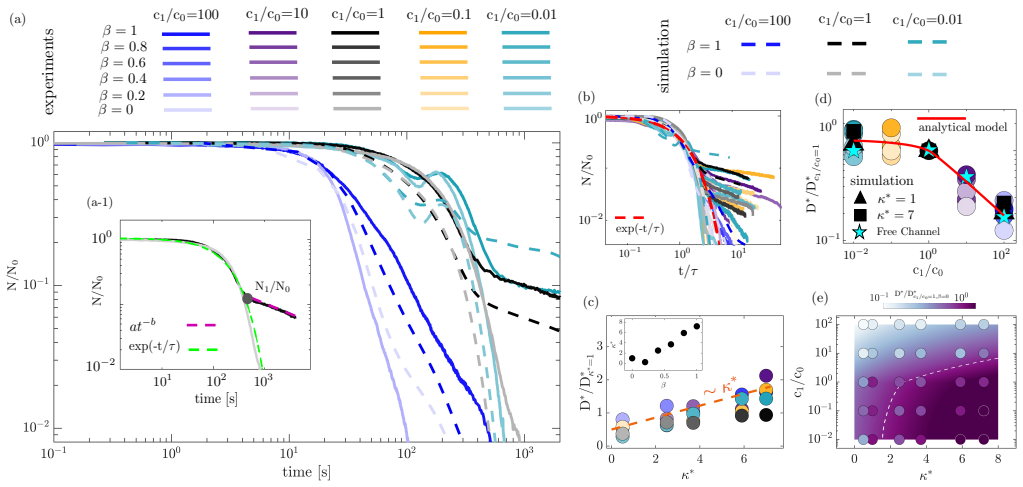
Combining microfluidic experiments, simulations, and modeling, the authors show that displacing a colloid suspension with a higher or lower salinity solution produces cross-streamline migration via diffusiophoresis. Although mixing reduces the resulting velocities by orders of magnitude below the imposed flow, the migration still changes macroscopic transit time and dispersion through the porous medium by an order of magnitude compared with uniform-salinity controls. Solute gradients thereby modulate the influence of geometric disorder on transport paths.
What carries the argument
Diffusiophoresis-induced cross-streamline migration of colloids, which occurs in response to local salinity gradients and redirects particles away from the streamlines they would follow under pure advection.
If this is right
- Solute gradients can override or strongly modify the role of pore geometry in setting colloid paths.
- Classical colloid-transport models that omit chemical gradients will underpredict or mispredict dispersion in salinity-varying environments.
- Managing background salt concentrations offers a route to control removal or retention of colloids in filtration and remediation applications.
- Mixing, while weakening gradients, does not eliminate their macroscopic effect on transport.
Where Pith is reading between the lines
- The same mechanism could be tested with other types of solute gradients, such as pH or temperature, to see whether they produce comparable redirection.
- Natural salinity variations in soils or aquifers may substantially alter microplastic or contaminant spread beyond what geometric models predict.
- Device designs that deliberately impose controlled gradients might be used to steer colloids for targeted delivery inside porous scaffolds.
Load-bearing premise
The measured order-of-magnitude shifts in transit time and dispersion arise primarily from diffusiophoresis rather than from unaccounted hydrodynamic interactions or incomplete mixing in the porous structure.
What would settle it
A control experiment that applies the same salinity-displacement protocol but suppresses diffusiophoresis (for example by matching colloid and fluid densities or using neutrally buoyant tracers) and checks whether the transit-time and dispersion changes disappear.
Figures
read the original abstract
Understanding how colloids move in crowded environments is key for gaining control over their transport in applications such as drug delivery, filtration, contaminant/microplastic remediation and agriculture. The classical models of colloid transport in porous media rely on geometric characteristics of the medium, and hydrodynamic/non-hydrodynamic equilibrium interactions to predict their behavior. However, chemical gradients are ubiquitous in these environments and can lead to the non-equilibrium diffusiophoretic migration of colloids. Here, combining microfluidic experiments, numerical simulations, and theoretical modeling we demonstrate that diffusiophoresis leads to significant macroscopic changes in the dispersion of colloids in porous media. We displace a suspension of colloids dispersed in a background salt solution with a higher/lower salinity solution and monitor the removal of the colloids from the medium. While mixing weakens the solute gradients, leading to the diffusiophoretic velocities that are orders of magnitude weaker than the background fluid flow, we show that the cross-streamline migration of colloids changes their macroscopic transit time and dispersion through the medium by an order of magnitude compared to the control case with no salinity gradients. Our observations demonstrate that solute gradients modulate the influence of geometric disorder on the transport, pointing to the need for revisiting the classical models of colloid transport in porous media to obtain predictive models for technological, medical, and environmental applications.
Editorial analysis
A structured set of objections, weighed in public.
Referee Report
Summary. The manuscript combines microfluidic experiments, numerical simulations, and theoretical modeling to argue that salinity gradients induce diffusiophoretic cross-streamline migration of colloids in porous media. Despite diffusiophoretic velocities being orders of magnitude weaker than the background flow (due to mixing), this migration produces order-of-magnitude changes in macroscopic transit time and dispersion relative to no-gradient controls, thereby modulating the effects of geometric disorder.
Significance. If the central attribution holds, the result would require classical colloid transport models in porous media (which rely on geometry and equilibrium interactions) to incorporate non-equilibrium chemical-gradient effects. The multi-method approach (experiment + simulation + theory) and the falsifiable comparison to no-gradient controls are strengths; the finding has direct relevance to filtration, remediation, and drug-delivery applications.
major comments (2)
- [Numerical simulations / Results] The central claim that the observed ~10× shifts arise specifically from diffusiophoretic cross-streamline migration (rather than salinity-induced changes in viscosity, density-driven flows, or particle-surface interactions) is load-bearing. The manuscript must demonstrate that the macroscopic effect vanishes when the diffusiophoretic term is removed from the particle velocity while all other hydrodynamic and boundary conditions are held fixed; without this isolation (e.g., in the numerical model described in the methods or results section), the attribution cannot be secured.
- [Theoretical modeling] The abstract states that mixing attenuates gradients so that diffusiophoretic speeds are orders of magnitude below the background flow, yet the integrated cross-streamline displacements still produce order-of-magnitude macroscopic changes. The paper should quantify the cumulative displacement per particle (or the effective transverse diffusivity) and show that it is sufficient to explain the observed transit-time shift; this calculation is needed to close the gap between the weak local velocity and the strong global effect.
minor comments (2)
- [Experimental methods] Clarify the precise definition of the control case (identical pressure-driven flow, identical porous geometry, but zero salinity contrast) and report the raw transit-time histograms or breakthrough curves for both cases.
- [Results] Provide error bars or statistical measures on the reported order-of-magnitude changes and state the number of independent experimental realizations.
Circularity Check
No significant circularity; central claims rest on direct experimental controls and independent simulations
full rationale
The paper's core demonstration compares colloid removal with and without salinity gradients in microfluidic experiments, supported by numerical simulations and theoretical modeling. The abstract explicitly contrasts results against a no-gradient control case, with no indication that any 'prediction' reduces to a fitted parameter, self-definition, or load-bearing self-citation chain. Diffusiophoretic velocities are acknowledged as weak, but the order-of-magnitude macroscopic effect is attributed via direct observation rather than by construction from inputs. This is the most common honest outcome for papers whose claims are externally falsifiable through controls.
Axiom & Free-Parameter Ledger
axioms (1)
- domain assumption Established theory of diffusiophoresis velocity in electrolyte gradients
Lean theorems connected to this paper
-
IndisputableMonolith/Cost/FunctionalEquation.leanwashburn_uniqueness_aczel unclear?
unclearRelation between the paper passage and the cited Recognition theorem.
The velocity field is governed by the Stokes equations... The solute transport is governed by an advection-diffusion equation, and the colloid transport is coupled to the solute transport via the diffusiophoretic velocity: ud p = Γp ∇ln c
-
IndisputableMonolith/Foundation/RealityFromDistinction.leanreality_from_one_distinction unclear?
unclearRelation between the paper passage and the cited Recognition theorem.
geometric disorder broadens the velocity field distribution... transition from the Fickian to non-Fickian behavior
What do these tags mean?
- matches
- The paper's claim is directly supported by a theorem in the formal canon.
- supports
- The theorem supports part of the paper's argument, but the paper may add assumptions or extra steps.
- extends
- The paper goes beyond the formal theorem; the theorem is a base layer rather than the whole result.
- uses
- The paper appears to rely on the theorem as machinery.
- contradicts
- The paper's claim conflicts with a theorem or certificate in the canon.
- unclear
- Pith found a possible connection, but the passage is too broad, indirect, or ambiguous to say the theorem truly supports the claim.
Reference graph
Works this paper leans on
-
[1]
J. L. Anderson, Colloid transport by interfacial forces, Annual Review of Fluid Mechanics 21, 61 (1989)
work page 1989
-
[2]
D. Velegol, A. Garg, R. Guha, A. Kar, and M. Kumar, Origins of concentration gradients for diffusiophoresis, Soft Matter12, 4686 (2016)
work page 2016
-
[3]
S. Marbach and L. Bocquet, Osmosis, from molecular insights to large-scale applications, Chem. Soc. Rev. 48, 3102 (2019)
work page 2019
-
[4]
Shin, Diffusiophoretic separation of colloids in microfluidic flows, Phys
S. Shin, Diffusiophoretic separation of colloids in microfluidic flows, Phys. Fluids. 32, 101302 (2020). 7
work page 2020
-
[5]
S. Shim, Diffusiophoresis, diffusioosmosis, and microflu- idics: Surface-flow-driven phenomena in the presence of flow, Chemical Reviews 122, 6986 (2022)
work page 2022
-
[6]
J. T. Ault and S. Shin, Physicochemical hydrodynamics of particle diffusiophoresis driven by chemical gradients, Annual Review of Fluid Mechanics (2024)
work page 2024
-
[7]
G. M. Whitesides and B. Grzybowski, Self- assembly at all scales, Science 295, 2418 (2002), https://www.science.org/doi/pdf/10.1126/science.1070821
-
[8]
B. A. Grzybowski, C. E. Wilmer, J. Kim, K. P. Browne, and K. J. M. Bishop, Self-assembly: from crystals to cells, Soft Matter 5, 1110 (2009)
work page 2009
-
[9]
M. Grzelczak, J. Vermant, E. M. Furst, and L. M. Liz-Marz´an, Directed self-assembly of nanoparticles, ACS Nano 4, 3591 (2010)
work page 2010
-
[10]
T. D. Edwards and M. A. Bevan, Controlling colloidal parti- cles with electric fields, Langmuir 30, 10793 (2014)
work page 2014
-
[11]
A. A. Harraq, B. D. Choudhury, and B. Bharti, Field-induced assembly and propulsion of colloids, Langmuir 38, 3001 (2022)
work page 2022
-
[12]
Z. Li, Q. Fan, and Y . Yin, Colloidal self-assembly approaches to smart nanostructured materials, Chemical Reviews 122, 4976 (2022)
work page 2022
-
[13]
K. J. Bishop, S. L. Biswal, and B. Bharti, Active colloids as models, materials, and machines, Annual Review of Chemical and Biomolecular Engineering 14, 1 (2023)
work page 2023
-
[14]
B. Abecassis, C. Cottin-Bizonne, C. Ybert, A. Ajdari, and L. Bocquet, Boosting migration of large particles by solute contrasts, Nature Materials 7, 785 (2008)
work page 2008
-
[15]
J. Palacci, B. Ab ´ecassis, C. Cottin-Bizonne, C. Ybert, and L. Bocquet, Colloidal motility and pattern formation un- der rectified diffusiophoresis, Phys. Rev. Lett. 104, 138302 (2010)
work page 2010
-
[16]
J. Palacci, C. Cottin-Bizonne, C. Ybert, and L. Bocquet, Os- motic traps for colloids and macromolecules based on loga- rithmic sensing in salt taxis, Soft Matter 8, 980 (2012)
work page 2012
-
[17]
J. S. Paustian, R. N. Azevedo, S.-T. B. Lundin, M. J. Gilkey, and T. M. Squires, Microfluidic microdialysis: Spatiotempo- ral control over solution microenvironments using integrated hydrogel membrane microwindows, Phys. Rev. X 3, 041010 (2013)
work page 2013
- [18]
-
[19]
A. Kar, R. Guha, N. Dani, D. Velegol, and M. Kumar, Particle deposition on microporous membranes can be enhanced or re- duced by salt gradients, Langmuir, Langmuir 30, 793 (2014)
work page 2014
- [20]
-
[21]
N. Shi, R. Nery-Azevedo, A. I. Abdel-Fattah, and T. M. Squires, Diffusiophoretic focusing of suspended colloids, Phys. Rev. Lett. 117, 258001 (2016)
work page 2016
-
[22]
A. Banerjee, I. Williams, R. N. Azevedo, M. E. Helgeson, and T. M. Squires, Soluto-inertial phenomena: Designing long- range, long-lasting, surface-specific interactions in suspen- sions, Proceedings of the National Academy of Sciences 113, 8612 (2016)
work page 2016
-
[23]
S. Shin, E. Um, B. Sabass, J. T. Ault, M. Rahimi, P. B. Warren, and H. A. Stone, Size-dependent control of colloid transport via solute gradients in dead-end channels, Proceedings of the National Academy of Sciences 113, 257 (2016)
work page 2016
-
[24]
S. Shin, J. T. Ault, P. B. Warren, and H. A. Stone, Accumu- lation of colloidal particles in flow junctions induced by fluid flow and diffusiophoresis, Phys. Rev. X7, 041038 (2017)
work page 2017
-
[25]
S. Shin, J. T. Ault, J. Feng, P. B. Warren, and H. A. Stone, Low-cost zeta potentiometry using solute gradients, Advanced Materials 29, 1701516 (2017)
work page 2017
-
[26]
S. Shin, O. Shardt, P. B. Warren, and H. A. Stone, Mem- braneless water filtration using co2, Nature Communications 8, 15181 (2017)
work page 2017
-
[27]
R. Nery-Azevedo, A. Banerjee, and T. M. Squires, Diffu- siophoresis in ionic surfactant gradients, Langmuir 33, 9694 (2017)
work page 2017
-
[28]
J. T. Ault, S. Shin, and H. A. Stone, Diffusiophoresis in narrow channel flows, J. Fluid Mech. 854, 420 (2018)
work page 2018
-
[29]
H. Lee, J. Kim, J. Yang, S. W. Seo, and S. J. Kim, Diffusio- phoretic exclusion of colloidal particles for continuous water purification, Lab Chip 18, 1713 (2018)
work page 2018
-
[30]
S. Shin, V . S. Doan, and J. Feng, Osmotic delivery and re- lease of lipid-encapsulated molecules via sequential solution exchange, Phys. Rev. Appl. 12, 024014 (2019)
work page 2019
-
[31]
J. T. Ault, S. Shin, and H. A. Stone, Characterization of surface–solute interactions by diffusioosmosis, Soft Matter15, 1582 (2019)
work page 2019
- [32]
-
[33]
A. Banerjee and T. M. Squires, Long-range, selective, on- demand suspension interactions: Combining and triggering soluto-inertial beacons, Science Advances 5 (2019)
work page 2019
- [34]
- [35]
-
[36]
J. L. Wilson, S. Shim, Y . E. Yu, A. Gupta, and H. A. Stone, Diffusiophoresis in multivalent electrolytes, Langmuir 36, 7014 (2020)
work page 2020
-
[37]
I. Williams, S. Lee, A. Apriceno, R. P. Sear, and G. Battaglia, Diffusioosmotic and convective flows induced by a nonelec- trolyte concentration gradient, Proceedings of the National Academy of Sciences 117, 25263 (2020)
work page 2020
-
[38]
S. Shin, J. T. Ault, K. Toda-Peters, and A. Q. Shen, Parti- cle trapping in merging flow junctions by fluid-solute-colloid- boundary interactions, Phys. Rev. Fluids 5, 024304 (2020)
work page 2020
-
[39]
P. B. Warren, Non-faradaic electric currents in the nernst- planck equations and nonlocal diffusiophoresis of suspended colloids in crossed salt gradients, Phys. Rev. Lett.124, 248004 (2020)
work page 2020
-
[40]
T. J. Shimokusu, V . G. Maybruck, J. T. Ault, and S. Shin, Col- loid separation by co2-induced diffusiophoresis, Langmuir, Langmuir 36, 7032 (2020)
work page 2020
- [41]
-
[42]
M. Jotkar and L. Cueto-Felgueroso, Particle separation through diverging nanochannels via diffusiophoresis and dif- fusioosmosis, Phys. Rev. Appl. 16, 064067 (2021)
work page 2021
-
[43]
S. Shim, S. Khodaparast, C.-Y . Lai, J. Yan, J. T. Ault, B. Ralla- bandi, O. Shardt, and H. A. Stone, Co2-driven diffusiophoresis for maintaining a bacteria-free surface, Soft Matter 17, 2568 (2021). 8
work page 2021
-
[44]
B. M. Alessio, S. Shim, E. Mintah, A. Gupta, and H. A. Stone, Diffusiophoresis and diffusioosmosis in tandem: Two- dimensional particle motion in the presence of multiple elec- trolytes, Phys. Rev. Fluids 6, 054201 (2021)
work page 2021
-
[45]
B. M. Alessio, S. Shim, A. Gupta, and H. A. Stone, Diffusioosmosis-driven dispersion of colloids: a taylor disper- sion analysis with experimental validation, Journal of Fluid Mechanics 942, A23 (2022)
work page 2022
-
[46]
B. E. McKenzie, H. C. W. Chu, S. Garoff, R. D. Tilton, and A. S. Khair, Drop deformation during diffusiophoresis, Jour- nal of Fluid Mechanics 949, A17 (2022)
work page 2022
-
[47]
S. Shim, J. K. Nunes, G. Chen, and H. A. Stone, Diffusio- phoresis in the presence of a ph gradient, Phys. Rev. Fluids 7, 110513 (2022)
work page 2022
-
[48]
V . S. Doan, D.-O. Kim, C. Snoeyink, Y . Sun, and S. Shin, Shape- and orientation-dependent diffusiophoresis of colloidal ellipsoids, Phys. Rev. E 107, L052602 (2023)
work page 2023
-
[49]
S. Lee, J. Lee, and J. T. Ault, The role of variable zeta po- tential on diffusiophoretic and diffusioosmotic transport, Col- loids and Surfaces A: Physicochemical and Engineering As- pects 659, 130775 (2023)
work page 2023
-
[50]
B. Akdeniz, J. A. Wood, and R. G. H. Lammertink, Diffusio- phoresis and diffusio-osmosis into a dead-end channel: Role of the concentration-dependence of zeta potential, Langmuir 39, 2322 (2023)
work page 2023
-
[51]
R. E. Migacz, G. Durey, and J. T. Ault, Convection rolls and three-dimensional particle dynamics in merging solute streams, Phys. Rev. Fluids 8, 114201 (2023)
work page 2023
- [52]
-
[53]
J. Teng, B. Rallabandi, and J. T. Ault, Diffusioosmotic dis- persion of solute in a long narrow channel, Journal of Fluid Mechanics 977, A5 (2023)
work page 2023
-
[54]
A. Yang, B. E. McKenzie, Y . Yi, A. S. Khair, S. Garoff, and R. D. Tilton, Effect of polymer/surfactant complexation on diffusiophoresis of colloids in surfactant concentration gradi- ents, Journal of Colloid and Interface Science642, 169 (2023)
work page 2023
-
[55]
I. Williams, P. B. Warren, R. P. Sear, and J. L. Keddie, Col- loidal diffusiophoresis in crossed electrolyte gradients: Ex- perimental demonstration of an “action-at-a-distance” effect predicted by the nernst-planck equations, Phys. Rev. Fluids 9, 014201 (2024)
work page 2024
-
[56]
R. E. Migacz, M. Castleberry, and J. T. Ault, Enhanced diffu- siophoresis in dead-end pores with time-dependent boundary solute concentration, Phys. Rev. Fluids 9, 044203 (2024)
work page 2024
-
[57]
A. Yang, B. E. McKenzie, B. Pavlat, E. S. Johnson, A. S. Khair, S. Garoff, and R. D. Tilton, Diffusiophoretic transport of charged colloids in ionic surfactant gradients entirely below versus entirely above the critical micelle concentration, Lang- muir 40, 10143 (2024)
work page 2024
- [58]
-
[59]
J. Deseigne, C. Cottin-Bizonne, A. D. Stroock, L. Bocquet, and C. Ybert, How a “pinch of salt” can tune chaotic mixing of colloidal suspensions, Soft Matter 10, 4795 (2014)
work page 2014
-
[60]
L. Schmidt, I. Fouxon, D. Krug, M. van Reeuwijk, and M. Holzner, Clustering of particles in turbulence due to phore- sis, Phys. Rev. E 93, 063110 (2016)
work page 2016
- [61]
- [62]
- [63]
-
[64]
F. Raynal and R. V olk, Diffusiophoresis, batchelor scale and effective p´eclet numbers, Journal of Fluid Mechanics876, 818 (2019)
work page 2019
-
[65]
H. C. Chu, S. Garoff, R. D. Tilton, and A. S. Khair, Macro- transport theory for diffusiophoretic colloids and chemotactic microorganisms, Journal of Fluid Mechanics917, A52 (2021)
work page 2021
- [66]
-
[67]
R. E. Migacz and J. T. Ault, Diffusiophoresis in a taylor- dispersing solute, Phys. Rev. Fluids 7, 034202 (2022)
work page 2022
-
[68]
H. C. W. Chu, S. Garoff, R. D. Tilton, and A. S. Khair, Tuning chemotactic and diffusiophoretic spreading via hydrodynamic flows, Soft Matter 18, 1896 (2022)
work page 2022
-
[69]
C. Anzivino, K. Xhani, M. Carpineti, S. Verrastro, A. Zac- cone, and A. Vailati, Convective instability driven by diffusio- phoresis of colloids in binary liquid mixtures, The Journal of Physical Chemistry Letters 15, 9030 (2024)
work page 2024
-
[70]
R. P. Sear, Diffusiophoresis in cells: A general nonequi- librium, nonmotor mechanism for the metabolism-dependent transport of particles in cells, Phys. Rev. Lett. 122, 128101 (2019)
work page 2019
-
[71]
B. Ramm, A. Goychuk, A. Khmelinskaia, P. Blumhardt, H. Eto, K. A. Ganzinger, E. Frey, and P. Schwille, A diffu- siophoretic mechanism for atp-driven transport without motor proteins, Nature Physics 17, 850 (2021)
work page 2021
-
[72]
T. Burkart, M. C. Wigbers, L. W ¨urthner, and E. Frey, Control of protein-based pattern formation via guiding cues, Nature Reviews Physics 4, 511 (2022)
work page 2022
-
[73]
B. M. Alessio and A. Gupta, Diffusiophoresis-enhanced turing patterns, Sci. Adv. 9, eadj2457 (2023)
work page 2023
-
[74]
E. Shandilya, B. Rallabandi, and S. Maiti, In situ enzymatic control of colloidal phoresis and catalysis through hydrolysis of atp, Nature Communications 15, 3603 (2024)
work page 2024
-
[75]
G. H ¨afner and M. M¨uller, Reaction-driven diffusiophoresis of liquid condensates: Potential mechanisms for intracellular or- ganization, ACS Nano 18, 16530 (2024)
work page 2024
-
[76]
V . S. Doan, I. Alshareedah, A. Singh, P. R. Banerjee, and S. Shin, Diffusiophoresis promotes phase separation and trans- port of biomolecular condensates, Nature Communications 15, 7686 (2024)
work page 2024
-
[77]
S. Shim, B. Gouveia, B. Ramm, V . A. Valdez, S. Petry, and H. A. Stone, Motorless transport of microtubules along tubu- lin, rangtp, and salt gradients, Nature Communications 15, 9434 (2024)
work page 2024
- [78]
-
[79]
L. Li, K. Maher, A. Navarre-Sitchler, J. Druhan, C. Meile, C. Lawrence, J. Moore, J. Perdrial, P. Sullivan, A. Thomp- son, L. Jin, E. W. Bolton, S. L. Brantley, W. E. Dietrich, K. U. Mayer, C. I. Steefel, A. Valocchi, J. Zachara, B. Kocar, J. Mcintosh, B. M. Tutolo, M. Kumar, E. Sonnenthal, C. Bao, and J. Beisman, Expanding the role of reactive transport ...
work page 2017
-
[80]
M. Rolle and T. Le Borgne, Mixing and Reactive Fronts in the Subsurface, Reviews in Mineralogy and Geochemistry85, 111 (2019)
work page 2019
discussion (0)
Sign in with ORCID, Apple, or X to comment. Anyone can read and Pith papers without signing in.