REVIEW 4 major objections 6 minor 74 references
Any-to-3D Generation via Hybrid Diffusion Supervision
T0 review · 4 major / 6 minor · reviewed 2026-08-12 · deepseek-v4-flash
Pith's one-line read A unified framework, XBind, generates 3D objects from text, image, or audio prompts using shared multimodal embeddings as diffusion conditions.
desk verdict A plausible first stab at unified any-to-3D with audio, but the reported SOTA margins are largely circular because the evaluation metrics overlap with the training objective. read the letter →
The pith
A machine-rendered reading of the paper's core claim, the machinery that carries it, and where it could break.
The reading
What carries the argument
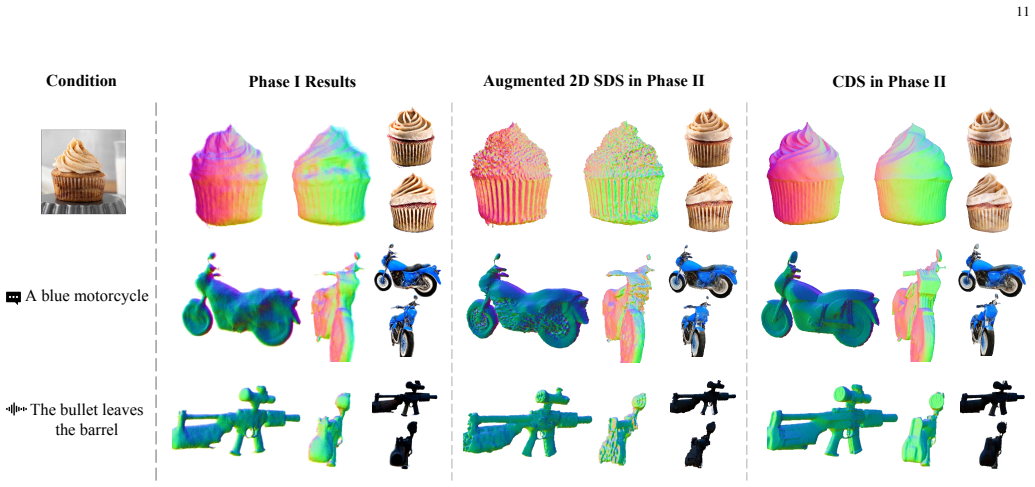
The central mechanism is the Modality Similarity (MS) loss combined with Hybrid Diffusion Supervision. The MS loss is a cosine-similarity objective between the ImageBind embedding of the prompt and CLIP image embeddings of augmented rendered views, giving any modality a direct gradient path into the 3D representation. Hybrid Diffusion Supervision adds pixel-level planar losses (augmented SDS and CDS from the 2D diffusion model) and spatial-level stereoscopic losses (3D SDS and a reference-view loss from the 3D-aware diffusion model), so the framework gets both open-world imagination and view consistency. The three-phase schedule, which starts with a low-resolution NeRF and refines geometry and then texture with DMTet (a hybrid surface representation), is the optimization scaffold that deploys these losses at increasing resolution.
What would settle it
Measure the distribution gap between ImageBind embeddings and the CLIP image embeddings that Stable Diffusion v2-1-unclip was trained on using a paired-image set; if the two spaces are far apart, the paper's direct conditioning of the 2D diffusion model by ImageBind vectors cannot be doing the work it claims.
Extended reading notes
Core claim
The central claim is that a single 3D-generation pipeline can be conditioned on any modality by using a shared embedding space. XBind encodes the input with ImageBind, feeds the resulting embedding into both a 2D diffusion model (Stable Diffusion v2-1-unclip) and a 3D-aware diffusion model (Zero-1-to-3), and optimizes a NeRF-to-DMTet representation under hybrid diffusion supervision. A new Modality Similarity loss ties the modality embedding to CLIP embeddings of augmented rendered views, which the paper says is what lets arbitrary modalities actually steer the 3D object. On the reported benchmarks, XBind reaches CLIP-R 0.8050 on the DreamFusion text gallery, compared with 0.7319 for ProlificDreamer, CLIP-I 0.8554 for image prompts, and ARCC 0.4860 for audio prompts; the ablations attribute the gains to the stereoscopic supervision, planar supervision, three-phase schedule, and MS loss.
Load-bearing premise
The load-bearing premise is that ImageBind embeddings can be fed directly into Stable Diffusion v2-1-unclip as if they were CLIP image embeddings, even though the two embedding spaces come from separately trained models and the paper describes no projection or fine-tuning to reconcile them.
Editorial extensions
If this is right
- A single trained pipeline can switch among text, image, and audio prompts without retraining or explicit modality conversion.
- Audio-to-3D generation becomes practical without first converting sound to text or images, avoiding information loss.
- Combining 2D and 3D diffusion supervision suppresses view-inconsistent artifacts such as the multi-face Janus problem.
- The coarse-to-fine NeRF-then-DMTet schedule yields high-resolution textured meshes rather than low-fidelity radiance fields.
- Prompt alignment, quantified by CLIP-R, CLIP-I, and ARCC, is higher than the constructed baselines and than the compared text-to-3D methods.
Reading between the lines
- Any new modality later added to a shared embedding space, such as depth or thermal sensing, should become a 3D prompt with no change to the 3D pipeline.
- Substituting a different aligned encoder for ImageBind would test whether the recipe depends on the shared-space property or on ImageBind's specific training; if the metrics transfer, the method generalizes as a recipe.
- Extending the same hybrid supervision to full 3D scenes, beyond single objects, is a natural next step that the paper's stated limitations leave open.
Editorial analysis
A structured set of objections, weighed in public.
Referee Report
Summary. The paper proposes XBind, a unified framework for generating 3D objects from prompts of arbitrary modality (text, image, audio). The method encodes the prompt with ImageBind into a shared embedding space, conditions a 2D diffusion model (Stable Diffusion v2-1-unclip) and a 3D-aware diffusion model (Zero-1-to-3) on that embedding, and optimizes a NeRF/DMTet representation in three phases (coarse NeRF, DMTet geometry, DMTet texture). The principal new components are the Modality Similarity (MS) loss (Eq. 2), which maximizes the cosine similarity between the ImageBind prompt embedding and CLIP image embeddings of rendered and augmented views; Hybrid Diffusion Supervision combining planar 2D losses with stereoscopic 3D losses; and the three-phase coarse-to-fine optimization schedule. The paper claims that XBind outperforms three constructed baselines and four SOTA text-to-3D methods on CLIP-R, CLIP-I, and a newly proposed ARCC metric (Tables I and II), and it presents qualitative comparisons and an ablation study (Figs. 3-7).
Significance. XBind targets a genuinely useful gap: a single pipeline that accepts text, image, and audio prompts for 3D object generation without an explicit modality-to-text or modality-to-image conversion step, and the qualitative results in Figs. 3-5 and the module-level ablation in Fig. 7 suggest that the framework can produce plausible, view-consistent objects. The MS loss is a reasonable mechanism for tightening prompt-render alignment, and the combination of ImageBind, Stable unCLIP, and Zero-1-to-3 priors inside one optimization loop is a sensible engineering idea with clear presentation. These strengths are real and should be credited. However, the quantitative evidence is not currently independent: CLIP-R, CLIP-I, and ARCC all overlap with the MS training objective, there are no error bars, significance tests, or repeated seeds, and the ablation is qualitative only. The significance of the paper is therefore conditional on a substantially reworked evaluation using human studies or held-out embedding spaces that were not part of the training objective.
major comments (4)
- [Sec. V-A.4, Eq. (2), Tables I-II] The three evaluation metrics overlap directly with the MS loss that XBind optimizes, so Tables I and II do not provide independent evidence of superiority. CLIP-R measures CLIP cosine similarity between the text prompt and rendered views, while the MS loss in Eq. (2) maximizes cos(C_m, E(x)) with E being the CLIP image encoder; consequently the text-to-3D margin (XBind 0.8050/0.8167 vs. ProlificDreamer 0.7319) partly reflects the fact that XBind explicitly optimizes a CLIP-similarity term that the SOTA methods do not. For image-to-3D, CLIP-I measures similarity to a reference image whose ImageBind embedding is the anchor C_m of the MS loss, and for audio-to-3D the proposed ARCC metric (Eq. 14) computes cos(C(A), C(I)) with the same ImageBind encoder that produces the conditioning embedding C_m, making the audio scores in Table I a near-direct evaluation of whether the MS loss was active. The baselines in Table I also omit the MS loss, and Section VI (Limitations) does not acknowledge this metric-objective overlap. The revision must add independent evaluation: human preference ratings, prompt-render similarity measured with an embedding model not used in the loss, and ideally multi-view consistency or geometry metrics, with repeated-seed runs and significance tests.
- [Sec. IV-A and footnote 1 (p. 4)] The conditioning path from ImageBind to the 2D diffusion model is underspecified and possibly invalid as stated. The paper says XBind conditions Stable Diffusion v2-1-unclip on ImageBind embeddings, but v2-1-unclip was trained to accept CLIP image embeddings of a specific dimension, whereas ImageBind embeddings come from a different encoder family; the paper describes no projection, linear layer, fine-tuning, or normalization step that reconciles the two spaces. The entire modality-conditional pipeline rests on this unstated compatibility assumption, and without it the method cannot be reproduced or even verified. Please specify the exact conditioning mechanism (embedding dimension, normalization, learned projection, or a fine-tuned unCLIP adapter) and validate it empirically; an ablation comparing raw ImageBind conditioning, a learned projection, and genuine CLIP embeddings would demonstrate that the claimed cross-modal pre-alignment is what makes any-to-3D work.
- [Tables I-II and Sec. V-B through V-F] The quantitative evaluation lacks statistical hygiene and internal consistency. No error bars, number of seeds, or significance tests are reported; the ablation study (Fig. 7) is qualitative only, leaving the individual contributions of the MS loss, hybrid supervision, and the three-phase schedule unquantified. In addition, XBind's CLIP-R score is 0.8050 in Table I but 0.8167 in Table II, and the paper does not state whether the prompt sets differ or why the numbers change. The ARCC metric (Eq. 14) is used to evaluate the method on the very objective it is trained on; even setting the circularity aside, a newly proposed evaluation metric should be validated against human judgments before being used as a headline result.
- [Sec. IV (Eqs. 2, 5, 8, 9, 11-13) and Algorithm 1] Several load-bearing hyperparameters are never given: the MS loss weights omega_g, omega_l, omega_z in Eq. (2); the hybrid-supervision weights omega_ms, omega_cds, omega_img, omega_nz, omega_3d, omega_rgb, and omega_mask in Eqs. (5), (8), (9), and (11)-(13); the augmentation weights W_i in Eq. (2); and the per-phase iteration counts N_phase-1, N_phase-2, and N_phase-3 in Algorithm 1. Without these values the framework cannot be reproduced, and the sensitivity of the reported results to these choices cannot be assessed. Please report the full configuration (or place it in a supplement) and state whether the same schedule is used for all three input modalities.
minor comments (6)
- [Sec. IV-A, Eq. (2)] The definition of W_i and the 'avg' operation over rendered images is ambiguous; please clarify whether the loss is averaged over a random subset of viewpoints per iteration and confirm explicitly that gradients flow through the differentiable renderer into the NeRF/DMTet parameters.
- [Table II] The SOTA results are obtained from threestudio; please state the resolution, number of iterations, and per-method compute budgets, since CLIP-R can be sensitive to training length and viewpoint coverage.
- [Fig. 3] The image-to-3D examples are described as style-preserving generation rather than reconstruction, but the criterion for when an output counts as aligned with the input image is never defined; a human-rated measure of style or layout alignment would make this claim concrete.
- [References] Reference [47] duplicates reference [8] (both cite Rombach et al.); the duplicate should be merged or removed.
- [Abstract and Sec. VII] The claim that XBind is 'the first method to generate 3D objects from any modality prompts' should be supported by a broader related-work search or softened, since the survey in Section II does not discuss possible audio-to-3D or unified multimodal-to-3D attempts in detail.
- [Throughout] Minor formatting issues include the inconsistent spacing of 'DMT ET' and the boxed notation in Algorithm 1; these should be cleaned up in revision.
Circularity Check
Quantitative SOTA margins are largely circular: the MS loss optimizes the same CLIP/ImageBind cosine similarities used by CLIP-R, CLIP-I, and ARCC, so Tables I and II do not independently establish superiority.
-
fitted input called prediction
[Section IV-A Eq. (2); Section V-A.4]
"we compute the MS loss between the embedding of the input modality prompt and those of the rendered images as follows: LMS = ωgLms-g + ωlLms-l + ωzLms-z, Lms-g = Σi {Wi × avg [cos(Cm, E(G(x)))]}, ... where Cm represents the embedding of the modality prompt encoded by the multimodal-aligned encoder, E denotes the CLIP image encoder"
CLIP-R computes the CLIP text-image similarity between each text prompt and the rendered views, and Cm for a text prompt is the same text embedding fed into the MS loss; E is the same CLIP image encoder. For image prompts, CLIP-I measures the reference-image-to-rendered CLIP similarity, again the quantity maximized by Eq. (2). Since the SOTA text-to-3D methods and the constructed baselines in Tables I and II are not trained with this term, their lower scores partly reflect that the evaluation metric is contained in the training loss. The margin is therefore not independent evidence of superior modality alignment.
-
fitted input called prediction
[Section V-A.4 Eq. (14); Section IV-A Eq. (2)]
"For audio-to-3D, due to the lack of suitable evaluation metrics, we propose the Audio-Rendering Cosine Consistency (ARCC) metric: ARCC(A, I) = cos(C(A), C(I)), (14) where A and I represent the audio prompts and rendered images, respectively, and C denotes the multimodal-aligned encoder."
For an audio prompt, the same ImageBind audio embedding is used as Cm in the MS loss and as C(A) in ARCC, and the rendered-image side is scored in the same aligned visual embedding space that ImageBind binds to that audio modality. Thus ARCC measures how well XBind maximized the very audio-image similarity that the MS loss and the frozen ImageBind space define, rather than an external or held-out measure of audio-3D alignment. The reported ARCC superiority over baselines largely reflects that only XBind optimizes this objective.
full rationale
The paper's technical contributions—hybrid diffusion supervision, three-phase optimization, and the any-modality pipeline—are independent of the metrics and are supported by qualitative figures and ablations. However, the headline quantitative claim rests on CLIP-R, CLIP-I, and ARCC, and each of these metrics is the same cosine-similarity objective trained in Eq. (2): Cm (from ImageBind/CLIP) is matched against rendered-view embeddings from the CLIP image encoder, while CLIP-R, CLIP-I, and ARCC score rendered views against the same prompt-embedding space. The constructed baselines and SOTA text-to-3D systems do not include the MS loss, so Tables I and II substantially re-demonstrate the effect of adding the MS loss to the reported metrics. No self-citation chain or imported uniqueness theorem is involved; the circularity is the loss/metric overlap. Score 7 reflects that the quantitative comparison is substantially circular while the qualitative and ablative evidence retains independent value.
Assumptions & free parameters
free parameters (3)
- MS loss weights omega_g, omega_l, omega_z =
not reported
- Hybrid supervision weights (omega_ms, omega_cds, omega_img, omega_nz, omega_3d, omega_rgb, omega_mask) =
not reported
- Phase iteration counts N_phase-1, N_phase-2, N_phase-3 =
not reported
assumptions (3)
- domain assumption ImageBind embeddings can be used directly as conditioning for Stable Diffusion v2-1-unclip, despite that model being trained on CLIP image embeddings.
- domain assumption Score distillation gradients (SDS, CDS) are valid for optimizing NeRF and DMTet representations in all three phases.
- domain assumption Cosine similarity in CLIP/ImageBind embedding spaces is a valid proxy for prompt-3D alignment.
invented entities (1)
-
Audio-Rendering Cosine Consistency (ARCC) metric
Cite this review
Pith. "Pith review of Any-to-3D Generation via Hybrid Diffusion Supervision." pith.science (2026). https://pith.science/paper/C5M5H2XI
@misc{pith2026241114715,
  author       = {Pith},
  title        = {Pith review of: Any-to-3D Generation via Hybrid Diffusion Supervision},
  year         = {2026},
  howpublished = {\url{https://pith.science/paper/C5M5H2XI}},
  note         = {Machine review of arXiv:2411.14715}
}
read the original abstract
Recent progress in 3D object generation has been fueled by the strong priors offered by diffusion models. However, existing models are tailored to specific tasks, accommodating only one modality at a time and necessitating retraining to change modalities. Given an image-to-3D model and a text prompt, a naive approach is to convert text prompts to images and then use the image-to-3D model for generation. This approach is both time-consuming and labor-intensive, resulting in unavoidable information loss during modality conversion. To address this, we introduce XBind, a unified framework for any-to-3D generation using cross-modal pre-alignment techniques. XBind integrates an multimodal-aligned encoder with pre-trained diffusion models to generate 3D objects from any modalities, including text, images, and audio. We subsequently present a novel loss function, termed Modality Similarity (MS) Loss, which aligns the embeddings of the modality prompts and the rendered images, facilitating improved alignment of the 3D objects with multiple modalities. Additionally, Hybrid Diffusion Supervision combined with a Three-Phase Optimization process improves the quality of the generated 3D objects. Extensive experiments showcase XBind's broad generation capabilities in any-to-3D scenarios. To our knowledge, this is the first method to generate 3D objects from any modality prompts. Project page: https://zeroooooooow1440.github.io/.
Figures


Figures from the paper (3 more)


Reference graph
Works this paper leans on
-
[1]
A comprehensive survey on 3d content generation,
J. Liu, X. Huang, T. Huang, L. Chen, Y . Hou, S. Tang, Z. Liu, W. Ouyang, W. Zuo, J. Jiang et al. , “A comprehensive survey on 3d content generation,” arXiv preprint arXiv:2402.01166 , 2024
arXiv 2024
-
[2]
Mvdream: Multi- view diffusion for 3d generation,
Y . Shi, P. Wang, J. Ye, M. Long, K. Li, and X. Yang, “Mvdream: Multi- view diffusion for 3d generation,” arXiv preprint arXiv:2308.16512 , 2023
arXiv 2023
-
[3]
Dreamcraft3d: Hierarchical 3d generation with bootstrapped diffusion prior,
J. Sun, B. Zhang, R. Shao, L. Wang, W. Liu, Z. Xie, and Y . Liu, “Dreamcraft3d: Hierarchical 3d generation with bootstrapped diffusion prior,” arXiv preprint arXiv:2310.16818 , 2023
arXiv 2023
-
[4]
Crm: Single image to 3d textured mesh with convolutional reconstruction model,
Z. Wang, Y . Wang, Y . Chen, C. Xiang, S. Chen, D. Yu, C. Li, H. Su, and J. Zhu, “Crm: Single image to 3d textured mesh with convolutional reconstruction model,” arXiv preprint arXiv:2403.05034 , 2024
arXiv 2024
-
[5]
Scalable diffusion models with transformers,
W. Peebles and S. Xie, “Scalable diffusion models with transformers,” in Proceedings of the IEEE/CVF International Conference on Computer Vision, 2023, pp. 4195–4205
2023
-
[6]
U-net: Convolutional networks for biomedical image segmentation,
O. Ronneberger, P. Fischer, and T. Brox, “U-net: Convolutional networks for biomedical image segmentation,” in Medical image computing and computer-assisted intervention–MICCAI 2015: 18th international con- ference, Munich, Germany, October 5-9, 2015, proceedings, part III 18 . Springer, 2015, pp. 234–241
2015
-
[7]
Hierarchical text-conditional image generation with clip latents,
A. Ramesh, P. Dhariwal, A. Nichol, C. Chu, and M. Chen, “Hierarchical text-conditional image generation with clip latents,” arXiv preprint arXiv:2204.06125, vol. 1, no. 2, p. 3, 2022
arXiv 2022
-
[8]
High- resolution image synthesis with latent diffusion models,
R. Rombach, A. Blattmann, D. Lorenz, P. Esser, and B. Ommer, “High- resolution image synthesis with latent diffusion models,” in Proceedings of the IEEE/CVF conference on computer vision and pattern recognition, 2022, pp. 10 684–10 695
2022
Show all 74 references
-
[9]
Fantasia3d: Disentangling geometry and appearance for high-quality text-to-3d content creation,
R. Chen, Y . Chen, N. Jiao, and K. Jia, “Fantasia3d: Disentangling geometry and appearance for high-quality text-to-3d content creation,” in Proceedings of the IEEE/CVF International Conference on Computer Vision, 2023, pp. 22 246–22 256
2023
-
[10]
Score jacobian chaining: Lifting pretrained 2d diffusion models for 3d generation,
H. Wang, X. Du, J. Li, R. A. Yeh, and G. Shakhnarovich, “Score jacobian chaining: Lifting pretrained 2d diffusion models for 3d generation,” in Proceedings of the IEEE/CVF Conference on Computer Vision and Pattern Recognition, 2023, pp. 12 619–12 629
2023
-
[11]
Consistent3d: Towards consistent high-fidelity text-to-3d generation with deterministic sampling prior,
Z. Wu, P. Zhou, X. Yi, X. Yuan, and H. Zhang, “Consistent3d: Towards consistent high-fidelity text-to-3d generation with deterministic sampling prior,” 2024
2024
-
[12]
Score distillation sampling with learned manifold corrective,
T. Alldieck, N. Kolotouros, and C. Sminchisescu, “Score distillation sampling with learned manifold corrective,” 2024
2024
-
[13]
Taming mode collapse in score distillation for text-to-3d generation,
P. Wang, D. Xu, Z. Fan, D. Wang, S. Mohan, F. Iandola, R. Ranjan, Y . Li, Q. Liu, Z. Wang, and V . Chandra, “Taming mode collapse in score distillation for text-to-3d generation,” arXiv preprint: 2401.00909, 2024
2024 arXiv
-
[14]
Prolific- dreamer: High-fidelity and diverse text-to-3d generation with variational score distillation,
Z. Wang, C. Lu, Y . Wang, F. Bao, C. Li, H. Su, and J. Zhu, “Prolific- dreamer: High-fidelity and diverse text-to-3d generation with variational score distillation,” Advances in Neural Information Processing Systems , vol. 36, 2024
2024
-
[15]
Text2mesh: Text-driven neural stylization for meshes,
O. Michel, R. Bar-On, R. Liu, S. Benaim, and R. Hanocka, “Text2mesh: Text-driven neural stylization for meshes,” in Proceedings of the IEEE/CVF Conference on Computer Vision and Pattern Recognition , 2022, pp. 13 492–13 502
2022
-
[16]
Cad: Photorealistic 3d generation via adversarial dis- tillation,
Z. Wan, D. Paschalidou, I. Huang, H. Liu, B. Shen, X. Xiang, J. Liao, and L. Guibas, “Cad: Photorealistic 3d generation via adversarial dis- tillation,” in Proceedings of the IEEE/CVF Conference on Computer Vision and Pattern Recognition , 2024, pp. 10 194–10 207
2024
-
[17]
Dreamgaussian: Generative gaussian splatting for efficient 3d content creation,
J. Tang, J. Ren, H. Zhou, Z. Liu, and G. Zeng, “Dreamgaussian: Generative gaussian splatting for efficient 3d content creation,” arXiv preprint arXiv:2309.16653, 2023
2023 arXiv
-
[18]
Make-it-3d: High-fidelity 3d creation from a single image with diffu- sion prior,
J. Tang, T. Wang, B. Zhang, T. Zhang, R. Yi, L. Ma, and D. Chen, “Make-it-3d: High-fidelity 3d creation from a single image with diffu- sion prior,” in Proceedings of the IEEE/CVF International Conference on Computer Vision , 2023, pp. 22 819–22 829
2023
-
[19]
Realfusion: 360deg reconstruction of any object from a single image,
L. Melas-Kyriazi, I. Laina, C. Rupprecht, and A. Vedaldi, “Realfusion: 360deg reconstruction of any object from a single image,” in Pro- ceedings of the IEEE/CVF conference on computer vision and pattern recognition, 2023, pp. 8446–8455
2023
-
[20]
Imagebind: One embedding space to bind them all,
R. Girdhar, A. El-Nouby, Z. Liu, M. Singh, K. V . Alwala, A. Joulin, and I. Misra, “Imagebind: One embedding space to bind them all,” in Proceedings of the IEEE/CVF Conference on Computer Vision and Pattern Recognition, 2023, pp. 15 180–15 190
2023
-
[21]
Any-to-any generation via composable diffusion,
Z. Tang, Z. Yang, C. Zhu, M. Zeng, and M. Bansal, “Any-to-any generation via composable diffusion,” Advances in Neural Information Processing Systems, vol. 36, 2024
2024
-
[22]
Dreamfusion: Text- to-3d using 2d diffusion,
B. Poole, A. Jain, J. T. Barron, and B. Mildenhall, “Dreamfusion: Text- to-3d using 2d diffusion,” 2022
2022
-
[23]
Zero-1-to-3: Zero-shot one image to 3d object,
R. Liu, R. Wu, B. Van Hoorick, P. Tokmakov, S. Zakharov, and C. V on- drick, “Zero-1-to-3: Zero-shot one image to 3d object,” in Proceedings of the IEEE/CVF International Conference on Computer Vision , 2023, pp. 9298–9309
2023
-
[24]
Mip-nerf: A multiscale representation for anti- aliasing neural radiance fields,
J. T. Barron, B. Mildenhall, M. Tancik, P. Hedman, R. Martin-Brualla, and P. P. Srinivasan, “Mip-nerf: A multiscale representation for anti- aliasing neural radiance fields,” in Proceedings of the IEEE/CVF Inter- national Conference on Computer Vision , 2021, pp. 5855–5864
2021
-
[25]
Instant neural graphics primitives with a multiresolution hash encoding,
T. M ¨uller, A. Evans, C. Schied, and A. Keller, “Instant neural graphics primitives with a multiresolution hash encoding,” ACM transactions on graphics (TOG), vol. 41, no. 4, pp. 1–15, 2022
2022
-
[26]
Deep marching tetrahedra: a hybrid representation for high-resolution 3d shape synthe- sis,
T. Shen, J. Gao, K. Yin, M.-Y . Liu, and S. Fidler, “Deep marching tetrahedra: a hybrid representation for high-resolution 3d shape synthe- sis,” Advances in Neural Information Processing Systems , vol. 34, pp. 6087–6101, 2021. 13
2021
-
[27]
Diffusion models: A comprehensive survey of methods and applications,
L. Yang, Z. Zhang, Y . Song, S. Hong, R. Xu, Y . Zhao, W. Zhang, B. Cui, and M.-H. Yang, “Diffusion models: A comprehensive survey of methods and applications,” ACM Computing Surveys , vol. 56, no. 4, pp. 1–39, 2023
2023
-
[28]
Score-based generative modeling through stochastic differ- ential equations,
Y . Song, J. Sohl-Dickstein, D. P. Kingma, A. Kumar, S. Ermon, and B. Poole, “Score-based generative modeling through stochastic differ- ential equations,” arXiv preprint arXiv:2011.13456 , 2020
2011 arXiv
-
[29]
Denoising diffusion probabilistic models,
J. Ho, A. Jain, and P. Abbeel, “Denoising diffusion probabilistic models,” Advances in neural information processing systems , vol. 33, pp. 6840– 6851, 2020
2020
-
[30]
Learning transferable visual models from natural language supervision,
A. Radford, J. W. Kim, C. Hallacy, A. Ramesh, G. Goh, S. Agarwal, G. Sastry, A. Askell, P. Mishkin, J. Clark et al., “Learning transferable visual models from natural language supervision,” in International conference on machine learning . PMLR, 2021, pp. 8748–8763
2021
-
[31]
Vector quantized diffusion model for text-to-image synthesis,
S. Gu, D. Chen, J. Bao, F. Wen, B. Zhang, D. Chen, L. Yuan, and B. Guo, “Vector quantized diffusion model for text-to-image synthesis,” in Proceedings of the IEEE/CVF conference on computer vision and pattern recognition, 2022, pp. 10 696–10 706
2022
-
[32]
Diffusion models beat gans on image synthesis,
P. Dhariwal and A. Nichol, “Diffusion models beat gans on image synthesis,” Advances in neural information processing systems , vol. 34, pp. 8780–8794, 2021
2021
-
[33]
Improving diffusion-based image synthesis with context pre- diction,
L. Yang, J. Liu, S. Hong, Z. Zhang, Z. Huang, Z. Cai, W. Zhang, and B. Cui, “Improving diffusion-based image synthesis with context pre- diction,” Advances in Neural Information Processing Systems , vol. 36, 2024
2024
-
[34]
Shifted diffusion for text-to-image generation,
Y . Zhou, B. Liu, Y . Zhu, X. Yang, C. Chen, and J. Xu, “Shifted diffusion for text-to-image generation,” in Proceedings of the IEEE/CVF conference on computer vision and pattern recognition , 2023, pp. 10 157–10 166
2023
-
[35]
Text2video-zero: Text-to-image diffusion models are zero-shot video generators,
L. Khachatryan, A. Movsisyan, V . Tadevosyan, R. Henschel, Z. Wang, S. Navasardyan, and H. Shi, “Text2video-zero: Text-to-image diffusion models are zero-shot video generators,” in Proceedings of the IEEE/CVF International Conference on Computer Vision, 2023, pp. 15 954–15 964
2023
-
[36]
Videofusion: Decomposed diffusion models for high-quality video generation,
Z. Luo, D. Chen, Y . Zhang, Y . Huang, L. Wang, Y . Shen, D. Zhao, J. Zhou, and T. Tan, “Videofusion: Decomposed diffusion models for high-quality video generation,” in 2023 IEEE/CVF Conference on Computer Vision and Pattern Recognition (CVPR) . IEEE, 2023, pp. 10 209–10 218
2023
-
[37]
Vidm: Video implicit diffusion models,
K. Mei and V . Patel, “Vidm: Video implicit diffusion models,” in Proceedings of the AAAI conference on artificial intelligence , vol. 37, no. 8, 2023, pp. 9117–9125
2023
-
[38]
Lavie: High-quality video generation with cascaded latent diffusion models,
Y . Wang, X. Chen, X. Ma, S. Zhou, Z. Huang, Y . Wang, C. Yang, Y . He, J. Yu, P. Yanget al., “Lavie: High-quality video generation with cascaded latent diffusion models,” arXiv preprint arXiv:2309.15103 , 2023
2023 arXiv
-
[39]
Prodiff: Progressive fast diffusion model for high-quality text-to-speech,
R. Huang, Z. Zhao, H. Liu, J. Liu, C. Cui, and Y . Ren, “Prodiff: Progressive fast diffusion model for high-quality text-to-speech,” in Proceedings of the 30th ACM International Conference on Multimedia , 2022, pp. 2595–2605
2022
-
[40]
Taming diffusion models for audio-driven co-speech gesture generation,
L. Zhu, X. Liu, X. Liu, R. Qian, Z. Liu, and L. Yu, “Taming diffusion models for audio-driven co-speech gesture generation,” inProceedings of the IEEE/CVF Conference on Computer Vision and Pattern Recognition, 2023, pp. 10 544–10 553
2023
-
[41]
Speech enhancement and dereverberation with diffusion-based genera- tive models,
J. Richter, S. Welker, J.-M. Lemercier, B. Lay, and T. Gerkmann, “Speech enhancement and dereverberation with diffusion-based genera- tive models,” IEEE/ACM Transactions on Audio, Speech, and Language Processing, vol. 31, pp. 2351–2364, 2023
2023
-
[42]
Storm: A diffusion-based stochastic regeneration model for speech enhancement and dereverberation,
J.-M. Lemercier, J. Richter, S. Welker, and T. Gerkmann, “Storm: A diffusion-based stochastic regeneration model for speech enhancement and dereverberation,” IEEE/ACM Transactions on Audio, Speech, and Language Processing, 2023
2023
-
[43]
Hyperfields: Towards zero-shot generation of nerfs from text,
S. Babu, R. Liu, A. Zhou, M. Maire, G. Shakhnarovich, and R. Hanocka, “Hyperfields: Towards zero-shot generation of nerfs from text,” arXiv preprint arXiv:2310.17075, 2023
2023 arXiv
-
[44]
Texfusion: Synthesiz- ing 3d textures with text-guided image diffusion models,
T. Cao, K. Kreis, S. Fidler, N. Sharp, and K. Yin, “Texfusion: Synthesiz- ing 3d textures with text-guided image diffusion models,” inProceedings of the IEEE/CVF International Conference on Computer Vision , 2023, pp. 4169–4181
2023
-
[45]
Luciddreamer: Towards high-fidelity text-to-3d generation via interval score matching,
Y . Liang, X. Yang, J. Lin, H. Li, X. Xu, and Y . Chen, “Luciddreamer: Towards high-fidelity text-to-3d generation via interval score matching,” in Proceedings of the IEEE/CVF Conference on Computer Vision and Pattern Recognition, 2024, pp. 6517–6526
2024
-
[46]
Scenetex: High-quality texture synthesis for indoor scenes via diffusion priors,
D. Z. Chen, H. Li, H.-Y . Lee, S. Tulyakov, and M. Nießner, “Scenetex: High-quality texture synthesis for indoor scenes via diffusion priors,” in Proceedings of the IEEE/CVF Conference on Computer Vision and Pattern Recognition, 2024, pp. 21 081–21 091
2024
-
[47]
High- resolution image synthesis with latent diffusion models,
R. Rombach, A. Blattmann, D. Lorenz, P. Esser, and B. Ommer, “High- resolution image synthesis with latent diffusion models,” in Proceedings of the IEEE/CVF Conference on Computer Vision and Pattern Recogni- tion (CVPR), June 2022, pp. 10 684–10 695
2022
-
[48]
Syncdreamer: Learning to generate multiview-consistent images from a single-view image,
Y . Liu, C. Lin, Z. Zeng, X. Long, L. Liu, T. Komura, and W. Wang, “Syncdreamer: Learning to generate multiview-consistent images from a single-view image,” arXiv preprint arXiv:2309.03453 , vol. 15, 2023
2023 arXiv
-
[49]
Objaverse: A universe of annotated 3d objects,
M. Deitke, D. Schwenk, J. Salvador, L. Weihs, O. Michel, E. VanderBilt, L. Schmidt, K. Ehsani, A. Kembhavi, and A. Farhadi, “Objaverse: A universe of annotated 3d objects,” in Proceedings of the IEEE/CVF Conference on Computer Vision and Pattern Recognition , 2023, pp. 13 142–13 153
2023
-
[50]
Objaverse-xl: A uni- verse of 10m+ 3d objects,
M. Deitke, R. Liu, M. Wallingford, H. Ngo, O. Michel, A. Kusupati, A. Fan, C. Laforte, V . V oleti, S. Y . Gadreet al., “Objaverse-xl: A uni- verse of 10m+ 3d objects,” Advances in Neural Information Processing Systems, vol. 36, 2024
2024
-
[51]
Omnivore: A single model for many visual modalities,
R. Girdhar, M. Singh, N. Ravi, L. Van Der Maaten, A. Joulin, and I. Misra, “Omnivore: A single model for many visual modalities,” in Proceedings of the IEEE/CVF conference on computer vision and pattern recognition, 2022, pp. 16 102–16 112
2022
-
[52]
Polyvit: Co-training vision transformers on images, videos and audio,
V . Likhosherstov, A. Arnab, K. Choromanski, M. Lucic, Y . Tay, A. Weller, and M. Dehghani, “Polyvit: Co-training vision transformers on images, videos and audio,” arXiv preprint arXiv:2111.12993 , 2021
2021 arXiv
-
[53]
Look, listen and learn,
R. Arandjelovic and A. Zisserman, “Look, listen and learn,” in Proceed- ings of the IEEE international conference on computer vision , 2017, pp. 609–617
2017
-
[54]
Omnimae: Single model masked pretraining on images and videos,
R. Girdhar, A. El-Nouby, M. Singh, K. V . Alwala, A. Joulin, and I. Misra, “Omnimae: Single model masked pretraining on images and videos,” in Proceedings of the IEEE/CVF conference on computer vision and pattern recognition , 2023, pp. 10 406–10 417
2023
-
[55]
Audio-visual instance discrimination with cross-modal agreement,
P. Morgado, N. Vasconcelos, and I. Misra, “Audio-visual instance discrimination with cross-modal agreement,” in Proceedings of the IEEE/CVF conference on computer vision and pattern recognition, 2021, pp. 12 475–12 486
2021
-
[56]
Contrastive multiview coding,
Y . Tian, D. Krishnan, and P. Isola, “Contrastive multiview coding,” in Computer Vision–ECCV 2020: 16th European Conference, Glasgow, UK, August 23–28, 2020, Proceedings, Part XI 16 . Springer, 2020, pp. 776–794
2020
-
[57]
Bevt: Bert pretraining of video transformers,
R. Wang, D. Chen, Z. Wu, Y . Chen, X. Dai, M. Liu, Y .-G. Jiang, L. Zhou, and L. Yuan, “Bevt: Bert pretraining of video transformers,” in Proceedings of the IEEE/CVF conference on computer vision and pattern recognition, 2022, pp. 14 733–14 743
2022
-
[58]
An image is worth 16x16 words: Transformers for image recognition at scale,
A. Dosovitskiy, L. Beyer, A. Kolesnikov, D. Weissenborn, X. Zhai, T. Unterthiner, M. Dehghani, M. Minderer, G. Heigold, S. Gelly et al., “An image is worth 16x16 words: Transformers for image recognition at scale,” arXiv preprint arXiv:2010.11929 , 2020
2010 arXiv
-
[59]
Flamingo: a visual language model for few-shot learning,
J.-B. Alayrac, J. Donahue, P. Luc, A. Miech, I. Barr, Y . Hasson, K. Lenc, A. Mensch, K. Millican, M. Reynolds et al. , “Flamingo: a visual language model for few-shot learning,” Advances in neural information processing systems, vol. 35, pp. 23 716–23 736, 2022
2022
-
[60]
Unifying vision-and-language tasks via text generation,
J. Cho, J. Lei, H. Tan, and M. Bansal, “Unifying vision-and-language tasks via text generation,” in International Conference on Machine Learning. PMLR, 2021, pp. 1931–1942
2021
-
[61]
Merlot: Multimodal neural script knowledge models,
R. Zellers, X. Lu, J. Hessel, Y . Yu, J. S. Park, J. Cao, A. Farhadi, and Y . Choi, “Merlot: Multimodal neural script knowledge models,” Advances in neural information processing systems, vol. 34, pp. 23 634– 23 651, 2021
2021
-
[62]
Multimodal few-shot learning with frozen language models,
M. Tsimpoukelli, J. L. Menick, S. Cabi, S. Eslami, O. Vinyals, and F. Hill, “Multimodal few-shot learning with frozen language models,” Advances in Neural Information Processing Systems , vol. 34, pp. 200– 212, 2021
2021
-
[63]
Vilam: A vision-language model with enhanced visual grounding and generalization capability,
X. Yang, L. Xu, H. Li, and S. Zhang, “Vilam: A vision-language model with enhanced visual grounding and generalization capability,” arXiv preprint arXiv:2311.12327, 2023
2023 arXiv
-
[64]
Tvlt: Textless vision- language transformer,
Z. Tang, J. Cho, Y . Nie, and M. Bansal, “Tvlt: Textless vision- language transformer,” Advances in neural information processing sys- tems, vol. 35, pp. 9617–9632, 2022
2022
-
[65]
i-code: An integrative and composable multimodal learning framework,
Z. Yang, Y . Fang, C. Zhu, R. Pryzant, D. Chen, Y . Shi, Y . Xu, Y . Qian, M. Gao, Y .-L. Chen et al. , “i-code: An integrative and composable multimodal learning framework,” inProceedings of the AAAI Conference on Artificial Intelligence , vol. 37, no. 9, 2023, pp. 10 880–10 890
2023
-
[66]
Merlot reserve: Neural script knowledge through vision and language and sound,
R. Zellers, J. Lu, X. Lu, Y . Yu, Y . Zhao, M. Salehi, A. Kusupati, J. Hessel, A. Farhadi, and Y . Choi, “Merlot reserve: Neural script knowledge through vision and language and sound,” in Proceedings of the IEEE/CVF Conference on Computer Vision and Pattern Recognition, 2022,...
2022
-
[67]
Codi-2: In-context interleaved and interactive any-to-any generation,
Z. Tang, Z. Yang, M. Khademi, Y . Liu, C. Zhu, and M. Bansal, “Codi-2: In-context interleaved and interactive any-to-any generation,” in Proceedings of the IEEE/CVF Conference on Computer Vision and Pattern Recognition, 2024, pp. 27 425–27 434
2024
-
[68]
Clap learning audio concepts from natural language supervision,
B. Elizalde, S. Deshmukh, M. Al Ismail, and H. Wang, “Clap learning audio concepts from natural language supervision,” in ICASSP 2023- 2023 IEEE International Conference on Acoustics, Speech and Signal Processing (ICASSP). IEEE, 2023, pp. 1–5
2023
-
[69]
Audioldm: Text-to-audio generation with latent diffusion models,
H. Liu, Z. Chen, Y . Yuan, X. Mei, X. Liu, D. Mandic, W. Wang, and M. D. Plumbley, “Audioldm: Text-to-audio generation with latent diffusion models,” arXiv preprint arXiv:2301.12503 , 2023
2023 arXiv
-
[70]
Clipcap: Clip prefix for image captioning,
R. Mokady, A. Hertz, and A. H. Bermano, “Clipcap: Clip prefix for image captioning,” arXiv preprint arXiv:2111.09734 , 2021
2021 arXiv
-
[71]
Representation learning with contrastive predictive coding,
A. v. d. Oord, Y . Li, and O. Vinyals, “Representation learning with contrastive predictive coding,” arXiv preprint arXiv:1807.03748 , 2018
2018 arXiv
-
[72]
Hifa: High-fidelity text-to- 3d generation with advanced diffusion guidance,
J. Zhu, P. Zhuang, and S. Koyejo, “Hifa: High-fidelity text-to- 3d generation with advanced diffusion guidance,” arXiv preprint arXiv:2305.18766, 2023
2023 arXiv
-
[73]
Magic3d: High-resolution text-to- 3d content creation,
C.-H. Lin, J. Gao, L. Tang, T. Takikawa, X. Zeng, X. Huang, K. Kreis, S. Fidler, M.-Y . Liu, and T.-Y . Lin, “Magic3d: High-resolution text-to- 3d content creation,” in Proceedings of the IEEE/CVF Conference on Computer Vision and Pattern Recognition , 2023, pp. 300–309
2023
-
[74]
threestudio: A unified framework for 3d content generation,
Y .-C. Guo, Y .-T. Liu, R. Shao, C. Laforte, V . V oleti, G. Luo, C.-H. Chen, Z.-X. Zou, C. Wang, Y .-P. Cao, and S.-H. Zhang, “threestudio: A unified framework for 3d content generation,” https://github.com/ threestudio-project/threestudio, 2023
2023
Reviewed August 12, 2026 · model on record in the stance chip above.
Discussion (0). Continue with ORCID to comment.