REVIEW 4 major objections 5 minor 44 references
De-biased Multimodal Electrocardiogram Analysis
T0 review · 4 major / 5 minor · reviewed 2026-08-12 · deepseek-v4-flash
Pith's one-line read This paper claims an ECG question-answering model can be trained to genuinely use the ECG waveform by removing a confounder, so it fails when the real ECG is replaced by a random one.
desk verdict Useful ECG-LLM paper with a clever random ECG probe; causal story oversold and probe lacks a control, but the direction is sound and worth refereeing. read the letter →
The pith
A machine-rendered reading of the paper's core claim, the machinery that carries it, and where it could break.
The reading
What carries the argument
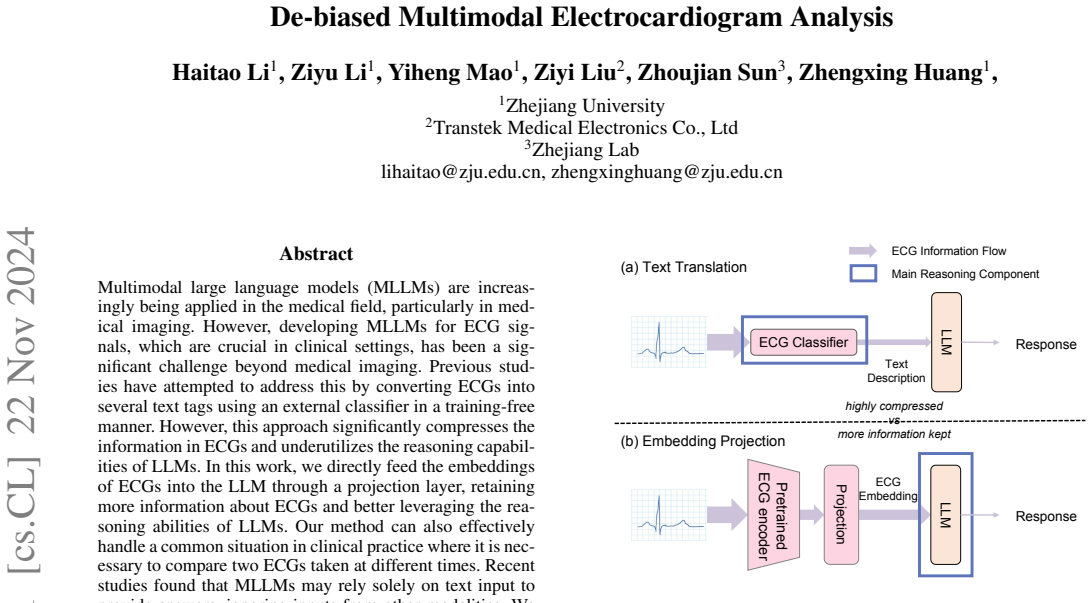
The load-bearing components are (1) an ECG encoder, a Vision-Transformer-style architecture pre-trained with multimodal contrastive learning on roughly 800,000 ECG–report pairs; (2) a linear projection layer that maps downsampled ECG encoder tokens into the token space of LLaMA2-7B-chat, with LoRA adapters keeping the LLM mostly frozen; and (3) the de-biased pre-training dataset, constructed by pairing each verify-type question with an ECG that answers 'yes' and an ECG that answers 'no,' intended to realize the backdoor adjustment formula and remove the severity-of-illness confounder. The mechanism that carries the argument is the Random ECG Test: replacing the input ECG with a random one and measuring the accuracy drop, which the paper uses as a probe for whether the model truly uses the ECG signal.
What would settle it
Measure a severity label (for example, number of abnormal leads or a clinical risk score) on the ECG-QA pairs, then check whether the de-biased model's accuracy varies across severity strata when the question wording is held fixed. If the model still answers correctly on 'yes' ECGs and incorrectly on 'no' ECGs in a way that tracks severity, the backdoor adjustment has not removed the confounder. A second falsifier: if a model trained with flipped yes/no pairing (or with pairs matched on severity) shows a similar Random ECG Test drop, the claimed necessity of the de-biasing scheme is called into question.
Extended reading notes
Core claim
The paper claims that the failure of ECG multimodal LLMs to use the input signal can be traced to a backdoor path $X \leftarrow C \rightarrow Y$, where $X$ is the (ECG, question) pair, $Y$ is the answer, and $C$ is the latent 'severity of illness.' Because sick patients ask more specific questions and get more 'abnormal' answers, the question text alone becomes a proxy for the answer. The authors implement the backdoor adjustment $P(Y \mid \mathrm{do}(X)) = \sum_c P(Y \mid X, c) P(c)$ by constructing a de-biased pre-training set: for every yes/no question, they pair one ECG that yields 'yes' with one that yields 'no,' balancing the strata. The result, they report, is a model that outperforms text-tagging baselines on the ECG-QA benchmark across single and dual-ECG question types, generalizes zero-shot to four external ECG datasets, and — the crucial test — loses 18.2 points of accuracy when the input ECG is replaced by a random recording, whereas the non-de-biased model loses only 2.0 points. The paper interprets this accuracy collapse as direct evidence that the de-biased model relies on the ECG content.
Load-bearing premise
The de-biased pre-training assumes that pairing each question with one ECG that yields 'yes' and one that yields 'no' actually implements the backdoor adjustment and removes the severity-of-illness confounder — but the paper never measures severity, so if the pairing does not balance the confounder, the causal claim collapses and the method is just a data re-balancing heuristic.
Editorial extensions
If this is right
- If correct, ECG question-answering models can be built that condition on the raw waveform, preserving information that text-tag pipelines compress away.
- The de-biasing recipe — per-question yes/no ECG pairing before fine-tuning — could become a standard pre-training step for medical MLLMs to break question–answer shortcuts.
- The method extends naturally to dual-ECG comparison questions, so longitudinal 'have things changed?' queries can be answered by the same architecture.
- The Random ECG Test offers a simple, model-agnostic diagnostic for whether any multimodal model is actually using its non-text input.
- Zero-shot results on external ECG datasets suggest the de-biased model can screen for arrhythmias without task-specific fine-tuning.
Reading between the lines
- The confounder argument likely transfers to other medical VQA settings where question specificity correlates with disease severity (for example, radiology reports); a severity-stratified question set would be a stronger test of genuine modality use than a random-input probe.
- The Random ECG Test could be sharpened into a calibration metric: instead of a random ECG, use a matched ECG from a different patient with the same diagnosis, separating 'uses ECG content' from 'uses ECG identity.'
- Because the paper never measures severity, the same de-biasing recipe could be tested with an explicit severity stratification (e.g., number of abnormal leads) to see whether the accuracy on the Random ECG Test further improves; this would convert the causal claim from assumption to measurement.
- A fully matched design — pairing yes/no ECGs on patient severity, age, and sex — might eliminate residual confounding more cleanly than the current question-level pairing, and would offer a direct test of whether the 1:1 ratio is doing the causal work.
Editorial analysis
A structured set of objections, weighed in public.
Referee Report
Summary. The paper proposes an ECG multimodal large language model (MLLM) that feeds ECG embeddings directly into LLaMA2-7B-chat through a learned projection, with LoRA adapters, rather than converting ECGs into text tags via an external classifier. The authors also present a causal analysis of ECG question-answering, arguing that a latent confounder, “severity of illness,” creates a spurious correlation between question text and answer, and they design a “de-biased” pre-training stage that pairs each yes/no question with one ECG yielding a yes answer and one yielding a no answer. The model is evaluated on the ECG-QA dataset under adversarial train/test splits, on zero-shot classification across four ECG datasets, and in an ablation study using a Random ECG Test. The main empirical findings are that the de-biased model outperforms baselines on most ECG-QA subsets, shows competitive zero-shot AUC, and exhibits a much larger accuracy drop than the non-de-biased model when the input ECG is replaced with a random ECG. The paper concludes that the model genuinely understands and utilizes the ECG signal.
Significance. If the causal interpretation and the Random ECG Test evidence were fully supported, this would be a valuable contribution to medical MLLMs: it would show both a practical architecture for ECG-grounded question answering and a method for reducing a model’s reliance on spurious question-answer correlations. The direct-embedding architecture, support for dual-ECG comparison, use of public benchmarks, and the demonstration that a model can be made more sensitive to the ECG input are all useful and credible components. However, the central causal claim is not backed by measurement of the confounder or a valid implementation of backdoor adjustment, and the Random ECG Test lacks controls for non-clinical sensitivity. As it stands, the paper is best read as an empirical engineering contribution with promising results, but the causal and interpretational conclusions outrun the evidence.
major comments (4)
- [Method: De-biased Pre-training, Eq. (6) and Table 1] The construction in Table 1(Lower) does not implement the backdoor adjustment in Eq. (6). The paper never measures the confounder C (“severity of illness”), never estimates P(c), and never stratifies the paired examples by any severity label. Equalizing the number of yes and no ECGs per question changes the marginal P(Y|question), but it is not equivalent to summing P(Y|X,c)P(c) over strata of C. Moreover, X in Eq. (6) is a single variable, while here X includes both the ECG and the question; applying the formula without further justification is not straightforward. The claim that the model is “deconfounded” is therefore unsupported. At minimum, the authors should reframe the procedure as a dataset-rebalancing heuristic, or provide a measured severity proxy and show that the paired data are balanced within severity strata.
- [Ablation Study with Random ECG Test, Table 5] The Random ECG Test does not, by itself, establish that the model “understands and utilizes” the ECG signal. The paper does not state how the random ECGs were generated (random patient recordings, noise, phase-randomized signals, or another source), nor does it include a control condition that preserves non-clinical statistics of the signal. Because the de-biased pre-training stage trains the projection and LoRA on paired yes/no ECGs for each question, the model may become sensitive to any ECG variation, including non-clinical artifacts, lead configurations, or amplitude calibration. A permuted-ECG control, a lead-shuffle control, or a noise-injection control is needed to distinguish clinical comprehension from brittle low-level sensitivity. The zero-shot results in Table 4 provide supporting evidence for clinically meaningful representations, but they are not integrated into the Random ECG Test comparison.
- [Introduction and Table 1(Upper)] The evidence for the causal claim C → X is only correlational. Table 1(Upper) shows that questions mentioning specific abnormalities are associated with a lower proportion of normal ECGs, but this does not establish that “severity of illness” causes question wording. The text says “we will prove this quantitatively in Table 1(Upper),” which overstates what the table can show. The authors should either temper the causal language or provide a sensitivity analysis over plausible severity distributions, ideally with an objective severity measure such as the number of abnormal findings or a clinical diagnosis label.
- [Experiments, ECG-QA Results, Table 3] The claim that the model “consistently outperformed both traditional and LLM-based methods” is too strong relative to the table. The model is worse than the best baseline on CC-Query (15.2 vs 22.0 for MedViLL) and CI-Query (3.2 vs 4.2), and no error bars, multiple seeds, or significance tests are reported. The central empirical claim would be strengthened by reporting variance across seeds and a statistical test, or at least by explicitly acknowledging the subsets where the method does not win and discussing why the de-biased pre-training may not transfer to query-type questions.
minor comments (5)
- [Throughout] There are several typos and formatting issues, including “Feed Froward” in Eq. (3), “Alighment” in the heading, and inconsistent spacing in equations such as Eq. (5).
- [Ablation Study with Random ECG Test, Table 5] The sentence “The de-biased model’s accuracy under the Random ECG Test is even lower than the non-de-biased model (about Random Guess)” is unclear: for binary verify questions, random guessing would be near 50%, but the reported values are near 65% and the random baseline for multi-class subsets is not defined. Please specify what “Random Guess” refers to.
- [Method, Eq. (5)] The downsampling notation z[4i], z[4i+1], z[4i+2], z[4i+3] is ambiguous without stating whether indices are 0-based and how boundary tokens are handled; please clarify.
- [Training] The de-biased pre-training stage uses only Verify questions, but the second stage adds Choose and Query questions. The paper should clarify how the de-biasing effect transfers to the other question types, since the Random ECG Test in Table 5 reports only Verify-type subsets.
- [Experiments, Zero-Shot Ability, Table 4] The zero-shot results are reported without confidence intervals or significance tests. Given the small differences on several labels, a measure of variance would help assess whether the improvements are meaningful.
Circularity Check
No significant circularity: the core ECG-QA and zero-shot results are held-out evaluations, and the random-ECG probe is an empirical intervention rather than a fitted prediction or self-cited premise.
full rationale
The paper's main claimed derivation chain is an ECG encoder pretrained on MIMIC-ECG report pairs, a projection into LLaMA2-7B-chat, LoRA fine-tuning on the ECG-QA training split, and evaluation on the ECG-QA adversarial test split and on external zero-shot datasets (PTB-XL, LUDB, Shaoxing, CPSC). These evaluations are not fitted to the test data, and the reported gains are external to the training objective. The de-biased pretraining step constructs paired yes/no ECG examples for each question from the training split, which is a data-balancing intervention; calling it a backdoor adjustment (Eq. 6) is a causal interpretation that is not experimentally verified, but that is a validity gap rather than a circular reduction: the paper never defines 'de-biased' as equivalent to the outcome it later claims, and the random-ECG test is an additional probe rather than the training objective. The random-ECG test itself is an intervention that replaces the input ECG with a random one and measures accuracy change; while one may question whether the drop reflects clinical comprehension versus low-level sensitivity (no permuted-ECG or noise control is reported), this is a test-design validity concern, not an equation-to-equation identity or a fitted parameter renamed as a prediction. No load-bearing self-citation is present: the cited prior work on ECG-QA, MIMIC-ECG, and ECG encoders is external, and no 'uniqueness theorem' from the authors is invoked to force the architecture or the debiasing choice. Therefore, under the stated circularity criteria, the paper merits a score of 0.
Assumptions & free parameters
free parameters (2)
- Yes/no pairing ratio in de-biased dataset =
1:1 chosen by hand
- ECG token downsampling factor =
4
assumptions (5)
- standard math Backdoor adjustment is a valid method for identifying P(Y|do(X)) in the specified SCM.
- domain assumption Severity of illness is the only confounder affecting both question and answer in ECG QA.
- domain assumption The ECG-QA adversarial split guarantees test questions are rephrased versions of training questions.
- domain assumption The MIMIC-ECG contrastive pre-training produces ECG embeddings that capture clinically relevant information for QA.
- domain assumption Replacing an ECG with a random ECG from the same dataset is an adequate probe of ECG reliance.
invented entities (1)
-
Latent confounder 'severity of illness' (C)
Cite this review
Pith. "Pith review of De-biased Multimodal Electrocardiogram Analysis." pith.science (2026). https://pith.science/paper/ZFFXWRMX
@misc{pith2026241114795,
  author       = {Pith},
  title        = {Pith review of: De-biased Multimodal Electrocardiogram Analysis},
  year         = {2026},
  howpublished = {\url{https://pith.science/paper/ZFFXWRMX}},
  note         = {Machine review of arXiv:2411.14795}
}
read the original abstract
Multimodal large language models (MLLMs) are increasingly being applied in the medical field, particularly in medical imaging. However, developing MLLMs for ECG signals, which are crucial in clinical settings, has been a significant challenge beyond medical imaging. Previous studies have attempted to address this by converting ECGs into several text tags using an external classifier in a training-free manner. However, this approach significantly compresses the information in ECGs and underutilizes the reasoning capabilities of LLMs. In this work, we directly feed the embeddings of ECGs into the LLM through a projection layer, retaining more information about ECGs and better leveraging the reasoning abilities of LLMs. Our method can also effectively handle a common situation in clinical practice where it is necessary to compare two ECGs taken at different times. Recent studies found that MLLMs may rely solely on text input to provide answers, ignoring inputs from other modalities. We analyzed this phenomenon from a causal perspective in the context of ECG MLLMs and discovered that the confounder, severity of illness, introduces a spurious correlation between the question and answer, leading the model to rely on this spurious correlation and ignore the ECG input. Such models do not comprehend the ECG input and perform poorly in adversarial tests where different expressions of the same question are used in the training and testing sets. We designed a de-biased pre-training method to eliminate the confounder's effect according to the theory of backdoor adjustment. Our model performed well on the ECG-QA task under adversarial testing and demonstrated zero-shot capabilities. An interesting random ECG test further validated that our model effectively understands and utilizes the input ECG signal.
Figures


Figures from the paper (1 more)

Reference graph
Works this paper leans on
-
[1]
, " * write output.state after.block = add.period write newline
ENTRY address archivePrefix author booktitle chapter edition editor eid eprint howpublished institution isbn journal key month note number organization pages publisher school series title type volume year label extra.label sort.label short.list INTEGERS output.state before.all mid.sentence after.sentence after.block FUNCTION init.state.consts #0 'before.a...
-
[2]
write newline
" write newline "" before.all 'output.state := FUNCTION n.dashify 't := "" t empty not t #1 #1 substring "-" = t #1 #2 substring "--" = not "--" * t #2 global.max substring 't := t #1 #1 substring "-" = "-" * t #2 global.max substring 't := while if t #1 #1 substring * t #2 global.max substring 't := if while FUNCTION word.in bbl.in capitalize " " * FUNCT...
-
[3]
Acharya, U. R.; Fujita, H.; Oh, S. L.; Raghavendra, U.; Tan, J. H.; Adam, M.; Gertych, A.; and Hagiwara, Y. 2018. Automated identification of shockable and non-shockable life-threatening ventricular arrhythmias using convolutional neural network. Future Generation Computer Systems, 79: 952--959
work page 2018
- [4]
-
[5]
Alayrac, J.-B.; Donahue, J.; Luc, P.; Miech, A.; Barr, I.; Hasson, Y.; Lenc, K.; Mensch, A.; Millican, K.; Reynolds, M.; et al. 2022. Flamingo: a visual language model for few-shot learning. Advances in Neural Information Processing Systems, 35: 23716--23736
2022
-
[6]
Chen, Z.; Du, Y.; Hu, J.; Liu, Y.; Li, G.; Wan, X.; and Chang, T.-H. 2022. Multi-modal masked autoencoders for medical vision-and-language pre-training. In International Conference on Medical Image Computing and Computer-Assisted Intervention, 679--689. Springer
work page 2022
-
[7]
Dong, Y.; Chen, H.; Chen, J.; Fang, Z.; Yang, X.; Zhang, Y.; Tian, Y.; Su, H.; and Zhu, J. 2023. How Robust is Google's Bard to Adversarial Image Attacks? arXiv preprint arXiv:2309.11751
arXiv 2023
-
[8]
Dosovitskiy, A.; Beyer, L.; Kolesnikov, A.; Weissenborn, D.; Zhai, X.; Unterthiner, T.; Dehghani, M.; Minderer, M.; Heigold, G.; Gelly, S.; et al. 2020. An image is worth 16x16 words: Transformers for image recognition at scale. arXiv preprint arXiv:2010.11929
arXiv 2020
Show all 44 references
-
[9]
H.; Karlinsky, L.; and Glass, J
Gong, Y.; Luo, H.; Liu, A. H.; Karlinsky, L.; and Glass, J. 2023. Listen, think, and understand. arXiv preprint arXiv:2305.10790
2023 arXiv
-
[10]
J.; Mirza, M.; Xiao, D.; Courville, A.; and Bengio, Y
Goodfellow, I. J.; Mirza, M.; Xiao, D.; Courville, A.; and Bengio, Y. 2013. An empirical investigation of catastrophic forgetting in gradient-based neural networks. arXiv preprint arXiv:1312.6211
2013 arXiv
-
[11]
A.; Johnson, A.; Moody, B.; Fernandes, C.; Greenbaum, N.; Berkowitz, S.; Moukheiber, D.; Eslami, P.; et al
Gow, B.; Pollard, T.; Nathanson, L. A.; Johnson, A.; Moody, B.; Fernandes, C.; Greenbaum, N.; Berkowitz, S.; Moukheiber, D.; Eslami, P.; et al. ???? MIMIC-IV-ECG-Diagnostic Electrocardiogram Matched Subset
-
[12]
Guo, L.; Sim, G.; and Matuszewski, B. 2019. Inter-patient ECG classification with convolutional and recurrent neural networks. Biocybernetics and Biomedical Engineering, 39(3): 868--879
2019
-
[13]
Han, H.; Park, S.; Min, S.; Choi, H.-S.; Kim, E.; Kim, H.; Park, S.; Kim, J.; Park, J.; An, J.; et al. 2021. Towards high generalization performance on electrocardiogram classification. In 2021 Computing in Cardiology (CinC), volume 48, 1--4. IEEE
2021
-
[14]
J.; Shen, Y.; Wallis, P.; Allen-Zhu, Z.; Li, Y.; Wang, S.; Wang, L.; and Chen, W
Hu, E. J.; Shen, Y.; Wallis, P.; Allen-Zhu, Z.; Li, Y.; Wang, S.; Wang, L.; and Chen, W. 2021. Lora: Low-rank adaptation of large language models. arXiv preprint arXiv:2106.09685
2021 arXiv
-
[15]
I.; Yusipov, I
Kalyakulina, A. I.; Yusipov, I. I.; Moskalenko, V. A.; Nikolskiy, A. V.; Kosonogov, K. A.; Osipov, G. V.; Zolotykh, N. Y.; and Ivanchenko, M. V. 2020. LUDB: a new open-access validation tool for electrocardiogram delineation algorithms. IEEE access, 8: 186181--186190
2020
-
[16]
Kiranyaz, S.; Ince, T.; and Gabbouj, M. 2015. Real-time patient-specific ECG classification by 1-D convolutional neural networks. IEEE Transactions on Biomedical Engineering, 63(3): 664--675
2015
-
[17]
C.; Lo, W.-Y.; et al
Kirillov, A.; Mintun, E.; Ravi, N.; Mao, H.; Rolland, C.; Gustafson, L.; Xiao, T.; Whitehead, S.; Berg, A. C.; Lo, W.-Y.; et al. 2023. Segment anything. In Proceedings of the IEEE/CVF International Conference on Computer Vision, 4015--4026
2023
-
[18]
Li, C.; Wong, C.; Zhang, S.; Usuyama, N.; Liu, H.; Yang, J.; Naumann, T.; Poon, H.; and Gao, J. 2023 a . Llava-med: Training a large language-and-vision assistant for biomedicine in one day. arXiv preprint arXiv:2306.00890
2023 arXiv
-
[19]
Li, J.; Li, D.; Savarese, S.; and Hoi, S. 2023 b . Blip-2: Bootstrapping language-image pre-training with frozen image encoders and large language models. In International conference on machine learning, 19730--19742. PMLR
2023
-
[20]
Liu, C.; Ma, Y.; Kothur, K.; Nikpour, A.; and Kavehei, O. 2023 a . BioSignal Copilot: Leveraging the power of LLMs in drafting reports for biomedical signals. medRxiv, 2023--06
2023
-
[21]
Liu, F.; Liu, C.; Zhao, L.; Zhang, X.; Wu, X.; Xu, X.; Liu, Y.; Ma, C.; Wei, S.; He, Z.; et al. 2018. An open access database for evaluating the algorithms of electrocardiogram rhythm and morphology abnormality detection. Journal of Medical Imaging and Health Informatics, 8(7)...
2018
-
[22]
Liu, H.; Li, C.; Wu, Q.; and Lee, Y. J. 2023 b . Visual instruction tuning. arXiv preprint arXiv:2304.08485
2023 arXiv
-
[23]
Liu, S.; Zheng, K.; and Chen, W. 2024. Paying More Attention to Image: A Training-Free Method for Alleviating Hallucination in LVLMs. arXiv preprint arXiv:2407.21771
2024 arXiv
-
[24]
Maaz, M.; Rasheed, H.; Khan, S.; and Khan, F. S. 2023. Video-chatgpt: Towards detailed video understanding via large vision and language models. arXiv preprint arXiv:2306.05424
2023 arXiv
-
[25]
H.; Lee, H.; Shin, W.; Kim, Y.-H.; and Choi, E
Moon, J. H.; Lee, H.; Shin, W.; Kim, Y.-H.; and Choi, E. 2022. Multi-modal understanding and generation for medical images and text via vision-language pre-training. IEEE Journal of Biomedical and Health Informatics, 26(12): 6070--6080
2022
-
[26]
P.; and Rajpurkar, P
Moor, M.; Huang, Q.; Wu, S.; Yasunaga, M.; Dalmia, Y.; Leskovec, J.; Zakka, C.; Reis, E. P.; and Rajpurkar, P. 2023. Med-flamingo: a multimodal medical few-shot learner. In Machine Learning for Health (ML4H), 353--367. PMLR
2023
-
[27]
Na, Y.; Park, M.; Tae, Y.; and Joo, S. 2024. Guiding Masked Representation Learning to Capture Spatio-Temporal Relationship of Electrocardiogram. arXiv preprint arXiv:2402.09450
2024 arXiv
-
[28]
Oh, J.; Bae, S.; Lee, G.; Kwon, J.-m.; and Choi, E. 2023. ECG-QA: A Comprehensive Question Answering Dataset Combined With Electrocardiogram. arXiv preprint arXiv:2306.15681
2023 arXiv
-
[29]
Pearl, J.; Glymour, M.; and Jewell, N. P. 2016. Causal inference in statistics: A primer. John Wiley & Sons
2016
-
[30]
W.; Hallacy, C.; Ramesh, A.; Goh, G.; Agarwal, S.; Sastry, G.; Askell, A.; Mishkin, P.; Clark, J.; et al
Radford, A.; Kim, J. W.; Hallacy, C.; Ramesh, A.; Goh, G.; Agarwal, S.; Sastry, G.; Askell, A.; Mishkin, P.; Clark, J.; et al. 2021. Learning transferable visual models from natural language supervision. In International conference on machine learning, 8748--8763. PMLR
2021
-
[31]
R.; and Nguyen, A
Rahmanzadehgervi, P.; Bolton, L.; Taesiri, M. R.; and Nguyen, A. T. 2024. Vision language models are blind. arXiv preprint arXiv:2407.06581
2024 arXiv
-
[32]
K.; Asawaroengchai, C.; Nguyen, D
Rubenstein, P. K.; Asawaroengchai, C.; Nguyen, D. D.; Bapna, A.; Borsos, Z.; Quitry, F. d. C.; Chen, P.; Badawy, D. E.; Han, W.; Kharitonov, E.; et al. 2023. AudioPaLM: A Large Language Model That Can Speak and Listen. arXiv preprint arXiv:2306.12925
2023 arXiv
-
[33]
H.; Hagiwara, Y.; Pang, W.; Lim, I.; Oh, S
Tan, J. H.; Hagiwara, Y.; Pang, W.; Lim, I.; Oh, S. L.; Adam, M.; San Tan, R.; Chen, M.; and Acharya, U. R. 2018. Application of stacked convolutional and long short-term memory network for accurate identification of CAD ECG signals. Computers in biology and medicine, 94: 19--26
2018
-
[34]
Touvron, H.; Lavril, T.; Izacard, G.; Martinet, X.; Lachaux, M.-A.; Lacroix, T.; Rozi \`e re, B.; Goyal, N.; Hambro, E.; Azhar, F.; et al. 2023. Llama: Open and efficient foundation language models. arXiv preprint arXiv:2302.13971
2023 arXiv
-
[35]
Tu, T.; Azizi, S.; Driess, D.; Schaekermann, M.; Amin, M.; Chang, P.-C.; Carroll, A.; Lau, C.; Tanno, R.; Ktena, I.; et al. 2023. Towards generalist biomedical ai. arXiv preprint arXiv:2307.14334
2023 arXiv
-
[36]
N.; Kaiser, .; and Polosukhin, I
Vaswani, A.; Shazeer, N.; Parmar, N.; Uszkoreit, J.; Jones, L.; Gomez, A. N.; Kaiser, .; and Polosukhin, I. 2017. Attention is all you need. Advances in neural information processing systems, 30
2017
-
[37]
I.; Samek, W.; and Schaeffter, T
Wagner, P.; Strodthoff, N.; Bousseljot, R.-D.; Kreiseler, D.; Lunze, F. I.; Samek, W.; and Schaeffter, T. 2020. PTB-XL, a large publicly available electrocardiography dataset. Scientific data, 7(1): 154
2020
-
[38]
Wan, Z.; Liu, C.; Wang, X.; Tao, C.; Shen, H.; Peng, Z.; Fu, J.; Arcucci, R.; Yao, H.; and Zhang, M. 2024. Electrocardiogram instruction tuning for report generation. arXiv preprint arXiv:2403.04945
2024 arXiv
-
[39]
Wang, W.; Lv, Q.; Yu, W.; Hong, W.; Qi, J.; Wang, Y.; Ji, J.; Yang, Z.; Zhao, L.; Song, X.; et al. 2023 a . Cogvlm: Visual expert for pretrained language models. arXiv preprint arXiv:2311.03079
2023 arXiv
-
[40]
Wang, Y.; Zhang, R.; Wang, H.; Bhattacharya, U.; Fu, Y.; and Wu, G. 2023 b . VaQuitA: Enhancing Alignment in LLM-Assisted Video Understanding. arXiv preprint arXiv:2312.02310
2023 arXiv
-
[41]
Yan, Q.; He, X.; Yue, X.; and Wang, X. E. 2024. Worse than Random? An Embarrassingly Simple Probing Evaluation of Large Multimodal Models in Medical VQA. arXiv preprint arXiv:2405.20421
2024 arXiv
-
[42]
Yildirim, \"O . 2018. A novel wavelet sequence based on deep bidirectional LSTM network model for ECG signal classification. Computers in biology and medicine, 96: 189--202
2018
-
[43]
Zhang, Y.; Unell, A.; Wang, X.; Ghosh, D.; Su, Y.; Schmidt, L.; and Yeung-Levy, S. 2024. Why are Visually-Grounded Language Models Bad at Image Classification? arXiv preprint arXiv:2405.18415
2024 arXiv
-
[44]
Zheng, J.; Guo, H.; and Chu, H. 2022. A large scale 12-lead electrocardiogram database for arrhythmia study (version 1.0. 0). PhysioNet 2022Available online: http://physionet. org/content/ecg-arrhythmia/1.0. 0/(accessed on 23 November 2022)
2022
Reviewed August 12, 2026 · model on record in the stance chip above.
Discussion (0). Continue with ORCID to comment.