REVIEW 4 major objections 4 minor 68 references
Machine Learning Insights into Quark-Antiquark Interactions: Probing Field Distributions and String Tension in QCD
T0 review · 4 major / 4 minor · reviewed 2026-08-12 · deepseek-v4-flash
Pith's one-line read The paper claims that a Kolmogorov–Arnold network trained on lattice QCD data produces a compact two-variable formula for the quark–antiquark chromoelectric field that reproduces the flux-tube string tension and width.
desk verdict Useful ML application to flux tube data, but the main KAN fit doesn't decay at large transverse distance, so the string tension and width integrals are undefined without a cutoff the paper never states. read the letter →
The pith
A machine-rendered reading of the paper's core claim, the machinery that carries it, and where it could break.
The reading
What carries the argument
The central object is the Kolmogorov–Arnold network (KAN), a neural architecture in which learnable spline activation functions on the edges embody the Kolmogorov–Arnold superposition theorem, so a multivariate function is represented as a finite sum of univariate functions. The paper's KAN configuration (2,6,1) for the two-variable problem is pruned and refined until the surviving single path can be read out as the symbolic formula in Eq. (4). An MLP with two hidden layers of 128 ReLU neurons serves as the benchmark, and the Clem parameterization, $E(x_t) = \frac{\phi}{2\pi}\frac{\mu^2}{\alpha}\frac{K_0[(\mu^2 x_t^2 + \alpha^2)^{1/2}]}{K_1[\alpha]}$, is the conventional fitting form used for comparison.
What would settle it
A high-statistics lattice QCD calculation of the chromoelectric field at a separation not in the training set, such as $d = 0.8$ fm, with its transverse profile compared against Eq. (4), would falsify the claim if the disagreement exceeds the simulation's quoted uncertainties.
Extended reading notes
Core claim
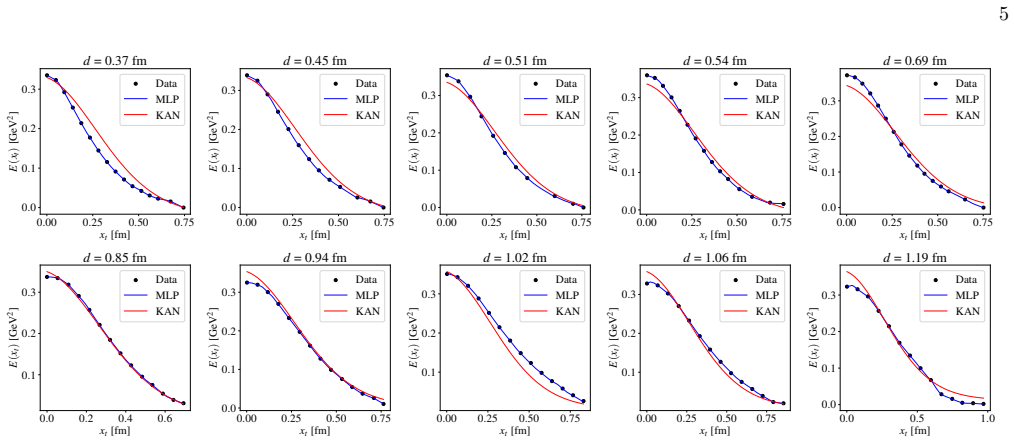
The paper's central discovery is a two-dimensional analytic expression for the chromoelectric field between a static quark–antiquark pair, obtained by training a Kolmogorov–Arnold network on the non-perturbative lattice data of Ref. [13]. Written as $E(d,x_t) = 0.0423\,d - 0.0388 + 0.0103\,\exp[-3.5478\,\sin(1.68\,x_t + 4.791)]$, it describes the transverse profile of the flux tube at ten separations and, according to the authors, closely mirrors lattice results. The expression is fed into $\sigma_T \simeq \frac{1}{2}\int d^2x_t\, E^2(x_t)$ and the flux-tube width integral to compute the string tension and width, which the authors compare with lattice values; they report that the MLP surrogate remains more accurate for the string tension while the KAN supplies the interpretable symbolic form. The paper presents this as a proof of principle that a neural-network inverse-problem approach can yield continuous descriptions where traditional parameterizations require a separate fit at each separation.
Load-bearing premise
The fitted formula inherits any errors in the lattice data used for training and assumes the chromo field does not vary along the longitudinal coordinate, so if either fails, the derived string tension and width are unreliable.
Editorial extensions
If this is right
- If Eq. (4) is correct, the chromo field can be interpolated continuously across quark separations from about 0.37 to 1.19 fm without refitting at each d.
- The learned formula, used in Eqs. (1) and (5), yields string tension and flux-tube width that can be checked against lattice results, providing a fast forward model for these observables.
- The KAN's symbolic output turns a black-box fit into an interpretable expression, making it straightforward to insert into analytic models of confinement and string breaking.
- The same training approach can be applied to other lattice QCD observables, such as the chromomagnetic field or full-QCD data, as more simulations become available.
Reading between the lines
- The structure of Eq. (4) implies the transverse shape of the flux tube changes only mildly with separation, since $d$ enters linearly and $x_t$ enters only through the oscillatory exponential; this shape-similarity is a testable prediction for new lattice data.
- Because the paper does not propagate lattice uncertainties into the KAN fit, the resulting formula has no error bars; a careful error analysis would determine whether the apparent agreement with the string tension is statistically meaningful.
- A natural next step is to include the longitudinal coordinate or temperature as additional inputs, which would let the fit test the paper's working assumption of longitudinal independence instead of assuming it.
- If Eq. (4) holds at intermediate separations not simulated, it could serve as an interpolation tool bridging the gap between small and large $d$ where lattice signal-to-noise degrades.
Editorial analysis
A structured set of objections, weighed in public.
Referee Report
Summary. The paper trains MLP and KAN networks on lattice QCD chromoelectric field profiles for quark-antiquark separations d ≈ 0.37–1.19 fm, using data from Ref. [13]. It reports MLP training and test losses near 1e-5, obtains a compact bivariate KAN symbolic expression for E(d, x_t) in Eq. (4), and uses Eqs. (1) and (5) to compute flux-tube string tension and width, comparing them with lattice results in Fig. 6. The central claim is that the KAN expression closely mirrors the lattice field distributions and provides a continuous analytic surrogate over the studied separations, demonstrating the usefulness of machine learning for QCD flux-tube phenomenology.
Significance. If the KAN formula in Eq. (4) were reliable, it would be a genuinely useful compact interpolant for the flux-tube profile as a function of both transverse coordinate and quark separation, going beyond the per-separation Clem fits of Eq. (2). The paper also provides a concrete MLP-versus-KAN comparison on a small physics dataset, and the low MLP loss with a held-out test set is a useful sanity check that the lattice data can be interpolated by a neural network. However, the quantitative payoff of the paper—the KAN string-tension and width curves in Fig. 6—is not established by the analysis as presented, because Eq. (4) is not normalizable, the comparison is in-sample, and no uncertainties are propagated. These issues must be addressed before the central quantitative claims can be accepted.
major comments (4)
- [Section III B, Eq. (4), Eqs. (1) and (5)] The KAN expression in Eq. (4) does not approach zero as x_t increases: the factor exp[-3.5478 sin(1.68 x_t + 4.791)] is bounded and oscillatory, so the integrals defining sigma_T and sqrt(w^2) do not converge over the full transverse plane. Since the manuscript neither specifies an integration cutoff nor justifies truncating the domain, every KAN-based point in Fig. 6 depends on an unspecified regularization, and the claimed agreement with the lattice results is not a well-defined quantitative statement. The problem is visible even inside the training range: for d = 0.37 fm and x_t = 0.85 fm, Eq. (4) gives E approximately -0.010 GeV^2, where the lattice profiles are non-negative, so the surrogate is not locally faithful either. This is aggravated by the authors' own warning in Sec. III A that KAN cannot accurately predict the unknown region.
- [Section III B and Fig. 6] The comparison in Fig. 6 is a self-consistency check rather than an independent validation, because Eq. (4) is fitted to the same lattice data from Ref. [13] that are then used as the 'Data' curves in that figure. The 20% held-out test set described in Sec. II B is selected from the same ten separations, so it cannot validate extrapolation or even interpolation in d. The predictive claim made in the abstract and in Sec. IV would require a separation-based holdout, such as training on nine values of d and testing on the tenth, or comparison with an independent lattice calculation; as it stands, the agreement only shows that the fitted formula reproduces its own training set.
- [Section III B and Fig. 5] The bivariate KAN training loss converges only to about 1e-2, three orders of magnitude worse than the MLP training and test losses of about 1e-5. Because Eq. (4) is the symbolic output of that same KAN training and the KAN curves in Fig. 6 are computed from Eq. (4), the KAN-based string tension and width carry an unknown but potentially large error. This is compounded by the explicit decision in Sec. III A not to consider uncertainties associated with the lattice simulation results or the parameterization; no error bars are propagated to Fig. 6, so the significance of the deviations between MLP, KAN, and lattice data cannot be assessed.
- [Sections II B, III A, and III B] The network architectures are described inconsistently, which prevents reproduction of the central numerical results. Figure 1 and Sec. II B specify an MLP with two hidden layers of 128 ReLU neurons; Sec. III A states that the MLP input is a single neuron for the univariate feasibility test; and Sec. III B introduces a '(2,6,1)' configuration without clarifying whether it replaces the earlier 128-neuron description. For KAN, Sec. II B gives a (1,3,1,1) structure while Sec. III A gives (1,3,3,1). Because the MLP and KAN results in Fig. 6 depend on these architectural choices, the paper should provide a consistent architecture and hyperparameter table, or release the code, before the numerical results can be considered reproducible.
minor comments (4)
- [Fig. 6, second panel] The y-axis label 'sqrt(w^2) [fm^2]' is dimensionally inconsistent: Eq. (5) defines sqrt(w^2) as a length, so the unit should be fm, or the label should be w^2.
- [Sec. I] The sentence 'where the signal-to-noise ratio becomes excessively high' should presumably read 'low' or 'unfavorable', since lattice signals degrade at large separations.
- [Sec. III B] The phrase 'with the calculation method outlined in the square root of Eq. (1)' is unclear; if Ref. [13] reports sqrt(sigma_T), the paper should explain how that quantity was obtained and how it is compared with the integral in Eq. (1).
- [Sec. II B and Eq. (3)] The output notation in Sec. II B says the output layer 'represents E(x_t)', although the bivariate model outputs E(d, x_t); please update the notation for consistency. In addition, Eq. (3) shares the non-decaying oscillatory behavior of Eq. (4); if KAN expressions are to be used as physical parameterizations in future work, a decaying or explicitly cutoff-regulated form should be imposed.
Circularity Check
The analytic KAN formula is a regression to the lattice field data, so the paper's Fig. 6 string-tension/width comparison is a self-consistency check rather than an independent prediction; no load-bearing self-citation circularity is present.
-
fitted input called prediction
[Section III B, paragraph before Fig. 6; Eqs. (1), (4), (5); echoed in Section IV]
"At this point, we have obtained the MLP and KAN results trained using lattice simulation data, making it necessary to calculate the corresponding flux tube string tension of the chromo field. In Ref. [13], the authors also provide results for the flux tube string tension, with the calculation method outlined in the square root of Eq. (1). ... In Fig. 6, we present the results of the chromo field calculated using both machine learning architectures to determine the flux tube string tension and flux tube width, compare them with the lattice results."
Eq. (4) is a symbolic-regression fit to the same Ref. [13] field data E(d, xt) that Ref. [13] used to obtain its string-tension and width values via the same Eqs. (1) and (5). Feeding the fitted E back through Eqs. (1) and (5) and comparing with the lattice values computes F(fit(E_lattice)) versus F(E_lattice) with identical functional F; any faithful fit reproduces the comparison. The 20% held-out split is reported only for MLP field-level error, not for the integrated Fig. 6 comparison, and no test split is described for the 2D KAN fit. The comparison is therefore a self-consistency check, not an independent prediction, and the agreement is forced once the field fit is accurate.
full rationale
The derivation of Eq. (4) itself is an honest curve fit, not a circular derivation: the paper explicitly describes the KAN symbolic-expression step as linear regression and acknowledges that KAN cannot reliably predict outside the training interval. The MLP field-level fit is partly checked on a 20% held-out test set. However, the paper's strongest quantitative claim, the Fig. 6 comparison of string tension and flux-tube width, is a fitted-input comparison: the same lattice field data from Ref. [13] that generated the training set also generated the lattice string-tension/width values, and the trained surrogate is fed through the same integral definitions. That comparison is statistically forced once the field-level fit is good, so it cannot serve as independent support for the method. The self-citations [23, 24] are used only as examples of prior analyses of the same external lattice data and do not carry the argument. No uniqueness theorem or ansatz-from-self-citation pattern appears. Separately, Eq. (4) contains an oscillatory, non-decaying term in x_t, so the integrals in Eqs. (1) and (5) need an unstated cutoff; that is a correctness risk, not a circularity, but it reinforces that the Fig. 6 curves are not well-defined independent outputs as presented.
Assumptions & free parameters
free parameters (3)
- KAN expression coefficients in Eq. (4) =
0.0423, -0.0388, 0.0103, -3.5478, 1.68, 4.791
- KAN expression coefficients in Eq. (3) =
0.1744, -0.1487, 1.6544, 2.6038, 7.9828, -0.1854
- MLP hyperparameters
assumptions (4)
- domain assumption The non-perturbative chromo field data from Ref. [13] are accurate and used without uncertainties.
- domain assumption The chromo field distribution is independent of the longitudinal coordinate.
- domain assumption String tension is given by sigma_T = (1/2) integral d^2 x_t E^2(x_t) (Eq. 1).
- standard math Kolmogorov-Arnold representation theorem permits representing the target as sums of univariate functions.
Cite this review
Pith. "Pith review of Machine Learning Insights into Quark-Antiquark Interactions: Probing Field Distributions and String Tension in QCD." pith.science (2026). https://pith.science/paper/EJM5LNOR
@misc{pith2026241114902,
  author       = {Pith},
  title        = {Pith review of: Machine Learning Insights into Quark-Antiquark Interactions: Probing Field Distributions and String Tension in QCD},
  year         = {2026},
  howpublished = {\url{https://pith.science/paper/EJM5LNOR}},
  note         = {Machine review of arXiv:2411.14902}
}
read the original abstract
Understanding the interactions between quark-antiquark pairs is essential for elucidating quark confinement within the framework of quantum chromodynamics (QCD). This study investigates the field distribution patterns that arise between these pairs by employing advanced machine learning techniques, namely multilayer perceptrons (MLP) and Kolmogorov-Arnold networks (KAN), to analyze data obtained from lattice QCD simulations. The models developed through this training are then applied to calculate the string tension and width associated with chromo flux tubes, and these results are rigorously compared to those derived from lattice QCD. Moreover, we introduce a preliminary analytical expression that characterizes the field distribution as a function of quark separation, utilizing the KAN methodology. Our comprehensive quantitative analysis underscores the potential of integrating machine learning approaches into conventional QCD research.
Figures


Figures from the paper (3 more)


Reference graph
Works this paper leans on
- [13]
-
[1]
J. Greensite, An Introduction to the Confinement Problem, Lecture Notes in Physics (Springer Berlin Heidelberg, 2011)
work page 2011
-
[2]
R. Gupta, Introduction to lattice QCD: Course, in Les Houches Summer School in Theoretical Physics, Session 68: Probing the Standard Model of Particle Interactions (1997) pp. 83–219, arXiv:hep-lat/9807028
arXiv 1997
-
[3]
A. Di Giacomo, M. Maggiore, and S. Olejnik, Evidence for Flux Tubes From Cooled QCD Configurations, Phys. Lett. B 236, 199 (1990)
work page 1990
-
[4]
M. Fukugita and T. Niuya, Distribution of Chromoelectric Flux in SU(2) Lattice Gauge Theory, Phys. Lett. B 132, 374 (1983)
work page 1983
-
[5]
J. W. Flower and S. W. Otto, The Field Distribution in SU(3) Lattice Gauge Theory, Phys. Lett. B 160, 128 (1985)
work page 1985
- [6]
- [7]
Show all 68 references
-
[8]
G. S. Bali, K. Schilling, and C. Schlichter, Observing long color flux tubes in SU(2) lattice gauge theory, Phys. Rev. D 51, 5165 (1995), arXiv:hep-lat/9409005
1995 arXiv
-
[9]
Luscher, G
M. Luscher, G. Munster, and P. Weisz, How Thick Are Chromoelectric Flux Tubes?, Nucl. Phys. B 180, 1 (1981)
1981
-
[10]
Baker, J
M. Baker, J. S. Ball, and F. Zachariasen, QCD Flux Tubes for SU(3), Phys. Rev. D 41, 2612 (1990)
1990
-
[11]
R. W. Haymaker, V. Singh, Y.-C. Peng, and J. Wosiek, Distribution of the color fields around static quarks: Flux tube profiles, Phys. Rev. D 53, 389 (1996), arXiv:hep- lat/9406021
1996
-
[12]
P. Cea, L. Cosmai, and A. Papa, Chromoelectric flux tubes and coherence length in QCD, Phys. Rev. D 86, 054501 (2012), arXiv:1208.1362 [hep-lat]
2012 arXiv
-
[14]
Galsandorj, S
E. Galsandorj, S. Chagdaa, and B. Purev, Color Screening from Flux Tube in (2 + 1)-Flavour QCD, Phys. Part. Nucl. Lett. 20, 10 (2023)
2023
-
[15]
Baker, P
M. Baker, P. Cea, V. Chelnokov, L. Cosmai, and A. Papa, Unveiling the flux tube structure in full QCD, (2024), arXiv:2409.20168 [hep-lat]
2024 arXiv
-
[16]
Baker, P
M. Baker, P. Cea, V. Chelnokov, L. Cosmai, and A. Papa, Investigating the flux tube structure within full QCD (2024) arXiv:2411.01886 [hep-lat]
2024 arXiv
-
[17]
Philipsen and H
O. Philipsen and H. Wittig, String breaking in nonAbelian gauge theories with fundamental matter fields, Phys. Rev. Lett. 81, 4056 (1998), [Erratum: Phys.Rev.Lett. 83, 2684 (1999)], arXiv:hep-lat/9807020
1998 arXiv
-
[18]
Kratochvila and P
S. Kratochvila and P. de Forcrand, String breaking with Wilson loops?, Nucl. Phys. B Proc. Suppl. 119, 670 (2003), arXiv:hep-lat/0209094
2003 arXiv
-
[19]
G. S. Bali, H. Neff, T. Duessel, T. Lippert, and K. Schilling (SESAM), Observation of string breaking in QCD, Phys. Rev. D 71, 114513 (2005), arXiv:hep- lat/0505012
2005
-
[20]
J. R. Clem, Simple model for the vortex core in a type ii superconductor, Journal of Low Temperature Physics 18, 427 (1975)
1975
-
[21]
D. E. Kharzeev and F. Loshaj, Partial restoration of chiral symmetry in a confining string, Phys. Rev. D 90, 037501 (2014), arXiv:1404.7746 [hep-ph]
2014 arXiv
-
[22]
Iritani, G
T. Iritani, G. Cossu, and S. Hashimoto, Partial restoration of chiral symmetry in the color flux tube, Phys. Rev. D 91, 094501 (2015), arXiv:1502.04845 [hep- lat]
2015 arXiv
-
[23]
Kou and X
W. Kou and X. Chen, Exploring quantum entanglement in chiral symmetry partial restoration with 1+1 string model, Phys. Lett. B 853, 138675 (2024), arXiv:2401.16673 [hep-ph]
2024 arXiv
-
[24]
Kou and X
W. Kou and X. Chen, Locating quark-antiquark string breaking in QCD through chiral symmetry restoration and Hawking-Unruh effect, Phys. Lett. B 856, 138942 (2024), arXiv:2405.18697 [hep-ph]
2024 arXiv
-
[25]
Forte, L
S. Forte, L. Garrido, J. I. Latorre, and A. Piccione, Neural network parametrization of deep inelastic structure functions, JHEP 05, 062, arXiv:hep- ph/0204232
-
[26]
A. J. Larkoski, I. Moult, and B. Nachman, Jet Substructure at the Large Hadron Collider: A Review of Recent Advances in Theory and Machine Learning, Phys. Rept. 841, 1 (2020), arXiv:1709.04464 [hep-ph]
2020 arXiv
-
[27]
Guest, K
D. Guest, K. Cranmer, and D. Whiteson, Deep Learning and its Application to LHC Physics, Ann. Rev. Nucl. Part. Sci. 68, 161 (2018), arXiv:1806.11484 [hep-ex]
2018 arXiv
-
[28]
Radovic, M
A. Radovic, M. Williams, D. Rousseau, M. Kagan, D. Bonacorsi, A. Himmel, A. Aurisano, K. Terao, and T. Wongjirad, Machine learning at the energy and intensity frontiers of particle physics, Nature 560, 41 (2018)
2018
-
[29]
Albertsson et al
K. Albertsson et al. , Machine Learning in High Energy Physics Community White Paper, J. Phys. Conf. Ser. 1085, 022008 (2018), arXiv:1807.02876 [physics.comp- ph]
2018 arXiv
-
[30]
Carleo, I
G. Carleo, I. Cirac, K. Cranmer, L. Daudet, M. Schuld, N. Tishby, L. Vogt-Maranto, and L. Zdeborov´ a, Machine learning and the physical sciences, Rev. Mod. Phys. 91, 045002 (2019), arXiv:1903.10563 [physics.comp-ph]
2019 arXiv
-
[31]
Bourilkov, Machine and Deep Learning Applications in Particle Physics, Int
D. Bourilkov, Machine and Deep Learning Applications in Particle Physics, Int. J. Mod. Phys. A 34, 1930019 (2020), arXiv:1912.08245 [physics.data-an]
2020 arXiv
-
[32]
M. D. Schwartz, Modern Machine Learning and Particle Physics 10.1162/99608f92.beeb1183 (2021), arXiv:2103.12226 [hep-ph]. 8
2021 arXiv
-
[33]
Karagiorgi, G
G. Karagiorgi, G. Kasieczka, S. Kravitz, B. Nachman, and D. Shih, Machine Learning in the Search for New Fundamental Physics, (2021), arXiv:2112.03769 [hep- ph]
2021 arXiv
-
[34]
Boehnlein et al
A. Boehnlein et al. , Colloquium: Machine learning in nuclear physics, Rev. Mod. Phys. 94, 031003 (2022), arXiv:2112.02309 [nucl-th]
2022 arXiv
-
[35]
Shanahan et al
P. Shanahan et al. , Snowmass 2021 Computational Frontier CompF03 Topical Group Report: Machine Learning, (2022), arXiv:2209.07559 [physics.comp-ph]
2022 arXiv
-
[36]
Z. Yang, Y. He, W. Chen, W.-Y. Ke, L.-G. Pang, and X.-N. Wang, Deep learning assisted jet tomography for the study of Mach cones in QGP, Eur. Phys. J. C 83, 652 (2023), arXiv:2206.02393 [nucl-th]
2023 arXiv
-
[37]
Li, H.-L
F.-P. Li, H.-L. L¨ u, L.-G. Pang, and G.-Y. Qin, Deep-learning quasi-particle masses from QCD equation of state, Phys. Lett. B 844, 138088 (2023), arXiv:2211.07994 [hep-ph]
2023 arXiv
-
[38]
He, Y.-G
W.-B. He, Y.-G. Ma, L.-G. Pang, H.-C. Song, and K. Zhou, High-energy nuclear physics meets machine learning, Nucl. Sci. Tech.34, 88 (2023), arXiv:2303.06752 [hep-ph]
2023 arXiv
-
[39]
K. Zhou, L. Wang, L.-G. Pang, and S. Shi, Exploring QCD matter in extreme conditions with Machine Learning, Prog. Part. Nucl. Phys. 135, 104084 (2024), arXiv:2303.15136 [hep-ph]
2024 arXiv
-
[40]
K. Zhou, L. Pang, S. Shi, and H. Stoecker, Deep Learning for inverse problems in nuclear physics, PoS F AIRness2022, 064 (2023)
2023
-
[41]
Pang, Studying high-energy nuclear physics with machine learning, Int
L.-G. Pang, Studying high-energy nuclear physics with machine learning, Int. J. Mod. Phys. E 33, 2430009 (2024)
2024
-
[42]
Ma, L.-G
Y.-G. Ma, L.-G. Pang, R. Wang, and K. Zhou, Phase Transition Study Meets Machine Learning, Chin. Phys. Lett. 40, 122101 (2023), arXiv:2311.07274 [nucl-th]
2023 arXiv
-
[43]
O.-Y. Luo, X. Chen, F.-P. Li, X.-H. Li, and K. Zhou, Neural Network Modeling of Heavy-Quark Potential from Holography, (2024), arXiv:2408.03784 [hep-ph]
2024 arXiv
-
[44]
B. Chen, X. Chen, X. Li, Z.-R. Zhu, and K. Zhou, Exploring Transport Properties of Quark-Gluon Plasma with a Machine-Learning assisted Holographic Approach, (2024), arXiv:2404.18217 [hep-ph]
2024 arXiv
-
[45]
Omana Kuttan, J
M. Omana Kuttan, J. Steinheimer, K. Zhou, A. Redelbach, and H. Stoecker, Extraction of global event features in heavy-ion collision experiments using PointNet, PoS F AIRness2022, 040 (2023)
2023
-
[46]
S. Shi, K. Zhou, J. Zhao, S. Mukherjee, and P. Zhuang, From lattice QCD to in-medium heavy-quark interactions via deep learning, PoS LA TTICE2021, 537 (2022)
2022
-
[47]
S. Shi, K. Zhou, J. Zhao, S. Mukherjee, and P. Zhuang, From lattice QCD to in-medium heavy-quark interactions via deep learning, EPJ Web Conf. 259, 04003 (2022)
2022
-
[48]
S. Shi, K. Zhou, J. Zhao, S. Mukherjee, and P. Zhuang, Heavy quark potential in the quark-gluon plasma: Deep neural network meets lattice quantum chromodynamics, Phys. Rev. D 105, 014017 (2022), arXiv:2105.07862 [hep- ph]
2022 arXiv
-
[49]
Mansouri, K
M. Mansouri, K. Bitaghsir Fadafan, and X. Chen, Holographic complex potential of a quarkonium from deep learning, (2024), arXiv:2406.06285 [hep-ph]
2024 arXiv
-
[50]
Chen and M
X. Chen and M. Huang, Flavor dependent Critical endpoint from holographic QCD through machine learning, (2024), arXiv:2405.06179 [hep-ph]
2024 arXiv
-
[51]
Chen and M
X. Chen and M. Huang, Machine learning holographic black hole from lattice QCD equation of state, Phys. Rev. D 109, L051902 (2024), arXiv:2401.06417 [hep-ph]
2024 arXiv
-
[52]
X.-Y. Wang, C. Dong, and X. Liu, Analysis of Strong Coupling Constant with Machine Learning and Its Application, Chin. Phys. Lett. 41, 031201 (2023), arXiv:2304.07682 [hep-ph]
2023 arXiv
-
[53]
Z. Liu, Y. Wang, S. Vaidya, F. Ruehle, J. Halverson, M. Soljaˇ ci´ c, T. Y. Hou, and M. Tegmark, Kan: Kolmogorov-arnold networks (2024), arXiv:2404.19756 [cs.LG]
2024 arXiv
-
[54]
Z. Liu, P. Ma, Y. Wang, W. Matusik, and M. Tegmark, Kan 2.0: Kolmogorov-arnold networks meet science (2024), arXiv:2408.10205 [cs.LG]
2024 arXiv
-
[55]
Singh, D
V. Singh, D. A. Browne, and R. W. Haymaker, Structure of Abrikosov vortices in SU(2) lattice gauge theory, Phys. Lett. B 306, 115 (1993), arXiv:hep-lat/9301004
1993 arXiv
-
[56]
Schilling, G
K. Schilling, G. S. Bali, and C. Schlichter, A Ginzburg- Landau analysis of the color electric flux tube, Nucl. Phys. B Proc. Suppl. 73, 638 (1999), arXiv:hep- lat/9809039
1999
-
[57]
M. N. Chernodub, F. V. Gubarev, M. I. Polikarpov, and V. I. Zakharov, Towards Abelian - like formulation of the dual gluodynamics, Nucl. Phys. B 600, 163 (2001), arXiv:hep-th/0010265
2001 arXiv
-
[58]
M. N. Chernodub, K. Ishiguro, Y. Mori, Y. Nakamura, M. I. Polikarpov, T. Sekido, T. Suzuki, and V. I. Zakharov, Vacuum type of SU(2) gluodynamics in maximally Abelian and Landau gauges, Phys. Rev. D 72, 074505 (2005), arXiv:hep-lat/0508004
2005 arXiv
-
[59]
Suzuki, M
T. Suzuki, M. Hasegawa, K. Ishiguro, Y. Koma, and T. Sekido, Gauge invariance of color confinement due to the dual Meissner effect caused by Abelian monopoles, Phys. Rev. D 80, 054504 (2009), arXiv:0907.0583 [hep- lat]
2009 arXiv
-
[60]
A. A. Abrikosov, On the Magnetic properties of superconductors of the second group, Sov. Phys. JETP 5, 1174 (1957)
1957
-
[61]
H. B. Nielsen and P. Olesen, Vortex Line Models for Dual Strings, Nucl. Phys. B 61, 45 (1973)
1973
-
[62]
Witten, Superconducting Strings, Nucl
E. Witten, Superconducting Strings, Nucl. Phys. B 249, 557 (1985)
1985
-
[63]
Hornik, M
K. Hornik, M. Stinchcombe, and H. White, Multilayer feedforward networks are universal approximators, Neural networks 2, 359 (1989)
1989
-
[64]
Cybenko, Approximation by superpositions of a sigmoidal function, Mathematics of control, signals and systems 2, 303 (1989)
G. Cybenko, Approximation by superpositions of a sigmoidal function, Mathematics of control, signals and systems 2, 303 (1989)
1989
-
[65]
Haykin, Neural networks: a comprehensive foundation (Prentice Hall PTR, 1998)
S. Haykin, Neural networks: a comprehensive foundation (Prentice Hall PTR, 1998)
1998
-
[66]
O’Malley, E
T. O’Malley, E. Bursztein, J. Long, F. Chollet, H. Jin, L. Invernizzi, et al. , Kerastuner, https://github.com/ keras-team/keras-tuner (2019)
2019
-
[67]
Almaeen, J
M. Almaeen, J. Grigsby, J. Hoskins, B. Kriesten, Y. Li, H.-W. Lin, and S. Liuti, Benchmarks for a Global Extraction of Information from Deeply Virtual Exclusive Scattering, (2022), arXiv:2207.10766 [hep-ph]
2022 arXiv
-
[68]
Almaeen, T
M. Almaeen, T. Alghamdi, B. Kriesten, D. Adams, Y. Li, H.-W. Lin, and S. Liuiti, V AIM-CFF: A variational autoencoder inverse mapper solution to Compton form factor extraction from deeply virtual exclusive reactions, (2024), arXiv:2405.05826 [hep-ph]
2024 arXiv
Reviewed August 12, 2026 · model on record in the stance chip above.
Discussion (0). Continue with ORCID to comment.