REVIEW 5 major objections 7 minor 118 references
Sources and Radiations of the Fermi Bubbles
T0 review · 5 major / 7 minor · reviewed 2026-08-12 · deepseek-v4-flash
Pith's one-line read The paper concludes that the Fermi Bubbles' gamma-ray and microwave glow comes from cosmic-ray electrons re-accelerated inside the bubbles, with protons contributing negligibly.
desk verdict A transparent synthesis of a decade of the authors' Fermi Bubble models, with a new but unquantified RT-turbulence-to-Alfven-wave link; worth reading as a review, not as a new result. read the letter →
The pith
A machine-rendered reading of the paper's core claim, the machinery that carries it, and where it could break.
The reading
What carries the argument
The argument is carried by a chain: a Kompaneets-type hydrodynamic solution for a shock envelope expanding into an exponential halo, powered by repeated tidal disruption events; Rayleigh-Taylor instability at the accelerating top of the bubble, which destroys the thin swept-up shell and injects hydrodynamic turbulence with a Kolmogorov-Obukhov spectrum; the Lighthill mechanism, which converts part of that hydrodynamic turbulence into Alfvén waves; and a kinetic equation for cosmic rays whose spatial and momentum diffusion coefficients are derived from the MHD wave spectrum, yielding the re-accelerated electron spectra compared with Fermi-LAT and Planck data. The paper is explicit that the numerical values of the diffusion coefficients could not be independently calculated, because no observation of the wave spectrum in the Fermi Bubble envelope exists.
What would settle it
Measure the spectrum of magnetic fluctuations inside the bubble envelope, for example through Faraday rotation variations or radio scintillation across the bubble, and check whether it is strong enough to re-accelerate GeV electrons to TeV energies; alternatively, find a hadronic signature such as a pion-decay feature in the gamma-ray spectrum, which would falsify the claim that the emission is purely leptonic.
Extended reading notes
Core claim
The central claim is that the nonthermal gamma-ray and microwave emissions of the Fermi Bubbles are generated by cosmic-ray electrons only. The electrons are not freshly accelerated at a strong shock: the observed eROSITA shell moves at Mach number roughly 1.5, too weak for efficient diffusive shock acceleration. Instead, GeV electrons supplied by supernova remnants in the Galactic disk are re-accelerated in situ inside the bubble envelope by stochastic Fermi acceleration in magnetohydrodynamic turbulence, reaching about $10^{12}$ eV, with adiabatic losses in a divergent outflow shaping the spectrum so that it simultaneously fits the Fermi-LAT gamma-ray spectrum and the Planck microwave haze. The same supersonic-turbulence framework re-accelerates protons that escape the bubbles, producing the cosmic-ray spectrum from $10^{15}$ eV to several $10^{18}$ eV observed at Earth.
Load-bearing premise
The load-bearing premise is that the thin swept-up bubble shell remains turbulent enough for Rayleigh-Taylor instabilities to drive a turbulence cascade that couples to Alfvén waves with an efficiency of order unity, even though the wave spectrum inside the Fermi Bubble envelope has never been observed.
Editorial extensions
If this is right
- If the leptonic re-acceleration model is correct, the gamma-ray and microwave emission share a single electron population, so their spectra should track each other as the bubble evolves.
- The same turbulence-driven re-acceleration engine should operate in any large stellar-disruption-powered outflow, not just the Milky Way's.
- The low Mach number of the eROSITA shell rules out shock acceleration at the bubble surface; acceleration must be stochastic and in-situ.
- Protons re-accelerated by supersonic turbulence inside the bubbles and escaping to the disk would account for the cosmic-ray spectrum between the knee and ankle, making the bubbles a source of Galactic cosmic rays above $10^{15}$ eV.
- The required re-acceleration power of about $2\times10^{38}$ erg s$^{-1}$ is a small fraction of the $3\times10^{41}$ erg s$^{-1}$ available from tidal disruption events, keeping the energy budget self-consistent.
Reading between the lines
- An extension the paper leaves implicit: mapping Faraday rotation fluctuations across the bubble would probe the MHD wave spectrum directly, and a spectrum too steep to re-accelerate GeV electrons to TeV energies would contradict the leptonic engine.
- A further implication: the re-acceleration model predicts a spatial gradient in the gamma-ray spectrum across the bubble as the balance of re-acceleration and adiabatic cooling shifts with height; future gamma-ray observations could look for that gradient.
- If escaping protons from the bubbles really make the knee-to-ankle cosmic-ray component, the composition of cosmic rays in that energy range should reflect the bubble's seed population and magnetic field, giving a compositional test.
- The same turbulence-to-Alfvén-wave-to-re-acceleration chain should apply to nuclear outflows in other galaxies whose shocks are too weak for diffusive shock acceleration, predicting electron-dominated gamma-ray and radio lobes in such systems.
Editorial analysis
A structured set of objections, weighed in public.
Referee Report
Summary. The paper proposes a unified model of the Fermi Bubbles: repeated tidal disruption events at the Galactic center power an outflow whose envelope is shredded by the Rayleigh-Taylor instability; the resulting hydrodynamic turbulence radiates Alfvén waves through the Lighthill mechanism, and those waves stochastically re-accelerate cosmic-ray electrons injected by supernova remnants. The re-accelerated electrons are then claimed to produce both the Fermi-LAT gamma-ray and Planck microwave spectra, while re-accelerated protons escape to contribute to the cosmic-ray spectrum from the knee to the ankle. The central quantitative statement is in Section 8.2, where a set of transport parameters is said to reproduce the observed spectra, and in Section 10, where the authors conclude that the nonthermal bubble emission is purely leptonic.
Significance. If quantitatively established, the model would be a significant synthesis because it connects TDE-driven outflows, Rayleigh-Taylor instability, MHD turbulence, and cosmic-ray transport into a single framework and makes a sharp, testable claim that the gamma-ray and microwave emissions share one leptonic population. The paper is commendably candid about its main gap: Section 6 and the summary explicitly state that the wave spectrum in the bubbles is unobserved and that numerical values of the diffusion coefficients could not be derived from it. That candor is a strength, but it also means the successful spectral comparison in Section 8.2 is a fit, not an independent prediction, and the re-acceleration engine remains unquantified. The paper is therefore best read as a synthesis of prior work by the same authors and their collaborators, with the new contribution being the explicit RT-Lighthill-Alfvén chain and its asserted consequences.
major comments (5)
- [§6, §8.2] The central in-situ re-acceleration mechanism is unquantified: the momentum diffusion coefficient Dp = κp² used in Eq. (72) is not derived from the wave spectrum, and Section 6 explicitly states that the authors were unable to estimate numerical values for the bubbles because of the lack of available observation on the wave spectrum. The value κ = 2×10⁻¹⁴ s⁻¹ quoted in §8.2 is therefore selected so that the re-accelerated electron spectrum matches the same gamma-ray and microwave data it is meant to explain, making the agreement a fit rather than a test of the model.
- [§5, Eq. (35)] The Lighthill Alfvén-wave power in Eq. (35) scales as ηA (v/vA) ρ v³ k, so the injected wave power depends on the magnetic Mach number MA = v/vA; the manuscript never computes the RT-driven turbulent velocity v or MA in the bubble envelope. Since the quoted Alfvén speed is vA ≈ 3×10⁷ cm/s, the authors should provide an order-of-magnitude estimate of v and MA from Eq. (18), because if MA ≲ 0.1 the wave power available for re-acceleration drops by more than an order of magnitude relative to the order-unity estimate.
- [§8.2, Eq. (73)] The required re-acceleration power Ḏ ≈ 2×10³⁸ erg/s in §8.2 is estimated numerically from the observed gamma-ray and microwave fluxes, but it is never compared with the power available from the RT-driven turbulence, e.g., Eq. (18), or from the Lighthill radiation, Eq. (38). Without this energy-budget comparison, the paper does not demonstrate that the proposed engine can supply the electron population that produces the observed radiation.
- [§7, §8.2] The paper quotes inconsistent magnetic-field values: Section 7 lists the envelope magnetic field as B ∼ 8 μG, while the successful fit in Section 8.2 uses B = 3 μG. Because the synchrotron emissivity, the Alfvén speed, and the Lighthill power all depend on B, the manuscript should explain which value applies, whether they refer to different regions, and how sensitive the spectral fit is to this choice.
- [§9.1, §10] The claim that cosmic-ray protons escaping the bubbles explain the observed spectrum from the knee to the ankle is presented as a conclusion in Section 10, but Section 9.1 itself warns that the underlying numerical result of Cheng et al. (2012) 'has free parameters and some physics have been ignored' and 'might not be very solid.' The current paper does not supply the missing physics or a sensitivity analysis, so this part of the summary is not supported beyond the earlier work that the authors themselves qualify as tentative.
minor comments (7)
- [§10] In the final bullet of Section 10, 'greaterorsimilar' is a LaTeX error and should read '≥'.
- [Abstract, §10] The typesetting of '10 −4 ∼ 10−5 yr−1' in the abstract and '10 52 ∼ 1053 erg' in Section 10 is broken and should be fixed.
- [Figure 7] The axis labels in Figure 7 are garbled (e.g., '1. /Multiply 10 /Minus 16'), making the momentum diffusion coefficient plot difficult to read.
- [§5, Refs] The text and reference list use 'Hendriksen' for what is usually spelled 'Henriksen'; please harmonize the spelling throughout.
- [§1] The embedded YouTube links in Section 1 are not appropriate for a journal article and should be removed or replaced with proper references.
- [§3, §4] The symbol λ is used both for the Rayleigh-Taylor perturbation wavelength in Eq. (14) and for the turbulence eddy scale in Section 4; this notational overlap can confuse the derivation.
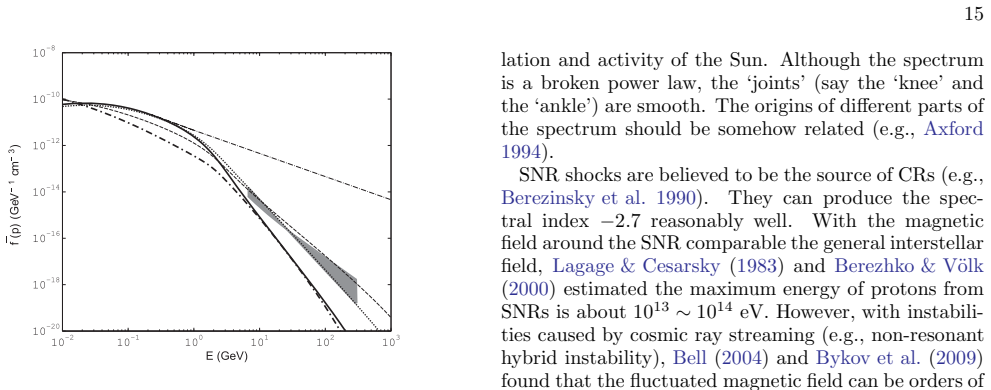
- [§8.2, Fig. 11] The caption of Figure 11 should state explicitly how the five curves are normalized and whether the gray band includes systematic uncertainties in the gamma-ray flux.
Circularity Check
The FB gamma-ray/microwave 'reproduction' is a self-admitted fit: Dp and Ė are estimated from the observed fluxes, then said to be reproduced; the preferred model also inherits its success from a same-group citation.
-
fitted input called prediction
[Section 6, paragraph after Eq. (54); Section 8.2, paragraph beginning 'In the phenomenological model...']
"At present we are unable to derive reliable numerical values of these coefficients, and try to estimate roughly these parameters from the data ignoring the equation for the origin of MHD turbulence needed for CR scattering and propagation. ... In the phenomenological model, the power, ˙E, is estimated numerically from the observed FB gamma-ray and microwave fluxes, and it is about ˙E ∼ 2 × 10^38 erg s−1."
The diffusion coefficients entering the re-acceleration equation (Eq. 72, Dp = κp²) are not computed from the RT-turbulence/Lighthill wave spectrum; the paper states it cannot. They and the required power are instead estimated from the observed FB gamma-ray and microwave fluxes. The successful 'reproduction' of those same fluxes in Fig. 8 is therefore a fit to the target data, not a prediction from the physical mechanism.
-
self citation load bearing
[Section 8.2, paragraph beginning 'Cheng et al. (2015b) showed...']
"Cheng et al. (2015b) showed that the gamma-ray and radio emissions of the re-accelerated electrons reproduced nicely the Fermi-LAT and Planck data points for the parameters: the spatial diffusion coefficient Ds = 10^29 cm2 s−1, the energy loss rate ν = 2 × 10⁻¹⁶ s−1 GeV−1, the velocity gradient of the advection in the halo v′ = 10−15 s−1, the magnetic field strength is B = 3 µG, the thickness of the re-acceleration region (say, the FB envelope) is about ∆rFB = 60 pc, and the parameter of re-acceleration in the FBs is κ = 2 × 10⁻¹⁴ s−1."
The central claim that the re-acceleration model 'reproduced nicely' Fermi-LAT and Planck data is imported from Cheng et al. (2015b), a paper by the same group (Cheng, Chernyshov, Dogiel, Ko). The parameter values quoted are the fitted ones, not derived in the present paper. Thus the paper's preferred conclusion leans on a self-citation carrying the fit rather than on externally verified evidence.
1 more flagged steps
-
fitted input called prediction
[Section 10, Summary bullets]
"We estimated roughly the spatial and momentum diffusions of cosmic rays in the envelope from the data of gamma-ray and microwave radiations from the Fermi bubbles. We concluded that the observed gamma-ray and microwave radiations from the envelope of the Fermi Bubbles are generated by cosmic ray electrons only."
The summary openly derives the transport coefficients from the gamma-ray and microwave radiations whose origin is the object of the conclusion. Estimating the electron population from the observed gamma-ray flux and then concluding that electrons (not protons) generate that gamma-ray flux is a self-definitional loop: the input data are the output claim.
full rationale
Most of the hydrodynamic machinery (Kompaneets envelope propagation, Rayleigh-Taylor instability, Lighthill radiation) is standard material and is not itself circular. The paper also invokes some genuinely external constraints: the eROSITA shock Mach number of about 1.5 disfavors strong diffusive-shock acceleration at the bubble surface, and the hadronic p-p model is rejected because its secondary-electron synchrotron spectrum is too soft and its normalization is too low. Those arguments give the leptonic-vs-hadronic discussion some independent content. However, the paper's preferred leptonic model is not independently predicted. Sections 4-6 do not deliver numerical values for the momentum-diffusion coefficient κ, the wave power, or the Alfvén-wave injection; Section 6 explicitly says the authors are 'unable to derive reliable numerical values' and instead estimate the parameters from the very gamma-ray and microwave data. Section 8.2 then fixes κ = 2e-14 s^-1, computes the required power from the observed fluxes, and normalizes the electron density to the observed gamma-ray flux. Reproducing Fig. 8 is therefore a fit to the same data, not a test. The 'reproduction' is also inherited from Cheng et al. (2015b), a same-group paper, so the self-citation is load-bearing for the central conclusion. This is partial but real circularity of the central claim, hence 7 rather than 0-2; it is not 10 because the hadronic exclusion and eROSITA shock-speed reasoning provide some independent, non-circular support, and the paper openly labels the model phenomenological.
Assumptions & free parameters
free parameters (9)
- Average GC power input Edot =
~3e41 erg/s
- Spatial diffusion coefficient D_s =
1e29 cm^2/s
- Energy loss rate coefficient nu =
2e-16 s^-1 GeV^-1
- Halo advection velocity gradient v' =
1e-15 s^-1
- Magnetic field B =
3 uG
- Thickness of re-acceleration region Delta r_FB =
60 pc
- Momentum diffusion coefficient kappa =
2e-14 s^-1
- Initial RT perturbation seed lambda(y0) =
0.01 d(y0)
- Lighthill radiation efficiency eta_A =
order unity
assumptions (7)
- domain assumption The halo gas distribution is exponential with scale height H = 2 kpc and base density n0 = 4e-3 cm^-3 (Eq. 1).
- domain assumption The strong-shock Kompaneets formalism describes the Fermi Bubble envelope evolution.
- standard math Rayleigh-Taylor instability growth is described by Eqs. (12) to (14) using the acceleration at the top of the bubble.
- domain assumption Hydrodynamic turbulence in the envelope follows the Kolmogorov-Obukhov spectrum (Eq. 16).
- domain assumption Lighthill radiation converts hydrodynamic turbulence into Alfven waves with order-unity efficiency (Eqs. 35 to 38).
- domain assumption The cosmic-ray transport equation (Eq. 54) with momentum diffusion and advection is the correct description for the bubble envelope.
- domain assumption Tidal disruption event rate is about 1e-4 to 1e-5 per year and each event releases 1e52 to 1e53 erg.
Cite this review
Pith. "Pith review of Sources and Radiations of the Fermi Bubbles." pith.science (2026). https://pith.science/paper/DO3VQT56
@misc{pith2026241114916,
  author       = {Pith},
  title        = {Pith review of: Sources and Radiations of the Fermi Bubbles},
  year         = {2026},
  howpublished = {\url{https://pith.science/paper/DO3VQT56}},
  note         = {Machine review of arXiv:2411.14916}
}
read the original abstract
Two enigmatic gamma-ray features in the Galactic central region, known as Fermi Bubbles (FBs), were found from Fermi-LAT data. An energy release (e.g., by tidal disruption events in the Galactic center, GC), generates a cavity with a shock that expands into the local ambient medium of the Galactic halo. A decade or so ago, a phenomenological model of the FBs was suggested as a result of routine star disruptions by the supermassive black hole in the GC which might provide enough energy for large-scale structures, like the FBs. In 2020, analytical and numerical models of the FBs as a process of routine tidal disruption of stars near the GC were developed, which can provide enough cumulative energy to form and maintain large scale structures like the FBs. The disruption events are expected to be ten to hundred events per million years, providing the average power of energy release from the GC into the halo of 3E41 erg/s, which is needed to support the FBs. Analysis of the evolution of superbubbles in exponentially stratified disks concluded that the FB envelope would be destroyed by the Rayleigh-Taylor (RT) instabilities at late stages. The shell is composed of a swept-up gas of the bubble, whose thickness is much thinner in comparison to the size of the envelope. We assume that hydrodynamic turbulence is excited in the FB envelope by the RT instability. In this case, the universal energy spectrum of turbulence may be developed in the inertial range of wavenumbers of fluctuations (the Kolmogorov-Obukhov spectrum). From our model we suppose the power of the FBs is transformed partly into the energy of hydrodynamic turbulence in the envelope. If so, hydrodynamic turbulence may generate MHD-fluctuations, which accelerate cosmic rays there and generate gamma-ray and radio emission from the FBs. We hope that this model may interpret the observed nonthermal emission from the bubbles.
Figures


Figures from the paper (9 more)




Reference graph
Works this paper leans on
-
[1]
Fermi-LAT Observations of the Diffuse γ-Ray Emission: Implications for Cosmic Rays and the Interstellar Medium
Ackermann, M., Ajello, M., Atwood, W. B. et al. 2012, “Fermi-LAT Observations of the Diffuse γ-Ray Emission: Implications for Cosmic Rays and the Interstellar Medium”, ApJ, 750, 3
2012
-
[2]
The Spectrum and Morphology of the Fermi Bubbles
Ackermann, M., Albert, A., Atwood, W. B. et al. 2014, “The Spectrum and Morphology of the Fermi Bubbles”, ApJ, 793, 64 18
2014
-
[3]
The Acceleration of Cosmic Rays by Shock Waves
Axford, W. I., Leer E., & Skadron, G. 1977, “The Acceleration of Cosmic Rays by Shock Waves”, in Proceedings of the 15th International Cosmic Ray Conference, 15th ICRC, Plovdiv, Bulgaria, 13-26 August 1977; 11, 132-137
1977
-
[4]
The Origins of High-Energy Cosmic Rays
Axford, W. I. 1994, “The Origins of High-Energy Cosmic Rays”, ApJS, 90, 937-944
1994
-
[5]
Superbubble evolution in disk galaxies. I. Study of blow-out by analytical models
Baumgartner, V., & Breitschwerdt, D. 2013, “Superbubble evolution in disk galaxies. I. Study of blow-out by analytical models”, A&A, 557, A140
2013
-
[6]
The acceleration of cosmic rays in shock fronts - I
Bell, A. R. 1978, “The acceleration of cosmic rays in shock fronts - I”, MNRAS, 182, 147-156
1978
-
[7]
Turbulent amplification of magnetic field and diffusive shock acceleration of cosmic rays
Bell, A. R. 2004, “Turbulent amplification of magnetic field and diffusive shock acceleration of cosmic rays”, MNRAS, 353, 550-558
2004
-
[8]
Cosmic ray acceleration
Bell, A. R. 2013, “Cosmic ray acceleration”, Astropart. Phys., 43, 56-70
2013
Show all 118 references
-
[9]
Kinetic theory of cosmic ray and gamma-ray production in supernova remnants expanding into wind bubbles
Berezhko, E. G., & V¨ olk, H. J. 2000, “Kinetic theory of cosmic ray and gamma-ray production in supernova remnants expanding into wind bubbles”, A&A, 357, 283-300
2000
-
[10]
S., Bulanov, S
Berezinskii, V. S., Bulanov, S. V., Dogiel, V. A., Ginzburg, V. L., & Ptuskin, V. S. 1990, Astrophysics of Cosmic Rays, ed. V. L. Ginzburg; North Holland: Amsterdam
1990
-
[11]
Shock-wave propagation in the nonuniform interstellar medium
Bisnovatyi-Kogan, G. S., & Silich, S. A. 1995, “Shock-wave propagation in the nonuniform interstellar medium”, RvMP, 67, 661-712
1995
-
[12]
The Large-Scale Bipolar Wind in the Galactic Center
Bland-Hawthorn, J., & Cohen, M. 2003, “The Large-Scale Bipolar Wind in the Galactic Center”, ApJ, 582, 246-256
2003
-
[13]
Particle acceleration by astrophysical shocks
Blandford, R. D., & Ostriker, J. P. 1978, “Particle acceleration by astrophysical shocks”, ApJ, 221, L29-L32
1978
-
[14]
Stochastic Acceleration and Nonthermal Radiation in Clusters of Galaxies
Blasi, P. 2000, “Stochastic Acceleration and Nonthermal Radiation in Clusters of Galaxies”, ApJ, 532, L9-L12
2000
-
[15]
Spectral Breaks as a Signature of Cosmic Ray Induced Turbulence in the Galaxy
Blasi, P., Amato, E., & Serpico, P. D. 2012, “Spectral Breaks as a Signature of Cosmic Ray Induced Turbulence in the Galaxy”, PRL, 109, 061101
2012
-
[16]
Galactic diffusion and wind models of cosmic-ray transport. I. Insight from CR composition studies and gamma-ray observations
Ptuskin, V. S. 1993, “Galactic diffusion and wind models of cosmic-ray transport. I. Insight from CR composition studies and gamma-ray observations”, A&A, 267, 372-387
1993
-
[17]
Galactic winds. I. Cosmic ray and wave-driven winds from the galaxy
Breitschwerdt, D., McKenzie, J. F., & V¨ olk, H. J. 1991, “Galactic winds. I. Cosmic ray and wave-driven winds from the galaxy”, A&A, 245, 79-98
1991
-
[18]
The gradient of diffuse γ-ray emission in the Galaxy
Breitschwerdt, D., Dogiel, V. A., & V¨ olk, H. J. 2002, “The gradient of diffuse γ-ray emission in the Galaxy”, A&A, 385, 216-238
2002
-
[19]
Particle reacceleration in the Coma cluster: radio properties and hard X-ray emission
Brunetti, G., Setti, G., Feretti, L., & Giovannini, G. 2001, “Particle reacceleration in the Coma cluster: radio properties and hard X-ray emission”, MNRAS, 320, 365-378
2001
-
[20]
Alfv´ enic reacceleration of relativistic particles in ga laxy clusters: MHD waves, leptons and hadrons
Brunetti, G., Blasi, P., Cassano, R., & Gabici, S. 2004, “Alfv´ enic reacceleration of relativistic particles in ga laxy clusters: MHD waves, leptons and hadrons”, MNRAS, 350, 1174-1194
2004
-
[21]
Alfv´ enic reacceleration o f relativistic particles in galaxy clusters in the presence o f secondary electrons and positrons
Brunetti, G., & Blasi, P. 2005, “Alfv´ enic reacceleration o f relativistic particles in galaxy clusters in the presence o f secondary electrons and positrons”, MNRAS, 363, 1173-1187
2005
-
[22]
The Electron Component of Cosmic Rays. I. Spatial Distribution and Energy Spectrum
Bulanov, S. V., Dogel’, V. A., & Syrovatskij, S. I. 1972, “The Electron Component of Cosmic Rays. I. Spatial Distribution and Energy Spectrum”, Cosmic Res., 10, 478
1972
-
[23]
The Influence of the Energy Dependence of the Diffusion Coefficient on the Spectrum of the Electron Component of Cosmic Rays and the Radio Background Radiation of the Galaxy
Bulanov, S. V., & Dogel, V. A. 1974, “The Influence of the Energy Dependence of the Diffusion Coefficient on the Spectrum of the Electron Component of Cosmic Rays and the Radio Background Radiation of the Galaxy”, Ap&SS, 29, 305-318
1974
-
[24]
Relativistic jet activity from the tidal disruption of a star by a massive black hole
Burrows, D. N., Kennea, J. A., Ghisellini, G. et al. 2011, “Relativistic jet activity from the tidal disruption of a star by a massive black hole”, Nature, 476, 421-424
2011
-
[25]
On non-thermal particle generation in superbubbles
Bykov, A. M., & Fleishman, G. D. 1992, “On non-thermal particle generation in superbubbles”, MNRAS, 255, 269-275
1992
-
[26]
Particle kinetics in highly turbulent plasmas (renormalization and self-consistent field methods)
Bykov, A. M., & Toptygin, I. N. 1993, “Particle kinetics in highly turbulent plasmas (renormalization and self-consistent field methods)”, Phys. Usp., 36, 1020-1052
1993
-
[27]
Long-wavelength MHD instability in the prefront of collisionless shocks with accelerated particles
Bykov, A. M., Osipov, S. M., & Toptygin, I. N. 2009, “Long-wavelength MHD instability in the prefront of collisionless shocks with accelerated particles”, Astron . Lett., 35, 555-563
2009
-
[28]
1961, Hydrodynamic and Hydromagnetic
Chandrasekhar, S. 1961, Hydrodynamic and Hydromagnetic
1961
-
[29]
Annihilation Emission from the Galactic Black Hole
Cheng, K.-S., Chernyshov, D. O., & Dogiel, V. A. 2006, “Annihilation Emission from the Galactic Black Hole”, ApJ, 645, 1138-1151
2006
-
[30]
Diffuse gamma-ray emission from the Galactic center – a multiple energy injection model
Cheng, K.-S., Chernyshov, D. O., & Dogiel, V. A. 2007, “Diffuse gamma-ray emission from the Galactic center – a multiple energy injection model”, A&A, 473, 351-356
2007
-
[31]
Origin of the Fermi Bubble
Cheng, K.-S., Chernyshov, D. O., Dogiel, V. A., Ko, C. M., & Ip, W.-H. 2011, “Origin of the Fermi Bubble”, ApJL, 731, L17
2011
-
[32]
The Fermi Bubble as a Source of Cosmic Rays in the Energy Range > 1015 eV
Ip, W.-H., & Wang, Y. 2012, “The Fermi Bubble as a Source of Cosmic Rays in the Energy Range > 1015 eV”, ApJ, 746, 116
2012
-
[33]
Multi-wavelength Emission from the Fermi Bubbles. I. Stochastic Acceleration from Background Plasma
Cheng, K.-S., Chernyshov, D. O., Dogiel, V. A., & Ko, C. M. 2014, “Multi-wavelength Emission from the Fermi Bubbles. I. Stochastic Acceleration from Background Plasma”, ApJ, 790, 23 19
2014
-
[34]
X-Ray Afterglow of Swift J1644+57: A Compton Echo?
Cheng, K.-S., Chernyshov, D. O., Dogiel, V. A., Kong, A. K. H., & Ko, C. M. 2016, “X-Ray Afterglow of Swift J1644+57: A Compton Echo?”, ApJL, 816, L10
2016
-
[35]
Stochastic Particle Acceleration and the Problem of Background Plasma Overheating
Chernyshov, D. O., Dogiel, V. A., & Ko, C. M. 2012, “Stochastic Particle Acceleration and the Problem of Background Plasma Overheating”, ApJ, 759, 113
2012
-
[36]
A Unified Model for Tidal Disruption Events
Dai, L., McKinney, J. C., Roth, N. et al. 2018, “A Unified Model for Tidal Disruption Events”, ApJL, 859, L20
2018
-
[37]
The Physics of Accretion Discs, Winds and Jets in Tidal Disruption Events
Dai, L., Lodato, G., & Cheng, R. 2021, “The Physics of Accretion Discs, Winds and Jets in Tidal Disruption Events”, SSRv, 217, 12
2021
-
[38]
On the thermal origin of the hard X-ray emission from the Coma cluster
Dogiel, V. A. 2000, “On the thermal origin of the hard X-ray emission from the Coma cluster”, A&A, 357, 66-74
2000
-
[39]
The Origin of Diffuse X-Ray Emission from the Galactic Ridge. I. Energy Output of Particle Sources
Strong, A. W. 2002, “The Origin of Diffuse X-Ray Emission from the Galactic Ridge. I. Energy Output of Particle Sources”, ApJ, 581, 1061-1070
2002
-
[40]
In-situ acceleration of subrelativistic electrons in the Coma halo and the halo’s influence on the Sunyaev-Zeldovich effect
Hwang, C. Y., Ip, W.-H., Birkinshaw, M., & Prokhorov, D. A. 2007, “In-situ acceleration of subrelativistic electrons in the Coma halo and the halo’s influence on the Sunyaev-Zeldovich effect”, A&A, 461, 433-443
2007
-
[41]
Formation of the Cosmic-Ray Halo: Galactic Spectrum of Primary Cosmic Rays
Dogiel, V. A., Ivlev, A. V., Chernyshov, D. O., & Ko, C. M. 2020, “Formation of the Cosmic-Ray Halo: Galactic Spectrum of Primary Cosmic Rays”, ApJ, 903, 135
2020
-
[42]
A Tidal Disruption Event in a nearby Galaxy Hosting an Intermediate Mass Black Hole
Donato, D., Cenko, S. B., Covino, S. et al. 2014, “A Tidal Disruption Event in a nearby Galaxy Hosting an Intermediate Mass Black Hole”, ApJ, 781, 59 Dorfi, E. A., & Breitschwerdt, D. 2012, “Time-dependent galactic winds. I. Structure and evolution of galactic outflows accompani...
2014
-
[43]
Particle reacceleration in radio galaxies
Eilek, J. A. 1979, “Particle reacceleration in radio galaxies”, ApJ, 230, 373-385
1979
-
[44]
The electron energy spectrum produced in radio sources by turbulent, resonant acceleration
Eilek, J. A., & Hendriksen, R. N. 1984, “The electron energy spectrum produced in radio sources by turbulent, resonant acceleration”, ApJ, 277, 820-831
1984
-
[45]
Nonthermal Emissions from Particles Accelerated by Turbulence in Clusters of Galaxies
Fujita, Y., Takizawa, M., & Sarazin C. L. 2003, “Nonthermal Emissions from Particles Accelerated by Turbulence in Clusters of Galaxies”, ApJ, 584, 190-202
2003
-
[46]
The Galactic Center massive black hole and nuclear star cluster
Genzel, R., Eisenhauer, F., & Gillessen, S. 2010, “The Galactic Center massive black hole and nuclear star cluster”, RvMP, 82, 3121-3195
2010
-
[47]
Tidal Disruption Events
Gezari, S. 2021, “Tidal Disruption Events”, ARA&A, 59, 21-58
2021
-
[48]
Stellar Orbits around the Galactic Center Black Hole
Ghez, A. M., Salim, S., Hornstein, S. D. et al. 2005, “Stellar Orbits around the Galactic Center Black Hole”, ApJ, 620, 744-757
2005
-
[49]
Monitoring Stellar Orbits Around the Massive Black Hole in the Galactic Center
Gillessen, S., Eisenhauer, F., Trippe, S. et al. 2009, “Monitoring Stellar Orbits Around the Massive Black Hole in the Galactic Center”, ApJ, 692, 1075-1109
2009
-
[50]
L., & Syrovatskii, S
Ginzburg, V. L., & Syrovatskii, S. I. 1964, The Origin of Cosmic Rays , Macmillan: New York
1964
-
[51]
Cosmic Magnetobremsstrahlung (Synchrotron Radiation)
Ginzburg, V. L., & Syrovatskii, S. I. 1965, “Cosmic Magnetobremsstrahlung (Synchrotron Radiation)”, ARA&A, 3, 297-350
1965
-
[52]
Ginzburg, V. L. 1989, Applications of Electrodynamics in Theoretical Physics and Astrophysics , Gordon and Breach: New York
1989
-
[53]
A radio-emitting outflow produced by the tidal disruption event AT2020vwl
Goodwin, A. J., Alexander, K. D., Miller-Jones, J. C. A. et al. 2023, “A radio-emitting outflow produced by the tidal disruption event AT2020vwl”, MNRAS, 522, 5084-5097
2023
-
[54]
End to the Cosmic-Ray Spectrum?
Greisen, K. 1966, “End to the Cosmic-Ray Spectrum?”, PRL, 16, 748-750
1966
-
[55]
On the amount of accelerated particles in an ionized gas under various accelerating mechanisms
Gurevich, A. V. 1960, “On the amount of accelerated particles in an ionized gas under various accelerating mechanisms”, Sov. Phys JETP, 38, 1150-1157
1960
-
[56]
1969, Cosmic Ray Physics , Wiley-Interscience: New York
Hayakawa, S. 1969, Cosmic Ray Physics , Wiley-Interscience: New York
1969
-
[57]
Synchrotron brightness distribution of turbulent radio jets
Hendriksen, R. N., Bridle, A. H., & Chan, K. L. 1982, “Synchrotron brightness distribution of turbulent radio jets”, ApJ, 257, 63-74
1982
-
[58]
Inflation of 430-parsec bipolar radio bubbles in the Galactic Centre by an energetic event
Heywood, I., Camilo, F., Cotton, W. D. et al. 2019, “Inflation of 430-parsec bipolar radio bubbles in the Galactic Centre by an energetic event”, Nature, 573, 235-237
2019
-
[59]
Sifting for Sapphires: Systematic Selection of Tidal Disruption Events in iPTF
Hung, T., Gezari, S., Cenko, S. B. et al. 2018, “Sifting for Sapphires: Systematic Selection of Tidal Disruption Events in iPTF”, ApJS, 238, 15
2018
-
[60]
On the origin of high-energy cosmic rays
Jokipii, J. R., & Morfill, G. E. 1985, “On the origin of high-energy cosmic rays”, ApJ, 290, L1-L4 20
1985
-
[61]
The Galactic Fountain
Kahn, F. D. 1998, “The Galactic Fountain”, in The Local Bubble and Beyond Lyman-Spitzer-Colloquium , eds. D
1998
-
[62]
Breitschwerdt, M. J. Freyberg, and J. Tr¨ umper, IAU Colluquium 166, Garching, Germany, 21-25 April 1997; Lecture Notes in Physics, Springer: Berlin; 506, 483-494
1997
-
[63]
Parameterization of γ, e± , and Neutrino Spectra Produced by p-p Interaction in Astronomical Environments
Kamae, T., Karlsson, N., Mizuno, T. et al. 2006, “Parameterization of γ, e± , and Neutrino Spectra Produced by p-p Interaction in Astronomical Environments”, ApJ, 647, 692-708
2006
-
[64]
Relativistic reverberation in the accretion flow of a tidal disruption event
Kara, E., Miller, J. M., Reynolds, C., & Dai, L. 2016, “Relativistic reverberation in the accretion flow of a tidal disruption event”, Nature, 535, 388-390
2016
-
[65]
Generation of Alfv´ en Waves from Turbulence
Kato, S. 1968, “Generation of Alfv´ en Waves from Turbulence”, PASJ, 20, 59-72
1968
-
[66]
Analytical and Numerical Studies of Central Galactic Outflows Powered by Tidal Disruption Events: A Model for the Fermi Bubbles?
Ko, C. M., Breitschwerdt, D., Chernyshov, D. O., Cheng, H., Dai, L., & Dogiel, V. A. 2020, “Analytical and Numerical Studies of Central Galactic Outflows Powered by Tidal Disruption Events: A Model for the Fermi Bubbles?”, ApJ , 904, 46
2020
-
[67]
A point explosion in the uniform atmosphere
Kompaneets, A. S. 1960, “A point explosion in the uniform atmosphere”, Akademiia Nauk SSSR, Doklady (DoSSR, in Russian), 130, 1001-1003
1960
-
[68]
Mechanism of regular acceleration on the front of the shock wave
Krymskii, G. F. 1977, “Mechanism of regular acceleration on the front of the shock wave”, Akademiia Nauk SSSR Dokl. (DoSSR, in Russian), 234, 1306-1307
1977
-
[69]
Effect of Magnetic Fields on Generation of Noise by Isotropic Turbulence
Kulsrud, R. 1955, “Effect of Magnetic Fields on Generation of Noise by Isotropic Turbulence”, ApJ, 121, 461-480
1955
-
[70]
The maximum energy of cosmic rays accelerated by supernova shocks
Lagage, P. O., & Cesarsky, C. J. 1983, “The maximum energy of cosmic rays accelerated by supernova shocks”, A&A, 125, 249-257
1983
-
[71]
D., & Lifshitz, E
Landau, L. D., & Lifshitz, E. M. 1987, Fluid Mechanics , Second Edition, Pergamon Press: Oxford
1987
-
[72]
An Extremely Luminous Panchromatic Outburst from the Nucleus of a Distant Galaxy
Levan, A. J., Tanvir, N. R., Cenko, S. B. et al. 2011, “An Extremely Luminous Panchromatic Outburst from the Nucleus of a Distant Galaxy”, Science, 333, 199-202
2011
-
[73]
The origin of radio haloes and non-thermal emission in clusters of galaxies
Liang, H., Dogiel, V. A., & Birkinshaw, M. 2002, “The origin of radio haloes and non-thermal emission in clusters of galaxies”, MNRAS, 337, 567-577
2002
-
[74]
M., & Pitaevski ˘i, L
Lifshitz, E. M., & Pitaevski ˘i, L. P. 1981, Physical Kinetics , Pergamon Press: Oxford
1981
-
[75]
On Sound Generated Aerodynamically. I. General Theory
Lighthill, M. J. 1952, “On Sound Generated Aerodynamically. I. General Theory”, Proc. Roy. Soc. London A, 211, 564-587
1952
-
[76]
A likely decade-long sustained tidal disruption event
Lin, D., Guillochon, J., Komossa, S. et al. 2017, “A likely decade-long sustained tidal disruption event”, Nat Astron, 1, 0033
2017
-
[77]
On the Missing Energy Puzzle of Tidal Disruption Events
Lu, W., & Kumar, P. 2018, “On the Missing Energy Puzzle of Tidal Disruption Events”, ApJ, 865, 128
2018
-
[78]
Fermi Gamma-Ray “Bubbles
Mertsch, P., & Sarkar, S. 2011, “Fermi Gamma-Ray “Bubbles” from Stochastic Acceleration of Electrons”, PRL, 107, 091101
2011
-
[79]
A bright year for tidal disruptions
Metzger, B. D., & Stone, N. C. 2016, “A bright year for tidal disruptions”, MNRAS, 461, 948-966
2016
-
[80]
Stochastic Proton Acceleration by Cascading Alfv´ en Waves in Impulsive Solar Flares
Miller, J. A., & Roberts, D. A. 1995, “Stochastic Proton Acceleration by Cascading Alfv´ en Waves in Impulsive Solar Flares”, ApJ, 452, 912-932
1995
-
[81]
The Interaction of the Fermi Bubbles with the Milky Way’s Hot Gas Halo
Miller, M. J., & Bregman, J. N. 2016, “The Interaction of the Fermi Bubbles with the Milky Way’s Hot Gas Halo”, ApJ, 829, 9
2016
-
[82]
An Energy Inventory of Tidal Disruption Events
Mockler, B., & Ramirez-Ruiz, E. 2021, “An Energy Inventory of Tidal Disruption Events”, ApJ, 906, 101
2021
-
[83]
Production and Propagation of Cosmic-Ray Positrons and Electrons
Moskalenko, I. V., & Strong, A. W. 1998, “Production and Propagation of Cosmic-Ray Positrons and Electrons”, ApJ, 493, 694-707
1998
-
[84]
Attenuation of Very High Energy Gamma Rays by the Milky Way Interstellar Radiation Field
Moskalenko, I. V., Porter, T. A., & Strong, A. W. 2006, “Attenuation of Very High Energy Gamma Rays by the Milky Way Interstellar Radiation Field”, ApJ, 640, L155-L158
2006
-
[85]
Cosmic-ray electrons and the magnetic field of the North Polar Spur
Mou, G., Wu, J., & Sofue, Y. 2023, “Cosmic-ray electrons and the magnetic field of the North Polar Spur”, A&A, 676, L3
2023
-
[86]
X-Ray Observation of a Magnetized Hot Gas Outflow in the Galactic Center Region
Nakashima, S., Koyama, K., Wang, Q. D. et al. 2019, “X-Ray Observation of a Magnetized Hot Gas Outflow in the Galactic Center Region”, ApJ, 875, 32
2019
-
[87]
Sgr A* envelope explosion and the young stars in the centre of the Milky Way
Nayakshin, S., & Zubovas, K. 2018, “Sgr A* envelope explosion and the young stars in the centre of the Milky Way”, MNRAS, 478, L127-L131
2018
-
[88]
The Turbulent Interstellar Medium: Generalizing to a Scale-dependent Phase Continuum
Norman, C. A., & Ferrara, A. 1996, “The Turbulent Interstellar Medium: Generalizing to a Scale-dependent Phase Continuum”, ApJ, 467, 280-291
1996
-
[89]
A Mechanism for Magnetic Enhancement of Sound-Wave Generation and the Dynamical Origin of Spicules
Parker, E. N. 1964, “A Mechanism for Magnetic Enhancement of Sound-Wave Generation and the Dynamical Origin of Spicules”, ApJ, 140, 1170-1173
1964
-
[90]
Particle acceleration and multimessenger emission from starburst-driven galactic winds
Peretti, E., Morlino, G., Blasi, P., & Cristofari, P. 2022, “Particle acceleration and multimessenger emission from starburst-driven galactic winds”, MNRAS, 511, 1336-1348
2022
-
[91]
On the Nonthermal Emission and Acceleration of Electrons in Coma and Other Clusters of Galaxies
Petrosian, V. 2001, “On the Nonthermal Emission and Acceleration of Electrons in Coma and Other Clusters of Galaxies”, ApJ, 557, 560-572
2001
-
[92]
Heating and Acceleration of Intracluster Medium Electrons by Turbulence
Petrosian, V., & East, W. E. 2008, “Heating and Acceleration of Intracluster Medium Electrons by Turbulence”, ApJ, 682, 175-185
2008
-
[93]
Disk Formation Versus Disk Accretion–What Powers Tidal Disruption Events?
Shiokawa, H. 2015, “Disk Formation Versus Disk Accretion–What Powers Tidal Disruption Events?”, ApJ, 806, 164 21 Planck Collaboration 2013, “ Planck intermediate results. IX. Detection of the Galactic haze with Planck”, A&A, 554, A139
2015
-
[94]
An X-ray chimney extending hundreds of parsecs above and below the Galactic Centre
Ponti, G., Hofmann, F., Churazov, E. et al. 2019, “An X-ray chimney extending hundreds of parsecs above and below the Galactic Centre”, Nature, 567, 347-350
2019
-
[95]
The Galactic center chimneys: the base of the multiphase outflow of the Milky Way
Ponti, G., Morris, M. R., Churazov, E. et al. 2021, “The Galactic center chimneys: the base of the multiphase outflow of the Milky Way”, A&A, 646, A66
2021
-
[96]
Inverse Compton Origin of the Hard X-Ray and Soft Gamma-Ray Emission from the Galactic Ridge
Porter, T. A., Moskalenko, I. V., Strong, A. W. et al. 2008, “Inverse Compton Origin of the Hard X-Ray and Soft Gamma-Ray Emission from the Galactic Ridge”, ApJ, 682, 400-407
2008
-
[97]
Detection of large-scale X-ray bubbles in the Milky Way halo
Predehl, P., Sunyaev, R. A., Becker, W. et al. 2020, “Detection of large-scale X-ray bubbles in the Milky Way halo”, Nature, 588, 227-231
2020
-
[98]
Dissipation of Magnetohydrodynamic Waves on Energetic Particles: Impact on Interstellar Turbulence and Cosmic-Ray Transport
Ptuskin, V. S., Moskalenko, I. V., Jones, F. C., Strong, A. W., & Zirakashvili, V. N. 2006, “Dissipation of Magnetohydrodynamic Waves on Energetic Particles: Impact on Interstellar Turbulence and Cosmic-Ray Transport”, ApJ, 642, 902-916
2006
-
[99]
Tidal disruption of stars by black holes of 10 6 − 108 solar masses in nearby galaxies
Rees, M. J. 1988, “Tidal disruption of stars by black holes of 10 6 − 108 solar masses in nearby galaxies”, Nature, 333, 523-528
1988
-
[100]
Misaligned Jets from Sgr A* and the Origin of Fermi/eROSITA Bubbles
Sarkar, K. C., Mondal, S, Sharma, P., & Piran, T. 2023, “Misaligned Jets from Sgr A* and the Origin of Fermi/eROSITA Bubbles”, ApJ, 951, 36
2023
-
[101]
The Fermi/eROSITA bubbles: a look into the nuclear outflow from the Milky Way
Sarkar, K. C. 2024, “The Fermi/eROSITA bubbles: a look into the nuclear outflow from the Milky Way”, A&ARv, 32, 1
2024
-
[102]
The time-dependent Rayleigh-Taylor instability in interstel lar shells and supershells, including the eROSITA bubbles
Schulreich, M., & Breitschwerdt, D. 2022, “The time-dependent Rayleigh-Taylor instability in interstel lar shells and supershells, including the eROSITA bubbles”, MNRAS, 509, 716-737
2022
-
[103]
Sedov, L. I. 1959, Similarity and Dimensional Methods in
1959
-
[104]
Propagation of magnetohydrodynamic waves from the galactic center. Origin of the 3-kpc arm and the North Polar Spur
Sofue, Y. 1977, “Propagation of magnetohydrodynamic waves from the galactic center. Origin of the 3-kpc arm and the North Polar Spur”, A&A, 60, 327-336
1977
-
[105]
Stellar chromospheric and coronal heating by magnetohydrodynamic waves
Stein, R. F. 1981, “Stellar chromospheric and coronal heating by magnetohydrodynamic waves”, ApJ, 246, 966-971
1981
-
[106]
Rates of stellar tidal disruption as probes of the supermassive black hole mass function
Stone, N. C., & Metzger, B. D. 2016, “Rates of stellar tidal disruption as probes of the supermassive black hole mass function”, MNRAS, 455, 859-883
2016
-
[107]
Cosmic-Ray Propagation and Interactions in the Galaxy
Strong, A. W., Moskalenko, I. V., & Ptuskin, V. S. 2007, “Cosmic-Ray Propagation and Interactions in the Galaxy”, ARNPS, 57, 285-327
2007
-
[108]
Giant Gamma-ray Bubbles from Fermi-LAT: Active Galactic Nucleus Activity or Bipolar Galactic Wind?
Su, M., Slatyer, T. R., & Finkbeiner, D. P. 2010, “Giant Gamma-ray Bubbles from Fermi-LAT: Active Galactic Nucleus Activity or Bipolar Galactic Wind?”, ApJ, 724, 1044-1082
2010
-
[109]
The Energy Spectra and Anisotropies of Cosmic Rays
Swordy, S. 2001, “The Energy Spectra and Anisotropies of Cosmic Rays”, SSRv, 99, 85-94
2001
-
[110]
GALPROP WebRun: An internet-based service for calculating galactic cosmic ray propagation and associated photon emissions
Vladimirov, A. E., Digel, S. W., Johannesson, G. et al. 2011, “GALPROP WebRun: An internet-based service for calculating galactic cosmic ray propagation and associated photon emissions”, CoPhC, 182, 1156-1161 V¨ olk, H. J., & Zirakashvili, V. N. 2004, “Cosmic ray acceleration ...
2011
-
[111]
Covariant Kinetic Theory with an Application to the Coma Cluster
Wolfe, B., & Melia, F. 2006, “Covariant Kinetic Theory with an Application to the Coma Cluster”, ApJ, 638, 125-137
2006
-
[112]
The Fermi Bubbles: Supersonic Active Galactic Nucleus Jets with Anisotropic Cosmic-Ray Diffusion
Yang, H.-Y. K., Ruszkowski, M., Ricker, P. M., Zweibel, E., & Lee, D. 2012, “The Fermi Bubbles: Supersonic Active Galactic Nucleus Jets with Anisotropic Cosmic-Ray Diffusion”, ApJ, 761, 185
2012
-
[113]
Fermi and eROSITA bubbles as relics of the past activity of the Galaxy’s central black hole
Yang, H.-Y. K., Ruszkowski, M., & Zweibel, E. G. 2022, “Fermi and eROSITA bubbles as relics of the past activity of the Galaxy’s central black hole”, Nat Astron, 6, 584-591
2022
-
[114]
Upper Limit of the Spectrum of Cosmic Rays
Zatsepin, G. T., & Kuz’min, V. A. 1966, “Upper Limit of the Spectrum of Cosmic Rays”, JETP Letters, 4, 78-80
1966
-
[115]
Birth of a relativistic outflow in the unusual γ-ray transient Swift J164449.3+573451
Zauderer, B. A., Berger, E., Soderberg, A. M. et al. 2011, “Birth of a relativistic outflow in the unusual γ-ray transient Swift J164449.3+573451”, Nature, 476, 425-428 Zel’dovich, Ya. B., & Raizer, Yu. P. 1967, Physics of Shock Waves and High-Temperature Hydrodynamic Phenomena...
2011
-
[116]
A magnetized Galactic halo from inner Galaxy outflows
Zhang, H.-S., Ponti, G., Carretti, E. et al. 2024, “A magnetized Galactic halo from inner Galaxy outflows”, Nat Astron, 8, https://doi.org/10.1038/s41550-024-02362-0
2024 doi
-
[117]
Galactic origin of ultrahigh energy cosmic rays
Zirakashvili, V. N., Ptuskin, V. S., & Rogovaya, S. I. 2024, “Galactic origin of ultrahigh energy cosmic rays”, PRD, 110, 023016
2024
-
[118]
Fermi bubbles in the Milky Way: the closest AGN feedback laboratory courtesy of Sgr A*?
Zubovas, K., & Nayakshin, S. 2012, “Fermi bubbles in the Milky Way: the closest AGN feedback laboratory courtesy of Sgr A*?”, MNRAS, 424, 666-683
2012
Reviewed August 12, 2026 · model on record in the stance chip above.
Discussion (0). Continue with ORCID to comment.