REVIEW 3 major objections 8 minor 53 references
Enhancement of dynamical coupling in artificial spin-ice systems by incorporating perpendicularly magnetized ferromagnetic matrix
T0 review · 3 major / 8 minor · reviewed 2026-08-12 · deepseek-v4-flash
Pith's one-line read Artificial spin ice gets strong magnon coupling from a magnetic matrix
desk verdict A solid numerical demonstration that embedding square artificial spin ice in a PMA matrix produces strong, vertex-tunable exchange-mediated magnon-magnon coupling—provided the idealized sharp interface in the model survives contact with the proposed FIB fabrication route. read the letter →
The pith
A machine-rendered reading of the paper's core claim, the machinery that carries it, and where it could break.
The reading
What carries the argument
The central object is the pair of hybridizing modes: the second-order bulk mode of the in-plane magnetized SSI nanoelement (a standing spin-wave mode quantized along the element's short axis) and the fundamental bulk mode of the perpendicularly magnetized matrix (an in-phase precession of the whole matrix). The coupling is carried by the exchange interaction across the sharp nanoelement-matrix interface; this is isolated by a spacer-layer test that removes exchange and drops the anticrossing gap from 1.04 to 0.32 GHz, while a single-nanoelement control (0.45 GHz) and a two-nanoelement control (0.78 GHz) show the additional role of dipolar inter-element coupling. Vertex type matters because the static magnetization texture at the vertex (S-shaped states in monopole configurations) modifies the overlap between the element and matrix modes.
What would settle it
Fabricate the SSI-PMA structure with a real ion-irradiation process and measure broadband FMR around 0.45 T. If the anticrossing gap between the second-order bulk element mode and the fundamental matrix mode is close to 0.3 GHz rather than ~1 GHz, the assumed bulk-like interface exchange is not realized. Alternatively, a continuous target-thickness series (13.2, 9.9, 6.6, 3.3 nm) should reproduce the inverse-thickness trend in gap width (1.04, 1.10, 1.24, 1.36 GHz) if the model is right.
Extended reading notes
Core claim
The central claim is that a square artificial spin-ice (SSI) lattice of in-plane magnetized nanoelements, when immersed in a perpendicularly magnetized Co/Pd multilayer, supports strong magnon-magnon coupling between the second-order bulk mode of the nanoelements and the fundamental bulk mode of the matrix. The evidence is a pronounced anticrossing in the field-dependent spectrum, with frequency gap Δf = 1.04 GHz for the low-energy Type 1 and Type 2 vertex configurations and Δf = 1.43 GHz for the monopole-carrying Type 3 and Type 4 configurations at 0.45 T. The authors show that removing the exchange interaction by inserting a thin nonmagnetic spacer collapses the gap to 0.32 GHz, identifying exchange coupling at the interface as the primary driver, with dipolar coupling between neighboring nanoelements adding further enhancement. They further demonstrate that the coupling strength is tunable—decreasing the vertex gap from 200 to 50 nm raises the normalized coupling from 0.044 to 0.085, and reducing the multilayer thickness from 13.2 to 3.3 nm raises it from 0.055 to 0.082—and that reconfiguring the vertices from ice-rule to monopole states increases the coupling by about 36%.
Load-bearing premise
The coupling depends on the exchange interaction across the nanoelement-matrix interface being almost as strong as the bulk exchange across a sharp boundary; if ion irradiation leaves a reduced or graded interface, the strong coupling would degrade toward the 0.32 GHz spacer-limited value.
Editorial extensions
If this is right
- The hybridized modes persist at realistic damping (α = 0.008), so the predicted anticrossing should be observable in broadband ferromagnetic resonance on fabricated samples.
- Reducing the vertex gap or the multilayer thickness raises the coupling strength, giving two geometric knobs for tuning magnon-magnon coupling in a single device.
- Switching the vertex configuration from ice-rule (Type 1/2) to monopole states (Type 3/4) increases the anticrossing gap by about 36%, offering a magnetization-state control channel for reconfigurable magnonics.
- Because exchange, rather than long-range dipolar coupling, drives the hybridization, the coupling does not rely on weak inter-element dipolar fields and can be strong even between a single nanoelement and the matrix.
Reading between the lines
- Beyond the paper: if the exchange coupling survives in real irradiated interfaces, the same design should transfer to other perpendicular-anisotropy multilayers, including low-damping oxide-based ones, where the hybridized modes would be narrower and easier to resolve.
- Beyond the paper: the vertex-state dependence of the gap suggests a non-imaging readout—measuring the anticrossing frequency at a fixed field could reveal which magnetic charge state the lattice is in.
- Beyond the paper: a continuous test would be to grade the interface exchange (e.g., by partial irradiation) and verify that the gap interpolates smoothly between the 0.32 GHz spacer-limited value and the 1.04 GHz full-exchange value.
Editorial analysis
A structured set of objections, weighed in public.
Referee Report
Summary. This paper uses micromagnetic simulations (LLG as implemented in Amumax) to study an artificial square spin-ice (SSI) array of in-plane magnetized nanoelements embedded in a perpendicularly magnetized Co/Pd matrix (SSI-PMA). It reports a hybridization between the second-order bulk mode of the nanoelements and the fundamental bulk mode of the matrix, with anticrossing gaps of 1.04 GHz for Type 1/2 vertices and 1.43 GHz for Type 3/4 vertices at 0.45 T. The authors attribute the strong coupling primarily to exchange interactions at the nanoelement-matrix interface, identify a smaller inter-element dipolar contribution, and show that the gap can be tuned by vertex gap and film thickness. They propose focused ion irradiation as a fabrication route and argue that the hybridized modes should be observable in broadband FMR.
Significance. If the central claim holds, the paper offers a concrete way to overcome the traditionally weak dipolar coupling in artificial spin ice by coupling all nanoelements through a common perpendicularly magnetized matrix, and it demonstrates vertex-state-dependent hybridization as a reconfigurability knob. The numerical protocol is transparent and reproducible in structure: the solver is open source, the material parameters (Aex, Ms, Ku) are imported from prior experiments, the anticrossing is an emergent LLG output rather than a fitted quantity, and the main gap is reproduced at realistic damping as well as in FMR-relevant excitation geometries. The main weakness is that the strong-coupling result rests on an idealized, bulk-like exchange contact at the nanoelement/matrix interface; this needs to be tested against a realistic ion-irradiated interface before the experimental claims are accepted.
major comments (3)
- [Sec. II and SI Sec. III] The central claim that the 1.04-1.43 GHz anticrossing indicates strong coupling in an experimentally realizable SSI-PMA depends on an idealized exchange contact. In the model, Aex and Ms are uniform and only Ku is stepped to zero inside the nanoelements, so the interface is a bulk-like exchange contact by construction. The control in SI Sec. III, where a 6.62 nm spacer reduces the gap from 1.04 to 0.32 GHz, shows that most of the gap is supplied by that exchange contact, but it is not a faithful sensitivity test for the proposed fabrication route: focused ion irradiation produces a graded damage profile over a finite lateral width, modifying Ku, Ms, and Aex rather than creating a discontinuous step, and the spacer also weakens dipolar coupling by increasing physical separation. This concern is reinforced by the authors' own earlier work [40-42], which describes FIB-produced in-plane rims around antidots. Please add simulations with a graded interface, for example a smooth profile of Aex and Ku over a 10-20 nm shell or an interfacial layer with reduced Aex, and report the resulting gap. Until such a test is provided, the abstract and conclusion should be restricted to the sharp-interface model.
- [SI Sec. IV] The attribution of the gap increase from 0.45 GHz (single nanoelement) to 0.78 GHz (two nanoelements) and 1.04 GHz (full SSI-PMA) to inter-nanoelement dipolar coupling is not as clean as stated, because the 'single nanoelement' simulation is performed with periodic boundary conditions. Under PBC, the single nanoelement is repeated with the 424.26 nm lattice period and therefore experiences residual periodic dipolar interactions; it is not an isolated element as claimed. Please state the unit-cell size and quantify the periodic-image dipolar field, or run an isolated-element test, to confirm that the 0.45 GHz baseline is truly the zero-interelement-coupling limit.
- [Sec. III B and SI Sec. III] The conclusion that exchange interactions are the primary driver of the coupling is drawn from the spacer experiment, but that experiment changes two physical effects simultaneously: it removes the exchange interaction and it increases the nanoelement-matrix separation, thereby also reducing the dipolar coupling. Since the gap falls to 0.32 GHz rather than to zero, the control does not by itself determine the relative weights of exchange and dipolar contributions. Please isolate the exchange contribution independently, for example by keeping the geometry fixed and reducing Aex only in a thin shell at the interface, or by separately scaling the dipolar field in the integration, and report the resulting gaps.
minor comments (8)
- [Sec. III A] The opening sentence 'Our SSI-PMA consists of periodic vortices' should read 'periodic vertices'; the same wording appears in the section heading and should be corrected.
- [Sec. III B] The sentence near Fig. 3(c) that begins 'whthis considered SS remains evident...' is garbled; please rewrite it, since the intended meaning is that the anticrossing survives at alpha = 0.008.
- [Sec. III C] The phrase 'integration of the ferromagnet[47]' has a misplaced citation; [47] appears to concern YIG magnonic crystals, so please integrate the citation grammatically or remove it.
- [Conclusion] The phrase 'ground state vertex configurations (Types 1 and 2)' is imprecise: in square artificial spin ice Type 1 is the lowest-energy state and Type 2 is a higher-energy ice-rule state, so please write 'ice-rule (zero-charge) configurations' unless an energy comparison for the SSI-PMA geometry is provided.
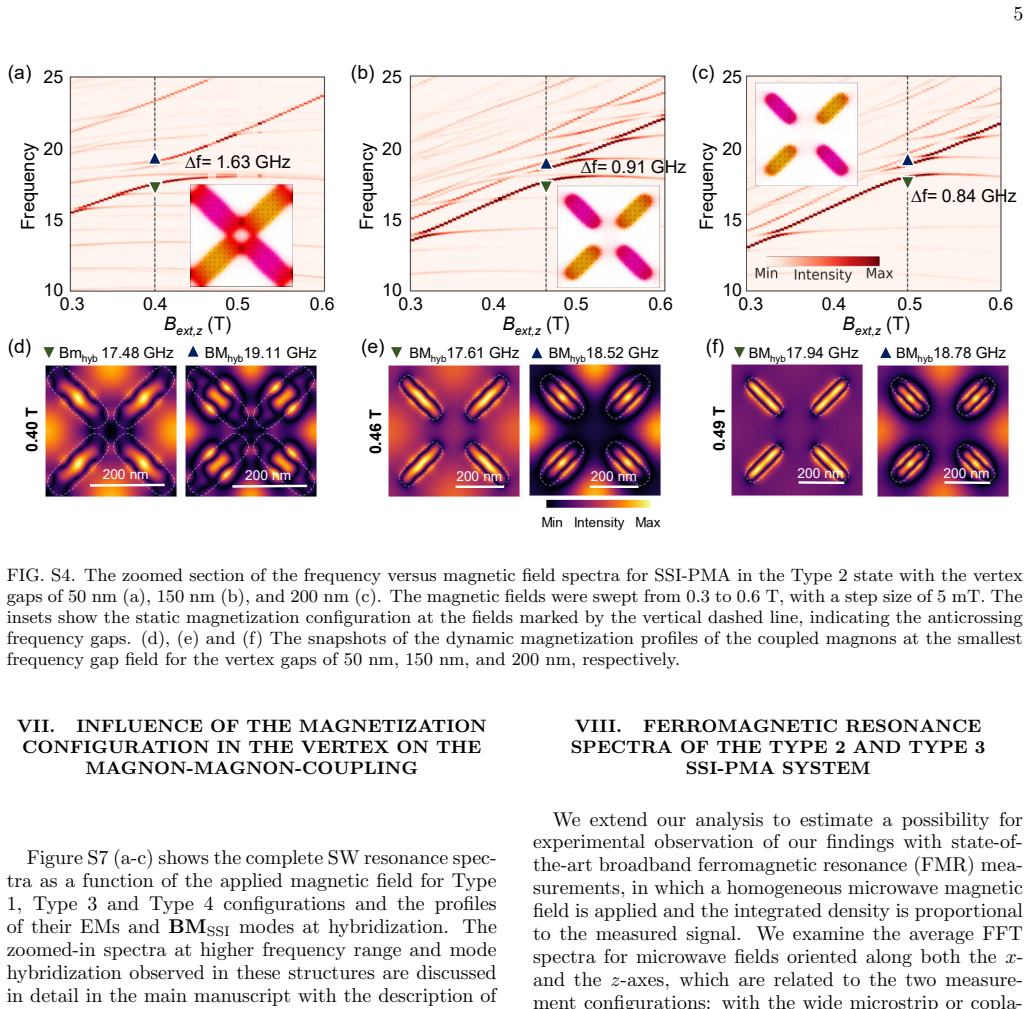
- [Fig. 4(a) / SI Sec. V] The difference between the 200 nm and 150 nm vertex-gap anticrossings (0.84 vs 0.91 GHz) is close to the ~0.065 GHz frequency resolution of the 15.38 ns sampling window; please add an uncertainty estimate or a finer spectral analysis before asserting a monotonic trend.
- [Fig. 4(c)] The 'magnetostatic field density' is plotted but not defined in the main text; please state the exact normalization used, either in the figure caption or in SI Sec. V.
- [SI Sec. V] The cross-reference 'Fig. S4 (c, f)' for the effective-thickness spectra should be 'Fig. S5 (a-c)'; please correct this.
- [Abstract / Conclusion] The abstract says 'almost 40%' while the conclusion says '36% enhancement'; please unify the numbers or specify which quantity each percentage refers to.
Circularity Check
No significant circularity: the anticrossing gaps are emergent micromagnetic-simulation outputs, not fitted parameters, and same-group citations are limited to material parameters and an analogous mechanism that the paper independently tests with a spacer control.
full rationale
The paper's derivation chain runs from externally characterized Co/Pd multilayer parameters (Aex = 13 pJ/m, Ms = 810 kA/m, Ku,bulk = 4.5e5 J/m3) through LLG dynamics in Amumax to FFT-extracted spin-wave spectra; the headline gaps (1.04 GHz for Type 1/2 and 1.43 GHz for Type 3/4 at 0.45 T) are read off anticrossings in these spectra and are not adjusted to match a target value. No equation in the paper defines the predicted gap in terms of the inputs by construction, and no parameter is fitted to a subset of the data and then renamed a prediction. The same-group citations (Refs. 40-41) supply material constants and a previously reported exchange-driven coupling mechanism in antidot lattices; the latter is not merely imported, because SI Sec. III independently breaks the exchange contact with a 6.62 nm spacer and shows the gap collapses from 1.04 to 0.32 GHz, and SI Sec. IV further decomposes the dipolar contribution. The skeptic's concern that a FIB-damaged interface may have graded, weaker exchange coupling is an experimental fidelity or robustness issue, not a circularity: the model's sharp-Ku-step assumption is stated, and the paper does not invoke a uniqueness theorem or ansatz from prior work to make its choice forced. Accordingly, while the quantitative predictions inherit the assumed bulk-like interface exchange, the derivation itself is self-contained and no circular step can be exhibited.
Assumptions & free parameters
assumptions (5)
- domain assumption Co/Pd multilayer is represented as a single ferromagnetic layer with effective exchange Aex=13 pJ/m, Ms=810 kA/m, and Ku,bulk=4.5e5 J/m^3
- domain assumption The exchange coupling at the nanoelement-matrix interface equals the bulk exchange constant of the effective medium
- domain assumption The magnetization configurations Type 1, 3, and 4, produced by artificial initialization followed by relaxation, represent physically accessible states of the SSI-PMA system
- domain assumption Periodic boundary conditions with 16 repetitions model the infinite lattice
- standard math The Landau-Lifshitz-Gilbert equation with the stated effective fields describes the spin dynamics
Cite this review
Pith. "Pith review of Enhancement of dynamical coupling in artificial spin-ice systems by incorporating perpendicularly magnetized ferromagnetic matrix." pith.science (2026). https://pith.science/paper/D455FD7M
@misc{pith2026241114918,
  author       = {Pith},
  title        = {Pith review of: Enhancement of dynamical coupling in artificial spin-ice systems by incorporating perpendicularly magnetized ferromagnetic matrix},
  year         = {2026},
  howpublished = {\url{https://pith.science/paper/D455FD7M}},
  note         = {Machine review of arXiv:2411.14918}
}
read the original abstract
Artificial spin-ice systems, consisting of arrays of interacting ferromagnetic nanoelements, offer a versatile platform for reconfigurable magnonics with potential in GHz logic and neuromorphic computing. However, weak dipolar coupling between nanoelements severely limits their functionality. We numerically demonstrate a rich spin-wave spectrum in a square spin-ice structure immersed in a perpendicularly magnetized ferromagnetic matrix, which is different from a single spin-ice system. We observe a strong magnon-magnon coupling between the bulk second-order mode of the nanoelements and the fundamental mode of the matrix, supported by a pronounced anticrossing frequency gap. We show that, in addition to the dipolar coupling, exchange interactions at the nanoelement-matrix interface play a crucial role in this hybridization. Furthermore, the strength of the coupling can be enhanced by almost 40% just by reconfiguring the magnetization at the vertices from low-energy to high-energy monopole states. These results open the way to exploit artificial spin-ice systems for magnonic applications, taking advantage of the strong coupling and vertex-dependent dynamics.
Figures


Figures from the paper (3 more)


Reference graph
Works this paper leans on
-
[1]
Review and prospects of magnonic crystals and devices with reprogrammable band structure,
M. Krawczyk and D. Grundler, “Review and prospects of magnonic crystals and devices with reprogrammable band structure,” Journal of physics: Condensed matter , vol. 26, no. 12, p. 123202, 2014
work page 2014
-
[2]
throughout the analysis. Hybridization between the 2nd-order BMSSI and fundamental BMPMA is observed across all structures in a similar frequency range, but at different magnetic field values. The anticrossing fre- quency gap varies with the vertex gap: ∆ f = 0.84 GHz for the 200 nm gap, ∆ f = 0.91 GHz for the 150 nm gap, and ∆f = 1.63 GHz for the 50 nm g...
work page 2020
-
[3]
V. Kruglyak, S. Demokritov, and D. Grundler, “Magnon- ics,” Journal of Physics D: Applied Physics , vol. 43, no. 26, p. 264001, 2010
work page 2010
-
[4]
A. Barman and J. Sinha, Spin dynamics and damping in ferromagnetic thin films and nanostructures , vol. 1. Springer, 2018
work page 2018
-
[5]
A. Barman, G. Gubbiotti, S. Ladak, A. O. Adeyeye, M. Krawczyk, J. Gr¨ afe, C. Adelmann, S. Cotofana, A. Naeemi, V. I. Vasyuchka, et al., “The 2021 magnon- ics roadmap,” Journal of Physics: Condensed Matter , vol. 33, no. 41, p. 413001, 2021
work page 2021
-
[6]
Advances in magnetics roadmap on spin-wave computing,
A. V. Chumak, P. Kabos, M. Wu, C. Abert, C. Adel- mann, A. Adeyeye, J. ˚Akerman, F. G. Aliev, A. Anane, A. Awad, et al. , “Advances in magnetics roadmap on spin-wave computing,” IEEE Transactions on Magnet- ics, vol. 58, no. 6, pp. 1–72, 2022
work page 2022
-
[7]
B. Flebus, D. Grundler, B. Rana, Y. Otani, I. Barsukov, A. Barman, G. Gubbiotti, P. Landeros, J. Akerman, U. S. Ebels, et al., “The 2024 magnonics roadmap,” Journal of Physics: Condensed Matter , vol. 36, p. 363501, 2024
work page 2024
-
[8]
A. Haldar, D. Kumar, and A. O. Adeyeye, “A recon- figurable waveguide for energy-efficient transmission and local manipulation of information in a nanomagnetic de- vice,” Nature nanotechnology, vol. 11, no. 5, pp. 437–443, 2016
work page 2016
Show all 53 references
-
[9]
Magneti- zation dynamics of nanoscale magnetic materials: A per- spective,
A. Barman, S. Mondal, S. Sahoo, and A. De, “Magneti- zation dynamics of nanoscale magnetic materials: A per- spective,” Journal of Applied Physics , vol. 128, no. 17, 2020
2020
-
[10]
Reconfigurable magnonics heats up,
D. Grundler, “Reconfigurable magnonics heats up,” Na- ture Physics, vol. 11, no. 6, pp. 438–441, 2015
2015
-
[11]
Magnon transistor for all-magnon data processing,
A. V. Chumak, A. A. Serga, and B. Hillebrands, “Magnon transistor for all-magnon data processing,” Na- ture communications, vol. 5, no. 1, p. 4700, 2014
2014
-
[12]
Reconfigurable ferro- magnetic resonances by engineering inhomogeneous mag- netic textures in artificial magnonic crystals,
L. Ji, R. Zhao, X. Hu, C. Hu, X. Shen, X. Liu, X. Zhao, J. Zhang, W. Chen, and X. Zhang, “Reconfigurable ferro- magnetic resonances by engineering inhomogeneous mag- netic textures in artificial magnonic crystals,” Advanced Functional Materials, vol. 32, no. 20, p. 2112956, 2022
2022
-
[13]
Reconfigurable magnonic crystals based on imprinted magnetization textures in hard and soft dipolar-coupled bilayers,
K. Szulc, S. Tacchi, A. Hierro-Rodriguez, J. Diaz, P. Gruszecki, P. Graczyk, C. Quiros, D. Marko, J. I. Mar- tin, M. Velez, D. S. Schmool, G. Carlotti, M. Krawczyk, and L. M. Alvarez-Prado, “Reconfigurable magnonic crystals based on imprinted magnetization textures in hard and...
2022
-
[14]
Artificial ferroic systems: novel functionality from structure, interactions and dynamics,
L. J. Heyderman and R. L. Stamps, “Artificial ferroic systems: novel functionality from structure, interactions and dynamics,” Journal of Physics: Condensed Matter , vol. 25, no. 36, p. 363201, 2013
2013
-
[15]
Colloquium: Ar- tificial spin ice: Designing and imaging magnetic frus- tration,
C. Nisoli, R. Moessner, and P. Schiffer, “Colloquium: Ar- tificial spin ice: Designing and imaging magnetic frus- tration,” Reviews of Modern Physics , vol. 85, no. 4, pp. 1473–1490, 2013
2013
-
[16]
Magnetization dynam- ics in artificial spin ice,
S. Lendinez and M. Jungfleisch, “Magnetization dynam- ics in artificial spin ice,” Journal of Physics: Condensed Matter, vol. 32, no. 1, p. 013001, 2019
2019
-
[17]
Emergent ice rule and mag- netic charge screening from vertex frustration in artificial spin ice,
I. Gilbert, G.-W. Chern, S. Zhang, L. O’Brien, B. Fore, C. Nisoli, and P. Schiffer, “Emergent ice rule and mag- netic charge screening from vertex frustration in artificial spin ice,” Nature Physics , vol. 10, no. 9, pp. 670–675, 2014
2014
-
[18]
Direct observation of magnetic monopole defects in an artificial spin-ice system,
S. Ladak, D. Read, G. Perkins, L. Cohen, and W. Bran- ford, “Direct observation of magnetic monopole defects in an artificial spin-ice system,” Nature Physics, vol. 6, no. 5, pp. 359–363, 2010
2010
-
[19]
Qubit spin ice,
A. D. King, C. Nisoli, E. D. Dahl, G. Poulin-Lamarre, and A. Lopez-Bezanilla, “Qubit spin ice,” Science, vol. 373, no. 6554, pp. 576–580, 2021
2021
-
[20]
Emerging chirality in artificial spin ice,
W. Branford, S. Ladak, D. E. Read, K. Zeissler, and L. Cohen, “Emerging chirality in artificial spin ice,” Sci- ence, vol. 335, no. 6076, pp. 1597–1600, 2012
2012
-
[21]
Topological frus- tration of artificial spin ice,
J. Drisko, T. Marsh, and J. Cumings, “Topological frus- tration of artificial spin ice,” Nature communications , vol. 8, no. 1, p. 14009, 2017
2017
-
[22]
Magnetic charge propagation upon a 3d artificial spin-ice,
A. May, M. Saccone, A. van den Berg, J. Askey, M. Hunt, and S. Ladak, “Magnetic charge propagation upon a 3d artificial spin-ice,” Nature communications, vol. 12, no. 1, p. 3217, 2021
2021
-
[23]
Dynamics of reconfigurable artificial spin ice: Toward magnonic func- tional materials,
S. Gliga, E. Iacocca, and O. G. Heinonen, “Dynamics of reconfigurable artificial spin ice: Toward magnonic func- tional materials,” APL Materials, vol. 8, no. 4, 2020
2020
-
[24]
Deliberate ex- otic magnetism via frustration and topology,
C. Nisoli, V. Kapaklis, and P. Schiffer, “Deliberate ex- otic magnetism via frustration and topology,” Nature Physics, vol. 13, no. 3, pp. 200–203, 2017
2017
-
[25]
Advances in artificial spin ice,
S. H. Skjærvø, C. H. Marrows, R. L. Stamps, and L. J. Heyderman, “Advances in artificial spin ice,” Nature Re- 10 views Physics, vol. 2, no. 1, pp. 13–28, 2020
2020
-
[26]
Review on magnon- ics with engineered spin textures,
D. Petti, S. Tacchi, and E. Albisetti, “Review on magnon- ics with engineered spin textures,” Journal of Physics D: Applied Physics, vol. 55, no. 29, p. 293003, 2022
2022
-
[27]
Spectral analysis of topological defects in an artificial spin-ice lattice,
S. Gliga, A. K´ akay, R. Hertel, and O. G. Heinonen, “Spectral analysis of topological defects in an artificial spin-ice lattice,” Physical review letters, vol. 110, no. 11, p. 117205, 2013
2013
-
[28]
Dynamic response of an artificial square spin ice,
M. Jungfleisch, W. Zhang, E. Iacocca, J. Sklenar, J. Ding, W. Jiang, S. Zhang, J. Pearson, V. Novosad, J. Ketter- son, et al., “Dynamic response of an artificial square spin ice,” Physical Review B, vol. 93, no. 10, p. 100401, 2016
2016
-
[29]
Observation and control of collective spin-wave mode hybridization in chevron arrays and in square, staircase, and brickwork ar- tificial spin ices,
T. Dion, J. Gartside, A. Vanstone, K. Stenning, D. Ar- roo, H. Kurebayashi, and W. Branford, “Observation and control of collective spin-wave mode hybridization in chevron arrays and in square, staircase, and brickwork ar- tificial spin ices,” Physical Review Research, vol. 4,...
2022
-
[30]
Emergent spin dynamics enabled by lattice interac- tions in a bicomponent artificial spin ice,
S. Lendinez, M. T. Kaffash, and M. B. Jungfleisch, “Emergent spin dynamics enabled by lattice interac- tions in a bicomponent artificial spin ice,” Nano Letters, vol. 21, no. 5, pp. 1921–1927, 2021
1921
-
[31]
Nonlinear multi- magnon scattering in artificial spin ice,
S. Lendinez, M. T. Kaffash, O. G. Heinonen, S. Gliga, E. Iacocca, and M. B. Jungfleisch, “Nonlinear multi- magnon scattering in artificial spin ice,” Nature Com- munications, vol. 14, no. 1, p. 3419, 2023
2023
-
[32]
Observation of mode splitting in artificial spin ice: A comparative ferromagnetic resonance and brillouin light scattering study,
S. Lendinez, M. Taghipour Kaffash, and M. B. Jungfleisch, “Observation of mode splitting in artificial spin ice: A comparative ferromagnetic resonance and brillouin light scattering study,” Applied Physics Letters, vol. 118, no. 16, 2021
2021
-
[33]
Broken vertex symmetry and finite zero-point entropy in the artificial square ice ground state,
S. Gliga, A. K´ akay, L. J. Heyderman, R. Hertel, and O. G. Heinonen, “Broken vertex symmetry and finite zero-point entropy in the artificial square ice ground state,” Physical Review B, vol. 92, no. 6, p. 060413, 2015
2015
-
[34]
Optimising network interactions through device agnostic models,
L. Manneschi, I. T. Vidamour, K. D. Stenning, J. C. Gartside, C. Swindells, G. Venkat, D. Griffin, S. Step- ney, W. R. Branford, T. Hayward, et al. , “Optimising network interactions through device agnostic models,” arXiv preprint arXiv:2401.07387 , 2024
2024 arXiv
-
[35]
Gigahertz frequency antiferro- magnetic resonance and strong magnon-magnon coupling in the layered crystal crcl 3,
D. MacNeill, J. T. Hou, D. R. Klein, P. Zhang, P. Jarillo- Herrero, and L. Liu, “Gigahertz frequency antiferro- magnetic resonance and strong magnon-magnon coupling in the layered crystal crcl 3,” Physical review letters , vol. 123, no. 4, p. 047204, 2019
2019
-
[36]
Realization of ground state in artificial kagome spin ice via topological defect-driven magnetic writing,
J. C. Gartside, D. M. Arroo, D. M. Burn, V. L. Bem- mer, A. Moskalenko, L. F. Cohen, and W. R. Branford, “Realization of ground state in artificial kagome spin ice via topological defect-driven magnetic writing,” Nature nanotechnology, vol. 13, no. 1, pp. 53–58, 2018
2018
-
[37]
Using magnons as a quantum technology platform: a perspec- tive,
P. K. Pal, A. K. Mondal, and A. Barman, “Using magnons as a quantum technology platform: a perspec- tive,” Journal of Physics: Condensed Matter , 2024
2024
-
[38]
Ultrastrong magnon- magnon coupling and chiral spin-texture control in a dipolar 3d multilayered artificial spin-vortex ice,
T. Dion, K. D. Stenning, A. Vanstone, H. H. Holder, R. Sultana, G. Alatteili, V. Martinez, M. T. Kaffash, T. Kimura, R. F. Oulton, et al. , “Ultrastrong magnon- magnon coupling and chiral spin-texture control in a dipolar 3d multilayered artificial spin-vortex ice,” Nature Com...
2024
-
[39]
Brillouin light scattering spectral fingerprinting of magnetic microstates in artificial spin ice,
A. K. Mondal, A. K. Chaurasiya, K. D. Stenning, A. Van- stone, J. C. Gartside, W. R. Branford, and A. Bar- man, “Brillouin light scattering spectral fingerprinting of magnetic microstates in artificial spin ice,” Nano Today, vol. 59, p. 102497, 2024
2024
-
[40]
Re- configurable magnonic mode-hybridisation and spectral control in a bicomponent artificial spin ice,
J. C. Gartside, A. Vanstone, T. Dion, K. D. Stenning, D. M. Arroo, H. Kurebayashi, and W. R. Branford, “Re- configurable magnonic mode-hybridisation and spectral control in a bicomponent artificial spin ice,” Nature com- munications, vol. 12, no. 1, p. 2488, 2021
2021
-
[41]
Edge localization of spin waves in antidot multilayers with perpendicular magnetic anisotropy,
S. Pan, S. Mondal, M. Zelent, R. Szwierz, S. Pal, O. Hell- wig, M. Krawczyk, and A. Barman, “Edge localization of spin waves in antidot multilayers with perpendicular magnetic anisotropy,” Physical Review B, vol. 101, no. 1, p. 014403, 2020
2020
-
[42]
The role of non-uniform magnetization texture for magnon– magnon coupling in an antidot lattice,
M. Moalic, M. Zelent, K. Szulc, and M. Krawczyk, “The role of non-uniform magnetization texture for magnon– magnon coupling in an antidot lattice,” Scientific Re- ports, vol. 14, no. 1, p. 11501, 2024
2024
-
[43]
Time-resolved measurement of spin-wave spectra in coo capped [co (t)/pt (7˚ a)] n-1 co (t) multilayer systems,
S. Pal, B. Rana, S. Saha, R. Mandal, O. Hellwig, J. Romero-Vivas, S. Mamica, J. Klos, M. Mruczkiewicz, M. Sokolovskyy, et al. , “Time-resolved measurement of spin-wave spectra in coo capped [co (t)/pt (7˚ a)] n-1 co (t) multilayer systems,” Journal of Applied Physics, vol. 111...
2012
-
[44]
The de- sign and verification of mumax3,
A. Vansteenkiste, J. Leliaert, M. Dvornik, M. Helsen, F. Garcia-Sanchez, and B. Van Waeyenberge, “The de- sign and verification of mumax3,” AIP advances, vol. 4, no. 10, 2014
2014
-
[45]
Mathieumoalic/amumax: 2023.10.26,
M. Moalic and M. Zelent, “Mathieumoalic/amumax: 2023.10.26,” Oct. 2023
2023
-
[46]
Emergent dynamics of artificial spin-ice lattice based on an ultrathin ferromagnet,
A. Ghosh, F. Ma, J. Lourembam, X. Jin, R. Maddu, Q. J. Yap, and S. Ter Lim, “Emergent dynamics of artificial spin-ice lattice based on an ultrathin ferromagnet,” Nano Letters, vol. 20, no. 1, pp. 109–115, 2019
2019
-
[47]
Dipolar coupling effect on magnetization dy- namics in artificial kagome spin ices,
X. Shen, H. Chen, D. Shi, H. Xia, J. Xu, F. Zeng, and Y. Wu, “Dipolar coupling effect on magnetization dy- namics in artificial kagome spin ices,” Physical Review B, vol. 106, no. 14, p. 144413, 2022
2022
-
[48]
Low-loss yig-based magnonic crystals with large tunable bandgaps,
H. Qin, G.-J. Both, S. J. H am al ainen, L. Yao, and S. van Dijken, “Low-loss yig-based magnonic crystals with large tunable bandgaps,” Nature Communications, vol. 9, p. 5445, Dec 2018
2018
-
[49]
Thickness dependence of spin wave excitations in an artificial square spin ice-like geometry,
Y. Li, G. Gubbiotti, F. Casoli, S. A. Morley, F. J. Goncalves, M. C. Rosamond, E. H. Linfield, C. H. Mar- rows, S. McVitie, and R. Stamps, “Thickness dependence of spin wave excitations in an artificial square spin ice-like geometry,” Journal of Applied Physics , vol. 121, no....
2017
-
[50]
Direct observation of thermal relaxation in artificial spin ice,
A. Farhan, P. M. Derlet, A. Kleibert, A. Balan, R. V. Chopdekar, M. Wyss, J. Perron, A. Scholl, F. Nolting, and L. J. Heyderman, “Direct observation of thermal relaxation in artificial spin ice,” Physical review letters , vol. 111, no. 5, p. 057204, 2013
2013
-
[51]
Understanding thermal annealing of artificial spin ice,
X. Zhang, Y. Lao, J. Sklenar, N. S. Bingham, J. T. Bat- ley, J. D. Watts, C. Nisoli, C. Leighton, and P. Schiffer, “Understanding thermal annealing of artificial spin ice,” APL Materials, vol. 7, no. 11, 2019
2019
-
[52]
Ultrastrong magnon-photon coupling achieved by magnetic films in contact with superconducting resonators,
A. Ghirri, C. Bonizzoni, M. Maksutoglu, A. Mercurio, O. Di Stefano, S. Savasta, and M. Affronte, “Ultrastrong magnon-photon coupling achieved by magnetic films in contact with superconducting resonators,” Physical Re- view Applied, vol. 20, no. 2, p. 024039, 2023
2023
-
[53]
Tuning of perpendicular magnetic anisotropy in bi-substituted yttrium iron garnet films by he+ ion irra- diation,
S. Das, R. Mansell, L. Flajˇ sman, L. Yao, J. W. van der Jagt, S. Chen, D. Ravelosona, L. H. Diez, and S. van Dijken, “Tuning of perpendicular magnetic anisotropy in bi-substituted yttrium iron garnet films by he+ ion irra- diation,” arXiv preprint arXiv:2410.04849 , 2024. Sup...
Reviewed August 12, 2026 · model on record in the stance chip above.
Discussion (0). Continue with ORCID to comment.