REVIEW 3 major objections 5 minor 1 cited by
A positive- and bound-preserving vectorial lattice Boltzmann method in two dimensions
T0 review · 3 major / 5 minor · reviewed 2026-08-12 · deepseek-v4-flash
Pith's one-line read A blended vectorial lattice Boltzmann scheme keeps density and pressure positive under a 1/4 CFL bound.
desk verdict A genuinely useful positivity-preserving VLBM for 2D Euler with sharp shock capture; the main proof is self-contained but one load-bearing formula is still sitting in an unpublished companion paper. read the letter →
The pith
A machine-rendered reading of the paper's core claim, the machinery that carries it, and where it could break.
The reading
What carries the argument
The load-bearing object is the convex decomposition of the updated state, $u^{{n+1}}$_{i,j} = (2α − 1)uⁿ_{i,j} + ((1 − α)/2)(u⁽¹⁾ + u⁽²⁾ + u⁽³⁾ + u⁽⁴⁾), written in terms of intermediate Riemann states and the second-order flux corrections; whenever α ∈ [1/2, 1), every local update is a convex combination of admissible states. On top of this decomposition sits the flux-limiter construction, with edge weights θ = min(1, θ_ρ, θ_p) that separately enforce density bounds and pressure positivity. For pressure, the condition is reduced to minimizing a ratio of quadratic forms ⟨z, Bz⟩/|⟨z, Az⟩|, whose minimum equals the inverse spectral radius of $B^{{−1/2}}$$AB^{{−1/2}}$; the paper uses the analytic formula ρ($B^{{−1/2}}$$AB^{{−1/2}}$) = max(|ΔFρ|/ρ*, (|γ₁| + √Δ)/(−2γ₀)) to set θ_p. The same convex decomposition yields the CFL bound, since the kinetic speed aₙ = 2βλⁿ/(1 − α) with β ≥ 1 gives λⁿΔtⁿ/Δx = (1 − α)/(2β) ≤ 1/4.
What would settle it
Compute the spectral radius of $B^{{−1/2}}$$AB^{{−1/2}}$ numerically for random density, momentum, and energy states and compare it with the closed formula max(|ΔFρ|/ρ*, (|γ₁| + √Δ)/(−2γ₀)); any mismatch would break the pressure-positivity limiter. Alternatively, run the near-vacuum isentropic-wave test with α set to 1, where exact vacuum occurs, and check whether the scheme produces negative density or pressure, contradicting the claimed preservation of G.
Extended reading notes
Core claim
On the paper's own terms, the discovery is that positivity and bound preservation in a vectorial lattice Boltzmann method do not require abandoning the collide-and-stream algorithm. Starting from a D2Q5 kinetic model with Maxwellian moments satisfying the Bouchut monotonicity criterion, the authors derive a first-order scheme that is convex-preserving under CFL ≤ 1/4 when the blending weight α lies in [1/2, 1). They then rewrite the second-order scheme as a first-order flux plus a correction and introduce a local edge-dependent blending parameter θ that interpolates between the two. Choosing θ to enforce density bounds (positivity, local maximum principle, or relaxed local maximum principle) and pressure positivity guarantees that the updated conserved state stays in G, and the scheme remains conservative because the blending acts only on fluxes. The numerical results show that the relaxed LMP limiter resolves strong shocks and near-vacuum regions with sharp discontinuities and weak oscillations.
Load-bearing premise
The pressure-positivity limiter depends on an analytical eigenvalue formula for $B^{{−1/2}}$$AB^{{−1/2}}$ that is stated without proof and attributed to the authors' companion paper [2], so the guaranteed positivity rests on that formula being correct and on the underlying second-order scheme being stable enough for the limiters to remain active.
Editorial extensions
If this is right
- For ideal-gas Euler equations in two dimensions, the blended scheme keeps ρ > 0 and internal energy > 0 at every step under the CFL condition λⁿΔtⁿ/Δx ≤ 1/4, for the PP, LMP, or RLMP density limiter.
- Exact conservation is preserved even though the blending parameter θ varies in space and time, because the blending is applied only to fluxes in the collide-and-stream update.
- The relaxed local maximum principle limiter provides a practical compromise: it cures the over-dissipation of the strict LMP limiter while still suppressing the strong oscillations of the PP-only scheme.
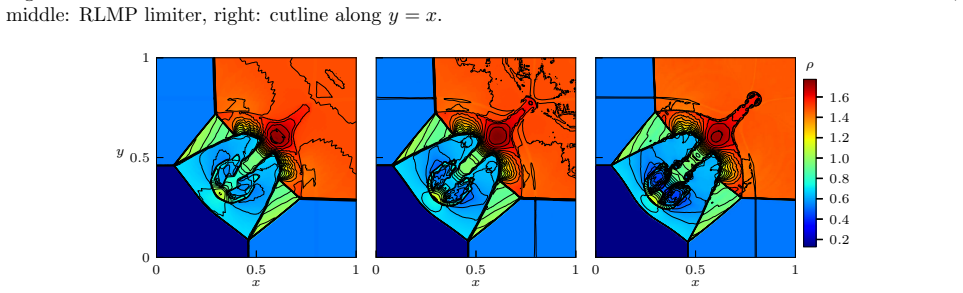
- The method resolves strong discontinuities sharply, capturing shock and contact discontinuities on about two and four cells in the Sod tube, and remains stable on Mach 80 and Mach 2000 jets with near-vacuum regions.
Reading between the lines
- A natural extension, not tested in the paper, is to apply the same convex-decomposition limiting to real-gas or tabulated equations of state; the machinery is independent of the ideal-gas law as long as the intermediate states remain admissible.
- The 3D extension, which the paper says is in principle straightforward, should inherit the positivity guarantee under an analogous CFL bound because the convex-decomposition argument is dimension-agnostic.
- Because the paper explicitly leaves von Neumann stability of the second-order D2Q5 scheme open, the practical robustness of the method likely depends on the limiters being active near discontinuities; one could test this by running smooth flows with the pure second-order scheme and measuring growth.
Editorial analysis
A structured set of objections, weighed in public.
Referee Report
Summary. The manuscript proposes a two-dimensional vectorial lattice Boltzmann method for the compressible Euler equations, obtained by blending a first-order scheme (10) with a second-order scheme (18) through edge-based parameters θ. The authors show that the first-order scheme admits a convex decomposition (Eq. (13)) and prove that, for α ∈ [1/2, 1) and under a stated CFL constraint, the blended update (25)-(27) remains in the admissible set G provided the edge states in Eq. (28) are in G. Density bounds are enforced with PP, LMP, or RLMP limiters in Sec. 3.3, and pressure positivity is reduced in Sec. 3.4 to a scalar condition on θp based on a stated spectral radius formula. The method is tested on Sod, Shu-Osher, near-vacuum, LeBlanc, Sedov, 2D Riemann, double Mach reflection, and astrophysical jet problems.
Significance. If the central claim holds, the paper makes a useful contribution: it shows how to preserve the collide-and-stream structure of lattice Boltzmann schemes while enforcing convex admissibility for strong compressible flows with near-vacuum states. The constructive convex-decomposition argument in Props. 3 and 4 is clear and essentially self-contained, and the numerical evidence covers a demanding and relevant set of benchmarks, including cases where unconstrained second-order schemes fail. The paper also honestly identifies open issues, such as the linear stability of the second-order scheme in Remark 2. However, the pressure-positivity guarantee relies on an eigenvalue identity that is neither proved nor publicly available in the cited companion work, and the numerical CFL setup uses a wave-speed estimate that is not clearly covered by the stated Bouchut criterion. These are load-bearing gaps, though they appear fixable within the manuscript's scope.
major comments (3)
- [Section 3.4, Eq. (30) and the following paragraph] The pressure-positivity limiter is built on the identity ρ(B^{-1/2}AB^{-1/2}) = max(|ΔFρ|/ρ*, (|γ1|+√Δ)/(-2γ0)), with the eigenvalue set {ΔFρ/ρ*, (-γ1 ± √Δ)/(2γ0)} stated as "demonstrated in [2]". Reference [2] is the authors' unpublished companion paper and no proof or preprint identifier is provided. This identity is not an auxiliary detail: it defines θp for every edge in Sec. 3.4 and is used in all numerical experiments of Sec. 4. Without a proof in this paper or a publicly verifiable reference, the manuscript does not establish that the blended intermediate states satisfy the pressure-positivity condition, and the central guarantee that un+1 remains in G is incomplete. I recommend adding a short appendix with the derivation, or at minimum replacing the citation with a complete, accessible proof.
- [Section 4, kinetic-speed choice before Eq. (an = 4λn)] The text states that the choice an = 4λn with λn = max sqrt(v1²+v2²+γp/ρ) "satisfies the critical case of Bouchut's criterion (5)". For α = 1/2, criterion (5) requires an ≥ 4 max(|v1|+c, |v2|+c) with c = sqrt(γp/ρ), since the spectral radius of the x- and y-direction Euler Jacobians are |v1|+c and |v2|+c. The quantity sqrt(v1²+v2²+c²) is not an upper bound for this maximum in general (e.g., v1 = 10, v2 = 0, c = 1 gives sqrt(101) < 11). Consequently, the numerical runs are not demonstrated to satisfy the sufficient condition used in Prop. 3, and the claimed CFL setting λn Δtn/Δx = 0.25 is weaker than the theorem's hypothesis. The authors should either choose λn = max(|v1|+c, |v2|+c) or prove that the scheme remains convex-preserving under the weaker estimate.
- [Section 3.3.3 and Eq. (28)] There are several inconsistencies in the formulas for the density limiter and in the convex decomposition that make the definitions hard to check. In Sec. 3.3.3, the first displayed formula for θρ,n uses |ΔFρ,n_{i,j+1/2}| in the denominator although the left-hand side is θρ,n_{i+1/2,j}, and the second formula defines θρ,n_{i+1/2,j} again instead of θρ,n_{i,j+1/2}; both should be corrected. In the list after Eq. (28), the state u(3)_{i,j+1/2} is defined twice and u(4)_{i,j+1/2} is missing; this is likely a typographical error, but it obscures the convex decomposition that is the basis of the method.
minor comments (5)
- [Eq. (23)] The second index in θn_{i-αk,j-αk} should presumably be j-βk; the current expression is a typo.
- [Appendix A, Eq. (20)] The averaged derivative operators are typeset inconsistently: Dxf appears twice in the displayed definitions, where the second occurrence should be the averaged operator used in Eq. (19), and the bar notation is not consistently reproduced. Please make the notation uniform.
- [Appendix A] The name Cayley-Hamilton is misspelled as Cayleigh-Hamilton.
- [Sec. 2.2] Crank-Nicholson should be Crank-Nicolson.
- [Remark 2] The statement that linear stability is left for future work is honest, but since the observed robustness of the second-order scheme is used in the numerical sections, a brief discussion of how the limiters compensate for the absence of a stability proof would help the reader assess the results.
Circularity Check
The convex-limiting construction is largely self-contained, but the pressure-positivity limiter's key spectral-radius formula is imported from the authors' own unpublished companion paper [2].
-
self citation load bearing
[Section 3.4, Pressure positivity (paragraph deriving theta_p after Eq. (30))]
"Furthermore, as demonstrated in [2], the eigenvalues of B^{-1/2}AB^{-1/2} can be computed analytically: we get {DeltaF_rho/rho*, (-gamma_1 +/- sqrt(Delta))/(2 gamma_0)} ... We finally take theta_{p,i+1/2,j}^n = max(0, kappa^n/(rho(B^{-1/2}AB^{-1/2}) - epsilon))."
The paper reduces the infinite pressure-positivity constraints (30) to the scalar limiter theta_p = kappa/rho(B^{-1/2}AB^{-1/2}). The eigenvalue set used to evaluate this spectral radius is not derived here; it is attributed to [2], an unpublished companion by the same authors (Abgrall, Liu, Wissocq). Every subsequent theta_p computation in the PP/RLMP/LMP variants and in Section 4 depends on this formula. Thus the load-bearing algebraic step of the central positivity proof rests on a same-author citation that is not independently verified in this manuscript. This is a load-bearing self-citation rather than an equivalence-by-definition, so the rest of the convex-limiting argument remains independent.
full rationale
No fitted parameter is renamed as a prediction, and the density-bound limiters of Sec. 3.3 are derived explicitly from the convex decomposition (28) with no reliance on the authors' prior work. The first-order convex-preservation proof (Prop. 3) is self-contained and uses standard Riemann-state arguments. The second-order equivalence and consistency results are also derived in the text or in Appendix A. The only load-bearing self-citation is the spectral-radius formula in Sec. 3.4 ([2]); the same section also cites the same-author preprint [1] for the Rayleigh-quotient reduction, but that reduction is a standard identity. Since the eigenvalue formula is a concrete algebraic lemma and the surrounding convex-limiting framework contains independent content, the paper is not globally circular, but the self-citation dependency justifies a moderate score. Separately, the Sec. 4 assertion that lambda_n = sqrt(v1^2+v2^2+gamma p/rho) satisfies Bouchut's criterion (5) is questionable because this value can be smaller than max(|v1|+c, |v2|+c); this is a correctness risk, not circularity. The manuscript also refers to an Appendix B (for [40]) that is not present, another completeness gap.
Assumptions & free parameters
free parameters (3)
- kinetic model weight α =
1/2
- Bouchut safety factor β =
β=2 (implied by a_n=4λ_n)
- strict positivity tolerance ϵ =
1e-16
assumptions (4)
- domain assumption The Riemann intermediate state u_{i+1/2,j} = (u_L+u_R)/2 - (f(u_R)-f(u_L))/(2λ) lies in G whenever u_L, u_R ∈ G and λ ≥ |∂f/∂u|.
- domain assumption Bouchut's monotonicity criterion (M'_k(u) diagonalizable with nonnegative eigenvalues) guarantees an H-theorem for the kinetic model.
- ad hoc to paper The eigenvalues of B^{-1/2} A B^{-1/2} are {ΔFρ/ρ*, (-γ1 ± √Δ)/(2γ0)} and the spectral radius is max(|ΔFρ|/ρ*, (|γ1|+√Δ)/(-2γ0)).
- standard math Cayley-Hamilton theorem applies to the matrix A of Eq. (35).
Cite this review
Pith. "Pith review of A positive- and bound-preserving vectorial lattice Boltzmann method in two dimensions." pith.science (2026). https://pith.science/paper/BZ3TGPJH
@misc{pith2026241115001,
  author       = {Pith},
  title        = {Pith review of: A positive- and bound-preserving vectorial lattice Boltzmann method in two dimensions},
  year         = {2026},
  howpublished = {\url{https://pith.science/paper/BZ3TGPJH}},
  note         = {Machine review of arXiv:2411.15001}
}
read the original abstract
We present a novel positive kinetic scheme built on the efficient collide-and-stream algorithm of the lattice Boltzmann method (LBM) to address hyperbolic conservation laws. We focus on the compressible Euler equations with strong discontinuities. Starting from the work of Jin and Xin [20] and then [4,8], we show how the LBM discretization procedure can yield both first- and second-order schemes, referred to as vectorial LBM. Noticing that the first-order scheme is convex preserving under a specific CFL constraint, we develop a blending strategy that preserves both the conservation and simplicity of the algorithm. This approach employs convex limiters, carefully designed to ensure either positivity (of the density and the internal energy) preservation (PP) or well-defined local maximum principles (LMP), while minimizing numerical dissipation. On challenging test cases involving strong discontinuities and near-vacuum regions, we demonstrate the scheme accuracy, robustness, and ability to capture sharp discontinuities with minimal numerical oscillations.
Figures


Figures from the paper (7 more)




Forward citations
Cited by 1 Pith paper
-
Equilibrium boundary conditions for vectorial multi-dimensional lattice Boltzmann schemes
Equilibrium boundary conditions for monotone lattice Boltzmann schemes are shown to converge to the Bardos-Leroux-Nedelec entropy solution in the scalar multidimensional case.
Reference graph
Works this paper leans on
-
[2]
R. Abgrall, Y. Liu, and G. Wissocq , Bound preserving PAMPA (Point-Average-Moment PolynomiAl-free) scheme: two-dimensional case , 2024
work page 2024
-
[1]
R. Abgrall, M. Jiao, Y. Liu, and K. Wu , Bound preserving Point-Average-Moment PolynomiAl- interpreted (PAMPA) scheme: one-dimensional case , 2024, https://arxiv.org/abs/2410.14292. 20
arXiv 2024
-
[3]
D. Aregba-Driollet , Convergence of Lattice Boltzmann methods with overrelaxation for a nonlinear conservation law, ESAIM: Mathematical Modelling and Numerical Analysis, 58 (2024), pp. 1935–1958
work page 2024
-
[4]
D. Aregba-Driollet and R. Natalini , Discrete kinetic schemes for multidimensional systems of conservation laws, SIAM Journal on Numerical Analysis, 37 (2000), pp. 1973–2004
work page 2000
-
[5]
H. Baty, F. Drui, P. Helluy, E. Franck, C. Klingenberg, and L. Thanh ¨auser, A robust and efficient solver based on kinetic schemes for Magnetohydrodynamics (MHD) equations. , Applied Mathe- matics and Computation, 440 (2023), p. 127667, https://doi.org/10.1016/j.amc.2022.127667
-
[6]
T. Bellotti, The influence of parasitic modes on stable lattice Boltzmann schemes and weakly unstable multi-step Finite Difference schemes , Computers & Mathematics with Applications, 174 (2024), pp. 397– 416, https://doi.org/10.1016/j.camwa.2024.09.028
-
[7]
T. Bellotti, B. Graille, and M. Massot , Finite Difference formulation of any lattice Boltzmann scheme, Numerische Mathematik, 152 (2022), pp. 1–40
work page 2022
-
[8]
F. Bouchut , Construction of BGK models with a family of kinetic entropies for a given system of conservation laws., Journal of Statistical Physics, 95 (1999)
work page 1999
Show all 44 references
-
[9]
Caetano, F
F. Caetano, F. Dubois, and B. Graille , A result of convergence for a mono-dimensional two- velocities lattice Boltzmann scheme . Preprint, arXiv:1905.12393 [math.AP], 2019
1905 arXiv
-
[10]
Coulette, C
D. Coulette, C. Court `es, E. Franck, and L. Navoret , Vectorial kinetic relaxation model with central velocity. application to implicit relaxations schemes , Communications in Computational Physics, 27 (2020), pp. 976–1013
2020
-
[11]
J. Duan, W. Barsukow, and C. Klingenberg , Active flux methods for hyperbolic conservation laws – flux vector splitting and bound-preservation , (2024), pp. 1–42, https://arxiv.org/abs/2411.00065
2024 arXiv
-
[12]
Dubois, Simulation of strong nonlinear waves with vectorial lattice Boltzmann schemes , International Journal of Modern Physics C, 25 (2014), pp
F. Dubois, Simulation of strong nonlinear waves with vectorial lattice Boltzmann schemes , International Journal of Modern Physics C, 25 (2014), pp. 1–9
2014
-
[13]
Graille, Approximation of mono-dimensional hyperbolic systems: A lattice Boltzmann scheme as a relaxation method, Journal of Computational Physics, 266 (2014), pp
B. Graille, Approximation of mono-dimensional hyperbolic systems: A lattice Boltzmann scheme as a relaxation method, Journal of Computational Physics, 266 (2014), pp. 74–88
2014
-
[14]
Guermond, M
J.-L. Guermond, M. Nazarov, B. Popov, and I. Tomas , Second-order invariant domain preserving approximation of the euler equations using convex limiting , SIAM J. Sci. Comput., 40 (2018), pp. A3211– A3239
2018
-
[15]
Guermond and B
J.-L. Guermond and B. Popov , Invariant Domains and First-Order Continuous Finite Element Ap- proximation for Hyperbolic Systems , SIAM Journal on Numerical Analysis, 54 (2016), pp. 2466–2489
2016
-
[16]
Guermond, B
J.-L. Guermond, B. Popov, and I. Tomas , Invariant domain preserving discretization independent schemes and convex limiting for hyperbolic systems , Comput. Method. Appl. M., 347 (2019), pp. 143–175
2019
-
[17]
Hajduk, Monolithic convex limiting in discontinuous galerkin discretizations of hyperbolic conservation laws, Comput
H. Hajduk, Monolithic convex limiting in discontinuous galerkin discretizations of hyperbolic conservation laws, Comput. Math. Appl., 87 (2021), pp. 120–138
2021
-
[18]
Harten, J
A. Harten, J. M. Hyman, P. D. Lax, and B. Keyfitz , On finite-difference approximations and entropy conditions for shocks , Communications on Pure and Applied Mathematics, 29 (1976), pp. 297– 322
1976
-
[19]
X. He, S. Chen, and G. D. Doolen , A Novel Thermal Model for the Lattice Boltzmann Method in Incompressible Limit, Journal of Computational Physics, 146 (1998), pp. 282–300
1998
-
[20]
Jin and Z
S. Jin and Z. Xin, The relaxation schemes for systems of conservation laws in arbitrary space dimensions, Commun. Pure Appl. Math., 48 (1995), p. 235–276. 21
1995
-
[21]
Kamm, Evaluation of the Sedov-von Neumann-Taylor Blast Wave Solutions , Tech
J. Kamm, Evaluation of the Sedov-von Neumann-Taylor Blast Wave Solutions , Tech. Report LA-UR-00- 6055, Los Alamos National Laboratory, 2000
2000
-
[22]
Kozhanova, R
K. Kozhanova, R. Loub`ere, P. Boivin, and S. Zhao , A Hybrid a Posteriori Mood Limited Lattice Boltzmann Method to Solve Compressible Fluid Flows (LbMOOD) , J. Comput. Phys., in press (2024)
2024
-
[23]
Kr¨uger, H
T. Kr¨uger, H. Kusumaatmaja, A. Kuzmin, O. Shardt, G. Silva, and E. M. Viggen, The Lattice Boltzmann Method , no. March 2015 in Graduate Texts in Physics, Springer International Publishing, Cham, 2017
2015
-
[24]
Kuzmin, Monolithic convex limiting for continuous finite element discretizations of hyperbolic conser- vation laws , Comput
D. Kuzmin, Monolithic convex limiting for continuous finite element discretizations of hyperbolic conser- vation laws , Comput. Method. Appl. M., 361 (2020), p. 112804
2020
-
[25]
P. D. Lax and X.-D. Liu, Solution of Two-Dimensional Riemann Problems of Gas Dynamics by Positive Schemes, SIAM Journal on Scientific Computing, 19 (1998), pp. 319–340
1998
-
[26]
Mari´e, D
S. Mari´e, D. Ricot, and P. Sagaut, Comparison between lattice Boltzmann method and Navier–Stokes high order schemes for computational aeroacoustics , Journal of Computational Physics, 228 (2009), pp. 1056–1070
2009
-
[27]
G. R. McNamara and G. Zanetti, Use of the Boltzmann Equation to Simulate Lattice-Gas Automata , Physical Review Letters, 61 (1988), pp. 2332–2335
1988
-
[28]
Natalini, A discrete kinetic approximation of entropy solution to multi-dimensional scalar conserva- tion laws , Journal of differential equations, 148 (1998), pp
R. Natalini, A discrete kinetic approximation of entropy solution to multi-dimensional scalar conserva- tion laws , Journal of differential equations, 148 (1998), pp. 292–317
1998
-
[29]
Perthame and C
B. Perthame and C. W. Shu , On positivity preserving finite volume schemes for Euler equations , Numerische Mathematik, 73 (1996), pp. 119–130
1996
-
[30]
Y. H. Qian, D. D’Humi `eres, and P. Lallemand , Lattice BGK Models for Navier-Stokes Equation , Europhysics Letters (EPL), 17 (1992), pp. 479–484
1992
-
[31]
Sedov, Similarity and dimensional methods in mechanics , Academic Press, New York, 1959
L. Sedov, Similarity and dimensional methods in mechanics , Academic Press, New York, 1959
1959
-
[32]
C. W. Shu and S. Osher , Efficient implementation of essentially non-oscillatory shock-capturing schemes, Journal of Computational Physics, 77 (1988), pp. 439–471
1988
-
[33]
G. A. Sod, A survey of several finite difference methods for systems of nonlinear hyperbolic conservation laws, Journal of Computational Physics, 27 (1978), pp. 1–31
1978
-
[34]
J. D. Sterling and S. Chen, Stability Analysis of Lattice Boltzmann Methods, Journal of Computational Physics, 123 (1996), pp. 196–206, https://doi.org/10.1006/jcph.1996.0016
1996
-
[35]
F. Vilar, A posteriori correction of high-order discontinuous Galerkin scheme through subcell finite vol- ume formulation and flux reconstruction , Journal of Computational Physics, 387 (2019), pp. 245–279
2019
-
[36]
Vilar, Local subcell monolithic DG/FV convex property preserving scheme on unstructured grids and entropy consideration, Journal of Computational Physics, (2024), p
F. Vilar, Local subcell monolithic DG/FV convex property preserving scheme on unstructured grids and entropy consideration, Journal of Computational Physics, (2024), p. 113535
2024
-
[37]
G. B. Whitham , Linear and nonlinear waves , Pure Appl. Math., Wiley-Intersci. Ser. Texts Monogr. Tracts, John Wiley & Sons, Hoboken, NJ, 1974
1974
-
[38]
Wissocq and R
G. Wissocq and R. Abgrall , A new local and explicit kinetic method for linear and non-linear convection-diffusion problems with finite kinetic speeds. I: One-dimensional case , J. Comput. Phys., 518 (2024), p. 29. Id/No 113333
2024
-
[39]
Wissocq and R
G. Wissocq and R. Abgrall , A new local and explicit kinetic method for linear and non-linear convection-diffusion problems with finite kinetic speeds. II: Multi-dimensional case , J. Comput. Phys., 516 (2024), p. 27. Id/No 113376
2024
-
[40]
Wissocq, T
G. Wissocq, T. Coratger, G. F arag, S. Zhao, P. Boivin, and P. Sagaut , Restoring the con- servativity of characteristic-based segregated models: Application to the hybrid lattice Boltzmann method , Physics of Fluids, 34 (2022), p. 046102. 22
2022
-
[41]
Wissocq, S
G. Wissocq, S. Taileb, S. Zhao, and P. Boivin , A hybrid lattice Boltzmann method for gaseous detonations, Journal of Computational Physics, 494 (2023), p. 112525
2023
-
[42]
Wu and C
K. Wu and C. W. Shu , Geometric Quasilinearization Framework for Analysis and Design of Bound- Preserving Schemes, SIAM Review, 65 (2023), pp. 1037–1073
2023
-
[43]
Yang and Z
M. Yang and Z. J. W ang , A parameter-free generalized moment limiter for high-order methods on unstructured grids, Advances in Applied Mathematics and Mechanics, 1 (2009), pp. 451–480
2009
-
[44]
Zhang and C
X. Zhang and C. W. Shu, On positivity-preserving high order discontinuous Galerkin schemes for com- pressible Euler equations on rectangular meshes, Journal of Computational Physics, 229 (2010), pp. 8918– 8934. 23
2010
Reviewed August 12, 2026 · model on record in the stance chip above.
Discussion (0). Continue with ORCID to comment.