REVIEW 3 major objections 4 minor 54 references
Energy participation ratio analysis for very anharmonic superconducting circuits
T0 review · 3 major / 4 minor · reviewed 2026-08-12 · deepseek-v4-flash
Pith's one-line read The paper claims that extending the energy participation ratio method to keep the exact Josephson cosine makes black-box quantization accurate for strongly anharmonic circuits such as fluxonium.
desk verdict A useful EPR extension for fluxonium with a genuinely predictive dispersive-shift test, but the validation is softened by fitted parameters and a missing Hilbert-space convergence check. read the letter →
The pith
A machine-rendered reading of the paper's core claim, the machinery that carries it, and where it could break.
The reading
What carries the argument
The machinery is the energy participation ratio (EPR), the fraction of a mode's total inductive energy stored in a given Josephson junction, together with the zero-point-fluctuation formula $\varphi_{mj}^2 = p_{mj}\hbar\omega_m/(2E_j)$, which converts classically computed participation ratios into the quantum phase operator. The extension is to keep the full Josephson cosine, $-E_J[\cos(\varphi_j - \varphi_{\text{ext}}) + \varphi_j^2/2]$, with the phase operator expanded in the two linear modes (qubit and resonator), implemented numerically in a truncated Fock basis via the matrix exponential of the phase operators. This replaces the usual fourth-order expansion, which would give an analytic but inaccurate dispersive shift, with an exact diagonalization from which the dispersive shift is read off as $2\chi = (\omega_{|1,1\rangle} - \omega_{|1,0\rangle}) - (\omega_{|0,1\rangle} - \omega_{|0,0\rangle})$.
What would settle it
The claim would be settled by applying the same pipeline to a new fluxonium device with a different geometry and, using $E_J$ and $E_L$ determined only from room-temperature junction measurements rather than fit to the qubit spectrum, comparing the predicted qubit and resonator frequencies and dispersive shift across the flux range; systematic disagreement would show that the linearized zero-point fluctuations in Eq. (12) break down under strong anharmonicity.
Extended reading notes
Core claim
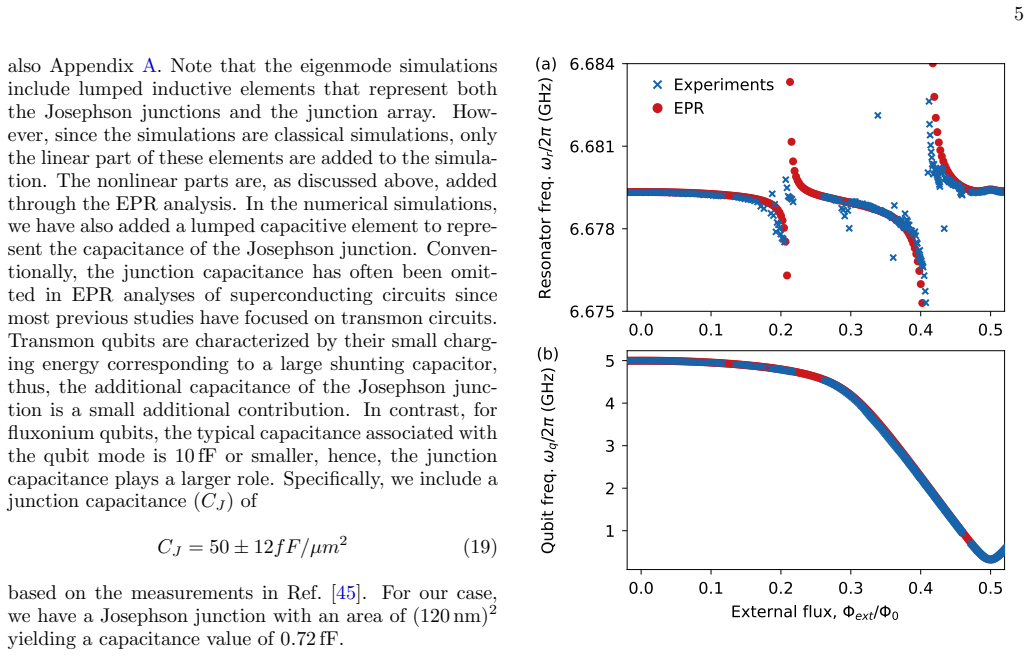
The central claim is that a black-box quantization method based on energy participation ratios can handle circuits whose nonlinearity is far beyond the weak-anharmonicity regime. The authors replace the truncated Taylor expansion of the Josephson energy with the exact cosine term, evaluated in the Fock basis of the linear modes as a matrix exponential, and include the external flux as a phase in that term. Applied to a measured fluxonium-resonator system, the method reproduces the flux dependence of the qubit frequency from about 5 GHz down to about 300 MHz, the resonator frequency including avoided crossings, and the dispersive shift $2\chi$ across the flux range, whereas a lumped-element model using the same electrostatic parameters is less accurate. The paper takes this as evidence that the mode distribution captured by the finite-element simulation renormalizes effective parameters such as charging energy and coupling strength, and that the extended EPR analysis 'can fully describe the nonlinear coupling of a highly anharmonic circuit.'
Load-bearing premise
The whole prediction rests on assuming that the size of the quantum jitter of the phase across the junction, computed from the linearized classical modes, is the same even when the nonlinearity is so large that the cosine cannot be truncated.
Editorial extensions
If this is right
- If the extended EPR method is correct, designers can predict the full flux-dependent spectrum of a fluxonium-resonator system, including higher-level avoided crossings, from a classical eigenmode simulation plus two calibrated energy scales, without a lumped-element circuit model.
- The predicted dispersive shift, which depends on many higher fluxonium levels, becomes a reliable design target, so qubit-resonator couplings and readout operating points can be chosen before fabrication.
- The method's success implies that distributed mode structure renormalizes effective circuit parameters such as charging energy and coupling strength, so lumped-element fits should be checked against EPR simulations for small-capacitance devices.
- Because the exact cosine is handled by a matrix exponential and only the Fock-basis truncation sets the accuracy, the same pipeline should extend to other strongly nonlinear elements and to multi-qubit circuits without changing the formalism.
Reading between the lines
- A natural next step, not taken in the paper, is to test the method on a device where the junction's Josephson energy is set independently by room-temperature resistance measurements, removing the two fitted energies and making the comparison fully parameter-free.
- The linearized zero-point-fluctuation assumption could be probed by comparing the exact diagonalization of the full distributed Hamiltonian (where accessible) with the EPR prediction as $E_J/E_L$ is varied; deviations would reveal where the two-mode basis begins to fail.
- Because the paper attributes the lumped model's error to the equipotential-island approximation, the EPR approach might be the practical route to computing mode-dependent 'renormalized' parameters for cross-chip fluxonium architectures, including tunable couplers.
Editorial analysis
A structured set of objections, weighed in public.
Referee Report
Summary. The paper extends the energy participation ratio (EPR) method to highly anharmonic superconducting circuits by replacing the Taylor expansion of the Josephson potential with the exact cosine operator. The cosine is expressed in a Fock basis of the linear modes obtained from classical finite-element simulations, using the zero-point fluctuations extracted from the energy participation ratios. As a proof of concept, the authors design, fabricate, and measure a fluxonium qubit coupled to a readout resonator, and compare the measured qubit and resonator frequencies and the dispersive shift as functions of external flux with the extended EPR analysis and with a lumped-element model. They report good agreement for the frequencies and a better match for the dispersive shift than the lumped model, concluding that the extended EPR analysis can fully describe nonlinear coupling in highly anharmonic circuits.
Significance. If the numerical and conceptual approximations are adequately justified, this is a useful extension of black-box quantization to fluxonium-class circuits, which are of growing importance for quantum information processing. The manuscript is transparent about the three fitted parameters (EJ, EL, and resonator offset), and the dispersive shift is a genuinely higher-order prediction that is not directly fitted. The paper also ships open-source code and measurement data, which supports reproducibility. The main weakness is the absence of a convergence study for the truncated Fock basis, which is load-bearing because the dispersive shift is the key unfitted observable and could be sensitive to the truncation.
major comments (3)
- [Sec. IV (paragraph beginning 'During EPR simulations')] The manuscript truncates the Hilbert space of each eigenmode to 30 Fock states without a convergence study. The dispersive shift defined in Eq. (18) is the central unfitted observable and is known to receive contributions from high-lying qubit levels; therefore it is precisely the quantity most likely to be affected by the truncation. The unexplained deviation near Φ_ext/Φ0 = 0.3 in Fig. 4 could be a truncation artifact. Please provide a convergence check as a function of Fock truncation (e.g., 20, 30, 40, and 60 states per mode) at several flux points, including 0.3, and report the resulting sensitivity of χ and of the qubit and resonator frequencies. If the results are stable, state this explicitly; if not, the validation is not yet quantitatively secure.
- [Sec. II, Eq. (12)] The zero-point fluctuations φ_mj are obtained from the linearized energy participation via φ²_mj = p_mj ℏω_m/(2E_j). The nonlinear Hamiltonian in Eq. (17) is treated exactly, but the basis itself is built from these linear zero-point fluctuations. For a fluxonium at Φ_ext/Φ0 = 0.5, the qubit frequency is ~0.3 GHz while the linear mode frequency is ~6 GHz, so the cosine term strongly mixes many Fock states and may also couple to modes beyond the two retained modes. The completeness of the two-mode Fock basis constructed from the linear modes is therefore not self-evident. Please justify this approximation, for example by comparing with exact circuit quantization for the same circuit parameters (e.g., using scqubits), or by studying convergence as additional modes are included in the EPR Hamiltonian.
- [Sec. IV (last paragraph) and Sec. V] The statement that the extended EPR analysis 'can fully describe the nonlinear coupling of a highly anharmonic circuit' is stronger than the evidence presented. The qubit and resonator frequency agreements in Fig. 3 rest partly on the fitted parameters EJ, EL, and the resonator offset, as the paper itself acknowledges. The genuinely predictive test is the dispersive shift in Fig. 4, but that display shows an unexplained discrepancy near 0.3 Φ0. The conclusion should be tempered accordingly, or additional parameter-free predictions should be provided (for example, the qubit frequency at flux points outside the two used for fitting, or an uncertainty estimate propagated from the junction capacitance CJ).
minor comments (4)
- [Sec. IV (paragraph after Fig. 3)] The sentence 'see red points in Fig. 3(b)' following the discussion of the resonator avoided crossings should refer to Fig. 3(a), since the resonator frequency is shown in panel (a) and the qubit frequency in panel (b).
- [Sec. II, Eq. (15)] The expression 2χ = E_j φ²_qj φ²_rj /12 is given without specifying the sign convention; please state whether the usual dispersive shift is negative and whether the Taylor-expansion result reproduces the sign expected for the fluxonium-resonator system.
- [Sec. IV, Eq. (19)] The junction capacitance is given as CJ = 50 ± 12 fF/μm², but the simulation results in Figs. 3 and 4 are presented without uncertainty bars. Please propagate the uncertainty in CJ (and, if possible, in the fitted parameters) into the predicted frequencies and dispersive shift, or state why these uncertainties are negligible.
- [Appendix A, Eqs. (A16)-(A17)] The definitions of C⋆ and Ccoup in Eqs. (A16) and (A17) are hard to parse because of the nested subscripts; a short verbal description of the effective capacitance network would improve readability.
Circularity Check
No significant circularity: the fitted EJ/EL and resonator offset are transparent calibrations, while the flux dependence and dispersive shift are out-of-sample predictions.
full rationale
The paper's derivation chain is self-contained in the sense that the central predictive claims do not reduce to the fitted inputs. The EPR mapping of Eq. (12), phi^2_mj = p_mj hbar omega_m/(2 E_j), is a conversion from the classically computed energy-participation ratio p_mj and linear mode frequency omega_m to a zero-point fluctuation; it is not a fit to the target observables. The Hamiltonian of Eq. (17) is then diagonalized numerically, and the frequencies and dispersive shift are computed. The only experimental feedback acknowledged in Sec. IV is the calibration of EJ and EL to the qubit frequency at flux points 0 and 0.5 Phi_0, plus a single constant offset for the resonator frequency at zero flux. The paper explicitly states, "While it is perhaps not too surprising that we can model the qubit and resonator frequencies given that we fitted the Josephson energy and the inductive energy," and then identifies the dispersive shift as the higher-order coupling prediction. The flux dependence of the resonator frequency including avoided crossings, the interior flux dependence of the qubit frequency, and especially the dispersive shift in Fig. 4 are not fitted and provide independent content. No load-bearing self-citation or imported uniqueness theorem is present: the EPR method is cited to external work (Ref. [20]) and the exact-cosine treatment follows Ref. [40], also external; the same-group Ref. [38] appears only as contextual support for fluxonium readout. The lack of a convergence study for the 30-Fock-state truncation is a numerical validation concern, not a circularity, because it does not make the predicted values equal to the inputs by construction.
Assumptions & free parameters
free parameters (3)
- Josephson energy EJ =
EJ/(2π) = 4.028 GHz
- Inductive energy EL (junction array) =
EL/(2π) = 0.775 GHz
- Resonator frequency offset =
Not stated; matched at zero flux
assumptions (5)
- domain assumption The EPR mapping φ²_mj = p_mj ℏω_m / (2 E_j) extracted from the linearized classical circuit gives the correct quantum zero-point fluctuations even when the nonlinearity is large.
- domain assumption The circuit can be described by only two modes (qubit and resonator), with all other modes neglected.
- domain assumption The external magnetic flux enters the Hamiltonian only through the Josephson phase offset φ_ext in the cosine term, not through the linear inductor or the array.
- domain assumption The junction capacitance value from Ref. [45] applies to this specific junction.
- standard math Standard circuit quantization and matrix exponentials in the Fock basis are valid.
Cite this review
Pith. "Pith review of Energy participation ratio analysis for very anharmonic superconducting circuits." pith.science (2026). https://pith.science/paper/DRMRCO6M
@misc{pith2026241115039,
  author       = {Pith},
  title        = {Pith review of: Energy participation ratio analysis for very anharmonic superconducting circuits},
  year         = {2026},
  howpublished = {\url{https://pith.science/paper/DRMRCO6M}},
  note         = {Machine review of arXiv:2411.15039}
}
read the original abstract
Superconducting circuits are being employed for large-scale quantum devices, and a pertinent challenge is to perform accurate numerical simulations of device parameters. One of the most advanced methods for analyzing superconducting circuit designs is the energy participation ratio (EPR) method, which constructs quantum Hamiltonians based on the energy distribution extracted from classical electromagnetic simulations. In the EPR approach, we extract linear terms from finite element simulations and add nonlinear terms using the energy participation ratio extracted from the classical simulations. However, the EPR method relies on a low-order expansion of nonlinear terms, which is prohibitive for accurately describing highly anharmonic circuits. An example of such a circuit is the fluxonium qubit, which has recently attracted increasing attention due to its high lifetimes and low error rates. In this work, we extend the EPR approach to effectively address highly nonlinear superconducting circuits, and, as a proof of concept, we apply our approach to a fluxonium qubit. Specifically, we design, fabricate, and experimentally measure a fluxonium qubit coupled to a readout resonator. We compare the measured frequencies of both the qubit and the resonator to those extracted from the EPR analysis, and we find an excellent agreement. Furthermore, we compare the dispersive shift as a function of external flux obtained from experiments with our EPR analysis and a simpler lumped element model. Our findings reveal that the EPR results closely align with the experimental data, providing more accurate estimations compared to the simplified lumped element simulations.
Figures


Figures from the paper (5 more)


Reference graph
Works this paper leans on
-
[1]
Arute, K
F. Arute, K. Arya, R. Babbush, D. Bacon, J. C. Bardin, R. Barends, R. Biswas, S. Boixo, F. G. Brandao, D. A. Buell, et al., Quantum supremacy using a programmable superconducting processor, Nature 574, 505 (2019)
2019
- [2]
-
[3]
S. Krinner, N. Lacroix, A. Remm, A. Di Paolo, E. Genois, C. Leroux, C. Hellings, S. Lazar, F. Swiadek, J. Her- rmann, et al., Realizing repeated quantum error correc- tion in a distance-three surface code, Nature 605, 669 (2022)
work page 2022
-
[4]
Y. Zhao, Y. Ye, H.-L. Huang, Y. Zhang, D. Wu, H. Guan, Q. Zhu, Z. Wei, T. He, S. Cao, et al., Realization of an error-correcting surface code with superconducting qubits, Physical Review Letters 129, 030501 (2022)
work page 2022
-
[5]
Q. Zhu, S. Cao, F. Chen, M.-C. Chen, X. Chen, T.-H. Chung, H. Deng, Y. Du, D. Fan, M. Gong, et al., Quan- tum computational advantage via 60-qubit 24-cycle ran- dom circuit sampling, Science bulletin 67, 240 (2022)
work page 2022
-
[6]
Y. Kim, A. Eddins, S. Anand, K. X. Wei, E. Van Den Berg, S. Rosenblatt, H. Nayfeh, Y. Wu, M. Zale- tel, K. Temme, et al., Evidence for the utility of quan- tum computing before fault tolerance, Nature 618, 500 (2023)
2023
- [7]
-
[8]
R. Acharya, L. Aghababaie-Beni, I. Aleiner, T. I. Ander- sen, M. Ansmann, F. Arute, K. Arya, A. Asfaw, N. As- trakhantsev, J. Atalaya, et al., Quantum error correc- tion below the surface code threshold, arXiv preprint arXiv:2408.13687 (2024)
arXiv 2024
Show all 54 references
-
[9]
H. Ali, J. Marques, O. Crawford, J. Majaniemi, M. Serra- Peralta, D. Byfield, B. Varbanov, B. M. Terhal, L. Di- 12 Carlo, and E. T. Campbell, Reducing the error rate of a superconducting logical qubit using analog readout in- formation, Physical Review Applied 22, 044031 (2024)
2024
-
[10]
M. H. Devoret et al., Quantum fluctuations in electrical circuits, Les Houches, Session LXIII 7, 133 (1995)
1995
-
[11]
Blais, R.-S
A. Blais, R.-S. Huang, A. Wallraff, S. M. Girvin, and R. J. Schoelkopf, Cavity quantum electrodynamics for superconducting electrical circuits: An architecture for quantum computation, Physical Review A—Atomic, Molecular, and Optical Physics 69, 062320 (2004)
2004
-
[12]
Bourassa, F
J. Bourassa, F. Beaudoin, J. M. Gambetta, and A. Blais, Josephson-junction-embedded transmission-line resonators: From kerr medium to in-line transmon, Phys- ical Review A—Atomic, Molecular, and Optical Physics 86, 013814 (2012)
2012
-
[13]
M. Leib, F. Deppe, A. Marx, R. Gross, and M. J. Hart- mann, Networks of nonlinear superconducting transmis- sion line resonators, New Journal of Physics 14, 075024 (2012)
2012
-
[14]
H. L. Mortensen, K. Mølmer, and C. K. Andersen, Nor- mal modes of a superconducting transmission-line res- onator with embedded lumped element circuit compo- nents, Physical Review A 94, 053817 (2016)
2016
-
[15]
Parra-Rodriguez, E
A. Parra-Rodriguez, E. Rico, E. Solano, and I. Egusquiza, Quantum networks in divergence-free circuit qed, Quantum Science and Technology 3, 024012 (2018)
2018
-
[16]
Z. K. Minev, T. G. McConkey, M. Takita, A. D. Cor- coles, and J. M. Gambetta, Circuit quantum electrody- namics (cqed) with modular quasi-lumped models, arXiv preprint arXiv:2103.10344 (2021)
2021 arXiv
-
[17]
Egusquiza and A
I. Egusquiza and A. Parra-Rodriguez, Algebraic canon- ical quantization of lumped superconducting networks, Physical Review B 106, 024510 (2022)
2022
-
[18]
S. E. Nigg, H. Paik, B. Vlastakis, G. Kirchmair, S. Shankar, L. Frunzio, M. H. Devoret, R. J. Schoelkopf, and S. M. Girvin, Black-box superconduct- ing circuit quantization, Physical Review Letters 108, 10.1103/physrevlett.108.240502 (2012)
2012 doi
-
[19]
Solgun, D
F. Solgun, D. W. Abraham, and D. P. DiVincenzo, Black- box quantization of superconducting circuits using ex- act impedance synthesis, Physical Review B 90, 134504 (2014)
2014
-
[20]
Z. K. Minev, Z. Leghtas, S. O. Mundhada, L. Chris- takis, I. M. Pop, and M. H. Devoret, Energy-participation quantization of josephson circuits, npj Quantum Infor- mation 7, 131 (2021)
2021
-
[21]
How- ever, as discussed above, we are focusing on fluxonium qubits, which have large anharmonicity
due to their relatively weak anharmonicity. How- ever, as discussed above, we are focusing on fluxonium qubits, which have large anharmonicity. Concretely, we therefore implement the exact cosine through the matrix exponential of the junction operators as we detail now. For th...
2000
-
[22]
J. Koch, M. Y. Terri, J. Gambetta, A. A. Houck, D. I. Schuster, J. Majer, A. Blais, M. H. Devoret, S. M. Girvin, and R. J. Schoelkopf, Charge-insensitive qubit design de- rived from the cooper pair box, Physical Review A 76, 042319 (2007)
2007
-
[23]
V. E. Manucharyan, J. Koch, L. I. Glazman, and M. H. Devoret, Fluxonium: Single cooper-pair circuit free of charge offsets, Science 326, 113 (2009)
2009
-
[24]
L. B. Nguyen, Y.-H. Lin, A. Somoroff, R. Mencia, N. Grabon, and V. E. Manucharyan, High-coherence flux- onium qubit, Physical Review X 9, 041041 (2019)
2019
-
[25]
L. Ding, M. Hays, Y. Sung, B. Kannan, J. An, A. Di Paolo, A. H. Karamlou, T. M. Hazard, K. Azar, D. K. Kim, et al., High-fidelity, frequency-flexible two- qubit fluxonium gates with a transmon coupler, Physical Review X 13, 031035 (2023)
2023
-
[26]
Somoroff, Q
A. Somoroff, Q. Ficheux, R. A. Mencia, H. Xiong, R. Kuzmin, and V. E. Manucharyan, Millisecond coher- ence in a superconducting qubit, Physical Review Letters 130, 267001 (2023)
2023
-
[27]
Zhang, C
H. Zhang, C. Ding, D. Weiss, Z. Huang, Y. Ma, C. Guinn, S. Sussman, S. P. Chitta, D. Chen, A. A. Houck, et al., Tunable inductive coupler for high-fidelity gates between fluxonium qubits, PRX Quantum 5, 020326 (2024)
2024
-
[28]
F. Wang, K. Lu, H. Zhan, L. Ma, F. Wu, H. Sun, H. Deng, Y. Bai, F. Bao, X. Chang, et al., Achieving millisecond coherence fluxonium through overlap joseph- son junctions, arXiv preprint arXiv:2405.05481 (2024)
2024 arXiv
-
[29]
Y.-H. Lin, L. B. Nguyen, N. Grabon, J. San Miguel, N. Pankratova, and V. E. Manucharyan, Demonstration of protection of a superconducting qubit from energy de- cay, Physical review letters 120, 150503 (2018)
2018
-
[30]
Earnest, S
N. Earnest, S. Chakram, Y. Lu, N. Irons, R. K. Naik, N. Leung, L. Ocola, D. A. Czaplewski, B. Baker, J. Lawrence, et al., Realization of a λ system with metastable states of a capacitively shunted fluxonium, Physical review letters 120, 150504 (2018)
2018
-
[31]
B. D. Josephson, Possible new effects in superconductive tunnelling, Physics letters 1, 251 (1962)
1962
-
[32]
Josephson, Phys
B. Josephson, Phys. letters 1, 251 (1962), Advan. Phys 14, 419 (1965)
1962
-
[33]
N. A. Masluk, I. M. Pop, A. Kamal, Z. K. Minev, and M. H. Devoret, Microwave characterization of joseph- son junction arrays: Implementing¡? format?¿ a low loss superinductance, Physical review letters 109, 137002 (2012)
2012
-
[34]
Puertas Mart ´ ınez, S
J. Puertas Mart ´ ınez, S. L´ eger, N. Gheeraert, R. Dasson- neville, L. Planat, F. Foroughi, Y. Krupko, O. Buisson, C. Naud, W. Hasch-Guichard, et al., A tunable joseph- son platform to explore many-body quantum optics in circuit-qed, npj Quantum Information 5, 19 (2019)
2019
-
[35]
Hazard, A
T. Hazard, A. Gyenis, A. Di Paolo, A. Asfaw, S. Lyon, A. Blais, and A. Houck, Nanowire superinductance flux- onium qubit, Physical review letters 122, 010504 (2019)
2019
-
[36]
Niepce, J
D. Niepce, J. Burnett, and J. Bylander, High kinetic in- ductance nb n nanowire superinductors, Physical Review Applied 11, 044014 (2019)
2019
-
[37]
Gr¨ unhaupt, M
L. Gr¨ unhaupt, M. Spiecker, D. Gusenkova, N. Maleeva, S. T. Skacel, I. Takmakov, F. Valenti, P. Winkel, H. Rotzinger, W. Wernsdorfer, et al., Granular alu- minium as a superconducting material for high- impedance quantum circuits, Nature materials 18, 816 (2019)
2019
-
[38]
Rieger, S
D. Rieger, S. G¨ unzler, M. Spiecker, P. Paluch, P. Winkel, L. Hahn, J. Hohmann, A. Bacher, W. Wernsdorfer, and I. Pop, Granular aluminium nanojunction fluxonium qubit, Nature Materials 22, 194 (2023)
2023
-
[39]
T. V. Stefanski and C. K. Andersen, Flux-pulse-assisted readout of a fluxonium qubit, Physical Review Applied 22, 014079 (2024)
2024
-
[40]
W.-J. Lin, H. Cho, Y. Chen, M. G. Vavilov, C. Wang, and V. E. Manucharyan, 24 days-stable cnot-gate on flux- onium qubits with over 99.9% fidelity, arXiv preprint arXiv:2407.15783 (2024)
2024 arXiv
-
[41]
G. Zhu, D. G. Ferguson, V. E. Manucharyan, and J. Koch, Circuit qed with fluxonium qubits: Theory of the dispersive regime, Physical Review B—Condensed Matter and Materials Physics 87, 024510 (2013)
2013
-
[42]
Chiaro, A
B. Chiaro, A. Megrant, A. Dunsworth, Z. Chen, R. Barends, B. Campbell, Y. Chen, A. Fowler, I. Hoi, E. Jeffrey, et al., Dielectric surface loss in superconduct- 13 ing resonators with flux-trapping holes, Superconductor Science and Technology 29, 104006 (2016)
2016
-
[43]
Potts, P
A. Potts, P. Routley, G. J. Parker, J. Baumberg, and P. De Groot, Novel fabrication methods for submicrom- eter josephson junction qubits, Journal of Materials Sci- ence: Materials in Electronics 12, 289 (2001)
2001
-
[44]
Dunsworth, A
A. Dunsworth, A. Megrant, C. Quintana, Z. Chen, R. Barends, B. Burkett, B. Foxen, Y. Chen, B. Chiaro, A. Fowler, et al., Characterization and reduction of ca- pacitive loss induced by sub-micron josephson junction fabrication in superconducting qubits, Applied Physics Letters ...
2017
-
[45]
Z. K. Minev, T. G. McConkey, J. Drysdale, P. Shah, D. Wang, M. Facchini, G. Harper, J. Blair, H. Zhang, N. Lanzillo, S. Mukesh, W. Shanks, C. Warren, and J. M. Gambetta, Qiskit Metal: An Open-Source Framework for Quantum Device Design & Analysis (2021)
2021
-
[46]
Deppe, S
F. Deppe, S. Saito, H. Tanaka, and H. Takayanagi, Deter- mination of the capacitance of nm scale josephson junc- tions, Journal of applied physics 95, 2607 (2004)
2004
-
[47]
J. G. Kroll, F. Borsoi, K. Van Der Enden, W. Uil- hoorn, D. De Jong, M. Quintero-P´ erez, D. Van Woerkom, A. Bruno, S. Plissard, D. Car, et al., Magnetic-field- resilient superconducting coplanar-waveguide resonators for hybrid circuit quantum electrodynamics experiments, Phys...
2019
-
[48]
I. N. Moskalenko, I. A. Simakov, N. N. Abramov, A. A. Grigorev, D. O. Moskalev, A. A. Pishchimova, N. S. Smirnov, E. V. Zikiy, I. A. Rodionov, and I. S. Besedin, High fidelity two-qubit gates on fluxoniums using a tun- able coupler, npj Quantum Information 8, 130 (2022)
2022
-
[49]
S. P. Chitta, T. Zhao, Z. Huang, I. Mondragon-Shem, and J. Koch, Computer-aided quantization and numeri- cal analysis of superconducting circuits, New Journal of Physics 24, 103020 (2022)
2022
-
[50]
Groszkowski and J
P. Groszkowski and J. Koch, Scqubits: a python package for superconducting qubits, Quantum 5, 583 (2021)
2021
-
[51]
The extended EPR Repository: https://github.com/ AndersenQubitLab/andersen-lab-pyEPR.git
-
[52]
Qiskit-Metal Repository: https://github.com/ AndersenQubitLab/andersen-lab-qiskit-metal
-
[53]
4121/833e20fb-9863-4d0d-828a-d2ec44108e12
Measurement Data Repository: https://doi.org/10. 4121/833e20fb-9863-4d0d-828a-d2ec44108e12
-
[54]
Bruno, G
A. Bruno, G. De Lange, S. Asaad, K. Van Der En- den, N. Langford, and L. DiCarlo, Reducing intrinsic loss in superconducting resonators by surface treatment and deep etching of silicon substrates, Applied Physics Let- ters 106 (2015)
2015
Reviewed August 12, 2026 · model on record in the stance chip above.
Discussion (0). Continue with ORCID to comment.