REVIEW 3 major objections 4 minor 76 references
Quantum-Electrodynamical Density-Functional Theory Exemplified by the Quantum Rabi Model
T0 review · 3 major / 4 minor · reviewed 2026-08-12 · deepseek-v4-flash
Pith's one-line read For the quantum Rabi model, every regular density pair is realized by exactly one ground state.
desk verdict Explicit QEDFT universal functional for the Rabi model, with v-representability and a nearly closed adiabatic connection; the main caveat is that the load-bearing existence theorems are inherited from the companion paper. read the letter →
The pith
A machine-rendered reading of the paper's core claim, the machinery that carries it, and where it could break.
The reading
What carries the argument
The central object is the Levy–Lieb constrained-search functional $F_{\mathrm{LL}}(\sigma,\xi)=\inf_{\psi\in M_{\sigma,\xi}}\langle\psi|\hat{H}_0|\psi\rangle$, minimized over normalized admissible states with fixed polarization and displacement. Its analysis uses the displacement rule $F_{\mathrm{LL}}(\sigma,\xi+\zeta)=F_{\mathrm{LL}}(\sigma,\xi)+\omega^2\zeta(\xi+\zeta/2)+g\sigma\zeta$, virial and hypervirial identities, and explicit Gaussian trial states. For regular $\sigma$, Lagrange-multiplier theorems from the companion paper turn optimizers into ground states of $\hat{H}(v,j)$, which yields uniqueness, convexity, and differentiability. The only non-explicit piece in the adiabatic connection is $I^\lambda(\sigma)=-\frac{4tg}{\omega^2}\int_0^\lambda \int (\varphi^\nu_+)' \varphi^\nu_- \,dq\,d\nu$, which is bounded analytically by two trial-state comparisons and numerically fitted to an ellipse-like form.
What would settle it
A dense numerical scan of ground states of $\hat{H}(v,j)$ over a large box in $(v,j)$-space should hit every $(\sigma,\xi)\in(-1,1)\times\mathbb{R}$ exactly once; finding a pair that is missed, or two different $(v,j)$ producing the same pair, would refute the bijection. Alternatively, testing the proposed ellipse form of $I^\lambda(\sigma)$ against the exact upper bound at large $\lambda$, where $I^\infty(\sigma)=t\sqrt{1-\sigma^2}$, would settle the strong-coupling saturation claim.
Extended reading notes
Core claim
The paper's central claim is that the map $(v,j)\mapsto(\sigma,\xi)$ from external potentials to ground-state density pairs is a bijection from $\mathbb{R}^2$ onto $(-1,1)\times\mathbb{R}$. Thus every regular density pair is pure-state $v$-representable, and the representing pair is unique, not merely up to a constant. From this, $F_{\mathrm{LL}}$ is differentiable and convex on regular densities and coincides with the Lieb functional $F_L$. The paper also derives the adiabatic connection for $F^\lambda_{\mathrm{LL}}$ with the coupling $\lambda$ scaling the light-matter interaction, leaving only the bounded correlation term $I^\lambda(\sigma)$ non-explicit, and proves that the exchange energy vanishes exactly, so the whole beyond-direct-coupling contribution is correlation. For critical polarizations $\sigma=\pm1$, no ground state realizes these pairs and the functional has the explicit values $F_{\mathrm{LL}}(\pm1,\xi)=\omega/2\pm g\xi+\omega^2\xi^2/2$.
Load-bearing premise
The argument inherits, without re-proving, the companion paper's theorems that constrained-search minimizers exist and satisfy the Lagrange-multiplier equations; if those theorems have gaps, the bijection and differentiability conclusions do not follow.
Editorial extensions
If this is right
- Because the map $(v,j)\mapsto(\sigma,\xi)$ is onto for all $\sigma\in(-1,1)$, QEDFT ground-state calculations for the Rabi model need not worry about missing $v$-representable densities or about mixed-state versus pure-state formulations.
- The equality $F_{\mathrm{LL}}=F_L$ turns the universal functional into a convex differentiable object, so subdifferential calculus and Legendre-transform methods apply without further approximation.
- The almost-explicit adiabatic connection reduces the correlation energy of the model to a single bounded function $I^\lambda(\sigma)$, giving an exact benchmark for approximate QEDFT correlation functionals.
- The vanishing exchange energy means that in this model all matter-photon interactions beyond the direct term are correlation, clarifying the target of approximate functionals in cavity QED.
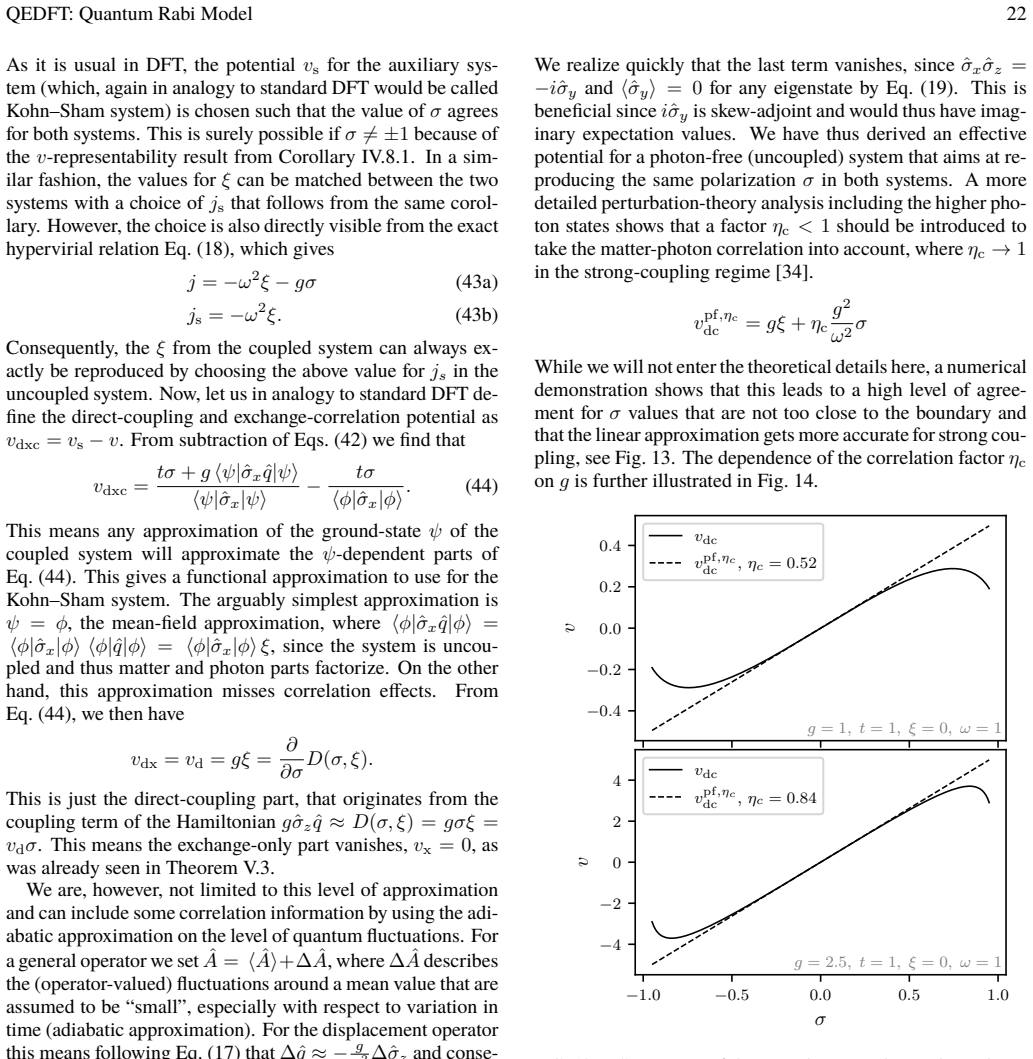
- The photon-free effective potential $v^{\mathrm{pf},\eta_c}_{\mathrm{dc}}=g\xi+\eta_c g^2\sigma/\omega^2$ with $\eta_c\to1$ for strong coupling reproduces the exact potential except near $\sigma=\pm1$, offering a controlled approximation route.
Reading between the lines
- The same constrained-search analysis could be pushed to the multi-mode Dicke model; the paper leaves $v$-representability there open, and a failure would highlight what the harmonic confinement in the single-mode Rabi model provides.
- The numerical ellipse ansatz for $I^\lambda(\sigma)$ suggests that exact or near-exact closed forms for correlation functionals may exist for other integrable light-matter models, and the fitted functions $a(\lambda,t)$, $b(\lambda,t)$ could be tested against the analytic bounds.
- If the saturation $I^\infty(\sigma)=t\sqrt{1-\sigma^2}$ holds, then in the strictly correlated limit the kinetic contribution is fully quenched; this is a concrete prediction for strong-coupling QEDFT functional construction.
- The photon-free approximation's site-coupling in the Dicke model implies an effective matter-matter interaction mediated by the eliminated photon mode—an effect that in macroscopic ensembles could be probed experimentally via polarization shifts at strong coupling.
Editorial analysis
A structured set of objections, weighed in public.
Referee Report
Summary. The paper develops quantum-electrodynamical density-functional theory (QEDFT) for the quantum Rabi model, taking the polarization σ and the photon-field displacement ξ as the internal density variables, and discusses extensions to the Dicke model. It establishes a Hohenberg–Kohn-type injection for regular densities, proves structural properties of the Levy–Lieb functional (symmetry, displacement rule, virial relations, positivity of optimizers), and imports from the companion paper [22] the existence, Lagrange-multiplier, and ground-state characterizations that yield unique pure-state v-representability for all (σ,ξ)∈(−1,1)×R, equality of the Levy–Lieb and Lieb functionals, and differentiability. The paper then derives an explicit zero-coupling functional, an almost explicit adiabatic connection F^λ_LL(σ,ξ) = ω/2 − t√(1−σ²) + ω²ξ²/2 + λgσξ − λ²g²(1−σ²)/(2ω²) + I^λ(σ), rigorous bounds on the non-explicit correlation term I^λ(σ), and photon-free effective potentials. The analytical derivations in the paper are largely self-consistent and check out, but the central v-representability and differentiability results rest on external theorems from [22] rather than on proofs given in the present manuscript.
Significance. If the companion-paper theorems are accepted, this is a valuable and nearly unique model-system demonstration of QEDFT: it gives explicit v-representability, convexity, differentiability, and an almost closed-form adiabatic connection in a setting that still has nontrivial light–matter correlation. The constructive N-representability proof, the displacement rule, the zero-coupling optimizer, the virial relations, and the analytic bounds on I^λ(σ) are genuine strengths, as is the public availability of the numerical code. The main caveat is that the strongest claims—especially the bijection between (−1,1)×R and (v,j), FLL=FL, and differentiability—are not proved self-contained but are quoted from [22]; the paper would be substantially stronger if those theorems were stated and proved, or if the dependency were made unavoidable and explicit.
major comments (3)
- [§IV.C, Theorems IV.3–IV.7 and Corollary IV.8] The central v-representability result of the paper is not self-contained. Theorem IV.3 (existence of optimizers), Theorem IV.4 (Lagrange-multiplier characterization), and Theorem IV.5 (critical boundary case) are imported from the companion paper [22, Theorems 3.4, 3.7, 3.18] and are not proved here. Corollary IV.8 then derives unique pure-state v-representability, FLL=FL, and differentiability from these imported statements. Since these are load-bearing for the paper's main claim, the manuscript should either reproduce the proofs, state the imported theorems verbatim with their exact hypotheses, or explicitly flag that the main theorem is conditional on [22]. If [22] is not yet published, an appendix with the missing proofs is needed.
- [§IV.C, proof of Theorem IV.7] The proof of Theorem IV.7 is incomplete as written. The text argues that the optimizer is the ground state because it 'has all the properties that we showed for ground states in Section IIC, in particular that it is unique.' However, Section IIC only proves that the unique ground state is strictly positive; it does not in itself exclude a strictly positive excited eigenstate. The missing step is an orthogonality/Perron–Frobenius argument showing that any strictly positive eigenfunction of H(v,j) must be the unique ground state. This step is directly load-bearing for the conclusion that every regular density pair is pure-state v-representable and should be supplied explicitly.
- [§V.D, strictly correlated regime] The statements lim_{λ→∞} a(λ,t)=1, lim_{λ→∞} b(λ,t)=t, and consequently I^∞(σ)=t√(1−σ²), are presented as established facts ('This shows, in particular...'), but they are inferred from numerical fits to the conjectured functional form of Conjecture V.5. The rigorous bounds in Eqs. (39) and (41) do not prove saturation of the upper bound. These claims should either be proved analytically or clearly labeled as numerical evidence for a conjecture rather than as derived limits.
minor comments (4)
- [§V.A, Eq. (33) and Eq. (35)] The notation would be clearer if ψ^λ and φ^ν were always explicitly tied to their density pairs: ψ^λ is the optimizer of F^λ_LL(σ,ξ) while φ^ν is the optimizer of F^ν_LL(σ,0). As written, the reader must infer this distinction from context.
- [§V.D, Conjecture V.5] The parameter-fitting procedure behind Figs. 11 and 12 is not described in the text: the fit functional form, the fitted data range, and the error model are missing. The statement that the largest standard deviation is 0.05 refers only to b; reporting errors for a and the joint fit would be more informative.
- [§VI.A, Eq. (46) and Figs. 13–14] The correlation factor η_c(g) is introduced after Eq. (46) without a derivation, with a citation to [34]. Since η_c is used in the main numerical comparison, the paper should state clearly whether η_c is derived, fitted, or taken from the cited work, and how it is computed for each g.
- [§V.C, Eqs. (39) and (41)] The bounds on I^λ(σ) are rigorous and clearly stated, but it would help to note explicitly that the two upper bounds are complementary: the exponential bound is tighter for large λ and the λ²g²/(2ω²) bound is relevant for small λ. This is implicit in the text but could be made explicit.
Circularity Check
The central v-representability, FLL=FL, and differentiability claims are inherited from the authors' companion paper [22] via Theorems IV.3–IV.5, which are cited but not re-proved; the explicit adiabatic-connection and photon-free expressions are nevertheless derived in-paper.
-
self citation load bearing
[Section IV.C, Theorems IV.3, IV.4, IV.5 and Corollary IV.8]
"The proof, also for the more general case of the Dicke model, can be found in Bakkestuen et al. [22, Theorem 3.4]. ... For the full argument, see the proof of Theorem 3.7 in Bakkestuen et al. [22], where the result is shown to hold for all regular σ in the generalization to the Dicke model, or Theorem 3.18 in the same reference for a specialization to the quantum Rabi model. The full derivation can be found in Bakkestuen et al. [22, Theorem 3.18]."
Corollary IV.8, which asserts unique pure-state v-representability, FLL=FL, and differentiability for every regular density pair, depends on Theorems IV.3, IV.4, and IV.5. These theorems provide the existence of Levy-Lieb optimizers, the Lagrange-multiplier characterization with a Schrodinger equation, and the critical-polarization structure. None of them is proved in the present paper; each is quoted from Bakkestuen et al. [22], a companion preprint with overlapping authors. If any of those companion theorems had a gap, the bijection between (v,j) and (-1,1)xR would fail, and with it the paper's central v-representability claim.
full rationale
The paper's own derivations are largely self-contained and not circular: the ground-state properties in Section II.C, the weak and strong Hohenberg-Kohn statements, the N-representability construction (Theorem IV.1), the displacement and virial rules (Theorem IV.2), and the explicit zero-coupling functional (Theorem IV.9) are all proved inside the manuscript. The adiabatic-connection formula (Theorem V.2) follows by combining the in-paper displacement rule, the Newton-Leibniz identity, and the in-paper virial relation, with the residual term I^lambda(σ) explicitly acknowledged as non-explicit and then bounded analytically. The numerical parameter fitting in Section V.D is presented as a conjecture, not as a first-principles prediction. The only significant circularity concern is the self-citation load-bearing structure: the existence of optimizers and the Lagrange-multiplier characterization that underlie Corollary IV.8 are imported verbatim from the authors' own companion work [22] rather than re-proved or independently verified. This prevents a score of 0-2, but the explicit functional expressions and bounds have independent content, so the score is 4 rather than higher. No fitted parameter is renamed as a prediction, and no definitional identity makes a result true by construction.
Assumptions & free parameters
free parameters (3)
- a(λ,t) =
Fitted numerically for λ,t ∈ [0,3] at ω=g=1, see Figs. 11 and 12
- b(λ,t) =
Fitted numerically, largest standard deviation 0.05, see Figs. 11 and 12
- η_c(g) =
Examples from Fig. 13: 0.52 for g=1, 0.84 for g=2.5; generally computed from derivative at σ=0
assumptions (4)
- domain assumption Theorems 3.4, 3.7, and 3.18 from Bakkestuen et al. [22] correctly prove existence of Levy-Lieb optimizers and the Lagrange multiplier characterization.
- standard math The hypervirial theorem holds for the quantum Rabi model.
- domain assumption The ground state of the quantum Rabi model is strictly positive and unique, via positivity improving imaginary-time evolution.
- standard math The harmonic-oscillator Hamiltonian has a purely discrete spectrum with form domain Q0, and the ground state exists for all external pairs (v,j).
Cite this review
Pith. "Pith review of Quantum-Electrodynamical Density-Functional Theory Exemplified by the Quantum Rabi Model." pith.science (2026). https://pith.science/paper/XZMXUAU5
@misc{pith2026241115256,
  author       = {Pith},
  title        = {Pith review of: Quantum-Electrodynamical Density-Functional Theory Exemplified by the Quantum Rabi Model},
  year         = {2026},
  howpublished = {\url{https://pith.science/paper/XZMXUAU5}},
  note         = {Machine review of arXiv:2411.15256}
}
read the original abstract
The key features of density-functional theory (DFT) within a minimalistic implementation of quantum electrodynamics are demonstrated, thus allowing to study elementary properties of quantum-electrodynamical density-functional theory (QEDFT). We primarily employ the quantum Rabi model, that describes a two-level system coupled to a single photon mode, and also discuss the Dicke model, where multiple two-level systems couple to the same photon mode. In these settings, the density variables of the system are the polarization and the displacement of the photon field. We give analytical expressions for the constrained-search functional and the exchange-correlation potential and compare to established results from QEDFT. We further derive a form for the adiabatic connection that is almost explicit in the density variables, up to only a non-explicit correlation term that gets bounded both analytically and numerically. This allows several key features of DFT to be studied without approximations.
Figures


Figures from the paper (12 more)




Reference graph
Works this paper leans on
-
[22]
Density-functional theory for the Dicke Hamiltonian
V. H. Bakkestuen, M. A. Csirik, A. Laestadius, and M. Penz, “Quantum- electrodynamical density-functional theory for the Dicke Hamiltonian,” (2024), arXiv:2409.13767 [math-ph]
work page Pith review arXiv 2024
-
[1]
Weinberg,The Quantum Theory of Fields (Cambridge University Press, 1995)
S. Weinberg,The Quantum Theory of Fields (Cambridge University Press, 1995)
work page 1995
-
[2]
M.E.PeskinandD.V.Schroeder, AnIntroductiontoQuantumFieldThe- ory (Perseus Books Publishing, L.L.C., 1995)
work page 1995
-
[3]
F. Mandl and G. Shaw,Quantum Field Theory, 2nd ed., A Wiley- Interscience publication (Wiley, 2010)
work page 2010
-
[4]
L. H. Ryder,Quantum field theory(Cambridge University Press, 1996)
work page 1996
- [5]
-
[6]
H.Spohn,Dynamicsofchargedparticlesandtheirradiationfield (Cam- bridge University Press, 2004)
work page 2004
-
[7]
Hybrid light–matter states in a molecular and material science perspective,
T. W. Ebbesen, “Hybrid light–matter states in a molecular and material science perspective,” Acc. Chem. Res.49, 2403–2412 (2016)
work page 2016
Show all 76 references
-
[8]
Manipulating matter by strong coupling to vacuum fields,
F. J. Garcia-Vidal, C. Ciuti, and T. W. Ebbesen, “Manipulating matter by strong coupling to vacuum fields,” Science373, eabd0336 (2021)
2021
-
[9]
Understanding polaritonic chemistry from ab initio quantum electrodynamics,
M. Ruggenthaler, D. Sidler, and A. Rubio, “Understanding polaritonic chemistry from ab initio quantum electrodynamics,” Chem. Rev.123, 11191–11229 (2023)
2023
-
[10]
Quantum-electrodynamicaldensity-functionaltheory: Bridg- ing quantum optics and electronic-structure theory,
M. Ruggenthaler, J. Flick, C. Pellegrini, H. Appel, I. V. Tokatly, and A.Rubio,“Quantum-electrodynamicaldensity-functionaltheory: Bridg- ing quantum optics and electronic-structure theory,” Phys. Rev. A90, 012508 (2014)
2014
-
[11]
Ground-state quantum-electrodynamical density- functional theory,
M. Ruggenthaler, “Ground-state quantum-electrodynamical density- functional theory,” (2017), arXiv:1509.01417 [quant-ph]
2017 arXiv
-
[12]
Fromaquantum-electrodynamicallight–matterdescriptiontonovel spectroscopies,
M. Ruggenthaler, N. Tancogne-Dejean, J. Flick, H. Appel, and A. Ru- bio,“Fromaquantum-electrodynamicallight–matterdescriptiontonovel spectroscopies,” Nat. Rev. Chem.2, 0118 (2018)
2018
-
[13]
Cou- pled cluster theory for molecular polaritons: Changing ground and ex- cited states,
T. S. Haugland, E. Ronca, E. F. Kjønstad, A. Rubio, and H. Koch, “Cou- pled cluster theory for molecular polaritons: Changing ground and ex- cited states,” Phys. Rev. X10, 041043 (2020)
2020
-
[14]
Polaritonic coupled-cluster theory,
U. Mordovina, C. Bungey, H. Appel, P. J. Knowles, A. Rubio, and F. R. Manby, “Polaritonic coupled-cluster theory,” Phys. Rev. Res.2, 023262 (2020)
2020
-
[15]
Perspectiveondensityfunctionaltheory,
K.Burke,“Perspectiveondensityfunctionaltheory,”J.Chem.Phys. 136, 150901 (2012)
2012
-
[16]
Status and challenges of density functional theory,
P. Verma and D. G. Truhlar, “Status and challenges of density functional theory,” Trends in Chemistry2, 302–318 (2020), special Issue - Laying Groundwork for the Future
2020
-
[17]
DFTexchange: Sharingperspectivesontheworkhorse of quantum chemistry and materials science,
A.M.Tealeetal.,“DFTexchange: Sharingperspectivesontheworkhorse of quantum chemistry and materials science,” Phys. Chem. Chem. Phys. 24, 28700–28781 (2022)
2022
-
[18]
Inhomogeneous electron gas,
P. Hohenberg and W. Kohn, “Inhomogeneous electron gas,” Phys. Rev. 136, B864–B871 (1964)
1964
-
[19]
Self-consistent equations including exchange and correlation effects,
W. Kohn and L. J. Sham, “Self-consistent equations including exchange and correlation effects,” Phys. Rev.140, A1133–A1138 (1965)
1965
-
[20]
Density functionals for Coulomb-systems,
E. H. Lieb, “Density functionals for Coulomb-systems,” Int. J. Quantum Chem. 24, 243–277 (1983)
1983
-
[21]
Density-functional theory: Beauty and the Beast
T. Helgaker, “Density-functional theory: Beauty and the Beast”, talk givenatthemeeting“DFTinChemistry—DisputeatInceptionandRise to Prominence” held at The Royal Swedish Academy of Sciences, Stock- holm, 7–8 November 2024. QEDFT: Quantum Rabi Model 25
2024
-
[23]
The structure of the density-potential mapping. part ii: Including magnetic fields,
M. Penz, E. I. Tellgren, M. A. Csirik, M. Ruggenthaler, and A. Laesta- dius, “The structure of the density-potential mapping. part ii: Including magnetic fields,” ACS Phys. Chem. Au3, 492–511 (2023)
2023
-
[24]
Time-dependent Kohn- Sham approach to quantum electrodynamics,
M. Ruggenthaler, F. Mackenroth, and D. Bauer, “Time-dependent Kohn- Sham approach to quantum electrodynamics,” Phys. Rev. A84, 042107 (2011)
2011
-
[25]
Time-dependent density functional theory for many- electron systems interacting with cavity photons,
I. V. Tokatly, “Time-dependent density functional theory for many- electron systems interacting with cavity photons,” Phys. Rev. Lett.110, 233001 (2013)
2013
-
[26]
Light–matterresponseinnonrelativisticquantumelectrodynamics,
J. Flick, D. M. Welakuh, M. Ruggenthaler, H. Appel, and A. Ru- bio,“Light–matterresponseinnonrelativisticquantumelectrodynamics,” ACS Photonics6, 2757–2778 (2019)
2019
-
[27]
Light-matter interactions within the Ehrenfest–Maxwell–Pauli–Kohn– Sham framework: fundamentals, implementation, and nano-optical ap- plications,
R. Jestädt, M. Ruggenthaler, M. J. Oliveira, A. Rubio, and H. Appel, “Light-matter interactions within the Ehrenfest–Maxwell–Pauli–Kohn– Sham framework: fundamentals, implementation, and nano-optical ap- plications,” Adv. Phys.68, 225–333 (2019)
2019
-
[28]
Relativistic linear response in quantum-electrodynamical density func- tional theory,
L. Konecny, V. P. Kosheleva, H. Appel, M. Ruggenthaler, and A. Rubio, “Relativistic linear response in quantum-electrodynamical density func- tional theory,” (2024), arXiv: 2407.02441 [physics.chem-ph]
2024 arXiv
-
[29]
Optimized effective potential for quantum electrodynamical time-dependent density functional theory,
C. Pellegrini, J. Flick, I. V. Tokatly, H. Appel, and A. Rubio, “Optimized effective potential for quantum electrodynamical time-dependent density functional theory,” Phys. Rev. Lett.115, 093001 (2015)
2015
-
[30]
Stronglight-mattercouplinginquan- tum chemistry and quantum photonics,
J.Flick,N.Rivera,andP.Narang,“Stronglight-mattercouplinginquan- tum chemistry and quantum photonics,” Nanophotonics7, 1479–1501 (2018)
2018
-
[31]
Quantum-electrodynamical time-dependent density functional theorywithinGaussianatomicbasis,
J. Yang, Q. Ou, Z. Pei, H. Wang, B. Weng, Z. Shuai, K. Mullen, and Y. Shao, “Quantum-electrodynamical time-dependent density functional theorywithinGaussianatomicbasis,”J.Chem.Phys. 155,064107(2021)
2021
-
[32]
Simple exchange-correlation energy functionals for strongly coupled light-matter systems based on the fluctuation-dissipation theo- rem,
J. Flick, “Simple exchange-correlation energy functionals for strongly coupled light-matter systems based on the fluctuation-dissipation theo- rem,” Phys. Rev. Lett.129, 143201 (2022)
2022
-
[33]
Assessing the effects of orbital relaxation and the coherent-state transformation in quantum electrodynamicsdensityfunctionalandcoupled-clustertheories,
M. D. Liebenthal, N. Vu, and A. E. DePrince III, “Assessing the effects of orbital relaxation and the coherent-state transformation in quantum electrodynamicsdensityfunctionalandcoupled-clustertheories,”J.Phys. Chem. A127, 5264–5275 (2023)
2023
-
[34]
Electron-photon exchange-correlation approximation for quantum-electrodynamical density-functional theory,
I.-T. Lu, M. Ruggenthaler, N. Tancogne-Dejean, S. Latini, M. Penz, and A. Rubio, “Electron-photon exchange-correlation approximation for quantum-electrodynamical density-functional theory,” Phys. Rev. A109, 052823 (2024)
2024
-
[35]
Optical emission spec- tra of molecular excitonic polariton computed at the first-principles level QED-TDDFT,
S. Deng, J. Yang, Y. Shao, Q. Ou, and Z. Shuai, “Optical emission spec- tra of molecular excitonic polariton computed at the first-principles level QED-TDDFT,” ChemPhotoChem , e202400117 (2024)
2024
-
[36]
Eschrig,The Fundamentals of Density Functional Theory, 2nd ed
H. Eschrig,The Fundamentals of Density Functional Theory, 2nd ed. (Edition am Gutenbergplatz Leipzig, 2003)
2003
-
[37]
Lieb variation principle in density- functionaltheory,
T. Helgaker and A. M. Teale, “Lieb variation principle in density- functionaltheory,”in ThePhysicsandMathematicsofElliottLieb ,edited byR.L.Frank,A.Laptev,M.Lewin,andR.Seiringer(EMSPress,2022) p. 527–559
2022
-
[38]
The quantum Rabi model: solution and dynamics,
Q. Xie, H. Zhong, M. T. Batchelor, and C. Lee, “The quantum Rabi model: solution and dynamics,” J. Phys. A: Math. Theor.50, 113001 (2017)
2017
-
[39]
Light–matter interaction in the long-wavelength limit: no ground-state without dipole self-energy,
V.Rokaj,D.M.Welakuh,M.Ruggenthaler,andA.Rubio,“Light–matter interaction in the long-wavelength limit: no ground-state without dipole self-energy,” J. Phys. B: At. Mol. Opt. Phys.51, 034005 (2018)
2018
-
[40]
Relevance of the quadraticdiamagneticandself-polarizationtermsincavityquantumelec- trodynamics,
C. Schäfer, M. Ruggenthaler, V. Rokaj, and A. Rubio, “Relevance of the quadraticdiamagneticandself-polarizationtermsincavityquantumelec- trodynamics,” ACS Photonics7, 975–990 (2020)
2020
-
[41]
Unraveling a cavity-induced molecular polarization mechanism from collective vibrational strong coupling,
D. Sidler, T. Schnappinger, A. Obzhirov, M. Ruggenthaler, M. Kowalewski, and A. Rubio, “Unraveling a cavity-induced molecular polarization mechanism from collective vibrational strong coupling,” J. Phys. Chem. Lett.15, 5208–5214 (2024)
2024
-
[42]
IntegrabilityoftheRabimodel,
D.Braak,“IntegrabilityoftheRabimodel,”Phys.Rev.Lett. 107,100401 (2011)
2011
-
[43]
Solution of the Dicke model for N=3,
D. Braak, “Solution of the Dicke model for N=3,” J. Phys. B: At. Mol. Opt. Phys.46, 224007 (2013)
2013
-
[44]
Analytical solutions of basic models in quantum optics,
D. Braak, “Analytical solutions of basic models in quantum optics,” in Applications+PracticalConceptualization+Mathematics=fruitfulIn- novation(Springer, 2015) p. 75–92
2015
-
[45]
Quantum electrodynamicaldensityfunctionaltheoryforgeneralizedDickemodel,
D. Novokreschenov, A. Kudlis, I. Iorsh, and I. V. Tokatly, “Quantum electrodynamicaldensityfunctionaltheoryforgeneralizedDickemodel,” Phys. Rev. B108 (2023), 10.1103/physrevb.108.235424
2023 doi
-
[46]
Unique continuation for many-body Schrödinger opera- tors and the Hohenberg-Kohn theorem,
L. Garrigue, “Unique continuation for many-body Schrödinger opera- tors and the Hohenberg-Kohn theorem,” Math. Phys. Anal. Geom.21, 27 (2018)
2018
-
[47]
Universal variational functionals of electron densities, first- order density matrices, and natural spin-orbitals and solution of the v- representability problem,
M. Levy, “Universal variational functionals of electron densities, first- order density matrices, and natural spin-orbitals and solution of the v- representability problem,” Proc. Natl. Acad. Sci. U.S.A.76, 6062–6065 (1979)
1979
-
[48]
Differentiability of Lieb functional in electronic density functional theory,
P. E. Lammert, “Differentiability of Lieb functional in electronic density functional theory,” Int. J. Quantum Chem.107, 1943–1953 (2007)
2007
-
[49]
Density-functional theory on graphs,
M. Penz and R. van Leeuwen, “Density-functional theory on graphs,” J. Chem. Phys.155 (2021), 10.1063/5.0074249
2021 doi
-
[50]
Nonuniqueness and derivative discontinu- itiesindensity-functionaltheoriesforcurrent-carryingandsuperconduct- ing systems,
K. Capelle and G. Vignale, “Nonuniqueness and derivative discontinu- itiesindensity-functionaltheoriesforcurrent-carryingandsuperconduct- ing systems,” Phys. Rev. B65, 113106 (2002)
2002
-
[51]
Choiceofbasicvariablesincurrent-density-functionalthe- ory,
E. I. Tellgren, S. Kvaal, E. Sagvolden, U. Ekström, A. M. Teale, and T.Helgaker,“Choiceofbasicvariablesincurrent-density-functionalthe- ory,” Phys. Rev. A86, 062506 (2012)
2012
-
[52]
Hohenberg–Kohn theorems in the presenceofmagneticfield,
A. Laestadius and M. Benedicks, “Hohenberg–Kohn theorems in the presenceofmagneticfield,”Int.J.QuantumChem. 114,782–795(2014)
2014
-
[53]
Revisiting density-functional theory of the total current density,
A. Laestadius, M. Penz, and E. Tellgren, “Revisiting density-functional theory of the total current density,” J. Phys.: Cond. Matter33, 295504 (2021)
2021
-
[54]
Theexchange-correlationenergyofametal- lic surface,
D.LangrethandJ.Perdew,“Theexchange-correlationenergyofametal- lic surface,” Solid State Communications17, 1425–1429 (1975)
1975
-
[55]
The adiabatic connection for- malism in dft – theory and practice,
E. Polak, K. J. Daas, and S. Vuckovic, “The adiabatic connection for- malism in dft – theory and practice,” inChemical Modelling: Volume 18 (Royal Society of Chemistry, 2024)
2024
-
[56]
Strong-interaction limit of density-functional theory,
M. Seidl, “Strong-interaction limit of density-functional theory,” Phys. Rev. A60, 4387–4395 (1999)
1999
-
[57]
Exchange-onlyvirialrelationfromthe adiabatic connection,
A. Laestadius, M. A. Csirik, M. Penz, N. Tancogne-Dejean, M. Ruggen- thaler,A.Rubio,andT.Helgaker,“Exchange-onlyvirialrelationfromthe adiabatic connection,” J. Chem. Phys.160 (2024), 10.1063/5.0184934
2024 doi
-
[58]
Densityfunctionalsforexchangeandcorrela- tion energies: Exact conditions and comparison of approximations,
M.LevyandJ.P.Perdew,“Densityfunctionalsforexchangeandcorrela- tion energies: Exact conditions and comparison of approximations,” Int. J. Quantum Chem.49, 539–548 (1994)
1994
-
[59]
Thestructureofthedensity-potentialmapping.PartI:Standarddensity- functional theory,
M.Penz,E.I.Tellgren,M.A.Csirik,M.Ruggenthaler,andA.Laestadius, “Thestructureofthedensity-potentialmapping.PartI:Standarddensity- functional theory,” ACS Phys. Chem. Au3, 334–347 (2023)
2023
-
[60]
Reed and B
M. Reed and B. Simon,Methods of Modern Mathematical Physics. Vol. I: Functional analysis, 2nd ed., Vol. 1 (Academic Press, 1980)
1980
-
[61]
Schrödinger operators with purely discrete spectrum,
B. Simon, “Schrödinger operators with purely discrete spectrum,” Meth- ods Funct. Anal. Topol.15, 61–66 (2009)
2009
-
[62]
E. A. Coddington and R. Carlson,Linear ordinary differential equations (SIAM, 1997)
1997
-
[63]
Absenceofenergylevelcrossingforthe ground state energy of the Rabi model,
M.HirokawaandF.Hiroshima,“Absenceofenergylevelcrossingforthe ground state energy of the Rabi model,” Comm. Stoch. Anal.8 (2014), 10.31390/cosa.8.4.08
2014 doi
-
[64]
Classical and quantum mechanical hypervirial theo- rems,
J. O. Hirschfelder, “Classical and quantum mechanical hypervirial theo- rems,” J. Chem. Phys.33, 1462–1466 (1960)
1960
-
[65]
Virialrelations forelectronscoupledtoquantumfieldmodes,
I.Theophilou,M.Penz,M.Ruggenthaler,andA.Rubio,“Virialrelations forelectronscoupledtoquantumfieldmodes,”J.Chem.TheoryComput. 16, 6236–6243 (2020)
2020
-
[66]
Exchangeenergieswithforcesindensity-functional theory,
N. Tancogne-Dejean, M. Penz, A. Laestadius, M. A. Csirik, M. Ruggen- thaler,andA.Rubio,“Exchangeenergieswithforcesindensity-functional theory,” J. Chem. Phys.160 (2024), 10.1063/5.0177346
2024 doi
-
[67]
Uniform magnetic fields in density-functional theory,
E. I. Tellgren, A. Laestadius, T. Helgaker, S. Kvaal, and A. M. Teale, “Uniform magnetic fields in density-functional theory,” J. Chem. Phys. 148, 024101 (2018)
2018
-
[68]
Geometry of degeneracy in potential and density space,
M. Penz and R. van Leeuwen, “Geometry of degeneracy in potential and density space,” Quantum7, 918 (2023)
2023
-
[69]
Density functionals in the presence of magnetic field,
A. Laestadius, “Density functionals in the presence of magnetic field,” Int. J. Quantum Chem.114, 1445–1456 (2014)
2014
-
[70]
Lower semicon- tinuity of the universal functional in paramagnetic current–density func- tional theory,
S. Kvaal, A. Laestadius, E. Tellgren, and T. Helgaker, “Lower semicon- tinuity of the universal functional in paramagnetic current–density func- tional theory,” J. Phys. Chem. Lett.12, 1421–1425 (2021)
2021
-
[71]
R. T. Rockafellar,Convex analysis(Princeton University Press, 1970)
1970
-
[72]
Seven useful ques- tions in density functional theory,
S. Crisostomo, R. Pederson, J. Kozlowski, B. Kalita, A. C. Cancio, K. Datchev, A. Wasserman, S. Song, and K. Burke, “Seven useful ques- tions in density functional theory,” Lett. Math. Phys.113, 42 (2023)
2023
-
[73]
Improved lower bound on the indirect Coulomb energy,
E. H. Lieb and S. Oxford, “Improved lower bound on the indirect Coulomb energy,” Int. J. Quantum Chem.19, 427–439 (1981). QEDFT: Quantum Rabi Model 26
1981
-
[74]
One-dimensional Lieb–Oxford bounds,
A. Laestadius and F. M. Faulstich, “One-dimensional Lieb–Oxford bounds,” J. Chem. Phys.152 (2020), 10.1063/5.0009419
2020 doi
-
[75]
Mak- ing ab initio QED functional(s): Nonperturbative and photon-free effec- tive frameworks for strong light–matter coupling,
C.Schäfer,F.Buchholz,M.Penz,M.Ruggenthaler,andA.Rubio,“Mak- ing ab initio QED functional(s): Nonperturbative and photon-free effec- tive frameworks for strong light–matter coupling,” Proc. Natl. Acad. Sci. U.S.A.118, e2110464118 (2021)
2021
-
[76]
Cavity Born–Oppenheimer Hartree–Fock ansatz: Light–matter properties of strongly coupled molecular ensembles,
T. Schnappinger, D. Sidler, M. Ruggenthaler, A. Rubio, and M. Kowalewski, “Cavity Born–Oppenheimer Hartree–Fock ansatz: Light–matter properties of strongly coupled molecular ensembles,” J. Phys. Chem. Lett.14, 8024–8033 (2023)
2023
Reviewed August 12, 2026 · model on record in the stance chip above.
Discussion (0). Continue with ORCID to comment.