REVIEW 2 major objections 4 minor 15 references
Evaporating black holes in de Sitter expanding universe
T0 review · 2 major / 4 minor · reviewed 2026-08-12 · deepseek-v4-flash
Pith's one-line read The paper constructs explicit exact solutions of Einstein's equations showing that a Schwarzschild-type black hole embedded in an expanding FLRW spacetime can evaporate completely into a surrounding dust cloud, with the de Sitter Hubble…
desk verdict A coherent exact-solution family whose evaporation law is an input, not an output; fix Eq. (36) and be explicit about the assumed conservation law. read the letter →
The pith
A machine-rendered reading of the paper's core claim, the machinery that carries it, and where it could break.
The reading
What carries the argument
The central object is the one-parameter family of $\kappa$-models, written in Painlev\'e-Gullstrand coordinates with $h_\epsilon(t,r)=-\frac{1}{3}\frac{\dot M}{M}r+\epsilon\sqrt{\frac{2M(t)}{r}+\kappa^2M(t)^2r^2}$. Solving Einstein's equations with a perfect fluid produces a dust component whose total mass is $\delta M(t)=-\frac{1}{3\epsilon\kappa}\frac{\dot M}{M}$, which converts the Hubble function into $\dot a/a=\epsilon\kappa[M(t)+\delta M(t)]$. This identity is the load-bearing mechanism: together with the conservation law $M+\delta M=m$, it selects the logistic mass function and drives the evaporation, while setting the de Sitter frequency $\omega_H=\kappa m$ without a cosmological constant.
What would settle it
Using the late-time metric $h_+\to\omega_H r$ and the dust density whose integral tends to $m$, compute a well-defined quasilocal mass (for example the Misner-Sharp mass) of the out state. The claim predicts empty de Sitter with zero ordinary-matter mass; if the calculation gives mass $m$, the claimed evaporation limit is inconsistent.
Extended reading notes
Core claim
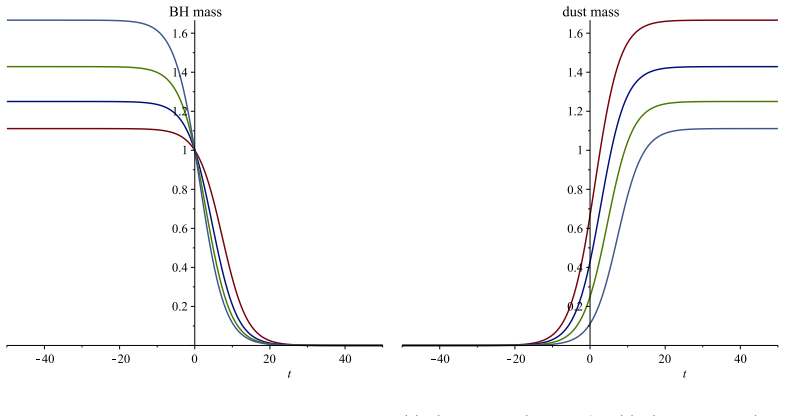
The central claim is that the $\kappa$-models with $\epsilon=1$ and conserved total mass describe a smooth, complete evaporation of a black hole in an expanding de Sitter universe. With $M(t)+\delta M(t)=m$, the black-hole mass is $M(t)=M_0\mu/[1+e^{3\omega_H(t-t_0)}(\mu-1)]$, falling from $m$ at $t\to-\infty$ to $0$ at $t\to\infty$, while the dust mass $\delta M(t)=m-M(t)$ climbs from $0$ to $m$. The metric function $h_+(t,r)$ evolves from the Schwarzschild-de Sitter form $\sqrt{2m/r+\omega_H^2r^2}$ to the pure de Sitter form $\omega_H r$, so the spacetime interpolates between $M(adS,m)$ and $M(adS)$. The Hubble constant of the asymptotic universe is fixed by $\kappa$ times the total mass $m$, replacing the cosmological constant.
Load-bearing premise
The evaporation law is an assumption, not a derived consequence: it follows from imposing the conservation law $M(t)+\delta M(t)=m$, so a different definition of conserved total mass would produce a different mass function and possibly no complete evaporation.
Editorial extensions
If this is right
- For $t\to-\infty$ the geometry is a Schwarzschild-de Sitter black hole of mass $m$; for $t\to\infty$ it is de Sitter, so the model exhibits complete evaporation as a purely geometric process.
- The total mass $m$ is conserved and $\omega_H=\kappa m$, so one can populate a single de Sitter universe with black holes of different masses by choosing $\kappa_i=\omega_H/m_i$.
- The null energy condition is satisfied because the dust density is non-negative, and the black-hole and cosmological horizons appear at a critical time and then separate, with the black-hole horizon collapsing to zero.
- In the physical domain a comoving observer can in principle measure the dust density, the redshift, and later the black-hole shadow, giving observational access to the evaporation.
Reading between the lines
- Editorial inference: because $M(t)$ is obtained by imposing the conservation law rather than derived from a microphysical radiation process, the logistic decay is one consistent evaporation history, not a uniqueness result; a different conserved quantity would give a different decay law.
- Editorial inference: the reading of the out state as empty de Sitter sits in tension with the dust mass tending to $m$; a sharper definition of conserved total mass in an asymptotically de Sitter spacetime is needed to decide whether the dust still acts as a source in the final geometry.
- Editorial inference: the mechanism relies on $\kappa\neq0$, since the dust-mass integral diverges at $\kappa=0$; extending the construction to the collapsing branch or to curved spatial sections would test how general the evaporation scenario is.
- Editorial inference: a testable signature is that the dust density at fixed radius grows monotonically while the black-hole mass decreases; mapping this profile during the evolution would distinguish geometric evaporation from thermal emission.
Editorial analysis
A structured set of objections, weighed in public.
Referee Report
Summary. The manuscript studies the one-parameter family of dynamical black hole solutions introduced in the author's earlier work, with line element (3) and metric function (20). It shows that the Einstein equations imply a point-dependent dust component whose total mass is finite, δM = -Ṁ/(3κM), and derives the relation H = κ(M+δM) between the Hubble function and the total mass of the black-hole/dust system. Imposing the conservation law M+δM = m leads to a logistic mass function M(t), identifies the asymptotic background as de Sitter with Hubble constant ω_H = κm, and produces an explicit evolution from Schwarzschild-de Sitter to de Sitter, with dynamical horizons governed by the cubic solutions in Appendix B.
Significance. The exact-solution construction is workmanlike and the algebra is largely consistent. The closed-form mass evolution (37), the convergence limits (39)-(42), and the horizon cubic solutions are useful analytic ingredients for modeling a black-hole-to-dust transition in an expanding background without a cosmological constant. The paper also gives an explicit criterion for the existence of dynamical horizons. Its main weakness is that the evaporation trajectory is imposed rather than derived: the field equations leave M(t) arbitrary, and the logistic law follows only after the extra conservation postulate M+δM = m. The paper therefore constructs a spacetime that realizes a prescribed evaporation, rather than predicting evaporation from the field equations.
major comments (2)
- [§3-§4, Eqs. (21)-(23), (30)-(35)] The Einstein equations do not determine M(t). Equations (21) and (22) merely express the density and pressure in terms of M(t) and its derivatives, and Eq. (23) defines the Hubble function for any smooth M(t). The evaporation law (37) is obtained only after imposing the conservation condition M+δM = m in Eq. (35); this is an additional postulate, not a consequence of the field equations. Consequently the Introduction's statement that the black hole evaporates 'naturally because of their geometries without involving supplemental mechanisms' overstates the result: choosing a different M(t), or a different H(t), would produce a different exact solution with a different or no evaporation. The manuscript should state explicitly that the conservation law is an assumption and discuss what physical principle might select it.
- [§4, Eqs. (40), (42), (45)] The final state is not globally an empty de Sitter spacetime. Equation (40) gives δM(t) → m, so the total dust mass equals the initial black hole mass, and Eq. (A.1) shows that the dust support moves to R ∼ M^{-1/3} → ∞. Thus for every fixed radius r the metric tends to the de Sitter form, but the full spacetime still contains a finite dust mass. Calling M|out = M(adS) in Eq. (45) and referring to an 'empty de Sitter' final state in the text is therefore imprecise; the paper should specify that the de Sitter limit is local rather than global and clarify the fate of the dust.
minor comments (4)
- [§4, Eq. (36)] The de Sitter density in Eq. (36) is off by a factor 1/(8π). From Eq. (27) with M = m and H = κm, one obtains ρ_adS = -p_adS = 3ω_H^2/(8π) = 3κ^2m^2/(8π), not 3ω_H^2.
- [§4, Eq. (40) and Fig. 1] The caption of Fig. 1 lists four mass values but the curves in the panels are not individually labeled; please identify which curve corresponds to which m. Also, in Eq. (40) the quantity μ - M(t)/M0 is written without rearrangement; since μ = m/M0 this is (m - M(t))/M0, which is correct but worth making explicit.
- [§4, around Eq. (43)] The notation κ_h and m_h is used to denote the threshold for the in-state horizon system, but the subscript is not defined in the text. Please define that these are 'horizon' thresholds to avoid confusion with the Hubble constant notation.
- [§3, Eq. (29)] The dust density δρ is described as a 'cloud of dust' surrounding the black hole, but the total fluid still carries the asymptotic pressure p_a. The distinction between the dust component (which has no pressure) and the pressure-carrying FLRW fluid should be stated more precisely when the decomposition is introduced.
Circularity Check
The evaporation curve and the de Sitter Hubble constant are imposed by the conservation law M+δM=m; Eq. (31) is an algebraic identity of the ansatz, so the central 'prediction' reduces by construction.
-
self definitional
[Section 3, Eq. (25)]
"expanding : ˙a(t)/a(t) > 0 ⇒ ˙M(t)/M(t) < 0 , ǫ = 1"
The paper's advertised result that the black hole evaporates when the background expands is already contained in this defining condition of the expanding κ-model: the expanding branch is selected by requiring M to decrease. The mass-loss sign is thus an input labeling of the ansatz family, not an output of the field equations.
-
self definitional
[Section 4, Eqs. (35)-(37)]
"Let us focus now on the models with ǫ = 1 in which the total mass m of the system black hole-dust is conserved such that, according to Eq. (31), we may write the conservation law M(t) + δM(t) = M(t) − 1/(3κ) ˙M(t)/M(t) = m. ... The function M(t) which gives the dynamics of the model may be derived integrating the differential equation (35) with the initial condition M(t0) = M0. Thus we obtain the black hole mass M(t)/M0 = μ/[1 + e^{3ωH(t−t0)}(μ − 1)]"
Eq. (31) is not an independent conservation law; it is obtained by substituting δM = −(1/(3κ)) ˙M/M from Eq. (30) into the already-known Hubble formula (23), and δM itself is the integral of a density term derived from the ansatz (20). The Einstein equations (21)-(22) do not constrain M(t); they only express ρκ and pκ in terms of M and its derivatives. Thus the ODE (35) is an extra 'conservation' assumption, and its logistic solution (37) is the evaporation curve by construction. The de Sitter Hubble constant ωH = κm is just κ times the imposed total mass, so the paper's central predictions are the chosen input restated.
full rationale
The paper adds a one-parameter family of exact solutions whose mass function M(t) is left free; the Einstein equations (21)-(22) only express the fluid density and pressure in terms of M and its derivatives. The central new relation (31) is obtained by substituting the computed dust-mass integral δM (Eq. 30) into the already-known Hubble formula (23), so it is an algebraic identity, not a physical conservation theorem. The 'conservation law' (35) is an extra assumption defining the class of models studied; its logistic solution (37) is therefore the evaporation curve by construction, and the asymptotic de Sitter frequency ωH = κm is just κ times the imposed conserved mass. Additionally, the expanding branch is selected by condition (25), which already requires ˙M/M < 0, so even qualitative mass-loss is built into the labeling of the family. However, the paper is explicit that it is constructing such models, uses no empirical fit, and does not hide the ansatz or lean on a self-citation uniqueness theorem; the prior work [10] is cited transparently as the source of the exact family. The apparent late-time conflict between a dust mass tending to m and an 'empty' de Sitter out state is mitigated because, from Eq. (A.1), the dust support moves to r ~ M^{-1/3} → ∞. Hence a score of 6: the central predictions reduce by construction, but the work is an honest model construction rather than a disguised expansion of its own definitions.
Assumptions & free parameters
free parameters (3)
- κ =
free parameter (non-negative constant)
- m (conserved total mass) =
free, with μ = m/M0 > 1
- M0 (initial black hole mass) =
free scale at t0
assumptions (6)
- standard math Einstein equations with a perfect fluid and no cosmological constant (Λ=0) are the governing equations.
- domain assumption The spacetime metric is restricted to the Painlevé-Gullstrand form of Eq. (3).
- ad hoc to paper The κ-model ansatz for h(t,r) in Eq. (20), taken from the author's prior paper [10], is assumed to describe dynamical black holes.
- ad hoc to paper Total mass conservation M(t) + δM(t) = m is imposed (Eq. 35).
- domain assumption The FLRW fluid in the de Sitter background is assumed to be dark energy with p = -ρ (Eq. 36).
- ad hoc to paper The parameter μ = m/M0 > 1 is required to avoid singularities in M(t) (Eq. 38).
Cite this review
Pith. "Pith review of Evaporating black holes in de Sitter expanding universe." pith.science (2026). https://pith.science/paper/TBSHCOW6
@misc{pith2026241115258,
  author       = {Pith},
  title        = {Pith review of: Evaporating black holes in de Sitter expanding universe},
  year         = {2026},
  howpublished = {\url{https://pith.science/paper/TBSHCOW6}},
  note         = {Machine review of arXiv:2411.15258}
}
read the original abstract
Models of evaporating black holes are constructed using the new solutions of Einstein's equations with perfect fluid in space-times with FLRW asymptotic behaviour derived recently [I. I. Cotaescu, Eur. Phys. J. C (2022) 82:86]. The dynamics of these models is exclusively due to the interplay between black holes and their environments, without resorting to additional matter sources or thermodynamic considerations. During evaporation the black hole mass dissipates into a cloud of dust which replaces the black hole while the background expands tending to the asymptotic one.
Figures

Reference graph
Works this paper leans on
-
[1]
V. P. Frolov and A. Zelnikov, Introduction to Black Hole Physics (Oxford Univ. Press. Inc., New York 2011)
work page 2011
-
[2]
C. Gao, X. Chen, Y.-G. Shen, and V. Faraoni, Phys. Rev. D 84, 10 4047 (2011)
work page 2011
- [3]
-
[4]
G. C. McVittie, MNRAS 93 (1933) 325
work page 1933
-
[5]
B. C. Nolan, Phys. Rev. D 58 (1998) 064006
work page 1998
- [6]
- [7]
- [8]
Show all 15 references
-
[9]
I. I. Cot˘ aescu, Eur. Phys. J. C 82 (2022) 86
2022
-
[10]
I. I. Cot˘ aescu, Eur. Phys. J. C 84 (2022) 819
2022
-
[11]
Painleve, C
P. Painleve, C. R. Acad. Sci. (Paris) 173 (1921) 677
1921
-
[12]
Gullstrand, Arkiv
A. Gullstrand, Arkiv. Mat. Astron. Fys. 16 (1922) 1
1922
-
[13]
S. W. Hawking and G. F. R. Ellis, The Large Scale Structure of Space Time (Cambridge University Press, Cambridge, England, 1973)
1973
-
[14]
S. A. Hayward, Phys. Rev. D 49 (1994) 6467
1994
-
[15]
I. I. Cot˘ aescu, Eur. Phys. J. C 81 (2021) 32. 12
2021
Reviewed August 12, 2026 · model on record in the stance chip above.
Discussion (0). Continue with ORCID to comment.