REVIEW 2 major objections 5 minor 100 references
Thermal Hall response of an abelian chiral spin liquid at finite temperatures
T0 review · 2 major / 5 minor · reviewed 2026-08-12 · deepseek-v4-flash
Pith's one-line read This paper argues that gauge fluctuations renormalize the low-temperature thermal Hall quantum of a kagome chiral spin liquid from the mean-field value 2 to exactly 1 in units of $\pi k_B^2/(6\hbar)$, and that at higher temperatures the…
desk verdict Solid low-temperature result, but the finite-temperature log-corrected power law rests on a stated assumption about DoS and Maki-Thompson diagrams rather than a computation. read the letter →
The pith
A machine-rendered reading of the paper's core claim, the machinery that carries it, and where it could break.
The reading
What carries the argument
The machinery is the U(1) Dirac Chern-Simons field theory with level $\hat{k} = k + (N_f/2)\mathrm{sgn}(m)$; with $k=-4$, $N_f=4$, and $m>0$ this gives $\hat{k}=-2$, the same topological class as the $\nu=1/2$ bosonic Laughlin state. Thermal Hall is extracted from the antisymmetric part of stress-tensor two-point functions with the energy-magnetization subtraction of Qin, Niu, and Shi. Gauge fluctuations enter at order one in the large-$N_f$ expansion through the Aslamazov-Larkin diagram, built from triangle vertices and the renormalized Maxwell-Chern-Simons gauge propagator with topological mass $m_t$, the gap the Chern-Simons term induces in the gauge boson. The analysis uses the long-wavelength limit of the finite-temperature polarization functions and temperature-dependent vertices and gauge propagators.
What would settle it
Evaluate the density-of-states and Maki-Thompson diagrams at $T\sim |m|$ in the same large-$N_f$ expansion; if their order-$1/N_f$ contribution grows to order one there, the predicted log-corrected power law for $\kappa_{xy}/T$ is not the full answer. On the quantized side, an exact numerical calculation of $\kappa_{xy}/T$ on small kagome clusters with the chirality term that yields a $T\to 0$ value of 2 rather than 1 in units of $\pi k_B^2/(6\hbar)$ would falsify the gauge-renormalized central charge.
Extended reading notes
Core claim
The central claim is that the chiral spin liquid obtained by adding scalar chirality to the kagome Heisenberg antiferromagnet is described at low energies by a U(1) Dirac Chern-Simons theory with level $\hat{k}=-2$, and that this theory's thermal Hall conductivity obeys $\kappa_{xy}/T = -(\pi k_B^2/6\hbar)\,\mathrm{sgn}(\hat{k})(|\hat{k}|-1) = \pi k_B^2/6\hbar$ as $T\to 0$. The right-hand side is the chiral central charge $c_-=1$ of the semion edge, replacing the value 2 that would follow from counting only the occupied spinon bands. At finite temperature, the leading gauge-fluctuation contribution comes from the Aslamazov-Larkin diagram, and above the topological mass scale it behaves as $\kappa_{xy}^{(\mathrm{AL})}/T \sim \mathrm{sgn}(\hat{k})\,T^{-1}\ln(T/|m_t|)$, so the total response in the quantum critical window is a logarithm-corrected power law rather than the free-fermion result.
Load-bearing premise
The finite-temperature prediction stands on the unproven assertion that the two remaining gauge-fluctuation corrections (the self-energy type and vertex-type diagrams) stay negligible at every temperature, and on taking the long-wavelength instead of the static limit of the gauge couplings; if either fails near $T\sim |m|$, the log-corrected power law is modified.
Editorial extensions
If this is right
- At zero temperature, $\kappa_{xy}/T$ in the semionic kagome chiral spin liquid equals exactly $\pi k_B^2/(6\hbar)$ ($c_-=1$), half the parton mean-field value; the paper identifies this as the correct quantized response.
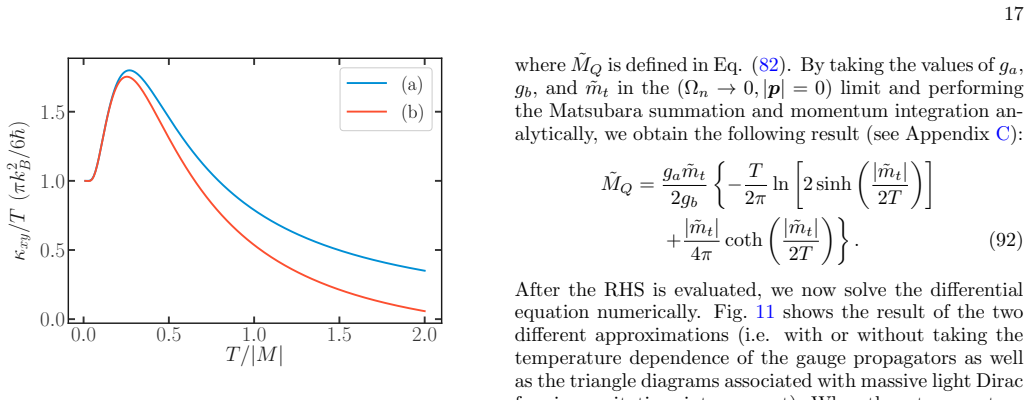
- Above the spectral gap, gauge fluctuations contribute a negative Aslamazov-Larkin term for $\hat{k}=-2$, producing a non-monotonic $\kappa_{xy}/T$ with a peak near the gap.
- At high temperature $T \gtrsim |M|$, the Aslamazov-Larkin contribution scales as $\mathrm{sgn}(\hat{k})\,T^{-1}\ln(T/|m_t|)$, so the quantum-critical-window response differs qualitatively from the noninteracting fermion result.
- The bulk Kubo-plus-energy-magnetization computation reproduces the edge conformal-field-theory quantized value as $T\to 0$, so bulk-boundary correspondence holds for thermal Hall in this abelian theory.
- The large-$N_f$ scheme generalizes to arbitrary abelian chiral spin liquids, with gauge contributions at order one and no $N_f$ dependence in the zero-temperature chiral central charge.
Reading between the lines
- Inference: if the predicted log-corrected power law holds, thermal Hall measurements across the gap in kagome chiral spin liquid candidates could distinguish gauge-fluctuation-dominated response from simple band, parton, or phonon backgrounds, because the temperature dependence carries the sign of $\hat{k}$.
- Inference: because the order-one Aslamazov-Larkin contribution is universal to abelian Maxwell-Chern-Simons theories, the same log-corrected regime should appear in other abelian chiral spin liquids whenever the matter gap is the smallest scale, not just on the kagome lattice.
- Inference: the paper's assumption that density-of-states and Maki-Thompson corrections are negligible at finite temperature could be checked before experimental comparison; if those diagrams matter near $T\sim |m|$, the clean log law would acquire additional temperature-dependent corrections.
Editorial analysis
A structured set of objections, weighed in public.
Referee Report
Summary. This manuscript studies the thermal Hall response of a kagome-lattice chiral spin liquid using a parton mean-field theory and a subsequent large-Nf continuum treatment of U(1) Dirac fermions coupled to a Chern-Simons gauge field. The authors compute the free-fermion (O(Nf)) contribution and the Aslamazov-Larkin (O(1)) contribution to kappa_xy/T, obtaining a low-temperature quantized value consistent with c_- = 1 (rather than the mean-field value 2) and predicting a log-corrected power-law behavior in the quantum critical window |m| lesssim T lesssim |M|.
Significance. If the finite-temperature prediction is correct, the work provides a concrete, falsifiable signature of semionic topological order and resolves the discrepancy between the parton mean-field central charge and the Chern-Simons/CFT value. The calculation is extensive and largely explicit; the low-temperature limit is benchmarked against gravitational anomaly, and the vanishing of the O(Nf) gauge diagrams is a nontrivial result. The main new prediction, however, rests on an assertion about the subleading behaviour of other O(1/Nf) diagrams, which needs to be substantiated.
major comments (2)
- [Sec. V.D.1] The statement 'Since the corrections are all O(1/Nf), we posit that the DoS and MT corrections are not important even at finite temperatures' is the only support for neglecting the density-of-states and Maki-Thompson diagrams. In the physical case Nf = 4, 1/Nf is not a small parameter, and the computed AL diagram is also O(1) relative to the O(Nf) spinon term, so the formal large-Nf ordering does not by itself distinguish AL from DoS/MT. Please provide a direct finite-temperature estimate of the DoS self-energy and MT vertex-correction contributions (at least their leading T dependence in the window |m| lesssim T lesssim |M|) and show that they are small compared with the AL term, or compute them explicitly. Without this, the central log-corrected power-law claim of the paper is not established.
- [Sec. V.A.2] The choice to use the long-wavelength limits (epsilon_n -> 0 with q = 0) for g_a and g_b, while discarding the static limit (epsilon_n = 0, q -> 0) because the resulting topological mass becomes momentum-dependent, is not justified by a kinematic analysis of the AL loop integral. The static limit is the relevant one for the zero Matsubara-frequency sector, which can dominate the thermal sum at T greatersim |m|. The authors should either show that the contributions from non-zero Matsubara modes dominate the AL integral in the quantum-critical window, or provide a sensitivity check using the static-limit propagator (e.g., including the n = 0 mode with the static g_a) to demonstrate that the log-corrected power law is unchanged.
minor comments (5)
- [Sec. V.D.2] The statement after Eq. (92) that kappa_xy^(AL)/T ~ sgn(M) T^{-1} ln(T/|M|) for T/|M| >> 1 is an extrapolation based on dimensional analysis. Since T/|M| >> 1 lies outside the regime where the Maxwell-Chern-Simons description is controlled, please mark this as an extrapolation or provide a supporting estimate.
- [Eq. (59)] The high-T asymptote of the free-fermion contribution contains a term proportional to |m|/|M|; for T >> |M| both masses are much smaller than T and the physical meaning of this mixed ratio deserves a clarifying comment.
- [Fig. 12 caption] Panel (a) is described as a 'bulk calculation' but it is simply the sum of Eq. (56) and Eq. (85); please clarify the difference between the two panels and the approximations used in each.
- [Sec. IV] The text states that the lattice result gives kappa_xy/T ~ T^{-3} at high temperatures, but the plot in Fig. 3 appears to show a slightly different effective power at intermediate T; please double-check the fitting range and exponent.
- [Sec. VI] There are several typos, including 'identicaly' in Sec. VI and 'T erm' in Table I; please proofread the manuscript.
Circularity Check
No significant circularity: low-T quantization is checked against CFT/gravitational-anomaly input, the finite-T log-corrected law comes from an explicit AL diagram with no parameter fitted to κxy, and the only flagged weakness (unproven DoS/MT truncation) is a correctness risk rather than a circular step.
full rationale
The paper's predictions do not reduce to their inputs. The zero-temperature value in Eq. (23) is fixed by the bulk-boundary/anomaly input and independently reproduced by adding the O(Nf) free-fermion result Eq. (58) to the O(1) Aslamazov-Larkin result Eq. (87); neither piece is fitted to the target. The finite-temperature log-corrected power law follows from explicit evaluation of the AL diagram (Eqs. (74)-(92)), with the integration constant c1 chosen so that the AL contribution vanishes as T→∞, not tuned to recover Eq. (23). The authors' reliance on their prior large-Nf work [17] supplies the diagrammatic framework and the Maxwell-Chern-Simons benchmark, but the U(1) calculation is rederived in the appendices, so this self-citation is not load-bearing in a way that forces the conclusion. The one genuinely fragile step is Sec. V.D.1, where the authors "posit that the DoS and MT corrections are not important even at finite temperatures" although 1/Nf = 1/4 is not small; this is a missing estimate and a correctness risk for the finite-T window, not a circular identification of output with input. Overall, the derivation chain is self-contained against external benchmarks and no circular step is exhibited.
Assumptions & free parameters
free parameters (4)
- light fermion mass m =
m = 5 in plots
- heavy fermion mass M =
M = -15 in plots
- hooping amplitude t =
energy unit
- integration constant c1 =
c1 = sgn(m_t)π/12
assumptions (5)
- domain assumption Kagome Heisenberg antiferromagnet realizes a gapless U(1) Dirac spin liquid with Nf=4 Dirac fermions.
- domain assumption The large-Nf limit with Nf → ∞ is a controlled approximation, and the physical Nf=4 value is used for quantitative results.
- domain assumption Heavy fermions are integrated out to a Maxwell-Chern-Simons effective action valid for |M| ≳ T.
- ad hoc to paper The DoS and Maki-Thompson diagrams are negligible at finite temperatures.
- ad hoc to paper Gauge propagator uses long-wavelength limits of g_a and g_b, discarding the static limit where the topological mass becomes momentum dependent.
Cite this review
Pith. "Pith review of Thermal Hall response of an abelian chiral spin liquid at finite temperatures." pith.science (2026). https://pith.science/paper/AR3C3BSV
@misc{pith2026241115304,
  author       = {Pith},
  title        = {Pith review of: Thermal Hall response of an abelian chiral spin liquid at finite temperatures},
  year         = {2026},
  howpublished = {\url{https://pith.science/paper/AR3C3BSV}},
  note         = {Machine review of arXiv:2411.15304}
}
abstract
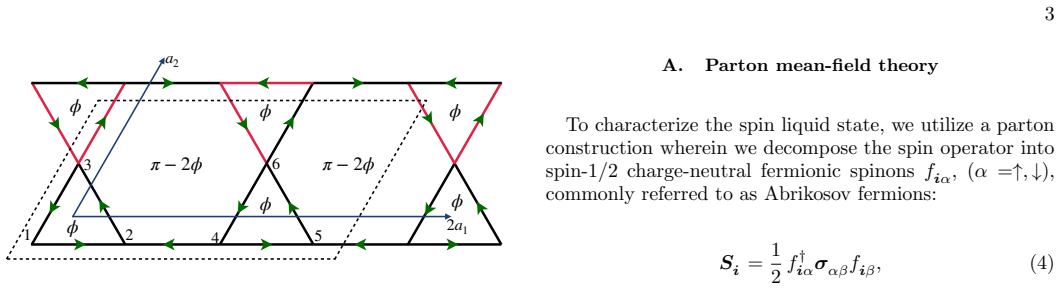
Thermal Hall transport has emerged as a valuable tool for probing the fractionalized excitations in chiral quantum spin liquids. Observing quantized thermal Hall response, expected at temperatures below the spectral gap, has been challenging and controversial. The finite temperature behavior, especially in the quantum critical regime above the spectral gap, can provide useful signatures of the underlying topological order. In this context, we study the spin-$1/2$ Heisenberg antiferromagnet on a kagome lattice that is believed to be a U$(1)$ Dirac spin liquid over a wide intermediate energy range. Scalar spin chirality perturbations turn this into a gapped abelian chiral spin liquid (CSL) with semionic topological order. Using a recently developed large-$N$ technique [Guo et al., Phys. Rev. B 101, 195126 (2020)], we obtain explicit expressions for the thermal Hall conductivity $\kappa_{xy}$ at finite temperatures taking into account both matter and gauge fluctuations. At low temperatures below the spectral gap, the quantized thermal Hall response agrees with that expected from conformal field theory and gravitational anomaly arguments. Our main finding is that in a large temperature window spanning the spectral gap and the Curie temperature scales where quantum critical fluctuations dominate, $\kappa_{xy}/T$ obeys a power-law with logarithmic corrections. Our analysis also provides a route to understanding the thermal Hall response at higher temperatures in the quantum critical regime.
Figures


Figures from the paper (5 more)


Reference graph
Works this paper leans on
-
[1]
9a and 9b, respectively, are not important in the |m|/T → ∞limit
The density of states (DoS) and Maki-Thompson (MT) diagrams In the earlier work related to the SU(2) case [17], it was argued that the DoS and MT [83, 84] diagrams listed in Figs. 9a and 9b, respectively, are not important in the |m|/T → ∞limit. The same reasons are applicable here. The DoS diagram is essentially a self-energy correction to the fermion pr...
-
[2]
9c , which con- sists of two dashed triangle diagrams and two renormalized gauge boson propagators
The Aslamazov-Larkin diagram Thus, the crucial Feynman diagram is the Aslamazov- Larkin (AL) correction [86], shown in Fig. 9c , which con- sists of two dashed triangle diagrams and two renormalized gauge boson propagators. Based on the gauge invariant stress-energy tensor in Eq. (40), there are four types of di- agrams that contribute to the dashed trian...
-
[3]
Heat-current operator and thermal Hall conductivity To compute the thermal Hall conductivity, we require two operators [77]: the heat current, given by J Q(r) ≡ J E(r) − µ J N (r), (38) and the heat density K(r) ≡ h(r) − µ n(r), (39) where µ, J E(r), J N (r), h(r) and n(r) are chemical poten- tial, energy current, particle current, local energy density, a...
-
[4]
Computation of Πµν f To begin, we calculate the fermion polarization func- tion Πµν f (q, iϵn) as defined in Eq. (30) at zero temperature, which can be expressed as: Πµν f (q, iϵn) = Nf T X iωn Z d2k (2π)2 Lµν(k; q) (ω2n + k2 + m2) × 1 ((ωn + ϵn)2 + (k + q)2 + m2) , (B1) where Lµν(k; q) = Tr [(iωn − τ · k − mτ z) τ µ ((iωn + iϵn) − τ · (k + q) − mτ z) τ ν...
-
[5]
Effective gauge boson propagator Dµν With the full polarization tensor determined, we proceed to calculate the renormalized gauge boson propagator in the Coulomb gauge. We can decompose the spatial component of the gauge field (ai) into longitudinal (aL) and transverse (aT ) components [92]: ai(q, iϵn) = i qi |q| aL(q, iϵn) + iϵij qiqj |q| aT (q, iϵn), (B...
-
[6]
Dashed triangle diagram in the |m|/T → ∞limit Here, we first demonstrate the zero temperature calculation for Γ µ0;αβ (AL),1(p, p+ q) in Eq. (64), which can be written as Γµ0;αβ (AL),1(p, p+ q) = − Nf 1p Nf !2 T X iωn Z d2k (2π)2 × Lµ0;αβ (AL),1(k; p; q) (ω2n + k2 + m2) ((ωn + ϵn)2 + (k + q)2 + m2) ((ωn − Ωn)2 + (k − p)2 + m2) , (C1) where Lµ0;αβ (AL),1(k...
-
[7]
To proceed, we redefine Eq
T ransport contribution from the Kubo formula at finite-T We now provide details of the computation of the dashed triangle diagram for general values of |m|/T in the long- wavelength limit ( ϵn → 0, |q| = 0) to obtain the DC re- sponse. To proceed, we redefine Eq. (C1) as Γµ0;αβ (AL),1(p, p+ q; T ) = − Z d2k (2π)2 S µ0;αβ (AL),1(k, T; p, iΩn; q, iϵn), (C1...
-
[8]
To evalu- ate Γµ0;αβ (AL) , we first perform the Matsubara sum over inter- nal fermionic frequency ωn at ϵn = 0, followed by taking the limit as q → 0
T ransport contribution from the energy magnetization at finite- T The computation of energy magnetization is carried out using a procedure similar to that of Kubo conductivity, with the added consideration of the static limit. To evalu- ate Γµ0;αβ (AL) , we first perform the Matsubara sum over inter- nal fermionic frequency ωn at ϵn = 0, followed by taki...
Show all 100 references
-
[9]
Anderson, Resonating valence bonds: A new kind of insulator?, Materials Research Bulletin 8, 153 (1973)
P. Anderson, Resonating valence bonds: A new kind of insulator?, Materials Research Bulletin 8, 153 (1973)
1973
-
[10]
P. A. Lee, N. Nagaosa, and X.-G. Wen, Doping a Mott insulator: Physics of high-temperature superconductivity, Rev. Mod. Phys. 78, 17 (2006)
2006
-
[11]
Wen, Quantum field theory of many-body systems: from the origin of sound to an origin of light and electrons (Oxford University Press, Oxford, 2007)
X.-G. Wen, Quantum field theory of many-body systems: from the origin of sound to an origin of light and electrons (Oxford University Press, Oxford, 2007)
2007
-
[12]
Savary and L
L. Savary and L. Balents, Quantum spin liquids: a review, Reports on Progress in Physics 80, 016502 (2016)
2016
-
[13]
Y. Zhou, K. Kanoda, and T.-K. Ng, Quantum spin liquid states, Rev. Mod. Phys. 89, 025003 (2017)
2017
-
[14]
Sachdev, Quantum Phases of Matter (Cambridge Uni- versity Press, Cambridge, U
S. Sachdev, Quantum Phases of Matter (Cambridge Uni- versity Press, Cambridge, U. K., 2023)
2023
-
[15]
Kalmeyer and R
V. Kalmeyer and R. B. Laughlin, Equivalence of the resonating-valence-bond and fractional quantum Hall states, Phys. Rev. Lett. 59, 2095 (1987)
1987
-
[16]
Kalmeyer and R
V. Kalmeyer and R. B. Laughlin, Theory of the spin liquid state of the Heisenberg antiferromagnet, Phys. Rev. B 39, 11879 (1989)
1989
-
[17]
Zhang, Y
X.-T. Zhang, Y. H. Gao, and G. Chen, Thermal Hall effects in quantum magnets (2024)
2024
-
[18]
Katsura, N
H. Katsura, N. Nagaosa, and P. A. Lee, Theory of the Ther- mal Hall Effect in Quantum Magnets, Phys. Rev. Lett.104, 066403 (2010)
2010
-
[19]
Matsumoto, R
R. Matsumoto, R. Shindou, and S. Murakami, Thermal Hall effect of magnons in magnets with dipolar interaction, Phys. Rev. B 89, 054420 (2014)
2014
-
[20]
Banerjee, M
M. Banerjee, M. Heiblum, V. Umansky, D. E. Feldman, Y. Oreg, and A. Stern, Observation of half-integer thermal Hall conductance, Nature (London) 559, 205 (2018)
2018
-
[21]
X. G. Wen, Chiral Luttinger Liquid and the Edge Excita- tions in the Fractional Quantum Hall States, Phys. Rev. B 41, 12838 (1990)
1990
-
[22]
C. L. Kane and M. P. A. Fisher, Quantized thermal trans- port in the fractional quantum hall effect, Phys. Rev. B 55, 15832 (1997)
1997
-
[23]
Cappelli, M
A. Cappelli, M. Huerta, and G. R. Zemba, Thermal trans- port in chiral conformal theories and hierarchical quantum hall states, Nuclear Physics B 636, 568–582 (2002)
2002
-
[24]
Di Francesco, P
P. Di Francesco, P. Mathieu, and D. Senechal, Conformal Field Theory , Graduate Texts in Contemporary Physics (Springer-Verlag, New York, 1997)
1997
-
[25]
H. Guo, R. Samajdar, M. S. Scheurer, and S. Sachdev, Gauge theories for the thermal Hall effect, Phys. Rev. B 101, 195126 (2020)
2020
-
[26]
Kitaev, Anyons in an exactly solved model and beyond, Annals of Physics 321, 2–111 (2006)
A. Kitaev, Anyons in an exactly solved model and beyond, Annals of Physics 321, 2–111 (2006)
2006
-
[27]
Nayak, S
C. Nayak, S. H. Simon, A. Stern, M. Freedman, and S. Das Sarma, Non-Abelian anyons and topological quan- 29 tum computation, Rev. Mod. Phys. 80, 1083 (2008)
2008
-
[28]
Kasahara, T
Y. Kasahara, T. Ohnishi, Y. Mizukami, O. Tanaka, S. Ma, K. Sugii, N. Kurita, H. Tanaka, J. Nasu, Y. Motome, T. Shibauchi, and Y. Matsuda, Majorana quantization and half-integer thermal quantum Hall effect in a Kitaev spin liquid, Nature (London) 559, 227 (2018)
2018
-
[29]
Czajka, T
P. Czajka, T. Gao, M. Hirschberger, P. Lampen-Kelley, A. Banerjee, J. Yan, D. G. Mandrus, S. E. Nagler, and N. P. Ong, Oscillations of the thermal conductivity in the spin-liquid state of α-RuCl3, Nature Physics 17, 915 (2021)
2021
-
[30]
Czajka, T
P. Czajka, T. Gao, M. Hirschberger, P. Lampen-Kelley, A. Banerjee, N. Quirk, D. G. Mandrus, S. E. Nagler, and N. P. Ong, Planar thermal Hall effect of topological bosons in the Kitaev magnet α-RuCl3, Nature Materials 22, 36 (2023)
2023
-
[31]
Lefran¸ cois, G
E. Lefran¸ cois, G. Grissonnanche, J. Baglo, P. Lampen- Kelley, J.-Q. Yan, C. Balz, D. Mandrus, S. E. Nagler, S. Kim, Y.-J. Kim, N. Doiron-Leyraud, and L. Taillefer, Evidence of a Phonon Hall Effect in the Kitaev Spin Liquid Candidate α−RuCl3, Phys. Rev. X 12, 021025 (2022)
2022
-
[32]
Grissonnanche, A
G. Grissonnanche, A. Legros, S. Badoux, E. Lefran¸ cois, V. Zatko, M. Lizaire, F. Lalibert´ e, A. Gourgout, J.-S. Zhou, S. Pyon, T. Takayama, H. Takagi, S. Ono, N. Doiron- Leyraud, and L. Taillefer, Giant thermal Hall conductivity in the pseudogap phase of cuprate superconduct...
2019
-
[33]
L. Chen, L. Le Roux, G. Grissonnanche, M.-E. Boulanger, S. Th´ eriault, R. Liang, D. A. Bonn, W. N. Hardy, S. Pyon, T. Takayama, H. Takagi, K.-J. Xu, Z.-X. Shen, and L. Taillefer, Planar Thermal Hall Effect from Phonons in Cuprates, Phys. Rev. X 14, 041011 (2024)
2024
-
[34]
Samajdar, S
R. Samajdar, S. Chatterjee, S. Sachdev, and M. S. Scheurer, Thermal Hall effect in square-lattice spin liquids: A Schwinger boson mean-field study, Phys. Rev. B99, 165126 (2019)
2019
-
[35]
Samajdar, M
R. Samajdar, M. S. Scheurer, S. Chatterjee, H. Guo, C. Xu, and S. Sachdev, Enhanced thermal Hall effect in the square- lattice N´ eel state, Nature Physics15, 1290–1294 (2019)
2019
-
[36]
Sun, J.-Y
X.-Q. Sun, J.-Y. Chen, and S. A. Kivelson, Large extrin- sic phonon thermal Hall effect from resonant scattering, Phys. Rev. B 106, 144111 (2022), arXiv:2109.12117 [cond- mat.mes-hall]
2022 arXiv
-
[37]
H. Guo, D. G. Joshi, and S. Sachdev, Resonant thermal Hall effect of phonons coupled to dynamical defects, Proceed- ings of the National Academy of Science 119, e2215141119 (2022), arXiv:2201.11681 [cond-mat.str-el]
2022 arXiv
-
[38]
J. S. Helton, K. Matan, M. P. Shores, E. A. Nytko, B. M. Bartlett, Y. Yoshida, Y. Takano, A. Suslov, Y. Qiu, J.-H. Chung, D. G. Nocera, and Y. S. Lee, Spin Dy- namics of the Spin-1 /2 Kagome Lattice Antiferromagnet ZnCu3(OH)6Cl2, Phys. Rev. Lett. 98, 107204 (2007)
2007
-
[39]
Suetsugu, T
S. Suetsugu, T. Asaba, S. Ikemori, Y. Sekino, Y. Kasa- hara, K. Totsuka, B. Li, Y. Zhao, Y. Li, Y. Kohama, and Y. Matsuda, Gapless spin excitations in a quantum spin liq- uid state of S=1/2 perfect kagome antiferromagnet, arXiv e-prints , arXiv:2407.16208 (2024), arXiv:2407.16...
2024 arXiv
-
[40]
Read and S
N. Read and S. Sachdev, Large- N expansion for frus- trated quantum antiferromagnets, Phys. Rev. Lett. 66, 1773 (1991)
1991
-
[41]
X. G. Wen, Mean-field theory of spin-liquid states with fi- nite energy gap and topological orders, Phys. Rev. B 44, 2664 (1991)
1991
-
[42]
Sachdev, Kagome- and triangular-lattice Heisenberg an- tiferromagnets: Ordering from quantum fluctuations and quantum-disordered ground states with unconfined bosonic spinons, Phys
S. Sachdev, Kagome- and triangular-lattice Heisenberg an- tiferromagnets: Ordering from quantum fluctuations and quantum-disordered ground states with unconfined bosonic spinons, Phys. Rev. B 45, 12377 (1992)
1992
-
[43]
M. B. Hastings, Dirac structure, R VB, and Goldstone modes in the kagome antiferromagnet, Phys. Rev. B 63, 014413 (2000)
2000
-
[44]
S. Yan, D. A. Huse, and S. R. White, Spin-Liquid Ground State of the S = 1/2 Kagome Heisenberg Antiferromagnet, Science 332, 1173–1176 (2011)
2011
-
[45]
Depenbrock, I
S. Depenbrock, I. P. McCulloch, and U. Schollw¨ ock, Nature of the Spin-Liquid Ground State of the S = 1/2 Heisenberg Model on the Kagome Lattice, Phys. Rev. Lett.109, 067201 (2012)
2012
-
[46]
Jiang, Z
H.-C. Jiang, Z. Wang, and L. Balents, Identifying topo- logical order by entanglement entropy, Nature Physics 8, 902–905 (2012)
2012
-
[47]
Y. Ran, M. Hermele, P. A. Lee, and X.-G. Wen, Projected- Wave-Function Study of the Spin-1/2 Heisenberg Model on the Kagome Lattice, Phys. Rev. Lett. 98, 117205 (2007)
2007
-
[48]
Iqbal, F
Y. Iqbal, F. Becca, and D. Poilblanc, Projected wave func- tion study of Z2 spin liquids on the kagome lattice for the spin- 1 2 quantum Heisenberg antiferromagnet, Phys. Rev. B 84, 020407 (2011)
2011
-
[49]
Iqbal, F
Y. Iqbal, F. Becca, S. Sorella, and D. Poilblanc, Gapless spin-liquid phase in the kagome spin- 1 2 Heisenberg antifer- romagnet, Phys. Rev. B 87, 060405 (2013)
2013
-
[50]
Iqbal, D
Y. Iqbal, D. Poilblanc, and F. Becca, Vanishing spin gap in a competing spin-liquid phase in the kagome Heisenberg antiferromagnet, Phys. Rev. B 89, 020407 (2014)
2014
-
[51]
Iqbal, D
Y. Iqbal, D. Poilblanc, and F. Becca, Spin- 1 2 Heisenberg J1−J2 antiferromagnet on the kagome lattice, Phys. Rev. B 91, 020402 (2015)
2015
-
[52]
Y.-C. He, M. P. Zaletel, M. Oshikawa, and F. Pollmann, Signatures of Dirac Cones in a DMRG Study of the Kagome Heisenberg Model, Phys. Rev. X 7, 031020 (2017)
2017
-
[53]
W. Zhu, X. Chen, Y.-C. He, and W. Witczak-Krempa, En- tanglement signatures of emergent Dirac fermions: Kagome spin liquid and quantum criticality, Science Advances 4, eaat5535 (2018)
2018
-
[54]
H. J. Liao, Z. Y. Xie, J. Chen, Z. Y. Liu, H. D. Xie, R. Z. Huang, B. Normand, and T. Xiang, Gapless Spin-Liquid Ground State in the S = 1 /2 Kagome Antiferromagnet, Phys. Rev. Lett. 118, 137202 (2017)
2017
-
[55]
Jiang, P
S. Jiang, P. Kim, J. H. Han, and Y. Ran, Competing Spin Liquid Phases in the S=1 2 Heisenberg Model on the Kagome Lattice, SciPost Phys. 7, 006 (2019)
2019
-
[56]
M. Fu, T. Imai, T.-H. Han, and Y. S. Lee, Evidence for a gapped spin-liquid ground state in a kagome Heisenberg antiferromagnet, Science 350, 655 (2015)
2015
-
[57]
J. Wang, W. Yuan, P. M. Singer, R. W. Smaha, W. He, J. Wen, Y. S. Lee, and T. Imai, Emergence of spin singlets with inhomogeneous gaps in the kagome lattice Heisenberg antiferromagnets Zn-barlowite and herbertsmithite, Nature Physics 17, 1109 (2021)
2021
-
[58]
Mei, J.-Y
J.-W. Mei, J.-Y. Chen, H. He, and X.-G. Wen, Gapped spin liquid with Z 2 topological order for the kagome Heisenberg model, Phys. Rev. B 95, 235107 (2017), arXiv:1606.09639 [cond-mat.str-el]
2017 arXiv
-
[59]
Ko, Z.-X
W.-H. Ko, Z.-X. Liu, T.-K. Ng, and P. A. Lee, Raman signature of the u(1) dirac spin-liquid state in the spin- 1 2 kagome system, Phys. Rev. B 81, 024414 (2010)
2010
-
[60]
Bauer, L
B. Bauer, L. Cincio, B. P. Keller, M. Dolfi, G. Vidal, S. Trebst, and A. W. W. Ludwig, Chiral spin liquid and emergent anyons in a Kagome lattice Mott insulator, Na- 30 ture Communications 5, 5137 (2014)
2014
-
[61]
S.-S. Gong, W. Zhu, and D. N. Sheng, Emergent Chiral Spin Liquid: Fractional Quantum Hall Effect in a Kagome Heisenberg Model, Scientific Reports 4, 6317 (2014)
2014
-
[62]
Y.-C. He, D. N. Sheng, and Y. Chen, Chiral Spin Liquid in a Frustrated Anisotropic Kagome Heisenberg Model, Phys. Rev. Lett. 112, 137202 (2014)
2014
-
[63]
He and Y
Y.-C. He and Y. Chen, Distinct Spin Liquids and Their Transitions in Spin-1 /2 XXZ Kagome Antiferromagnets, Phys. Rev. Lett. 114, 037201 (2015)
2015
-
[64]
W.-J. Hu, W. Zhu, Y. Zhang, S. Gong, F. Becca, and D. N. Sheng, Variational Monte Carlo study of a chiral spin liquid in the extended Heisenberg model on the kagome lattice, Phys. Rev. B 91, 041124 (2015)
2015
-
[65]
S.-S. Gong, W. Zhu, L. Balents, and D. N. Sheng, Global phase diagram of competing ordered and quantum spin- liquid phases on the kagome lattice, Phys. Rev. B 91, 075112 (2015)
2015
-
[66]
Bieri, L
S. Bieri, L. Messio, B. Bernu, and C. Lhuillier, Gapless chiral spin liquid in a kagome Heisenberg model, Phys. Rev. B 92, 060407 (2015)
2015
-
[67]
Y.-C. He, S. Bhattacharjee, F. Pollmann, and R. Moessner, Kagome Chiral Spin Liquid as a Gauged U (1) Symmetry Protected Topological Phase, Phys. Rev. Lett. 115, 267209 (2015)
2015
-
[68]
Kumar, K
K. Kumar, K. Sun, and E. Fradkin, Chiral spin liquids on the kagome lattice, Phys. Rev. B 92, 094433 (2015)
2015
-
[69]
S. Niu, J. Hasik, J.-Y. Chen, and D. Poilblanc, Chiral spin liquids on the kagome lattice with projected entangled sim- plex states, Phys. Rev. B 106, 245119 (2022)
2022
-
[70]
Watanabe, K
D. Watanabe, K. Sugii, M. Shimozawa, Y. Suzuki, T. Ya- jima, H. Ishikawa, Z. Hiroi, T. Shibauchi, Y. Matsuda, and M. Yamashita, Emergence of nontrivial magnetic excita- tions in a spin-liquid state of kagom´ e volborthite, Proceed- ings of the National Academy of Sciences 113,...
2016
-
[71]
H. Doki, M. Akazawa, H.-Y. Lee, J. H. Han, K. Sugii, M. Shimozawa, N. Kawashima, M. Oda, H. Yoshida, and M. Yamashita, Spin Thermal Hall Conductivity of a Kagome Antiferromagnet, Phys. Rev. Lett. 121, 097203 (2018)
2018
-
[72]
Akazawa, M
M. Akazawa, M. Shimozawa, S. Kittaka, T. Sakakibara, R. Okuma, Z. Hiroi, H.-Y. Lee, N. Kawashima, J. H. Han, and M. Yamashita, Thermal Hall Effects of Spins and Phonons in Kagome Antiferromagnet Cd-Kapellasite, Phys. Rev. X 10, 041059 (2020)
2020
-
[73]
A. Mook, J. Henk, and I. Mertig, Spin dynamics simulations of topological magnon insulators: From transverse current correlation functions to the family of magnon Hall effects, Phys. Rev. B 94, 174444 (2016)
2016
-
[74]
S. A. Owerre, Topological thermal Hall effect in frustrated kagome antiferromagnets, Phys. Rev. B 95, 014422 (2017)
2017
-
[75]
Y. H. Gao and G. Chen, Topological thermal Hall effect for topological excitations in spin liquid: Emergent Lorentz force on the spinons, SciPost Physics Core 2, 10.21468/sci- postphyscore.2.2.004 (2020)
2020 doi
-
[76]
Sen and R
D. Sen and R. Chitra, Large- U limit of a Hubbard model in a magnetic field: Chiral spin interactions and paramag- netism, Phys. Rev. B 51, 1922 (1995)
1995
-
[77]
Wen, Quantum orders and symmetric spin liquids, Phys
X.-G. Wen, Quantum orders and symmetric spin liquids, Phys. Rev. B 65, 165113 (2002)
2002
-
[78]
Hermele, Y
M. Hermele, Y. Ran, P. A. Lee, and X.-G. Wen, Properties of an algebraic spin liquid on the kagome lattice, Phys. Rev. B 77, 224413 (2008)
2008
-
[79]
X. G. Wen, F. Wilczek, and A. Zee, Chiral spin states and superconductivity, Phys. Rev. B 39, 11413 (1989)
1989
-
[80]
N. R. Cooper, B. I. Halperin, and I. M. Ruzin, Thermo- electric response of an interacting two-dimensional electron gas in a quantizing magnetic field, Phys. Rev. B 55, 2344 (1997)
1997
-
[81]
S. M. Girvin and K. Yang, Modern Condensed Matter Physics (Cambridge University Press, Cambridge ; New York, NY, 2019)
2019
-
[82]
J. M. Luttinger, Theory of Thermal Transport Coefficients, Phys. Rev. 135, A1505 (1964)
1964
-
[83]
Smrcka and P
L. Smrcka and P. Streda, Transport coefficients in strong magnetic fields, J. Phys. C: Solid State Phys. 10, 2153 (1977)
1977
-
[84]
Matsumoto and S
R. Matsumoto and S. Murakami, Theoretical Prediction of a Rotating Magnon Wave Packet in Ferromagnets, Phys. Rev. Lett. 106, 197202 (2011)
2011
-
[85]
T. Qin, Q. Niu, and J. Shi, Energy Magnetization and the Thermal Hall Effect, Phys. Rev. Lett. 107, 236601 (2011)
2011
-
[86]
Yang, G.-M
Y.-F. Yang, G.-M. Zhang, and F.-C. Zhang, Universal Be- havior of the Thermal Hall Conductivity, Phys. Rev. Lett. 124, 186602 (2020)
2020
-
[87]
Kumar and V
A. Kumar and V. Tripathi, Thermal Hall conductivity near field-suppressed magnetic order in a Kitaev-Heisenberg model, Phys. Rev. B 107, L220406 (2023)
2023
-
[88]
R. K. Kaul and S. Sachdev, Quantum criticality of U(1) gauge theories with fermionic and bosonic matter in two spatial dimensions, Phys. Rev. B 77, 155105 (2008)
2008
-
[89]
Dorey and N
N. Dorey and N. E. Mavromatos, QED in three-dimension and two-dimensional superconductivity without parity vio- lation, Nucl. Phys. B 386, 614 (1992)
1992
-
[90]
Vafek, Quasiparticles and Vortices in the High Tempera- ture Cuprate Superconductors, Ph.D
O. Vafek, Quasiparticles and Vortices in the High Tempera- ture Cuprate Superconductors, Ph.D. thesis, Johns Hopkins University, Baltimore, MD (2003)
2003
-
[91]
Maki, The Critical Fluctuation of the Order Param- eter in Type-II Superconductors, Progress of Theoretical Physics 39, 897 (1968)
K. Maki, The Critical Fluctuation of the Order Param- eter in Type-II Superconductors, Progress of Theoretical Physics 39, 897 (1968)
1968
-
[92]
R. S. Thompson, Microwave, Flux Flow, and Fluctuation Resistance of Dirty Type-II Superconductors, Phys. Rev. B 1, 327 (1970)
1970
-
[93]
Brout and F
R. Brout and F. Englert, Gravitational Ward Identity and the Principle of Equivalence, Phys. Rev. 141, 1231 (1966)
1966
-
[94]
L. G. Aslamazov and A. I. Larkin, Effect of fluctuations on the properties of a superconductor above the critical temperature, in World Scientific Series in 20th Century Physics (WORLD SCIENTIFIC, 1996) p. 23–28
1996
-
[95]
Barth´ elemy, E
Q. Barth´ elemy, E. Lefran¸ cois, J. Baglo, P. Bourgeois- Hope, D. Chatterjee, P. Leflo ¨ ıc, M. Vel´ azquez, V. Bal´ edent, B. Bernu, N. Doiron-Leyraud, F. Bert, P. Mendels, and L. Taillefer, Heat conduction in herbertsmithite: Field de- pendence at the onset of the quantum s...
2023
-
[96]
Kolezhuk, S
A. Kolezhuk, S. Sachdev, R. R. Biswas, and P. Chen, The- ory of quantum impurities in spin liquids, Physical Review B 74, 10.1103/physrevb.74.165114 (2006)
2006 doi
-
[97]
Banerjee, W
S. Banerjee, W. Zhu, and S.-Z. Lin, Electromagnetic signa- tures of a chiral quantum spin liquid, npj Quantum Mate- rials 8, 10.1038/s41535-023-00595-2 (2023)
2023 doi
-
[98]
Lee and M
C.-J. Lee and M. Mulligan, Universal conductivity at a two- dimensional superconductor-insulator transition: The ef- fects of quenched disorder and Coulomb interaction, Phys. Rev. B 108, 235142 (2023)
2023
-
[99]
Aitchison and J
I. Aitchison and J. Zuk, The Non-local Odd-Parity O(e2) Effective Action of QED 3 at Finite Temperature, Annals 31 of Physics 242, 77–116 (1995)
1995
-
[100]
Kachru, M
S. Kachru, M. Mulligan, G. Torroba, and H. Wang, Mirror symmetry and the half-filled landau level, Phys. Rev. B 92, 235105 (2015)
2015
Reviewed August 12, 2026 · model on record in the stance chip above.
Discussion (0). Continue with ORCID to comment.