REVIEW 4 major objections 4 minor 103 references
tonalli: an asexual genetic code to characterise APOGEE-2 stellar spectra. I. Validation with synthetic and solar spectra
T0 review · 4 major / 4 minor · reviewed 2026-08-12 · deepseek-v4-flash
Pith's one-line read An asexual genetic algorithm extracts four stellar parameters from APOGEE-2 spectra with no appreciable bias for stars from 3200 to 6250 K.
desk verdict A careful APOGEE-2 fitting pipeline whose headline four-parameter operating range is not backed by the synthetic tests, because only Teff and log(g) are varied at solar abundances. read the letter →
The pith
A machine-rendered reading of the paper's core claim, the machinery that carries it, and where it could break.
The reading
What carries the argument
The load-bearing mechanism is the asexual genetic algorithm of Cantó et al. (2009), which differs from classical genetic algorithms by generating each new generation within a shrinking hyper-cube around each of the $N_p$ fittest parents, with side lengths decreasing as $(\Delta x_i)_n = (\Delta x_i)_0 \, p^n$ for a convergence factor $p\in(0,1)$. Each offspring's synthetic spectrum is formed by 4D linear interpolation over the nearest $N_{\rm interpol}$ MARCS grid points, convolved to APOGEE-2 resolution, rotationally broadened, and Doppler-shifted, and its fitness is the $\chi^2$ between that spectrum and the observed one. Before fitting, both observed and synthetic spectra are mapped onto a common pseudo-continuum by an iterative BIC-selected polynomial fit with asymmetric $\sigma$-clipping, and the wavelength window for the figure of merit excludes the chip edges where the Brackett lines distort the normalization. A $k$-nearest-neighbours classifier on Mg i, Al i, and CO equivalent widths gates high-temperature and emission-line stars, and the whole fine search is repeated in a Monte Carlo loop so that the reported parameters are the median and interquartile range of the resulting distributions.
What would settle it
Apply tonalli to APOGEE-2 spectra of benchmark cool stars with independent effective temperatures from interferometry and surface gravities from asteroseismology, spanning 3200 to 6250 K, and check whether the recovered medians agree with the independent values within the claimed bias of less than half a MARCS grid step; a systematic offset that grows as $T_{\rm eff}$ approaches 6250 K, or an offset on real stars that is absent in the synthetic recovery tests, would refute the working-range claim.
Extended reading notes
Core claim
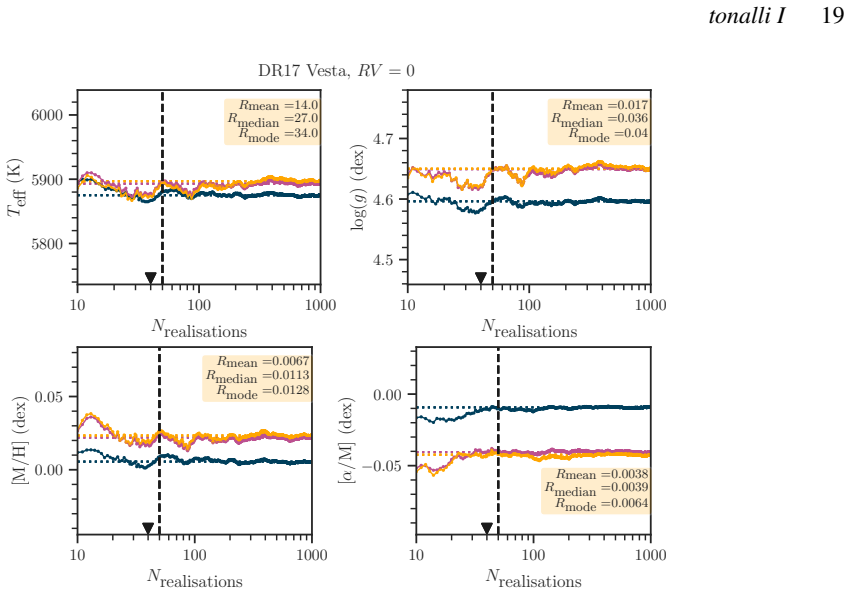
On its own terms, the paper's contribution is the demonstration that an asexual genetic algorithm can reliably locate the best-fitting MARCS model for an APOGEE-2 spectrum without appreciable bias in a defined working range. In the noisy synthetic experiments, the reported bias stays below half the MARCS grid step for the four parameters over roughly 3200 to 6250 K, with the temperature bias growing at higher temperatures because the continuum normalization degrades near the Brackett lines at the chip edges. For the Vesta solar spectrum, the adopted univariate medians are $T_{\rm eff}=5779$ K, $\log(g)=4.51$ dex, $[{\rm M/H}]=-0.03$ dex, and $[\alpha/{\rm M}]=0.00$ dex, with credible intervals on the order of a few hundred kelvin and a few tenths of a dex, and the paper finds these consistent with published spectroscopic determinations of the Sun.
Load-bearing premise
The load-bearing premise is that the iterative continuum normalization places real and synthetic spectra on a common pseudo-continuum across all three APOGEE-2 chips; if it distorts line-to-continuum ratios, especially near the Brackett lines at the chip edges, the chi-squared fit is biased, and the synthetic validation against the same MARCS library measures internal consistency rather than the fidelity of the models to real stars.
Editorial extensions
If this is right
- APOGEE-2 spectra of cool dwarfs and subgiants can be parameterized entirely by direct synthetic fitting, with no training labels and with per-star Monte Carlo uncertainties.
- The working range from 3200 to 6250 K includes pre-main-sequence stars, giving a model-based route for studying young stellar populations where the standard APOGEE-2 pipeline is known to struggle.
- The released continuum-normalized MARCS library and the user-selectable library interface allow the same pipeline to be re-run against other model grids, such as BT-NextGen, BOSZ, PHOENIX, or SpecModels, to expose model dependence.
- The stopping criterion based on the temperature hyper-volume shrinking to 1 K, together with the recommended input parameters, provides a reproducible recipe for parameter recovery.
- The median of the one-dimensional Monte Carlo distribution is argued to be a robust statistic when parameter degeneracies make the distribution multimodal, giving a concrete reporting convention.
Reading between the lines
- Beyond the paper, the synthetic validation uses spectra drawn from the same MARCS library that tonalli fits, so the reported accuracy is primarily internal consistency; a cross-check against asteroseismic or interferometric benchmarks for cool dwarfs would test the model-fidelity part of the claim.
- The paper's own Vesta experiment shows parameter degeneracies, including a shift in $\log(g)$ when the radial velocity is optimized, so adding priors as the authors say they plan could shrink credible intervals substantially without changing the method.
- The continuum-normalization failure above roughly 6250 K is tied to Brackett lines near chip edges, so restricting the figure-of-merit windows or adopting a different normalization for early-type stars might extend the same machinery to hotter stars.
- The classifier gating is trained on young stars in the Pleiades and W3/4/5, so applying tonalli to field cool stars assumes those equivalent-width classes transfer; re-training on field stars would harden the pipeline for general surveys.
Editorial analysis
A structured set of objections, weighed in public.
Referee Report
Summary. The manuscript presents tonalli, a Python code implementing an asexual genetic algorithm (Cantó et al. 2009) to fit APOGEE-2 spectra against a continuum-normalized, resolution-matched MARCS synthetic library. The fitted parameters are Teff, log(g), [M/H], [alpha/M], v sin(i), and RV, with limb darkening fixed at a chosen value. The paper describes the algorithm, the iterative BIC-based sigma-clipping continuum normalization, a k-nearest-neighbour spectral classifier, and a Monte Carlo repetition scheme for uncertainties. Validation is performed with 50 Monte Carlo realizations on 66 synthetic MARCS spectra at solar abundances, in three configurations (M0: already-normalized library spectra; M1: re-normalized spectra; M2: M1 plus noise at several S/N), and on the APOGEE-2 DR17 Vesta solar spectrum with RV fixed and optimized. The central claim is that tonalli can recover all four stellar parameters without appreciable bias for stars with effective temperatures between roughly 3200 and 6250 K.
Significance. If the stated operating range were fully established, tonalli would be a useful open tool for cool-dwarf and pre-main-sequence parameter estimation from APOGEE-2 spectra, a regime in which ASPCAP is known to be less reliable. The paper has real strengths: the algorithm is described in unusual detail with pseudo-code, the parameter-control exploration in Appendix B is systematic, the Monte Carlo uncertainty treatment is honest, and the continuum-normalized MARCS library is publicly released with a DOI. The Vesta analysis openly reports broad credible intervals, multimodal distributions, and model degeneracy. However, the headline accuracy claim is broader than the validation actually supports: the Section 3 synthetic experiment varies only Teff and log(g) while fixing [M/H]=[alpha/M]=0, and all targets are drawn from the same MARCS library used for fitting. These two issues make the four-parameter, 3200-6250 K claim load-bearing and currently under-supported.
major comments (4)
- [Section 3.2, Figure 6, Table 3] The synthetic validation set is described as having "zero metal and alpha-elements abundances" with only Teff and log(g) varied (Section 3.2, second paragraph: 66 models with [M/H]=[alpha/M]=0). Consequently the heat maps in Figure 6 and the temperature ranges in Table 3 exercise recovery of Teff and log(g) at solar composition; they do not test recovery of [M/H] or [alpha/M] at non-solar values. The sentence in Section 3.2.3 stating that tonalli "can recover with success the four stellar parameters in this experiment for stars with effective temperatures between ~3200 and ~6250 K" is therefore not established for the two abundance parameters. Because abundance changes alter line depths and molecular opacities and can trade off against Teff and log(g), the absence of non-solar-abundance tests is load-bearing. I request adding M1/M2-style experiments at non-zero abundances, for example [M/H] = -0.5, -0.25, +0.25 and [alpha/M] = +0.2 or +0.4, or, failing that, explicitly restricting the claimed operating range to solar-composition recovery.
- [Section 3.2 and Section 2.3.8] All three validation experiments (M0, M1, M2) generate the target spectra from the same MARCS library that tonalli fits against. These experiments therefore measure internal consistency of the interpolator, the optimizer, the continuum-normalization procedure, and the noise handling; they cannot detect systematic errors of the MARCS models relative to real stars. The paper acknowledges model dependence in Section 2.3.8, but the abstract and Section 3.2.3 present the M2 results as accuracy. The solar Vesta comparison is an external anchor, but its default credible intervals are broad (Table 5: Teff = 5779+372/-304 K, log(g) = 4.51+0.40/-0.33, [M/H] = -0.03+/-0.15, [alpha/M] = 0.00+0.16/-0.14). Please either reword the accuracy claims as "internal recovery within the MARCS grid" or add independent validation such as a second synthetic grid (PHOENIX, BT-Settl, or BOSZ) or a set of benchmark stars with interferometric or asteroseismic parameters.
- [Section 4.3.2, Table 5, Equation (10)] The second row of Table 5, with much tighter quoted intervals (Teff = 5780+55/-51 K, log(g) = 4.44+0.06/-0.03, [M/H] = -0.028+0.029/-0.033, [alpha/M] = -0.024+0.020/-0.025), is not the default tonalli result. It is the model selected by Equation (10) as minimizing a chi-square against the IAU solar values among the Appendix B2 models. This is a post hoc model-selection step that uses the same target values as the objective, so the resulting tight intervals quantify proximity to the chosen solar priors rather than independent precision. I advise presenting Equation (10) explicitly as a calibration or selection diagnostic and avoiding the selected row as evidence of nominal accuracy in the abstract or conclusions.
- [Section 3, Abstract] The abstract states that tonalli efficiently predicts rotational and radial velocities in addition to the four stellar parameters, but Section 3 contains no synthetic recovery test for v sin(i) or RV. The Vesta run reports v sin(i) values near the APOGEE-2 resolution limit and an RV close to the header value, but these are not accuracy tests. Either add synthetic experiments that vary v sin(i) and RV and report their biases, or remove them from the abstract-level claim of predicted parameters.
minor comments (4)
- [Figure 2 caption and Section 2.3.3] The text defines label 2 as emission-line stars, while the Figure 2 caption refers to "label 3 (emission line) stars"; this inconsistency should be corrected.
- [Section 1 and Section 3.2] The introduction states the method is applicable for 3.0 <= log(g) <= 6.0, but the Section 3.2 synthetic grid uses log(g) = 3, 4, and 5 dex only. Either extend the validation to log(g) = 6 or adjust the stated gravity range.
- [Section 2.3.7 and Appendix B] The adopted zero-generation population is given as N0 = 240 in Section 2.3.7 and Table 3, while Appendix B1 states N0 = 250 and refers to "our adopted input parameters N0 = 240"; the two values should be reconciled.
- [Section 2.3.3] The text mentions the option "weigthts" in KNeighborsClassifier; this is a typo for "weights".
Circularity Check
Partial circularity: the refined solar parameters are selected to match IAU values, and the synthetic validation is a same-library closed-box test that never varies [M/H] or [alpha/M].
-
fitted input called prediction
[Section 4.3.2, Eq. (10), Table 5 note d]
"The second row of Table 5 presents the model with the minimum chi-squared of all the models computed in Appendix B2 with IQR <= Delta-X/2 ... where we adopt the solar values of the IAU definition (Prsa et al. 2016), and the subscript m refers to the tonalli model."
The 'refined' tonalli solar parameters (Teff = 5780 K, log(g) = 4.44, [M/H] = -0.028, [alpha/M] = -0.024) are the single model among 108 hyperparameter combinations whose median lies closest to the IAU solar values, as measured by Eq. (10). Agreement with the IAU scale is therefore a selection criterion, not an independent prediction. Presenting this row as a tonalli spectroscopic determination in Table 5 means the agreement with the reference values is forced by construction rather than demonstrated.
-
self definitional
[Section 3.2, Section 3.2.3]
"For this, we select synthetic spectra with zero metal and alpha-elements abundances, effective temperatures of 3000-4000 K (in steps of 100 K) and 4250-7000 K (in steps of 250 K), and log(g) of 3, 4, 5 dex, resulting in a set of 66 synthetic stars."
The accuracy test feeds tonalli synthetic spectra drawn from the same continuum-normalised MARCS library against which tonalli fits. The 'true' parameters are grid labels of the fitting library itself, so the reported biases measure interpolation and optimizer convergence, not the fidelity of MARCS to real stellar spectra. The claim that 'tonalli can recover with success the four stellar parameters in this experiment for stars with effective temperatures between ~3200 and ~6250 K' is a self-consistency check within one model family; moreover, [M/H] and [alpha/M] are never varied from zero, so the recovery of those two parameters is only tested at a single point.
1 more flagged steps
-
fitted input called prediction
[Appendix B1, Section 2.3.7, Section 4]
"The following experiments were conducted with the APOGEE-2 DR17 solar spectrum reflected by Vesta as our sample spectrum. ... From the experiments carried out and detailed in Appendix B, we suggest the following values for the input parameters ... N0 = 240, Np = 10, p = 0.4."
The adopted AGA hyperparameters are selected by scanning 108 configurations on the Vesta spectrum and comparing the resulting parameters with the IAU solar values (X_sun - X_tonalli). Section 4 then validates tonalli on the same Vesta spectrum using those hyperparameters. The solar 'validation' is therefore performed on the tuning set; part of the agreement with solar reference values is inherited from the hyperparameter search rather than being an out-of-sample test.
full rationale
The paper is transparent about the model-dependent nature of its results and provides a genuinely implemented algorithm, Monte Carlo uncertainty estimation, and a public continuum-normalised library; those components are not circular. However, several load-bearing claims reduce partially to their own inputs. First, the refined solar parameters in Table 5 row 2 are selected as the model minimizing Eq. (10), a chi-squared distance to the IAU solar values, so their agreement with those values is a selection artifact. Second, the central accuracy and operating-range claims for 3200-6250 K rest on synthetic spectra drawn from the same MARCS library used for fitting; this validates internal consistency of the optimizer and interpolator, not model truth, and the test never varies [M/H] or [alpha/M] away from zero despite claiming recovery of all four stellar parameters. Third, the AGA hyperparameters are tuned on the same Vesta spectrum later used as the external solar validation, further reducing the independence of that anchor. These issues do not make the code useless, but the headline 'accuracy and precision' statements are partly circular, supporting a score of 6 rather than a fully clean result.
Assumptions & free parameters
free parameters (6)
- Convergence factor p =
0.4 (0.8 for refined solar model)
- Population size N0 =
240 (500 for refined solar model)
- Number of parents Np =
10 (10 for refined solar model; 6 used in an intermediate test)
- Interpolation stencil Ninterpol =
16 (coarse), 36-64 (fine)
- Limb-darkening parameter epsilon =
0.4 fixed; 0.25 for the Sun
- Sigma-clipping thresholds =
delta_l=1.2, delta_u=3, box width 15
assumptions (5)
- domain assumption MARCS synthetic spectra are accurate representations of real stellar H-band spectra for the target parameter range.
- domain assumption scipy griddata linear interpolation in the 4D parameter space yields spectra sufficiently close to true library spectra for chi-square minimisation to locate the right parameters.
- domain assumption The asexual genetic algorithm, with the adopted stopping criterion (Delta T <= 1 K), converges to the global chi-square minimum or a representative neighbourhood when repeated.
- domain assumption The observed and synthetic spectra can be continuum-normalised to a common pseudo-continuum using the same iterative sigma-clipping polynomial procedure.
- domain assumption The k-NN equivalent-width classifier reliably separates low-temperature from high-temperature or emission-line stars so that the Teff search range can be restricted.
Cite this review
Pith. "Pith review of tonalli: an asexual genetic code to characterise APOGEE-2 stellar spectra. I. Validation with synthetic and solar spectra." pith.science (2026). https://pith.science/paper/6NLH5MYV
@misc{pith2026241115342,
  author       = {Pith},
  title        = {Pith review of: tonalli: an asexual genetic code to characterise APOGEE-2 stellar spectra. I. Validation with synthetic and solar spectra},
  year         = {2026},
  howpublished = {\url{https://pith.science/paper/6NLH5MYV}},
  note         = {Machine review of arXiv:2411.15342}
}
abstract
We present tonalli, a spectroscopic analysis python code that efficiently predicts effective temperature, stellar surface gravity, metallicity, $\alpha$-element abundance, and rotational and radial velocities for stars with effective temperatures between 3200 and 6250 K, observed with the Apache Point Observatory Galactic Evolution Experiment 2 (APOGEE-2). tonalli implements an asexual genetic algorithm to optimise the finding of the best comparison between a target spectrum and the continuum-normalised synthetic spectra library from the Model Atmospheres with a Radiative and Convective Scheme (MARCS), which is interpolated in each generation. Using simulated observed spectra and the APOGEE-2 solar spectrum of Vesta, we study the performance, limitations, accuracy and precision of our tool. Finally, a Monte Carlo realisation was implemented to estimate the uncertainties of each derived stellar parameter. The ad hoc continuum-normalised library is publicly available on Zenodo (DOI 10.5281/zenodo.12736546).
Figures


Figures from the paper (11 more)




Reference graph
Works this paper leans on
-
[1]
, " * write output.state after.block = add.period write newline
ENTRY address author booktitle chapter edition editor howpublished institution journal key month note number organization pages publisher school series title type volume year label extra.label sort.label short.list INTEGERS output.state before.all mid.sentence after.sentence after.block FUNCTION init.state.consts #0 'before.all := #1 'mid.sentence := #2 '...
-
[2]
write newline
" write newline "" before.all 'output.state := FUNCTION n.dashify 't := "" t empty not t #1 #1 substring "-" = t #1 #2 substring "--" = not "--" * t #2 global.max substring 't := t #1 #1 substring "-" = "-" * t #2 global.max substring 't := while if t #1 #1 substring * t #2 global.max substring 't := if while FUNCTION word.in bbl.in " " * FUNCTION format....
-
[3]
F., Andrews , B
Abdurro'uf , Accetta , K., Aerts , C., Silva Aguirre , V., Ahumada , R., Ajgaonkar , N., Filiz Ak , N., Alam , S., Allende Prieto , C., Almeida , A., Anders , F., Anderson , S. F., Andrews , B. H., Anguiano , B., Aquino-Ort \' z , E., Arag \'o n-Salamanca , A., Argudo-Fern \'a ndez , M., Ata , M., Aubert , M., Avila-Reese , V., Badenes , C., Barb \'a , R....
2022
-
[4]
Model Atmospheres From Very Low Mass Stars to Brown Dwarfs , in 16th Cambridge Workshop on Cool Stars, Stellar Systems, and the Sun\/ , vol
Allard , F., Homeier , D., & Freytag , B., 2011. Model Atmospheres From Very Low Mass Stars to Brown Dwarfs , in 16th Cambridge Workshop on Cool Stars, Stellar Systems, and the Sun\/ , vol. 448 of Astronomical Society of the Pacific Conference Series , p. 91
2011
-
[5]
Stellar to Substellar Model Atmospheres , in From Interacting Binaries to Exoplanets: Essential Modeling Tools\/ , vol
Allard , F., Homeier , D., & Freytag , B., 2012. Stellar to Substellar Model Atmospheres , in From Interacting Binaries to Exoplanets: Essential Modeling Tools\/ , vol. 282, pp. 235--242
2012
-
[6]
M., & Rodriguez-Casal, A., 2021
Ameijeiras-Alonso, J., Crujeiras, R. M., & Rodriguez-Casal, A., 2021. multimode: An r package for mode assessment, Journal of Statistical Software\/ , 97 (9), 1–32
2021
-
[7]
Dos and don'ts of reduced chi-squared , arXiv e-prints\/ , p
Andrae , R., Schulze-Hartung , T., & Melchior , P., 2010. Dos and don'ts of reduced chi-squared , arXiv e-prints\/ , p. arXiv:1012.3754
arXiv 2010
-
[8]
P., Tollerud , E
Astropy Collaboration , Robitaille , T. P., Tollerud , E. J., Greenfield , P., Droettboom , M., Bray , E., Aldcroft , T., Davis , M., Ginsburg , A., Price-Whelan , A. M., Kerzendorf , W. E., Conley , A., Crighton , N., Barbary , K., Muna , D., Ferguson , H., Grollier , F., Parikh , M. M., Nair , P. H., Unther , H. M., Deil , C., Woillez , J., Conseil , S....
2013
Show all 103 references
-
[9]
M., Sip o cz , B
Astropy Collaboration , Price-Whelan , A. M., Sip o cz , B. M., G \"u nther , H. M., Lim , P. L., Crawford , S. M., Conseil , S., Shupe , D. L., Craig , M. W., Dencheva , N., Ginsburg , A., Vand erPlas , J. T., Bradley , L. D., P \'e rez-Su \'a rez , D., de Val-Borro , M., Ald...
2018
-
[10]
e , G., Sousa , S
Baratella , M., D'Orazi , V., Carraro , G., Desidera , S., Randich , S., Magrini , L., Adibekyan , V., Smiljanic , R., Spina , L., Tsantaki , M., Tautvai s ien \. e , G., Sousa , S. G., Jofr \'e , P., Jim \'e nez-Esteban , F. M., Delgado-Mena , E., Martell , S., Van der Swaelm...
2020
-
[11]
L., Oelkers , R
Beaton , R. L., Oelkers , R. J., Hayes , C. R., Covey , K. R., Chojnowski , S. D., De Lee , N., Sobeck , J. S., Majewski , S. R., Cohen , R. E., Fern \'a ndez-Trincado , J., Longa-Pe \ n a , P., O'Connell , J. E., Santana , F. A., Stringfellow , G. S., Zasowski , G., Aerts , C...
2021
-
[12]
W., Mann , A
Birky , J., Hogg , D. W., Mann , A. W., & Burgasser , A., 2020. Temperatures and Metallicities of M Dwarfs in the APOGEE Survey , \/ , 892 (1), 31
2020
-
[13]
C., M \'e sz \'a ros , S., Fleming , S
Bohlin , R. C., M \'e sz \'a ros , S., Fleming , S. W., Gordon , K. D., Koekemoer , A. M., & Kov \'a cs , J., 2017. A New Stellar Atmosphere Grid and Comparisons with HST/STIS CALSPEC Flux Distributions , \/ , 153 (5), 234
2017
-
[14]
Spectral classification and photometry of selected Pleiades stars
Breger , M., 1984. Spectral classification and photometry of selected Pleiades stars. , \/ , 57 , 217--218
1984
-
[15]
Cannon , A. J. & Pickering , E. C., 1993. VizieR Online Data Catalog: Henry Draper Catalogue and Extension (Cannon+ 1918-1924; ADC 1989) , VizieR Online Data Catalog\/ , p. III/135A
1993
-
[16]
A simple algorithm for optimization and model fitting: AGA (asexual genetic algorithm) , \/ , 501 (3), 1259--1268
Cant \'o , J., Curiel , S., & Mart \' nez-G \'o mez , E., 2009. A simple algorithm for optimization and model fitting: AGA (asexual genetic algorithm) , \/ , 501 (3), 1259--1268
2009
-
[17]
e , E., Tautvai s ien \
Carbajo-Hijarrubia , J., Casamiquela , L., Carrera , R., Balaguer-N \'u \ n ez , L., Jordi , C., Anders , F., Gallart , C., Pancino , E., Drazdauskas , A., Stonkut \. e , E., Tautvai s ien \. e , G., Carrasco , J. M., Masana , E., Cantat-Gaudin , T., & Blanco-Cuaresma , S., 20...
2024
-
[18]
Open clusters in APOGEE and GALAH
Carrera , R., Bragaglia , A., Cantat-Gaudin , T., Vallenari , A., Balaguer-N \'u \ n ez , L., Bossini , D., Casamiquela , L., Jordi , C., Sordo , R., & Soubiran , C., 2019. Open clusters in APOGEE and GALAH. Combining Gaia and ground-based spectroscopic surveys , \/ , 623 , A80
2019
-
[19]
& Kurucz , R
Castelli , F. & Kurucz , R. L., 2003. New Grids of ATLAS9 Model Atmospheres , in Modelling of Stellar Atmospheres\/ , vol. 210, p. A20
2003
-
[20]
P., & Castilho , B
Coelho , P., Barbuy , B., Mel \'e ndez , J., Schiavon , R. P., & Castilho , B. V., 2005. A library of high resolution synthetic stellar spectra from 300 nm to 1.8 m with solar and -enhanced composition , \/ , 443 (2), 735--746
2005
-
[21]
R., Meyer , M
Cottaar , M., Covey , K. R., Meyer , M. R., Nidever , D. L., Stassun , K. G., Foster , J. B., Tan , J. C., Chojnowski , S. D., da Rio , N., Flaherty , K. M., Frinchaboy , P. M., Skrutskie , M., Majewski , S. R., Wilson , J. C., & Zasowski , G., 2014. IN-SYNC I: Homogeneous Ste...
2014
-
[22]
R., Lada , C
Covey , K. R., Lada , C. J., Rom \'a n-Z \'u \ n iga , C., Muench , A. A., Forbrich , J., & Ascenso , J., 2010. The Age, Stellar Content, and Star Formation Timescale of the B59 Dense Core , \/ , 722 (2), 971--988
2010
-
[23]
Cui , X.-Q., Zhao , Y.-H., Chu , Y.-Q., Li , G.-P., Li , Q., Zhang , L.-P., Su , H.-J., Yao , Z.-Q., Wang , Y.-N., Xing , X.-Z., Li , X.-N., Zhu , Y.-T., Wang , G., Gu , B.-Z., Luo , A. L., Xu , X.-Q., Zhang , Z.-C., Liu , G.-R., Zhang , H.-T., Yang , D.-H., Cao , S.-Y., Chen ...
2012
-
[24]
P., Huber , K
Czesla , S., Schr \"o ter , S., Schneider , C. P., Huber , K. F., Pfeifer , F., Andreasen , D. T., & Zechmeister , M., 2019. PyA: Python astronomy-related packages
2019
-
[25]
C., Covey , K
Da Rio , N., Tan , J. C., Covey , K. R., Cottaar , M., Foster , J. B., Cullen , N. C., Tobin , J. J., Kim , J. S., Meyer , M. R., Nidever , D. L., Stassun , K. G., Chojnowski , S. D., Flaherty , K. M., Majewski , S., Skrutskie , M. F., Zasowski , G., & Pan , K., 2016. IN-SYNC....
2016
-
[26]
M., Freeman , K
De Silva , G. M., Freeman , K. C., Bland-Hawthorn , J., Martell , S., de Boer , E. W., Asplund , M., Keller , S., Sharma , S., Zucker , D. B., Zwitter , T., Anguiano , B., Bacigalupo , C., Bayliss , D., Beavis , M. A., Bergemann , M., Campbell , S., Cannon , R., Carollo , D., ...
2015
-
[27]
La mesure des vitesses radiales au prisme objectif XIX, , Publications of the Observatoire Haute-Provence\/ , 8 (25), 155--214
Fehrenbach , C., 1966. La mesure des vitesses radiales au prisme objectif XIX, , Publications of the Observatoire Haute-Provence\/ , 8 (25), 155--214
1966
-
[28]
corner.py: Scatterplot matrices in python, The Journal of Open Source Software\/ , 1 (2), 24
Foreman-Mackey, D., 2016. corner.py: Scatterplot matrices in python, The Journal of Open Source Software\/ , 1 (2), 24
2016
-
[29]
Simulation of genetic systems by automatic digital computers i
Fraser, A., 1957. Simulation of genetic systems by automatic digital computers i. introduction, Australian Journal of Biological Sciences\/ , 10 (4), 484--491, http://www.publish.csiro.au/bi/pdf/bi9570484
1957
-
[30]
u ller , H., Stephenson , C. A., S \
Gaia Collaboration , Recio-Blanco , A., Kordopatis , G., de Laverny , P., Palicio , P. A., Spagna , A., Spina , L., Katz , D., Re Fiorentin , P., Poggio , E., McMillan , P. J., Vallenari , A., Lattanzi , M. G., Seabroke , G. M., Casamiquela , L., Bragaglia , A., Antoja , T., B...
2023
-
[31]
E., Allende Prieto , C., Holtzman , J
Garc \' a P \'e rez , A. E., Allende Prieto , C., Holtzman , J. A., Shetrone , M., M \'e sz \'a ros , S., Bizyaev , D., Carrera , R., Cunha , K., Garc \' a-Hern \'a ndez , D. A., Johnson , J. A., Majewski , S. R., Nidever , D. L., Schiavon , R. P., Shane , N., Smith , V. V., S...
2016
-
[32]
H., Blake, C
Gilhool, S. H., Blake, C. H., Terrien, R. C., Bender, C., Mahadevan, S., & Deshpande, R., 2017. The rotation of m dwarfs observed by the apache point galactic evolution experiment, The Astronomical Journal\/ , 155 (1), 38
2017
-
[33]
G., Nordlund , A ., & Plez , B., 2008
Gustafsson , B., Edvardsson , B., Eriksson , K., J rgensen , U. G., Nordlund , A ., & Plez , B., 2008. A grid of MARCS model atmospheres for late-type stars. I. Methods and general properties , \/ , 486 (3), 951--970
2008
-
[34]
Luminous stars in the Northern Milky Way
Hardorp , J., Rohlfs , K., Slettebak , A., & Stock , J., 1959. Luminous stars in the Northern Milky Way. Part I. , Hamburger Sternw. Warner & Swasey Obs.\/ , C01 , 0
1959
-
[35]
Flash stars in stellar aggregates , in The Galaxy and the Magellanic Clouds\/ , vol
Haro , G., 1964. Flash stars in stellar aggregates , in The Galaxy and the Magellanic Clouds\/ , vol. 20, p. 30
1964
-
[36]
R., Millman, K
Harris, C. R., Millman, K. J., van der Walt, S. J., Gommers, R., Virtanen, P., Cournapeau, D., Wieser, E., Taylor, J., Berg, S., Smith, N. J., Kern, R., Picus, M., Hoyer, S., van Kerkwijk, M. H., Brett, M., Haldane, A., Fernández del Río, J., Wiebe, M., Peterson, P., Gérard-Ma...
2020
-
[37]
A Combined Chandra and LAMOST Study of Stellar Activity , \/ , 871 (2), 193
He , L., Wang , S., Liu , J., Soria , R., Bai , Z., Yang , H., Bai , Y., & Guo , J., 2019. A Combined Chandra and LAMOST Study of Stellar Activity , \/ , 871 (2), 193
2019
-
[38]
J., Soubiran , C., & Th \'e venin , F., 2015
Heiter , U., Jofr \'e , P., Gustafsson , B., Korn , A. J., Soubiran , C., & Th \'e venin , F., 2015. Gaia FGK benchmark stars: Effective temperatures and surface gravities , \/ , 582 , A49
2015
-
[39]
Spectral Analysis and Classification of Herbig Ae/Be Stars , \/ , 127 (3), 1682--1701
Hern \'a ndez , J., Calvet , N., Brice \ n o , C., Hartmann , L., & Berlind , P., 2004. Spectral Analysis and Classification of Herbig Ae/Be Stars , \/ , 127 (3), 1682--1701
2004
-
[40]
A., 1995
Hillenbrand , L. A., 1995. Herbig Ae/Be Stars: An Investigation of Molecular Environments and Associated Stellar Populations \/ , Ph.D. thesis, University of California System; University of Texas, Austin, Department of Astronomy; -; -
1995
-
[41]
A., Shetrone , M., Johnson , J
Holtzman , J. A., Shetrone , M., Johnson , J. A., Allende Prieto , C., Anders , F., Andrews , B., Beers , T. C., Bizyaev , D., Blanton , M. R., Bovy , J., Carrera , R., Chojnowski , S. D., Cunha , K., Eisenstein , D. J., Feuillet , D., Frinchaboy , P. M., Galbraith-Frew , J., ...
2015
-
[42]
D., 2007
Hunter , J. D., 2007. Matplotlib: A 2d graphics environment, Computing in Science Engineering\/ , 9 (3), 90--95
2007
-
[43]
O., Wende-von Berg , S., Dreizler , S., Homeier , D., Reiners , A., Barman , T., & Hauschildt , P
Husser , T. O., Wende-von Berg , S., Dreizler , S., Homeier , D., Reiners , A., Barman , T., & Hauschildt , P. H., 2013. A new extensive library of PHOENIX stellar atmospheres and synthetic spectra , \/ , 553 , A6
2013
-
[44]
Spectrographic Observations of IC 1805 , \/ , 22 , 277
Ishida , K., 1970. Spectrographic Observations of IC 1805 , \/ , 22 , 277
1970
-
[45]
A., Allende Prieto , C., Cunha , K., Garc \' a-Hern \'a ndez , D
J \"o nsson , H., Holtzman , J. A., Allende Prieto , C., Cunha , K., Garc \' a-Hern \'a ndez , D. A., Hasselquist , S., Masseron , T., Osorio , Y., Shetrone , M., Smith , V., Stringfellow , G. S., Bizyaev , D., Edvardsson , B., Majewski , S. R., M \'e sz \'a ros , S., Souto , ...
2020
-
[46]
M., Kim , J
Kiminki , M. M., Kim , J. S., Bagley , M. B., Sherry , W. H., & Rieke , G. H., 2015. The O- and B-Type Stellar Population in W3: Beyond the High-Density Layer , \/ , 813 (1), 42
2015
-
[47]
Koenig , X. P. & Allen , L. E., 2011. Disk Evolution in W5: Intermediate-mass Stars at 2-5 Myr , \/ , 726 (1), 18
2011
-
[48]
A., Zasowski , G., Rix , H.-W., Johns , M., Anderson , S
Kollmeier , J. A., Zasowski , G., Rix , H.-W., Johns , M., Anderson , S. F., Drory , N., Johnson , J. A., Pogge , R. W., Bird , J. C., Blanc , G. A., Brownstein , J. R., Crane , J. D., De Lee , N. M., Klaene , M. A., Kreckel , K., MacDonald , N., Merloni , A., Ness , M. K., O'...
2017 arXiv
-
[49]
& Zawadzki, Z., 2022
Kosiorowski, D. & Zawadzki, Z., 2022. DepthProc An R Package for Robust Exploration of Multidimensional Economic Phenomena\/
2022
-
[50]
M., Su \'a rez , G., Stassun , K
Kounkel , M., Covey , K., Moe , M., Kratter , K. M., Su \'a rez , G., Stassun , K. G., Rom \'a n-Z \'u \ n iga , C., Hernandez , J., Kim , J. S., Pe \ n a Ram \' rez , K., Roman-Lopes , A., Stringfellow , G. S., Jaehnig , K. O., Borissova , J., Tofflemire , B., Krolikowski , D...
2019
-
[51]
The stellar parameters and elemental abundances from low-resolution spectra - I
Li , Z., Zhao , G., Chen , Y., Liang , X., & Zhao , J., 2022. The stellar parameters and elemental abundances from low-resolution spectra - I. 1.2 million giants from LAMOST DR8 , \/ , 517 (4), 4875--4891
2022
-
[52]
G., Hern \'a ndez , J., S \'a nchez , E., Fern \'a ndez-Trincado , J
L \'o pez-Valdivia , R., Adame , L., Zagala Lagunas , E., Rom \'a n-Z \'u \ n iga , C. G., Hern \'a ndez , J., S \'a nchez , E., Fern \'a ndez-Trincado , J. G., Carigi , L., Kounkel , M., Lane , R. R., Stassun , K. G., & Villanova , S., 2024. Atmospheric parameters and chemica...
2024
-
[53]
The Stagger-grid: A grid of 3D stellar atmosphere models
Magic , Z., Chiavassa , A., Collet , R., & Asplund , M., 2015. The Stagger-grid: A grid of 3D stellar atmosphere models. IV. Limb darkening coefficients , \/ , 573 , A90
2015
-
[54]
H., Sim \'o n-D \' az , S., Lorenzo , J., Sota , A., Gamen , R
Ma \' z Apell \'a niz , J., Trigueros P \'a ez , E., Negueruela , I., Barb \'a , R. H., Sim \'o n-D \' az , S., Lorenzo , J., Sota , A., Gamen , R. C., Fari \ n a , C., Salas , J., Caballero , J. A., Morrell , N. I., Pellerin , A., Alfaro , E. J., Herrero , A., Arias , J. I., ...
2019
-
[55]
R., Schiavon , R
Majewski , S. R., Schiavon , R. P., Frinchaboy , P. M., Allende Prieto , C., Barkhouser , R., Bizyaev , D., Blank , B., Brunner , S., Burton , A., Carrera , R., Chojnowski , S. D., Cunha , K., Epstein , C., Fitzgerald , G., Garc \' a P \'e rez , A. E., Hearty , F. R., Henderso...
2017
-
[56]
W., 1974
McCuskey , S. W., 1974. The space density of A stars in a region in Cassiopeia. , \/ , 79 , 107--115
1974
-
[57]
D ata S tructures for S tatistical C omputing in P ython, in P roceedings of the 9th P ython in S cience C onference\/ , pp
M c K inney, W., 2010. D ata S tructures for S tatistical C omputing in P ython, in P roceedings of the 9th P ython in S cience C onference\/ , pp. 56 -- 61
2010
-
[58]
Mendoza V. , E. E., 1956. A Spectroscopic Study of the Pleiades. , \/ , 123 , 54
1956
-
[59]
V., Fontal, A., Matsen, E., Stachelek, J., & liuzj039, 2023
Mori, H., moshi, Kim, Staffuzza, R. V., Fontal, A., Matsen, E., Stachelek, J., & liuzj039, 2023. ponnhide/patchworklib: v0.6.3
2023
-
[60]
Depth Statistics \/ , pp
Mosler , K., 2013. Depth Statistics \/ , pp. 17--34, Springer Berlin Heidelberg , Berlin, Heidelberg
2013
-
[61]
V., Kuzmin , A
Nesterov , V. V., Kuzmin , A. V., Ashimbaeva , N. T., Volchkov , A. A., R \"o ser , S., & Bastian , U., 1995. The Henry Draper Extension Charts: A catalogue of accurate positions, proper motions, magnitudes and spectral types of 86933 stars , \/ , 110 , 367
1995
-
[62]
On the metallicity of open clusters - iii
Netopil , M., Paunzen , E., Heiter , U., & Soubiran , C., 2016. On the metallicity of open clusters - iii. homogenised sample, A&A\/ , 585 , A150
2016
-
[63]
R., Charbonneau, D., Irwin, J., & Mann, A
Newton, E. R., Charbonneau, D., Irwin, J., & Mann, A. W., 2015. An empirical calibration to estimate cool dwarf fundamental parameters from h-band spectra, The Astrophysical Journal\/ , 800 (2), 85, http://arxiv.org/pdf/1412.2758
2015 arXiv
-
[64]
Descriptive statistics for multivariate distributions, Statistics & Probability Letters\/ , 1 (6), 327--332
Oja, H., 1983. Descriptive statistics for multivariate distributions, Statistics & Probability Letters\/ , 1 (6), 327--332
1983
-
[65]
parmap: Easy to use map and starmap python equivalents
Oller-Moreno, S., 2020. parmap: Easy to use map and starmap python equivalents
2020
-
[66]
T., Yin , Y., Howard , E., Covey , K
Olney , R., Kounkel , M., Schillinger , C., Scoggins , M. T., Yin , Y., Howard , E., Covey , K. R., Hutchinson , B., & Stassun , K. G., 2020. APOGEE Net: Improving the Derived Spectral Parameters for Young Stars through Deep Learning , \/ , 159 (4), 182
2020
-
[67]
Origlia , L., Moorwood , A. F. M., & Oliva , E., 1993. The 1.5-1.7 mu.m spectrum of cool stars : line identifications, indices for spectral classification and the stellar content of the Seyfert galaxy NGC 1068. , \/ , 280 , 536--550
1993
-
[68]
Pecaut , M. J. & Mamajek , E. E., 2013. Intrinsic Colors, Temperatures, and Bolometric Corrections of Pre-main-sequence Stars , \/ , 208 (1), 9
2013
-
[69]
Scikit-learn: Machine learning in P ython, Journal of Machine Learning Research\/ , 12 , 2825--2830
Pedregosa, F., Varoquaux, G., Gramfort, A., Michel, V., Thirion, B., Grisel, O., Blondel, M., Prettenhofer, P., Weiss, R., Dubourg, V., Vanderplas, J., Passos, A., Cournapeau, D., Brucher, M., Perrot, M., & Duchesnay, E., 2011. Scikit-learn: Machine learning in P ython, Journa...
2011
-
[70]
F., da Silva , R., da Silva , L., & de Nader , R
Porto de Mello , G. F., da Silva , R., da Silva , L., & de Nader , R. V., 2014. A photometric and spectroscopic survey of solar twin stars within 50 parsecs of the Sun. I. Atmospheric parameters and color similarity to the Sun , \/ , 563 , A52
2014
-
[71]
F., Stauffer , J., & Kraft , R
Prosser , C. F., Stauffer , J., & Kraft , R. P., 1991. The Search for Faint Members of the Pleiades. II. Colors, Spectral Types, and H-alpha Emission Line Strengths for M Dwarfs in the Pleiades, Hyades, and Gliese Field , \/ , 101 , 1361
1991
-
[72]
W., Laskar , J., Mason , B
Pr s a , A., Harmanec , P., Torres , G., Mamajek , E., Asplund , M., Capitaine , N., Christensen-Dalsgaard , J., Depagne , \'E ., Haberreiter , M., Hekker , S., Hilton , J., Kopp , G., Kostov , V., Kurtz , D. W., Laskar , J., Mason , B. D., Milone , E. F., Montgomery , M., Ric...
2016
-
[73]
R: A Language and Environment for Statistical Computing\/ , R Foundation for Statistical Computing, Vienna, Austria
R Core Team , 2023. R: A Language and Environment for Statistical Computing\/ , R Foundation for Statistical Computing, Vienna, Austria
2023
-
[74]
E., Fabregat , J., Steeghs , D., Wright , N
Raddi , R., Drew , J. E., Fabregat , J., Steeghs , D., Wright , N. J., Sale , S. E., Farnhill , H. J., Barlow , M. J., Greimel , R., Sabin , L., Corradi , R. M. L., & Drake , J. J., 2013. First results of an H based search of classical Be stars in the Perseus Arm and beyond , ...
2013
-
[75]
G., Roman-Lopes , A., Rom \'a n-Z \'u \ n iga , C
Ram \' rez-Preciado , V. G., Roman-Lopes , A., Rom \'a n-Z \'u \ n iga , C. G., Hern \'a ndez , J., Garc \' a-Hern \'a ndez , D. A., Stassun , K., Stringfellow , G. S., & Kim , J. S., 2020. Spectral Classification of B Stars: The Empirical Sequence Using SDSS-IV/APOGEE Near-IR...
2020
-
[76]
A., Borissova , J., Minniti , D., Covey , K
Roman-Lopes , A., Rom \'a n-Z \'u \ n iga , C., Tapia , M., Chojnowski , D., G \'o mez Maqueo Chew , Y., Garc \' a-Hern \'a ndez , D. A., Borissova , J., Minniti , D., Covey , K. R., Longa-Pe \ n a , P., Fernandez-Trincado , J. G., Zamora , O., & Nitschelm , C., 2018. Massive ...
2018
-
[77]
G., Tapia , M., Hern \'a ndez , J., Ram \' rez-Preciado , V., Stringfellow , G
Roman-Lopes , A., Rom \'a n-Z \'u \ n iga , C. G., Tapia , M., Hern \'a ndez , J., Ram \' rez-Preciado , V., Stringfellow , G. S., Ybarra , J. E., Kim , J. S., Minniti , D., Covey , K. R., Kounkel , M., Su \'a rez , G., Borissova , J., Garc \' a-Hern \'a ndez , D. A., Zamora ,...
2019
-
[78]
G., Kounkel , M., Hern \'a ndez , J., Pe \ n a Ram \' rez , K., L \'o pez-Valdivia , R., Covey , K
Rom \'a n-Z \'u \ n iga , C. G., Kounkel , M., Hern \'a ndez , J., Pe \ n a Ram \' rez , K., L \'o pez-Valdivia , R., Covey , K. R., Stutz , A. M., Roman-Lopes , A., Campbell , H., Khilfeh , E., Tapia , M., Stringfellow , G. S., Downes , J. J., Stassun , K. G., Minniti , D., B...
2023
-
[79]
C., Melo , C., James , D
Santos , N. C., Melo , C., James , D. J., Gameiro , J. F., Bouvier , J., & Gomes , J. I., 2008. Chemical abundances in six nearby star-forming regions. Implications for galactic evolution and planet searches around very young stars , \/ , 480 (3), 889--897
2008
-
[80]
Derivation of parameters for 3748 FGK stars using H-band spectra from APOGEE Data Release 14 , \/ , 636 , A85
Sarmento , P., Delgado Mena , E., Rojas-Ayala , B., & Blanco-Cuaresma , S., 2020. Derivation of parameters for 3748 FGK stars using H-band spectra from APOGEE Data Release 14 , \/ , 636 , A85
2020
-
[81]
Estimating the Dimension of a Model , The Annals of Statistics\/ , 6 (2), 461--464
Schwarz, G., 1978. Estimating the Dimension of a Model , The Annals of Statistics\/ , 6 (2), 461--464
1978
-
[82]
B., & Raftery, A
Scrucca, L., Fraley, C., Murphy, T. B., & Raftery, A. E., 2023. Model-Based Clustering, Classification, and Density Estimation Using mclust in R \/ , Chapman and Hall/CRC
2023
-
[83]
mrfDepth: Depth Measures in Multivariate, Regression and Functional Settings\/ , R package version 1.0.15
Segaert, P., Hubert, M., Rousseeuw, P., & Raymaekers, J., 2023. mrfDepth: Depth Measures in Multivariate, Regression and Functional Settings\/ , R package version 1.0.15
2023
-
[84]
W., 1981
Silverman, B. W., 1981. Using kernel density estimates to investigate multimodality, Journal of the Royal Statistical Society: Series B (Methodological)\/ , 43 (1), 97--99
1981
-
[85]
W., 1986
Silverman , B. W., 1986. Density estimation for statistics and data analysis \/
1986
-
[86]
G., 1990
Small, C. G., 1990. A survey of multidimensional medians, International Statistical Review / Revue Internationale de Statistique\/ , 58 (3), 263--277
1990
-
[87]
The PASTEL catalogue: 2016 version , \/ , 591 , A118
Soubiran , C., Le Campion , J.-F., Brouillet , N., & Chemin , L., 2016. The PASTEL catalogue: 2016 version , \/ , 591 , A118
2016
-
[88]
G., Alfaro , E
Spina , L., Randich , S., Palla , F., Biazzo , K., Sacco , G. G., Alfaro , E. J., Franciosini , E., Magrini , L., Morbidelli , L., Frasca , A., Adibekyan , V., Delgado-Mena , E., Sousa , S. G., Gonz \'a lez Hern \'a ndez , J. I., Montes , D., Tabernero , H., Tautvai s ien \. e...
2014
-
[89]
D., Friel , E
Spina , L., Randich , S., Magrini , L., Jeffries , R. D., Friel , E. D., Sacco , G. G., Pancino , E., Bonito , R., Bravi , L., Franciosini , E., Klutsch , A., Montes , D., Gilmore , G., Vallenari , A., Bensby , T., Bragaglia , A., Flaccomio , E., Koposov , S. E., Korn , A. J.,...
2017
-
[90]
R., Hutchinson , B., Lingg , R., Stassun , K
Sprague , D., Culhane , C., Kounkel , M., Olney , R., Covey , K. R., Hutchinson , B., Lingg , R., Stassun , K. G., Rom \'a n-Z \'u \ n iga , C. G., Roman-Lopes , A., Nidever , D., Beaton , R. L., Borissova , J., Stutz , A., Stringfellow , G. S., Ram \' rez , K. P., Ram \' rez-...
2022
-
[91]
A., Kollmeier, J
Straumit, I., Tkachenko, A., Gebruers, S., Audenaert, J., Xiang, M., Zari, E., Aerts, C., Johnson, J. A., Kollmeier, J. A., Rix, H.-W., Beaton, R. L., Saders, J. L. V., Teske, J., Roman-Lopes, A., Ting, Y.-S., & Román-Zúñiga, C. G., 2022. Zeta-payne: A fully automated spectrum...
2022
-
[92]
Spectroscopic Determination of Atmospheric Parameters of Solar-Type Stars: Description of the Method and Application to the Sun , \/ , 54 , 451--462
Takeda , Y., Ohkubo , M., & Sadakane , K., 2002. Spectroscopic Determination of Atmospheric Parameters of Solar-Type Stars: Description of the Method and Application to the Sun , \/ , 54 , 451--462
2002
-
[93]
B., 2005
Taylor , M. B., 2005. TOPCAT & STIL: Starlink Table/VOTable Processing Software , in Astronomical Data Analysis Software and Systems XIV\/ , vol. 347 of Astronomical Society of the Pacific Conference Series , p. 29
2005
-
[94]
& Drake, F
Van Rossum, G. & Drake, F. L., 2009. Python 3 Reference Manual\/ , CreateSpace, Scotts Valley, CA
2009
-
[95]
E., Haberland, M., Reddy, T., Cournapeau, D., Burovski, E., Peterson, P., Weckesser, W., Bright, J., van der Walt , S
Virtanen, P., Gommers, R., Oliphant, T. E., Haberland, M., Reddy, T., Cournapeau, D., Burovski, E., Peterson, P., Weckesser, W., Bright, J., van der Walt , S. J., Brett, M., Wilson, J., Millman, K. J., Mayorov, N., Nelson, A. R. J., Jones, E., Kern, R., Larson, E., Carey, C. J...
2020
-
[96]
I., Guseva , N
Voroshilov , V. I., Guseva , N. G., Kalandadze , N. B., Kolesnik , L. N., Kuznetsov , V. I., Metreveli , M. D., & Shapovalov , A. N., 1985. Catalogue of BV magnitudes and spectral classes for 6000 stars. Ukrainian Acad. Nauk, Kiev, 1-140. \/ , ""
1985
-
[97]
C., Augspurger, T., Halchenko, Y., Warmenhoven, J., Cole, J
Waskom, M., Gelbart, M., Botvinnik, O., Ostblom, J., Hobson, P., Lukauskas, S., Gemperline, D. C., Augspurger, T., Halchenko, Y., Warmenhoven, J., Cole, J. B., de Ruiter, J., Vanderplas, J., Hoyer, S., Pye, C., Miles, A., Swain, C., Meyer, K., Martin, M., Bachant, P., Quintero...
2020
-
[98]
The SIMBAD astronomical database
Wenger , M., Ochsenbein , F., Egret , D., Dubois , P., Bonnarel , F., Borde , S., Genova , F., Jasniewicz , G., Lalo \"e , S., Lesteven , S., & Monier , R., 2000. The SIMBAD astronomical database. The CDS reference database for astronomical objects , \/ , 143 , 9--22
2000
-
[99]
C., Hearty , F., Skrutskie , M
Wilson , J. C., Hearty , F., Skrutskie , M. F., Majewski , S., Schiavon , R., Eisenstein , D., Gunn , J., Blank , B., Henderson , C., Smee , S., Barkhouser , R., Harding , A., Fitzgerald , G., Stolberg , T., Arns , J., Nelson , M., Brunner , S., Burton , A., Walker , E., Lam ,...
2010
-
[100]
C., Hearty , F., Skrutskie , M
Wilson , J. C., Hearty , F., Skrutskie , M. F., Majewski , S. R., Schiavon , R., Eisenstein , D., Gunn , J., Holtzman , J., Nidever , D., Gillespie , B., Weinberg , D., Blank , B., Henderson , C., Smee , S., Barkhouser , R., Harding , A., Hope , S., Fitzgerald , G., Stolberg ,...
2012
-
[101]
R., Covey , K
Yao , Y., Meyer , M. R., Covey , K. R., Tan , J. C., & Da Rio , N., 2018. IN-SYNC. VIII. Primordial Disk Frequencies in NGC 1333, IC 348, and the Orion A Molecular Cloud , \/ , 869 (1), 72
2018
-
[102]
mixR: Finite Mixture Modeling for Raw and Binned Data\/ , R package version 0.2.0
Yu, Y., 2021. mixR: Finite Mixture Modeling for Raw and Binned Data\/ , R package version 0.2.0
2021
-
[103]
E., Chojnowski , S
Zasowski , G., Cohen , R. E., Chojnowski , S. D., Santana , F., Oelkers , R. J., Andrews , B., Beaton , R. L., Bender , C., Bird , J. C., Bovy , J., Carlberg , J. K., Covey , K., Cunha , K., Dell'Agli , F., Fleming , S. W., Frinchaboy , P. M., Garc \' a-Hern \'a ndez , D. A., ...
2017
Reviewed August 12, 2026 · model on record in the stance chip above.
Discussion (0). Continue with ORCID to comment.