REVIEW 2 major objections 4 minor 14 references
Addendum: Modeling the amplitude and energy decay of a weakly damped harmonic oscillator using the energy dissipation rate and a simple trick (2025 Eur. J. Phys. 46(1) 015004)
T0 review · 2 major / 4 minor · reviewed 2026-08-12 · deepseek-v4-flash
Pith's one-line read This addendum extends the energy-dissipation-rate trick from viscous damping to sliding friction and velocity-squared air resistance, producing closed-form amplitude envelopes that need no equation-of-motion solution.
desk verdict A clear pedagogical addendum whose central derivation step is an implicit RMS averaging, not the derivation it claims to be; still worth a referee for classroom use. read the letter →
The pith
A machine-rendered reading of the paper's core claim, the machinery that carries it, and where it could break.
The reading
What carries the argument
The central object is the common amplitude envelope $f(t)$ appearing in both approximate solutions, and the 'simple trick' of combining the energy-dissipation rates from two equal-energy, quarter-cycle-shifted initial conditions. For each damping law the trick turns two phase-dependent equations into one equation for $f$ by exploiting $|\sin(\omega_0 t)|^2 + |\cos(\omega_0 t)|^2 = 1$ after an appropriate power (squaring for sliding friction, $2/3$ power for air resistance). This is what lets the derivation bypass both the equation of motion and the period-averaging used in the comparison method.
What would settle it
Measure the displacement maxima of a spring-mass oscillator with velocity-squared drag over at least ten periods and fit them to $x_0\left(1 + C\omega_0 x_0 t/(2^{3/2}m)\right)^{-1}$; if the value of $C$ required to fit the decay disagrees with an independent measurement beyond the weak-damping tolerance, the envelope formula fails. For sliding friction, compare the predicted stop time $\tau = \sqrt{2}\omega_0 x_0/(\mu g)$ with the exact piecewise solution of the Coulomb-damped equation of motion, which stops at nonzero displacement.
Extended reading notes
Core claim
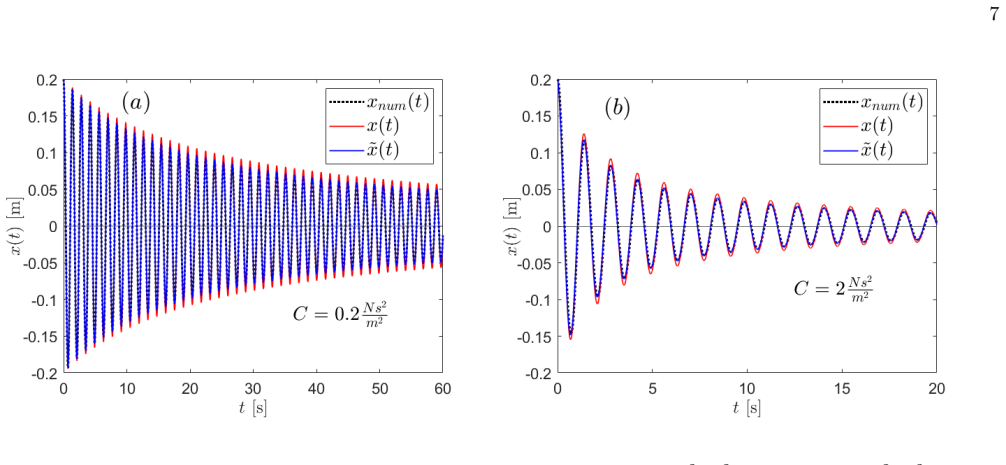
The central claim is that the 'simple trick' previously used for viscous damping can be adapted to sliding friction and air resistance by writing the two weakly damped solutions as $x_0 f(t)\cos(\omega_0 t)$ and $x_0 f(t)\sin(\omega_0 t)$ with a common envelope. Equating the time derivative of the shared energy $E = m\omega_0^2 x_0^2 f^2/2$ to the instantaneous damping power for each initial condition gives two equations for $df/dt$ containing $|\sin(\omega_0 t)|$ and $|\cos(\omega_0 t)|$ (or their cubes). The paper squares these equations for sliding friction and raises them to the $2/3$ power for air resistance, then adds them; the identity $|\sin|^2 + |\cos|^2 = 1$ removes the oscillatory factors and leaves a single first-order ODE whose solutions are the two envelopes above. The paper's comparisons show the air-resistance envelope agrees well with the period-averaged and numerical solutions, while the sliding-friction envelope is adequate but stops somewhat earlier than the exact piecewise solution.
Load-bearing premise
The load-bearing premise is that the two motions share a single envelope $f(t)$ and that adding the squared (or appropriately powered) dissipation rates gives the true average decay rate; this averaging step is not derived from the dynamics and must be checked case by case.
Editorial extensions
If this is right
- First-year students can derive the sliding-friction and air-resistance envelopes without solving equations of motion or performing period averages.
- For sliding friction the derivation yields a simple stopping-time estimate $\tau = \sqrt{2}\omega_0 x_0/(\mu g)$ and a weak-damping condition $\mu \ll \sqrt{2}\, k x_0/(mg)$.
- For air resistance it yields a reciprocal-in-time envelope and a weak-damping condition $C \ll 2^{3/2}m/x_0$.
- Because the air-resistance derivation needs only one integral, it offers a shorter path to the known result than the period-averaging treatment.
- The paper shows the trick works for equal-energy, $\pi/2$-shifted initial conditions for $n=0$ and $n=2$ damping, while for viscous damping the energy amplitudes need not be equal.
Reading between the lines
- A natural extension not explored in the paper is to damping forces proportional to $|v|^n$: the same construction would use the exponent $2/(n+1)$ to make $|\sin(\omega_0 t)|^{n+1}$ and $|\cos(\omega_0 t)|^{n+1}$ combine through the identity $|\sin|^2+|\cos|^2=1$, and one could test numerically whether the resulting envelope remains accurate for fractional $n$.
- Because the weak-damping conditions for sliding friction and air resistance depend on the initial displacement $x_0$, the method implies that initial energy sets the validity regime; measuring the same system at several starting amplitudes could separate the damping law's nonlinearity from ordinary viscous behavior.
- One can test whether the agreement with numerics persists as $C$ or $\mu$ grows toward the weak-damping bound, since the paper only checks one or two parameter values for each damping law.
Editorial analysis
A structured set of objections, weighed in public.
Referee Report
Summary. This addendum extends a previously published 'simple trick' for deriving the amplitude decay of a weakly damped harmonic oscillator from energy dissipation rates. For sliding friction and quadratic air resistance, the authors posit two approximate solutions sharing a common envelope f(t), write the energy balance dE/dt = F_d v for each of two initial-condition pairs, and then combine the two resulting equations by squaring (friction) or raising to the 2/3 power (air resistance) and adding, exploiting sin^2 + cos^2 = 1. This yields a linear decay f(t) = 1 - μg t/(√2 ω0 x0) for sliding friction and f(t) = [1 + Cω0 x0 t/(2^{3/2} m)]^{-1} for air resistance. The results are compared with the period-averaged method of Wang et al. and with exact/numerical solutions, showing reasonable agreement in the weak-damping regime.
Significance. The paper addresses a genuine pedagogical gap: amplitude decay for non-viscous damping is usually omitted from introductory textbooks. The final formulas are correct approximations, and the comparisons with exact and numerical solutions are a strength, as are the explicit weak-damping conditions (24) and (37). However, the novelty is modest, since the same final expressions are obtained by standard cycle-averaging; the contribution is the claim that the 'trick' avoids time averaging and is suitable for first-year students. The central derivation step is logically problematic, as detailed below, so the significance currently rests on a heuristic that is presented as a derivation.
major comments (2)
- [§III, Eqs. (17)-(18) and §IV, Eqs. (29)-(30)] For a single envelope f(t), Eqs. (17) and (18) cannot both hold except at instants where |sin ω0t| = |cos ω0t|. The step of squaring and adding them (Eqs. (19)-(21)) is therefore not a logical consequence of the energy balance; it is an algebraic averaging prescription. The same issue occurs in Section IV, where Eqs. (29) and (30) are mutually inconsistent unless |sin ω0t|^3 = |cos ω0t|^3, and the 2/3 power is chosen only to make the trigonometric terms add to unity. The paper should explicitly acknowledge this inconsistency and present the squaring-and-adding step as a heuristic that effectively averages over phase, rather than as a derivation. The advertised advantage 'no need for time averaging' is misleading: the operation is an implicit RMS-type average. The authors should also note that the resulting coefficients 1/√2 and 2^(-3/2) differ from the period-averaged values 2/π and 4/(3π) by about 11% and 20%, respectively, so the agreement with known results is not exact.
- [Abstract and §VII] The abstract and conclusion state that the approach 'derives' the amplitude decay and avoids time averaging. Because of the inconsistency in Eqs. (17)-(18) and (29)-(30), the derivation is not logically forced; it is a plausible extension of the trick in [1] that happens to yield useful approximations. The authors should either prove that the combined equation is a valid approximation in some quantified sense or clearly label it as an approximate construction validated by comparison with exact/numerical solutions. This is load-bearing, because the paper's central claim is the availability of a low-math derivation, not just the final formulas.
minor comments (4)
- [§VII, Eqs. (45)-(46)] The notation sin^{n+1}(ω0t + φ0) should be |sin|^{n+1} (or the absolute value should be explicitly indicated), since the power of the damping force is -C|v|^{n+1}.
- [§V, Fig. 1] The caption says 'See text for details' but the text does not explicitly identify which curve corresponds to which solution; adding labels or a legend to the figure would improve clarity.
- [§V, text near Eq. (40)] The phrase 'at displacement +0.02x0' is ambiguous; it should read 'at displacement 0.02 x0' or 'at +0.02x0 relative to the equilibrium position'.
- [References] Reference [4] lists the author as 'Anastasios Adamopoulosa'; the final 'a' appears to be a typo and should be 'Adamopoulos'.
Circularity Check
Self-contained and externally benchmarked; the square-and-add 'trick' is an implicit averaging of two mutually inconsistent envelope equations, so the 'no time averaging' claim is overstated, but there is no parameter fit or load-bearing self-citation chain.
-
other
[Section III, Eqs. (17)-(22) (sliding friction); Section IV, Eqs. (29)-(34) (air resistance); 'no time averaging' claims in Introduction, Section VI, and Conclusion.]
"By adding (19) and (20) we get (df/dt)^2 = 1/2 (µg/(ω0x0))^2, since identity |sin(ω0t)|^2 + |cos(ω0t)|^2 = 1 is valid... We raise the relations (29) and (30) to the power of 2/3... We add (31) and (32) and get (−df/dt)^(2/3) = 1/2 (Cω0x0/m)^(2/3) f^(4/3)(t)... In this approach, there is no need for the time averaging used in [2, 3]."
For a single envelope f(t), Eq. (17) gives df/dt = −(µg/(ω0x0))|sin ω0t| and Eq. (18) gives df/dt = −(µg/(ω0x0))|cos ω0t|; these are incompatible wherever |sin|≠|cos|, and the air-resistance pair Eqs. (29)-(30) requires |sin|^3=|cos|^3. Squaring and adding two mutually contradictory equations is not a consequence of the dynamics: the exponent 2 (respectively 2/3) is chosen so that sin^2+cos^2=1 cancels the time dependence, so the output coefficients 1/√2 and 2^(−3/2) are fixed by algebraic construction (a hidden RMS-style average), not by the physics.
full rationale
This addendum extends the energy-dissipation 'trick' of the authors' prior paper [1] to Coulomb (n=0) and quadratic (n=2) damping. The load-bearing derivation is fully restated in this paper (Eqs. 7-34): two equal-energy initial conditions are assumed to share one envelope f(t), the energy balance dE/dt = P_d gives two first-order equations for df/dt, and the combination is performed via sin^2+cos^2=1 (exponent 2 for friction, 2/3 for air resistance). No parameter is fitted to data, and no unverified result is imported: the citation of [1] supplies the strategy, not the n=0/n=2 results, and the paper openly states in the Introduction that [1] had found the trick not to work for these damping types. The final formulas are benchmarked against the exact Coulomb solution (Eq. 40) and against numerical ode45 solutions (Fig. 2), so the central claim has independent content. The reviewer's legitimate concern is mathematical validity rather than circularity: Eqs. (17) and (18) assign two different values to df/dt of the same f and are inconsistent except at instants where |sin|=|cos| (similarly Eqs. (29)-(30) require |sin|^3=|cos|^3). Squaring (or raising to 2/3) and adding imposes an RMS-style average whose coefficient (1/√2, 2^(−3/2)) is fixed by the trigonometric identity rather than by the dynamics, and which differs from the cycle-averaged coefficients (2/π, 4/(3π)) by 11-20%. Thus the claim 'there is no need for the time averaging' is overstated, but the step is a heuristic averaging and a transparency issue, not a self-referential derivation: the final answer is not presupposed in the inputs. The paper also discloses in Section VII that for n≠1 the approach works only for equal-energy, phase-shifted initial-condition pairs. Overall circularity is minimal: one construction-based averaging step with external benchmarks, and a non-load-bearing self-citation, giving a score of 2.
Assumptions & free parameters
assumptions (4)
- ad hoc to paper The damped solutions for both pairs of initial conditions are x1=x0 f(t) cos(ω0t) and x2=x0 f(t) sin(ω0t) with one common envelope f(t).
- standard math The energy dissipation rate equals the power of the damping force: dE/dt = F_d v.
- domain assumption Weak damping justifies neglecting \dot f compared to ω0 f in the velocities, giving v1=-ω0 x0 f sin and v2=ω0 x0 f cos.
- ad hoc to paper The squared and added equations (19)+(20) and (31)+(32) determine a single ODE for the common envelope.
Cite this review
Pith. "Pith review of Addendum: Modeling the amplitude and energy decay of a weakly damped harmonic oscillator using the energy dissipation rate and a simple trick (2025 Eur. J. Phys. 46(1) 015004)." pith.science (2026). https://pith.science/paper/M5W2ICTK
@misc{pith2026241115588,
  author       = {Pith},
  title        = {Pith review of: Addendum: Modeling the amplitude and energy decay of a weakly damped harmonic oscillator using the energy dissipation rate and a simple trick (2025 Eur. J. Phys. 46(1) 015004)},
  year         = {2026},
  howpublished = {\url{https://pith.science/paper/M5W2ICTK}},
  note         = {Machine review of arXiv:2411.15588}
}
read the original abstract
We show how to adapt the approach introduced for viscous damping in [1] to derive the approximate amplitude decay in the case of damping by a force of constant magnitude (sliding friction) and in the case of damping by a force proportional to the square of velocity (air resistance). We obtain two first-order differential equations from which we obtain the approximate time-dependent amplitudes corresponding to the considered damping forces. Our approach is suitable for first-year undergraduates, as it relies on the physical concepts and mathematical techniques they are familiar with.
Figures

Reference graph
Works this paper leans on
-
[1]
Lelas and R
K. Lelas and R. Pezer. Modeling the amplitude and energy decay of a weakly damped harmonic oscillator using the energy dissipation rate and a simple trick. European Journal of Physics , 46(1):015004, dec 2024
2024
-
[2]
X. Wang, C. Schmitt, and M. Payne. Oscillations with three damping effects. European Journal of Physics, 23(2):155–164, jan 2002
2002
-
[3]
An elementary proof of the amplitude’s exponential decrease in damped oscillations
Stylianos-Vasileios Kontomaris and Anna Malamou. An elementary proof of the amplitude’s exponential decrease in damped oscillations. Physics Education, 59(2):025030, feb 2024
work page 2024
-
[4]
Anastasios Adamopoulosa and N
A. Anastasios Adamopoulosa and N. Adamopoulos. Constant and quadratic damping of free oscillations: easy solutions. International Journal of Mathematical Education in Science and Technology , 53(11):3151–3161, jan 2022
2022
-
[5]
I. R. Lapidus. Motion of a harmonic oscillator with sliding friction. American Journal of Physics , 38(11):1360–1361, nov 1970
work page 1970
-
[6]
Marchewka, David
A. Marchewka, David. S. Abbott, and R. J. BeichnerKamela. Oscillator damped by a constant-magnitude friction force. American Journal of Physics , 72(4):477–483, apr 2004
2004
-
[7]
Young and Roger A
Hugh D. Young and Roger A. Freedman. University Physics with Modern Physics . Pearson, 2020
2020
-
[8]
Fundamentals of Physics
David Halliday, Robert Resnick, and Jearl Walker. Fundamentals of Physics . John Wiley & Sons, 2013
2013
Show all 14 references
-
[9]
M. Kamela. An oscillating system with sliding friction. The Physics Teacher, 45(2):110–113, feb 2007
2007
-
[10]
J. A. Rizcallah. Revisiting the coulomb-damped harmonic oscillator. European Journal of Physics , 40(5), aug 2019
2019
-
[11]
Damped harmonic oscillator revisited: The fastest route to equilibrium
Karlo Lelas, Nikola Poljak, and Dario Juki´ c. Damped harmonic oscillator revisited: The fastest route to equilibrium. American Journal of Physics , 91(10):767–775, 10 2023
2023
-
[12]
Lelas and I
K. Lelas and I. Naki´ c. Optimal damping of vibrating systems: Dependence on initial conditions. Journal of Sound and Vibration, 576:118303, 2024
2024
-
[13]
Cutnell and K.W
J.D. Cutnell and K.W. Johnson. Physics. John Wiley & Sons, 2009
2009
-
[14]
Crawford
Frank S. Crawford. Waves: Berkeley Physics Course. volume 3 . McGraw-Hill, New York, 1968
1968
Reviewed August 12, 2026 · model on record in the stance chip above.
Discussion (0). Continue with ORCID to comment.