REVIEW 3 major objections 4 minor 30 references
The generalized Darboux matrices with the same poles and their applications
T0 review · 3 major / 4 minor · reviewed 2026-08-12 · deepseek-v4-flash
Pith's one-line read Solving one linear system builds every n-fold Darboux matrix for 2x2 Lax pairs.
desk verdict Solid constructive Darboux-matrix paper with explicit new formulas, but the converse half of the central theorem has an omitted subcase that needs completing before the unification claim is fully backed. read the letter →
The pith
A machine-rendered reading of the paper's core claim, the machinery that carries it, and where it could break.
The reading
What carries the argument
The load-bearing mechanism is the interpolation condition (132), which converts the transformation problem into linear algebra in the coefficients $D_i(x,t)$. For the same-pole case the paper's first-order building block is $S=H\Lambda H^{-1}$ with $H=(b_0,b_0^{(1)})$ and $\Lambda=\begin{pmatrix}\lambda_0&1\\0&\lambda_0\end{pmatrix}$, so its Jordan canonical form is a single block; when $n$ copies are folded, the product is rewritten in pole form (8)-(9) with coefficients assembled by the $\Gamma$ matrix (62). The $\Gamma$ matrix is what connects the chosen solutions $b(\lambda)$ of the Lax pair and $a(\lambda)$ of the adjoint Lax pair to the residues of $D(\lambda)$ and $D^{-1}(\lambda)$. Theorem 7 uses these ingredients to build an order-$s$ monic Darboux matrix by solving (132), and Theorem 8 closes the loop by showing that any decomposable monic Darboux matrix satisfies such conditions at the spectral values appearing in its factors.
What would settle it
Take any $2\times2$ Lax pair and a monic Darboux matrix known to factor as a product of first-order monic Darboux matrices; if at some real $(x,t)$ the coefficient matrix of the linear system (132) built from its factors has determinant zero while the product Darboux matrix is well defined, then Theorem 7's 'can be constructed by solving (132)' claim fails. A direct place to look is the focusing NLS example, where the paper shows $H_1$ in (126) has zeros that the iterated construction cancels, so one can test whether the coefficient matrix in (132) also degenerates exactly at those points.
Extended reading notes
Core claim
The central claim is a characterization theorem. A monic polynomial $D(x,t;\lambda)=\lambda^s I+\lambda^{s-1}D_1+\cdots+D_s$ is a Darboux matrix if, for prescribed $\lambda_j$ and multiplicities $m_j$ with $2s=\sum_j m_j$, it satisfies the linear conditions $\partial^{k_j}/\partial\lambda^{k_j}(D(\lambda)b_j(\lambda))|_{\lambda=\lambda_j}=0$ for $k_j=0,\ldots,m_j-1$ (Theorem 7), and conversely any Darboux matrix that is a product of $n$ first-order monic Darboux matrices arises this way up to a scalar factor (Theorem 8). The proof shows that the classic first-order Darboux matrix, the same-pole first-order Darboux matrix, and their iterations all satisfy such interpolation conditions, so the unified theorem holds in this 'formal' regime, with invertibility of the linear system's coefficient matrix assumed. The same-pole specialization is made explicit in Theorem 5: $D(\lambda)=(\lambda-\lambda_0)^n(I-(b_0\ b_0^{(1)}\ \cdots\ b_0^{(n-1)})\Gamma^{-1}(a(\lambda_0)/(\lambda-\lambda_0),\ldots,\partial^{n-1}/\partial\lambda_0^{n-1}(a(\lambda_0)/(\lambda-\lambda_0)))^T)$, with $\Gamma$ given by a combinatorial sum of products of derivatives of $a$ and $b$. This formula is the paper's new tool for writing Darboux matrices of arbitrary pole order and their inverses in closed form.
Load-bearing premise
The construction assumes the coefficient matrix of the linear system (132) is invertible, and with it the $\Gamma$ matrix in (62); the paper labels this a formal assumption and notes in Remark 4 that the equivalence of the alternative invertibility conditions is not proved.
Editorial extensions
If this is right
- To build an $n$-fold Darboux matrix, one solves the linear system (132) once; no repeated limit in $\lambda$ is needed, and the result automatically transforms the Lax pair into another Lax pair with polynomial coefficients.
- For the focusing NLS equation, the same-pole construction reproduces the known first- and second-order rogue waves, and the pole-distribution theorem says these are equivalent to the standard generalized Darboux transformation with a different pole splitting.
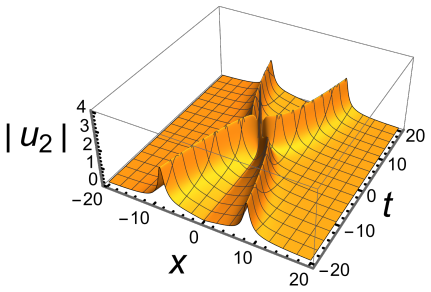
- For the $x$-nonlocal focusing NLS equation, the formulas produce global multiple-pole soliton solutions with spectral parameter $\lambda=0$; single-pole solitons are stationary, while multi-pole branches move with velocity of order $O(1/\sqrt{t})$.
- For the good Kaup-Boussinesq equation, the unified theorem yields explicit multi-soliton, multi-pole, and rational solutions, including rational solutions that are singular at a point, and it also exhibits irreducible polynomial Darboux matrices that cannot be factored into first-order monic Darboux matrices.
Reading between the lines
- The derivative-with-respect-to-$\lambda$ device is likely a general principle: any construction that classically needs a limiting process at a degenerate spectral point can be replaced by Taylor coefficients of the eigenfunction, which may extend these formulas to Lax pairs of rank higher than 2.
- The invertibility assumption in Theorem 7 is probably the same obstruction that makes the $\Gamma$-matrix and the interpolation matrix fail simultaneously; a systematic classification of singular cases could yield a minimal-degree regularized construction, in the spirit of the paper's focusing NLS example where a singular intermediate factor cancels.
- The pole-distribution invariance means Darboux transformations form equivalence classes under redistributing pole order between $D(\lambda)$ and $D^{-1}(\lambda)$; if this holds beyond $2\times2$ systems, it would let soliton and rogue-wave solutions be transferred between different dressing conventions without changing the solution.
Editorial analysis
A structured set of objections, weighed in public.
Referee Report
Summary. The paper develops an algebraic construction of Darboux matrices for 2x2 Lax pairs whose coefficient matrices are polynomials in the spectral parameter. It treats first-order monic Darboux matrices with a single pole, gives an explicit n-th order pole formula using solutions of the Lax pair and its adjoint, states an invariance theorem for pole distributions, and proposes a unified construction (Theorem 7) by which any monic Darboux matrix that is a product of first-order monic Darboux matrices can be obtained by solving the linear system (132)/(145). The theoretical results are illustrated on the x-nonlocal focusing NLS equation, the focusing NLS equation, and the Kaup-Boussinesq equation, with explicit multi-pole soliton and rational solutions. The central claim is that the linear equations determine all decomposable Darboux matrices, up to scalar factors.
Significance. If the main theorems are fully correct, the paper offers a useful unification of classic and generalized Darboux transformations, together with explicit pole-form formulas that are not available in this form elsewhere. The classification of first-order monic Darboux matrices, the explicit inverse formula in Proposition 2, the pole-distribution invariance theorem, and the large collection of explicit solutions are all concrete contributions. I also credit the paper for being explicit about its limitations: Remark 4 and the opening of Section 5 state that the relevant invertibility conditions are assumed formally and that their equivalence is not proven, and the examples include cases where a matrix H1 becomes singular. The main reserve is that the converse half of the central claim, Theorem 8, contains an omitted subcase, and the construction therefore remains conditional on a nondegeneracy assumption that is not established.
major comments (3)
- [Section 5, Theorem 8 (Subcase 2.3)] The induction proof of the converse half omits Subcase 2.3, where both eigenvalues µ1 and µ2 of the final first-order factor already lie in the set {λ1,...,λp} used by the lower-order factor. The text says only that the proof is similar to Subcase 2.2 and omits it. This omission is load-bearing: the case requires increasing both multiplicities m1 and m2 at once, so the redefinition of the seed vector in (166) cannot be performed for one pole without simultaneously controlling the condition at the other pole. The simultaneous adjustment of the two seed vectors, and the invertibility of the enlarged linear system (145) after both multiplicities are increased, need to be proved. Until this subcase is completed, Theorem 8 does not establish that every decomposable monic Darboux matrix can be constructed from (132)/(145).
- [Section 5, opening paragraph and Eq. (132); Remark 4] The paper explicitly labels as formal the assumption that the coefficient matrix of the linear equations (132) is invertible, and Remark 4 concedes that the equivalence of this condition with invertibility of the Γ matrix and of the matrices H[k] is not proven. This assumption is used in Theorem 8 through the uniqueness of solutions of (145); without it, the constructed G may differ from the target Darboux matrix even when the induction subcases are completed. The manuscript should either prove the relevant invertibility under the theorem hypotheses or state Theorems 7 and 8 as conditional on this genericity assumption. The focusing NLS example in Section 4, where H1 becomes singular yet the iterated DT yields a global solution, shows that the invertibility failure is not merely hypothetical.
- [Section 3, Theorem 5 proof, step (2)] The central identity for the vanishing of the derivatives (D(λ)b(λ))_0^{(s)} at λ=λ0 for s=0,...,n−1 is stated as "the second equality comes from" an unproved combinatorial sum involving arrangement numbers; no derivation or reference is supplied. Since this identity is exactly what verifies the defining condition (59), the proof of Theorem 5 should include the combinatorial calculation or an explicit reference. The identity may be correct, but as written the proof is incomplete at a load-bearing point.
minor comments (4)
- [Throughout] There are several typos and infelicities: "multiple-ploe" in the introduction, "loos of generality" in Proposition 1, "dose not change" in Remark 3, and a duplicated phrase in the quadruple-pole sentence of Section 4. Please proofread carefully.
- [Section 4, after Eq. (116)] The text refers to "Table 2(a)" and "Table 2(b)" when the quoted tables are numbered Table 3 and Table 4. Fix the cross-references.
- [Lemma 3 and Section 4] The phrase "conjugate transport" is used for what appears to be the conjugate transpose operation (∗). Please standardize the terminology with a definition at first use.
- [Notation, Eqs. (69), (129)] The notation D[λ0, n, b(λ)] introduced in (69) is later used in different forms such as D[1][λ0, 2, h1(x,t;λ)] in (129). The meaning of the bracketed arguments and the order of the superscripts should be explained consistently.
Circularity Check
No significant circularity: the Darboux-matrix construction is derived from explicit Lax-pair data; the omitted subcase is a proof gap, not a circular step.
full rationale
This paper does not derive its target by fitting or by self-referential definition. The generalized Darboux matrices are constructed explicitly from Lax-pair eigenfunctions and adjoint eigenfunctions (Theorems 1, 3, and 5), and the 'same pole' first-order case is classified by direct coefficient comparison in the defining polynomiality conditions (Theorem 4). The unified Theorem 7 is a linear-algebra construction: equations (132) form a system of 2s linear equations for the s coefficient matrices of a monic degree-s polynomial, and the proof exhibits a solution as a product of previously constructed first-order Darboux matrices; Corollary 2 then reads off the factorization. The converse Theorem 8 proceeds by induction using the classification and the induction hypothesis; no step is shown to be equivalent to the conclusion by construction. The explicitly omitted 'Subcase 2.3' and the explicit 'formal' invertibility assumption in Section 5 are genuine proof gaps or regularity conditions rather than circular reductions. Cited external results such as [GHZ04], [Cie09], and [GLL12] are background or comparison material; the only self-citation ([GSW22]) concerns stability of Kaup-Boussinesq solutions and is not load-bearing for the Darboux construction. Therefore no circular step is present.
Assumptions & free parameters
free parameters (2)
- ξ^{(j)}_0 (coefficients in ξ(λ)) =
Specified in examples, e.g., (1,-i), (0,-1), (1,0), (0,0), (-3,0), (0,0), (45,0), (0,0), (-1575,0), (0,0) for n≤5 in…
- Seed solutions u0, w0 and spectral parameter λ0 in examples =
u0=0, λ0=0 for x-nonlocal NLS; u0=(1/2)e^{-it/2} for focusing NLS; u0=c, w0=d for Kaup-Boussinesq
assumptions (4)
- standard math Liouville's theorem and the fundamental theorem of algebra are used to show that holomorphic functions with certain growth or zero counts vanish.
- domain assumption The Lax pair (1) admits a fundamental solution matrix Φ(x,t;λ) that is analytic at the used spectral points λ0, and the adjoint Lax pair has corresponding row solutions a(x,t;λ).
- domain assumption The derivative conditions (60), namely ∂^s(a(λ)b(λ))=0 at λ0 for s=0,...,n-1, can be satisfied for the chosen seed and auxiliary solutions.
- ad hoc to paper The Γ matrix in (62) and the coefficient matrix of the linear system (132) are invertible for the problems considered.
Cite this review
Pith. "Pith review of The generalized Darboux matrices with the same poles and their applications." pith.science (2026). https://pith.science/paper/2B32TCXI
@misc{pith2026241115599,
  author       = {Pith},
  title        = {Pith review of: The generalized Darboux matrices with the same poles and their applications},
  year         = {2026},
  howpublished = {\url{https://pith.science/paper/2B32TCXI}},
  note         = {Machine review of arXiv:2411.15599}
}
abstract
Darboux transformation plays a key role in constructing explicit closed-form solutions of completely integrable systems. This paper provides an algebraic construction of generalized Darboux matrices with the same poles for the $2\times2$ Lax pair, in which the coefficient matrices are polynomials of spectral parameter. The first-order monic Darboux matrix is constructed explicitly and its classification theorem is presented. Then by using the solutions of the corresponding adjoint Lax pair, the $n$-order monic Darboux matrix and its inverse, both sharing the same unique pole, are derived explicitly. Further, a theorem is proposed to describe the invariance of Darboux matrix regarding pole distributions in Darboux matrix and its inverse. Finally, a unified theorem is offered to construct formal Darboux transformation in general form. All Darboux matrices expressible as the product of $n$ first-order monic Darboux matrices can be constructed in this way. The nonlocal focusing NLS equation, the focusing NLS equation and the Kaup-Boussinesq equation are taken as examples to illustrate the application of these Darboux transformations.
Figures


Figures from the paper (9 more)


Reference graph
Works this paper leans on
-
[1]
The inverse scattering transform-Fourier analysis for nonlinear problems Stud
Ablowitz MJ, Kaup DJ, Newell AC and Segur H. The inverse scattering transform-Fourier analysis for nonlinear problems Stud. Appl. Math. 1974; 53: 249-315
work page 1974
-
[2]
Integrable nonlocal nonlinear Schr \"o dinger equation
Ablowitz MJ and Musslimani ZH. Integrable nonlocal nonlinear Schr \"o dinger equation. Phys. Rev. Lett. 2013; 110: 064105
work page 2013
-
[3]
A binary Darboux transformation for the Toda lattice
Babich VM, Matveev VB and Sail' MA. A binary Darboux transformation for the Toda lattice. J. Soviet Math. 1986; 35: 2582-2589
work page 1986
-
[4]
Periodic travelling waves of the modified KdV equation and rogue waves on the periodic background
Chen J, Pelinovsky DE. Periodic travelling waves of the modified KdV equation and rogue waves on the periodic background. J. Nonlinear Sci. 2019;29: 2797-2843
work page 2019
-
[5]
Algebraic construction of the Darboux matrix revisited
Cie \'s li \'n ski JL. Algebraic construction of the Darboux matrix revisited. J. Phys. A: Math. Theor. 2009;42: 404003
work page 2009
-
[6]
Multicomponent integrable wave equations I
Degasperis A and Lombardo S. Multicomponent integrable wave equations I. Darboux-dressing transformation. J. Phys. A: Math. Theor. 2007; 40: 961
work page 2007
-
[7]
Noncommutative bispectral Darboux transformations
Geiger J, Horozov E and Yakimov M. Noncommutative bispectral Darboux transformations. Trans. Amer. Math. Soc. 2017; 369: 5889-5919
work page 2017
-
[8]
Darboux transformations in integrable systems: theory and their applications to geometry
Gu CH, Hu HS and Zhou ZX. Darboux transformations in integrable systems: theory and their applications to geometry. Springer, 2004
work page 2004
Show all 30 references
-
[9]
Nonlinear Schr \"o dinger equation: generalized Darboux transformation and rogue wave solutions
Guo BL, Ling LM and Liu QP. Nonlinear Schr \"o dinger equation: generalized Darboux transformation and rogue wave solutions. Phys. Rev. E 2012; 85: 026607
2012
-
[10]
Linear stability of exact solutions for the generalized Kaup-Boussinesq equation and their dynamical evolutions
Gong RZ, Shi YR and Wang DS. Linear stability of exact solutions for the generalized Kaup-Boussinesq equation and their dynamical evolutions. Discrete Contin. Dyn. Syst. 2022; 42: 3355-3378
2022
-
[11]
Determinant representation of n -times Darboux transformation for the defocusing nonlinear Schr \"o dinger equation
Han JW, Yu J and He JS. Determinant representation of n -times Darboux transformation for the defocusing nonlinear Schr \"o dinger equation. Mod. Phys. Lett. B 2013; 27: 1350216
2013
-
[12]
Two-component integrable systems modelling shallow water waves: the constant vorticity case
Ivanov R. Two-component integrable systems modelling shallow water waves: the constant vorticity case. Wave Motion 2009; 46: 389-396
2009
-
[13]
Polynomial and rational matrices: applications in dynamical systems theory , Springer, 2007
Kaczorek T. Polynomial and rational matrices: applications in dynamical systems theory , Springer, 2007
2007
-
[14]
An exact solution for a derivative nonlinear Schr \"o dinger equation
Kaup DJ and Newell AC. An exact solution for a derivative nonlinear Schr \"o dinger equation. J. Math. Phys. 1978; 19: 798-801
1978
-
[15]
The Darboux transformation of the Schr \"o dinger equation with an energy-dependent potential
Lin J, Li YS and Qian XM. The Darboux transformation of the Schr \"o dinger equation with an energy-dependent potential. Phys. Lett. A. 2007; 362: 212-214
2007
-
[16]
Binary Darboux transformation for general matrix mKdV equations and reduced counterparts
Ma WX. Binary Darboux transformation for general matrix mKdV equations and reduced counterparts. Chaos, Solitons & Fractals 2021; 146: 110824
2021
-
[17]
The theory of matrices , Springer, 1933
Mac Duffee CC. The theory of matrices , Springer, 1933
1933
-
[18]
Darboux transformations and solitons , Springer, 1991
Matveev VB and Salle MA. Darboux transformations and solitons , Springer, 1991
1991
-
[19]
Solitons on the rarefaction wave background via the Darboux transformation
Mucalica A and Pelinovsky DE. Solitons on the rarefaction wave background via the Darboux transformation. Proc. R. Soc. A 2022; 478: 20220474
2022
-
[20]
A vectorial binary Darboux transformation for the first member of the negative part of the AKNS hierarchy
M \"u ller-Hoissen F. A vectorial binary Darboux transformation for the first member of the negative part of the AKNS hierarchy. J. Phys. A: Math. Theor. 2023;56: 125701
2023
-
[21]
Darboux transformation and explicit solutions for two integrable equations J
Qiao ZJ. Darboux transformation and explicit solutions for two integrable equations J. Math. Analy. Appl. 2011; 380: 794-806
2011
-
[22]
Darboux transformations for effective mass Schr \"o dinger equations with energy-dependent potentials
Schulze-Halberg A. Darboux transformations for effective mass Schr \"o dinger equations with energy-dependent potentials. Int. J. Mod. Phys. A. 2008; 23: 537-546
2008
-
[23]
Darboux and binary Darboux transformations for discrete integrable systems I
Shi Y, Nimmo JJC and Zhang DJ. Darboux and binary Darboux transformations for discrete integrable systems I. Discrete potential KdV equation J. Phys. A: Math. Theor. 2014; 47: 025205
2014
-
[24]
Darboux and binary Darboux transformations for discrete integrable systems
Shi Y, Nimmo JJC and Zhao JX. Darboux and binary Darboux transformations for discrete integrable systems. II. Discrete potential mKdV equation. SIGMA Symmetry Integrability Geom. Methods Appl. 2017;13: 036
2017
-
[25]
Darboux transformation and multi-soliton solutions of the Camassa-Holm equation and modified Camassa-Holm equation
Xia B, Zhou R and Qiao Z. Darboux transformation and multi-soliton solutions of the Camassa-Holm equation and modified Camassa-Holm equation. J. Math. Phys. 2016; 57: 103502
2016
-
[26]
Binary Darboux transformation and new soliton solutions of the focusing nonlocal nonlinear Schr \"o dinger equation
Xu CX, Xu T, Meng DX, Zhang TL, An LC and Han LJ. Binary Darboux transformation and new soliton solutions of the focusing nonlocal nonlinear Schr \"o dinger equation. J. Math. Anal. Appl. 2022; 516: 126514
2022
-
[27]
The Darboux transformation of the derivative nonlinear Schr \"o dinger equation
Xu SW, He JS and Wang LH. The Darboux transformation of the derivative nonlinear Schr \"o dinger equation. J. Phys. A: Math. Theor. 2011; 44: 305203
2011
-
[28]
Rogue waves in the nonlocal PT-symmetric nonlinear Schr \"o dinger equation
Yang B and Yang JK. Rogue waves in the nonlocal PT-symmetric nonlinear Schr \"o dinger equation. Lett. Math. Phys. 2019; 109: 945-973
2019
-
[29]
Darboux transformations of lower degree for two-dimensional C^ (1) _l and D^ (2) _ l+1 Toda equations
Zhou ZX. Darboux transformations of lower degree for two-dimensional C^ (1) _l and D^ (2) _ l+1 Toda equations. Inverse Problems 2008; 24: 045016
2008
-
[30]
On the integrability of classical spinor models in two-dimensional space-time
Zakharov VE and Mikhailov AV. On the integrability of classical spinor models in two-dimensional space-time. Commun. Math. Phys. 1980; 74: 21-40
1980
Reviewed August 12, 2026 · model on record in the stance chip above.
Discussion (0). Continue with ORCID to comment.