REVIEW 3 major objections 5 minor 2 cited by
Faulty towers: recovering a functioning quantum random access memory in the presence of defective routers
T0 review · 3 major / 5 minor · reviewed 2026-08-12 · deepseek-v4-flash
Pith's one-line read A defective QRAM can be repaired by rerouting around its broken routers, yielding a working memory of half size with only a handful of extra qubits.
desk verdict A genuinely useful repair scheme for faulty interior QRAM routers, with honest accounting of the assumptions; the headline resource numbers hold up under conditional acceptance. read the letter →
The pith
A machine-rendered reading of the paper's core claim, the machinery that carries it, and where it could break.
The reading
What carries the argument
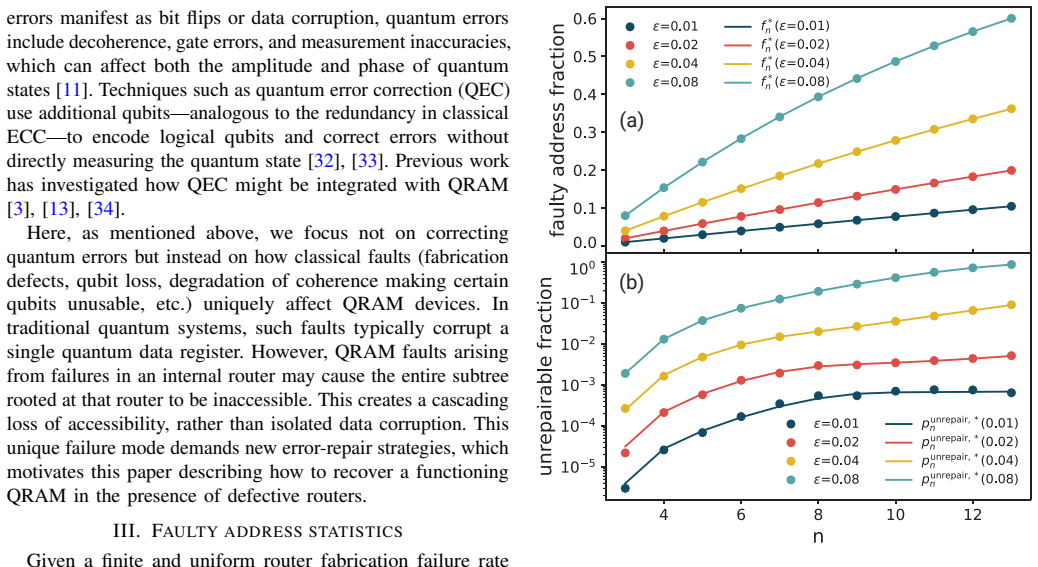
The load-bearing objects are the router-based bucket-brigade QRAM tree and the faulty-router table obtained by local quantum process tomography, which immediately implies the faulty-address table. On top of these sit three algorithmic devices: one-way-street relabelling; layer-by-layer self-repair in which the already-repaired upper QRAM routes flag qubits to detect and redirect queries aimed at faulty routers; and a generating-set construction in which each flag qubit applies one address bit-flip pattern and combinations of patterns cover all assignments, drastically reducing the ancilla count. The statistical treatment uses a Galton-Watson branching-process recursion giving the expected faulty-address count $F_n(\epsilon)=2^n(1-(1-\epsilon)^n)$ and an exact recursion for the probability that an instance is repairable.
What would settle it
Randomly generate depth-13 trees with 1% per-router failure conditioned on the top three routers being good and on at least $2^{12}$ reachable leaves, run IterativeRepair, and count flag qubits per layer; the central claim is false if a nontrivial fraction of such repairable instances fail to yield a 12-bit QRAM, or if the maximum per-layer flag-qubit count systematically exceeds $n-3$.
Extended reading notes
Core claim
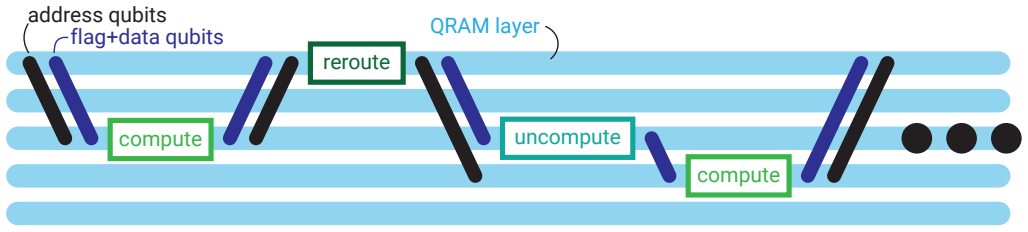
The paper's central claim is that a repairable faulty QRAM—one with at least $2^{n-1}$ accessible leaves and healthy routers at the top two levels—can be turned into a functioning $(n-1)$-bit QRAM. It establishes this constructively with two algorithms. RelabelRepair treats some routers as one-way streets and relabels surviving addresses as the addresses of a reduced QRAM; when that fails, IterativeRepair grows the working QRAM one layer at a time: at each layer it classically assigns each faulty router on the repairable side to an available router on the spare side, then uses the already-working smaller QRAM to activate ancilla flag qubits that encode the required rerouting, unloads the address qubits, applies the corresponding CNOTs, and reloads them one layer deeper before uncomputing. The flag qubits are reused across layers. A greedy classical algorithm, FlagQubitMinimization, chooses which address bit-flip pattern each flag qubit encodes so that the fewest generating patterns cover all needed reroutings; simulation shows about 1.5 flag qubits suffice on average for the depth-13, 1%-defect case, versus 13 for the naive mask technique.
Load-bearing premise
The whole procedure starts only if the top three routers (a functioning 2-bit QRAM) are defect-free and at least half the addresses remain reachable; if a router among the top levels is dead, the recursive repair cannot get off the ground.
Editorial extensions
If this is right
- A fabricated QRAM with a few percent router loss need not be discarded; it can be commissioned as a next-smaller memory with all of its addresses working.
- The per-query time of the repaired memory grows from $\mathcal{O}(n)$ to $\mathcal{O}(n^2)$, which is still polylogarithmic in the memory size $N=2^n$.
- The flag-qubit cost is far below the naive one-flag-per-address-qubit count: for $\epsilon=1\%$ and $n=13$, about 1.5 flag qubits on average instead of 13.
- Interior router faults, not just bottom-cell faults, are covered; a faulty router deep in the tree can be routed around, unlike prior redundancy schemes that only repaired bottom memory cells.
Reading between the lines
- Beyond the paper, the layer-by-layer repair strategy transfers to any binary-tree routing fabric with known bad nodes, such as classical memory repair or photonic and atomic routing networks where a fault table is available.
- Because the repair mapping is classical and reused across queries, the per-query cost is dominated by recomputing the flag-qubit CNOT patterns; one could cache assignments and update only when the fault table changes, a dynamic-fault regime the paper does not analyze.
- The authors divide the tree into just repairable and spare halves; subdividing into quarters or using more spare partitions is an obvious generalization that should improve the repairable fraction and likely reduce flag-qubit counts further.
Editorial analysis
A structured set of objections, weighed in public.
Referee Report
Summary. This paper addresses fabrication defects in binary-tree quantum random access memory (QRAM). Assuming a faulty-router table is available and at least 2^(n-1) addresses remain accessible, the authors propose two classical repair strategies: RelabelRepair, which relabels addresses and fixes some routers as one-way streets, and IterativeRepair, which repairs the tree layer by layer using ancilla flag qubits to reroute queries from faulty routers to available spare routers. The paper derives analytic expressions for the expected number of faulty addresses (Eqs. (4) and (7)) and for the unrepairable fraction (Eq. (11)), and validates them with Monte Carlo simulations. For n=13 and a router failure rate of 1%, the headline claim is that on average about 430 addresses need repair while only about 1.5 ancilla flag qubits are required on average. Pseudocode for all algorithms is provided, and the simulation code is released at a public repository.
Significance. If the results hold, this is a useful contribution to the practical problem of improving QRAM fabrication yield. The paper's strengths include a clean analytic faulty-address count based on a Galton-Watson recursion, a semi-analytic unrepairability estimate that agrees well with numerical sampling, explicit pseudocode for all proposed algorithms, Monte Carlo simulations with stated numbers of instances, and a public code release. The result that a small number of flag qubits can reroute many faulty addresses is striking and potentially important for hardware proposals. The main caveats are that the headline flag-qubit numbers are produced by a greedy, not optimal, assignment heuristic, and that IterativeRepair relies on interior-tree classical-data access that is explicitly documented only for the authors' own hardware proposal.
major comments (3)
- [VI.B and Eq. (7)] The text states that for n=13 and epsilon=0.01, '857 faulty addresses, thus 429 faulty routers' and that '214 routers need repair.' This inference is not justified by Eq. (7), which counts inaccessible bottom addresses, not faulty routers. A router at depth k renders 2^(n-k+1) addresses inaccessible, so the expected number of faulty routers is not F*_n(epsilon)/2. Moreover, in IterativeRepair, a faulty router whose parent is faulty is never reached and is removed in Algorithm 2, so the number of routers that actually require assignment is the number of 'first' faulty routers on accessible paths, which is substantially smaller than F*_n(epsilon)/2. Please report the actually simulated number of router assignments and correct the abstract and Sec. VI.B accordingly.
- [IV-B] The IterativeRepair algorithm requires the flag-qubit lookup to access classical data at interior nodes of the QRAM tree, as stated in Sec. IV-B: 'this strategy assumes that we can access classical data even in the interior of the QRAM tree, and not just at the leaves.' The only cited support for this functionality is Ref. [7], the authors' own hardware proposal. Because IterativeRepair is exactly the algorithm used when RelabelRepair fails, the central resource claim is conditional on this architectural feature. Please either provide independent evidence that the other QRAM platforms cited in Sec. II-C support mid-tree data access, or explicitly scope the claims to architectures with interior data registers and explain how the flag-qubit lookup would be performed otherwise.
- [V-B and VI.B] FlagQubitMinimization is a greedy heuristic, and the paper acknowledges that it can require up to n-1 flag qubits even in cases where n-3 suffice (Sec. VI.B and Fig. 10). The abstract's statement 'we require only 1.5 ancilla flag qubits on average' should therefore be phrased as the number used by the greedy heuristic, not as the minimum required. If the minimal number is intended, please provide an optimality check, for example by comparing the greedy result with an exact integer-programming solution for small instances.
minor comments (5)
- [Algorithm 3] The description of FlagQubitMinimization says the algorithm chooses the bit-flip pattern that 'assigns the most unique faulty routers to the most unique available routers'; this wording is ambiguous, and the tie-breaking rule should be specified.
- [Eq. (11)] The exponent '2n-1-2' in Eq. (11) should be typeset as 2^{n-1}-2 to avoid ambiguity with the text-based rendering.
- [Fig. 9] Fig. 9 shows average flag-qubit counts without error bars; please state whether error bars are omitted for readability or are too small to display.
- [General terminology] The term 'faulty routers' is used both for physical defective routers and for bottom-layer address pairs that are inaccessible as a consequence of higher-level faults, especially in Sec. VI.B. Please unify this terminology throughout the paper.
- [References] Reference [20] lists 'S. Heng' twice; please verify the author list.
Circularity Check
No significant circularity: the paper's analytic statistics and simulated flag-qubit counts are derived from stated parameters, and its explicit hardware assumptions are acknowledged conditions rather than hidden inputs.
full rationale
The paper's central quantitative claims are not fitted inputs disguised as predictions. The expected faulty-address count F_n(epsilon) is derived recursively from a Galton-Watson branching model in Eqs. (2)-(4), and the unrepairable fraction in Eqs. (9)-(11) is a semi-analytic calculation of the probability that fewer than 2^(n-1) addresses remain available; the Monte Carlo simulations test exactly these formulas with no parameters fitted to the simulated outputs. The flag-qubit resource counts (e.g., 1.5 ancillas on average for n=13, epsilon=1%) are outputs of the greedy FlagQubitMinimization and IterativeRepair algorithms run on randomly generated faulty-tree instances, not quantities used to calibrate the model. The two load-bearing conditions are explicitly stated: the paper says in Sec. IV-B that it 'assume[s] only that we initially have access to a functioning 2-bit QRAM (i.e., the top three routers are not faulty),' and it explicitly flags that IterativeRepair 'assumes that we can access classical data even in the interior of the QRAM tree, and not just at the leaves,' citing the authors' own hardware proposal Ref. [7]. These are transparent assumptions and limitations, not circular reductions; the algorithmic construction is an inductive bootstrapping from a small working seed to a larger repaired tree, with the base case and the interior-access requirement stated as conditions. The self-citation to Ref. [7] is load-bearing for the architectural applicability of IterativeRepair, but the paper does not claim to derive that capability from within the present argument, nor does it rename a fitted value as a prediction. No equation or algorithm reduces to its own input by construction, so no circularity is established.
Assumptions & free parameters
free parameters (1)
- router failure rate epsilon =
0.01, 0.02, 0.04, 0.08
assumptions (6)
- domain assumption The top three routers (top two levels) are not faulty.
- domain assumption Classical data can be accessed at interior nodes of the QRAM tree, not just at the leaves.
- domain assumption A faulty link is equivalent to a faulty router beneath it.
- domain assumption The faulty-router table (FRT) is known exactly.
- standard math QRAM query time is O(j + b) for a j-bit QRAM with b bus qubits.
- domain assumption Routers that are not faulty operate perfectly during a query.
invented entities (2)
-
ancilla flag qubits
-
one-way street routers
Cite this review
Pith. "Pith review of Faulty towers: recovering a functioning quantum random access memory in the presence of defective routers." pith.science (2026). https://pith.science/paper/ZG2GTQHR
@misc{pith2026241115612,
  author       = {Pith},
  title        = {Pith review of: Faulty towers: recovering a functioning quantum random access memory in the presence of defective routers},
  year         = {2026},
  howpublished = {\url{https://pith.science/paper/ZG2GTQHR}},
  note         = {Machine review of arXiv:2411.15612}
}
abstract
Proposals for quantum random access memory (QRAM) generally have a binary-tree structure, and thus require hardware that is exponential in the depth of the QRAM. For solid-state based devices, a fabrication yield that is less than $100\%$ implies that certain addresses at the bottom of the tree become inaccessible if a router in the unique path to that address is faulty. We discuss how to recover a functioning QRAM in the presence of faulty routers. We present the \texttt{IterativeRepair} algorithm, which constructs QRAMs layer by layer until the desired depth is reached. This algorithm utilizes ancilla flag qubits which reroute queries to faulty routers. We present a classical algorithm \texttt{FlagQubitMinimization} that attempts to minimize the required number of such ancilla. For a router failure rate of $1\%$ and a QRAM of depth $n=13$, we expect that on average 430 addresses need repair: we require only 1.5 ancilla flag qubits on average to perform this rerouting.
Figures


Figures from the paper (7 more)




Forward citations
Cited by 2 Pith papers
-
OQRAM: Oblivious Quantum Random Access Memory for Securing Delegated Quantum Queries
OQRAM hides coherent QRAM address states and encrypted data from an untrusted server via offline shuffle/encrypt plus online qPRP or qOTP address masking, with optional decoy checks.
-
Analysis and Suppression of Errors in Quantum Random Access Memory under Extended Noise Models
The bucket-brigade QRAM retains polylogarithmic query infidelity under arbitrary initialization, spatially correlated noise, and coherent noise, with a delayed Pauli twirling scheme restoring quadratic scaling.
Reference graph
Works this paper leans on
-
[7]
Quantum random access memory architectures using 3d superconducting cavities,
D. Weiss, S. Puri, and S. Girvin, “Quantum random access memory architectures using 3d superconducting cavities,” PRX Quantum, vol. 5, p. 020312, 2024. [Online]. Available: https: //link.aps.org/doi/10.1103/PRXQuantum.5.020312
-
[1]
A fast quantum mechanical algorithm for database search,
L. K. Grover, “A fast quantum mechanical algorithm for database search,” in Proceedings of the Twenty-Eighth Annual ACM Symposium on Theory of Computing , ser. STOC ’96. New York, NY , USA: Association for Computing Machinery, 1996, p. 212. [Online]. Available: https://doi.org/10.1145/237814.237866
arXiv 1996
-
[2]
Encoding electronic spectra in quantum circuits with linear t complexity,
R. Babbush, C. Gidney, D. W. Berry, N. Wiebe, J. McClean, A. Paler, A. Fowler, and H. Neven, “Encoding electronic spectra in quantum circuits with linear t complexity,” Phys. Rev. X , vol. 8, p. 041015, Oct 2018. [Online]. Available: https://link.aps.org/doi/10.1103/PhysRevX.8.041015
-
[3]
S. Jaques and A. G. Rattew, “QRAM: A Survey and Critique,” 2023, arXiv:2305.10310 [quant-ph]. [Online]. Available: http://arxiv.org/abs/ 2305.10310
arXiv 2023
-
[4]
Quantum algorithms: A survey of applications and end-to-end complexities,
A. M. Dalzell, S. McArdle, M. Berta, P. Bienias, C.-F. Chen, A. Gily ´en, C. T. Hann, M. J. Kastoryano, E. T. Khabiboulline, A. Kubica, G. Salton, S. Wang, and F. G. S. L. Brand ˜ao, “Quantum algorithms: A survey of applications and end-to-end complexities,” 2023
work page 2023
-
[5]
Hardware-efficient quantum random access memory with hybrid quantum acoustic systems,
C. T. Hann, C.-L. Zou, Y . Zhang, Y . Chu, R. J. Schoelkopf, S. M. Girvin, and L. Jiang, “Hardware-efficient quantum random access memory with hybrid quantum acoustic systems,” Phys. Rev. Lett. , vol. 123, p. 250501, 2019. [Online]. Available: https: //link.aps.org/doi/10.1103/PhysRevLett.123.250501
-
[6]
Quantum random access memory with transmon-controlled phonon routing,
Z. Wang, H. Qiao, A. N. Cleland, and L. Jiang, “Quantum random access memory with transmon-controlled phonon routing,” 2024. [Online]. Available: https://arxiv.org/abs/2411.00719
arXiv 2024
-
[8]
Scalable and high-fidelity quantum random access memory in spin- photon networks,
K. C. Chen, W. Dai, C. Errando-Herranz, S. Lloyd, and D. Englund, “Scalable and high-fidelity quantum random access memory in spin- photon networks,” PRX Quantum, vol. 2, p. 030319, Aug 2021. [Online]. Available: https://link.aps.org/doi/10.1103/PRXQuantum.2.030319
Show all 38 references
-
[9]
Robust quantum random access memory,
F.-Y . Hong, Y . Xiang, Z.-Y . Zhu, L.-Z. Jiang, and L.-N. Wu, “Robust quantum random access memory,” Phys. Rev. A, vol. 86, p. 010306(R), Jul 2012. [Online]. Available: https://link.aps.org/doi/10.1103/PhysRevA. 86.010306
2012 doi
-
[10]
Architectures for a quantum random access memory,
V . Giovannetti, S. Lloyd, and L. Maccone, “Architectures for a quantum random access memory,” Phys. Rev. A, vol. 78, p. 052310, Nov 2008. [Online]. Available: https://link.aps.org/doi/10.1103/PhysRevA.78.052310
2008 doi
-
[11]
M. A. Nielsen and I. L. Chuang, Quantum Computation and Quantum Information: 10th Anniversary Edition . Cambridge University Press, 2010
2010
-
[12]
Quantum random access memory,
V . Giovannetti, S. Lloyd, and L. Maccone, “Quantum random access memory,” Phys. Rev. Lett. , vol. 100, p. 160501, Apr 2008. [Online]. Available: https://link.aps.org/doi/10.1103/PhysRevLett.100.160501
2008 doi
-
[13]
Resilience of Quantum Random Access Memory to Generic Noise,
C. T. Hann, G. Lee, S. M. Girvin, and L. Jiang, “Resilience of Quantum Random Access Memory to Generic Noise,” PRX Quantum, vol. 2, p. 020311, 2021. [Online]. Available: https: //doi.org/10.1103/PRXQuantum.2.020311
2021 doi
-
[14]
Efficient spare allocation in reconfigurable arrays,
S.-Y . Kuo and W. K. Fuchs, “Efficient spare allocation in reconfigurable arrays,” in Proceedings of the 23rd ACM/IEEE Design Automation Conference, ser. DAC ’86. IEEE Press, 1986, p. 385
1986
-
[15]
Quantum supremacy using a programmable superconducting processor,
F. Arute, K. Arya, R. Babbush, D. Bacon, J. C. Bardin, R. Barends, R. Biswas, S. Boixo, F. G. S. L. Brandao, D. A. Buell, B. Burkett, Y . Chen, Z. Chen, B. Chiaro, R. Collins, W. Courtney, A. Dunsworth, E. Farhi, B. Foxen, A. Fowler, C. Gidney, M. Giustina, R. Graff, K. Guerin...
2019
-
[16]
Quantum computational advantage via 60-qubit 24-cycle random circuit sampling,
Q. Zhu, S. Cao, F. Chen, M.-C. Chen, X. Chen, T.-H. Chung, H. Deng, Y . Du, D. Fan, M. Gong, C. Guo, C. Guo, S. Guo, L. Han, L. Hong, H.-L. Huang, Y .-H. Huo, L. Li, N. Li, S. Li, Y . Li, F. Liang, C. Lin, J. Lin, H. Qian, D. Qiao, H. Rong, H. Su, L. Sun, L. Wang, S. Wang, D. ...
2021 arXiv
-
[17]
Fault-tolerance thresholds for the surface code with fabrication errors,
J. M. Auger, H. Anwar, M. Gimeno-Segovia, T. M. Stace, and D. E. Browne, “Fault-tolerance thresholds for the surface code with fabrication errors,” Phys. Rev. A , vol. 96, p. 042316, 2017. [Online]. Available: https://link.aps.org/doi/10.1103/PhysRevA.96.042316
2017 doi
-
[18]
Luci in the surface code with dropouts,
D. M. Debroy, M. McEwen, C. Gidney, N. Shutty, and A. Zalcman, “Luci in the surface code with dropouts,” 2024. [Online]. Available: https://arxiv.org/abs/2410.14891
2024
-
[19]
Codesign of quantum error-correcting codes and modular chiplets in the presence of defects,
S. F. Lin, J. Viszlai, K. N. Smith, G. S. Ravi, C. Yuan, F. T. Chong, and B. J. Brown, “Codesign of quantum error-correcting codes and modular chiplets in the presence of defects,” in Proceedings of the 29th ACM International Conference on Architectural Support for Programming...
2024
-
[20]
Maximizing the yield of bucket brigade quantum random access memory using redundancy repair,
D. Kim, S. Heng, S. Heng, and Y . Han, “Maximizing the yield of bucket brigade quantum random access memory using redundancy repair,” 2023
2023
-
[21]
Circuit quantum electrodynamics,
A. Blais, A. L. Grimsmo, S. M. Girvin, and A. Wallraff, “Circuit quantum electrodynamics,” Rev. Mod. Phys. , vol. 93, p. 025005, May
-
[22]
Trapped-ion quantum computing: Progress and challenges,
C. D. Bruzewicz, J. Chiaverini, R. McConnell, and J. M. Sage, “Trapped-ion quantum computing: Progress and challenges,” Appl. Phys. Rev. , vol. 6, no. 2, p. 021314, 2019. [Online]. Available: https://doi.org/10.1063/1.5088164
2019 doi
-
[23]
Logical quantum processor based on reconfigurable atom arrays,
D. Bluvstein, S. J. Evered, A. A. Geim, S. H. Li, H. Zhou, T. Manovitz, S. Ebadi, M. Cain, M. Kalinowski, D. Hangleiter, J. P. Bonilla Ataides, N. Maskara, I. Cong, X. Gao, P. Sales Rodriguez, T. Karolyshyn, G. Semeghini, M. J. Gullans, M. Greiner, V . Vuleti ´c, and M. D. Luk...
2024 doi
-
[24]
Hardware-efficient, fault-tolerant quantum computation with rydberg atoms,
I. Cong, H. Levine, A. Keesling, D. Bluvstein, S.-T. Wang, and M. D. Lukin, “Hardware-efficient, fault-tolerant quantum computation with rydberg atoms,” Phys. Rev. X , vol. 12, p. 021049, 2022. [Online]. Available: https://link.aps.org/doi/10.1103/PhysRevX.12.021049
2022 doi
-
[25]
Diamond nv centers for quantum computing and quantum networks,
L. Childress and R. Hanson, “Diamond nv centers for quantum computing and quantum networks,” MRS Bulletin , vol. 38, no. 2, pp. 134–138, 2013. [Online]. Available: https://doi.org/10.1557/mrs.2013.20
2013 doi
-
[26]
Quantum computing is scalable on a planar array of qubits with fabrication defects,
A. Strikis, S. C. Benjamin, and B. J. Brown, “Quantum computing is scalable on a planar array of qubits with fabrication defects,” Phys. Rev. Appl. , vol. 19, p. 064081, 2023. [Online]. Available: https://link.aps.org/doi/10.1103/PhysRevApplied.19.064081
2023 doi
-
[27]
Resolving catastrophic error bursts from cosmic rays in large arrays of superconducting qubits,
M. McEwen, L. Faoro, K. Arya, A. Dunsworth, T. Huang, S. Kim, B. Burkett, A. Fowler, F. Arute, J. C. Bardin, A. Bengtsson, A. Bilmes, B. B. Buckley, N. Bushnell, Z. Chen, R. Collins, S. Demura, A. R. Derk, C. Erickson, M. Giustina, S. D. Harrington, S. Hong, E. Jeffrey, J. Kel...
2022
-
[28]
Systems architecture for quantum random access memory,
S. Xu, C. T. Hann, B. Foxman, S. M. Girvin, and Y . Ding, “Systems architecture for quantum random access memory,” in Proceedings of the 56th Annual IEEE/ACM International Symposium on Microarchitecture, ser. MICRO ’23. New York, NY , USA: Association for Computing Machinery, ...
2023
-
[29]
Dram errors in the wild: a large-scale field study,
B. Schroeder, E. Pinheiro, and W.-D. Weber, “Dram errors in the wild: a large-scale field study,” ACM SIGMETRICS Performance Evaluation Review, vol. 37, no. 1, pp. 193–204, 2009
2009
-
[30]
A case for redundant arrays of inexpensive disks (raid),
D. A. Patterson, G. Gibson, and R. H. Katz, “A case for redundant arrays of inexpensive disks (raid),” in Proceedings of the 1988 ACM SIGMOD international conference on Management of data , 1988, pp. 109–116
1988
-
[31]
Comparison of accelerated dram soft error rates measured at component and system level,
L. Borucki, G. Schindlbeck, and C. Slayman, “Comparison of accelerated dram soft error rates measured at component and system level,” in 2008 IEEE International Reliability Physics Symposium . IEEE, 2008, pp. 482–487
2008
-
[32]
Good quantum error-correcting codes exist,
A. R. Calderbank and P. W. Shor, “Good quantum error-correcting codes exist,” Physical Review A , vol. 54, no. 2, p. 1098, 1996
1996
-
[33]
The heisenberg representation of quantum computers,
D. Gottesman, “The heisenberg representation of quantum computers,” arXiv:quant-ph/9807006, 1998. [Online]. Available: https://arxiv.org/abs/ quant-ph/9807006
1998 arXiv
-
[34]
Practicality of quantum random access memory,
C. Hann, “Practicality of quantum random access memory,” Ph.D. Dissertation, Yale Graduate School of Arts and Sciences, 2021, yale Graduate School of Arts and Sciences Dissertations. 346. [Online]. Available: https://elischolar.library.yale.edu/gsas dissertations/346
2021
-
[35]
T. E. Harris, The Theory of Branching Processes , ser. Die Grundlehren der Mathematischen Wissenschaften. Berlin, Heidelberg: Springer, 1964, vol. 119
1964
-
[36]
Efficient and error-resilient data access protocols for a limited- sized quantum random access memory,
Z.-Y . Chen, C. Xue, Y .-J. Wang, T.-P. Sun, H.-Y . Liu, X.-N. Zhuang, M.-H. Dou, T.-R. Zou, Y . Fang, Y .-C. Wu, and G.-P. Guo, “Efficient and error-resilient data access protocols for a limited- sized quantum random access memory,” 2023. [Online]. Available: https://arxiv.or...
2023 arXiv
-
[37]
D. K. Weiss, https://github.com/dkweiss31/QRAMfaultyrouters, 2024
2024
-
[2021]
Available: https://link.aps.org/doi/10.1103/RevModPhys
[Online]. Available: https://link.aps.org/doi/10.1103/RevModPhys. 93.025005
Reviewed August 12, 2026 · model on record in the stance chip above.
Discussion (0). Continue with ORCID to comment.