REVIEW 2 major objections 4 minor 52 references
Learning state and proposal dynamics in state-space models using differentiable particle filters and neural networks
T0 review · 2 major / 4 minor · reviewed 2026-08-12 · deepseek-v4-flash
Pith's one-line read StateMixNN recovers hidden states without knowing the dynamics
desk verdict A promising empirical method whose central likelihood claim is mathematically wrong; fix Eq. (11) and validate the learned transition before trusting the 'learns dynamics' story. read the letter →
The pith
A machine-rendered reading of the paper's core claim, the machinery that carries it, and where it could break.
The reading
What carries the argument
The load-bearing object is the particle weight equation $w_t = g(y_t|x_t) f(x_t|x_{t-1}) / \pi(x_t|x_{t-1}, y_t)$, together with the two networks that produce $f$ and $\pi$. Each network is a multilayer perceptron whose final layer emits, for each of $S$ mixture components, a $d_x$-dimensional mean and a $d_x$-dimensional covariance scale vector; the covariance is diagonal, so $C^{(s)} = \mathrm{diag}(c^{(s)})^2$, and the mixture weights are fixed equal. The transition network takes only the previous particle, preserving Markovianity; the proposal network takes the previous particle and the current observation. Training uses the stop-gradient differentiable particle filter so gradients of the log-likelihood flow through resampling, with the Gumbel-Softmax reparameterization for the mixture component draw and the reparameterization trick for each Gaussian. Parameters are learned in an alternating scheme, proposal conditional on transition and then transition conditional on proposal, with telescoping observation batches to avoid likelihood degeneracy.
What would settle it
In the Lorenz 96 or Kuramoto synthetic setting, train StateMixNN and then compare the learned transition mixture $\hat f$ with the known true transition density over a grid of $(x_{t-1}, x_t)$ pairs. If $\hat f$ is close to the true $f$ and filtering MSE stays low, the paper's attribution is supported; if $\hat f$ is far from the true $f$ while MSE remains low, the improvement is a proposal artifact.
Extended reading notes
Core claim
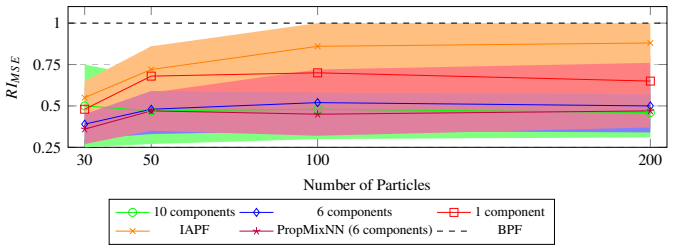
The paper's central claim is that by estimating both the transition distribution $f(x_t|x_{t-1})$ and the proposal distribution $\pi(x_t|x_{t-1}, y_t)$ from the observation series alone, one can estimate the hidden state given only the observation model $g$. This is new because standard particle filters and learned proposals such as PropMixNN assume $f$ is known; StateMixNN drops that requirement by training a transition network and a proposal network in alternation. The two distributions are equal-weight mixtures of diagonal multivariate Gaussians, with component parameters generated by multilayer perceptrons, and training targets the observation log-likelihood via a stop-gradient differentiable particle filter. The reported result is that StateMixNN obtains relative mean-square error values below 1 compared with the bootstrap filter for the Lorenz 96 and Kuramoto systems across the tested ranges, with larger gains in highly nonlinear regimes and with more mixture components.
Load-bearing premise
The method's load-bearing premise is that maximizing the observation log-likelihood can separate the transition kernel from the proposal, so the learned transition is the true dynamics rather than one half of a compensating pair $(f, \pi)$ that only makes the filter's weights look good.
Editorial extensions
If this is right
- Filtering becomes possible for systems whose dynamics are unknown, as long as the observation model is specified, because the transition kernel no longer needs to be supplied.
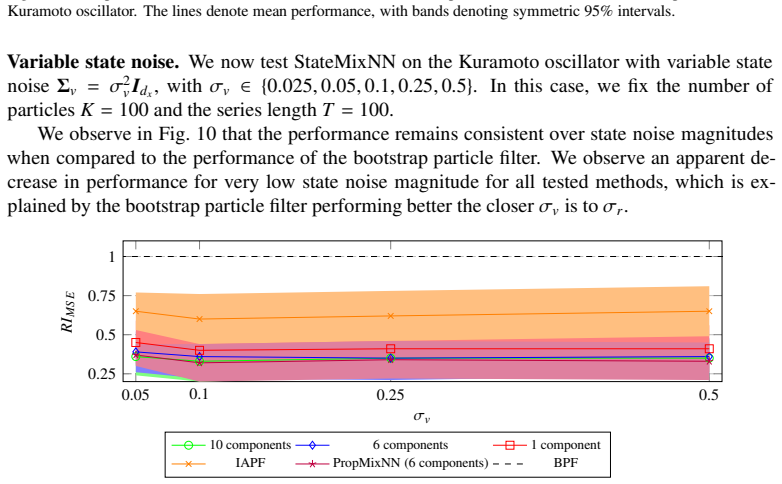
- Trained particle filters can beat both the bootstrap filter and an observation-aware auxiliary filter on chaotic, multimodal systems, with the margin growing as state noise increases.
- The learned proposal effectively carries the observation information that the transition alone lacks, which should help exactly when the bootstrap filter degenerates: diffuse transition, informative observation.
- The training target needs only the observation series, so the method applies to real-world datasets where hidden states are never recorded.
Reading between the lines
- Editorial inference: the reported state-recovery gain does not by itself prove that the learned transition kernel is the true one; the paper's own identifiability discussion implies a check that compares the learned kernel with known dynamics in a synthetic setting.
- Editorial inference: a natural stress test beyond the paper is to freeze the trained transition network and run filtering with a bootstrap proposal; if performance collapses, the learned proposal is doing the lifting rather than the learned dynamics.
- Editorial inference: the architecture is deliberately simple, so the same likelihood-based training could be tried with heavier-tailed mixture components, such as Student-t mixands, to test whether Gaussian mixtures limit performance on heavy-tailed chaotic transitions.
Editorial analysis
A structured set of objections, weighed in public.
Referee Report
Summary. The paper proposes StateMixNN, a differentiable particle filter (DPF) in which the transition distribution and the proposal distribution of a state-space model are both approximated by multivariate Gaussian mixtures whose means and diagonal covariances are outputs of neural networks. The networks are trained by maximizing an estimated parameter log-likelihood using the stop-gradient DPF of Sciberior and Wood, requiring only observations and a known observation model. The method is evaluated on stochastic Lorenz 96 and Kuramoto oscillator systems, with reported relative mean squared error (RIMSE) against a bootstrap particle filter, across varying numbers of particles, series lengths, state noise levels, and state dimensions. The central empirical claim is that StateMixNN improves hidden-state recovery relative to the bootstrap filter and the improved auxiliary particle filter, especially in highly nonlinear regimes.
Significance. If the method works as claimed, it would be a practically valuable contribution: it offers a way to perform filtering when the transition kernel is unknown, a setting where standard particle filters cannot be applied directly. The empirical study is thorough, with 200 independent runs and 95% intervals for two nonlinear systems and four experimental axes. The paper also provides a useful discussion of mixture parametrizations, conditioning updates, and likelihood degeneracy. However, the significance hinges on the training objective being a genuine likelihood estimator and on the learned transition being the actual dynamics; both points are currently not established.
major comments (2)
- [Section 3.2, Eq. (11)] The training objective in Eq. (11) is not the particle-filter log-likelihood. After resampling at every step, the standard unbiased estimator of the log marginal likelihood is sum_t log( (1/K) sum_k w_t^(k) ), i.e., a sum over time of log-sum-exp terms, whereas Eq. (11) is sum_t sum_k log w_t^(k). For K > 1 these are not proportional: the log of a sum is not the sum of logs. The statement in Section 3.2 that 'the log-likelihood is maximised when all weights are equal' is a property of the sum-of-log-weights surrogate, not of the marginal likelihood of the observation series. Consequently, the learned theta^(f) and theta^(pi) are not maximum-likelihood estimates, and the claim in the abstract and Section 1 that the method is 'trained targeting the log-likelihood' is unsupported. If the implementation actually computes log-sum-exp, this is an exposition error; as written, the loss is a heuristic that rewards weight concentration around sampled particles and can be increased by making the ratio f/pi large at sampled locations, allowing the learned transition to adapt to the proposal and observations rather than to the true dynamics. This issue is load-bearing because the central claim of learning state dynamics 'given only the observation model' rests on the likelihood interpretation of the training objective.
- [Section 4.3 and Section 5] The learned transition kernel is never validated against the true transition kernel. Section 4.3 acknowledges that changes in the log-likelihood can be attributed either to the transition or to the proposal, and that the two distributions interact in the weight computation; the paper assumes the alternating scheme resolves this, but alternating conditional updates only attribute gradient changes to the updated network, they do not identify the pair (f, pi). Because the importance weights depend on f and pi only through the ratio f/pi, many pairs give the same likelihood. The reported RIMSE improvements in Figures 4-11 could come from a proposal that compensates for an inaccurate transition rather than from learning the actual dynamics. A direct validation of the learned f against the true kernel (e.g., a KL divergence or predictive comparison on held-out transitions) is necessary to support the claim that StateMixNN learns state dynamics; without it, the method's advantage over baselines that require the true transition is not attributable to correct dynamics learning.
minor comments (4)
- [Abstract and Section 6] The abstract claims the method 'significantly improves recovery of the hidden state in comparison with the state-of-the-art', but the conclusion (Section 6) states that StateMixNN 'performs similarly to PropMixNN', a method that requires the true transition. The abstract should be qualified to indicate that the significant improvements are relative to bootstrap and improved auxiliary particle filters, not to PropMixNN.
- [Section 3.2, Eq. (12)] In Eq. (12), the proposal density in the last term is written as pi(xt|...) with xt rather than x_t^(k); this is a typographical inconsistency that may confuse readers.
- [Section 5.1] The term 'relative improvement in MSE' is used for RIMSE = MSE_method / MSE_baseline, which is a ratio rather than an improvement; consider renaming it 'relative MSE' or defining the improvement as 1 - RIMSE to avoid ambiguity.
- [Section 4.4] The telescoping observation batching in Algorithm 4 is a heuristic, and the claim that it prevents behavior where only the start and end of the series are well represented is not empirically demonstrated; a sensitivity analysis or an ablation for the batch schedule would strengthen the presentation.
Circularity Check
No circular derivation: the state-recovery claim is benchmarked against external baselines on synthetic ground truth; the main caveats are an identifiability limitation and a mislabeled likelihood objective, not circular reductions.
full rationale
The paper's central numerical claim is that StateMixNN improves hidden-state recovery relative to the bootstrap particle filter and the improved auxiliary particle filter on Lorenz-96 and Kuramoto systems with known synthetic ground truth. Those comparisons are externally falsifiable and do not reduce to the fitted transition or proposal parameters by construction. The learned transition kernel is never compared with the true kernel, but the paper does not claim to recover the true transition; its claim is about filtering accuracy. Section 4.3 explicitly acknowledges that "any change in the weights or particles, and hence in the log-likelihood, can be attributed to either a change in the transition kernel, or a change in the proposal distribution." That is an identifiability limitation, not a circular step, because the reported state estimates are still evaluated against ground truth and against methods that know the true transition. A separate correctness concern is that Eqs. (10) and (11) define the training objective as a sum of log weights, which is not the particle-filter log-marginal-likelihood estimator; the log of a sum is not the sum of logs, so the claim that training targets the log-likelihood is unsupported as written. This is an exposition or objective-design issue rather than a circular reduction, since the experimental metric is MSE against true states, not the training objective itself. The only self-referential element is the PropMixNN comparator from the authors' prior ICASSP paper, but PropMixNN requires the true transition kernel and therefore cannot force StateMixNN's result. No load-bearing derivation in the paper is equivalent to its own inputs by construction.
Assumptions & free parameters
free parameters (5)
- Number of mixture components S =
1, 6, and 10 tested
- Network architecture =
3 layers, hidden widths 128 and 256
- ADAM learning rate =
3e-3
- Training schedule (B, J, A) =
B=ceil(T/5), J=50, A=20
- Gumbel-Softmax temperature =
not reported
assumptions (5)
- standard math Multilayer perceptrons can approximate arbitrary continuous functions in the infinite-width or infinite-depth limit.
- domain assumption Equal-weight Gaussian mixtures with diagonal covariances are sufficiently expressive for the transition and proposal densities needed here.
- domain assumption The observation model g is known and fixed.
- domain assumption Maximizing the estimated particle-filter log-likelihood in Eq. (10) yields a pair (f, pi) that improves filtering performance.
- ad hoc to paper Telescoping observation batches alleviate likelihood concentration.
Cite this review
Pith. "Pith review of Learning state and proposal dynamics in state-space models using differentiable particle filters and neural networks." pith.science (2026). https://pith.science/paper/KIMM7XGE
@misc{pith2026241115638,
  author       = {Pith},
  title        = {Pith review of: Learning state and proposal dynamics in state-space models using differentiable particle filters and neural networks},
  year         = {2026},
  howpublished = {\url{https://pith.science/paper/KIMM7XGE}},
  note         = {Machine review of arXiv:2411.15638}
}
read the original abstract
State-space models are a popular statistical framework for analysing sequential data. Within this framework, particle filters are often used to perform inference on non-linear state-space models. We introduce a new method, StateMixNN, that uses a pair of neural networks to learn the proposal distribution and transition distribution of a particle filter. Both distributions are approximated using multivariate Gaussian mixtures. The component means and covariances of these mixtures are learnt as outputs of learned functions. Our method is trained targeting the log-likelihood, thereby requiring only the observation series, and combines the interpretability of state-space models with the flexibility and approximation power of artificial neural networks. The proposed method significantly improves recovery of the hidden state in comparison with the state-of-the-art, showing greater improvement in highly non-linear scenarios.
Figures


Figures from the paper (9 more)




Reference graph
Works this paper leans on
-
[1]
A survey of recent advances in particle filters and remaining challenges for multitarget tracking
Xuedong Wang, Tiancheng Li, Shudong Sun, and Juan M Corch ado. A survey of recent advances in particle filters and remaining challenges for multitarget tracking. Sensors, 17(12):2707, 2017
work page 2017
-
[2]
Particle learning for Bayesian semi-parametric stochastic volatility model
Audron˙ e Virbickait˙ e, Hedibert F Lopes, M Concepci´ onAus´ ın, and Pedro Galeano. Particle learning for Bayesian semi-parametric stochastic volatility model. Econometric Reviews, 2019. 21
work page 2019
-
[3]
Toby A Patterson, Alison Parton, Roland Langrock, Paul G Blackwell, Len Thomas, and Ruth King. Statistical modelling of individual animal movement: an overview of key methods and a discussion of practical challenges. AStA Advances in Statistical Analysis , 101:399–438, 2017
work page 2017
-
[4]
State-space models for ecological time-series data: Practical model-fi tting
Ken Newman, Ruth King, V´ ıctor Elvira, Perry de V alpine, Rachel S McCrea, and Byron JT Morgan. State-space models for ecological time-series data: Practical model-fi tting. Methods in Ecology and Evolution , 14(1):26–42, 2023
work page 2023
-
[5]
Adam M Clayton, Andrew C Lorenc, and Dale M Barker. Operat ional implementation of a hybrid ensemble /4d- Var global data assimilation system at the Met O ffice. Quarterly Journal of the Royal Meteorological Society , 139 (675):1445–1461, 2013
work page 2013
-
[6]
Kalman and extended Kalman filters : Concept, derivation and properties
Maria Isabel Ribeiro. Kalman and extended Kalman filters : Concept, derivation and properties. Institute for Systems and Robotics, 43(46):3736–3741, 2004
work page 2004
-
[7]
The unscented Kalman filter for nonlinear estimation
Eric A Wan and Rudolph V an Der Merwe. The unscented Kalman filter for nonlinear estimation. In Proceedings of the IEEE 2000 Adaptive Systems for Signal Processing, Com munications, and Control Symposium (Cat. No. 00EX373), pages 153–158. IEEE, 2000
work page 2000
-
[8]
Novel approach to nonlinear and non- Gaussian Bayesian state estimation
Neil Gordon, David Salmond, and Adrian Frederick Melhui sh Smith. Novel approach to nonlinear and non- Gaussian Bayesian state estimation. IEE Proceedings-F Radar and Signal Processing , 140:107–113, 1993
work page 1993
Show all 52 references
-
[9]
Particle filtering
Petar M Djuric, Jayesh H Kotecha, Jianqui Zhang, Y ufei Hu ang, Tadesse Ghirmai, M´ onica F Bugallo, and Joaquin Miguez. Particle filtering. IEEE signal processing magazine, 20(5):19–38, 2003
2003
-
[10]
A tutorial on part icle filtering and smoothing: Fifteen years later
Arnaud Doucet, Adam M Johansen, et al. A tutorial on part icle filtering and smoothing: Fifteen years later. Hand- book of nonlinear filtering , 12(656-704):3, 2009
2009
-
[11]
Cambridge University Press, 1st edition, 2013
Simo S¨ arkk¨ a.Bayesian filtering and smoothing . Cambridge University Press, 1st edition, 2013
2013
-
[12]
Di fferentiable particle filtering via entropy-regularized optimal transport
Adrien Corenflos, James Thornton, George Deligiannidi s, and Arnaud Doucet. Di fferentiable particle filtering via entropy-regularized optimal transport. In International Conference on Machine Learning , pages 2100–2111. PMLR, 2021
2021
-
[13]
Differentiable particle filtering without modifying the forwar d pass
Adam ´Scibior and Frank Wood. Differentiable particle filtering without modifying the forwar d pass. arXiv preprint arXiv:2106.10314, 2021
2021 arXiv
-
[14]
An overview of di fferentiable particle filters for data-adaptive sequential B ayesian inference
Xiongjie Chen and Y unpeng Li. An overview of di fferentiable particle filters for data-adaptive sequential B ayesian inference. arXiv preprint arXiv:2302.09639, 2023
2023 arXiv
-
[15]
Differentiable bootstrap particle filters for regime-switching models
Wenhan Li, Xiongjie Chen, Wenwu Wang, V´ ıctor Elvira, a nd Y unpeng Li. Differentiable bootstrap particle filters for regime-switching models. arXiv preprint arXiv:2302.10319, 2023
2023 arXiv
-
[16]
Particle filter networks with application to visual localization
Peter Karkus, David Hsu, and Wee Sun Lee. Particle filter networks with application to visual localization. In Conference on robot learning, pages 169–178. PMLR, 2018
2018
-
[17]
Filtering via simulat ion: Auxiliary particle filters
Michael K Pitt and Neil Shephard. Filtering via simulat ion: Auxiliary particle filters. Journal of the American statistical association, 94(446):590–599, 1999
1999
-
[18]
Elucidating the auxiliary particle filter via multiple importance sampling [lecture notes]
Victor Elvira, Luca Martino, Monica F Bugallo, and Peta r M Djuric. Elucidating the auxiliary particle filter via multiple importance sampling [lecture notes]. IEEE Signal Processing Magazine, 36(6):145–152, 2019
2019
-
[19]
Optimized auxili ary particle filters: adapting mixture proposals via convex optimization
Nicola Branchini and V´ ıctor Elvira. Optimized auxili ary particle filters: adapting mixture proposals via convex optimization. In Uncertainty in Artificial Intelligence , pages 1289–1299. PMLR, 2021
2021
-
[20]
Bugallo, and P etar M
V´ ıctor Elvira, Luca Martino, M´ onica F. Bugallo, and P etar M. Djuri´ c. In search for improved auxiliary par- ticle filters. In 2018 26th European Signal Processing Conference (EUSIPCO) , pages 1637–1641, 2018. doi: 10.23919/EUSIPCO.2018.8553361
2018
-
[21]
Neural adaptive sequential Monte Carlo
Shixiang Shane Gu, Zoubin Ghahramani, and Richard E Tur ner. Neural adaptive sequential Monte Carlo. Advances in neural information processing systems , 28, 2015
2015
-
[22]
V ariational sequential Monte Carlo
Christian Naesseth, Scott Linderman, Rajesh Ranganat h, and David Blei. V ariational sequential Monte Carlo. In International conference on artificial intelligence and st atistics, pages 968–977. PMLR, 2018
2018
-
[23]
E nd- to-end learning of gaussian mixture proposals using di fferentiable particle filters and neural networks
Benjamin Cox, Sara P´ erez-Vieites, Nicolas Zilberste in, Martin Sevilla, Santiago Segarra, and V´ ıctor Elvira. E nd- to-end learning of gaussian mixture proposals using di fferentiable particle filters and neural networks. In ICASSP 2024-2024 IEEE International Conference on A...
2024
-
[24]
Improving population monte carlo: Alternative weighting and resampling schemes
V´ ıctor Elvira, Luca Martino, David Luengo, and M´ onica F Bugallo. Improving population monte carlo: Alternative weighting and resampling schemes. Signal Processing, 131:77–91, 2017
2017
-
[25]
Unrolling particles: Unsupervise d learning of sampling distributions
Fernando Gama, Nicolas Zilberstein, Richard G Baraniu k, and Santiago Segarra. Unrolling particles: Unsupervise d learning of sampling distributions. In ICASSP 2022-2022 IEEE International Conference on Acoustics, Speech and Signal Processing (ICASSP), pages 5498–5502. IEEE, 2022
2022
-
[26]
Baraniuk, and Santiago Segarra
Fernando Gama, Nicolas Zilberstein, Martin Sevilla, R ichard G. Baraniuk, and Santiago Segarra. Unsupervised learning of sampling distributions for particle filters. IEEE Transactions on Signal Processing , 71:3852–3866,
-
[27]
Auto-encoding varia tional bayes
Diederik P Kingma and Max Welling. Auto-encoding varia tional bayes. arXiv preprint arXiv:1312.6114, 2013
2013 arXiv
-
[28]
Towa rds di fferentiable resampling
Michael Zhu, Kevin Murphy, and Rico Jonschkowski. Towa rds di fferentiable resampling. arXiv preprint 22 arXiv:2004.11938, 2020
2004 arXiv
-
[29]
Kingma and Jimmy Ba
Diederik P . Kingma and Jimmy Ba. Adam: A method for stoch astic optimization. In Y oshua Bengio and Y ann LeCun, editors, 3rd International Conference on Learning Representations, ICLR 2015, San Diego, CA, USA, May 7-9, 2015, Conference Track Proceedings, 2015. URL http://arx...
2015 arXiv
-
[30]
On the variance of the adaptive learning rate and beyond
Liyuan Liu, Haoming Jiang, Pengcheng He, Weizhu Chen, X iaodong Liu, Jianfeng Gao, and Jiawei Han. On the variance of the adaptive learning rate and beyond. arXiv preprint arXiv:1908.03265, 2019
1908 arXiv
-
[31]
Stochast ic gradient methods with layer-wise adaptive moments for training of deep networks
Boris Ginsburg, Patrice Castonguay, Oleksii Hrinchuk , Oleksii Kuchaiev, Vitaly Lavrukhin, Ryan Leary, Jason Li, Huyen Nguyen, Y ang Zhang, and Jonathan M Cohen. Stochast ic gradient methods with layer-wise adaptive moments for training of deep networks. arXiv preprint arXiv:1...
1905 arXiv
-
[32]
Jasper: An end-to-end convolutional neura l acoustic model
Jason Li, Vitaly Lavrukhin, Boris Ginsburg, Ryan Leary , Oleksii Kuchaiev, Jonathan M Cohen, Huyen Nguyen, and Ravi Teja Gadde. Jasper: An end-to-end convolutional neura l acoustic model. arXiv preprint arXiv:1904.03288 , 2019
1904 arXiv
-
[33]
Adaptive importance sampling: The past, the present, and the future
Monica F Bugallo, Victor Elvira, Luca Martino, David Lu engo, Joaquin Miguez, and Petar M Djuric. Adaptive importance sampling: The past, the present, and the future. IEEE Signal Processing Magazine, 34(4):60–79, 2017
2017
-
[34]
Recurrent neural networks: design and applications
Larry Medsker and Lakhmi C Jain. Recurrent neural networks: design and applications . CRC press, 1999
1999
-
[35]
Bidirectional recu rrent neural networks
Mike Schuster and Kuldip K Paliwal. Bidirectional recu rrent neural networks. IEEE transactions on Signal Pro- cessing, 45(11):2673–2681, 1997
1997
-
[36]
Recent advances in recurrent neural networks
Hojjat Salehinejad, Sharan Sankar, Joseph Barfett, Er rol Colak, and Shahrokh V alaee. Recent advances in recurrent neural networks. arXiv preprint arXiv:1801.01078, 2017
2017 arXiv
-
[37]
Informer: Beyond efficient transformer for long sequence time-series forecasti ng
Haoyi Zhou, Shanghang Zhang, Jieqi Peng, Shuai Zhang, J ianxin Li, Hui Xiong, and Wancai Zhang. Informer: Beyond efficient transformer for long sequence time-series forecasti ng. In Proceedings of the AAAI conference on artificial intelligence , volume 35, pages 11106–11115, 2021
2021
-
[38]
Equinox: neural ne tworks in JAX via callable PyTrees and filtered transforma- tions
Patrick Kidger and Cristian Garcia. Equinox: neural ne tworks in JAX via callable PyTrees and filtered transforma- tions. Differentiable Programming workshop at Neural Information Pro cessing Systems 2021, 2021
2021
-
[39]
V ariational infere nce with normalizing flows
Danilo Rezende and Shakir Mohamed. V ariational infere nce with normalizing flows. In International conference on machine learning, pages 1530–1538. PMLR, 2015
2015
-
[40]
Conditional densit y estimation with bayesian normalising flows
Brian L Trippe and Richard E Turner. Conditional densit y estimation with bayesian normalising flows. arXiv preprint arXiv:1802.04908, 2018
2018 arXiv
-
[41]
Categorical repa rameterization with gumbel-softmax
Eric Jang, Shixiang Gu, and Ben Poole. Categorical repa rameterization with gumbel-softmax. arXiv preprint arXiv:1611.01144, 2016
2016 arXiv
-
[42]
A family of nonpar ametric density estimation algorithms
Esteban G Tabak and Cristina V Turner. A family of nonpar ametric density estimation algorithms. Communications on Pure and Applied Mathematics , 66(2):145–164, 2013
2013
-
[43]
Pytorch: An imperative style, high-performance deep learning libra ry
Adam Paszke, Sam Gross, Francisco Massa, Adam Lerer, Ja mes Bradbury, Gregory Chanan, Trevor Killeen, Zem- ing Lin, Natalia Gimelshein, Luca Antiga, Alban Desmaison, Andreas Kopf, Edward Y ang, Zachary DeVito, Martin Raison, Alykhan Tejani, Sasank Chilamkurthy, Benoit Steiner,...
2019
-
[44]
JAX: composable transforma- tions of Python+NumPy programs, 2018
James Bradbury, Roy Frostig, Peter Hawkins, Matthew Ja mes Johnson, Chris Leary, Dougal Maclaurin, George Necula, Adam Paszke, Jake V anderPlas, Skye Wanderman-Milne, and Qiao Zhang. JAX: composable transforma- tions of Python+NumPy programs, 2018. URL http://github.com/jax-ml/jax
2018
-
[45]
Mart´ ın Abadi, Ashish Agarwal, Paul Barham, Eugene Bre vdo, Zhifeng Chen, Craig Citro, Greg S. Corrado, Andy Davis, Jeffrey Dean, Matthieu Devin, Sanjay Ghemawat, Ian Goodfellow, Andrew Harp, Geoffrey Irving, Michael Isard, Y angqing Jia, Rafal Jozefowicz, Lukasz Kaiser, Manjun...
2015
-
[46]
Neural ordinary differential equations
Ricky TQ Chen, Y ulia Rubanova, Jesse Bettencourt, and D avid K Duvenaud. Neural ordinary differential equations. Advances in neural information processing systems , 31, 2018
2018
-
[47]
O n robustness of neural ordinary di fferential equations
Hanshu Y an, Jiawei Du, Vincent YF Tan, and Jiashi Feng. O n robustness of neural ordinary di fferential equations. arXiv preprint arXiv:1910.05513, 2019
1910 arXiv
-
[48]
Di ffeqflux
Chris Rackauckas, Mike Innes, Yingbo Ma, Jesse Bettenc ourt, Lyndon White, and V aibhav Dixit. Di ffeqflux. jl-a julia library for neural di fferential equations. arXiv preprint arXiv:1902.02376, 2019
1902 arXiv
-
[49]
Predictability: A problem partly solv ed
Edward N Lorenz. Predictability: A problem partly solv ed. In Proc. Seminar on predictability. ECMWF, 1996
1996
-
[50]
Gaussian sum partic le filtering
Jayesh H Kotecha and Petar M Djuric. Gaussian sum partic le filtering. IEEE Transactions on signal processing , 51(10):2602–2612, 2003
2003
-
[51]
Chemical Oscillations, W aves, and Turbulence
Y oshiki Kuramoto. Chemical Oscillations, W aves, and Turbulence. Springer, 1984. ISBN 978-3-642-69691-6. doi: 10.1007/978-3-642-69689-3. 23
1984 doi
-
[2023]
doi: 10.1109 /TSP .2023.3324221
2023
Reviewed August 12, 2026 · model on record in the stance chip above.
Discussion (0). Continue with ORCID to comment.