REVIEW 3 major objections 5 minor 38 references
RIS with Coupled Phase Shift and Amplitude: Capacity Maximization and Configuration Set Selection
T0 review · 3 major / 5 minor · reviewed 2026-08-12 · deepseek-v4-flash
Pith's one-line read A linear-complexity algorithm provably finds capacity-maximizing RIS reflection coefficients under a practical coupled phase-amplitude model, and a one-dimensional integral selects the near-optimal discrete configuration set.
desk verdict Solid capacity-maximization core with an unsupported linear-complexity claim and an overhyped configuration-set heuristic; worth refereeing but needs major revision. read the letter →
The pith
A machine-rendered reading of the paper's core claim, the machinery that carries it, and where it could break.
The reading
What carries the argument
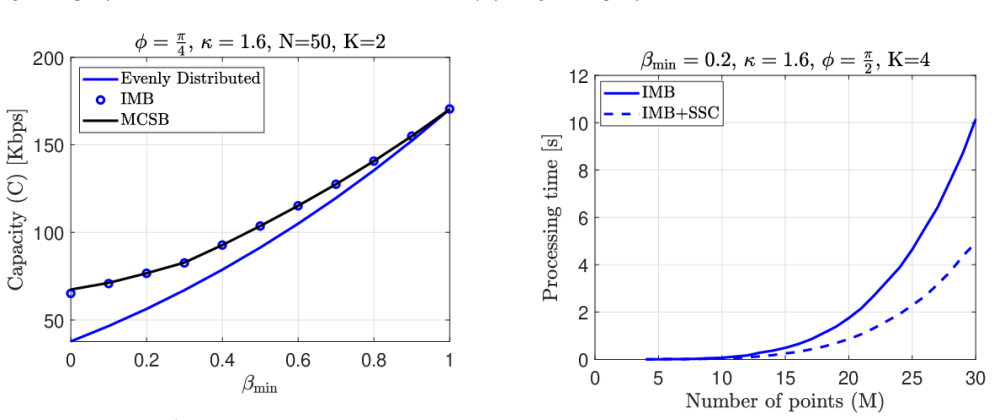
The load-bearing object is the upper envelope of the per-element projection curves, $F_n(\angle h^*) = \max_i \hat{\beta}_i \cos(\angle h^* - \angle g_{n,i})$, together with the phase-shifted, element-independent version $S(x) = \max_i \hat{\beta}_i \cos(x - \hat{\alpha}_i)$. The machinery has three parts. First, Theorem 1 turns the combinatorial choice per element into a largest-projection rule once $\angle h^*$ is fixed, so the only unknown left is that single phase. Second, Theorem 2 shows each cosine curve can dominate on at most one interval, so the active boundaries of the optimal phase are the pairwise intersections of the $K$ curves, and shifting by $\angle v_n - \angle v_m$ transfers one element's boundaries to all others. Third, Eqs. (25)-(26) replace the stochastic average over channel realizations by the deterministic integral of $S(x)$, turning configuration-set selection from a Monte Carlo problem into evaluation of one one-dimensional integral per candidate menu, with a final symmetry reduction cutting candidates in half.
What would settle it
Take a single-user RIS link with a strong direct path (e.g., $|h_0|$ comparable to the RIS-aided path) and uneven element channel magnitudes, and compare the configuration set chosen by maximizing $\int_0^{2\pi} S(x)\,dx$ with the set chosen by exhaustive Monte Carlo selection over all $\binom{M}{K}$ menus; if the integral-based set does not achieve the largest average capacity, the approximation in Eq. (25) is the point of failure.
Extended reading notes
Core claim
The paper's central claim is that, for a single-user RIS link whose elements obey the practical coupled amplitude-phase relation in (8), the capacity-maximizing reflection coefficients can be found exactly for any finite configuration set in time linear in the number of elements $N$ and the menu size $K$. The argument fixes the phase $\angle h^*$ of the optimal end-to-end channel; for a fixed $\angle h^*$, element $n$'s best choice is the menu entry maximizing $\hat{\beta}_i \cos(\angle h^* - \angle v_n - \hat{\alpha}_i)$, i.e., the largest projection of the element's cascaded channel onto $\angle h^*$ (Theorem 1). Because each element's projection curves are cosine waves and each curve can be the maximum on at most one interval of $\angle h^*$ (Theorem 2), the optimal assignment changes only at finitely many phase boundaries; shifting one element's boundaries by $\angle v_n - \angle v_m$ gives every other element's boundaries, so the whole axis splits into at most $NK$ regions. For configuration-set selection, the paper shows that under a weak-direct-path, equal-magnitude, uniform-phase approximation, the average capacity is a monotone function of the integral $\int_0^{2\pi} S(x)\,dx$ with $S(x) = \max_i \hat{\beta}_i \cos(x - \hat{\alpha}_i)$, so the best menu is the one with the largest such integral.
Load-bearing premise
The configuration-set-selection shortcut rests on the assumption that all cascaded channel magnitudes are approximately equal, the direct transmitter-to-receiver path is weak, and the cascaded phases are spread uniformly over $[0,2\pi)$, so that the average capacity can be replaced by the integral of $S(x)$; when the direct path is strong or the element channels are not similar, the integral-based menu choice can be suboptimal.
Editorial extensions
If this is right
- For any finite reflection-coefficient menu generated by the coupled model, the capacity-maximizing assignment for a channel realization is computed in time linear in $N$ and $K$, replacing exhaustive search over $K^N$ combinations.
- The per-element optimal choice is exactly the menu entry with the largest projection onto the optimal channel phase, so capacity maximization needs no heuristic alignment with the direct channel.
- The best configuration set can be selected by maximizing the single integral $\int_0^{2\pi} S(x)\,dx$, avoiding Monte Carlo simulation over channel realizations.
- Mirror-symmetric menu pairs give identical integrals, so the number of candidate sets to evaluate is cut approximately in half with no loss in selected capacity.
- In the lossless limit ($\beta_{\min}=1$ or $\kappa=0$), the coupled model degenerates to independent amplitude and phase and the evenly spaced phase set is recovered as optimal.
Reading between the lines
- Editorial inference: the exact linear-complexity capacity-maximization procedure does not actually depend on the specific functional form (8); it only needs a finite menu of amplitude-phase pairs, so measured phase-amplitude tables from a specific RIS prototype could be plugged in directly.
- Editorial inference: because the integral criterion discards the direct path, a hybrid objective that adds a direct-path-alignment term to the integral would likely outperform it in strong-line-of-sight settings, a regime the paper's approximation excludes.
- Editorial inference: the near-independence of the optimal menu from the cascaded channel phases suggests that an integral-selected configuration set chosen for one scattering environment should remain near-optimal in another environment with similar element-strength statistics; this is a testable prediction the paper does not run.
- Editorial inference: the same integral proxy could be extended to multi-user or frequency-selective links by summing $S(x)$ over users or subcarriers, though the paper's proof is for a single narrowband user.
Editorial analysis
A structured set of objections, weighed in public.
Referee Report
Summary. The paper considers a single-user RIS-aided channel in which each RIS element's reflection coefficient is chosen from a finite configuration set, with the amplitude and phase coupled through a practical model (Eq. (8)). The first contribution is an algorithm that, for a given configuration set, finds the globally optimal reflection coefficients maximizing capacity by sweeping over the finitely many active intervals of the upper envelope of per-element curves (Sections III-A to III-E); the paper claims this runs in time linear in the number of elements N and the number of choices K. The second contribution is a configuration-set-selection method (IMB) that replaces Monte Carlo averaging by the integral of a one-dimensional function S(x), together with a search-space compression (SSC) that halves the number of candidate sets (Section IV). Numerical results compare the capacity maximization algorithm with exhaustive search and heuristic projection methods, and compare IMB with Monte Carlo based selection.
Significance. If the linear-complexity and global-optimality claims held as stated, the capacity maximization part would be a useful contribution to discrete RIS reflection optimization under the practical coupled phase-amplitude model, extending prior work on arbitrary discrete phase shifts. The IMB idea of replacing channel-average capacity maximization by maximizing a one-dimensional integral is attractive computationally, and the SSC symmetry argument is clean. The paper contains mathematical proofs of the upper-envelope properties and of Theorem 1, and the simulation study is relevant. However, the advertised complexity guarantee is not supported by the described algorithm, and the configuration-set-selection method is an unquantified approximation while being described as optimal. These two issues affect the paper's central claims.
major comments (3)
- [Sec. III-C to III-E] The central complexity claim, repeated in the abstract, Section I, Section III-E, and the conclusion, is not supported by the algorithm actually described. In Section III-C, computing the K active intervals for one reference RIS element requires, for each curve i, intersecting it with the other K-1 curves through Eq. (15) and the CRC operations of Table I; this is Theta(K^2) work, not O(K). Section III-D shifts the resulting reference active intervals to the other N-1 elements, but it does not eliminate this Theta(K^2) preprocessing cost. Section III-E argues that because there are at most NK active intersections, the method is linear in N and K; this confuses the number of swept regions with the cost of finding and sorting them. Producing the sorted list of up to NK breakpoints for the sweep requires Omega(NK log NK) comparisons in general, and even a k-way merge of the shifted copies would require Omega(NK log N). Thus the advertised 'linear with N and K' guarantee fails for the presented algorithm, even though the enumeration itself may still be exact.
- [Sec. IV-A, Eqs. (24)-(26)] The IMB configuration-set-selection claim is not proven to the strength stated. The reduction of average capacity to the integral of S relies on three assumptions introduced around Eq. (25): |v_n| approximately equal to c, |h0| approximately zero, and replacement of the sum over n of S(angle h*_r - angle v_n) by the integral (N/2pi) integral S(x) dx. None of these assumptions is quantified with an error bound, and the Riemann-sum-to-integral step also requires a uniformity or large-N condition that is not stated. Moreover, Eq. (26) replaces each realization |h*_r| by the same constant and then effectively equates E[log(1 + gamma |h*|^2)] with log(1 + gamma (E|h*|)^2), which is not valid in general. Consequently, the statement that maximizing the average capacity is approximately equivalent to maximizing the integral of S is a heuristic, and the abstract's wording that IMB 'optimally selects the configuration set' overstates the result. The authors should either provide a formal approximation guarantee (e.g., a large-N or asymptotic error bound) or explicitly label IMB as an approximate heuristic and soften the optimality claims throughout.
- [Sec. V-B and Fig. 10] The numerical validation of IMB is performed only in the regime consistent with the assumptions of Eq. (25): the simulations set |h0| = |v_n| = -140 dB, which satisfies |h0| approximately 0 and equal cascaded magnitudes. Since the derivation explicitly assumes a weak direct path, the claim that IMB is the optimal configuration set selection method for the considered system is not tested for stronger direct paths. Figure 9 shows that direct-channel strength qualitatively changes the capacity-maximization problem, so the paper should either characterize the regime in which the IMB approximation is intended to hold or report results for varying |h0|.
minor comments (5)
- [Sec. III-C, Eq. (15)] The arctangent-based formula for the intersection points requires care when the denominator is zero and for choosing the correct quadrant; a formulation using atan2 or a short discussion of degenerate cases would improve clarity.
- [Sec. III-C and Table I] The active-interval construction assumes that no two curves coincide on an interval and that intersections are generic; the treatment of ties, where two curves are exactly equal at a boundary or over an interval, is not specified and should be addressed.
- [References] Reference [20] contains a typo: 'adn M.-S. Alouini' should be 'and M.-S. Alouini'.
- [Sec. IV-B, Eq. (28)] In the SSC derivation, the symbol psi_k is used both for a reflection coefficient choice and for its phase via angle psi_k; the notation should be made explicit to avoid confusion.
- [Sec. V-A, Fig. 9] The observation that improved CPP approaches the optimal method as |h0| grows is interesting; a brief remark connecting this to the validity regime of the IMB method in Section IV would help the reader.
Circularity Check
No significant circularity: the capacity-maximization proof is self-contained, and the configuration-set-selection equivalence is an explicit approximation rather than a definitional restatement.
full rationale
The capacity-maximization derivation in Section III is self-contained: Theorem 1 is proved from the inner-product decomposition, Theorem 2 follows from the pairwise intersection property of the cosine curves, and the global sweep over active regions directly enumerates the finite set of phase intervals in which the element-wise optimal choices are constant. No fitted parameters enter, and no target result is assumed. The only self-citation to the authors' prior work [34] motivates the arbitrary-discrete-phase setting but is not used as a load-bearing proof step; the coupled-amplitude generalization is derived independently in the present paper. The configuration-set-selection result in Section IV-A rests on Eq. (25), which explicitly assumes |v_n| approximately constant, a weak direct path |h0| ≈ 0, and uniform element phases before replacing the sum by an integral. The equivalence between average capacity and the integral of S(x) is therefore an approximate consequence of stated modeling assumptions, not a definitional identity. If those assumptions fail, the IMB method may be suboptimal, but that is an accuracy and robustness concern rather than circularity. The advertised linear-complexity claim is also potentially under-supported by the described interval-intersection preprocessing and sorting costs, but that is a complexity-analysis concern, not circularity of the derivation itself.
Assumptions & free parameters
assumptions (6)
- domain assumption The practical RIS model β_n(α_n) = (1 − β_min)((sin(α_n − φ) + 1)/2)^κ + β_min from [36] accurately describes real RIS element behavior.
- domain assumption Cascaded channel magnitudes are approximately equal (|v_1| ≈ ... ≈ |v_N| = c).
- domain assumption Weak direct path, |h0| ≈ 0.
- domain assumption The phases ∠v_n are uniformly distributed over [0,2π), so the sum (1/N)Σ S(∠h* − ∠v_n) can be replaced by the integral (1/2π)∫ S(x)dx.
- standard math Cosine curves are in general position (no two curves are identical and no triple intersections occur at a single point).
- domain assumption Large N justifies convergence of the empirical average to the integral and makes the variance of the sum negligible.
Cite this review
Pith. "Pith review of RIS with Coupled Phase Shift and Amplitude: Capacity Maximization and Configuration Set Selection." pith.science (2026). https://pith.science/paper/PRJ3FQL3
@misc{pith2026241115696,
  author       = {Pith},
  title        = {Pith review of: RIS with Coupled Phase Shift and Amplitude: Capacity Maximization and Configuration Set Selection},
  year         = {2026},
  howpublished = {\url{https://pith.science/paper/PRJ3FQL3}},
  note         = {Machine review of arXiv:2411.15696}
}
read the original abstract
A reconfigurable intelligent surface (RIS) is a planar surface that can enhance the quality of communication by providing control over the communication environment. Reflection optimization is one of the pivotal challenges in RIS setups. While there has been lots of research regarding the reflection optimization of RIS, most works consider the independence of the phase shift and the amplitude of RIS reflection coefficients. In practice, the phase shift and the amplitude are coupled and according to a recent study, the relation between them can be described using a function. In our work, we consider a practical system model with coupled phase shift and amplitude. We develop an efficient method for achieving capacity maximization by finding the optimal reflection coefficients of the RIS elements. The complexity of our method is linear with the number of RIS elements and the number of discrete phase shifts. We also develop a method that optimally selects the configuration set of the system, where a configuration set means a discrete set of reflection coefficient choices that a RIS element can take.
Figures


Figures from the paper (9 more)



Reference graph
Works this paper leans on
-
[34]
Optimal configura- tion of reconfigurable intelligent surfaces with arbitrary discrete phase shifts,
S. Hashemi, H. Jiang and M. Ardakani, “Optimal configura- tion of reconfigurable intelligent surfaces with arbitrary discrete phase shifts,” IEEE Trans. Commun. , early access, Jul. 2024, doi: 10.1109/TCOMM.2024.3422220
-
[1]
Intelligent reflecting surface enhanced wireless network via joint active and passive beamforming,
Q. Wu and R. Zhang, “Intelligent reflecting surface enhanced wireless network via joint active and passive beamforming,” IEEE Trans. Wireless Commun., vol. 18, no. 11, pp. 5394–5409, Nov. 2019
2019
-
[2]
Secrecy rate maximization for intelligent reflecting surface assisted multi-antenna communications,
H. Shen, W. Xu, S. Gong, Z. He, and C. Zhao, “Secrecy rate maximization for intelligent reflecting surface assisted multi-antenna communications,” IEEE Commun. Lett. , vol. 23, no. 9, pp. 1488–1492, Sep. 2019. 5Here q1 and q2 are ∠h∗ values of the two intersections. 6Recall that each interval is defined within [0, 2π) in Section III-B. Here interval (q2 −...
work page 2019
-
[3]
Enabling indoor mobile millimeter-wave networks based on smart reflect-arrays,
X. Tan, Z. Sun, D. Koutsonikolas, and J. M. Jornet, “Enabling indoor mobile millimeter-wave networks based on smart reflect-arrays,” Proc. IEEE INFOCOM 2018 , pp. 1–6
work page 2018
-
[4]
Downlink and uplink intelligent reflecting surface aided networks: NOMA and OMA,
Y . Cheng, K. H. Li, Y . Liu, K. C. Teh, and H. V . Poor, “Downlink and uplink intelligent reflecting surface aided networks: NOMA and OMA,” IEEE Trans. Wireless Commun., vol. 20, no. 6, pp. 3988–4000, Jun. 2021
work page 2021
-
[5]
Joint design of hybrid beamforming and reflection coefficients in RIS-aided mmWave MIMO systems,
R. Li, B. Guo, M. Tao, Y .-F. Liu, and W. Yu, “Joint design of hybrid beamforming and reflection coefficients in RIS-aided mmWave MIMO systems,” IEEE Trans. Commun. , vol. 70, no. 4, pp. 2404–2416, Apr. 2022
work page 2022
-
[6]
Optimal grouping strategy for reconfigurable intelligent surface assisted wireless communications,
N. K. Kundu, Z. Li, J. Rao, S. Shen, M. R. McKay, and R. Murch, “Optimal grouping strategy for reconfigurable intelligent surface assisted wireless communications,” IEEE Wireless Commun. Lett. , vol. 11, no. 5, pp. 1082–1086, May 2022
work page 2022
-
[7]
E. Bj ¨ornson, ¨O. ¨Ozdogan, and E. G. Larsson, “Intelligent reflecting surface versus decode-and-forward: How large surfaces are needed to beat relaying?” IEEE Wireless Commun. Lett., vol. 9, no. 2, pp. 244–248, Feb. 2020
work page 2020
Show all 38 references
-
[8]
Joint BS-RIS-user association and beamforming design for RIS-assisted cellular networks,
S. Liu, R. Liu, M. Li, Y . Liu, and Q. Liu, “Joint BS-RIS-user association and beamforming design for RIS-assisted cellular networks,” IEEE Trans. Veh. Technol., vol. 72, no. 5, pp. 6113–6128, May 2023
2023
-
[9]
Intelligent reflecting surface enhanced wireless network: Joint active and passive beamforming design,
Q. Wu and R. Zhang, “Intelligent reflecting surface enhanced wireless network: Joint active and passive beamforming design,” in Proc. IEEE Global Commun. Conf. (GLOBECOM) , Dec. 2018, pp. 1–6
2018
-
[10]
Capacity characterization for intelligent reflect- ing surface aided MIMO communication,
S. Zhang and R. Zhang, “Capacity characterization for intelligent reflect- ing surface aided MIMO communication,” IEEE J. Sel. Areas Commun. , vol. 38, no. 8, pp. 1823–1838, Aug. 2020
2020
-
[11]
On the capacity of intelligent reflecting surface aided MIMO communication,
S. Zhang and R. Zhang, “On the capacity of intelligent reflecting surface aided MIMO communication,” in Proc. IEEE Int. Symp. Inf. Theory (ISIT), Jun. 2020, pp. 2977–2982
2020
-
[12]
Intelligent reflecting surface-assisted multiple access with user pairing: NOMA or OMA?
B. Zheng, Q. Wu, and R. Zhang, “Intelligent reflecting surface-assisted multiple access with user pairing: NOMA or OMA?” IEEE Commun. Lett., vol. 24, no. 4, pp. 753–757, Apr. 2020
2020
-
[13]
Intelligent reflecting surface enhanced wideband MIMO-OFDM communications: From prac- tical model to reflection optimization,
H. Li, W. Cai, Y . Liu, M. Li, Q. Liu, and Q. Wu, “Intelligent reflecting surface enhanced wideband MIMO-OFDM communications: From prac- tical model to reflection optimization,” IEEE Trans. Commun. , vol. 69, no. 7, pp. 4807–4820, Jul. 2021
2021
-
[14]
Joint transmit and reflective beamforming design for IRS-assisted multiuser MISO SWIPT systems,
Y . Tang, G. Ma, H. Xie, J. Xu, and X. Han, “Joint transmit and reflective beamforming design for IRS-assisted multiuser MISO SWIPT systems,” in Proc. IEEE Int. Conf. Commun. (ICC) , Jun. 2020, pp. 1–6
2020
-
[15]
Joint receive and passive Beamforming optimization for RIS-assisted uplink RSMA systems,
Q. Sun et al., “Joint receive and passive Beamforming optimization for RIS-assisted uplink RSMA systems,” IEEE Wireless Commun. Lett. , vol. 12, no. 7, pp. 1204–1208, Jul. 2023
2023
-
[16]
Sum rate maximization in STAR-RIS assisted full-duplex communication systems,
P. P. Perera, V . G. Warnasooriya, D. Kudathanthirige, and H. A. Suraweera, “Sum rate maximization in STAR-RIS assisted full-duplex communication systems,” in Proc. IEEE Int. Conf. Commun. (ICC), May 2022, pp. 3281–3286
2022
-
[17]
Joint beamforming design and power splitting optimization in IRS-assisted SWIPT NOMA networks,
Z. Li, W. Chen, Q. Wu, K. Wang, and J. Li, “Joint beamforming design and power splitting optimization in IRS-assisted SWIPT NOMA networks,” IEEE Trans. Wireless Commun., vol. 21, no. 3, pp. 2019–2033, Mar. 2022
2019
-
[18]
Reconfigurable intelligent surfaces for energy efficiency in wireless communication,
C. Huang, A. Zappone, G. C. Alexandropoulos, M. Debbah, and C. Yuen, “Reconfigurable intelligent surfaces for energy efficiency in wireless communication,” IEEE Trans. Wireless Commun. , vol. 18, no. 8, pp. 4157–4170, Aug. 2019
2019
-
[19]
Intelligent reflecting surface assisted non-orthogonal multiple access,
G. Yang, X. Xu, and Y .-C. Liang, “Intelligent reflecting surface assisted non-orthogonal multiple access,” in Proc. IEEE Wireless Commun. Netw. Conf. (WCNC), May 2020, pp. 1–6
2020
-
[20]
Asymptotic max–min SINR analysis of reconfigurable intelligent surface assisted MISO systems,
Q.-U.-A. Nadeem, A. Kammoun, A. Chaaban, M. Debbah, adn M.-S. Alouini “Asymptotic max–min SINR analysis of reconfigurable intelligent surface assisted MISO systems,” IEEE Trans. Wireless Commun., vol. 19, no. 12, pp. 7748–7764, Dec. 2020
2020
-
[21]
Optimal RIS Partitioning and Power Control for Bidirectional NOMA Networks,
M. Makin, S. Arzykulov, A. Celik, A. M. Eltawil, and G. Nauryzbayev, “Optimal RIS Partitioning and Power Control for Bidirectional NOMA Networks,” IEEE Trans. Wireless Commun. , vol. 23, no. 4, pp. 3175– 3189, Apr. 2024
2024
-
[22]
Intelligent reflecting surface aided multi-user communication: Capacity region and deployment strategy,
S. Zhang and R. Zhang, “Intelligent reflecting surface aided multi-user communication: Capacity region and deployment strategy,” IEEE Trans. Commun., vol. 69, no. 9, pp. 5790–5806, Sep. 2021
2021
-
[23]
A novel NOMA solution with RIS partition- ing,
A. Khaleel and E. Basar, “A novel NOMA solution with RIS partition- ing,” IEEE J. Sel. Topics Signal Process. , vol. 16, no. 1, pp. 70–81, Jan. 2022
2022
-
[24]
Iterative power control for wireless networks with distributed reconfigurable intelligent surfaces,
J. Mao and A. Yener, “Iterative power control for wireless networks with distributed reconfigurable intelligent surfaces,” in Proc. IEEE Global Commun. Conf. (GLOBECOM) , 2022, pp. 3290-3295
2022
-
[25]
Intelligent re- flecting surface-aided wireless communications: A tutorial,
Q. Wu, S. Zhang, B. Zheng, C. You, and R. Zhang, “Intelligent re- flecting surface-aided wireless communications: A tutorial,” IEEE Trans. Commun., vol. 69, no. 5, pp. 3313–3351, May 2021
2021
-
[26]
Reconfigurable intelligent surfaces: A signal pro- cessing perspective with wireless applications,
E. Bj ¨ornson, H. Wymeersch, B. Matthiesen, P. Popovski, L. Sanguinetti, and E. de Carvalho, “Reconfigurable intelligent surfaces: A signal pro- cessing perspective with wireless applications,” IEEE Signal Process. Mag., vol. 39, no. 2, pp. 135–158, Mar. 2022
2022
-
[27]
A prototype of reconfigurable intelligent surface with continuous control of the reflection phase,
R. Fara, P. Ratajczak, D.-T. Phan-Huy, A. Ourir,M. Di Renzo, and J. de Rosny, “A prototype of reconfigurable intelligent surface with continuous control of the reflection phase,” IEEE Wireless Communications, vol. 29, no. 1, pp. 70–77, Feb. 2022
2022
-
[28]
An overview of signal processing techniques for RIS/IRSaided wireless systems,
C. Pan et al., “An overview of signal processing techniques for RIS/IRSaided wireless systems,” IEEE J. Sel. Topics Signal Process., vol. 16, no. 5, pp. 883–917, Aug. 2022
2022
-
[29]
Reconfigurable intelligent surfaces: Principles and oppor- tunities,
Y . Liu et al., “Reconfigurable intelligent surfaces: Principles and oppor- tunities,” IEEE Commun. Surveys Tuts. , vol. 23, no. 3, pp. 1546–1577, 3rd Quart., 2021
2021
-
[30]
Beamforming optimization for intelligent reflect- ing surface with discrete phase shifts,
Q. Wu and R. Zhang, “Beamforming optimization for intelligent reflect- ing surface with discrete phase shifts,” in Proc. IEEE ICASSP, May 2019, pp. 7830–7833
2019
-
[31]
Beamforming optimization for wireless network aided by intelligent reflecting surface with discrete phase shifts,
Q. Wu and R. Zhang, “Beamforming optimization for wireless network aided by intelligent reflecting surface with discrete phase shifts,” IEEE Trans. Commun., vol. 68, no. 3, pp. 1838–1851, Mar. 2020
2020
-
[32]
A linear time algorithm for the optimal discrete IRS beamforming,
S. Ren, K. Shen, X. Li, X. Chen, and Z.-Q. Luo, “A linear time algorithm for the optimal discrete IRS beamforming,”IEEE Wireless Commun. Lett., vol. 12, no. 3, pp. 496–500, Mar. 2023
2023
-
[33]
Reconfigurable intelligent surface-based wireless commu- nications: Antenna design, prototyping, and experimental results,
L. Dai et al., “Reconfigurable intelligent surface-based wireless commu- nications: Antenna design, prototyping, and experimental results,” IEEE Access, vol. 8, pp. 45913–45923, 2020
2020
-
[35]
Intelligent omni-surfaces for full-dimensional wire- less communications: Principles, technology, and implementation,
H. Zhang et al., “Intelligent omni-surfaces for full-dimensional wire- less communications: Principles, technology, and implementation,” IEEE Commun. Mag., vol. 60, no. 2, pp. 39–45, Feb. 2022
2022
-
[36]
Intelligent reflecting surface: practical phase shift model and beamforming optimization,
S. Abeywickrama, R. Zhang, Q. Wu, and C. Yuen “Intelligent reflecting surface: practical phase shift model and beamforming optimization,”IEEE Trans. Commun., vol. 68, no. 9, pp. 5849–5863, Sep. 2020
2020
-
[37]
Joint beamforming and reflection design for RIS assisted bistatic backscatter networks With practical phase shift and amplitude response,
H. Zhao, M. Peng, Y . Ni, L. Li and M. Zhu, “Joint beamforming and reflection design for RIS assisted bistatic backscatter networks With practical phase shift and amplitude response,” IEEE Commun. Lett. , vol. 28, no. 6, pp. 1362–1366, Jun. 2024
2024
-
[38]
Performance analysis of RIS-aided systems with practical phase shift and amplitude response,
Y . Zhang, J. Zhang, M. D. Renzo, H. Xiao, and B. Ai, “Performance analysis of RIS-aided systems with practical phase shift and amplitude response,” IEEE Trans. Veh. Technol., vol. 70, no. 5, pp. 4501–4511, May 2021
2021
Reviewed August 12, 2026 · model on record in the stance chip above.
Discussion (0). Continue with ORCID to comment.