REVIEW 3 major objections 6 minor 1 cited by
Anisotropic anomalous diffusion in microgravity dusty plasma. Part One: Nonextensive Statistical Analysis
T0 review · 3 major / 6 minor · reviewed 2026-08-12 · deepseek-v4-flash
Pith's one-line read Dust in an ISS plasma diffuses superdiffusively along the electric field and crosses into Lévy transport at higher pressure.
desk verdict Unique PK-4 analysis and a useful drift-correction method, but the Lévy crossover claim rests on Eq. 8 outside its own domain, so the abstract overstates the MSD evidence. read the letter →
The pith
A machine-rendered reading of the paper's core claim, the machinery that carries it, and where it could break.
The reading
What carries the argument
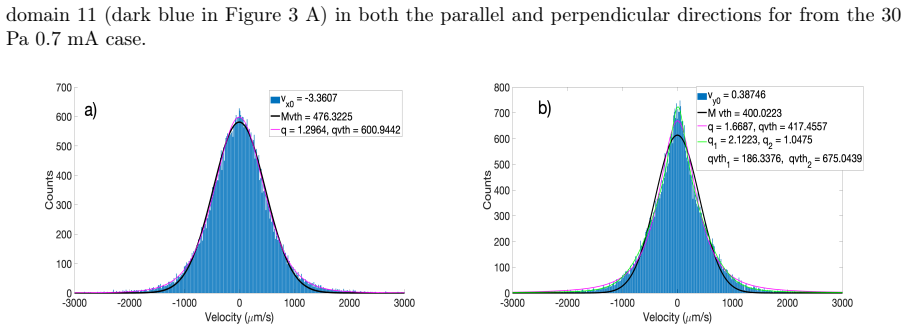
The machinery is Tsallis nonextensive statistics applied to the nonlinear Fokker-Planck equation. The paper uses the q-Gaussian solution of the porous-medium-type equation (Eq. 5) to fit displacement and velocity histograms, with the fitted nonextensive exponent $q_p$ (positions) and $q_v$ (velocities) quantifying how far the distributions are from Gaussian. The second moment of that q-Gaussian solution gives the scaling $\mathrm{MSD} \propto \tau^{2/(3-q)}$ (Eq. 8), which yields the classification $q > 5/3$, equivalently $\alpha > 3/2$, for a Lévy process. For the perpendicular direction, the key object is the Bi-q-Gaussian, a sum of two q-Gaussians that captures the coexistence of a bulk population and a fat-tailed halo.
What would settle it
A direct test would be to re-fit the axial MSD curves for the 70 Pa cases with a truncated Lévy-stable model and compare the inferred stability index with the criterion $q > 5/3$; if the Lévy index disagrees with the q-Gaussian classification, or if the MSD exponent no longer follows $\alpha = 2/(3-q)$, the crossover claim loses its support.
Extended reading notes
Core claim
The central claim is that the direction of transport in PK-4 dusty plasma determines the diffusion regime, with the mechanism being the anisotropic ion wakefield around each dust grain. In the axial direction, parallel to the electric field, MSD exponents satisfy $\alpha_\parallel > 1$ for all nine pressure-current cases and exceed the Lévy threshold $\alpha = 3/2$ in several cases, especially at 70 Pa, so the paper concludes that parallel transport is superdiffusive with a crossover to Lévy processes at higher pressure. In the perpendicular direction the MSD is smaller, shows brief subdiffusive trapping at short time delays, and the displacement and velocity histograms are best fitted by the sum of two q-Gaussians, a roughly Gaussian sub-population and a fat-tailed halo, which the paper interprets as two distinct thermodynamic populations, one classically diffusing and one superdiffusive but not Lévy. The paper also claims that the nonextensive parameter $q_{v\parallel}$ stays close to 1 even while parallel diffusion is large, indicating strong energy exchange and near-equilibrium, whereas $q_{v\perp}$ lies further from 1, signaling departure from equilibrium, and that pressure and current act as opposing controls on the equilibrium state.
Load-bearing premise
The Lévy classification from MSD uses the scaling $\alpha = 2/(3-q)$ obtained from the second moment of the q-Gaussian solution, but that second moment diverges for $q \geq 5/3$, so the relation is applied in the very regime where its derivation is no longer valid.
Editorial extensions
If this is right
- If the classification is right, parallel dust transport is superdiffusive in every pressure-current case examined, and crosses into Lévy-type jumping at the highest pressure (70 Pa).
- Cross-field transport remains anomalous but non-Lévy: a near-classical bulk population and a superdiffusive halo population coexist, which explains the Bi-q-Gaussian histograms.
- Pressure and current are opposing equilibrium controls: raising pressure cools and thermalizes the dust, while raising current increases the wakefield-driven nonequilibrium.
- Sub-domain analysis implies that single q-Gaussian fits can describe local regions even when global cross-field histograms require two populations, so global averages can obscure locally distinct thermodynamic states.
- The same Tsallis framework can classify diffusion regimes in other strongly coupled systems from a single experimental run, since the q exponents and MSD exponent are extracted from the same tracks.
Reading between the lines
- A direct extension would be to vary the polarity-switching frequency (500 Hz here) and test whether $\alpha_\parallel$ shifts, because the wakefield asymmetry that drives superdiffusion is created by the switching itself.
- Mapping the q-Gaussian to kappa distributions via $\kappa = 1/(q-1)$ suggests the cross-field Bi-q-Gaussian is the dusty-plasma analog of the solar-wind core-plus-halo structure, so the same data could be re-fitted with kappa distributions.
- The claim that electrostatic-fluctuation energy explains high dust temperatures predicts that floating-potential fluctuations of order $10^{-5}$ V should be measurable; simulations of the local wakefield potential could test this quantitatively.
- Because the global Bi-q-Gaussian may be an averaging artifact of pooling domains with different $q_v$, one test is to construct global histograms only from domains whose local $q_v$ values agree and check whether a single q-Gaussian suffices.
Editorial analysis
A structured set of objections, weighed in public.
Referee Report
Summary. The paper analyzes nine pressure-current datasets from the PK-4 microgravity dusty plasma experiment, using particle tracking data to compute mean squared displacements (MSDs) and displacement/velocity histograms. The authors fit the histograms to Tsallis q-Gaussian and bi-q-Gaussian distributions to extract nonextensive exponents qp and qv, and fit MSD curves to obtain anomalous diffusion exponents α. They report anisotropic anomalous diffusion: motion parallel to the electric field is superdiffusive and, for some high-pressure cases, crosses over to Lévy behavior, while cross-field motion is described by a superposition of two populations. They also use qv values and velocity histograms to infer nonequilibrium tendencies, temperature gradients, and a possible link between temperature gradients and the nonextensive parameter through Eq. (16).
Significance. If the central claim were fully supported, the paper would provide a valuable characterization of direction-dependent anomalous diffusion in a microgravity complex plasma, with the nonextensive framework connecting PDF shape to transport exponents. The paper's strengths include a carefully described data pipeline (particle tracking, nonhomogeneous drift subtraction with velocity-autocorrelation validation, and histogram fitting with goodness-of-fit metrics), open-source code availability, and the use of ISS experimental data. However, the central claim is currently weakened by an internal inconsistency in the MSD-based Lévy criterion, the lack of uncertainties on the key fitted parameters, and the small number of PDF cases that directly support the crossover. These issues are load-bearing for the abstract's statement that both MSDs and PDFs indicate a crossover.
major comments (3)
- [§3.2, §5.1, Eq. (8)] The MSD-based Lévy criterion α>3/2 is not a valid consequence of the Tsallis scaling relation. The paper states in §3.2 that the second moment of the q-Gaussian diverges for 5/3≤q<3, so Eq. (8) is undefined in exactly the Lévy regime that the criterion is used to identify. For q<5/3, the exponent 2/(3−q) from Eq. (8) is bounded above by 3/2, so the inequality α>3/2 cannot be produced by a finite-variance q-Gaussian. Consequently, the dashed α=3/2 line in Fig. 7 is not an independent confirmation of the qp>5/3 histogram classification, and the abstract's claim that 'Both MSDs and PDFs indicate a crossover' is not supported by the present analysis. This point should be addressed by either deriving a valid MSD-based Lévy criterion or explicitly presenting the qp fits as the only Lévy indicator.
- [§5.2, Table 2] No uncertainties are reported for any of the fitted parameters α, qp, or qv in Table 2, and the crossover to Lévy behavior rests on only two values of qp∥ (1.81 for 70 Pa/1 mA and 1.70 for 70 Pa/0.7 mA). With roughly 20k data points per case, bootstrap or fit-covariance uncertainties should be straightforward to provide; without them, the reader cannot judge whether qp∥=1.70 is statistically distinguishable from 5/3, which is load-bearing for the claimed crossover. The absence of error bars also makes it difficult to assess the trends in Figs. 7 and 9.
- [§6.1] The discussion acknowledges that only the 70 Pa/1 mA case has qp∥>5/3, while the MSD exponents α∥>3/2 for nearly all parallel cases. For cases such as 46 Pa/1 mA (qp∥=1.44, α∥=2.40), the relation α=2/(3−q) from Eq. (8) fails badly, indicating that the MSD fit is not described by the same q-Gaussian as the displacement histogram. This internal inconsistency means the statement in the conclusions that 'for several pressure-current cases, superdiffusion crosses over to a Lévy process' is not supported by the data; at most the PDF fits indicate a crossover for two high-pressure cases. The manuscript should either soften the claim or provide a mechanism that reconciles the MSD and PDF exponents.
minor comments (6)
- [§1] Typographical errors include 'microgravty' and 'non-Mazwellian'; these should be 'microgravity' and 'non-Maxwellian'.
- [§4.1] The text mentions 'MHDS' plots; this appears to be a typo for 'MSD'.
- [Fig. 5] The y-axis label 'mean squared displacement (µm/s)' has incorrect units; MSD should be in µm².
- [Eq. (11)] The limiting expression for the q-Gaussian as q→1 appears to have a misplaced factor of m in the denominator; please verify the formula.
- [Table 3] The three sub-tables for 30 Pa, 46 Pa, and 70 Pa appear to have identical entries in the first and third rows, which is likely a copy-paste error; the 46 Pa table should be checked.
- [§5.2] The notation for the scaling relation α=2/(3−q) is used inconsistently; standardizing the symbols for the MSD exponent would improve readability.
Circularity Check
The MSD-based Lévy criterion in §5.1 is derived from the same q-Gaussian second moment used to define qp>5/3, so the claimed MSD/PDF agreement is not an independent confirmation; Eq. 8 is also invalid in the regime it is used to certify.
-
self definitional
[Section 3.2 (Eqs. 8-9) and Section 5.1; abstract]
"Anomalous diffusion is described by taking the second moment of Eq. 5, which yields ... ⟨(x − x0)2⟩ = Bq(Dτ)^{2/(3−q)} ... Recall that Tsallis’ theory claims that the diffusion is a Lévy process when q >5/3. Using the scaling relation MSD = ⟨r2⟩ ∝ τ^{2/(3−qp)} [61] yields the criterion α >3/2 for a Lévy process."
The α>3/2 criterion is obtained by setting qp=5/3 in Eq. 8, which is exactly the q-Gaussian second moment whose divergence defines the Lévy condition ('The variances of these distributions are finite for q <5/3 but diverge for 5/3≤q<3'). Thus the MSD 'indicator' is not an independent observable; it is the qp>5/3 criterion restated through the model's own scaling. Moreover, Eq. 8 is derived as that second moment, so it has no validity for qp≥5/3; using it to certify α>3/2 is an extrapolation into the divergent regime. Hence the abstract's 'Both MSDs and PDFs indicate a crossover' is not two independent lines of evidence: the MSD line inherits the q-Gaussian model's definition and cannot independently confirm the histogram classification.
full rationale
The paper's central classification has one genuine self-consistency problem. In §5.1 the Lévy threshold for the MSD exponent (α>3/2) is not an independent diagnostic: it is obtained from Eq. 8, the q-Gaussian second-moment scaling, by the same condition (q=5/3) that defines the PDF Lévy crossover. Equation 8 is the second moment that the paper itself states diverges for 5/3≤q<3, so applying it to certify α>3/2 uses the model in a regime where the derived formula has no validity. The abstract's 'Both MSDs and PDFs indicate a crossover' therefore overstates the evidence; the MSD indicator is model-internal and not an independent confirmation. That said, the qp and qv histogram fits are direct measurements of the data, Table 2 reports the fitted values, and the paper openly records disagreements between α∥ and qp∥ (e.g., α∥>3/2 for nearly all parallel cases while only two high-pressure cases have qp∥>5/3). The central crossover claim therefore retains independent empirical content from the PDF analysis, and the self-citations to companion structure papers ([59], [83]) are not load-bearing for the Lévy conclusion. On balance, the circularity is partial: the MSD-based evidence reduces to the q-Gaussian model by construction, but the PDF evidence does not.
Assumptions & free parameters
free parameters (6)
- qp (nonextensive position exponent), parallel and perpendicular =
qp||: 1.25 to 1.81; qp⊥1: 0.94 to 1.40; qp⊥2: 1.10 to 1.60 (Table 2)
- qv (nonextensive velocity exponent), parallel and perpendicular =
qv||: 1.13 to 1.41; qv⊥1: 1.11 to 1.30; qv⊥2: 1.38 to 2.31 (Table 2)
- MSD exponents α|| and α⊥ =
α||: 1.50 to 2.40; α⊥: 0.88 to 1.45 (Table 2)
- Diffusion coefficients D and thermal velocities v_th =
Ranges shown in Figures 10, 14, 15
- Time delay τ = 5 s for displacement histograms =
5 s
- Number of NHDS subdomains =
12
assumptions (7)
- standard math The q-Gaussian form (Eqs. 5, 10) solves the nonlinear Fokker-Planck equation and normalizes via Eq. 7.
- ad hoc to paper The scaling MSD = Bq(Dτ)^(2/(3-q)) (Eq. 8) is valid for the fitted q values, including q ≥ 5/3.
- domain assumption After nonhomogeneous drift subtraction, residual dust motion is purely diffusive.
- domain assumption The dust is unresponsive to the 500 Hz polarity-switched field and experiences only anisotropic ion-wake interactions.
- domain assumption Cross-field histograms are superpositions of two q-Gaussians (Eq. 14), not a single q-Gaussian or another family.
- domain assumption Temperature conversion Tq(5q-3)/2 = TM (Eq. 12) applies to these dust distributions.
- ad hoc to paper Eq. 16 relating qv to thermophoretic and electric forces is qualitatively applicable to PK-4.
Cite this review
Pith. "Pith review of Anisotropic anomalous diffusion in microgravity dusty plasma. Part One: Nonextensive Statistical Analysis." pith.science (2026). https://pith.science/paper/BPA5WRZL
@misc{pith2026241115705,
  author       = {Pith},
  title        = {Pith review of: Anisotropic anomalous diffusion in microgravity dusty plasma. Part One: Nonextensive Statistical Analysis},
  year         = {2026},
  howpublished = {\url{https://pith.science/paper/BPA5WRZL}},
  note         = {Machine review of arXiv:2411.15705}
}
read the original abstract
Anisotropic anomalous dust diffusion in microgravity dusty plasma is investigated using experimental data from the Plasmakristall-4 (PK-4) facility on board the International Space Station. The PK-4 experiment uses video cameras to track individual dust particles, which allows the collection of large amounts of statistical information on the dust particle positions and velocities. These statistics are used to quantify anomalous dust diffusion caused by anisotropies in the plasma-mediated dust-dust interactions in PK-4. Anisotropies are caused by an externally applied polarity-switched electric field, which modifies the ion wakefields surrounding the dust grains. Video data for nine sets of pressure-current conditions are used to recover Mean Squared Displacement (MSD) plots after subtracting particle drift. Position and velocity histograms are fitted to Tsallis nonextensive probability distribution functions (PDFs). Both MSDs and PDFs indicate a crossover from suprathermal to L\'evy diffusion in the axial direction at higher pressure conditions. In addition, increasing the pressure enhances dust thermal equilibrium, while increasing the current drives the system away from equilibrium.
Figures


Figures from the paper (17 more)




Forward citations
Cited by 1 Pith paper
-
Structural States of Filamentary Microgravity Dusty Plasma
Dust filaments in microgravity dusty plasma show pressure-dependent ordering patterns analogous to nematic and smectic liquid crystal phases.
Reference graph
Works this paper leans on
-
[1]
P. K. Shukla. A survey of dusty plasma physics.Physics of Plasmas, 2001
2001
-
[2]
R. L. Merlino, J. R. Heinrich, S.-H. Hyun, and J. K. Meyer. Nonlinear dust acoustic waves and shocks. Physics of Plasmas, 19(5), March 2012
2012
-
[3]
S. A. Khrapak, B. A. Klumov, P. Huber, V. I. Molotkov, A. M. Lipaev, V. N. Naumkin, A. V. Ivlev, H. M. Thomas, M. Schwabe, G. E. Morfill, Yu. Malentschenko, S. Volkov, et al. Fluid-solid phase transitions in three-dimensional complex plasmas under microgravity conditions.Physical Review E, 2012
2012
-
[4]
Made to order: Researchers discover a new form of crystalline matter
American Physical Society. Made to order: Researchers discover a new form of crystalline matter. https://phys.org/news/2015-11-crystalline.html, 2015. Accessed: 2024-08-14
2015
-
[5]
Kostadinova, Emerson Gehr, Bradley Andrew, Lorin S
Evdokiya G. Kostadinova, Emerson Gehr, Bradley Andrew, Lorin S. Matthews, Truell W. Hyde, and Abbie Terrell. Liquid plasma crystals on the ISS. InAIAA SCITECH 2023 Forum. American Institute of Aeronautics and Astronautics, January 2023
2023
-
[6]
M. G. Hariprasad, P. Bandyopadhyay, V. S. Nikolaev, D. A. Kolotinskii, S. Arumugam, G. Arora, S. Singh, A. Sen, and A. V. Timofeev. Self-sustained non-equilibrium co-existence of fluid and solid states in a strongly coupled complex plasma system.Scientific Reports, 12(1), August 2022
2022
-
[7]
Alexei V. Ivlev, Philip C. Brandt, Gregor E. Morfill, Christoph Rath, Hubertus M. Thomas, Glenn Joyce, Vladimir E. Fortov, Andrey M. Lipaev, Vladimir I. Molotkov, and Oleg F. Petrov. Elec- trorheological complex plasmas.IEEE Transactions on Plasma Science, 38(4):733–740, April 2010. Conference Name: IEEE Transactions on Plasma Science
work page 2010
-
[8]
V. N. Tsytovich, U. De Angelis, R. Bingham, and D. Resendes. Long-range correlations in dusty plasmas. Physics of Plasmas, 1997
1997
Show all 86 references
-
[9]
Smith, J
B. Smith, J. Vasut, T. Hyde, L. Matthews, J. Reay, M. Cook, and J. Schmoke. Dusty plasma correlation function experiment.Advances in Space Research, 34(11):2379–2383, 2004
2004
-
[10]
Correia, Emerson J
Matheus V. Correia, Emerson J. Freitas, Leonardo R. E. Cabral, and Clécio C. de Souza Silva. Structural phases of classical 2d clusters with competing two-body and three-body interactions. Journal of Physics: Condensed Matter, 35(41):415404, July 2023. 27
2023
-
[11]
Lazar, Shahzad Mahmood, Aman-ur-Rehman, and S
Kashif Arshad, M. Lazar, Shahzad Mahmood, Aman-ur-Rehman, and S. Poedts. Kinetic study of electrostatic twisted waves instability in nonthermal dusty plasmas. Physics of Plasmas, 24(2):023701, 2017
2017
-
[12]
O. F. Petrov, V. E. Fortov, O. S. Vaulina, A. V. Chernyshev, S. N. Antipov, A. V. Gavrikov, and I. A. Shakhova. Experimental study of dusty plasma kinetics.Physica Scripta, 72(2):205–207, 2005
2005
-
[13]
Goree, M
Bin Liu, J. Goree, M. Y. Pustylnik, H. M. Thomas, V. E. Fortov, A. M. Lipaev, A. D. Usachev, V. I. Molotkov, O. F. Petrov, and M. H. Thoma. Particle velocity distribution in a three-dimensional dusty plasma under microgravity conditions.AIP Conference Proceedings, 1925(1):020003, 2018
1925
-
[14]
PhD thesis, The University of Iowa, 2010
Yan Feng.Microscopic dynamics in two-dimensional strongly-coupled dusty plasmas. PhD thesis, The University of Iowa, 2010
2010
-
[15]
Joshi, M
E. Joshi, M. Y. Pustylnik, M. H. Thoma, H. M. Thomas, and M. Schwabe. Recrystallization in string-fluid complex plasmas.Physical Review Research, 5(1):013086, March 2023
2023
-
[16]
E. G. Kostadinova, R. Banka, J. L. Padgett, C. D. Liaw, L. S. Matthews, and T. W. Hyde. Fractional Laplacian spectral approach to turbulence in a dusty plasma monolayer.Physics of Plasmas, 28(12):123703, 2021
2021
-
[17]
Observation of kolmogorov turbulence due to multiscale vortices in dusty plasma experiments.Physics of Plasmas, 31(1):013701, 2024
Sachin Sharma, Rauoof Wani, Prabhakar Srivastav, Meenakshee Sharma, Sayak Bose, Yogesh Saxena, and Sanat Tiwari. Observation of kolmogorov turbulence due to multiscale vortices in dusty plasma experiments.Physics of Plasmas, 31(1):013701, 2024
2024
-
[18]
A review on the vortex and coherent structures in dusty plasma medium
Mangilal Choudhary. A review on the vortex and coherent structures in dusty plasma medium. Physics of Plasmas, 31(1):013702, 2024
2024
-
[19]
Stronglycoupledplasmaphysicsandhighenergy-densitymatter
M.S.Murillo. Stronglycoupledplasmaphysicsandhighenergy-densitymatter. Physics of Plasmas, 11(5):2964–2971, 2004
2004
-
[20]
A. V. Ivlev, G. E. Morfill, H. M. Thomas, C. Räth, G. Joyce, P. Huber, R. Kompaneets, V. E. Fortov, A. M. Lipaev, V. I. Molotkov, T. Reiter, M. Turin, and P. Vinogradov. First observation of electrorheological plasmas.Physical Review Letters, 100(9):095003, March 2008
2008
-
[21]
Phasetransitioninelectrorheologicalplasmas
ChristopherDietz, JohannesBudak, TobiasKamprich, MichaelKretschmer, andMarkusH.Thoma. Phasetransitioninelectrorheologicalplasmas. Contributions to Plasma Physics, 61(10):e202100079, 2021
2021
-
[22]
Beckers, J
J. Beckers, J. Berndt, D. Block, M. Bonitz, P. J. Bruggeman, L. Couëdel, G. L. Delzanno, Y. Feng, R. Gopalakrishnan, F. Greiner et al. Physics and applications of dusty plasmas: The perspectives
-
[23]
Perspective: Dusty plasma experiments—a learning tool for physics graduate students
Mangilal Choudhary. Perspective: Dusty plasma experiments—a learning tool for physics graduate students. European Journal of Physics, 42(6):065203, 2021
2021
-
[24]
Robert L. Merlino. Dusty plasmas: from Saturn’s rings to semiconductor processing devices. Advances in Physics: X, 6(1):1873859, 2021
2021
-
[25]
E. G. Kostadinova, K. Busse, N. Ellis, J. Padgett, C. D. Liaw, L. S. Matthews, and T. W. Hyde. Delocalization in infinite disordered two-dimensional lattices of different geometry.Physical Review B, 96(23):235408, 2017
2017
-
[26]
E. G. Kostadinova, C. D. Liaw, L. S. Matthews, and T. W. Hyde. Physical interpretation of the spectral approach to delocalization in infinite disordered systems. Materials Research Express, 3(12):125904, 2016
2016
-
[27]
E. G. Kostadinova, F. Guyton, A. Cameron, K. Busse, C. D. Liaw, L. S. Matthews, and T. W. Hyde. Transport properties of disordered two-dimensional complex plasma crystal.Contributions to Plasma Physics, 58(2-3):209–216, 2018. 28
2018
-
[28]
Goree, and Yan Feng
Bin Liu, J. Goree, and Yan Feng. Non-Gaussian statistics and superdiffusion in a driven-dissipative dusty plasma. Physical Review E, 78(2):026405, 2008
2008
-
[29]
M. Y. Pustylnik, M. A. Fink, V. Nosenko, T. Antonova, T. Hagl, H. M. Thomas, A. V. Zob- nin, A. M. Lipaev, A. D. Usachev, V. I. Molotkov et al. Plasmakristall-4: New complex (dusty) plasma laboratory on board the International Space Station. Review of Scientific Instruments, 8...
2016
-
[30]
V. N. Naumkin, D. I. Zhukhovitskii, A. M. Lipaev, A. V. Zobnin, A. D. Usachev, O. F. Petrov, H. M. Thomas, M. H. Thoma, O. I. Skripochka, and A. A. Ivanishin. Excitation of progressing dust ionization waves on pk-4 facility.Physics of Plasmas, 28(10):103701, 2021
2021
-
[31]
Mendoza, D
A. Mendoza, D. Jiménez Martí, L. S. Matthews, B. Rodríguez Saenz, P. Hartmann, E. Kostadinova, M. Rosenberg, and T. W. Hyde. Ion density waves driving the formation of filamentary dust structures. Physics of Plasmas, 31(1):013701, 2024
2024
-
[32]
Goree, Bin Liu, M
J. Goree, Bin Liu, M. Y. Pustylnik, H. M. Thomas, V. E. Fortov, A. M. Lipaev, V. I. Molotkov, A. D. Usachev, O. F. Petrov, M. H. Thoma, E. Thomas, U. Konopka, and S. Prokopiev. Correlation and spectrum of dust acoustic waves in a radio-frequency plasma using pk-4 on the intern...
2020
-
[33]
Bin Liu, John Goree, M. Y. Pustylnik, H. M. Thomas, V. E. Fortov, A. M. Lipaev, A. D. Usachev, O. F. Petrov, A. V. Zobnin, and M. H. Thoma. Time-dependent shear motion in a strongly coupled dustyplasmainpk-4ontheinternationalspacestation(iss). IEEE Transactions on Plasma Scien...
2021
-
[34]
Lunarexosphere: Dust-in-plasma? dustyplasma? Journal of Space Operations and Communicator, 20(4), 2024
RonaldH.Freeman. Lunarexosphere: Dust-in-plasma? dustyplasma? Journal of Space Operations and Communicator, 20(4), 2024
2024
-
[35]
PeterHartmann, MarleneRosenberg, ZoltanJuhasz, LorinS.Matthews, DustinL.Sanford, Katrina Vermillion, Jorge Carmona-Reyes, and Truell W. Hyde. Ionization waves in the pk-4 direct current neon discharge. Plasma Sources Science and Technology, 29(11):115014, November 2020
2020
-
[36]
Matthews, Peter Hartmann, Marlene Rosenberg, Evdokiya Kostadinova, Jorge Carmona-Reyes, Truell W
Katrina Vermillion, Dustin Sanford, Lorin S. Matthews, Peter Hartmann, Marlene Rosenberg, Evdokiya Kostadinova, Jorge Carmona-Reyes, Truell W. Hyde, Andrey M. Lipaev, Alexandr D. Usachev et al. Influence of temporal variations in plasma conditions on the electric potential nea...
2022
-
[37]
Kostadinova, Peter Hartmann, Lorin S
Katrina Vermillion, Abbie Terrell, Emerson Gehr, Evdokiya G. Kostadinova, Peter Hartmann, Lorin S. Matthews, and Truell W. Hyde. Numerical modeling of the plasmakristall-4 experiment on the iss. InAIAA SCITECH 2023 Forum. American Institute of Aeronautics and Astronautics, Jan...
2023
-
[38]
TNF and IL-1 exhibit distinct ubiquitin requirements for inducing NEMO–IKK supramolecular structures.Jour- nal of Cell Biology, 204(2):231–245, January 2014
Nadine Tarantino, Jean-Yves Tinevez, Elizabeth Faris Crowell, Bertrand Boisson, Ricardo Hen- riques, Musa Mhlanga, Fabrice Agou, Alain Israël, and Emmanuel Laplantine. TNF and IL-1 exhibit distinct ubiquitin requirements for inducing NEMO–IKK supramolecular structures.Jour- na...
2014
-
[39]
Liberating Lévy walk research from the shackles of optimal foraging.Physics of Life Reviews, 14:59–83, September 2015
Andy Reynolds. Liberating Lévy walk research from the shackles of optimal foraging.Physics of Life Reviews, 14:59–83, September 2015
2015
-
[40]
Benhamou
M. Benhamou. Lecture on the anomalous diffusion in Condensed Matter Physics.Materials and Devices, 3(1):1–12, 2018
2018
-
[41]
Goree, and Bin Liu
Yan Feng, J. Goree, and Bin Liu. Identifying anomalous diffusion and melting in dusty plasmas. Physical Review E, 81(3):036403, March 2010
2010
-
[42]
Anoma- lous Diffusion: A Basic Mechanism for the Evolution of Inhomogeneous Systems
FernandoA.Oliveira, RogelmaM.S.Ferreira, LucianoC.Lapas, andMendeliH.Vainstein. Anoma- lous Diffusion: A Basic Mechanism for the Evolution of Inhomogeneous Systems. Frontiers in Physics, 7:18, February 2019. 29
2019
-
[43]
Daniels, Christian Beck, and Eberhard Bodenschatz
Karen E. Daniels, Christian Beck, and Eberhard Bodenschatz. Defect turbulence and generalized statistical mechanics. Physica D: Nonlinear Phenomena, 193(1-4):208–217, June 2004
2004
-
[44]
A. M. Reynolds and M. Veneziani. Rotational dynamics of turbulence and Tsallis statistics.Physics Letters A, 327(1):9–15, June 2004
2004
-
[45]
AGING IN EARTHQUAKE MODELS Complexity, Metastability and Nonexten- sivity
Urgur Tirnakli. AGING IN EARTHQUAKE MODELS Complexity, Metastability and Nonexten- sivity. World Scientific, 2005
2005
-
[46]
A. Y. Abul-Magd. Nonextensive random matrix theory approach to mixed regular-chaotic dynam- ics. Physical Review E, 71(6):066207, June 2005
2005
-
[47]
Ivanova, H
K. Ivanova, H. N. Shirer, T. P. Ackerman, and E. E. Clothiaux. Dynamical model and nonextensive statistical mechanics of liquid water path fluctuations in stratus clouds.Journal of Geophysical Research: Atmospheres, 112(D15):D15207, August 2007
2007
-
[48]
Douglas, S
P. Douglas, S. Bergamini, and F. Renzoni. Tunable Tsallis Distributions in Dissipative Optical Lattices. Physical Review Letters, 96(11):110601, March 2006
2006
-
[49]
Bediaga, E
I. Bediaga, E. M. F. Curado, and J. M. de Miranda. A nonextensive thermodynamical equilibrium approach in hadrons. Physica A: Statistical Mechanics and its Applications, 286(1-2):156–163, October 2000
2000
-
[50]
L. P. Karakatsanis, G. P. Pavlos, and M. N. Xenakis. Tsallis non-extensive statistics, intermittent turbulence, SOC and chaos in the solar plasma. part two: Solar flares dynamics. Physica A: Statistical Mechanics and its Applications, 392(18):3920–3944, September 2013
2013
-
[51]
G. P. Pavlos, L. P. Karakatsanis, and M. N. Xenakis. Tsallis non-extensive statistics, intermittent turbulence, SOC and chaos in the solar plasma, part one: Sunspot dynamics.Physica A: Statistical Mechanics and its Applications, 391(24):6287–6319, 2012
2012
-
[52]
Danny Summers and Richard M. Thorne. The modified plasma dispersion function.Physics of Fluids B: Plasma Physics, 3(8):1835–1847, August 1991
1991
-
[53]
A nonextensive approach for the instability of current-driven ion-acoustic waves in space plasmas.Physics of Plasmas, 16(7):072903, July 2009
Zhipeng Liu, Liyan Liu, and Jiulin Du. A nonextensive approach for the instability of current-driven ion-acoustic waves in space plasmas.Physics of Plasmas, 16(7):072903, July 2009
2009
-
[54]
Linear analysis of whistler mode instability in anisotropic q- nonextensive distributed plasmas: a numerical approach
Muhammad Bilal, Aman ur Rehman, Mushtaq Ahmad, Muhammad Ahsan Shahzad, Muhammad Sarfraz, and Shahzad Mahmood. Linear analysis of whistler mode instability in anisotropic q- nonextensive distributed plasmas: a numerical approach. Physica Scripta, 98(9):095607, August 2023
2023
-
[55]
Thecollisionfrequenciesintheplasmaswiththepower-lawq-distributions in nonextensive statistics.Physica A: Statistical Mechanics and its Applications, 566:125623, 2021
YueWangandJiulinDu. Thecollisionfrequenciesintheplasmaswiththepower-lawq-distributions in nonextensive statistics.Physica A: Statistical Mechanics and its Applications, 566:125623, 2021
2021
-
[56]
Dust charging processes in the nonequilibrium dusty plasma with nonextensive power-law distribution.Physics of Plasmas, 19(2):023702, February 2012
Jingyu Gong and Jiulin Du. Dust charging processes in the nonequilibrium dusty plasma with nonextensive power-law distribution.Physics of Plasmas, 19(2):023702, February 2012
2012
-
[57]
Dust acoustic instability driven by drifting ions and electrons in the dust plasma with lorentzian kappa distribution.Physics of Plasmas, 16(12):123707, December 2009
Zhipeng Liu and Jiulin Du. Dust acoustic instability driven by drifting ions and electrons in the dust plasma with lorentzian kappa distribution.Physics of Plasmas, 16(12):123707, December 2009
2009
-
[58]
Fiji: An Open-Source Platform for Biological-Image Analysis.Nature Methods, 9(7):676–682, July 2012
Johannes Schindelin, Ignacio Arganda-Carreras, Erwin Frise, Verena Kaynig, Mark Longair, Tobias Pietzsch, Stephan Preibisch, Curtis Rueden, Stephan Saalfeld, Benjamin Schmid et al. Fiji: An Open-Source Platform for Biological-Image Analysis.Nature Methods, 9(7):676–682, July 2012
2012
-
[59]
Structural states of filamentary microgravity dusty plasma
Emerson Gehr, Abbie Terrell, Katrina Vermillion, and Alexandria Mendoza. Structural states of filamentary microgravity dusty plasma. In review forPhysics of Plasmas, 2025
2025
-
[60]
Springer Series in Synergetics
Till Daniel Frank.Nonlinear Fokker-Planck Equations: Fundamentals and Applications. Springer Series in Synergetics. Springer, 2005. 30
2005
-
[61]
Introduction to Nonextensive Statistical Mechanics: Approaching a Complex World
Constantino Tsallis. Introduction to Nonextensive Statistical Mechanics: Approaching a Complex World. Springer, New York, 2009
2009
-
[62]
J. L. Padgett, E. G. Kostadinova, C. D. Liaw, K. Busse, L. S. Matthews, and T. W. Hyde. Anoma- lous diffusion in one-dimensional disordered systems: A discrete fractional Laplacian method.Jour- nal of Physics A: Mathematical and Theoretical, 53(18):185701, April 2020
2020
-
[63]
Some properties of q-Gaussian distributions.arXiv preprint arXiv:2101.00516, 2021
Nahla Ben Salah. Some properties of q-Gaussian distributions.arXiv preprint arXiv:2101.00516, 2021
2021 arXiv
-
[64]
Identification of time scales of the violation of the Stokes–Einstein relation in Yukawa liquids.Physics of Plasmas, 28(4):043703, April 2021
Zahra Ghannad. Identification of time scales of the violation of the Stokes–Einstein relation in Yukawa liquids.Physics of Plasmas, 28(4):043703, April 2021
2021
-
[65]
Possible generalization of Boltzmann-Gibbs statistics.Journal of Statistical Physics, 52(1-2):479–487, July 1988
Constantino Tsallis. Possible generalization of Boltzmann-Gibbs statistics.Journal of Statistical Physics, 52(1-2):479–487, July 1988
1988
-
[66]
Shivanandan, A
A. Shivanandan, A. Radenovic, and I. F. Sbalzarini. MosaicIA: An ImageJ/Fiji plugin for spatial pattern and interaction analysis.BMC Bioinformatics, 14:349, December 2013
2013
-
[67]
Avinash, R
K. Avinash, R. L. Merlino, and P. K. Shukla. Anomalous dust temperature in dusty plasma experiments. Physics Letters A, 375(30-31):2854–2857, July 2011
2011
-
[68]
Nonextensivity in nonequilibrium plasma systems with Coulombian long-range interac- tions
Jiulin Du. Nonextensivity in nonequilibrium plasma systems with Coulombian long-range interac- tions. Physics Letters A, 329(3):262–273, November 2004
2004
-
[69]
The nonextensive parameter for nonequilibrium plasmas in magnetic field
Yu Haining and Du Jiulin. The nonextensive parameter for nonequilibrium plasmas in magnetic field. Physica A: Statistical Mechanics and its Applications, 410:302–309, August 2014
2014
-
[70]
R. A. Treumann, C. H. Jaroschek, and M. Scholer. Stationary plasma states far from equilibrium. Physics of Plasmas, 11(4):1317–1325, April 2004
2004
-
[71]
Livadiotis, M
G. Livadiotis, M. I. Desai, and L. B. Wilson. Generation of Kappa distributions in solar wind at 1 au. The Astrophysical Journal, 853(2):142, February 2018
2018
-
[72]
M. P. Leubner and Z. Vörös. A nonextensive entropy approach to solar wind intermittency.The Astrophysical Journal, 618(1):547–555, January 2005
2005
-
[73]
Anjos, and Ernesto P
Constantino Tsallis, Joao C. Anjos, and Ernesto P. Borges. Fluxes of cosmic rays: A delicately balanced stationary state.Physics Letters A, 310(5-6):372–376, December 2003
2003
-
[74]
L. F. Burlaga and A. F. Viñas. Tsallis distributions of the large-scale magnetic field strength fluctuations in the solar wind from 7 to 87 au.Journal of Geophysical Research: Space Physics, 110(A7):A07106, July 2005
2005
-
[75]
A. V. Ivlev, G. E. Morfill, U. Konopka, and M. Kretschmer. Electrorheology of complex plasmas. Physical Review Letters, 106(15):155001, 2011. DOI: 10.1103/PhysRevLett.106.155001
2011 doi
-
[76]
M. Y. Pustylnik, S. A. Khrapak, A. G. Khrapak, M. H. Thoma, H. M. Thomas, G. E. Morfill, A. M. Lipaev, A. D. Usachev, V. I. Molotkov, O. F. Petrov, A. V. Zobnin, and V. E. Fortov. Electrorheological phenomena in dusty plasma.Physical Review Research, 2(3):033314, 2020. DOI: 10...
2020 doi
-
[77]
D. I. Zhukhovitskii. On the controversy of dust ionization waves.Physics of Plasmas, 29(7):073701,
-
[78]
M. Y. Pustylnik. Dust ionization wave analysis and response to critiques. Physics of Plasmas, 29(11):114701, 2022. DOI: 10.1063/5.0116237
2022 doi
-
[79]
L. S. McCabe, J. Williams, S. C. Thakur, U. Konopka, E. G. Kostadinova, M. Y. Pustylnik, H. M. Thomas, M. H. Thoma, and E. Thomas. Experiments and modeling of dust particle heating resulting from changes in polarity switching in the PK-4 microgravity laboratory.arXiv preprint,
-
[80]
Hartmann, M
P. Hartmann, M. Rosenberg, Z. Juhasz, L. S. Matthews, D. L. Sanford, K. Vermillion, J. Carmona- Reyes and T. W. Hyde Ionization waves in the PK-4 direct current neon discharge.Plasma Sources Science and Technology, 2020. https://iopscience.iop.org/article/10.1088/1361-6595/ abb955
2020 doi
-
[81]
L. S. Matthews, T. W. Hyde, K. Vermillion, D. Sanford, P. Hartmann, M. Rosen- berg, E. G. Kostadinova, and J. Carmona-Reyes. Effect of ionization waves on dust chain formation in a DC discharge. Journal of Plasma Physics , 2020. https://www.cambridge.org/core/journals/journal-...
2020
-
[82]
Vermillion, D
K. Vermillion, D. Sanford, L. S. Matthews, P. Hartmann, M. Rosenberg, E. G. Kostadinova, J. Carmona-Reyes, T. W. Hyde, A. M. Lipaev, A. D. Usachev et al. Influence of temporal variations in plasma on dust-dust interactions. Physics of Plasmas, 2022. https://pubs.aip.org/aip/po...
2022
-
[83]
Liquid Plasma Crystals on the ISS,
E. G. Kostadinova, E. Gehr, B. Andrew, L. S. Matthews, T. W. Hyde, and A. Terrell, “Liquid Plasma Crystals on the ISS,” inAIAA SCITECH 2023 Forum, p. 2615, 2023. 32
2023
-
[2022]
DOI: 10.1063/5.0098892
-
[2023]
Physics of Plasmas, 30(12):120601, December 2023
2023
-
[2025]
https://arxiv.org/abs/2501.12248. 31
Reviewed August 12, 2026 · model on record in the stance chip above.
Discussion (0). Continue with ORCID to comment.