REVIEW 2 major objections 5 minor 8 references
Occupation and diffusion of interstitial solutes in dilute alloys in perspective of the Gauss Legendre three square theorem
T0 review · 2 major / 5 minor · reviewed 2026-08-12 · deepseek-v4-flash
Pith's one-line read The equivalent occupation sites of interstitial solutes in dilute alloys form exactly seven polyhedra.
desk verdict A modest, correct application of the three-square theorem to a materials diffusion problem, with an abstract that overstates the seven-polyhedron claim and a proof that is sketched, not finished. read the letter →
The pith
A machine-rendered reading of the paper's core claim, the machinery that carries it, and where it could break.
The reading
What carries the argument
The load-bearing object is the Gauss–Legendre three-square theorem, used as a sieve on neighbor-shell distances: a shell at squared distance $i$ exists precisely when $i$ is not of the form $4^k(8m+7)$. Equally important is the coordinate notation $(a,b,c)$ for points of the simple cubic lattice formed by BCC lattice sites and octahedral interstitial sites, with the substitutional solute at the origin. Connecting all equivalent sites of one shell forms the convex hull of the signed coordinate-permutation orbit of $(a,b,c)$, and the equality and zero pattern of $a,b,c$ decides which of the seven polyhedra that hull is. One-step migration paths are the axis steps $(a\pm1,b\pm1,c\pm1)$ that stay on interstitial sites, and the graph of these paths is shown to be the Wythoffian operation diagram of the cube-octahedron family, that is, the standard truncation and rectification operations that generate uniform polyhedra from a cube or octahedron seed.
What would settle it
Search for a shell of geometrically equivalent interstitial positions around one substitutional solute in a dilute BCC alloy whose relaxed convex hull is not one of the seven listed polyhedra, for example a density-functional calculation of carbon near a substitutional solute in iron that shows occupied sites shifted off exact integer coordinates. Alternatively, enumerate all integer triples $a\ge b\ge c$ up to a large bound and check whether the convex hull of the signed permutation orbit is always one of the seven types; a single outside type would disprove the claimed exhaustiveness.
Extended reading notes
Core claim
The central discovery is that the geometry of interstitial occupation and migration in dilute alloys is fixed by the representation $i=a^2+b^2+c^2$. For a substitutional solute at the origin, an octahedral interstitial site or host lattice site is a point $(a,b,c)$ with nonnegative integers $a\ge b\ge c$, and its squared distance is $i$. By the Gauss–Legendre three-square theorem, shells with $i=7,15,23,28,\dots$ cannot occur, and when all equivalent sites of an existing shell are joined as vertices, the convex polyhedron is determined solely by which coordinates are zero and which are equal: $a=b=c\ne 0$ gives a cube; $a\ne 0$, $b=c=0$ gives an octahedron; $a=b\ne 0$, $c=0$ gives a cuboctahedron; $a\ne b$, $c=0$ gives a truncated octahedron; $a=b>c$ gives a truncated cube; $a>b=c$ gives a rhombicuboctahedron; and $a>b>c$ gives a truncated cuboctahedron. The paper argues that this seven-way case split exhausts all nonnegative triples, so no further polyhedron type can occur.
Load-bearing premise
The load-bearing assumption is that host lattice sites and interstitial sites form an exact simple cubic lattice with integer coordinates relative to the substitutional solute, so every squared distance is exactly a sum of three squares; lattice relaxation or electronic distortion that moves a site off that lattice would break the shell counts and the seven polyhedron shapes.
Editorial extensions
If this is right
- If the classification is correct, the 7th, 15th, 23rd, and 28th neighbor shells of a substitutional solute do not exist as octahedral interstitial or lattice sites in the simple-cubic scheme, so earlier neighbor lists that included them are overcomplete.
- Every allowed one-step jump of C, N, or O in dilute BCC iron changes exactly one coordinate by $\pm1$, and from a given octahedral site at most four of the six axis directions are viable because the other two land on lattice sites.
- The same $(a,b,c)$ notation labels migration paths without computing energetics, giving a purely geometric pruning rule for kinetic Monte Carlo and rate-theory diffusion models.
- The seven-polyhedron list and the Wythoffian diagram transfer to any host in which interstitial sites and lattice sites together form a simple cubic lattice, including vacancy diffusion in appropriate dilute alloys.
Reading between the lines
- Beyond the paper, the seven shapes depend only on equality and zero patterns of $(a,b,c)$, not on the chemical identity of host or solute, so the same list should appear in any dilute alloy with an exact cubic interstitial grid whenever relaxation is negligible.
- The appearance of Wythoffian operations suggests the diffusion graph is the edge graph of the uniform polyhedra in the cube-octahedron family; one could test whether jump sequences observed in atomistic simulations follow those graph edges in the same proportions the diagram predicts.
- The classification is purely geometric, so it also predicts where relaxation will first blur the picture: at small $a,b,c$, where a site displacement is largest relative to the shell radius, the exact polyhedron should be most easily distorted.
Editorial analysis
A structured set of objections, weighed in public.
Referee Report
Summary. The manuscript applies the Gauss–Legendre three-square theorem to the classification of the polyhedra formed by equivalent neighbor sites around a substitutional solute in a dilute alloy. The host BCC lattice and its octahedral interstitial sites are modeled as a simple cubic lattice in units of half the lattice parameter, so each site has integer coordinates (a,b,c) and squared distance i = a^2+b^2+c^2. The paper argues that the sites whose distances are integers not of the form 4^k(8m+7) are exactly those allowed by the theorem, and that connecting all equivalent i-th neighbor sites yields one of seven polyhedra: cube, octahedron, cuboctahedron, truncated octahedron, truncated cube, rhombicuboctahedron, and truncated cuboctahedron. The author then uses a parity rule to distinguish octahedral interstitial sites from host lattice sites, derives that an interstitial site has at most four possible first-neighbor jumps to other interstitial sites, and observes that the abstracted migration-path diagram corresponds to Wythoffian operations on the cube–octahedron family.
Significance. If the classification is correct, it offers a clean mathematical organizing principle for the local geometry of interstitial solutes near a substitutional solute, with potential generalization to other host lattices. The paper's derivation is based on an external theorem with no free parameters, and the vertex/edge/face counts in Table 2 are internally consistent with the stated criteria. The identification of exactly seven polyhedral types is a falsifiable claim that can be checked by enumerating integer triples. The connection to Wythoffian operations is an original and interesting observation. These strengths make the paper potentially valuable despite the presentation issues detailed below.
major comments (2)
- [Abstract and Section 3 (parity rule)] The abstract claims that 'the polyhedron consisting of equivalent occupation of interstitial solutes in dilute alloys' is classified into 7 groups including the cube. However, according to the parity rule stated in Section 3, a site (a,b,c) is a host lattice site when a, b, c are all odd or all even; for the cube type this requires a=b=c, hence all cube vertices are host lattice sites, not octahedral interstitial sites. The seven-type classification is therefore valid only for the union of octahedral interstitial sites and host lattice sites, as the conclusion in Section 4 correctly states. The abstract (and the opening of Section 3) should be reworded to make this restriction explicit, or the number of types for pure octahedral interstitial sites (six, excluding the cube) should be stated. This is a load-bearing inconsistency because the main claim is misstated.
- [Section 3 (classification rule and 'No more polyhedron can be found')] The paper asserts that the classification into seven types is exhaustive, but the proof of this exhaustiveness is incomplete. The list of seven criteria in terms of (a,b,c) covers all possible relative magnitudes, yet the paper only illustrates the rhombicuboctahedron case (a>b=c) and asserts the polyhedral identity for the other six cases without showing the vertex configuration or face structure. To make the 'no more polyhedron' claim rigorous, the authors should provide for each criterion the set of vertex coordinates, the faces, and the resulting (Nv,Nf,Ne), or an explicit geometric argument demonstrating that the named polyhedron is the unique convex hull of the equivalent sites. Without this, the reader cannot verify that no other polyhedron can arise.
minor comments (5)
- [Section 2] The maximal concentrations of substitutional solutes are given as 1.85, 0.78, 0.40, and 0.23 at.% with no derivation or citation; please provide the calculation or a reference.
- [Section 2] The statement that 'most attractive/repulsive interactions between C, N, O and substitutional solute usually occur at the 1st, 2nd or 5th neighbor distances' is made without a citation; please add a reference or qualify it as an assumption.
- [Section 3] The grammar should be corrected: 'neighbor sites does not exist' should be 'neighbor sites do not exist'; 'vertexes' should be 'vertices'; 'in consistent with' should be 'consistent with'.
- [Figure 3] Figure 3 introduces colored points corresponding to the seven polyhedron types but the mapping of colors to types is only given in the caption; consider adding a table or legend in the main text for clarity.
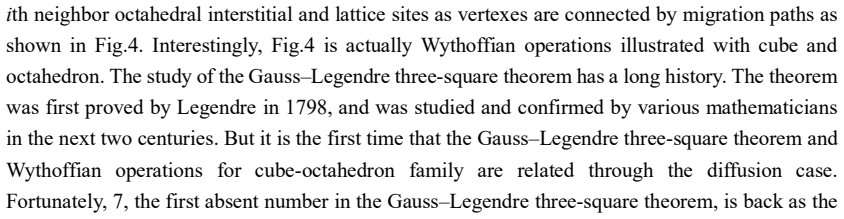
- [Section 4] The phrase 'the Wythoffian operations illustrated with cube and octahedron is observed' should specify the operations (e.g., truncation, rectification) and explain how they are read off from Fig. 4; the claim is currently more suggestive than demonstrated.
Circularity Check
No significant circularity: the seven-polyhedron classification follows from an external number-theoretic theorem plus an explicit case split on (a,b,c), with no fitted parameter or load-bearing self-citation.
full rationale
The derivation chain is self-contained apart from an external mathematical theorem. The paper assumes that, relative to a substitutional solute at the origin, the octahedral interstitial sites and host lattice sites form a simple cubic lattice, so that squared distances are exactly i = a^2 + b^2 + c^2. The Gauss–Legendre three-square theorem is then used only to eliminate integer triples corresponding to numbers of the form 4^k(8m+7); this is an external, machine-independent mathematical result, not an input derived from the paper's conclusions. For each admissible triple (a,b,c) with a≥b≥c≥0, the paper classifies the orbit under sign changes and coordinate permutations into one of seven polyhedra: cube, octahedron, cuboctahedron, truncated octahedron, truncated cube, rhombicuboctahedron, and truncated cuboctahedron. The asserted exhaustiveness follows from the fact that the equalities and inequalities among a, b, and c exhaust all possibilities. No output quantity is used to define the input, no parameter is fitted and then called a prediction, and no central step rests on a self-citation: references [4-6] by the author are used only as background for the neighbor-site notation, not to justify the classification or its uniqueness. The numeric coincidence that 7 is both the first number excluded by the three-square theorem and the number of polyhedral types is explicitly noted as a curiosity, not used as a derivation. The only substantive concern visible in the manuscript is an internal wording issue: the abstract says the polyhedra consist of equivalent occupation of interstitial solutes, while Table 1 and Section 3 include cube vertices with a=b=c, which the parity rule identifies as host lattice sites rather than octahedral interstitial sites. That is a correctness or presentation issue, not circularity, because it does not involve the conclusion feeding back into the premises. Therefore the circularity score is 0.
Assumptions & free parameters
assumptions (2)
- domain assumption The octahedral interstitial sites and BCC lattice sites form a simple cubic lattice with integer coordinates around a substitutional solute at the origin.
- domain assumption Interstitial solutes C, N, O occupy octahedral sites in BCC iron.
Cite this review
Pith. "Pith review of Occupation and diffusion of interstitial solutes in dilute alloys in perspective of the Gauss Legendre three square theorem." pith.science (2026). https://pith.science/paper/P4JPX2NH
@misc{pith2026241115725,
  author       = {Pith},
  title        = {Pith review of: Occupation and diffusion of interstitial solutes in dilute alloys in perspective of the Gauss Legendre three square theorem},
  year         = {2026},
  howpublished = {\url{https://pith.science/paper/P4JPX2NH}},
  note         = {Machine review of arXiv:2411.15725}
}
read the original abstract
In the example of the diffusion of C, N, O in dilute ferric iron alloys, it is shown that the polyhedron consisting of equivalent occupation of interstitial solutes in dilute alloys, can be classified into 7 groups altogether, i.e., cube, octahedron, cuboctahedron, truncated octahedron, truncated cube, rhombicuboctahedron and truncated cuboctahedron. No more polyhedron can be found. The notation and the migration paths of C, N, O in dilute alloys are well described by the Gauss Legendre three square theorem. The abstraction of the migration paths gives rise to the Wythoffian operations illustrated with cube and octahedron. The occupation and migration paths of the diffuser in this work can be generalized to the diffusion of vacancy and interstitial atoms in other host materials with low concentration of substitutional solutes.
Figures


Figures from the paper (1 more)
Reference graph
Works this paper leans on
-
[1]
H. Mehrer, Diffusion in solids: fundamentals, methods, materials, diffusion-controlled processes, Springer Science & Business Media2007
- [2]
- [3]
-
[4]
X. Wang, M. Posselt, J. Faßbender, Physical Review B, 98 (2018)
work page 2018
-
[5]
X. Wang, J. Faßbender, M. Posselt, Physical Review B, 101 (2020)
work page 2020
-
[6]
X. Wang, J. Fassbender, M. Posselt, Materials (Basel), 12 (2019)
work page 2019
-
[7]
M. Fedorov, J.S. Wróbel, A.J. London, K.J. Kurzydłowski, C.-C. Fu, T. Tadić, S.L. Dudarev, D. Nguyen-Manh, Journal of Nuclear Materials, 587 (2023)
work page 2023
- [8]
Reviewed August 12, 2026 · model on record in the stance chip above.
Discussion (0). Continue with ORCID to comment.