REVIEW 4 major objections 5 minor 45 references
OccludeNet: A Causal Journey into Mixed-View Actor-Centric Video Action Recognition under Occlusions
T0 review · 4 major / 5 minor · reviewed 2026-08-12 · deepseek-v4-flash
Pith's one-line read By training a video backbone on the divergence between original predictions and predictions from actor-erased counterfactuals, the paper claims to isolate and reinforce the causal contribution of unoccluded actor features, making action…
desk verdict A genuinely useful occlusion dataset wrapped in a causal story the implementation does not support. read the letter →
The pith
A machine-rendered reading of the paper's core claim, the machinery that carries it, and where it could break.
The reading
What carries the argument
The load-bearing object is the structural causal model over four feature groups — actor A, background B, context or motion F, and occlusion O — feeding a prediction P, with O influencing all three other factors. From this graph the paper derives the interventional prediction via back-door adjustment over O, and implements it operationally as counterfactual video generation: the actor is segmented and removed while the rest of the frame is kept, producing a counterfactual video whose logits are subtracted from the original logits to form a corrected softmax prediction. The training objective is cross-entropy plus a KL-divergence term weighted by a hyperparameter, which the paper interprets as a supervised signal for the treatment effect of actor features. The mechanism is what makes the method parameter-free at inference: the loss reshapes the backbone so that the original classifier itself becomes occlusion-robust, so no extra module is needed when deploying.
What would settle it
Train CAR with counterfactual videos in which a random rectangular patch or a blurred region is removed instead of the segmented actor, matching the same occluder statistics; if the accuracy gain matches CAR's gain, the causal interpretation is not needed to explain the improvement. A second check is to measure the pixel difference outside the actor mask between original and counterfactual frames — if erasing the actor also alters background or occluder pixels, the modeled intervention was not actually realized.
Extended reading notes
Core claim
The paper's central claim is that the drop in prediction quality under occlusion can be counteracted by supervising the model with a causal effect estimate: the difference between the softmax prediction on the original video and the softmax prediction on a counterfactual video in which the actor has been erased. Treating occlusion as a confounder of actor features and the prediction, CAR applies the back-door adjustment of causal inference and approximates the interventional prediction by feeding a counterfactual video into the same backbone. The training loss combines cross-entropy with a Kullback-Leibler term that pulls the original prediction toward a corrected prediction formed by subtracting counterfactual logits from original logits. The paper reports consistent top-1 and top-5 gains over baselines on the OccludeNet subsets and on unoccluded Kinetics-400 with a fine-tuned video transformer, and class activation maps show attention shifting from occluders to the actor.
Load-bearing premise
The load-bearing premise is that cutting the actor out of the video realizes the causal intervention 'make the actor absent' while leaving background, occluder, and motion cues untouched; the paper assumes this correspondence without testing it.
Editorial extensions
If this is right
- If the causal adjustment is doing what the paper claims, then any video backbone can be made more occlusion-robust by fine-tuning with the counterfactual KL loss, without adding inference-time cost.
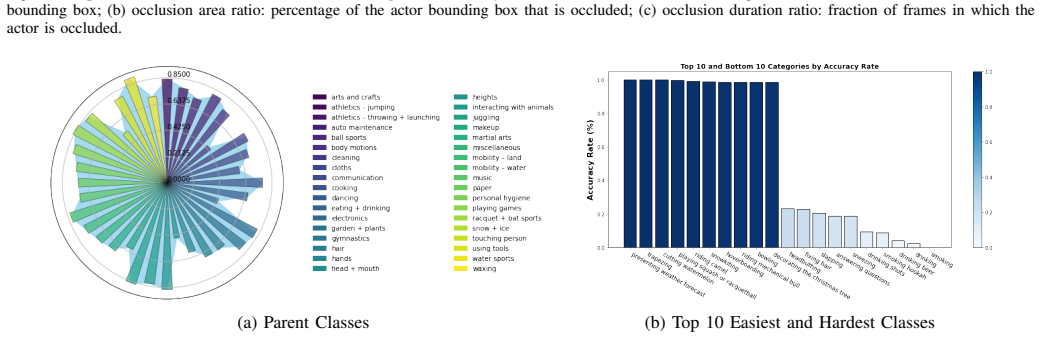
- The class-correlation analysis predicts which action classes will gain most from such training: low-scene-relevance, body-part-dependent actions should benefit most, while background-driven classes gain little.
- Synthetic tracking occlusions transfer to real occluded footage, so the synthetic subset can serve as a scalable training source for real-world occlusion robustness.
- The dataset itself provides a graded benchmark in which occlusion degree, area ratio, and duration ratio can be varied independently, allowing future methods to be compared along each axis.
Reading between the lines
- My inference: the subtraction-of-logits operation is mathematically equivalent to training on a mask-sensitivity signal, so the observed gains might be reproducible with any strong erasure, such as random patches, blur, or background replacement, rather than requiring a causal interpretation.
- My inference: a testable extension of the paper's logic is that the KL term should matter most when the actor is genuinely occluded; if it is just a regularizer, gains should appear equally on unoccluded data with no occlusion in the counterfactual.
- My inference: the paper leaves implicit that its counterfactual 'erase the actor' operation cannot hold background and occluder fixed in the dynamic-occlusion subset, because the occluder is placed over the actor bounding box and is erased together with the actor; measuring the pixel change outside the actor mask would test whether the intervention was actually realized.
Editorial analysis
A structured set of objections, weighed in public.
Referee Report
Summary. The paper introduces OccludeNet, a large occlusion-focused action recognition dataset with four subsets: OccludeNet-D (233,769 synthetic dynamic-occlusion clips built from Kinetics-400), OccludeNet-S (256 real static-occlusion clips), OccludeNet-I (345 single-view interactive clips), and OccludeNet-M (1,242 multi-view interactive clips). The authors benchmark eight action recognition models on these subsets and analyze which action classes are most affected by occlusion. They also propose Causal Action Recognition (CAR), which models an occluded scene with an SCM, invokes backdoor adjustment, and trains a model by comparing original predictions with predictions on an actor-erased counterfactual video. The empirical results show small but mostly positive accuracy gains for CAR over baselines on several subsets.
Significance. The dataset contribution is potentially useful: OccludeNet-D is large, covers a Kinetics-scale class set, and the paper provides a broad benchmark comparison of eight models, along with an analysis of class-specific sensitivity to occlusions. The data and code are promised publicly, which is a practical asset for the occlusion robustness community. However, the causal claims are the central novelty of the paper, and they are not supported by the implementation or the experiments. The backdoor adjustment is never computed, the counterfactual video does not realize the required intervention, and the training loss directly optimizes the quantity that is later reported as evidence for the causal model. Without the causal framing, the contribution reduces to a dataset plus an auxiliary supervision loss with modest empirical gains, which changes the significance of the work substantially.
major comments (4)
- [Section IV-B, Eq. (4)] The paper claims to apply backdoor adjustment, but Eq. (4) is never computed anywhere in the method or the experiments. The training pipeline in Section IV-C and Fig. 12 generates one actor-erased counterfactual per clip and forms the logit difference p_i - c_i in Eq. (7); there is no sum over occlusion states o with weights P(o), no estimate of P(o), and no ablation that implements Eq. (4). The statement in the abstract and conclusion that CAR 'uses backdoor adjustment' is therefore unsupported by the presented method.
- [Section IV-B, Section IV-C, Fig. 12] The counterfactual video does not faithfully realize the intervention do(A=a) while holding O, B, and F fixed. According to Eq. (2), O influences A, B, and F, so an intervention on A must not change O. Erasing the actor with segmentation removes actor pixels that are part of the visible scene, reveals background that was previously hidden behind the actor, and in OccludeNet-D the occluder is centered on the actor's bounding box (Fig. 3), so part of the occluder is erased as well. The paper provides no analysis demonstrating that the erasure leaves O, B, and F approximately invariant, which is a precondition for the causal interpretation of Eq. (5).
- [Section IV-C, Eq. (8)] The training loss is circular with respect to the causal claim. Eq. (5) defines the treatment effect as the difference between original and counterfactual predictions, and Eq. (8) explicitly trains the model so that the original softmax P moves toward Y, the softmax of (p_i - c_i). Any accuracy improvement on Tables IV and V is exactly what this supervised objective asks for, regardless of whether the counterfactual has any causal validity. Reporting these gains as evidence for the SCM or for 'causal influence of unoccluded actor features' is therefore circular.
- [Table V] The test sets for OccludeNet-I and OccludeNet-M are very small: a 15% test split of 345 clips gives roughly 52 test clips for O-I, and 15% of 1,242 gives roughly 186 test clips for O-M. Table V reports point improvements of 0.93-4.64 percentage points without confidence intervals or significance tests. Differences of this size on these sample sizes are within sampling noise, so the claims of consistent robustness gains from CAR are not statistically supported.
minor comments (5)
- [Abstract and Section I] There are typos and formatting errors, including 'textitasize' in the Introduction and 'availibale' in the abstract; the dataset name is also inconsistently capitalized as OccludeNet and OCCLUDENET.
- [Section VI, Applications] The applications list is malformed: item 3 ends without a main verb, and item 4 begins with a dangling number ('...varied occlusions, 4) OccludeNet enables...'). Please renumber and complete each sentence.
- [Section V-B, Table VII] The comparison with actor-mask training lacks implementation details: the mask construction procedure, the auxiliary loss form, the number of training epochs, and the choice of backbone are not specified. The qualitative explanation that the mask auxiliary signal 'often lacks continuity' is vague and should be either quantified or removed.
- [Fig. 14 caption] The caption states that 'ten classes with the largest drops on OccludeNet-D were selected at random'; random selection without a fixed seed or repeated trials makes this comparison difficult to interpret. Please specify the selection protocol.
- [Section IV-C, Eq. (5)] The notation in Eq. (5) is unclear: P(A=A,O=O) and P(do(A=a),O=O) mix feature variables with the prediction P, and the expectation over ~A is not defined in terms of the actual counterfactual generation process. Please clarify the notation or move the causal formalism to a setting where it is well-defined.
Circularity Check
No significant circularity; the causal-interpretation gap is a validity concern, not a circular derivation.
full rationale
The paper's training loss (Eq. 8) does use the counterfactual-adjusted prediction Y = softmax(p_i - c_i) (Eq. 7) as a supervision target, so the loss is a direct implementation of the claimed treatment effect rather than an independent test of it. But this is a method-design choice, not a circular derivation: the paper evaluates the resulting model against external baselines (StillMix, FAME), held-out datasets (Kinetics-400, EPIC-Kitchens), and a control ablation (actor-mask training, Table VII) that shows the specific logit-difference objective outperforms a simple actor-erasure baseline. Table VI also shows that the auxiliary loss can degrade accuracy (α = 2.0), so the improvement is not guaranteed by construction. The self-citations ([13], [16], [27]) appear only in related-work context and are not load-bearing. The substantive weakness is that the backdoor adjustment in Eq. (4) is never actually computed: the method uses a single actor-erased counterfactual and does not establish that O, B, and F are held fixed. That is a correctness/validity gap in the causal interpretation, not a circularity, and per the review rules it does not raise the circularity score. The derivation chain of the training objective is self-contained with respect to the reported empirical comparisons.
Assumptions & free parameters
free parameters (2)
- alpha =
1.0
- occluder_scale_levels =
0.25, 0.50, 0.75
assumptions (3)
- domain assumption Occlusion O is a confounder causing actor features A, background features B, other features F, and prediction P (Eq 2).
- ad hoc to paper Removing the actor with segmentation tools realizes the intervention do(A=a) while holding other variables fixed.
- standard math Pearl's do-calculus and backdoor adjustment are applicable to this SCM.
Cite this review
Pith. "Pith review of OccludeNet: A Causal Journey into Mixed-View Actor-Centric Video Action Recognition under Occlusions." pith.science (2026). https://pith.science/paper/PKSQVQ2U
@misc{pith2026241115729,
  author       = {Pith},
  title        = {Pith review of: OccludeNet: A Causal Journey into Mixed-View Actor-Centric Video Action Recognition under Occlusions},
  year         = {2026},
  howpublished = {\url{https://pith.science/paper/PKSQVQ2U}},
  note         = {Machine review of arXiv:2411.15729}
}
read the original abstract
The lack of occlusion data in common action recognition video datasets limits model robustness and hinders consistent performance gains. We build OccludeNet, a large-scale occluded video dataset including both real and synthetic occlusion scenes in different natural settings. OccludeNet includes dynamic occlusion, static occlusion, and multi-view interactive occlusion, addressing gaps in current datasets. Our analysis shows occlusion affects action classes differently: actions with low scene relevance and partial body visibility see larger drops in accuracy. To overcome the limits of existing occlusion-aware methods, we propose a structural causal model for occluded scenes and introduce the Causal Action Recognition (CAR) method, which uses backdoor adjustment and counterfactual reasoning. This approach strengthens key actor information and improves model robustness to occlusion. We hope the challenges of OccludeNet will encourage more study of causal links in occluded scenes and lead to a fresh look at class relations, ultimately leading to lasting performance improvements. Our code and data is availibale at: https://github.com/The-Martyr/OccludeNet-Dataset
Figures


Figures from the paper (8 more)





Reference graph
Works this paper leans on
-
[25]
Counterfactual debiasing inference for compositional action recognition,
P. Sun, B. Wu, X. Li, W. Li, L. Duan, and C. Gan, “Counterfactual debiasing inference for compositional action recognition,” in Proc. ACM Int. Conf. Multimedia , 2021, pp. 3220–3228
work page 2021
-
[26]
Counterfactual VQA: A cause-effect look at language bias,
Y . Niu, K. Tang, H. Zhang, Z. Lu, X. Hua, and J. Wen, “Counterfactual VQA: A cause-effect look at language bias,” in Proc. IEEE/CVF Conf. Comput. Vis. Pattern Recognit. , 2021, pp. 12 700–12 710
work page 2021
-
[1]
Going deeper into action recognition: A survey,
S. Herath, M. T. Harandi, and F. Porikli, “Going deeper into action recognition: A survey,” Image Vis. Comput., vol. 60, pp. 4–21, 2017
work page 2017
-
[2]
Human action recognition and prediction: A survey,
Y . Kong and Y . Fu, “Human action recognition and prediction: A survey,” Int. J. Comput. Vis. , vol. 130, no. 5, pp. 1366–1401, 2022
work page 2022
-
[3]
The kinetics human action video dataset,
W. Kay, J. Carreira, K. Simonyan, B. Zhang, C. Hillier, S. Vijaya- narasimhan, F. Viola, T. Green, T. Back, P. Natsev, M. Suleyman, and A. Zisserman, “The kinetics human action video dataset,” arXiv preprint arXiv:1705.06950, 2017
arXiv 2017
-
[4]
UCF101: A dataset of 101 human actions classes from videos in the wild,
K. Soomro, A. R. Zamir, and M. Shah, “UCF101: A dataset of 101 human actions classes from videos in the wild,” arXiv preprint arXiv:1212.0402, 2012
arXiv 2012
-
[5]
HMDB: A large video database for human motion recognition,
H. Kuehne, H. Jhuang, E. Garrote, T. A. Poggio, and T. Serre, “HMDB: A large video database for human motion recognition,” in Proc. IEEE/CVF Int. Conf. Comput. Vis. , 2011, pp. 2556–2563
work page 2011
-
[6]
Revealing the unseen: Bench- marking video action recognition under occlusion,
S. Grover, V . Vineet, and Y . S. Rawat, “Revealing the unseen: Bench- marking video action recognition under occlusion,” in Adv. Neural Inf. Process. Syst., 2023
work page 2023
Show all 45 references
-
[7]
Grad-cam: Visual explanations from deep networks via gradient-based localization,
R. R. Selvaraju, M. Cogswell, A. Das, R. Vedantam, D. Parikh, and D. Batra, “Grad-cam: Visual explanations from deep networks via gradient-based localization,” Int. J. Comput. Vis. , vol. 128, no. 2, pp. 336–359, 2020
2020
-
[8]
Causal reasoning in typical computer vision tasks,
K. Zhang, Q. Sun, C. Zhao, and Y . Tang, “Causal reasoning in typical computer vision tasks,” arXiv preprint arXiv:2307.13992 , 2023
2023 arXiv
-
[9]
Mitigating and evaluating static bias of action representations in the background and the foreground,
H. Li, Y . Liu, H. Zhang, and B. Li, “Mitigating and evaluating static bias of action representations in the background and the foreground,” in Proc. IEEE/CVF Int. Conf. Comput. Vis. , 2023, pp. 19 854–19 866
2023
-
[10]
Motion-aware contrastive video representation learning via foreground-background merging,
S. Ding, M. Li, T. Yang, R. Qian, H. Xu, Q. Chen, J. Wang, and H. Xiong, “Motion-aware contrastive video representation learning via foreground-background merging,” in Proc. IEEE/CVF Conf. Comput. Vis. Pattern Recognit., 2022, pp. 9706–9716
2022
-
[11]
Causal inference,
J. Pearl, “Causal inference,” in Adv. Neural Inf. Process. Syst. Workshop, 2010, pp. 39–58
2010
-
[12]
Making action recognition robust to occlusions and viewpoint changes,
D. Weinland, M. ¨Ozuysal, and P. Fua, “Making action recognition robust to occlusions and viewpoint changes,” in Proc. Eur. Conf. Comput. Vis., 2010, pp. 635–648
2010
-
[13]
Dual- recommendation disentanglement network for view fuzz in action recog- nition,
W. Liu, X. Zhong, Z. Zhou, K. Jiang, Z. Wang, and C. Lin, “Dual- recommendation disentanglement network for view fuzz in action recog- nition,” IEEE Trans. Image Process. , vol. 32, pp. 2719–2733, 2023
2023
-
[14]
Occlusion-aware graph neural networks for skeleton action recognition,
W. Shi, D. Li, Y . Wen, and W. Yang, “Occlusion-aware graph neural networks for skeleton action recognition,” IEEE Trans. Ind. Informatics, vol. 19, no. 10, pp. 10 288–10 298, 2023
2023
-
[15]
Unveiling the hidden realm: Self-supervised skeleton-based action recognition in occluded environments,
Y . Chen, K. Peng, A. Roitberg, D. Schneider, J. Zhang, J. Zheng, R. Liu, Y . Chen, K. Yang, and R. Stiefelhagen, “Unveiling the hidden realm: Self-supervised skeleton-based action recognition in occluded environments,” arXiv preprint arXiv:2309.12029 , 2023
2023 arXiv
-
[16]
Dynamic and static mutual fitting for action recognition,
W. Liu, X. Jia, X. Zhong, K. Jiang, X. Yu, and M. Ye, “Dynamic and static mutual fitting for action recognition,” Pattern Recognit., vol. 157, p. 110948, 2025
2025
-
[17]
OSD: an occlusion skeleton dataset for action recognition,
Y . Wu, H. Qiu, J. Wen, and R. Feng, “OSD: an occlusion skeleton dataset for action recognition,” in Proc. IEEE Int. Conf. Big Data , 2020, pp. 3355–3360
2020
-
[18]
Intelligent and connected vehicles: Current status and future perspectives,
D. Yang, K. Jiang, D. Zhao, C. Yu, Z. Cao, S. Xie, Z. Xiao, X. Jiao, S. Wang, and K. Zhang, “Intelligent and connected vehicles: Current status and future perspectives,” Sci. China Tech. Sci., vol. 61, pp. 1446– 1471, 2018
2018
-
[19]
Robot learning from demon- stration for path planning: A review,
Z. Xie, Q. Zhang, Z. Jiang, and H. Liu, “Robot learning from demon- stration for path planning: A review,” Sci. China Tech. Sci. , vol. 63, no. 8, pp. 1325–1334, 2020
2020
-
[20]
Causality learning: A new perspective for interpretable machine learning,
G. Xu, T. D. Duong, Q. Li, S. Liu, and X. Wang, “Causality learning: A new perspective for interpretable machine learning,” CoRR, vol. abs/2006.16789, 2020
2006 arXiv
-
[21]
Achieving causal fairness through generative adversarial networks,
D. Xu, Y . Wu, S. Yuan, L. Zhang, and X. Wu, “Achieving causal fairness through generative adversarial networks,” in Proc. Int. Joint Conf. Artif. Intell., S. Kraus, Ed., 2019, pp. 1452–1458
2019
-
[22]
Fairness in decision-making - the causal explanation formula,
J. Zhang and E. Bareinboim, “Fairness in decision-making - the causal explanation formula,” in Proc. AAAI Conf. Artif. Intell., 2018, pp. 2037– 2045
2018
-
[23]
Causal discovery with reinforcement learning,
S. Zhu, I. Ng, and Z. Chen, “Causal discovery with reinforcement learning,” in Proc. Int. Conf. Learn. Represent. , 2020
2020
-
[24]
Explainable reinforcement learning through a causal lens,
P. Madumal, T. Miller, L. Sonenberg, and F. Vetere, “Explainable reinforcement learning through a causal lens,” in Proc. AAAI Conf. Artif. Intell., 2020, pp. 2493–2500
2020
-
[27]
Mitigating modality prior-induced hallucinations in multimodal large language models via deciphering attention causality,
G. Zhou, Y . Yan, X. Zou, K. Wang, A. Liu, and X. Hu, “Mitigating modality prior-induced hallucinations in multimodal large language models via deciphering attention causality,” in The Thirteenth Interna- tional Conference on Learning Representations , 2025
2025
-
[28]
ultralytics/yolov5: v3. 1-bug fixes and performance improvements,
G. Jocher, A. Stoken, J. Borovec, L. Changyu, A. Hogan, L. Diaconu, F. Ingham, J. Poznanski, J. Fang, L. Yu et al. , “ultralytics/yolov5: v3. 1-bug fixes and performance improvements,” Zenodo, 2020
2020
-
[29]
Real-world anomaly detection in surveillance videos,
W. Sultani, C. Chen, and M. Shah, “Real-world anomaly detection in surveillance videos,” in Proc. IEEE/CVF Conf. Comput. Vis. Pattern Recognit., 2018, pp. 6479–6488
2018
-
[30]
Microsoft COCO: common objects in context,
T. Lin, M. Maire, S. J. Belongie, J. Hays, P. Perona, D. Ramanan, P. Doll ´ar, and C. L. Zitnick, “Microsoft COCO: common objects in context,” in Proc. Eur. Conf. Comput. Vis. , 2014, pp. 740–755
2014
-
[31]
Grounding DINO: marrying DINO with grounded pre-training for open-set object detection,
S. Liu, Z. Zeng, T. Ren, F. Li, H. Zhang, J. Yang, C. Li, J. Yang, H. Su, J. Zhu, and L. Zhang, “Grounding DINO: marrying DINO with grounded pre-training for open-set object detection,” in Proc. Eur. Conf. Comput. Vis., 2024
2024
-
[32]
Grounded SAM: assembling open-world models for diverse visual tasks,
T. Ren, S. Liu, A. Zeng, J. Lin, K. Li, H. Cao, J. Chen, X. Huang, Y . Chen, F. Yan, Z. Zeng, H. Zhang, F. Li, J. Yang, H. Li, Q. Jiang, and L. Zhang, “Grounded SAM: assembling open-world models for diverse visual tasks,” arXiv preprint arXiv:2401.14159 , 2024
2024 arXiv
-
[33]
Segment and track anything,
Y . Cheng, L. Li, Y . Xu, X. Li, Z. Yang, W. Wang, and Y . Yang, “Segment and track anything,” arXiv preprint arXiv:2305.06558 , 2023
2023 arXiv
-
[34]
Segment anything,
A. Kirillov, E. Mintun, N. Ravi, H. Mao, C. Rolland, L. Gustafson, T. Xiao, S. Whitehead, A. C. Berg, W. Lo, P. Doll´ar, and R. B. Girshick, “Segment anything,” in Proc. IEEE/CVF Int. Conf. Comput. Vis. , 2023, pp. 3992–4003
2023
-
[35]
Efficientvit: Enhanced linear attention for high-resolution low-computation visual recognition,
H. Cai, C. Gan, and S. Han, “Efficientvit: Enhanced linear attention for high-resolution low-computation visual recognition,” arXiv preprint arXiv:2205.14756, 2022
2022 arXiv
-
[36]
Quo vadis, action recognition? A new model and the kinetics dataset,
J. Carreira and A. Zisserman, “Quo vadis, action recognition? A new model and the kinetics dataset,” in Proc. IEEE/CVF Conf. Comput. Vis. Pattern Recognit., 2017, pp. 4724–4733
2017
-
[37]
X3D: expanding architectures for efficient video recognition,
C. Feichtenhofer, “X3D: expanding architectures for efficient video recognition,” in Proc. IEEE/CVF Conf. Comput. Vis. Pattern Recognit. , 2020, pp. 200–210
2020
-
[38]
Mvitv2: Improved multiscale vision transformers for classification and detection,
Y . Li, C. Wu, H. Fan, K. Mangalam, B. Xiong, J. Malik, and C. Feichtenhofer, “Mvitv2: Improved multiscale vision transformers for classification and detection,” in Proc. IEEE/CVF Conf. Comput. Vis. Pattern Recognit., 2022, pp. 4794–4804
2022
-
[39]
Videomae: Masked autoen- coders are data-efficient learners for self-supervised video pre-training,
Z. Tong, Y . Song, J. Wang, and L. Wang, “Videomae: Masked autoen- coders are data-efficient learners for self-supervised video pre-training,” in Adv. Neural Inf. Process. Syst. , 2022
2022
-
[40]
Uniformerv2: Unlocking the potential of image vits for video under- standing,
K. Li, Y . Wang, Y . He, Y . Li, Y . Wang, L. Wang, and Y . Qiao, “Uniformerv2: Unlocking the potential of image vits for video under- standing,” in Proc. IEEE/CVF Int. Conf. Comput. Vis. , 2023, pp. 1632– 1643. 10
2023
-
[41]
Videomae V2: scaling video masked autoencoders with dual masking,
L. Wang, B. Huang, Z. Zhao, Z. Tong, Y . He, Y . Wang, Y . Wang, and Y . Qiao, “Videomae V2: scaling video masked autoencoders with dual masking,” in Proc. IEEE/CVF Conf. Comput. Vis. Pattern Recognit. , 2023, pp. 14 549–14 560
2023
-
[42]
Videomamba: State space model for efficient video understanding,
K. Li, X. Li, Y . Wang, Y . He, Y . Wang, L. Wang, and Y . Qiao, “Videomamba: State space model for efficient video understanding,” in Proc. Eur. Conf. Comput. Vis. , 2024
2024
-
[43]
Internvideo2: Scaling video foundation models for multimodal video understanding,
Y . Wang, K. Li, X. Li, J. Yu, Y . He, G. Chen, B. Pei, R. Zheng, J. Xu, Z. Wang, Y . Shi, T. Jiang, S. Li, H. Zhang, Y . Huang, Y . Qiao, Y . Wang, and L. Wang, “Internvideo2: Scaling video foundation models for multimodal video understanding,” arXiv preprint arXiv:2403.15377, 2024
2024 arXiv
-
[44]
Openmmlab’s next generation video understanding toolbox and benchmark,
M. Contributors, “Openmmlab’s next generation video understanding toolbox and benchmark,” 2020
2020
-
[45]
Scaling egocentric vision: The EPIC-KITCHENS dataset,
D. Damen, H. Doughty, G. M. Farinella, S. Fidler, A. Furnari, E. Kaza- kos, D. Moltisanti, J. Munro, T. Perrett, W. Price, and M. Wray, “Scaling egocentric vision: The EPIC-KITCHENS dataset,” in Proc. Eur. Conf. Comput. Vis., 2018
2018
Reviewed August 12, 2026 · model on record in the stance chip above.
Discussion (0). Continue with ORCID to comment.