REVIEW 4 major objections 4 minor 54 references
Analysis of the near-side ridge structure in pp collisions via Momentum-Kick Model
T0 review · 4 major / 4 minor · reviewed 2026-08-12 · deepseek-v4-flash
Pith's one-line read The Momentum-Kick Model's three parameters reproduce the near-side ridge in pp collisions at 13 and 7 TeV.
desk verdict A legitimate extension of the Momentum-Kick Model to 7 TeV, multiplicity ranges, and 14 TeV, but the scaling relations carry too much weight and the conclusions overstate the fits. read the letter →
The pith
A machine-rendered reading of the paper's core claim, the machinery that carries it, and where it could break.
The reading
What carries the argument
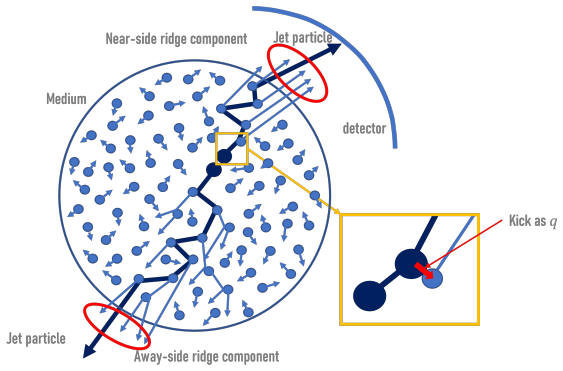
The central object is the Momentum-Kick Model's ridge component, a phase-space transformation that shifts the initial soft-scattering parton distribution by a momentum kick q along the jet direction. The distribution is controlled by three effective parameters: q (the average transverse momentum transferred per kick), T (a medium temperature entering a modified Boltzmann-like factor), and f_R⟨N_k⟩ (the product of a survival factor and the mean number of kicked partons, acting as an overall amplitude). The model converts the initial parton transverse momentum p_Ti to p_T via p_Ti² = p_T² − 2 p_T q cos(Δφ) + q², which is what redistributes partons toward small Δφ and generates a ridge that extends over a wide Δη range. The paper's quantitative claim rests on fitting these three parameters to the experimental correlations and on two scaling rules—T proportional to ⟨p_T⟩ and q inversely proportional to multiplicity—used to carry the model to other energies and multiplicity classes.
What would settle it
Compare the MKM's published 14 TeV prediction, with its ±10% parameter band (q≈1.075, T≈1.193, f_R⟨N_k⟩≈2.310), to the measured long-range near-side Δφ correlation in high-multiplicity pp collisions from LHC Run 3; a data point falling outside that band, or a peak position and width that deviate from the predicted shape, would falsify the energy scaling used to extend the model.
Extended reading notes
Core claim
On the paper's own terms, the central discovery is that the Momentum-Kick Model—originally built for heavy-ion collisions—reproduces the long-range near-side ridge structure in high-multiplicity pp collisions at LHC energies, using a single set of physics parameters for each collision energy rather than an ad hoc per-bin adjustment. At 13 TeV the authors treat the medium temperature T as a free parameter, obtaining T=1.19 GeV, q=1.12 GeV, and f_R⟨N_k⟩=2.13 from the ALICE and CMS data, and find the same values describe the ATLAS data over a wider 0.5–5 GeV transverse-momentum window. At 7 TeV they fix T by the mean-p_T ratio, obtaining q=1.39 GeV and f_R⟨N_k⟩=1.05, and note the product (q13/q7)×(⟨N13⟩/⟨N7⟩)≈0.93, which supports an inverse proportionality between the kick q and event multiplicity. Extending this idea to ATLAS multiplicity bins yields a description of the Δφ correlations for 50≤N_rec^ch≤150, and the same energy scaling leads to the 14 TeV prediction with ±10% parameter bands.
Load-bearing premise
The load-bearing premise is that the model's parameters carry over between energies and multiplicities through two scaling rules—T scaling with mean transverse momentum and q inversely with multiplicity—rules inferred from a single comparison between 13 and 7 TeV; if either scaling is wrong, the 7 TeV fits, the multiplicity-bin description, and the 14 TeV prediction lose quantitative support even if the 13 TeV fits stand.
Editorial extensions
If this is right
- If the MKM describes the ridge, the near-side ridge in small systems can be produced without collective flow or a quark–gluon plasma, so the ridge alone is not evidence for QGP in pp collisions.
- The same parameter values fit ALICE and CMS at 13 TeV and are then applied to ATLAS conditions, implying the model is largely insensitive to the experimental Δη window and pT binning within the tested ranges.
- The inverse relation between q and multiplicity means that as events become more crowded, each kick carries less momentum per collision, a specific kinematic prediction that can be checked at other multiplicities and energies.
- The 14 TeV prediction gives a concrete, quantitative target for LHC Run 3: the height and width of the near-side ridge should fall within the ±10% parameter band shown in Figure 9.
- The disappearance of pT dependence in f_R⟨N_k⟩ at 13 TeV suggests that the earlier pT-dependent normalization was an artifact of fixing T from AuAu rather than a genuine physical feature.
Reading between the lines
- A sharper test of the q–multiplicity scaling would be to fit the MKM to pp or p–Pb data at an intermediate energy such as 5.02 TeV: if the product (q ratio)×(multiplicity ratio) deviates from unity beyond the 13/7 TeV point's uncertainty, the inverse-proportionality rule is only a two-point coincidence.
- The model's plateau assumption for the initial parton rapidity distribution could be checked by comparing its Δη dependence with the measured ridge shape at very large |Δη| (e.g., |Δη|>4), where the ATLAS window extends farther than ALICE's.
- Because f_R⟨N_k⟩ is essentially a free amplitude at each multiplicity bin, the model's predictive content at 14 TeV is concentrated in the shape and peak position of the Δφ correlation rather than its absolute normalization; a shape mismatch would be a more informative failure than an overall yield offset.
Editorial analysis
A structured set of objections, weighed in public.
Referee Report
Summary. The manuscript applies the Momentum-Kick Model (MKM) to the near-side ridge in high-multiplicity proton-proton collisions at 13 TeV (ALICE, CMS, ATLAS data) and 7 TeV (CMS data). The model parameters T, q, and f_R⟨N_k⟩ are fitted to the 13 TeV ALICE and CMS Δφ correlations; the same parameters are then applied to ATLAS conditions, extended to 7 TeV using a ⟨p_T⟩-ratio scaling for T and a fit for q and f_R⟨N_k⟩, and further extended to several ATLAS multiplicity bins using scaling assumptions encoded in Eqs. (9)-(11). The paper also gives a 14 TeV prediction based on extrapolating the 7-to-13 TeV energy dependence. The central conclusion is that MKM effectively explains the near-side ridge in pp collisions across these energies, multiplicities, and experimental conditions.
Significance. If the claims are supported, the paper offers a purely kinematic alternative to hydrodynamic and glasma explanations of the ridge in small systems, with a simple few-parameter model and a falsifiable 14 TeV prediction. Credit is due for the transparent presentation of the model, the effort to restore the ATLAS data to a common ZYAM convention, and the explicit parameter tables. However, the significance is currently limited by the fact that the broad conclusions rest on scaling relations inferred from a single energy pair and on fits with one free amplitude per multiplicity bin; the directly fitted 13 TeV ALICE/CMS results are the only clearly out-of-sample-free part of the analysis.
major comments (4)
- [§3.2, Eq. (8)] The inverse proportionality between q and multiplicity — the load-bearing input for Eqs. (9) and (10) and for the 14 TeV extrapolation in Section 4 — rests on a single product q_13/q_7 × ⟨N_13⟩/⟨N_7⟩ ≈ 0.93 with no quoted uncertainty. Moreover, the 7 TeV comparison is not an out-of-sample test: T is fixed by Eq. (7), but q and f_R⟨N_k⟩ are fitted to the CMS 7 TeV data, so Eq. (8) is a post-hoc consistency check rather than a validation. The manuscript should either supply independent evidence for the scaling or explicitly restrict the claims to the directly fitted 13 TeV cases.
- [§3.2, Fig. 6] The text states that the MKM result “may adequately describe” the ATLAS data within experimental uncertainties, but Fig. 6 visibly underestimates the near-side peak and no uncertainty information is shown or quoted. Invoking unavailable uncertainties makes the agreement untestable; the claim that the MKM applies to ATLAS conditions should be quantified (e.g., by a chi-square or by showing the data uncertainties) or explicitly softened.
- [§3.3, Table 4 vs. Conclusions] The Conclusions quote A = 0.221 for the lowest multiplicity bin (50 ≤ N_rec_ch < 60) and A = 0.111 for the highest bin (130 ≤ N_rec_ch), whereas Table 4 lists A = 0.082 and A = 5.949 for the same bins. These numbers must be reconciled; as written, the concluding values contradict the table and undermine confidence in the reported fits.
- [§3.3, Eq. (11), Fig. 8] In the multiplicity extension, q and T are imposed by Eqs. (9)-(10) and only the amplitude A is free per bin, so the visual agreement in Fig. 8 is weak evidence for the model; the fit does not test the predicted multiplicity dependence of the shape. The additional trend in A (Table 4) is itself nonlinear and indicates that the assumed linear dependence in Eq. (11) is not capturing the multiplicity dependence, so the statement that MKM “effectively explains” the multiplicity dependence is stronger than the evidence shown.
minor comments (4)
- [Throughout] The notation “ZY AM” is used with an unusual space; it should be “ZYAM” consistently.
- [Eq. (5)] The expression for the beam rapidity, y_b = cosh^{-1} √s_NN / 2m_N, is ambiguous; parentheses should be added.
- [References [11] and [46]] References [11] (Allison et al.) and [46] (Sisodiya et al.) appear unrelated to ridge measurements and are cited in the introductory list of ridge observations; please verify the intended sources.
- [Section 2 and Fig. 5] There are small grammatical issues (“This results are shown”) and a mismatch between the Fig. 5 caption (“Grey circles and red squares”) and the text (“Red squares and grey squares”); these should be harmonized.
Circularity Check
No significant circularity; fitted parameters are explicitly labeled as fits, and the only true prediction (14 TeV) is out-of-sample. Thin scaling laws and an internal inconsistency weaken the evidence but do not make the derivation circular.
full rationale
I find no circular step that satisfies the required standard of an equation reducing to its own input or a fitted parameter being passed off as a prediction. The 13 TeV ALICE/CMS parameters q, T, and fR<Nk> are openly fitted to the data, and the agreement there is a fit, not a derived prediction. For the 7 TeV comparison, T is fixed by the <pT> ratio in Eq. (7), while q and fR<Nk> are again stated as fitting parameters, so the comparison is a post-diction; Eq. (8) is a post-hoc consistency check based on those fitted values, which is weak validation but not circularity. In the multiplicity extension, q and T are set by the empirical scalings of Eqs. (9) and (10), and the slope in Eq. (11) is fit to integrated-yield data; the text explicitly says A is 'the only free parameter when fitting the Delta-phi correlation data,' so the amplitude agreement in Fig. 8 is by construction. However, the shape of the Delta-phi distribution is still a genuine model output rather than a refit of the data, and the paper does not label this procedure a prediction. The 14 TeV curves are a real out-of-sample extrapolation, albeit with ad hoc +/-10% bands. The self-citations to the earlier MKM papers [37, 54] and to Wong's model papers are routine references to prior model development and are not used as an unverified uniqueness theorem or to forbid alternatives. I also note two non-circular weaknesses: the inverse-q scaling rests on a single product near unity with no uncertainty, and the Conclusions quote A=0.221 and 0.111 for the lowest and highest multiplicity bins, inconsistent with Table 4's 0.082 and 5.949; these are correctness and evidence-strength concerns, not circularity.
Assumptions & free parameters
free parameters (7)
- q =
1.12 GeV (13 TeV), 1.39 GeV (7 TeV), 0.887-2.237 GeV across multiplicity bins
- T =
1.19 GeV (13 TeV), 1.17 GeV (7 TeV), 1.086-1.224 GeV across multiplicity bins
- f_R<N_k> =
2.13 (13 TeV), 1.05 (7 TeV), 0.118-6.038 across multiplicity bins
- A =
0.082-5.949 per multiplicity bin
- m_d =
1 GeV
- a =
0.5
- Slope in Eq. (11) =
0.00065
assumptions (8)
- domain assumption The ridge component is described by Eqs. (1)-(5) from the MKM, including the soft scattering model for the initial parton distribution.
- domain assumption Kinematic jet-parton interactions dominate in small systems, so no hydrodynamic collective flow is required.
- domain assumption Initial medium partons form a plateau in mid-rapidity and jets are emitted perpendicular to the beam axis (eta_jet=0).
- domain assumption Medium partons have the pion mass and the beam particle mass m_N is the proton mass.
- ad hoc to paper Temperature at 7 TeV is obtained from the 13 TeV temperature via the <p_T> ratio (Eq. 7).
- ad hoc to paper q is inversely proportional to multiplicity (Eq. 9), a relation inferred from two energy points.
- ad hoc to paper f_R<N_k> depends linearly on multiplicity with slope 0.00065 (Eq. 11).
- ad hoc to paper At 14 TeV, multiplicity and <p_T> scale with center-of-mass energy in the same way as between 7 and 13 TeV.
Cite this review
Pith. "Pith review of Analysis of the near-side ridge structure in pp collisions via Momentum-Kick Model." pith.science (2026). https://pith.science/paper/H5N4MMVC
@misc{pith2026241115756,
  author       = {Pith},
  title        = {Pith review of: Analysis of the near-side ridge structure in pp collisions via Momentum-Kick Model},
  year         = {2026},
  howpublished = {\url{https://pith.science/paper/H5N4MMVC}},
  note         = {Machine review of arXiv:2411.15756}
}
abstract
The near-side ridge structure has been observed in the long-range two-particle correlations in heavy-ion collisions, such as AuAu collisions at the Relativistic Heavy Ion Collider(RHIC) and PbPb collisions at the Large Hadron Collider (LHC). Hydrodynamic models have successfully explained the ridge structure in heavy-ion collisions, indicating the presence of Quark-Gluon Plasma (QGP). Interestingly, similar ridge structures have been detected in high-multiplicity proton-proton and proton-lead collisions, which are classified as small systems in the LHC experiments. Because small systems have been considered insufficient to generate QGP, the applicability of theories developed for heavy-ion collisions to small systems remains controversial. Assuming that kinematic effects play a more significant role in small systems, we expect that the Momentum-Kick Model (MKM) can provide a satisfactory explanation. This model elucidates the long-range and near-side ridge structure in dihadron $\Delta\eta-\Delta\phi$ correlation by explaining that jet particles kick and rearrange medium partons along the direction of the jets. In this study, we apply the MKM to explain high-multiplicity proton-proton collisions at both 13 TeV and 7 TeV in the LHC over various ranges of momenta. Furthermore, we introduce multiplicity dependence in the model to account for the 13 TeV data at various multiplicity ranges. We conclude that the MKM effectively explains the near-side ridge structure observed in proton-proton collisions. The LHC has entered Run 3, achieving higher center-of-mass energies and better luminosity than Run 2. We offer $\Delta\phi$ correlation predictions for pp collisions at 14 TeV and suggest possible extensions of the MKM for future studies.
Figures


Figures from the paper (6 more)


Reference graph
Works this paper leans on
-
[1]
Aad, G., et al. (ATLAS), 2011. Charged-particle multiplicities in pp interactions mea- sured with the ATLAS detector at the LHC. New J. Phys. 13, 053033. doi:10.1088/1367- 2630/13/5/053033,arXiv:1012.5104
arXiv 2011
-
[2]
Aad, G., et al. (ATLAS), 2016a. Charged-particle distributions in √s=13 TeV pp in- teractions measured with the ATLAS detector at the LHC. Phys. Lett. B 758, 67–88. doi:10.1016/j.physletb.2016.04.050,arXiv:1602.01633
arXiv 2016
-
[3]
Aad, G., et al. (ATLAS), 2016b. Observation of long-range elliptic azimuthal anisotropies in √s=13 and 2.76 tevppcollisions with the atlas detector. Phys. Rev. Lett. 116, 172301. URL:https://link.aps.org/doi/10.1103/PhysRevLett.116.172301, doi:10.1103/PhysRevLett.116.172301
-
[4]
Abelev, B., et al. (ALICE), 2013. Long-range angular correlations ofπ, k and p in p–pb collisions at snn=5.02 tev. Physics Letters B 726, 164–177. URL: https://www.sciencedirect.com/science/article/pii/S0370269313006503, doi:https://doi.org/10.1016/j.physletb.2013.08.024
-
[5]
Acharya, S., et al. (ALICE), 2021. Long- and short-range correlations and their event- scale dependence in high-multiplicity pp collisions at √s=13 TeV. JHEP 05, 290. doi:10.1007/JHEP05(2021)290,arXiv:2101.03110
work page Pith review arXiv 2021
-
[6]
Adam, J., et al. (ALICE), 2016. Forward-central two-particle correlations in p–pb collisions at snn=5.02 tev. Physics Letters B 753, 126–139. URL: https://www.sciencedirect.com/science/article/pii/S0370269315009533, doi:https://doi.org/10.1016/j.physletb.2015.12.010
-
[7]
Adams, J., et al. (STAR), 2005. Distributions of charged hadrons as- sociated with high transverse momentum particles inppand Au+Au collisions at √sNN =200 GeV. Phys. Rev. Lett. 95, 152301. URL:https://link.aps.org/doi/10.1103/PhysRevLett.95.152301, doi:10.1103/PhysRevLett.95.152301
-
[8]
Adams, J., et al. (STAR), 2006. Minijet deformation and charge-independent angular cor- relations on momentum subspace (η,ϕ) in au-au collisions at √sNN =130 gev. Phys. Rev. C 73, 064907. URL:https://link.aps.org/doi/10.1103/PhysRevC.73.064907, doi:10.1103/PhysRevC.73.064907
Show all 54 references
-
[9]
(PHENIX), 2016
Adare, A., et al. (PHENIX), 2016. Azimuthally anisotropic emission of low- momentum direct photons in au+au collisions at √sNN =200 gev. Phys. Rev. C 94, 064901. URL:https://link.aps.org/doi/10.1103/PhysRevC.94.064901, doi:10.1103/PhysRevC.94.064901
2016 doi
-
[10]
Decomposition of harmonic and jet contributions to particle-pair correlations at ultrarelativistic energies
Ajitanand, N.N., Alexander, J.M., Chung, P., Holzmann, W.G., Issah, M., Lacey, R.A., Shevel, A., Taranenko, A., Danielewicz, P., 2005. Decomposition of harmonic and jet contributions to particle-pair correlations at ultrarelativistic energies. Phys. Rev. C 72, 011902. URL:http...
2005 doi
-
[11]
Ab initio liquid hydrogen muon cooling simulation with ELMS
Allison, W.W.M., Cobb, J.H., Holmes, S.J., Fernow, R.C., Palmer, R.B., 2007. Ab initio liquid hydrogen muon cooling simulation with ELMS. J. Phys. G 34, 679–685. doi:10.1088/0954-3899/34/4/007,arXiv:physics/0609195
2007 arXiv
-
[12]
(PHOBOS), 2008
Alver, B., et al. (PHOBOS), 2008. High p(T) Triggered Delta eta, Delta-phi Corre- lations over a Broad Range in Delta eta. J. Phys. G 35, 104080. doi:10.1088/0954- 3899/35/10/104080,arXiv:0804.3038
2008 arXiv
-
[13]
(STAR), 2008
Barannikova, O. (STAR), 2008. Back-to-back di-jet triggered multi-hadron correlations as medium probes in STAR. J. Phys. G 35, 104086. doi:10.1088/0954-3899/35/10/104086
2008 doi
-
[14]
Correlations from hydrodynamic flow in ppb collisions
Bo˙ zek, P., Broniowski, W., 2013. Correlations from hydrodynamic flow in ppb collisions. Physics Letters B 718, 1557–1561. URL: https://www.sciencedirect.com/science/article/pii/S0370269312013044, doi:https://doi.org/10.1016/j.physletb.2012.12.051
2013 doi
-
[15]
Initial- state geometry and the role of hydrodynamics in proton-proton, proton- nucleus, and deuteron-nucleus collisions
Bzdak, A., Schenke, B., Tribedy, P., Venugopalan, R., 2013. Initial- state geometry and the role of hydrodynamics in proton-proton, proton- nucleus, and deuteron-nucleus collisions. Phys. Rev. C 87, 064906. URL:https://link.aps.org/doi/10.1103/PhysRevC.87.064906, doi:10.1103/P...
2013 doi
-
[16]
(CMS), 2011
Chatrchyan, S., et al. (CMS), 2011. Long-range and short-range dihadron angu- lar correlations in central pbpb collisions at √sNN =2.76 tev. Journal of High Energy Physics 2011, 76. URL:https://doi.org/10.1007/JHEP07(2011)076, doi:10.1007/JHEP07(2011)076
2011 doi
-
[17]
(CMS), 2013a
Chatrchyan, S., et al. (CMS), 2013a. Multiplicity and transverse momentum dependence of two- and four-particle correlations in ppb and pbpb collisions. Physics Letters B 724, 213–240. URL: https://www.sciencedirect.com/science/article/pii/S0370269313005030, doi:https://doi.org...
-
[18]
(CMS), 2013b
Chatrchyan, S., et al. (CMS), 2013b. Observation of long-range, near-side angular correlations in ppb collisions at the lhc. Physics Letters B 718, 795–814. URL: https://www.sciencedirect.com/science/article/pii/S0370269312011768, doi:https://doi.org/10.1016/j.physletb.2012.11.025
-
[19]
(CMS), 2014
Chatrchyan, S., et al. (CMS), 2014. Studies of azimuthal dihadron correlations in ultra- central pbpb collisions at√sNN =2.76 tev. Journal of High Energy Physics 2014, 88. URL: https://doi.org/10.1007/JHEP02(2014)088, doi:10.1007/JHEP02(2014)088
2014 doi
-
[20]
Parton momentum distribution at the moment of jet-parton collisions
Cheuk-Yin, W., 2008. Parton momentum distribution at the moment of jet-parton collisions. Chinese Physics Letters 25, 3936–3939. URL: https://doi.org/10.1088/0256-307x/25/11/027, doi:10.1088/0256- 307x/25/11/027
2008 doi
-
[21]
(STAR), 2008
Daugherity, M. (STAR), 2008. Anomalous centrality variation of minijet angular correla- tions in Au-Au collisions at 62-GeV and 200-GeV from STAR. J. Phys. G 35, 104090. doi:10.1088/0954-3899/35/10/104090,arXiv:0806.2121. 18
2008 arXiv
-
[22]
The ridge in proton–proton collisions at the lhc
Dumitru, A., Dusling, K., Gelis, F., Jalilian-Marian, J., Lappi, T., Venugopalan, R., 2011. The ridge in proton–proton collisions at the lhc. Physics Letters B 697, 21–25. URL: https://www.sciencedirect.com/science/article/pii/S0370269311000487, doi:https://doi.org/10.1016/j.p...
2011 doi
-
[23]
Glasma flux tubes and the near side ridge phenomenon at rhic
Dumitru, A., Gelis, F., McLerran, L., Venugopalan, R., 2008. Glasma flux tubes and the near side ridge phenomenon at rhic. Nuclear Physics A 810, 91–108. URL: https://www.sciencedirect.com/science/article/pii/S0375947408005927, doi:https://doi.org/10.1016/j.nuclphysa.2008.06.012
2008 doi
-
[24]
Long range two-particle rapidity correlations in a+a collisions from high en- ergy qcd evolution
Dusling, K., Gelis, F., Lappi, T., Venugopalan, R., 2010. Long range two-particle rapidity correlations in a+a collisions from high en- ergy qcd evolution. Nuclear Physics A 836, 159–182. URL: https://www.sciencedirect.com/science/article/pii/S0375947409009853, doi:https://doi...
2010 doi
-
[25]
Azimuthal collimation of long range rapidity correlations by strong color fields in high multiplic- ity hadron-hadron collisions
Dusling, K., Venugopalan, R., 2012. Azimuthal collimation of long range rapidity correlations by strong color fields in high multiplic- ity hadron-hadron collisions. Phys. Rev. Lett. 108, 262001. URL: https://link.aps.org/doi/10.1103/PhysRevLett.108.262001, doi:10.1103/PhysRev...
2012 doi
-
[26]
Comparison of the color glass condensate to dihadron correlations in proton-proton and proton-nucleus collisions
Dusling, K., Venugopalan, R., 2013a. Comparison of the color glass condensate to dihadron correlations in proton-proton and proton-nucleus collisions. Phys. Rev. D 87, 094034. URL:https://link.aps.org/doi/10.1103/PhysRevD.87.094034, doi:10.1103/PhysRevD.87.094034
-
[27]
Evidence for bfkl and satura- tion dynamics from dihadron spectra at the lhc
Dusling, K., Venugopalan, R., 2013b. Evidence for bfkl and satura- tion dynamics from dihadron spectra at the lhc. Phys. Rev. D 87, 051502. URL:https://link.aps.org/doi/10.1103/PhysRevD.87.051502, doi:10.1103/PhysRevD.87.051502
-
[28]
Explanation of systematics of cms p+Pb high multiplicity dihadron data at √snn=5.02 TeV
Dusling, K., Venugopalan, R., 2013c. Explanation of systematics of cms p+Pb high multiplicity dihadron data at √snn=5.02 TeV. Phys. Rev. D 87, 054014. URL:https://link.aps.org/doi/10.1103/PhysRevD.87.054014, doi:10.1103/PhysRevD.87.054014
-
[29]
(STAR), 2008
Feng, A. (STAR), 2008. Reaction Plane Dependent Away-side Modification and Near-side Ridge in Au+Au Collisions. J. Phys. G 35, 104082. doi:10.1088/0954-3899/35/10/104082, arXiv:0807.4606
2008 arXiv
-
[30]
Understanding jet quenching and medium response with di-hadron correlation
Jia, J., 2008. Understanding jet quenching and medium response with di-hadron correlation. J. Phys. G 35, 104033. doi:10.1088/0954-3899/35/10/104033,arXiv:0805.0160
2008 arXiv
-
[31]
Measurement of long-range near-side two-particle angular correlations in p p collisions at s=13 tev
Khachatryan, V ., Sirunyan, A.M., Tumasyan, A., Adam, W., Asilar, E., Bergauer, T., Brand- stetter, J., Brondolin, E., Dragicevic, M., Erö, J., Flechl, M., Friedl, M., Frühwirth, R., Ghete, V .M., Hartl, C., Hörmann, N., Hrubec, J., Jeitler, M., Knünz, V ., Woods, N., 2016a. M...
-
[32]
(CMS), 2010
Khachatryan, V ., et al. (CMS), 2010. Observation of long-range, near-side angular correla- tions in proton-proton collisions at the lhc. Journal of High Energy Physics 2010, 91. URL: https://doi.org/10.1007/JHEP09(2010)091, doi:10.1007/JHEP09(2010)091
2010 doi
-
[33]
(CMS), 2015a
Khachatryan, V ., et al. (CMS), 2015a. Evidence for collective multi- particle correlations inp−Pb collisions. Phys. Rev. Lett. 115, 012301. URL:https://link.aps.org/doi/10.1103/PhysRevLett.115.012301, doi:10.1103/PhysRevLett.115.012301
-
[34]
(CMS), 2015b
Khachatryan, V ., et al. (CMS), 2015b. Long-range two-particle corre- lations of strange hadrons with charged particles in ppb and pbpb col- lisions at lhc energies. Physics Letters B 742, 200–224. URL: https://www.sciencedirect.com/science/article/pii/S0370269315000441, doi:h...
-
[35]
(CMS), 2016b
Khachatryan, V ., et al. (CMS), 2016b. Correlations between jets and charged particles in pbpb and pp collisions at √sNN =2.76tev. Journal of High Energy Physics 2016, 156. URL:https://doi.org/10.1007/JHEP02(2016)156, doi:10.1007/JHEP02(2016)156
2016 doi
-
[36]
(CMS), 2017
Khachatryan, V ., et al. (CMS), 2017. Evidence for collectivity in pp collisions at the lhc. Physics Letters B 765, 193–220. URL: https://www.sciencedirect.com/science/article/pii/S037026931630747X, doi:https://doi.org/10.1016/j.physletb.2016.12.009
2017 doi
-
[37]
Momentum-kick model application to high- multiplicity pp collisions at √s=13tev at the lhc
Kim, B., Youn, H., Cho, S., Yoon, J.H., 2021. Momentum-kick model application to high- multiplicity pp collisions at √s=13tev at the lhc. International Journal of Theoreti- cal Physics 60, 1246–1253. URL:https://doi.org/10.1007/s10773-021-04750-y, doi:10.1007/s10773-021-04750-y
2021 doi
-
[38]
(STAR), 2009
van Leeuwen, M. (STAR), 2009. Recent high-p(T) results from STAR. Eur. Phys. J. C 61, 569–574. doi:10.1140/epjc/s10052-009-1007-1,arXiv:0808.4096
2009 arXiv
-
[39]
Observation of Delta phi Delta eta scaled correlation signals which increase wirh centrality of Au Au collisions at s(NN)**(1/2)=200- GeV
Longacre, R.S., 2007. Observation of Delta phi Delta eta scaled correlation signals which increase wirh centrality of Au Au collisions at s(NN)**(1/2)=200- GeV. Int. J. Mod. Phys. E 16, 2149–2153. doi:10.1142/S021830130700760X,arXiv:nucl-ex/0702008
2007 arXiv
-
[40]
Systemat- ics of azimuthal anisotropy harmonics in proton–nucleus collisions at the lhc from the color glass condensate
Mace, M., Skokov, V .V ., Tribedy, P., Venugopalan, R., 2019. Systemat- ics of azimuthal anisotropy harmonics in proton–nucleus collisions at the lhc from the color glass condensate. Physics Letters B 788, 161–165. URL: https://www.sciencedirect.com/science/article/pii/S037026...
2019 doi
-
[41]
(PHENIX), 2008
McCumber, M.P. (PHENIX), 2008. The ’Shoulder’ and the ’Ridge’ in PHENIX. J. Phys. G 35, 104081. doi:10.1088/0954-3899/35/10/104081,arXiv:0804.4319
2008 arXiv
-
[42]
Jet-like correlations between forward- and mid- rapidity in p+p, d+au and au+au collisions from star atsqrts NN = 200GeV
Molnar, L., the STAR Collaboration, 2007. Jet-like correlations between forward- and mid- rapidity in p+p, d+au and au+au collisions from star atsqrts NN = 200GeV. Journal of Physics G: Nuclear and Particle Physics 34, S593–S597. URL: https://doi.org/10.1088/0954-3899/34/8/s51...
2007 doi
-
[43]
System and energy dependence of strange and non-strange particle cor- relations in STAR at RHIC
Nattrass, C., 2008. System and energy dependence of strange and non-strange particle cor- relations in STAR at RHIC. J. Phys. G 35, 104110. doi:10.1088/0954-3899/35/10/104110, arXiv:0804.4683
2008 arXiv
-
[44]
(STAR), 2008
Netrakanti, P.K. (STAR), 2008. Identifying the underlying physics of the ridge via 3- particle Delta eta - Delta eta correlations. J. Phys. G 35, 104010. doi:10.1088/0954- 3899/35/10/104010,arXiv:0804.4417
2008 arXiv
-
[45]
Elliptic and triangular flow anisotropy in deuteron-gold collisions at √sNN =200 gev at rhic and in proton- lead collisions at √sNN =5.02 tev at the lhc
Qin, G.Y ., Müller, B., 2014. Elliptic and triangular flow anisotropy in deuteron-gold collisions at √sNN =200 gev at rhic and in proton- lead collisions at √sNN =5.02 tev at the lhc. Phys. Rev. C 89, 044902. URL:https://link.aps.org/doi/10.1103/PhysRevC.89.044902, doi:10.1103...
2014 doi
-
[46]
Strange diquark stars within the framework of an effective phi**4 theory
Sisodiya, A.K., Kaushal, R.S., Parashar, D., Bhasin, V .S., 2007. Strange diquark stars within the framework of an effective phi**4 theory. J. Phys. G 34, 929–947. doi:10.1088/0954-3899/34/5/012
2007 doi
-
[47]
Evidence for flow from hydrodynamic simulations ofp−Pb collisions at 5.02 tev fromv 2 mass splitting
Werner, K., Bleicher, M., Guiot, B., Karpenko, I., Pierog, T., 2014. Evidence for flow from hydrodynamic simulations ofp−Pb collisions at 5.02 tev fromv 2 mass splitting. Phys. Rev. Lett. 112, 232301. URL:https://link.aps.org/doi/10.1103/PhysRevLett.112.232301, doi:10.1103/Phy...
2014 doi
-
[48]
“ridge” in proton- proton scattering at 7 tev
Werner, K., Karpenko, I., Pierog, T., 2011. “ridge” in proton- proton scattering at 7 tev. Phys. Rev. Lett. 106, 122004. URL: https://link.aps.org/doi/10.1103/PhysRevLett.106.122004, doi:10.1103/PhysRevLett.106.122004
2011 doi
-
[49]
Introduction to High-Energy Heavy- Ion Collisions
Wong, C.Y ., 1994. Introduction to High-Energy Heavy- Ion Collisions. WORLD SCIENTIFIC. URL: https://www.worldscientific.com/doi/abs/10.1142/1128, doi:10.1142/1128, arXiv:https://www.worldscientific.com/doi/pdf/10.1142/1128
1994 doi
-
[50]
Ridge structure in the∆ϕ−∆ηcorrelation func- tion associated with a near-side jet
Wong, C.Y ., 2007. Ridge structure in the∆ϕ−∆ηcorrelation func- tion associated with a near-side jet. Phys. Rev. C 76, 054908. URL:https://link.aps.org/doi/10.1103/PhysRevC.76.054908, doi:10.1103/PhysRevC.76.054908
2007 doi
-
[51]
Momentum kick model description of the near-side ridge and jet quenching
Wong, C.Y ., 2008. Momentum kick model description of the near-side ridge and jet quenching. Phys. Rev. C 78, 064905. URL:https://link.aps.org/doi/10.1103/PhysRevC.78.064905, doi:10.1103/PhysRevC.78.064905
2008 doi
-
[52]
Momentum kick model analysis of phenix near-side ridge data and photon jet
Wong, C.Y ., 2009. Momentum kick model analysis of phenix near-side ridge data and photon jet. Phys. Rev. C 80, 034908. URL:https://link.aps.org/doi/10.1103/PhysRevC.80.034908, doi:10.1103/PhysRevC.80.034908. 21
2009 doi
-
[53]
Momentum-kick model description of the ridge in ∆φ-∆ηcorrelations inppcollisions at 7 tev
Wong, C.Y ., 2011. Momentum-kick model description of the ridge in ∆φ-∆ηcorrelations inppcollisions at 7 tev. Phys. Rev. C 84, 024901. URL:https://link.aps.org/doi/10.1103/PhysRevC.84.024901, doi:10.1103/PhysRevC.84.024901
2011 doi
-
[54]
Application of the momentum kick model to pbpb colli- sions at √sNN =2.76tevat the lhc
Youn, T., Yoon, J.H., 2017. Application of the momentum kick model to pbpb colli- sions at √sNN =2.76tevat the lhc. Journal of the Korean Physical Society 71, 917–922. doi:10.3938/jkps.71.917. 22
2017 doi
Reviewed August 12, 2026 · model on record in the stance chip above.
Discussion (0). Continue with ORCID to comment.