REVIEW 4 major objections 5 minor 89 references
Rare $ \Lambda_c $ decays and new physics effects
T0 review · 4 major / 5 minor · reviewed 2026-08-12 · deepseek-v4-flash
Pith's one-line read This paper derives all ten form factors for the rare Lambda_c -> p l+l- decay from QCD sum rules, turning it into a new-physics test.
desk verdict A legitimate new QCD sum-rule calculation of the complete Lambda_c -> p form-factor set, but the resonance-dominated rates are calibrated to data, the no-resonance rate is two orders below lattice, and the Borel-window checks are missing for most form factors. read the letter →
The pith
A machine-rendered reading of the paper's core claim, the machinery that carries it, and where it could break.
The reading
What carries the argument
The load-bearing machinery is the three-point QCD sum rule. Two interpolating currents with the quark content of $\Lambda_c$ and the proton are contracted with a weak transition current, and the resulting correlation function is evaluated both phenomenologically, through hadronic states and decay constants $\lambda_{\Lambda_c},\lambda_p$, and in QCD, through an operator-product expansion truncated at dimension six that includes quark, gluon, mixed, and four-quark condensates. Matching the two representations by quark-hadron duality and a double Borel transform yields the form factors; the extraction is kept only in a Borel window where the ground-state pole contribution exceeds 40% and the highest-dimension condensate stays below 30%. The $z$-series parametrization then carries the ten form factors from the large-recoil region to the full physical $q^2$ range, and helicity amplitudes built from the form factors produce the differential width and the angular observables $A_{FB}$ and $F_L$. A useful internal identity is $f_{T2}(0)=g_{T2}(0)$, which emerges from the sum rules and matches the covariant quark-model result.
What would settle it
A direct check would be to plot, for each of the ten form factors, the pole-contribution ratio and the relative $\langle \bar q q\rangle^2$ contribution across the Borel window; any form factor violating the stated 40%/30% criteria would break the extraction. An independent lattice QCD computation of $g_2(0)$ would also settle the issue, since the paper's value $-0.25\pm0.02$ differs sharply from the existing lattice estimate near zero.
Extended reading notes
Core claim
The central claim is that a first-principles QCD-sum-rule calculation yields a complete hadronic description of $\Lambda_c \to p$: the ten form factors $f_1,f_2,f_3,f_{T1},f_{T2},g_1,g_2,g_3,g_{T1},g_{T2}$ at $q^2=0$, extrapolated across the physical region by a $z$-series fit. From these the paper predicts the differential and total branching fractions for $\Lambda_c \to p e^+e^-$ and $\Lambda_c \to p \mu^+\mu^-$ with and without long-distance $\rho,\omega,\phi$ resonance contributions, and shows that the no-resonance rate lies below the present experimental upper limit. It also finds $A_{FB}=0$ throughout the physical range in the Standard Model, $F_L=1/3$ at both kinematic endpoints, and uses U-spin relations to estimate $\Xi_c \to (\Sigma,\Lambda)\ell^+\ell^-$ branching fractions. These results are offered as concrete tests: a nonzero forward-backward asymmetry, or resonance structure in $F_L$ absent in the Standard Model, would signal new physics in $c \to u \ell^+\ell^-$ transitions.
Load-bearing premise
The calculation assumes that in the chosen Borel window for $\Lambda_c \to p$ the truncated operator-product expansion converges and ground-state baryons, not excited states, dominate the sum rule; the paper sets these criteria as a pole contribution above 40 percent and a dimension-six condensate below 30 percent, and it reports that the same criteria fail for $\Lambda_b \to n$. If either condition fails for any of the ten form factors, the extracted form factors and the observables built from them would not be reliable.
Editorial extensions
If this is right
- The predicted no-resonance branching fractions for $\Lambda_c \to p e^+e^-$ and $\Lambda_c \to p \mu^+\mu^-$, $(3.2\pm2.3)\times10^{-13}$ and $(2.4\pm1.8)\times10^{-13}$, sit below the current experimental upper limit and can be tested with more data.
- $A_{FB}$ is predicted to vanish across the full $q^2$ range in the Standard Model, so any nonzero measurement is a clean new-physics signal.
- $F_L$ takes the parameter-free endpoint values $1/3$ at $q^2=4m_\ell^2$ and at $q^2=(M_{\Lambda_c}-M_p)^2$, independent of the form-factor uncertainties.
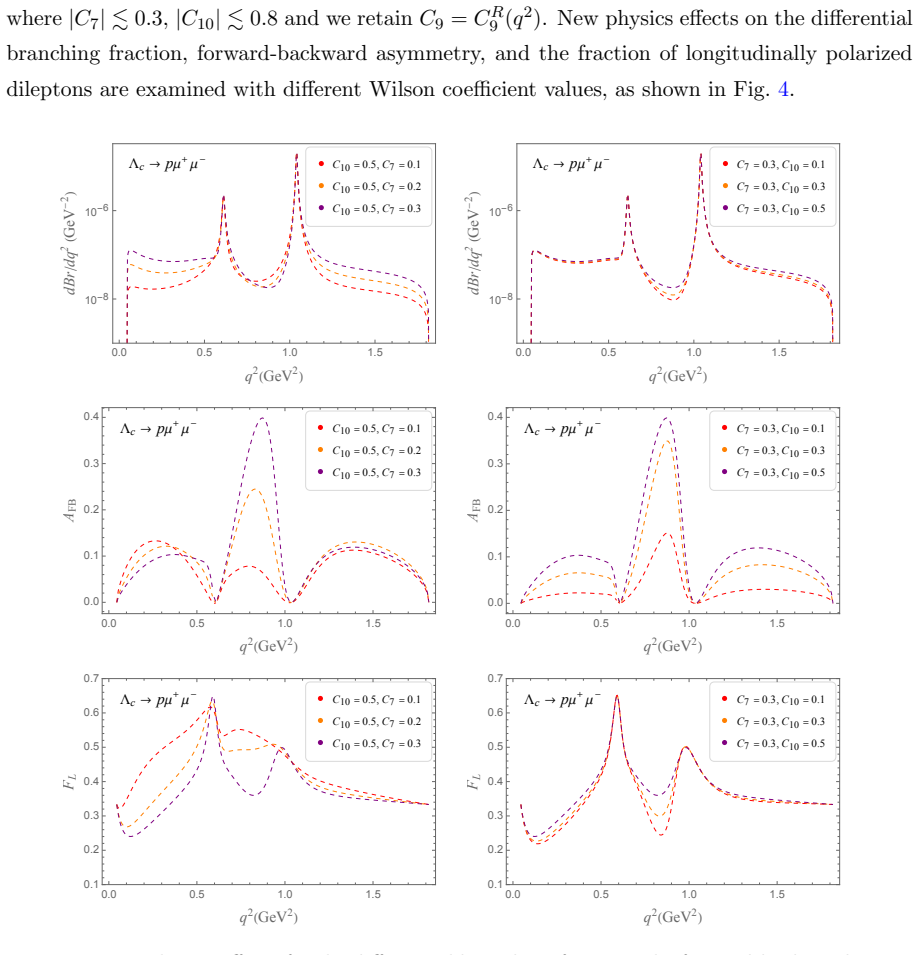
- Under new physics, $F_L$ acquires resonance peaks at the $\rho,\omega,\phi$ poles that are absent in the Standard Model, providing a distinguishing signature.
- U-spin relations extend the $\Lambda_c\to p$ form factors to six $\Xi_c$ rare modes, for example predicting ${\rm Br}(\Xi_c^+\to\Sigma^+\mu^+\mu^-)=(5.2\pm3.7)\times10^{-13}$ without resonance contributions.
Reading between the lines
- Our inference: because the same sum rules fail their convergence test for $\Lambda_b\to n$, where the $\langle\bar q q\rangle^2$ contribution reaches 50-90%, the method should not be expected to transfer directly to $b$-baryon decays; a light-cone or heavy-quark-effective-theory formulation would be needed there.
- Our inference: a first measurement of $\Xi_c^+\to\Sigma^+\mu^+\mu^-$ could validate the U-spin-extended form factors more cheaply than $\Lambda_c$ decays, since the predicted rate sits in a range future datasets might reach.
- Our inference: the roughly 60% uncertainty attributed to the charm-scale choice implies that improved Wilson coefficients, not just better form factors, are the limiting input for precision tests of $c\to u\ell^+\ell^-$ transitions.
- Our inference: the endpoint identity $F_L=1/3$ is a parameter-free prediction that a future angular analysis can test immediately; a measured deviation would point to new physics or to missing Standard Model contributions.
Editorial analysis
A structured set of objections, weighed in public.
Referee Report
Summary. The paper derives, within the QCD sum-rule framework, a complete set of ten form factors for the transition Λc → p (f1,f2,f3,g1,g2,g3,fT1,fT2,gT1,gT2). The form factors are computed at q^2 = 0 and in a small spacelike interval q^2 ∈ [−0.4,0.4] GeV^2, then extrapolated to the full physical region using a z-series parametrization. These form factors are used to compute branching fractions for Λc → p e+e− and Λc → p μ+μ−, both with and without long-distance vector-resonance contributions, as well as angular observables (AFB and FL). Flavor-symmetry relations are used to estimate branching fractions for Ξc decays. The paper also studies the sensitivity of the observables to new physics in the Wilson coefficients C7 and C10.
Significance. If the form-factor set is correct, this would be a useful ingredient for charm-baryon rare-decay phenomenology, complementing lattice QCD and quark-model results. The paper has several positive features: the QCD sum-rule framework is standard, the comparison with existing LQCD and RQM predictions is informative, and the z-series formalism is appropriate in spirit. The no-resonance branching fractions are genuine predictions and correctly respect the LHCb upper limit on Λc → pμ+μ−. The angular observables proposed as new-physics diagnostics, especially the vanishing SM AFB, are well motivated. However, the central claim of a complete and reliable form-factor set is not fully supported by the evidence presented: the Borel-window/OPE-convergence checks are not shown for most form factors, one form factor disagrees sharply with lattice QCD without being discussed, and the z-series fits have very large slope uncertainties. The resonance-included branching fractions are also normalized to the same data they are meant to predict, which weakens their significance. These issues are reparable, but they need to be addressed before the paper can be accepted.
major comments (4)
- [Sec. 3.1, Eqs. (17)–(18) and Fig. 1] The paper states two criteria for choosing the Borel window: the pole contribution must exceed 40% and the ⟨qq̄⟩^2 condensate contribution must remain below 30%. However, only the second criterion is displayed, and only for the single form factor f1. No RPC curves or Borel-window values are shown for the other nine form factors, and Fig. 1 shows only the ⟨qq̄⟩^2 fraction for f1. Since the fits in Table 2 use points in q^2 ∈ [−0.4,0.4] GeV^2, convergence must hold at each fitted point and for each Lorentz structure. Without these checks, the claim of a complete and reliable set of form factors is unsupported.
- [Table 1] The value g2(0) = −0.25 ± 0.02 disagrees with lattice QCD, g2(0) = 0.003 ± 0.052 [46], by approximately 5σ, yet the paper's list of form factors with reasonable agreement (f3, fT1, gT1) does not include g2. This discrepancy is either a sign/convention error or a sign that the sum rule fails for the g2 structure. The authors need to investigate and either correct the calculation or explain the discrepancy, because g2 enters the helicity amplitudes in Eq. (29) and affects the branching fractions and FL.
- [Sec. 3.1, Eq. (19) and Table 2] The z-series fits have extremely large slope uncertainties (for example, f1: a1 = −0.36 ± 4.44; gT1: a1 = −23.25 ± 16.28), despite the fits being performed over the narrow interval [−0.4,0.4] GeV^2. Using these fits to extrapolate to q^2 ≈ 1.8 GeV^2, the entire physical range, is uncontrolled. The paper should either justify that a single slope parameter suffices, add constraints from the endpoint behavior, or provide error bands that faithfully propagate the slope uncertainties into the branching fractions.
- [Sec. 3.2, Eqs. (25)–(28) and Table 3] The resonance couplings aω and aφ are determined from Eq. (26), which equates the contribution from C9^R alone to the measured Br(Λc → pV)Br(V → μ+μ−). Consequently, the resonance-included branching fraction for Λc → pμ+μ− in Table 3 is essentially the experimental input reflected back and is not an independent prediction. The agreement with the LHCb limit in Fig. 3 is therefore not a test of the calculation. The paper should clearly separate genuine predictions (no-resonance rates and off-resonance bins) from input-normalized estimates, and the new-physics analysis in Sec. 3.3, which uses C9 = C9^R, should be framed accordingly.
minor comments (5)
- [Abstract and Introduction] There are several typographical and grammatical issues, e.g., "exhibit an heavily dependence" in the Introduction and "the the four-vector" near Eq. (1). The abstract and text should be carefully proofread.
- [Fig. 3 caption] The caption writes "the √q2 region" in a way that is hard to read; it should say "the region of sqrt(q^2) excluding ±40 MeV intervals around mω and mφ" for clarity.
- [Fig. 2 and Table 2] The text says the symbol points in Fig. 2 denote the fitted points, but the figure appears to show only central curves; the caption should clarify what the points and error bands represent, especially given the large a1 uncertainties.
- [Sec. 3.2, Flavor-symmetry relations] The Xi_c predictions in Table 3 rely on U-spin symmetry and on adopting aω from Λc → p; this should be stated as an order-of-magnitude estimate rather than a precise prediction, and the large systematic uncertainty from the symmetry assumption should be acknowledged in the discussion.
- [References] Ref. [75] is used both as a source of input parameters and as a comparison for LCSR form factors; the text should be explicit about which quantities are taken from which reference to avoid ambiguity.
Circularity Check
Resonance-included branching fractions are normalized to the experimental two-body inputs via Eq. (26), so Table 3's resonance entries largely return those inputs; the QCDSR form factors and no-resonance results remain independent.
-
fitted input called prediction
[Section 3.2, Eqs. (25)-(28) and Table 3 (Lambda_c resonance rows)]
"To fix the two couplings aω and aϕ, the following approximation is employed: Br(Λc(→ pV ) → pµ+µ−) = Br(Λc → pV )Br(V → µ+µ−) , V = ω, ϕ . (26) Here, the left-hand side is directly calculated using only CR9(q2), considering only the contributions from the ω and ϕ, while the right-hand side is evaluated by the latest experimental data [27,73]: As a result, we obtain aω = 0.072 ± 0.015, aϕ = 0.104 ± 0.010."
The couplings aω and aϕ are determined by requiring the resonance-only CR9(q2) calculation of Λc→pμ+μ− to reproduce the measured products Br(Λc→pV)Br(V→μ+μ−). The 'resonance' branching fractions in Table 3 are then obtained by integrating the same CR9(q2)-dominated amplitudes, so their central values are essentially the normalization inputs reflected back. This is a consistency check of the Breit-Wigner normalization, not an independent prediction for the total rate. The no-resonance branching fractions and the QCD sum-rule form factors do not participate in this reduction.
-
fitted input called prediction
[Section 3.2, Xi_c paragraph and Table 3 (Xi_c resonance rows)]
"Regarding the couplings aϕ and aω, only one relevant two-body decay mode, Ξ0c → Λϕ, has been observed. The branching fraction for this decay is Br(Ξ0c → Λϕ) = (4.9 ± 1.5) × 10−4 [88], which suggest aϕ = 0.20 ± 0.04 in Ξc decay mode. There is no sufficient experimental data to determine aω, so we adopt the same value as in the Λc → p process."
The Ξc resonance predictions use aϕ fixed from Br(Ξ0c→Λϕ), so the Ξ0c→Λℓ+ℓ− resonance entries in Table 3 largely return that measured two-body rate multiplied by V→ℓ+ℓ−, and the Ξ+c→Σ+ entries inherit the same fitted aϕ via U-spin. The listed 'rough estimates' are therefore normalized to the very data they purport to predict. Only the treatment of ω and the no-resonance estimates remain independent of this particular input.
full rationale
The central form-factor derivation is not circular: the ten form factors are computed from three-point QCD sum rules with the input parameters listed in Eq. (15); the z-series fit is performed on the sum-rule outputs over q²∈[-0.4,0.4] GeV² and is checked against the directly computed f_i(0). No external branching-fraction data enter that part of the chain, and the self-citations (e.g. Refs. [57], [64]) are not load-bearing for the main claims. The circularity is confined to the resonance-included branching fractions. Equations (25)-(28) fix aω and aφ by matching the CR9-only Λc→pμ+μ− rate to Br(Λc→pV)Br(V→μ+μ−), and Table 3's resonance rows then integrate the same CR9-dominated amplitudes; likewise aφ for Ξc is set by Br(Ξ0c→Λφ) and the Ξc resonance rates inherit that input. These entries are normalizations returned as predictions, so the paper receives score 6 under the fitted-input-called-prediction pattern. The no-resonance branching fractions, the angular observables, and the new-physics sensitivity plots are not reduced by these normalizations and retain independent content. The missing per-form-factor Borel-window/OPE-convergence curves noted in Section 3.1 are a reproducibility and correctness risk, not a demonstrated circular step.
Assumptions & free parameters
free parameters (6)
- Lambda_c decay constant lambda_Lambda_c =
0.0119 GeV^3
- proton decay constant lambda_p =
0.02 GeV^3
- threshold parameters s0_1, s0_2 =
s0_1 = 9.5-10.5 GeV^2, s0_2 = 2.4-3.0 GeV^2
- z-series slope parameters a1 for 10 form factors =
Table 2 (e.g., f1: -0.36 +/- 4.44; gT1: -23.25 +/- 16.28)
- resonance couplings a_omega, a_phi =
0.072 +/- 0.015, 0.104 +/- 0.010 (Lambda_c); 0.20 +/- 0.04 (Xi_c phi)
- strong phases delta_omega, delta_phi =
varied over [0, 2pi]
assumptions (7)
- domain assumption Quark-hadron duality: the integrated spectral density with continuum subtraction equals the hadronic sum over ground states and resonances.
- domain assumption Truncated OPE at dimension 6 is convergent, with the <qqbar>^2 term below 30%.
- domain assumption Pole contribution exceeds 40% in the Borel window.
- ad hoc to paper The z-series with a single slope a1 plus pole factor is adequate to extrapolate form factors from q^2 in [-0.4,0.4] GeV^2 to the full physical region.
- domain assumption Factorization approximation of Eq. (26): Br(Lambda_c(->pV) -> p l+l-) = Br(Lambda_c -> pV) Br(V -> l+l-).
- domain assumption Flavor symmetry relations: f(Lambda_c->p) = f(Xi_c+->Sigma+) = sqrt(2) f(Xi_c0->Sigma0) = sqrt(6) f(Xi_c0->Lambda).
- domain assumption The interpolating currents of Eqs. (5)-(6) couple only to the ground-state baryons with decay constants lambda_Lambda_c and lambda_p.
Cite this review
Pith. "Pith review of Rare $ \Lambda_c $ decays and new physics effects." pith.science (2026). https://pith.science/paper/3DQUOVNV
@misc{pith2026241115857,
  author       = {Pith},
  title        = {Pith review of: Rare $ \Lambda_c $ decays and new physics effects},
  year         = {2026},
  howpublished = {\url{https://pith.science/paper/3DQUOVNV}},
  note         = {Machine review of arXiv:2411.15857}
}
abstract
Recent experimental progress on baryonic rare decays has spurred a deeper investigation on flavor-changing neutral current transitions in the baryon sector. Within the framework of QCD sum rules, we derive a complete set of form factors for the $ \Lambda_c\to p $ process in the large recoil region and use the $z$-series parametrization to extrapolate them across the full physical range. Employing these form factors and flavor symmetries, we compute branching fractions for the decays $\Lambda_c \to p e^+ e^-$ and $\Lambda_c \to p \mu^+ \mu^-$, as well as for rare $ \Xi_c $ decay modes. We examine as well the new physics effects through specific angular observables such as the lepton forward-backward asymmetry and the fraction of longitudinally polarized dileptons. Results indicate that new physics models may be testified in baryonic rare decays, with immense data collected in running and future colliders.
Figures


Figures from the paper (1 more)
Reference graph
Works this paper leans on
- [42]
-
[46]
S. Meinel, Λ c → N form factors from lattice QCD and phenomenology of Λ c → nℓ+νℓ and Λc → pµ+µ− decays, Phys. Rev. D 97, 034511 (2018)
work page 2018
-
[1]
S. L. Glashow, J. Iliopoulos, and L. Maiani, Weak Interactions with Lepton-Hadron Sym- metry, Phys. Rev. D 2, 1285–1292 (1970)
1970
-
[2]
J. L. Hewett and J. D. Wells, Searching for supersymmetry in rare B decays, Phys. Rev. D 55, 5549–5560 (1997)
1997
-
[3]
Buchalla, G
G. Buchalla, G. Hiller, and G. Isidori, Phenomenology of nonstandard Z couplings in ex- clusive semileptonic b → s transitions, Phys. Rev. D 63, 014015 (2000)
2000
-
[4]
C. Bird, P. Jackson, R. V. Kowalewski, and M. Pospelov, Search for dark matter in b → s transitions with missing energy, Phys. Rev. Lett. 93, 201803 (2004)
2004
-
[5]
Davidson, D
S. Davidson, D. C. Bailey, and B. A. Campbell, Model independent constraints on lepto- quarks from rare processes, Z. Phys. C 61, 613–644 (1994)
1994
-
[6]
Abe et al., Observation of the decay B → Kℓ+ℓ−, Phys
K. Abe et al., Observation of the decay B → Kℓ+ℓ−, Phys. Rev. Lett. 88, 021801 (2002)
2002
Show all 89 references
-
[7]
Aubert et al., Measurements of branching fractions, rate asymmetries, and angular distributions in the rare decays B → Kℓ+ℓ− and B → K∗ℓ+ℓ−, Phys
B. Aubert et al., Measurements of branching fractions, rate asymmetries, and angular distributions in the rare decays B → Kℓ+ℓ− and B → K∗ℓ+ℓ−, Phys. Rev. D 73, 092001 (2006)
2006
-
[8]
Aubert et al., Direct CP, Lepton Flavor and Isospin Asymmetries in the Decays B → K(∗)ℓ+ℓ−, Phys
B. Aubert et al., Direct CP, Lepton Flavor and Isospin Asymmetries in the Decays B → K(∗)ℓ+ℓ−, Phys. Rev. Lett. 102, 091803 (2009)
2009
-
[9]
J. T. Wei et al., Measurement of the Differential Branching Fraction and Forward-Backward Asymmetry for B → K(∗)ℓ+ℓ−, Phys. Rev. Lett. 103, 171801 (2009)
2009
-
[10]
Aaij et al., Differential branching fraction and angular analysis of the B+ → K+µ+µ− decay, JHEP 02, 105 (2013)
R. Aaij et al., Differential branching fraction and angular analysis of the B+ → K+µ+µ− decay, JHEP 02, 105 (2013)
2013
-
[11]
Aaij et al., Differential branching fractions and isospin asymmetries of B → K(∗)µ+µ− decays, JHEP 06, 133 (2014)
R. Aaij et al., Differential branching fractions and isospin asymmetries of B → K(∗)µ+µ− decays, JHEP 06, 133 (2014)
2014
-
[12]
Choudhury et al., Test of lepton flavor universality and search for lepton flavor violation in B → Kℓℓ decays, JHEP 03, 105 (2021)
S. Choudhury et al., Test of lepton flavor universality and search for lepton flavor violation in B → Kℓℓ decays, JHEP 03, 105 (2021). 17
2021
-
[13]
Aaij et al., Search for lepton-universality violation in B+ → K+ℓ+ℓ− decays, Phys
R. Aaij et al., Search for lepton-universality violation in B+ → K+ℓ+ℓ− decays, Phys. Rev. Lett. 122, 191801 (2019)
2019
-
[14]
J. P. Lees et al., Searches for Rare or Forbidden Semileptonic Charm Decays, Phys. Rev. D 84, 072006 (2011)
2011
-
[15]
Aaij et al., Search for D+ s → π+µ+µ− and D+ s → π−µ+µ+ decays, Phys
R. Aaij et al., Search for D+ s → π+µ+µ− and D+ s → π−µ+µ+ decays, Phys. Lett. B 724, 203–212 (2013)
2013
-
[16]
Aaij et al., Searches for 25 rare and forbidden decays of D+ and D+ s mesons, JHEP 06, 044 (2021)
R. Aaij et al., Searches for 25 rare and forbidden decays of D+ and D+ s mesons, JHEP 06, 044 (2021)
2021
-
[17]
Rubin et al., Search for rare and forbidden decays of charm and charmed-strange mesons to final states h+ − e− + e+, Phys
P. Rubin et al., Search for rare and forbidden decays of charm and charmed-strange mesons to final states h+ − e− + e+, Phys. Rev. D 82, 092007 (2010)
2010
-
[18]
V. M. Abazov et al., Search for flavor-changing-neutral-current D meson decays, Phys. Rev. Lett. 100, 101801 (2008)
2008
-
[19]
J. R. Batley et al., Precise measurement of the K± → π±e+e− decay, Phys. Lett. B 677, 246–254 (2009)
2009
-
[20]
Cortina Gil et al., A measurement of the K+ → π+µ+µ− decay, JHEP 11, 011 (2022), [Addendum: JHEP 06, 040 (2023)]
E. Cortina Gil et al., A measurement of the K+ → π+µ+µ− decay, JHEP 11, 011 (2022), [Addendum: JHEP 06, 040 (2023)]
2022
-
[21]
Mannel and S
T. Mannel and S. Recksiegel, Flavor changing neutral current decays of heavy baryons: The Case Λb → Λγ, J. Phys. G 24, 979–990 (1998)
1998
-
[22]
Wang, Y.-G
R.-M. Wang, Y.-G. Xu, C. Hua, and X.-D. Cheng, StudyingB1( 1 2 +) → B2( 1 2 +)ℓ+ℓ− semilep- tonic weak baryon decays with the SU(3) flavor symmetry, Phys. Rev. D103, 013007 (2021)
2021
-
[23]
Aaltonen et al., Observation of the Baryonic Flavor-Changing Neutral Current Decay Λb → Λµ+µ−, Phys
T. Aaltonen et al., Observation of the Baryonic Flavor-Changing Neutral Current Decay Λb → Λµ+µ−, Phys. Rev. Lett. 107, 201802 (2011)
2011
-
[24]
Aaij et al., Measurement of the differential branching fraction of the decay Λ0 b → Λµ+µ−, Phys
R. Aaij et al., Measurement of the differential branching fraction of the decay Λ0 b → Λµ+µ−, Phys. Lett. B 725, 25–35 (2013)
2013
-
[25]
Aaij et al., Evidence for the rare decay Σ + → pµ+µ−, Phys
R. Aaij et al., Evidence for the rare decay Σ + → pµ+µ−, Phys. Rev. Lett. 120, 221803 (2018)
2018
-
[26]
J. R. Batley et al., First observation and branching fraction and decay parameter measure- ments of the weak radiative decay Ξ 0 → Λe+e−, Phys. Lett. B 650, 1–8 (2007)
2007
-
[27]
Aaij et al., Search for the rare decay of charmed baryon Λ c into the pµ+µ− final state, Phys
R. Aaij et al., Search for the rare decay of charmed baryon Λ c into the pµ+µ− final state, Phys. Rev. D 110, 052007 (2024)
2024
-
[28]
Aaij et al., Search for the rare decay Λ + c → pµ+µ−, Phys
R. Aaij et al., Search for the rare decay Λ + c → pµ+µ−, Phys. Rev. D 97, 091101 (2018). 18
2018
-
[29]
de Boer and G
S. de Boer and G. Hiller, Flavor and new physics opportunities with rare charm decays into leptons, Phys. Rev. D 93, 074001 (2016)
2016
-
[30]
Fajfer, S
S. Fajfer, S. Prelovsek, and P. Singer, Rare charm meson decays D → P l+l− and c → ul+l− in SM and MSSM, Phys. Rev. D 64, 114009 (2001)
2001
-
[31]
A. Paul, I. I. Bigi, and S. Recksiegel, On D → Xul+l− within the Standard Model and Frameworks like the Littlest Higgs Model with T Parity, Phys. Rev. D 83, 114006 (2011)
2011
-
[32]
M. Golz, G. Hiller, and T. Magorsch, Probing for new physics with rare charm baryon (Λ c, Ξc, Ωc) decays, JHEP 09, 208 (2021)
2021
-
[33]
Aaij et al., Angular Analysis of the B+ → K∗+µ+µ− Decay, Phys
R. Aaij et al., Angular Analysis of the B+ → K∗+µ+µ− Decay, Phys. Rev. Lett. 126, 161802 (2021)
2021
-
[34]
Y.-M. Wang, Y. Li, and C.-D. Lu, Rare Decays of Λ b → Λ + γ and Λ b → Λ + l+l− in the Light-cone Sum Rules, Eur. Phys. J. C 59, 861–882 (2009)
2009
-
[35]
Cheng, C.-Y
H.-Y. Cheng, C.-Y. Cheung, G.-L. Lin, Y. C. Lin, T.-M. Yan, and H.-L. Yu, Effective Lagrangian approach to weak radiative decays of heavy hadrons, Phys. Rev. D 51, 1199– 1214 (1995)
1995
-
[36]
R. N. Faustov and V. O. Galkin, Rare Λ b → Λl+l− and Λb → Λγ decays in the relativistic quark model, Phys. Rev. D 96, 053006 (2017)
2017
-
[37]
R. N. Faustov and V. O. Galkin, Rare Λ b → nl+l− decays in the relativistic quark-diquark picture, Mod. Phys. Lett. A 32, 1750125 (2017)
2017
-
[38]
R. N. Faustov and V. O. Galkin, Rare Λ c → pℓ+ℓ− decay in the relativistic quark model, Eur. Phys. J. C 78, 527 (2018)
2018
-
[39]
Gutsche, M
T. Gutsche, M. A. Ivanov, J. G. Korner, V. E. Lyubovitskij, and P. Santorelli, Rare baryon decays Λ b → Λl+l−(l = e, µ, τ) and Λ b → Λγ : differential and total rates, lepton- and hadron-side forward-backward asymmetries, Phys. Rev. D 87, 074031 (2013)
2013
-
[40]
Liu, X.-W
L.-L. Liu, X.-W. Kang, Z.-Y. Wang, and X.-H. Guo, Rare Λ b → Λℓ+ℓ− decay in the Bethe- Salpeter equation approach, Chin. Phys. C 44, 083107 (2020)
2020
-
[41]
L.-L. Liu, C. Wang, X.-W. Kang, and X.-H. Guo, FCNC transitions of Λ b to neutron in Bethe-Salpeter equation approach, Eur. Phys. J. C 80, 193 (2020)
2020
-
[43]
Gan, Y.-L
L.-F. Gan, Y.-L. Liu, W.-B. Chen, and M.-Q. Huang, Improved Light-cone QCD Sum Rule Analysis Of The Rare Decays Λ b → Λγ And Λ b → Λl+l−, Commun. Theor. Phys. 58, 872–882 (2012). 19
2012
-
[44]
T. M. Aliev, T. Barakat, and M. Savcı, Form factors for the rare Λ b(Λ∗ b ) → N ℓ+ℓ− decays in light cone QCD sum rules, Phys. Rev. D 98, 035033 (2018)
2018
-
[45]
Detmold and S
W. Detmold and S. Meinel, Λ b → Λℓ+ℓ− form factors, differential branching fraction, and angular observables from lattice QCD with relativistic b quarks, Phys. Rev. D 93, 074501 (2016)
2016
-
[47]
Hussain, D.-S
F. Hussain, D.-S. Liu, M. Kramer, J. G. Korner, and S. Tawfiq, General analysis of weak decay form-factors in heavy to heavy and heavy to light baryon transitions, Nucl. Phys. B 370, 259–277 (1992)
1992
-
[48]
Mannel, W
T. Mannel, W. Roberts, and Z. Ryzak, Baryons in the heavy quark effective theory, Nucl. Phys. B 355, 38–53 (1991)
1991
-
[49]
Chen and C
C.-H. Chen and C. Q. Geng, Rare Λ b → Λl+l− decays with polarized lambda, Phys. Rev. D 63, 114024 (2001)
2001
-
[50]
Huang and H.-G
C.-S. Huang and H.-G. Yan, Exclusive rare decays of heavy baryons to light baryons: Λb → Λγ and Λ b → Λl+l−, Phys. Rev. D 59, 114022 (1999), [Erratum: Phys.Rev.D 61, 039901 (2000)]
1999
-
[51]
D.-K. Lian, W. Chen, H.-X. Chen, L.-Y. Dai, and T. G. Steele, Strong decays of T a c¯s0(2900)++/0 as a fully open-flavor tetraquark state, Eur. Phys. J. C 84, 1 (2024)
2024
-
[52]
Wang, Analysis of the strong decay X(5568) → B0 s π+ with QCD sum rules, Eur
Z.-G. Wang, Analysis of the strong decay X(5568) → B0 s π+ with QCD sum rules, Eur. Phys. J. C 76, 279 (2016)
2016
-
[53]
J. M. Dias, X. Liu, and M. Nielsen, Predicition for the decay width of a charged state near the Ds ¯D∗/D∗ s ¯D threshold, Phys. Rev. D 88, 096014 (2013)
2013
-
[54]
Wan and C.-F
B.-D. Wan and C.-F. Qiao, About the exotic structure of Zcs, Nucl. Phys. B 968, 115450 (2021)
2021
-
[55]
Wang, Decipher the width of the X(3872) via the QCD sum rules, Phys
Z.-G. Wang, Decipher the width of the X(3872) via the QCD sum rules, Phys. Rev. D 109, 014017 (2024)
2024
-
[56]
Dai, C.-S
Y.-B. Dai, C.-S. Huang, M.-Q. Huang, and C. Liu, QCD sum rule analysis for the Λ b → Λc semileptonic decay, Phys. Lett. B 387, 379–385 (1996)
1996
-
[57]
Zhang and C.-F
S.-Q. Zhang and C.-F. Qiao, Λ c semileptonic decays, Phys. Rev. D 108, 074017 (2023)
2023
-
[58]
Huang, C.-F
C.-S. Huang, C.-F. Qiao, and H.-G. Yan, Decay Λ b → pl¯ν in QCD sum rules, Phys. Lett. B 437, 403–407 (1998). 20
1998
-
[59]
R. S. Marques de Carvalho, F. S. Navarra, M. Nielsen, E. Ferreira, and H. G. Dosch, Form- factors and decay rates for heavy Lambda semileptonic decays from QCD sum rules, Phys. Rev. D 60, 034009 (1999)
1999
-
[60]
Y.-J. Shi, W. Wang, and Z.-X. Zhao, QCD Sum Rules Analysis of Weak Decays of Doubly- Heavy Baryons, Eur. Phys. J. C 80, 568 (2020)
2020
-
[61]
Zhao, R.-H
Z.-X. Zhao, R.-H. Li, Y.-L. Shen, Y.-J. Shi, and Y.-S. Yang, The semi-leptonic form factors of Λb → Λc and Ξb → Ξc in QCD sum rules, Eur. Phys. J. C 80, 1181 (2020)
2020
-
[62]
Zhao, X.-Y
Z.-X. Zhao, X.-Y. Sun, F.-W. Zhang, Y.-P. Xing, and Y.-T. Yang, Semileptonic form factors of Ξc → Ξ in QCD sum rules, Phys. Rev. D 108, 116008 (2023)
2023
-
[63]
Xing and Z.-X
Z.-P. Xing and Z.-X. Zhao, QCD sum rules analysis of weak decays of doubly heavy baryons: the b → c processes, Eur. Phys. J. C 81, 1111 (2021)
2021
-
[64]
Zhang, X.-H
S.-Q. Zhang, X.-H. Zhang, and C.-F. Qiao, Hyperon semileptonic decays in QCD sum rules, JHEP 06, 122 (2024)
2024
-
[65]
Xing and Z.-X
Z.-P. Xing and Z.-X. Zhao, Weak decays of doubly heavy baryons: the FCNC processes, Phys. Rev. D 98, 056002 (2018)
2018
-
[66]
Chung, H
Y. Chung, H. G. Dosch, M. Kremer, and D. Schall, QCD Sum Rules for ’Baryonic Currents’, Phys. Lett. B 102, 175–179 (1981)
1981
-
[67]
Wang, Semileptonic decays B∗ c → ηcℓ¯νℓ with QCD sum rules, Commun
Z.-G. Wang, Semileptonic decays B∗ c → ηcℓ¯νℓ with QCD sum rules, Commun. Theor. Phys. 61, 81–88 (2014)
2014
-
[68]
Yang, Semileptonic decay of B and D → K∗ 0 (1430)¯ℓν from QCD sum rule, Phys
M.-Z. Yang, Semileptonic decay of B and D → K∗ 0 (1430)¯ℓν from QCD sum rule, Phys. Rev. D 73, 034027 (2006), [Erratum: Phys.Rev.D 73, 079901 (2006)]
2006
-
[69]
Du, J.-W
D.-S. Du, J.-W. Li, and M.-Z. Yang, Form-factors and semileptonic decay of D+ s → ϕ¯lν from QCD sum rule, Eur. Phys. J. C 37, 173–184 (2004)
2004
-
[70]
M. A. Shifman, A. I. Vainshtein, and V. I. Zakharov, QCD and Resonance Physics: Appli- cations, Nucl. Phys. B 147, 448–518 (1979)
1979
-
[71]
Wan, S.-Q
B.-D. Wan, S.-Q. Zhang, and C.-F. Qiao, Possible structure of the newly found exotic state η1(1855), Phys. Rev. D 106, 074003 (2022)
2022
-
[72]
Colangelo and A
P. Colangelo and A. Khodjamirian, QCD sum rules, a modern perspective, At The Frontier of Particle Physics 1495–1576 (2000)
2000
-
[73]
Navas et al., Review of particle physics, Phys
S. Navas et al., Review of particle physics, Phys. Rev. D 110, 030001 (2024)
2024
-
[74]
Wan, S.-Q
B.-D. Wan, S.-Q. Zhang, and C.-F. Qiao, Light baryonium spectrum, Phys. Rev. D 105, 014016 (2022). 21
2022
-
[75]
Khodjamirian, C
A. Khodjamirian, C. Klein, T. Mannel, and Y. M. Wang, Form Factors and Strong Cou- plings of Heavy Baryons from QCD Light-Cone Sum Rules, JHEP 09, 106 (2011)
2011
-
[76]
Chung, H
Y. Chung, H. G. Dosch, M. Kremer, and D. Schall, Chiral Symmetry Breaking Condensates for Baryonic Sum Rules, Z. Phys. C 25, 151 (1984)
1984
-
[77]
Wan and H.-T
B.-D. Wan and H.-T. Xu, 0 −− hidden-heavy tetraquark states via QCD sum rules, Chin. Phys. C 48, 093103 (2024)
2024
-
[78]
Wan, Mass spectra of 0 −− and 0 +− hidden-heavy baryoniums, Eur
B.-D. Wan, Mass spectra of 0 −− and 0 +− hidden-heavy baryoniums, Eur. Phys. J. C 84, 760 (2024)
2024
-
[79]
Zhang, B.-D
S.-Q. Zhang, B.-D. Wan, L. Tang, and C.-F. Qiao, Gluonic nature of the newly observed state X(2600), Phys. Rev. D 106, 074010 (2022)
2022
-
[80]
Leljak and B
D. Leljak and B. Melic, |Vub| determination and testing of lepton flavour universality in semileptonic Bc → D∗ decays, JHEP 02, 171 (2020)
2020
-
[81]
Ball and V
P. Ball and V. M. Braun, Use and misuse of QCD sum rules in heavy to light transitions: The Decay B → ρeν reexamined, Phys. Rev. D 55, 5561–5576 (1997)
1997
-
[82]
Khodjamirian and R
A. Khodjamirian and R. Ruckl, QCD sum rules for exclusive decays of heavy mesons, Adv. Ser. Direct. High Energy Phys. 15, 345–401 (1998)
1998
-
[83]
Bourrely, I
C. Bourrely, I. Caprini, and L. Lellouch, Model-independent description of B → πlν decays and a determination of |Vub|, Phys. Rev. D 79, 013008 (2009), [Erratum: Phys.Rev.D 82, 099902 (2010)]
2009
-
[84]
Bona et al., New UTfit Analysis of the Unitarity Triangle in the Cabibbo-Kobayashi- Maskawa scheme, Rend
M. Bona et al., New UTfit Analysis of the Unitarity Triangle in the Cabibbo-Kobayashi- Maskawa scheme, Rend. Lincei Sci. Fis. Nat. 34, 37–57 (2023)
2023
-
[85]
de Boer and G
S. de Boer and G. Hiller, Rare radiative charm decays within the standard model and beyond, JHEP 08, 091 (2017)
2017
-
[86]
B. B. S ¸irvanli, Search for c → ul+l− transition in charmed baryon decays, Phys. Rev. D 93, 034027 (2016)
2016
-
[87]
A. Dery, M. Ghosh, Y. Grossman, and S. Schacht, SU(3) F analysis for beauty baryon decays, JHEP 03, 165 (2020)
2020
-
[88]
Chistov et al., First observation of Cabibbo-suppressed Ξ 0 c decays, Phys
R. Chistov et al., First observation of Cabibbo-suppressed Ξ 0 c decays, Phys. Rev. D 88, 071103 (2013)
2013
-
[89]
Gisbert, G
H. Gisbert, G. Hiller, and D. Suelmann, Effective field theory analysis of rare |∆c| = |∆u| = 1 charm decays, JHEP 12, 102 (2024). 22
2024
Reviewed August 12, 2026 · model on record in the stance chip above.
Discussion (0). Continue with ORCID to comment.