REVIEW 4 major objections 5 minor 2 cited by
SVTRv2: CTC Beats Encoder-Decoder Models in Scene Text Recognition
T0 review · 4 major / 5 minor · reviewed 2026-08-12 · deepseek-v4-flash
Pith's one-line read A CTC-only scene text recognizer now beats encoder-decoder models in accuracy and speed.
desk verdict SVTRv2 is a serious empirical paper with a genuine architectural claim, but the headline comparison rests on an in-house benchmark whose tuning details are under-disclosed; worth refereeing seriously. read the letter →
The pith
A machine-rendered reading of the paper's core claim, the machinery that carries it, and where it could break.
The reading
What carries the argument
The argument is carried by three mechanisms. MSR divides input images into four aspect-ratio buckets ($R<1.5$, $1.5\le R<2.5$, $2.5\le R<3.5$, $R\ge 3.5$) and resizes each text instance to a predefined size per bucket, avoiding the distortion caused by fixed $32\times128$ resizing. FRM learns a soft probability matrix $M\in\mathbb{R}^{W/4\times(H/8\times W/4)}$ that maps 2D visual features $F$ into a sequence $\tilde{F}=MF$ aligned with the text reading order, first horizontally and then vertically using multi-head self-attention and a selecting token. SGM takes the left and right character strings around each target character, encodes them into embeddings, and uses attention between the string context and the visual features to force the visual model to encode linguistic cues; since only the visual model is needed at inference, SGM is dropped and inference remains a single forward pass through the visual backbone plus a CTC classifier.
What would settle it
Run a duplicate and near-duplicate image audit using embedding-based search between U14M-Filter and the Union14M-Benchmark test subsets; if hundreds of near-duplicate samples remain, the reported accuracy advantage could be an artifact of leakage. Additionally, re-train the strongest EDTR baselines with longer schedules or larger epochs on the same unfiltered protocol; if one baseline exceeds SVTRv2 under those conditions, the claimed CTC superiority would be scheduling-dependent rather than architectural.
Extended reading notes
Core claim
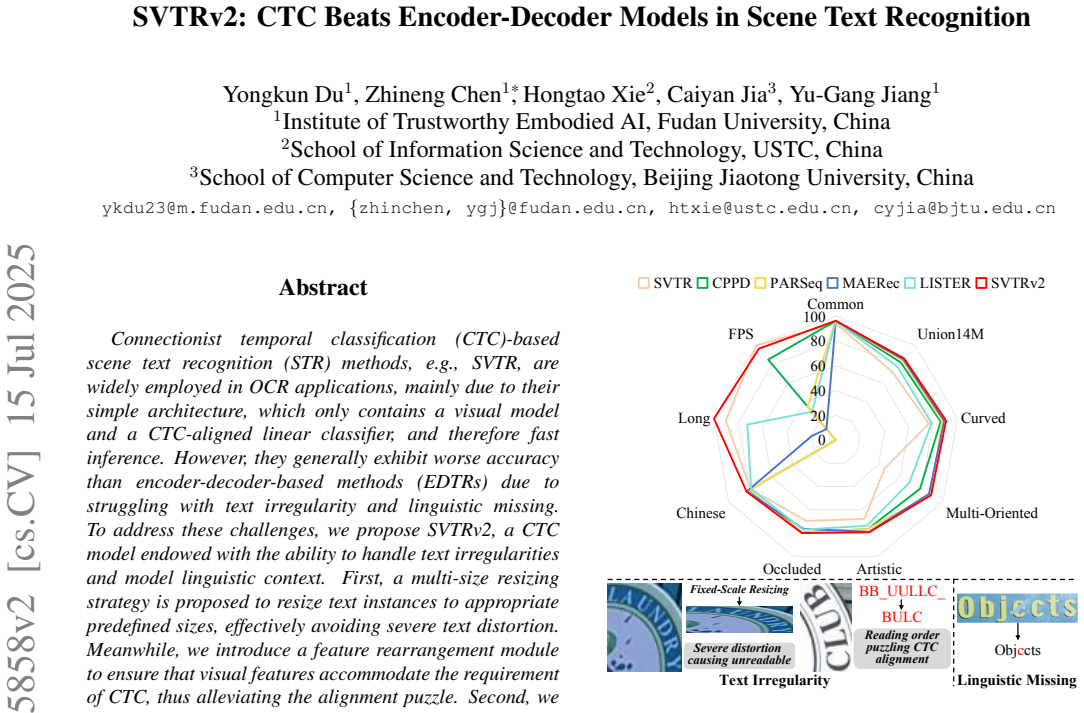
The central discovery is that a purely CTC-based recognizer, once upgraded with an aspect-ratio-aware resize policy, a learned feature-rearrangement step that aligns visual features with the reading order required by CTC, and a training-only semantic guidance module that injects linguistic context into visual features, can reach or surpass the accuracy of encoder-decoder STR models that dominate recent benchmarks. In the reported experiments, SVTRv2-B reaches 96.57% average accuracy on the six common benchmarks, 86.14% on Union14M-Benchmark, 80.0% on occluded scene text, and 50.2% on long text, while running at 143 FPS on a 1080Ti with 19.8M parameters. The paper also introduces U14M-Filter, a leakage-filtered version of Union14M-L, and retrains 24 popular STR methods under a standardized protocol so that the comparisons are not contaminated by training/test overlap.
Load-bearing premise
The headline comparison stands or falls on whether U14M-Filter truly removes every training image that overlaps with the Union14M-Benchmark test set, and on whether the 24 baselines were tuned to their actual best performance under the shared protocol.
Editorial extensions
If this is right
- High-accuracy scene text recognition no longer requires an autoregressive or attention decoder at inference, because the decoder's language-modeling role can be pushed into the visual features during training.
- The same architecture handles long text of 25 to 35 characters, whereas many EDTRs cap the recognition length near 25 and cannot read longer strings.
- U14M-Filter provides a leakage-free training and evaluation protocol for the Union14M benchmark, which changes previously reported accuracy numbers for the methods that were trained on overlapping data.
- The three proposed modules improve multiple visual backbones beyond SVTR, including ResNet, FocalNet, ConvNeXtV2, and ViT-S, suggesting they are adaptable components rather than a single bespoke architecture.
- When combined with synthetic pretraining and fine-tuning, SVTRv2-B reaches 97.83% average accuracy on common benchmarks with about one-seventh the parameters of CLIP-based EDTR baselines, showing that the speed and parameter advantage persists at the high-accuracy end.
Reading between the lines
- A natural extension is to apply the SGM 'train-side language injection' recipe to other CTC-based sequence-labeling tasks such as speech recognition or handwriting recognition, where decoders are often kept only for accuracy and would be costly to run on device.
- The success of MSR suggests that fixed input size is itself an important bottleneck in STR, and adaptive resizing based on aspect ratio could benefit other image-recognition pipelines that currently normalize aspect ratios away.
- If the claims replicate in independent evaluations, OCR deployment will likely shift toward lighter CTC models, because the cost of linguistic context is paid once at training time and the runtime keeps the fast single-pass inference.
- A controlled study that isolates the contribution of the higher feature resolution ($H/16\to H/8$) from the three named modules, with compute matched across variants, would sharpen the attribution of the reported gains.
Editorial analysis
A structured set of objections, weighed in public.
Referee Report
Summary. The paper proposes SVTRv2, a CTC-based scene text recognition model that combines a multi-size resizing strategy (MSR), a feature rearrangement module (FRM), and a training-only semantic guidance module (SGM). The authors argue that these components let a CTC model handle irregular text and use linguistic context, so that it can match or exceed encoder-decoder STR models (EDTRs) in accuracy while retaining CTC's fast inference. The paper introduces U14M-Filter, a deduplicated version of Union14M-L, and reports extensive experiments on standard and challenging benchmarks, including a retrained set of 24 baselines, with SVTRv2 claiming top results in most scenarios.
Significance. If the claims hold, the paper challenges the prevailing assumption that an attention-based decoder is necessary for high-accuracy scene text recognition, offering a faster alternative that is attractive for deployment. The three proposed modules are simple, backbone-agnostic, and analyzed through systematic ablations. The paper also contributes U14M-Filter and a large set of retrained baselines, which could become a community resource. The training-only SGM is an interesting mechanism for injecting linguistic context without inference cost. The main caveat is that the headline comparison depends on the fairness and reproducibility of the baseline tuning and dataset construction, which are not fully disclosed.
major comments (4)
- [Supplementary Sec. 12, Tab. 12] The claim that 24 baselines were 'extensively tuned' and that the 'best result we got' is reported is not verifiable: the supplementary material gives only a uniform protocol with flexible clauses (e.g., 'the learning rate is adjusted multiple times to achieve the best results'), but it does not list the actual hyperparameters used for each baseline, nor does it specify the model-selection procedure (for example, whether a validation split or the test set was used to pick the best configuration). Because the central claim that CTC outperforms EDTRs depends on the baselines being at or near their best, please provide a per-model table of hyperparameters, describe the search space and selection rule, and ideally release training logs or checkpoints.
- [Sec. 4.1; Supplementary Sec. 8, Tab. 9] The construction of U14M-Filter is not described in sufficient detail. Tab. 9 reports the number of removed instances but not the method used to identify overlaps between U14M-L and the U14M test subsets. The reliability of the benchmark depends on this deduplication being complete; exact matching may miss near-duplicates, leading to data leakage. Please specify the duplicate-detection procedure (e.g., perceptual hashing, image retrieval, manual verification) and report any checks for remaining contamination.
- [Sec. 4.3, Tab. 5] For the Chinese recognition experiments, the baselines marked with * are 'retrained using the same setting as SVTRv2 (Sec. 4.1)', rather than being tuned per-model as in the English experiments. Given the paper's own statement that tuning yields 5-10% improvements for most models, the Chinese state-of-the-art claim is not established at the same standard as the English claim. Please either tune the Chinese baselines with the same per-model care, or present the Chinese results as a preliminary comparison.
- [Sec. 1 vs. Sec. 4.3, Tab. 3] The introduction states that 'SVTRv2 consistently outperforms all the compared EDTRs across the evaluated scenarios in terms of accuracy and speed,' but Tab. 3 shows that SMTR outperforms SVTRv2-B on LTB (55.5 vs 50.2) and MAERec outperforms SVTRv2-B on the Salient subset (86.3 vs 86.2). The abstract's 'most EDTRs' is the accurate claim; the introduction should be corrected to avoid overclaiming.
minor comments (5)
- [Sec. 3.4] The context-window size ls in SGM is defined but its value is not given in the experiments; only Fig. 3 mentions 'li set to 5' (likely a typo for ls). Please specify the default value and, if possible, report sensitivity to this hyperparameter.
- [Sec. 3.3] There is a typo in the sentence 'LN ans MLP means Layer Normalization and Multi-Layer Perceptron' — 'ans' should be 'and'.
- [Sec. 4.1] The protocol filters test images with text length > 25 for all test sets except LTB, but the paper does not report how many images are removed from each benchmark. This information is needed to judge the impact of the filtering on the reported accuracy.
- [Fig. 1] The normalized FPS visualization is difficult to interpret because it mixes accuracy and speed on different scales; consider replacing it with a scatter plot or a table that shows raw values.
- [References] Some references contain formatting errors, for example '[4] D. Bautista and R.l Atienza' has an odd capitalization of 'R.l'; please proofread the reference list.
Circularity Check
No circularity: SVTRv2's accuracy claims rest on held-out evaluation with retrained baselines, not on construction or self-citation.
full rationale
The paper's central claim that the CTC-based SVTRv2 surpasses most encoder-decoder STR models is established by a genuine train/test comparison, not by an equation that reduces the result to its inputs. The three proposed modules are defined and trained independently: MSR uses four fixed resizing buckets based on aspect ratio (Sec. 3.1); FRM learns a soft feature-rearrangement matrix M through the CTC and cross-entropy losses on U14M-Filter (Sec. 3.3); SGM is an auxiliary training-time module supervised by ground-truth labels and is explicitly removed at inference (Sec. 3.4-3.5). No parameter is fitted to any test set. The new U14M-Filter training split is constructed by removing images overlapping the U14M benchmark, which is data hygiene rather than circular fitting (Sec. 4.1, Suppl. Sec. 8). The 24 baseline comparisons are retrained from scratch under a standardized protocol; even if one questions the fairness or transparency of that protocol, the reported accuracies are measurements, not consequences implied by the paper's definitions. No load-bearing step relies on a self-citation for its validity, and no 'uniqueness theorem' or ansatz is smuggled in from the authors' prior work. The skeptic's concern about baseline tuning is a benchmarking-validity risk, not a circularity, and does not affect the derivation chain of SVTRv2's own formulation.
Assumptions & free parameters
free parameters (3)
- SGM context window ls =
5
- Loss weights lambda1, lambda2 =
0.1, 1
- MSR aspect-ratio buckets =
[64,64], [48,96], [40,112], [32,floor(R)*32] with thresholds 1.5, 2.5, 3.5
assumptions (5)
- domain assumption CTC alignment presumes characters appear in near canonical left-to-right order.
- domain assumption Resizing a text image to an aspect-ratio-preserving bucket reduces distortion and improves discriminative features.
- domain assumption Filtering training images that also appear in the U14M test benchmark removes data leakage.
- domain assumption Maximizing the attention relevance between a context-string query and visual features forces the visual model to encode linguistic context into visual features.
- standard math Standard softmax attention, CTC loss, and cross-entropy are used as published.
Cite this review
Pith. "Pith review of SVTRv2: CTC Beats Encoder-Decoder Models in Scene Text Recognition." pith.science (2026). https://pith.science/paper/YTGA3MKN
@misc{pith2026241115858,
  author       = {Pith},
  title        = {Pith review of: SVTRv2: CTC Beats Encoder-Decoder Models in Scene Text Recognition},
  year         = {2026},
  howpublished = {\url{https://pith.science/paper/YTGA3MKN}},
  note         = {Machine review of arXiv:2411.15858}
}
read the original abstract
Connectionist temporal classification (CTC)-based scene text recognition (STR) methods, e.g., SVTR, are widely employed in OCR applications, mainly due to their simple architecture, which only contains a visual model and a CTC-aligned linear classifier, and therefore fast inference. However, they generally exhibit worse accuracy than encoder-decoder-based methods (EDTRs) due to struggling with text irregularity and linguistic missing. To address these challenges, we propose SVTRv2, a CTC model endowed with the ability to handle text irregularities and model linguistic context. First, a multi-size resizing strategy is proposed to resize text instances to appropriate predefined sizes, effectively avoiding severe text distortion. Meanwhile, we introduce a feature rearrangement module to ensure that visual features accommodate the requirement of CTC, thus alleviating the alignment puzzle. Second, we propose a semantic guidance module. It integrates linguistic context into the visual features, allowing CTC model to leverage language information for accuracy improvement. This module can be omitted at the inference stage and would not increase the time cost. We extensively evaluate SVTRv2 in both standard and recent challenging benchmarks, where SVTRv2 is fairly compared to popular STR models across multiple scenarios, including different types of text irregularity, languages, long text, and whether employing pretraining. SVTRv2 surpasses most EDTRs across the scenarios in terms of accuracy and inference speed. Code: https://github.com/Topdu/OpenOCR.
Figures


Figures from the paper (5 more)


Forward citations
Cited by 2 Pith papers
-
Towards Better Dental AI: A Multimodal Benchmark and Instruction Dataset for Panoramic X-ray Analysis
MMOral is a large new dental X-ray instruction dataset and benchmark, but the proposed model's 24.73% improvement is from fine-tuning and then testing on the same data pool.
-
Seeing the Signs: A Survey of Edge-Deployable OCR Models for Billboard Visibility Analysis
For cropped street words, a 15M-parameter CNN OCR model matches or beats much larger VLMs under synthetic weather, while Qwen2.5-VL 3B is the best full-scene VLM.
Reference graph
Works this paper leans on
- [1]
-
[2]
J. Baek, G. Kim, J. Lee, S. Park, D. Han, S. Yun, S. J. Oh, and H. Lee. What is wrong with scene text recognition model comparisons? dataset and model analysis. In ICCV, pages 4714–4722, 2019. 2
work page 2019
-
[3]
H. Bao, L. Dong, S. Piao, and F. Wei. BEiT: BERT pre- training of image transformers. In ICLR, 2022. 3
work page 2022
-
[4]
D. Bautista and R.l Atienza. Scene text recognition with permuted autoregressive sequence models. In ECCV, pages 178–196, 2022. 1, 2, 3, 5, 6, 7, 8, 4
work page 2022
-
[5]
J. Chen, B. Li, and X. Xue. Scene Text Telescope: Text- focused scene image super-resolution. In CVPR, pages 12021–12030, 2021. 7, 8
work page 2021
-
[6]
J. Chen, H. Yu, J. Ma, M. Guan, X. Xu, X. Wang, S. Qu, B. Li, and X. Xue. Benchmarking chinese text recogni- tion: Datasets, baselines, and an empirical study. CoRR, abs/2112.15093, 2021. 2, 5
arXiv 2021
-
[7]
X. Chen, L. Jin, Y . Zhu, C. Luo, and T. Wang. Text recog- nition in the wild: A survey. ACM Comput. Surv. , 54(2): 42:1–42:35, 2022. 1, 2
work page 2022
- [8]
Show all 80 references
-
[9]
C. Da, P. Wang, and C. Yao. Levenshtein OCR. In ECCV, pages 322–338, 2022. 2, 4
2022
-
[10]
Dosovitskiy, L
A. Dosovitskiy, L. Beyer, A. Kolesnikov, D. Weissenborn, X. Zhai, T. Unterthiner, M. Dehghani, M. Minderer, G. Heigold, S. Gelly, J. Uszkoreit, and N. Houlsby. An image is worth 16x16 words: Transformers for image recognition at scale. In ICLR, 2021. 6
2021
-
[11]
Y . Du, Z. Chen, C. Jia, X. Yin, T. Zheng, C. Li, Y . Du, and Y .- G. Jiang. SVTR: Scene text recognition with a single visual model. In IJCAI, pages 884–890, 2022. 1, 2, 3, 4, 6, 7, 8
2022
-
[12]
Y . Du, Z. Chen, C. Jia, X. Gao, and Y .-G. Jiang. Out of length text recognition with sub-string matching. In AAAI, pages 2798–2806, 2025. 2, 3, 5, 7, 8, 4
2025
-
[13]
Y . Du, Z. Chen, C. Jia, X. Yin, C. Li, Y . Du, and Y .-G. Jiang. Context perception parallel decoder for scene text recogni- tion. IEEE Trans. Pattern Anal. Mach. Intell. , 47(6):4668– 4683, 2025. 1, 2, 3, 7, 8, 4
2025
-
[14]
Y . Du, Z. Chen, Y . Su, C. Jia, and Y .-G. Jiang. Instruction- guided scene text recognition. IEEE Trans. Pattern Anal. Mach. Intell., 47(4):2723–2738, 2025. 3, 7, 8, 4
2025
-
[15]
S. Fang, H. Xie, Y . Wang, Z. Mao, and Y . Zhang. Read Like Humans: Autonomous, bidirectional and iterative language modeling for scene text recognition. In CVPR, pages 7098– 7107, 2021. 2, 3, 6, 7, 8, 4
2021
-
[16]
ABINet++: Autonomous, bidirectional and iterative language modeling for scene text spotting
Shancheng Fang, Zhendong Mao, Hongtao Xie, Yuxin Wang, Chenggang Yan, and Yongdong Zhang. ABINet++: Autonomous, bidirectional and iterative language modeling for scene text spotting. IEEE Trans. Pattern Anal. Mach. In- tell., 45(6):7123–7141, 2023. 2
2023
-
[17]
Graves, S
A. Graves, S. Fern ´andez, F. Gomez, and J. Schmidhu- ber. Connectionist temporal classification: Labelling unseg- mented sequence data with recurrent neural networks. In ICML, pages 369–376, 2006. 1
2006
-
[18]
T. Guan, C. Gu, J. Tu, X. Yang, Q. Feng, Y . Zhao, and W. Shen. Self-Supervised implicit glyph attention for text recog- nition. In CVPR, pages 15285–15294, 2023. 2, 4
2023
-
[19]
T. Guan, W. Shen, X. Yang, Q. Feng, Z. Jiang, and X. Yang. Self-Supervised Character-to-Character distillation for text recognition. In ICCV, pages 19473–19484, 2023. 2, 4
2023
-
[20]
Gupta, A
A. Gupta, A. Vedaldi, and A. Zisserman. Synthetic data for text localisation in natural images. In CVPR, pages 2315– 2324, 2016. 2, 8, 4
2016
-
[21]
K. He, X. Zhang, S. Ren, and J. Sun. Deep residual learning for image recognition. In CVPR, pages 770–778, 2016. 6, 1
2016
-
[22]
K. He, X. Chen, S. Xie, Y . Li, P. Doll´ar, and R. B. Girshick. Masked autoencoders are scalable vision learners. In CVPR, pages 15979–15988, 2022. 3
2022
-
[23]
W. Hu, X. Cai, J. Hou, S. Yi, and Z. Lin. GTC: Guided train- ing of ctc towards efficient and accurate scene text recogni- tion. In AAAI, pages 11005–11012, 2020. 1, 2, 6
2020
-
[24]
Jaderberg, K
M. Jaderberg, K. Simonyan, A. Vedaldi, and A. Zisserman. Synthetic data and artificial neural networks for natural scene text recognition. CoRR, abs/1406.2227, 2014. 2, 8, 4
2014 arXiv
-
[25]
Jiang, J
Q. Jiang, J. Wang, D. Peng, C. Liu, and L. Jin. Revisiting scene text recognition: A data perspective. In ICCV, pages 20486–20497, 2023. 1, 2, 3, 5, 6, 7, 8
2023
-
[26]
Karatzas, L
D. Karatzas, L. Gomez-Bigorda, A. Nicolaou, S. Ghosh, A. Bagdanov, M. Iwamura, J. Matas, L. Neumann, V . R. Chan- drasekhar, S. Lu, F. Shafait, S. Uchida, and E. Valveny. IC- DAR 2015 competition on robust reading. In ICDAR, pages 1156–1160, 2015. 5, 4, 7
2015
-
[27]
KaratzasAU, F
D. KaratzasAU, F. ShafaitAU, S. UchidaAU, M. Iwamu- raAU, L. G. i. BigordaAU, S. R. MestreAU, J. MasAU, D. F. MotaAU, J. A. Almaz`anAU, and L. P. de las Heras. ICDAR 2013 robust reading competition. In ICDAR, pages 1484– 1493, 2013. 5, 4, 6
2013
-
[28]
C. Li, W. Liu, R. Guo, X. Yin, K. Jiang, Y . Du, Y . Du, L. Zhu, B. Lai, X. Hu, D. Yu, and Y . Ma. PP-OCRv3: More attempts for the improvement of ultra lightweight ocr system. CoRR, abs/2206.03001, 2022. 1, 2, 5
2022 arXiv
-
[29]
H. Li, P. Wang, C. Shen, and G. Zhang. Show, attend and read: A simple and strong baseline for irregular text recogni- tion. In AAAI, pages 8610–8617, 2019. 2, 3, 7, 8, 4
2019
-
[30]
Loshchilov and F
I. Loshchilov and F. Hutter. Decoupled weight decay regu- larization. In ICLR, 2019. 5
2019
-
[31]
N. Lu, W. Yu, X. Qi, Y . Chen, P. Gong, R. Xiao, and X. Bai. MASTER: Multi-aspect non-local network for scene text recognition. Pattern Recognit., 117:107980, 2021. 7, 8
2021
-
[32]
C. Luo, L. Jin, and Z. Sun. MORAN: A multi-object rec- tified attention network for scene text recognition. Pattern Recognit., 90:109–118, 2019. 2, 3, 7, 8, 4
2019
-
[33]
Mishra, A
A. Mishra, A. Karteek, and C. V . Jawahar. Scene text recog- nition using higher order language priors. In BMVC, pages 1–11, 2012. 5, 4, 6
2012
-
[34]
B. Na, Y . Kim, and S. Park. Multi-modal Text Recognition Networks: Interactive enhancements between visual and se- mantic features. In ECCV, pages 446–463, 2022. 3, 7, 4
2022
-
[35]
T. Q. Phan, P. Shivakumara, S. Tian, and C. L. Tan. Recog- nizing text with perspective distortion in natural scenes. In CVPR, pages 569–576, 2013. 2, 5, 4, 6
2013
-
[36]
Z. Qiao, Y . Zhou, D. Yang, Y . Zhou, and W. Wang. SEED: Semantics enhanced encoder-decoder framework for scene text recognition. In CVPR, pages 13525–13534, 2020. 2, 3, 6, 7, 8, 4
2020
-
[37]
M. Rang, Z. Bi, C. Liu, Y . Wang, and K. Han. An empirical study of scaling law for scene text recognition. In CVPR, pages 15619–15629, 2024. 2, 5, 3
2024
-
[38]
Sheng, Z
F. Sheng, Z. Chen, and B. Xu. NRTR: A no-recurrence sequence-to-sequence model for scene text recognition. In ICDAR, pages 781–786, 2019. 2, 3, 7, 4
2019
-
[39]
B. Shi, X. Bai, and C. Yao. An end-to-end trainable neural network for image-based sequence recognition and its appli- cation to scene text recognition. IEEE Trans. Pattern Anal. Mach. Intell., 39(11):2298–2304, 2017. 1, 2, 7, 8, 4
2017
-
[40]
B. Shi, M. Yang, X. Wang, P. Lyu, C. Yao, and X. Bai. ASTER: An attentional scene text recognizer with flexible rectification. IEEE Trans. Pattern Anal. Mach. Intell., 41(9): 2035–2048, 2019. 2, 3, 6, 7, 8, 4
2019
-
[41]
Vaswani, N
A. Vaswani, N. Shazeer, N. Parmar, J. Uszkoreit, L. Jones, A. Gomez, Ł. Kaiser, and I. Polosukhin. Attention is all you need. In NIPS, pages 5998–6008, 2017. 4, 7
2017
-
[42]
Loshchilov and F
I. Loshchilov and F. Hutter. SGDR: stochastic gradient de- scent with warm restarts. In ICLR, 2017. 5
2017
-
[43]
Z. Wan, F. Xie, Y . Liu, X. Bai, and C. Yao. 2d-ctc for scene text recognition. CoRR, abs/1907.09705, 2019. 2
1907 arXiv
-
[44]
K. Wang, B. Babenko, and S. Belongie. End-to-end scene text recognition. In ICCV, pages 1457–1464, 2011. 5, 4, 6
2011
-
[45]
P. Wang, C. Da, and C. Yao. Multi-Granularity Prediction for scene text recognition. In ECCV, pages 339–355, 2022. 2, 7, 4
2022
-
[46]
T. Wang, Y . Zhu, L. Jin, C. Luo, X. Chen, Y . Wu, Q. Wang, and M. Cai. Decoupled attention network for text recogni- tion. In AAAI, pages 12216–12224, 2020. 2, 3, 7, 4
2020
-
[47]
Y . Wang, H. Xie, S. Fang, J. Wang, S. Zhu, and Y . Zhang. From Two to One: A new scene text recognizer with visual language modeling network. In ICCV, pages 14194–14203,
-
[48]
Y . Wang, H. Xie, S. Fang, M. Xing, J. Wang, S. Zhu, and Y . Zhang. PETR: Rethinking the capability of transformer- based language model in scene text recognition.IEEE Trans. Image Process., 31:5585–5598, 2022
2022
-
[49]
J. Wei, H. Zhan, Y . Lu, X. Tu, B. Yin, C. Liu, and U. Pal. Image as a language: Revisiting scene text recognition via balanced, unified and synchronized vision-language reason- ing network. In AAAI, pages 5885–5893, 2024. 2, 7, 4
2024
-
[50]
S. Woo, S. Debnath, R. Hu, X. Chen, Z. Liu, I. S. Kweon, and S. Xie. Convnext V2: co-designing and scaling convnets with masked autoencoders. In CVPR, pages 16133–16142,
-
[51]
X. Xie, L. Fu, Z. Zhang, Z. Wang, and X. Bai. Toward Un- derstanding WordArt: Corner-guided transformer for scene text recognition. In ECCV, pages 303–321, 2022. 2, 3, 7, 4
2022
-
[52]
J. Xu, Y . Wang, H. Xie, and Y . Zhang. OTE: Exploring accu- rate scene text recognition using one token. In CVPR, pages 28327–28336, 2024. 2, 3, 7, 4
2024
-
[53]
Focal modulation networks
Jianwei Yang, Chunyuan Li, Xiyang Dai, and Jianfeng Gao. Focal modulation networks. In NeurIPS, pages 4203–4217,
-
[54]
M. Yang, B. Yang, M. Liao, Y . Zhu, and X. Bai. Class-aware mask-guided feature refinement for scene text recognition. Pattern Recognition, 149:110244, 2024. 2, 3, 6, 7, 8, 4
2024
-
[55]
D. Yu, X. Li, C. Zhang, T. Liu, J. Han, J. Liu, and E. Ding. Towards accurate scene text recognition with semantic rea- soning networks. In CVPR, pages 12113–12122, 2020. 2, 3, 7, 4
2020
-
[56]
H. Yu, X. Wang, B. Li, and X. Xue. Chinese text recogni- tion with a pre-trained CLIP-Like model through image-ids aligning. In ICCV, pages 11909–11918, 2023. 7, 8
2023
-
[57]
X. Yue, Z. Kuang, C. Lin, H. Sun, and W. Zhang. Ro- bustScanner: Dynamically enhancing positional clues for ro- bust text recognition. In ECCV, pages 135–151, 2020. 2, 3, 7, 4
2020
-
[58]
Zhang, H
B. Zhang, H. Xie, Y . Wang, J. Xu, and Y . Zhang. Linguistic More: Taking a further step toward efficient and accurate scene text recognition. In IJCAI, pages 1704–1712, 2023. 2, 3, 5, 7, 4
2023
-
[59]
Zhang, Q
H. Zhang, Q. Yao, M. Yang, Y . Xu, and X. Bai. AutoSTR: Efficient backbone search for scene text recognition. In ECCV, pages 751–767. Springer, 2020. 2, 6, 7, 4
2020
-
[60]
Zhang, N
Z. Zhang, N. Lu, M. Liao, Y . Huang, C. Li, M. Wang, and W. Peng. Self-distillation regularized connectionist temporal classification loss for text recognition: A simple yet effective approach. In AAAI, pages 7441–7449, 2024. 8, 4
2024
-
[61]
S. Zhao, Y . Du, Z. Chen, and Y .-G. Jiang. Decoder pre- training with only text for scene text recognition. In ACM MM, pages 5191–5200, 2024. 2, 8
2024
-
[62]
S. Zhao, R. Quan, L. Zhu, and Y . Yang. CLIP4STR: A simple baseline for scene text recognition with pre-trained vision-language model. IEEE Trans. Image Process. , 33: 6893–6904, 2024. 8
2024
-
[63]
Z. Zhao, J. Tang, C. Lin, B. Wu, C. Huang, H. Liu, X. Tan, Z. Zhang, and Y . Xie. Multi-modal in-context learn- ing makes an ego-evolving scene text recognizer. In CVPR, pages 15567–15576, 2024. 2, 8
2024
-
[64]
Zheng, Z
T. Zheng, Z. Chen, J. Bai, H. Xie, and Y .-G. Jiang. TPS++: Attention-enhanced thin-plate spline for scene text recogni- tion. In IJCAI, pages 1777–1785, 2023. 2, 3, 6
2023
-
[65]
Zheng, Z
T. Zheng, Z. Chen, S. Fang, H. Xie, and Y .-G. Jiang. CDis- tNet: Perceiving multi-domain character distance for robust text recognition. Int. J. Comput. Vis., 132(2):300–318, 2024. 2, 3, 6, 7, 4
2024
-
[66]
Zhong, Z
H. Zhong, Z. Yang, Z. Li, P. Wang, J. Tang, W. Cheng, and C. Yao. VL-Reader: Vision and language reconstructor is an effective scene text recognizer. In ACM MM, pages 4207– 4216, 2024. 2, 8
2024
-
[67]
B. Zhou, Y . Qu, Z. Wang, Z. Li, B. Zhang, and H. Xie. Focus on the whole character: Discriminative character modeling for scene text recognition. InIJCAI, pages 1762–1770, 2024. 2, 3 SVTRv2: CTC Beats Encoder-Decoder Models in Scene Text Recognition Supplementary Material
2024
-
[68]
The key advancements and their impact are de- tailed as follows: Removal of the rectification Module and introduction of MSR and FRM
More Details of Ablation Study SVTRv2 builds upon the foundation of SVTR by introduc- ing several innovative strategies aimed at addressing chal- lenges in recognizing irregular text and modeling linguistic context. The key advancements and their impact are de- tailed as follo...
-
[69]
Baseline (ID 0): The original SVTR serves as the baseline for comparison
-
[70]
This confirms its limitations in bal- ancing different recognition tasks
Rectification Module Removal (ID 1) reveals that while the rectification module (e.g., TPS) improves irreg- ular text recognition accuracy, it hinders the model’s ability to recognize long text. This confirms its limitations in bal- ancing different recognition tasks
-
[71]
Improvement in Feature Resolution (ID 2): Doubling the height resolution ( H 16 → H 8 ) significantly boosts perfor- mance across challenging datasets, particularly for irregular text
-
[72]
Replacement of Local Attention with Conv 2 (ID 3): Replacing the sliding window-based local attention with two consecutive group convolutions (Conv 2) yields im- provements in artistic text, with a 3.0% increase in accu- racy. This result highlights the efficacy of convolution...
-
[73]
Incorporation of MSR and FRM (ID 4 and ID 5): These components collectively enhance accuracy on ir- regular text benchmarks (e.g., Curve), surpassing the rectification-based SVTR (ID 0) by 6.0%, without compro- mising the CTC model’s ability to generalize to long text
-
[74]
Integration of SGM (ID 6): Adding SGM yields sig- nificant gains on multiple datasets, improving accuracy on OST by 5.11% and U14M by 2.28%. It can be summarized as that, by integrating Conv 2, MSR, FRM, and SGM, SVTRv2 significantly improves per- formance in recognizing irreg...
-
[75]
By varying them, SVTRv2 architectures with different capacities could be obtained and we construct three typical ones, i.e., SVTRv2-T (Tiny), SVTRv2-S (Small), SVTRv2- B (Base)
SVTRv2 Variants There are several hyper-parameters in SVTRv2, including the depth of channel ( Di) and the number of heads at each stage, the number of mixing blocks (Ni) and their permuta- tion. By varying them, SVTRv2 architectures with different capacities could be obtained...
-
[76]
There are three large-scale real- world training sets, i.e., the Real dataset [4], REBU-Syn [37], and Union14M-L (U14M-Train) [25]
More Details of Real-World Datasets For English recognition, we train models on real-world datasets, from which the models exhibit stronger recogni- tion capability [4, 25, 37]. There are three large-scale real- world training sets, i.e., the Real dataset [4], REBU-Syn [37], a...
-
[77]
We first mea- sure the inference time for 3,000 images with a batch size of 1, calculating the average inference time for each text length
More Details of Inference Time In terms of the inference time, we do not utilize any accel- eration framework and instead employ PyTorch’s dynamic graph mode on one NVIDIA 1080Ti GPU. We first mea- sure the inference time for 3,000 images with a batch size of 1, calculating th...
-
[78]
Following this protocol, we also train SVTRv2 and other models on synthetic datasets
Results when Trained on Synthetic Datasets Previous research typically follows a typical evaluation protocol, where models are trained on synthetic datasets and validated using Com, the six widely recognized real- world benchmarks. Following this protocol, we also train SVTRv2...
-
[79]
Qualitative Analysis of Recognition Results The SVTRv2 model achieved an average accuracy of 96.57% on Com (see Tab. 3). To investigate the underly- ing causes of the remaining 3.43% of recognition errors, we conducted a detailed analysis of the misclassified samples, as illus...
-
[80]
However, key factors such as training epochs, data augmentations, input size, and evaluation protocols significantly influence model accuracy
Standardized Model Training Settings The optimal hyperparameters for training different models vary and are not universally fixed. However, key factors such as training epochs, data augmentations, input size, and evaluation protocols significantly influence model accuracy. To ...
2019
Reviewed August 12, 2026 · model on record in the stance chip above.
Discussion (0). Continue with ORCID to comment.