REVIEW 4 major objections 6 minor 70 references
ShaNQar: Simulator of Network Quantique
T0 review · 4 major / 6 minor · reviewed 2026-08-12 · deepseek-v4-flash
Pith's one-line read The paper claims ShaNQar reproduces real QKD and quantum teleportation experiments, with 1–4% QBER and at most 2% teleportation error.
desk verdict A genuinely useful new simulator whose central accuracy claim is only qualitatively validated; send to peer review but expect a major revision. read the letter →
The pith
A machine-rendered reading of the paper's core claim, the machinery that carries it, and where it could break.
The reading
What carries the argument
The load-bearing mechanism is the component stack. Each photon carries a Jones-vector polarization state together with wavelength, linewidth, and temporal width; each optical component transforms that state using Jones matrices, noise channels (polarization rotation, depolarization, amplitude damping, phase damping, and complete decoherence), and probabilistic transmission or reflection; and the node-level detection analysis separates true photon arrivals from dark-count candidates by applying time cutoffs. Timing and synchronization come from a discrete-event simulation engine with effectively no time-resolution limit, and the environment adapts to each photon individually when two entangled photons propagate simultaneously. For teleportation, a 50:50 non-polarizing beam splitter followed by polarizing beam splitters implements partial Bell-state measurement: it distinguishes $|\psi^+\rangle$ and $|\psi^-\rangle$ outcomes, which are the cases used for teleportation, but cannot distinguish $|\phi^+\rangle$ from $|\phi^-\rangle$.
What would settle it
Fix every component parameter to the measured specifications of a single published fiber QKD experiment and a single published teleportation experiment, run the same protocols in ShaNQar, and compare the simulated per-detector click histograms, QBER-versus-distance curve, and teleportation error to the recorded data. If the simulated QBER leaves the 1–4% range or the teleportation error exceeds 2% once parameters are matched to that hardware, the accuracy claim would be falsified.
Extended reading notes
Core claim
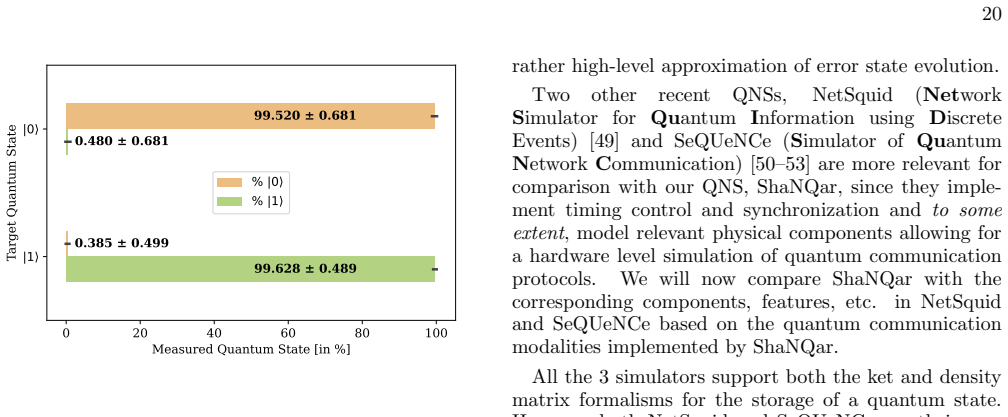
The paper's discovery claim is that a single simulation stack, with no experiment-specific rewriting, reproduces the behavior of two real photonic experiments. For QKD, the simulated BB84 setup produces QBER that rises gradually from about 1% to 4% as the quantum channel grows from 1 km to 20 km, and key generation rates that decrease exponentially with distance, from roughly 0.1 Mb/s down to 0.1 Kb/s at the secret-key stage. For quantum teleportation, the measured states match the target states $|0\rangle$ and $|1\rangle$ in about 99.5% and 99.6% of cases respectively, corresponding to a maximum error near 2%. The authors conclude that these results validate ShaNQar's reliability and accuracy.
Load-bearing premise
The accuracy claim rests on the assumption that the literature-derived parameter values in Tables I and II faithfully represent the real hardware of the reference experiments, and that the cited experimental ranges (1–4% QBER and about 2% teleportation error) are the right benchmark; the paper never compares its simulated curves or histograms directly with measured data from those experiments.
Editorial extensions
If this is right
- Researchers can use ShaNQar to choose laser power, repetition rate, channel length, and detector settings before building hardware, and to estimate the maximum link length that still keeps QBER below a security threshold.
- Under the modeled parameters, secret key generation decays roughly exponentially with distance, so a 20 km standard-fiber link should expect key rates near 0.1 Kb/s rather than the 0.1 Mb/s seen at short distances.
- Because ShaNQar's Bell-state measurement is partial, simulated teleportation only succeeds on $|\psi^+\rangle$ and $|\psi^-\rangle$ detection events, so the success count will be lower than what full Bell-state measurement could deliver.
- The modular design means new encoding schemes (time-bin, phase) and new components (quantum memories) can be added without rewriting the timing and synchronization core.
- The effectively unlimited time resolution allows the simulator to track femtosecond-scale photon arrival statistics and dispersion-induced temporal broadening that nanosecond-resolution simulators miss.
Reading between the lines
- The reported evidence establishes range-level agreement with published experiments; a natural next validation step is to fit simulated detection histograms to experimental ones, which would also identify which parameter dominates the residual error.
- A use the authors do not demonstrate is protocol comparison: because components are modular, a user could hold hardware parameters fixed and compare BB84, decoy-state, or measurement-device-independent QKD under identical noise and loss conditions.
- If the timing model performs as claimed, the same machinery could predict where quantum repeaters or quantum memories improve entanglement distribution rates on heterogeneous fiber links, since arrival jitter, dispersion, and dark counts are already modeled.
- A useful next check, not reported in the paper, is the per-shot distribution of teleportation errors, since rare large deviations from polarization rotation or dark-count clustering could dominate practical failure rates even when the average error is 2%.
Editorial analysis
A structured set of objections, weighed in public.
Referee Report
Summary. The paper presents ShaNQar, a modular photonic quantum network simulator built on the SimPy discrete-event framework. It models photons, lasers, neutral-density filters, entangled-photon-pair sources, quantum channels, mirrors, waveplates, beam splitters, single-photon detectors, and nodes, with a polarization-based (Jones vector) description of quantum states and standard quantum-operation noise models. The authors implement BB84 QKD and a linear-optics quantum teleportation protocol, and they claim to have 'successfully simulated previous real-life experimental setups' for both, reporting QBER 1–4%, key generation rates from 0.1 kb/s to 0.1 Mb/s, and a maximum teleportation error of about 2%. The component-level derivations (e.g., the NPBS unitary and HOM cancellation) are mostly standard and appear sound, but the validation of the central 'reliability and accuracy' claim rests on qualitative agreement with literature ranges rather than quantitative comparison with the cited experiments.
Significance. If the accuracy claim were properly established, ShaNQar would be a useful open-source addition to the quantum network simulator landscape: it offers a modular component library, explicit timing control, and a broad set of tunable parameters, and it ships with public code. The paper also gives a careful derivation of the 50:50 beam-splitter transformation and its use in Bell-state measurement, which is correctly presented. However, the paper's headline contribution is the validation against real experiments, and that validation is not currently convincing. The strengths—open code, modular design, and standard theoretical components—do not by themselves demonstrate that simulations reproduce real hardware behavior without a direct, quantitative comparison to measured data.
major comments (4)
- [III.2.2 and IV.2.2] The central accuracy claim is not supported by the evidence presented. In Section III.2.2 the simulated QBER and KGRs are stated to be "in line with previous QKD experiments" with references [37,38], but no measured data from those experiments are overlaid on Figs. 5–6 or compared through any statistical measure. Similarly, Section IV.2.2 states agreement with [40,41] based on a "maximum error of ≈2%", but the reported fidelities of those references are not discussed, and no direct comparison is made to Fig. 8. Because the abstract and conclusion rest on "demonstrating the reliability and accuracy of ShaNQar," this validation gap is load-bearing.
- [IV.2.2] Teleportation success counts are internally inconsistent. The text says teleportation was attempted 2500 times per run over 10 runs (25,000 attempts per target state) and reports "≈ 10^4 qubits and 10^6 qubits" successfully transmitted. If these are 10^4 and 10^6, neither matches the approximately 99.5% success implied by a 2% maximum error (about 24,875 successes); 10^6 exceeds the total number of attempts. These numbers need to be corrected and reconciled with the success rate before the simulation results can be interpreted.
- [Tables I and II] Parameter provenance is insufficient for a validation claim. The tables describe all parameters as "established from the literature" with aggregated citation groups [1,36,37] and [1,20,39], but individual parameters—especially noise levels such as NL=0.01, γ_amp_damp=0.3, λ_phase_damp=0.45, Fpol=0.90, and p=0.3—are not tied to specific hardware values of the experiments being reproduced. Without per-parameter justification, the reported agreement could be an artifact of the chosen parameters rather than evidence of simulator accuracy.
- [III.2.1 and IV.2.1] The comparability of the cited experimental benchmarks is questionable. Section III.2.1 explicitly notes that the inspired setup [36] uses free-space channels while the simulation is all-fiber, and the quoted benchmark [37] is a 122-km fiber experiment, whereas Figs. 5–6 cover 1–20 km. Section IV.2.1 states the setup is inspired by [39] (Bouwmeester et al.), but the validation cites [40,41] without showing that their parameter regimes match. These differences need to be addressed quantitatively before claiming agreement.
minor comments (6)
- [III.2.2] The notation "2.2 100 µa pulses" near the end of the first paragraph is unreadable; it should be typeset as a numeric coefficient times a power of ten divided by µ_a.
- [II.10.1] In Eq. (55), the cancelled terms |1⟩_3|1⟩_4 and −|1⟩_3|1⟩_4 appear as display artifacts; the equation should be written so the cancellation is mathematically clear, for example by pairing the terms explicitly.
- [References] Reference [28] attributes "Fiber-Optic Communication Systems" to C. C. Gerry and P. L. Knight; the standard author of this book is G. P. Agrawal, so this reference should be corrected or replaced.
- [IV.2.2] The phrase "≈ 104 qubits and 106 qubits" lacks superscripts; the intended powers of ten should be typeset consistently as 10^4 and 10^6.
- [Fig. 8] The y-axis label "Measured Quantum State [in %]" is ambiguous; it should state that the bars show the percentage of detected events, and the legend labels "% |0" and "% |1" appear truncated.
- [II.4] The sentence in Section II.4 that "the energy of the photon(s) transmitted by the ND filter is less than or equal to the maximum allowable value" is physically imprecise: individual photons are not partially attenuated; the model should be described in terms of a probabilistic transmission probability.
Circularity Check
No significant circularity: QBER and teleportation fidelity emerge from independent component models, and the only self-citation is a non-load-bearing Cascade implementation.
full rationale
The paper's accuracy claim rests on simulated QBERs, KGRs, and teleportation fidelities produced by a discrete-event simulation of Jones-calculus polarization states, Poissonian weak-laser sources, SPDC entanglement sources, fiber loss and noise, detector dark counts, and standard BB84/teleportation post-processing. No target quantity (QBER 1-4%, maximum teleportation error 2%) is used as a fitting target or inserted as an input; the parameters in Tables I and II are stated as 'established from the literature' and the outputs were not shown to be fitted to the cited ranges. The only self-citation is [33] (Choudhary and Wasan) for the Cascade reconciliation implementation; this is a subroutine and does not carry the simulator-validation claim, so it is not load-bearing. There is no imported uniqueness theorem, no ansatz-by-citation, and no renaming of a known result. The validation is nevertheless weak on non-circularity grounds: Section III.2.2 compares to broad literature ranges without raw-data overlays or statistical tests, Section IV.2.2 compares 98% fidelity to experiments [40,41] that report lower fidelities, and the reported teleportation success counts (about 10^4 and 10^6 qubits with 2500 attempts per run over 10 runs) are internally inconsistent. These are benchmarking and correctness concerns, not circularity, so the circularity score stays near zero.
Assumptions & free parameters
free parameters (5)
- Laser and channel noise levels: NL=0.01, gamma_amp_damp=0.3, lambda_phase_damp=0.45, Fpol=0.90, depolarization p=0.3 =
NL=0.01, gamma=0.3, lambda=0.45, Fpol=0.90, p=0.3
- Weak laser mean photon number for QKD =
0.2179 photons per pulse (Table I: 10^5 photons/s)
- Detection analysis cutoff multiplier k =
not specified
- Cascade error-probability offset =
QBER estimate + 2%
- Privacy amplification compression factor f =
half the reconciled key length
assumptions (8)
- domain assumption A photon's quantum state is completely described by a polarization Jones vector (Section II.1); all encoding is polarization based.
- domain assumption Loss, noise, and component imperfections act as trace-preserving quantum operations with probabilities chosen per component (Sections II.1, II.3-II.11).
- domain assumption SPDC sources produce the ideal entangled states given by Kwiat et al [21] and White et al [20], with a user-set conversion efficiency (Section II.6).
- domain assumption Fiber transmission is governed by T=10^{-alpha L/10} and dispersion spreads arrival times as a Gaussian with sigma = D_chr Delta_lambda L (Eqs 33-36).
- domain assumption The classical channel is lossless, completely reliable, and only adds the mean propagation delay (Section II.7.2).
- domain assumption Detector dark counts follow a Poisson process; dead time and timing jitter follow the model in Eq 65 and the detection analysis rules of Section II.12.
- standard math The 50:50 NPBS transformation with t=1/sqrt(2), r=i/sqrt(2) and HOM cancellation of identical photons is correct (Section II.10.1).
- domain assumption Cascade information reconciliation as optimized in [33] and Toeplitz universal hashing work as assumed (Sections III.1.1-III.1.2).
Cite this review
Pith. "Pith review of ShaNQar: Simulator of Network Quantique." pith.science (2026). https://pith.science/paper/MGAZ5745
@misc{pith2026241115865,
  author       = {Pith},
  title        = {Pith review of: ShaNQar: Simulator of Network Quantique},
  year         = {2026},
  howpublished = {\url{https://pith.science/paper/MGAZ5745}},
  note         = {Machine review of arXiv:2411.15865}
}
read the original abstract
The nature-inspired field of quantum communication has witnessed exciting developments over the past few years with countries all over the world working hard to scale their experimental quantum networks to larger sizes and increased coverage. Evidently, quantum network simulators are the need of the hour as they provide a framework for tuning hardware parameters, optimizing control protocols, and testing configurations of large and complex quantum networks before their deployment in the real world. In this work, we present ShaNQar (Simulator of Network Quantique): a modular and customizable photonic quantum network simulator. It comprises models of components such as photons, lasers, neutral density filters, sources of entangled photon pairs, communication channels, mirrors, waveplates, beam splitters, single photon detectors, and nodes which incorporate a diverse set of tunable parameters for variability and versatility. It enables adaptive timing control and synchronization with virtually no simulation time resolution limit and features a 'plug and play' design for faster coding and efficient execution. We successfully simulated previous real-life experimental setups for Quantum Key Distribution (QKD) and quantum teleportation, thereby, demonstrating the reliability and accuracy of ShaNQar.
Figures


Figures from the paper (5 more)


Reference graph
Works this paper leans on
-
[36]
R. W. Boyd, Nonlinear Optics, 3rd ed. (Academic Press (Elsevier), 2008)
work page 2008
-
[37]
P. S. Theocaris and E. E. Gdoutos, Matrix Theory of Photoelasticity (Springer Berlin, Heidelberg, 2013)
work page 2013
-
[39]
C. C. Gerry and P. L. Knight, Introductory Quantum Optics (Cambridge University Press, 2005)
2005
-
[1]
Alice chooses 2 random classical bit strings of length Ntr, say, p and q and then encodes each bit of p in the basis indicated by the correspond- ing bit of q. Thus, q represents a random string of polarization bases: a 0 represents the Rectilin- ear (Horizontal/Vertical) or Z basis while a 1 rep- resents the Diagonal (Diagonal/Anti-Diagonal) or X basis. ...
-
[2]
Further, (here) B denotes the transformation matrix of the NPBS such that: B = t r r t
and output field modes (subscripts 3 and 4) and t and r represent the transmittance and the reflectance of the NPBS respectively. Further, (here) B denotes the transformation matrix of the NPBS such that: B = t r r t . Since B is unitary, BB † = I and thus, t r r t t∗ r∗ r∗ t∗ = 1 0 0 1 , which upon simplification yields: |t|2 + |r|2 = 1, (44) and tr∗ + r...
-
[3]
|0⟩3 |0⟩4 = 1√ 2 (|1⟩3 |0⟩4 + i |0⟩3 |1⟩4). Hence, the probabilities of obtaining the above 2 states at the output end of the 50:50 NPBS are given by: P (Output = |1⟩3 |0⟩4) = 1√ 2 2 = 1 2 , and P (Output = |0⟩3 |1⟩4) = i√ 2 2 = 1 2 . which clearly means that the transmission and reflection of a single photon incident on a 50:50 NPBS are equiprob- able. N...
-
[4]
(50) Considering the case of a 50:50 NPBS, since |t| = |r|, using (44), we get that: |t| = |r| = 1√ 2 . (51) Further, expressing |t| as teiθ and |r| as reiϕ and using (45), we get that: |t||r|ei(θ−ϕ) + |r||t|ei(ϕ−θ) = 0 =⇒ 2|t||r| ei(θ−ϕ) + e−i(θ−ϕ) 2 = 0 =⇒ 2|t||r| cos (θ − ϕ) = 0. Using (51), we get that: cos (θ − ϕ) = 0. Hence, θ − ϕ = ± π 2 . 9 Since ...
-
[5]
(56) Thus, the 2 photons can be transmitted or reflected to- gether with the same probability
|0⟩3 |0⟩4 = 1 2 (i |2⟩3 |0⟩4 + |1⟩3 |1⟩4 − |1⟩3 |1⟩4 + i |0⟩3 |2⟩4) (55) = i√ 2 (|2⟩3 |0⟩4 + |0⟩3 |2⟩4). (56) Thus, the 2 photons can be transmitted or reflected to- gether with the same probability. It is however, not pos- sible for one of the photons to be reflected and the other one to be transmitted. This is the Hong-Ou-Mandel (HOM) effect [26]. Note ...
Show all 70 references
-
[6]
Corresponding to each quantum state |ψpiqi ⟩ sent by Alice, Bob receives the state E(|ψpiqi ⟩⟨ψpiqi |), where, E refers to the quantum operation encap- sulating the effects of both (any possible) eaves- dropping and (the ubiquitous) noise. It is impor- tant to note that in a p...
-
[7]
At his end, Bob checks the indices of the bit strings q and q′ so as to figure out a list of indices qidx,same such that ∀ k ∈ qidx,same, qk = q′ k
With the help of a public (classical) channel, Al- ice then communicates the value of q to Bob. At his end, Bob checks the indices of the bit strings q and q′ so as to figure out a list of indices qidx,same such that ∀ k ∈ qidx,same, qk = q′ k. He then sends across qidx,same t...
-
[8]
c is essentially the check list which serves as a check on any unacceptable level of noise and eavesdropping effects
Alice then randomly chooses a half of the bits in ep such that their indices (together) form a list c of length j Nsif t 2 k . c is essentially the check list which serves as a check on any unacceptable level of noise and eavesdropping effects. Alice and Bob then share with th...
-
[9]
In order to correct errors in s′ and hence, obtain a string es′ ≈ s, Alice and Bob perform information reconciliation
Evidently, even s and s′ wouldn’t be completely equal to one another. In order to correct errors in s′ and hence, obtain a string es′ ≈ s, Alice and Bob perform information reconciliation. Effectively, es′ is Bob’s reconciled key string
-
[10]
The information reconciliation stage does involve the exchange of some information regarding the key shared by Alice and Bob over a public channel which may give an eavesdropper additional infor- mation to construct the same key. Consequently, Alice and Bob use a process known...
-
[11]
Es- sentially, this is because PBS HV will generally transmit a horizontally polarized photon and re- flect a vertically polarized photon
If an incoming photon with a quantum state |ψ⟩ ≡ |0⟩ or |ψ⟩ ≡ |1⟩ is reflected by the NPBS to the quantum channel QC PBS HV, it will then be effectively measured in the correct basis by the polarizing beam splitter PBS HV positioned at the receiver end of QC PBS HV (provided t...
-
[12]
As noted earlier in Section II.9, (upto an irrelevant global phase factor) such a half- wave plate acts as a Hadamard ( H) gate
If an incoming photon with a quantum state |ψ⟩ ≡ |+⟩ or |ψ⟩ ≡ |−⟩is reflected by the NPBS to the quantum channel QC HWP, it will then be made to pass through the half-waveplate HWP in- clined at θ = π 8 . As noted earlier in Section II.9, (upto an irrelevant global phase facto...
-
[13]
If an incoming photon with a quantum state |ψ⟩ ≡ |+⟩ or |ψ⟩ ≡ |−⟩is reflected by the NPBS to the quantum channel QC PBS HV, it will then be ef- fectively measured in the incorrect basis by the po- larizing beam splitter PBS HV positioned at the receiver end of QC PBS HV. Furth...
-
[14]
When such photons are made to pass through HWP, their quantum states will be effectively changed to |+⟩ and |−⟩ respectively
If an incoming photon with a quantum state |ψ⟩ ≡ |0⟩ or |ψ⟩ ≡ |1⟩ is reflected by the NPBS to the quantum channel QC HWP, it will then be effec- tively measured in the incorrect basis by the polar- izing beam splitter PBS DA. When such photons are made to pass through HWP, the...
-
[15]
M. A. Nielsen and I. L. Chuang, Quantum Computation and Quantum Information , 10th Anniversary ed. (Cam- bridge University Press, 2010)
2010
-
[16]
Pompili, S
M. Pompili, S. L. N. Hermans, S. Baier, H. K. C. Beukers, P. C. Humphreys, R. N. Schouten, R. F. L. Vermeulen, M. J. Tiggelman, L. dos Santos Martins, B. Dirkse, S. Wehner, and R. Hanson, Realization of a multinode quantum network of remote solid-state qubits, Science 372, 259 (2021)
2021
-
[17]
M. Fore, Chicago expands and activates quantum net- work, taking steps toward a secure quantum internet, https://news.uchicago.edu/story/chicago-quantum -network-argonne-pritzker-molecular-engineering -toshiba (2022)
2022
-
[18]
Sasaki, M
M. Sasaki, M. Fujiwra, H. Ishizuka, W. Klaus, K. Wakui, M. Takeoka, A. Tanaka, K. Yoshino, Y. Nambu, S. Taka- hashi, A. Tajima, A. Tomita, T. Domeki, T. Hasegawa, Y. Sakai, H. Kobayashi, T. Asai, K. Shimizu, T. Tokura, T. Tsurumaru, M. Matsui, T. Honjo, K. Tamaki, H. Takesue, ...
2011
-
[19]
Y.-A. Chen, Q. Zhang, T.-Y. Chen, W.-Q. Cai, S.-K. Liao, J. Zhang, K. Chen, J. Yin, J.-G. Ren, Z. Chen, and et al., An integrated space-to-ground quantum com- munication network over 4,600 kilometres, Nature 589, 214–219 (2021)
2021
-
[20]
ID Quantique, IDQ and SK Broadband complete phase one of nation-wide Korean QKD Network, https://ww w.idquantique.com/idq-and-sk-broadband-complet e-phase-one-of-nation-wide-korean-qkd-network/ (2022)
2022
-
[21]
Quantum Communications Hub, The UK Quantum Net- work, https://www.quantumcommshub.net/research-c ommunity/about-the-hub/phase-2/work-package-1/ (2020)
2020
-
[22]
Stucki, M
D. Stucki, M. Legr´ e, F. Buntschu, B. Clausen, N. Felber, N. Gisin, L. Henzen, P. Junod, G. Litzistorf, P. Mon- baron, L. Monat, J. B. Page, D. Perroud, G. Ribordy, A. Rochas, S. Robyr, J. Tavares, R. T. Thew, P. Trinkler, S. Ventura, R. Voirol, N. Walenta, and H. Zbinden, Lo...
2011
-
[23]
M. Ramesh, Building India’s home-grown quantum in- ternet network, https://www.thehindubusinessline.c 22 om/business-tech/building-indias-home-grown-qua ntum-internet-network/article69040549.ece (2023)
2023
-
[24]
Wehner, D
S. Wehner, D. Elkouss, and R. Hanson, Quantum inter- net: A vision for the road ahead, Science 362, eaam9288 (2018)
2018
-
[25]
Capra, Shiva’s cosmic dance at cern, https://www
F. Capra, Shiva’s cosmic dance at cern, https://www. fritjofcapra.net/shivas-cosmic-dance-at-cern/ (2004)
2004
-
[26]
Team SimPy, SimPy, https://simpy.readthedocs.io /en/4.0.2/ (2023)
2023
-
[27]
Hecht, Optics, 5th Global ed
E. Hecht, Optics, 5th Global ed. (Pearson, 2017)
2017
-
[28]
Javadi-Abhari, M
A. Javadi-Abhari, M. Treinish, K. Krsulich, C. J. Wood, J. Lishman, J. Gacon, S. Martiel, P. D. Nation, L. S. Bishop, A. W. Cross, B. R. Johnson, and J. M. Gambetta, Quantum computing with Qiskit (2024), arXiv:2405.08810 [quant-ph]
2024 arXiv
-
[29]
Ghosh, A
J. Ghosh, A. G. Fowler, and M. R. Geller, Surface code with decoherence: An analysis of three superconducting architectures, Phys. Rev. A 86, 062318 (2012)
2012
-
[30]
Lasota and P
M. Lasota and P. Kolenderski, Optimal photon pairs for quantum communication protocols, Sci Rep 10, 20810 (2020)
2020
-
[31]
Thyagarajan and A
K. Thyagarajan and A. Ghatak, Lasers: Fundamentals and Applications, 2nd ed. (Springer, 2010)
2010
-
[32]
Einstein, B
A. Einstein, B. Podolsky, and N. Rosen, Can quantum- mechanical description of physical reality be considered complete?, Phys. Rev. 47, 777 (1935)
1935
-
[33]
J. S. Bell, On the einstein podolsky rosen paradox, Physics Physique Fizika 1, 195 (1964)
1964
-
[34]
A. G. White, D. F. V. James, P. H. Eberhard, and P. G. Kwiat, Nonmaximally entangled states: Produc- tion, characterization, and utilization, Phys. Rev. Lett. 83, 3103 (1999)
1999
-
[35]
P. G. Kwiat, K. Mattle, H. Weinfurter, A. Zeilinger, A. V. Sergienko, and Y. Shih, New high-intensity source of polarization-entangled photon pairs, Phys. Rev. Lett. 75, 4337 (1995)
1995
-
[38]
Paschotta, Beam splitters, RP Photonics Encyclope- dia (2008)
R. Paschotta, Beam splitters, RP Photonics Encyclope- dia (2008)
2008
-
[40]
C. K. Hong, Z. Y. Ou, and L. Mandel, Measurement of subpicosecond time intervals between two photons by in- terference, Phys. Rev. Lett. 59, 2044 (1987)
1987
-
[41]
Hadfield, Single-photon detectors for optical quantum information applications, Nature Photonics 3, 696–705 (2009)
R. Hadfield, Single-photon detectors for optical quantum information applications, Nature Photonics 3, 696–705 (2009)
2009
-
[42]
C. C. Gerry and P. L. Knight, Fiber-Optic Communica- tion Systems , 5th ed. (Wiley, 2021)
2021
-
[43]
Diffie and M
W. Diffie and M. Hellman, New directions in cryptogra- phy, IEEE Transactions on Information Theory 22, 644 (1976)
1976
-
[44]
R. L. Rivest, A. Shamir, and L. Adleman, A method for obtaining digital signatures and public-key cryptosys- tems, Commun. ACM 21, 120–126 (1978)
1978
-
[45]
C. H. Bennett and G. Brassard, Quantum cryptography: Public key distribution and coin tossing, in IEEE Inter- national Conference on Computers Systems and Signal Processing (1984) pp. 175–179
1984
-
[46]
Wiesner, Conjugate coding, SIGACT News 15, 78–88 (1983)
S. Wiesner, Conjugate coding, SIGACT News 15, 78–88 (1983)
1983
-
[47]
Choudhary and A
A. Choudhary and A. Wasan, Cracking the curious case of the cascade protocol, IEEE Access 11, 84709 (2023)
2023
-
[48]
C. H. Bennett, G. Brassard, and J.-M. Robert, Privacy amplification by public discussion, SIAM J. Comput. 17, 210–229 (1988)
1988
-
[49]
C.-H. F. Fung, X. Ma, and H. F. Chau, Practical issues in quantum-key-distribution postprocessing, Phys. Rev. A 81, 012318 (2010)
2010
-
[50]
A. Jain, A. Khanna, J. Bhatt, P. V. Sakhiya, and R. K. Bahl, Experimental demonstration of free space quan- tum key distribution system based on the bb84 proto- col, in 2020 11th International Conference on Comput- ing, Communication and Networking Technologies (ICC- CNT) (202...
2020
-
[51]
Gobby, Z
C. Gobby, Z. L. Yuan, and A. J. Shields, Quan- tum key distribution over 122 km of stan- dard telecom fiber, Applied Physics Letters 84, 3762 (2004), https://pubs.aip.org/aip/apl/article- pdf/84/19/3762/18588579/3762 1 online.pdf
2004
-
[52]
Almeida, N
´Alvaro J. Almeida, N. J. Muga, N. A. Silva, A. D. Sto- janovic, P. S. Andr´ e, A. N. Pinto, J. Mora, and J. Cap- many, Enabling quantum communications through accu- rate photons polarization control, in 8th Iberoamerican Optics Meeting and 11th Latin American Meeting on Op- t...
2013
-
[53]
Bouwmeester, J.-W
D. Bouwmeester, J.-W. Pan, K. Mattle, M. Eibl, H. We- infurter, and A. Zeilinger, Experimental quantum tele- portation, Nature 390, 575 (1997)
1997
-
[54]
Valivarthi, M
R. Valivarthi, M. G. Puigibert, Q. Zhou, G. H. Aguilar, V. B. Verma, F. Marsili, M. D. Shaw, S. W. Nam, D. Oblak, and W. Tittel, Quantum teleportation across a metropolitan fibre network, Nature Photonics 10, 676 (2016)
2016
-
[55]
S. Shen, C. Yuan, Z. Zhang, H. Yu, R. Zhang, C. Yang, H. Li, Z. Wang, Y. Wang, G. Deng, H. Song, L. You, Y. Fan, G. Guo, and Q. Zhou, Hertz-rate metropolitan quantum teleportation, Light: Science & Applications 12, 115 (2023)
2023
-
[56]
Diadamo, J
S. Diadamo, J. N¨ otzel, B. Zanger, and M. M. Be¸ se, QuNetSim: a software framework for quantum networks, IEEE Transactions on Quantum Engineering 2, 1 (2021)
2021
-
[57]
L. Chen, K. Xue, J. Li, N. Yu, R. Li, Q. Sun, and J. Lu, SimQN: a network-layer simulator for the quantum net- work investigation, IEEE Network , 1 (2023)
2023
-
[58]
Dahlberg and S
A. Dahlberg and S. Wehner, SimulaQron — a simula- tor for developing quantum internet software, Quantum Science and Technology 4, 015001 (2018)
2018
-
[59]
Diadamo and J
S. Diadamo and J. N¨ otzel, QuNetSim: a software frame- work for quantum networks, https://tqsd.github.io /QuNetSim/intro.html (2021)
2021
-
[60]
Chen, Welcome to SimQN’s documentation!, https: //ertuil.github.io/SimQN/introduction.html#overv iew (2022)
L. Chen, Welcome to SimQN’s documentation!, https: //ertuil.github.io/SimQN/introduction.html#overv iew (2022)
2022
-
[61]
Bartlett, A distributed simulation frame- work for quantum networks and channels (2018), arXiv:1808.07047 [quant-ph]
B. Bartlett, A distributed simulation frame- work for quantum networks and channels (2018), arXiv:1808.07047 [quant-ph]
2018 arXiv
-
[62]
Satoh, M
R. Satoh, M. Hajduˇ sek, N. Benchasattabuse, S. Na- gayama, K. Teramoto, T. Matsuo, S. A. Metwalli, P. Pathumsoot, T. Satoh, S. Suzuki, and R. V. Meter, QuISP: a quantum internet simulation package, in 2022 IEEE International Conference on Quantum Computing and Engineering (QC...
2022
-
[63]
Coopmans, R
T. Coopmans, R. Knegjens, A. Dahlberg, and D. Maier et 23 al., NetSquid, a NETwork Simulator for QUantum Infor- mation using Discrete events, Communications Physics 4, 10.1038/s42005-021-00647-8 (2021)
2021 doi
-
[64]
X. Wu, J. Chung, A. Kolar, E. Wang, T. Zhong, R. Ket- timuthu, and M. Suchara, Simulations of photonic quan- tum networks for performance analysis and experiment design, in 2019 IEEE/ACM Workshop on Photonics- Optics Technology Oriented Networking, Information and Computing Sy...
2019
-
[65]
X. Wu, A. Kolar, J. Chung, D. Jin, T. Zhong, R. Ket- timuthu, and M. Suchara, SeQUeNCe: a customizable discrete-event simulator of quantum networks, Quantum Science and Technology 6, 045027 (2021)
2021
-
[66]
A. Zang, A. Kolar, J. Chung, M. Suchara, T. Zhong, and R. Kettimuthu, Simulation of entanglement generation between absorptive quantum memories, in2022 IEEE In- ternational Conference on Quantum Computing and En- gineering (QCE) (2022) pp. 617–623
2022
-
[67]
Mazza, C
F. Mazza, C. Zhan, J. Chung, R. Kettimuthu, M. Cal- effi, and A. S. Cacciapuoti, Simulation of entanglement- enabled connectivity in qlans using sequence (2024), arXiv:2411.11031 [quant-ph]
2024
-
[68]
IEEE, Ieee standard for floating-point arithmetic, IEEE Std 754-2019 (Revision of IEEE 754-2008) , 1 (2019)
2019
-
[69]
X. Wu, A. Kolar, J. Chung, D. Jin, T. Zhong, R. Ket- timuthu, and M. Suchara, SeQUeNCe: a customizable discrete-event simulator of quantum networks, https: //github.com/sequence-toolbox/SeQUeNCe (2021)
2021
-
[70]
X. Wu, A. Kolar, J. Chung, D. Jin, M. Suchara, and R. Kettimuthu, Parallel simulation of quantum networks with distributed quantum state management, ACM Trans. Model. Comput. Simul. 34, 10.1145/3634701 (2024)
2024 doi
Reviewed August 12, 2026 · model on record in the stance chip above.
Discussion (0). Continue with ORCID to comment.