REVIEW 2 major objections 4 minor 50 references
Finding Thermodynamically Favorable Pathways in Chemical Reaction Networks Using Flows in Hypergraphs and Mixed-Integer Linear Programming
T0 review · 2 major / 4 minor · reviewed 2026-08-12 · deepseek-v4-flash
Pith's one-line read A mixed-integer linear programming formulation of pathway search in chemical reaction networks enforces that every reaction in a returned pathway is thermodynamically favorable and ranks alternative pathways by cumulative Gibbs free…
desk verdict Useful thermodynamic extension of integer hyperflow pathway search, but Eq. (6) drops the RT/ln10 factor, so the reported numbers are computed with the wrong model. read the letter →
The pith
A machine-rendered reading of the paper's core claim, the machinery that carries it, and where it could break.
The reading
What carries the argument
The machinery combines integer hyperflows with continuous concentration variables in one mixed-integer linear program. A pathway is an integer flow vector $f_e$ on hyperedges representing reactions, extended with half-edges for sources and targets; flow conservation (2) fixes the overall reaction. Each molecule has a standard chemical potential $x^{G^0}_v$ from an external thermodynamic oracle and a log-concentration variable $x^K_v$ bounded by user-set limits (here $-3$ to $1$ in $\log_{10}$ M). The per-reaction free energy change is the linear expression $x^{\Delta G}_e = \sum_{v\in e^+} x^{G^0}_v - \sum_{v\in e^-} x^{G^0}_v + RT(\sum_{v\in e^+} x^K_v - \sum_{v\in e^-} x^K_v)$, so the concentration dependence is linear in log concentration. Binary variables $z_e$ indicate whether edge $e$ is used, linked to $f_e$ by big-M constraints; constraint (17) enforces $z_e = 1 \Rightarrow x^{\Delta G}_e \le 0$, and the objective (24) minimizes the sum of $x^{\Delta G}_e$ over used edges, interpreted by the authors as maximizing the probability of the pathway under an exponential ansatz. Optional integer variables $t_v$ enforce a partial temporal order on visited molecules, so a pathway can be read as a synthesis plan.
What would settle it
Fix the concentrations of HCN, NH3, and H2O at experimentally measured or reported reactor values inside the $10^{-3}$ to $10^1$ M window, remove the optimizer's freedom to move $x^K_v$, and re-solve the MILP for the formamide-trimer target. If the rank-0 pathway of Figure 4 becomes infeasible or contains a reaction with $x^{\Delta G}_e > 0$ at those fixed concentrations, the thermodynamic guarantee is an artifact of the concentration bounds rather than a property of the network.
Extended reading notes
Core claim
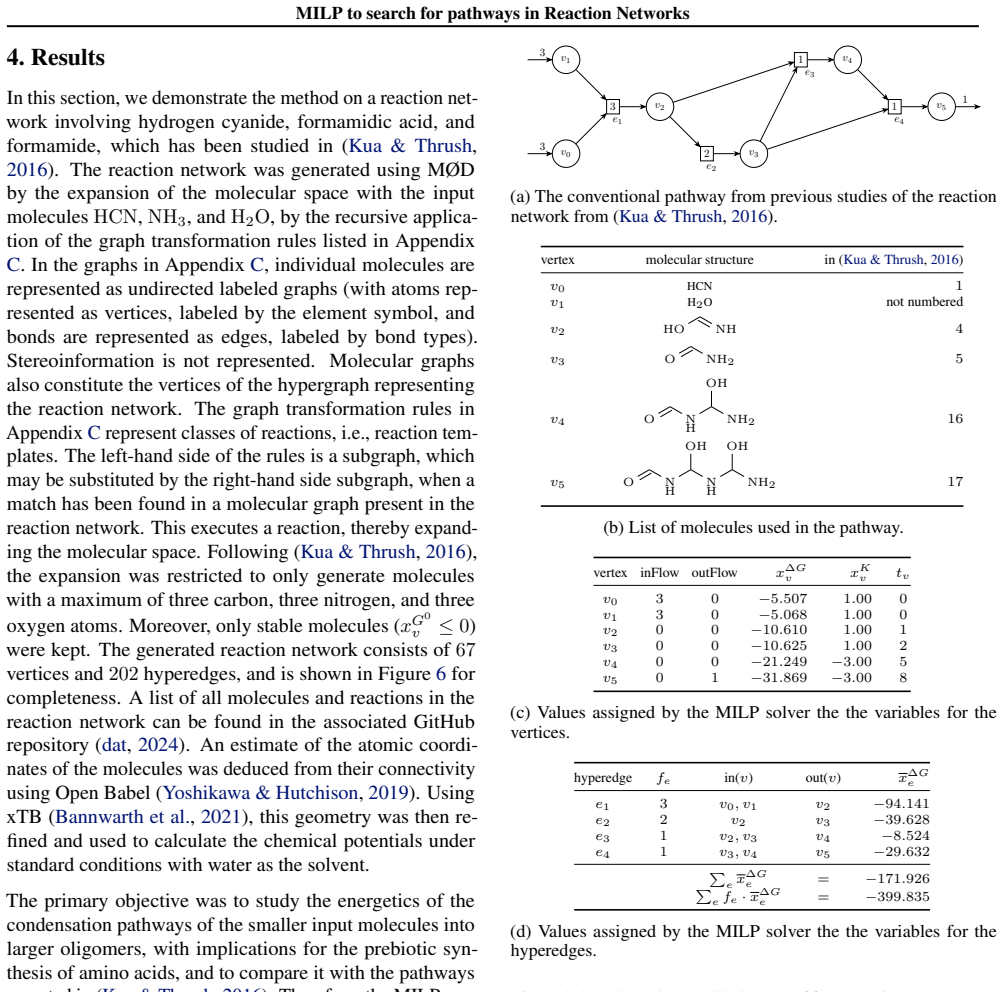
The central claim is that the implication constraint $f_e > 0 \Rightarrow x^{\Delta G}_e \le 0$, linearized as $x^{\Delta G}_e + M(z_e - 1) \le 0$, makes the MILP return only pathways in which every reaction with positive flow has a negative computed Gibbs free energy change, and that the objective $\min \sum_{e\in E} x^{\Delta G}_e$ gives a thermodynamically meaningful ranking of alternative pathways. The authors demonstrate this on a 67-vertex, 202-hyperedge HCN-formamide network queried from HCN, NH3, and H2O to the trimer of formamide. They enumerate thirteen distinct pathways; the top-ranked pathway has objective value $-305.697$ kJ/mol and uses five reactions and a tautomer not present in the earlier literature route, while the previously hypothesized pathway scores $-171.926$ kJ/mol. The flow-weighted net free energy difference is identical for every enumerated pathway, as expected for a path-independent quantity, so the ranking is driven by how the same overall driving force is distributed among the reactions.
Load-bearing premise
Everything rests on the assumption that the log-concentration variables are independent degrees of freedom within the hand-picked bounds from $-3$ to $1$ in $\log_{10}$ M; the solver always drives these variables to the bounds, so if realistic reactor concentrations fall outside that window, the reported 'thermodynamically favorable' pathways may not be favorable in the actual reactor.
Editorial extensions
If this is right
- Pathway search can be screened so that only reactions with negative computed Gibbs free-energy changes enter the flow, eliminating thermodynamically implausible routes before any experimental work.
- Because the solver enumerates over integer flow variables, users receive a ranked list of alternative pathways rather than a single solution, which hedges against errors in the chemical-potential estimates.
- The thermodynamic oracle is modular: any method that maps a molecule to a chemical potential can replace the semi-empirical default, so the same filter and ranking can be rerun with more accurate potentials as they become available.
- On the HCN-formamide network the enumeration yields thirteen pathways, and the literature route ranks only 12th under the chosen objective, with the top route using fewer reactions and a tautomer absent from the earlier study.
- The optional temporal-ordering constraints make returned pathways interpretable as acyclic synthesis plans, at the cost of excluding pathways that contain catalytic cycles.
Reading between the lines
- Editorial inference: because the optimizer always pushes every log-concentration variable to an extremal bound, the returned ranking should be read as what is achievable somewhere inside the chosen concentration window, not as favorability at any single realistic reactor state; rerunning with molecule-specific bounds would show how much the ranking depends on the window.
- Editorial inference: the min-sum objective can favor pathways that load all driving force into one strongly exergonic step; the authors' suggested min-max variant, which ranks by the least-favorable reaction, is a natural next test and may select different routes.
- Editorial inference: the same inequality template could become a kinetic filter; if a barrier-height oracle were available, replacing $x^{\Delta G}_e$ by an activation free energy in constraint (17) would return pathways whose rate-limiting steps remain accessible, coupling thermodynamics and kinetics in one search.
- Editorial inference: enumeration over flow variables while leaving concentration variables free conflates pathway structure with the optimizer's freedom to choose concentrations; a two-stage procedure that fixes concentrations first and then enumerates would be a stricter test of whether a pathway is thermodynamically viable as written.
Editorial analysis
A structured set of objections, weighed in public.
Referee Report
Summary. The paper extends the integer hyperflow framework for searching pathways in chemical reaction networks by adding thermodynamic constraints through a mixed-integer linear programming (MILP) formulation. Chemical potentials are assigned by a GFN2-xTB oracle, and log-concentration variables xK_v are introduced so that the Gibbs free energy change of each reaction can be expressed linearly. A constraint (5)/(17) is used to require that every reaction appearing in a returned pathway has a non-positive computed free energy change, and an objective function (24) ranks enumerated pathways by the sum of these free energy changes. The method is implemented in MØD and applied to an HCN-formamide reaction network, where 13 pathways to a formamide trimer are enumerated and compared with a previously reported route.
Significance. If the technical issues are corrected, the work provides a useful and modular extension of an existing pathway-search tool: it demonstrates how an external thermodynamic oracle can be combined with MILP-based enumeration over integral hyperflows, and the case study gives a concrete proof of concept. The authors make the implementation and generated data publicly available, which is a strength. The central mathematical idea is not circular: it applies standard equilibrium thermodynamics and an external quantum-chemical oracle. However, the current numerical results and the associated claim that the returned pathways are thermodynamically favorable rest on an incorrect linearization of the concentration term, and the free concentration variables make the thermodynamic filter sensitive to arbitrarily chosen bounds; these issues must be resolved before the quantitative claims can be accepted.
major comments (2)
- [§3.1.1, Eq. (6)] Equation (6) is inconsistent with the derivation that immediately follows it. The paper defines xK_v as log10(conc(v)), so the concentration term in the linearized expression for x∆G_e must carry the factor RT/ln(10), not RT. As written, RT·(Σ xK out − Σ xK in) overestimates the concentration correction by a factor of about 2.303. This error propagates into constraint (17), the objective function (24), and all reported reaction free energies in Figures 3–4 and Table 6. For example, for hyperedge e1 in Figure 3, using the displayed xG0 values and ΔxK = −1, the incorrect formula gives about −94.4 kJ/mol, matching the reported −94.141 kJ/mol, whereas the correct formula gives about −93.0 kJ/mol. The authors need to correct Eq. (6), rerun the MILP enumeration, and re-evaluate the pathway rankings; the current numbers and the claim that the listed pathways are thermodynamically favorable under the stated concentration model are not reliable.
- [§4, Tables 3c/4c and accompanying text] The authors observe that the optimizer always assigns the log-concentration variables xK_v to the extremal values of the hand-picked uniform bounds (−3 and 1). This means that the thermodynamic filter in (5)/(17) does not evaluate whether a pathway is favorable at a specified, physically meaningful reactor composition; instead, it optimizes over the concentration variables to make the pathway favorable. The paper acknowledges this and offers a reinterpretation in terms of perturbation directions, but the abstract and introduction still state that the search is constrained to return pathways containing only thermodynamically favorable reactions. This overstates what the method computes. The authors should state this limitation more prominently and, ideally, report sensitivity of the enumerated rankings to the chosen bounds, for example by repeating the enumeration with different xK ranges or with species-specific bounds.
minor comments (4)
- [§3.1.2, Eq. (8)] Equation (8) is written with a “max” operator, but the surrounding text describes minimization and Eq. (24) uses “min”. Please reconcile these; the intended objective should be stated unambiguously.
- [§4, Table 6] The statement that the last column is path-independent and therefore the same for all pathways is not exactly reflected in the table, as the reported values range from −399.835 to −399.837 kJ/mol. A brief explanation of numerical tolerance would help.
- [§3.1.1] There is a typo: “the absolute temperate of the system” should be “the absolute temperature of the system.”
- [§4, Tables 3c and 4c] The column headers “x∆G_v” in these tables are confusing because the listed values are standard chemical potentials xG0_v in atomic units, not free energy differences. Rename the headers to “xG0_v”.
Circularity Check
No significant circularity: the MILP search is a constraint-based optimization over an external thermodynamic oracle, with no fitted input renamed as a prediction.
full rationale
The derivation chain is self-contained. The paper extends the integer hyperflow formalism of Andersen et al. (2019) with standard equilibrium thermodynamics and chemical potentials from GFN2-xTB, an external quantum-chemical oracle. The thermodynamic filter in constraint (5), linearized in (17), literally enforces xΔG_e ≤ 0 for every used reaction, so the statement that returned pathways contain only thermodynamically favorable reactions is a direct consequence of the constraint, not a hidden input or a fitted target. The objective function (8)/(24) ranks pathways by the same xΔG values; ranking by one's own explicitly chosen objective is not circular, and the paper labels it as 'our chosen objective function.' The enumeration includes the literature pathway from Kua & Thrush (2016) as a sanity check and reports better-scoring alternatives, which is an external benchmark rather than a fitted target. The self-citations to Andersen et al. (2019), Fagerberg et al. (2018), and Banke et al. (2023) support the underlying hyperflow, synthesis-plan, and realizability machinery; these are code-implemented (MØD) and independent of the thermodynamic claims, so they do not raise the circularity score. No uniqueness theorem or ansatz is imported from the authors' prior work to force the present conclusions. The separately noted concern about a possible missing 1/ln(10) factor in Eq. (6) is a substantive modeling and correctness issue, but it is not circularity: it does not make the output equivalent to the input by construction. No circular step is present.
Assumptions & free parameters
free parameters (2)
- concentration bounds xK_min=-3, xK_max=1 =
-3 to 1 (log10 M)
- Big-M constant M =
100
assumptions (4)
- domain assumption The reaction network is near equilibrium, so equilibrium thermodynamics can be applied as a first-order approximation for pathway driving forces.
- domain assumption Reaction favorability is a valid proxy for reaction kinetics (Evans-Polanyi-Semenov principle).
- domain assumption GFN2-xTB-calculated chemical potentials under standard conditions are accurate enough for the pathway search.
- standard math The integer hyperflow model from (Andersen et al., 2019) correctly represents pathway stoichiometry.
Cite this review
Pith. "Pith review of Finding Thermodynamically Favorable Pathways in Chemical Reaction Networks Using Flows in Hypergraphs and Mixed-Integer Linear Programming." pith.science (2026). https://pith.science/paper/AFOAW6PT
@misc{pith2026241115900,
  author       = {Pith},
  title        = {Pith review of: Finding Thermodynamically Favorable Pathways in Chemical Reaction Networks Using Flows in Hypergraphs and Mixed-Integer Linear Programming},
  year         = {2026},
  howpublished = {\url{https://pith.science/paper/AFOAW6PT}},
  note         = {Machine review of arXiv:2411.15900}
}
read the original abstract
The search for pathways that optimize the formation of a particular target molecule in a reaction network is a key problem in many settings, including reactor systems. Chemical reaction networks are mathematically well represented as hypergraphs, modeling that facilitates the search for pathways by computational means. We propose to enrich an existing search method for pathways by including thermodynamic principles. In more detail, we give a mixed-integer linear programming (mixed ILP) formulation of the search problem into which we integrate chemical potentials and concentrations for individual molecules, enabling us to constrain the search to return pathways containing only thermodynamically favorable reactions. Moreover, if multiple possible pathways are found, we can rank these by objective functions based on thermodynamics. As an example of use, we apply the framework to a reaction network representing the HCN-formamide chemistry. Alternative pathways to the one currently hypothesized in the literature are queried and enumerated, including some that score better according to our chosen objective function.
Figures


Figures from the paper (3 more)


Reference graph
Works this paper leans on
-
[1]
https://github.com/AdittyaPal/thermodynamicsWithILP.git, 2024
supplementary data repository on G it H ub. https://github.com/AdittyaPal/thermodynamicsWithILP.git, 2024
work page 2024
- [2]
-
[3]
https://github.com/openbabel/openbabel, 2024
O pen B abel G ithub repository. https://github.com/openbabel/openbabel, 2024
work page 2024
-
[4]
list of solutions returned by the solver. https://github.com/AdittyaPal/thermodynamicsWithILP/blob/5f7aed70fe8706bbe0ffc2efedd68316d44e0f42/listOfSolutions.pdf, 2025
work page 2025
-
[5]
Andersen, J., Flamm, C., Merkle, D., and Stadler, P. F. Maximizing output and recognizing autocatalysis in chemical reaction networks is N P -complete . J Syst Chem, 3 0 (1), 01 2012. doi:10.1186/1759-2208-3-1. URL https://doi.org/10.1186/1759-2208-3-1
-
[6]
L., Flamm, C., Merkle, D., and Stadler, P
Andersen, J. L., Flamm, C., Merkle, D., and Stadler, P. F. A S oftware P ackage for C hemically I nspired G raph T ransformation. In Graph Transformation, pp.\ 73--88, Cham, 2016. Springer International Publishing. URL https://doi.org/10.1007/978-3-319-40530-8_5
-
[7]
L., Flamm, C., Merkle, D., and Stadler, P
Andersen, J. L., Flamm, C., Merkle, D., and Stadler, P. F. Chemical T ransformation M otifs— M odelling P athways as I nteger H yperflows. IEEE/ACM Trans. Comput. Biol. Bioinformatics, 16 0 (2): 0 510–523, April 2019. ISSN 1545-5963. doi:10.1109/TCBB.2017.2781724. URL https://doi.org/10.1109/TCBB.2017.2781724
arXiv 2019
-
[8]
Circuit theory for C hemical R eaction N etworks
Avanzini, F., Freitas, N., and Esposito, M. Circuit theory for C hemical R eaction N etworks. Phys. Rev. X, 13: 0 021041, Jun 2023. doi:10.1103/PhysRevX.13.021041. URL https://doi.org/10.1103/PhysRevX.13.021041
Show all 50 references
-
[9]
L., Flamm, C., Merkle, D., and Stadler, P
Banke, S., Fagerberg, R., Andersen, J. L., Flamm, C., Merkle, D., and Stadler, P. F. On the R ealisability of C hemical P athways, 2023. URL https://doi.org/10.1007/978-981-99-7074-2_32
2023 doi
-
[10]
Extended tight-binding quantum chemistry methods
Bannwarth, C., Caldeweyher, E., Ehlert, S., Hansen, A., Pracht, P., Seibert, J., Spicher, S., and Grimme, S. Extended tight-binding quantum chemistry methods. WIREs Computational Molecular Science, 11 0 (2): 0 e1493, 2021. doi:10.1002/wcms.1493. URL https://doi.org/10.1002/wcms.1493
2021 doi
-
[11]
W., Redkar, N
Barter, D., Clark Spotte-Smith, E. W., Redkar, N. S., Khanwale, A., Dwaraknath, S., Persson, K. A., and Blau, S. M. Predictive stochastic analysis of massive filter-based electrochemical reaction networks. Digital Discovery, 2: 0 123--137, 2023. doi:10.1039/D2DD00117A. URL htt...
2023 doi
-
[12]
Beasley, J. E. and Planes, F. J. Recovering metabolic pathways via optimization. Bioinformatics, 23 0 (1): 0 92--98, 10 2006. ISSN 1367-4803. doi:10.1093/bioinformatics/btl554. URL https://doi.org/10.1093/bioinformatics/btl554
2006 doi
-
[13]
M., Patel, H
Blau, S. M., Patel, H. D., Spotte-Smith, E. W. C., Xie, X., Dwaraknath, S., and Persson, K. A. A chemically consistent graph architecture for massive reaction networks applied to solid-electrolyte interphase formation. Chem. Sci., 12: 0 4931--4939, 2021. doi:10.1039/D0SC05647B...
2021 doi
-
[14]
J., Segler, M
Bradshaw, J., Paige, B., Kusner, M. J., Segler, M. H. S., and Hernández-Lobato, J. M. Barking up the right tree: an approach to search over molecule synthesis D A G s, 2020. URL https://arxiv.org/abs/2012.11522
2020 arXiv
-
[15]
Cantú, A. G. and Nicolis, G. T oward a T hermodynamic C haracterization of C hemical R eaction N etworks. Journal of Non-Equilibrium Thermodynamics, 31 0 (1): 0 23--46, 2006. doi:10.1515/JNETDY.2006.003. URL https://doi.org/10.1515/JNETDY.2006.003
2006 doi
-
[16]
and Fiaschi, L
Cococcioni, M. and Fiaschi, L. The B ig- M method with the numerical infinite M . M. Optim Lett, 15: 0 2455--2468, September 2020. doi:10.1007/s11590-020-01644-6. URL https://doi.org/10.1007/s11590-020-01644-6
2020 doi
-
[17]
G., Johnson, M
Dana, A. G., Johnson, M. S., Allen, J. W., et al. Automated reaction kinetics and network exploration ( A rkane): A statistical mechanics, thermodynamics, transition state theory, and master equation software. International Journal of Chemical Kinetics, 55 0 (6): 0 300--323, 2...
2023 doi
-
[18]
Fagerberg, R., Flamm, C., Kianian, R., Merkle, D., and Stadler, P. F. Finding the K best synthesis plans. J Cheminform, 10 0 (19), April 2018. doi:10.1186/s13321-018-0273-z. URL https://doi.org/10.1186/s13321-018-0273-z
2018 doi
-
[19]
coin-or/cbc: Release releases/2.10.12, August 2024
Forrest, J., Ralphs, T., Vigerske, S., et al. coin-or/cbc: Release releases/2.10.12, August 2024. URL https://doi.org/10.5281/zenodo.13347261
2024 doi
-
[20]
S., Broadbelt, L
Henry, C. S., Broadbelt, L. J., and Hatzimanikatis, V. Thermodynamics- B ased M etabolic F lux A nalysis. Biophysical Journal, 92 0 (5): 0 1792--1805, 2007. ISSN 0006-3495. doi:10.1529/biophysj.106.093138. URL https://doi.org/10.1529/biophysj.106.093138
2007 doi
-
[21]
Analysis of mass-action systems by split network translation
Johnston, M. Analysis of mass-action systems by split network translation. J Math Chem, 60: 0 195–218, November 2021. doi:10.1007/s10910-021-01299-3. URL https://doi.org/10.1007/s10910-021-01299-3
2021 doi
-
[22]
A linear programming approach to weak reversibility and linear conjugacy of chemical reaction networks
Johnston, M., Siegel, D., and Szederkényi, G. A linear programming approach to weak reversibility and linear conjugacy of chemical reaction networks. J Math Chem, 50: 0 274–288, September 2011. doi:10.1007/s10910-011-9911-7. URL https://doi.org/10.1007/s10910-011-9911-7
2011 doi
-
[23]
Karp, R. M. Reducibility among combinatorial problems. In Complexity of Computer Computations, pp.\ 85--103, NY, 1972. Plenum Press. URL https://doi.org/10.1007/978-1-4684-2001-2_9
1972 doi
-
[24]
and Thrush, K
Kua, J. and Thrush, K. L. H C N , F ormamidic A cid, and F ormamide in A queous S olution: A F ree- E nergy M ap. The Journal of Physical Chemistry B, 120 0 (33): 0 8175--8185, 2016. doi:10.1021/acs.jpcb.6b01690. URL https://doi.org/10.1021/acs.jpcb.6b01690
2016 doi
-
[25]
and Jiang, X
Li, J. and Jiang, X. M ol- B E R T : A n E ffective M olecular R epresentation with B E R T for M olecular P roperty prediction. Wireless Communications and Mobile Computing, 2021 0 (1): 0 7181815, 2021. doi:10.1155/2021/7181815. URL https://doi.org/10.1155/2021/7181815
2021 doi
-
[26]
S., et al
Liu, M., Grinberg Dana, A., Johnson, M. S., et al. R eaction M echanism G enerator v3.0: A dvances in A utomatic M echanism G eneration. Journal of Chemical Information and Modeling, 61 0 (6): 0 2686--2696, 2021. doi:10.1021/acs.jcim.0c01480. URL https://doi.org/10.1021/acs.jc...
2021 doi
-
[27]
The common optimization interface for operations research: Promoting open-source software in the operations research community
Lougee-Heimer, R. The common optimization interface for operations research: Promoting open-source software in the operations research community. IBM J. Res. Dev., 47 0 (1): 0 57–66, January 2003. ISSN 0018-8646. doi:10.1147/rd.471.0057. URL https://doi.org/10.1147/rd.471.0057
2003 doi
-
[28]
A uto M e K in2021: An open-source program for automated reaction discovery
Martínez-Núñez, Emilio, Barnes, L., G., et al. A uto M e K in2021: An open-source program for automated reaction discovery. Journal of Computational Chemistry, 42 0 (28): 0 2036--2048, 2021. doi:10.1002/jcc.26734. URL https://doi.org/10.1002/jcc.26734
2021 doi
-
[29]
J., Dwaraknath, S
McDermott, M. J., Dwaraknath, S. S., and Persson, K. A. A graph-based network for predicting chemical reaction pathways in solid-state materials synthesis. Nat Commun, 12, April 2021. doi:10.1038/s41467-021-23339-x. URL https://doi.org/10.1038/s41467-021-23339-x
2021 doi
-
[30]
and Castellana, M
Miangolarra, A. and Castellana, M. On N on-ideal C hemical R eaction N etworks and P hase S eparation. J Stat Phys, 190 0 (23), November 2023. doi:10.1007/s10955-022-03037-8. URL https://doi.org/10.1007/s10955-022-03037-8
2023 doi
-
[31]
Machine learning for molecular simulation
Noé, F., Tkatchenko, A., Müller, K.-R., and Clementi, C. Machine learning for molecular simulation. Annual Review of Physical Chemistry, 71 0 (Volume 71, 2020): 0 361--390, 2020. ISSN 1545-1593. doi:10.1146/annurev-physchem-042018-052331. URL https://doi.org/10.1146/annurev-ph...
2020 doi
-
[32]
A., Mucelini, J., Soares, M
Pinheiro, G. A., Mucelini, J., Soares, M. D., Prati, R. C., Da Silva, J. L. F., and Quiles, M. G. Machine learning prediction of nine molecular properties based on the S M I L E S representation of the Q M 9 quantum-chemistry dataset. The Journal of Physical Chemistry A, 124 0...
2020 doi
-
[33]
Planes, F. J. and Beasley, J. E. A critical examination of stoichiometric and path-finding approaches to metabolic pathways. Briefings in Bioinformatics, 9 0 (5): 0 422--436, 04 2008. ISSN 1467-5463. doi:10.1093/bib/bbn018. URL https://doi.org/10.1093/bib/bbn018
2008 doi
-
[34]
and Gagliardi, A
Rahaman, O. and Gagliardi, A. Deep learning total energies and orbital energies of large organic molecules using hybridization of molecular fingerprints. Journal of Chemical Information and Modeling, 60 0 (12): 0 5971--5983, 2020. doi:10.1021/acs.jcim.0c00687. URL https://doi....
2020 doi
-
[35]
and Esposito, M
Rao, R. and Esposito, M. N onequilibrium T hermodynamics of C hemical R eaction N etworks: W isdom from S tochastic T hermodynamics. Phys. Rev. X, 6: 0 041064, Dec 2016. doi:10.1103/PhysRevX.6.041064. URL https://doi.org/10.1103/PhysRevX.6.041064
2016 doi
-
[36]
K., Casewit, C
Rappe, A. K., Casewit, C. J., Colwell, K. S., Goddard, W. A. I., and Skiff, W. M. U F F , a full periodic table force field for molecular mechanics and molecular dynamics simulations. Journal of the American Chemical Society, 114 0 (25): 0 10024--10035, 1992. doi:10.1021/ja000...
1992 doi
-
[37]
C., and Hatzimanikatis, V
Salvy, P., Fengos, G., Ataman, M., Pathier, T., Soh, K. C., and Hatzimanikatis, V. py T F A and mat T F A : a P ython package and a M atlab toolbox for T hermodynamics-based F lux A nalysis. Bioinformatics, 35 0 (1): 0 167--169, 07 2018. ISSN 1367-4803. doi:10.1093/bioinformat...
2018 doi
-
[38]
and Seifert, U
Schmiedl, T. and Seifert, U. Stochastic thermodynamics of chemical reaction networks . The Journal of Chemical Physics, 126 0 (4): 0 044101, 01 2007. ISSN 0021-9606. doi:10.1063/1.2428297. URL https://doi.org/10.1063/1.2428297
2007 doi
-
[39]
M., Strutz, J., Broadbelt, L
Shebek, K. M., Strutz, J., Broadbelt, L. J., and Tyo, K. E. J. Pickaxe: a P ython library for the prediction of novel metabolic reactions. BMC Bioinformatics, 24 0 (106), March 2023. doi:10.1186/s12859-023-05149-8. URL https://doi.org/10.1186/s12859-023-05149-8
2023 doi
-
[40]
and Hangos, K
Szederkényi, G. and Hangos, K. Finding complex balanced and detailed balanced realizations of chemical reaction networks. J Math Chem, 49: 0 1163–1179, March 2011. doi:10.1007/s10910-011-9804-9. URL https://doi.org/10.1007/s10910-011-9804-9
2011 doi
-
[41]
Quantum mechanics and machine learning synergies: Graph attention neural networks to predict chemical reactivity
Tavakoli, M., Mood, A., Van Vranken, D., and Baldi, P. Quantum mechanics and machine learning synergies: Graph attention neural networks to predict chemical reactivity. Journal of Chemical Information and Modeling, 62 0 (9): 0 2121--2132, 2022. doi:10.1021/acs.jcim.1c01400. UR...
2022 doi
-
[42]
Exposing the limitations of molecular machine learning with activity cliffs
van Tilborg, D., Alenicheva, A., and Grisoni, F. Exposing the limitations of molecular machine learning with activity cliffs. Journal of Chemical Information and Modeling, 62 0 (23): 0 5938--5951, 2022. doi:10.1021/acs.jcim.2c01073. URL https://doi.org/10.1021/acs.jcim.2c01073
2022 doi
-
[43]
Challenges for machine learning force fields in reproducing potential energy surfaces of flexible molecules
Vassilev-Galindo, V., Fonseca, G., Poltavsky, I., and Tkatchenko, A. Challenges for machine learning force fields in reproducing potential energy surfaces of flexible molecules. The Journal of Chemical Physics, 154 0 (9): 0 094119, 03 2021. ISSN 0021-9606. doi:10.1063/5.003851...
2021 doi
-
[44]
Vijay, S., Kastlunger, G., Chan, K., and Nørskov, J. K. Limits to scaling relations between adsorption energies? The Journal of Chemical Physics, 156 0 (23): 0 231102, 06 2022. ISSN 0021-9606. doi:10.1063/5.0096625. URL https://doi.org/10.1063/5.0096625
2022 doi
-
[45]
Willis, M. J. and von Stosch, M. Inference of chemical reaction networks using mixed integer linear programming. Computers & Chemical Engineering, 90: 0 31--43, 2016. ISSN 0098-1354. doi:10.1016/j.compchemeng.2016.04.019. URL https://doi.org/10.1016/j.compchemeng.2016.04.019
2016 doi
-
[46]
and Hutchison, G
Yoshikawa, N. and Hutchison, G. Fast, efficient fragment-based coordinate generation for O pen B abel. J Cheminform, 11 0 (49), August 2019. doi:10.1186/s13321-019-0372-5. URL https://doi.org/10.1186/s13321-019-0372-5
2019 doi
-
[47]
A., Silcock, J
Young, T. A., Silcock, J. J., Sterling, A. J., and Duarte, F. autod E : A utomated C alculation of R eaction E nergy P rofiles— A pplication to O rganic and O rganometallic R eactions. Angewandte Chemie International Edition, 60 0 (8): 0 4266--4274, 2021. doi:10.1002/anie.2020...
2021 doi
-
[48]
Zichi, L., Barter, D., Sivonxay, E., Spotte-Smith, E. W. C., Mohanakrishnan, R. S., Chan, E. M., Persson, K. A., and Blau, S. M. R N M C : kinetic M onte C arlo implementations for complex reaction networks. Journal of Open Source Software, 9 0 (104): 0 7244, 2024. doi:10.2110...
2024 doi
-
[49]
S., Nebgen, B
Zubatyuk, R., Smith, J. S., Nebgen, B. T., Tretiak, S., and Isayev, O. Teaching a neural network to attach and detach electrons from molecules. Nat Commun, 12, August 2021. doi:10.1038/s41467-021-24904-0. URL https://doi.org/10.1038/s41467-021-24904-0
2021 doi
-
[50]
write newline
" write newline "" before.all 'output.state := FUNCTION n.dashify 't := "" t empty not t #1 #1 substring "-" = t #1 #2 substring "--" = not "--" * t #2 global.max substring 't := t #1 #1 substring "-" = "-" * t #2 global.max substring 't := while if t #1 #1 substring * t #2 gl...
Reviewed August 12, 2026 · model on record in the stance chip above.
Discussion (0). Continue with ORCID to comment.