REVIEW 3 major objections 5 minor 4 references
Convergence of supercell and superspace methods for computing spectra of quasiperiodic operators
T0 review · 3 major / 5 minor · reviewed 2026-08-12 · deepseek-v4-flash
Pith's one-line read This paper proves that continued-fraction supercell approximants converge to the true quasiperiodic spectrum with explicit error bounds, and that the superspace lift has the same spectrum.
desk verdict The supercell convergence theorem is a solid, citable result with explicit rates, but the superspace spectral equality is not proven as printed due to a Fourier-mode mismatch that looks like a typo. read the letter →
The pith
A machine-rendered reading of the paper's core claim, the machinery that carries it, and where it could break.
The reading
What carries the argument
The engine of the supercell result is the continued-fraction approximant $\theta_l = p_l/q_l$ combined with a localised approximate-eigenfunction construction. A Bloch eigenfunction of the periodic approximant is multiplied by a smooth cut-off supported on a window of length comparable to $q_l$; the commutator with the operator is then $O(q_l^{-1})$, and the coefficient mismatch between approximants is controlled by the continued-fraction bound $|\theta_m-\theta_l| \le (q_l q_{l+1})^{-1}$. For the superspace claim the load-bearing object is the lifted operator $B_\theta = \sum_k a_k(x,y) D_\theta^k$ with $D_\theta = \partial_x + \theta\,\partial_y$, whose Fourier modes are matched to the generalised Fourier modes of the one-dimensional operator. A secondary mechanism is the trace-map recursion for Fibonacci tilings, which provides the explicit super-band-gap criterion used to certify persistent gaps from finitely many iterates.
What would settle it
Carry out the displayed mode matching directly: applying $D_\theta = \partial_x + \theta\,\partial_y$ to $e^{2\pi i(mx+\theta n y)}$ gives frequency $m + \theta^2 n$, whereas the one-dimensional operator acts on $e^{2\pi i(m+\theta n)x}$ with frequency $m + \theta n$; the two match only if $\theta\in\{0,1\}$, so this computation would refute the superspace theorem as printed and force a corrected lift.
Extended reading notes
Core claim
The paper's central claim is that two widely used computational heuristics for quasiperiodic spectra are convergent in a strong, quantitative sense. Theorem 3.4 states that if $A_\theta$ is a self-adjoint elliptic operator with quasiperiodic coefficients and $\theta_l = p_l/q_l$ is the $l$-th continued fraction approximant of $\theta$, then every point of the supercell spectrum $\sigma(A_{\theta_l})$ lies within distance $C(1+|\lambda|) q_l^{-1}$ of $\sigma(A_\theta)$, and conversely every point of $\sigma(A_\theta)$ lies within an explicitly bounded distance of $\sigma(A_{\theta_l})$ expressed as a convergent series. Hence the supercell spectra converge to the quasiperiodic spectrum in Hausdorff distance, and persistent spectral gaps in a supercell band diagram must be gaps of the limiting operator. Theorem 4.1 asserts the same spectrum for the superspace lift $B_\theta = \sum_k a_k(x,y) D_\theta^k$ on the two-dimensional torus, with $D_\theta = \partial_x + \theta\partial_y$, thereby validating the superspace method and attributing its observed spectral pollution to the numerical discretisation rather than to the lifting idea.
Load-bearing premise
The superspace part of the paper hinges on a frequency-matching identity between the original operator's modes and the plane-wave modes of its two-dimensional lift; if that identity is wrong, the claimed equality of spectra does not follow.
Editorial extensions
If this is right
- Supercell band diagrams built from continued-fraction approximants converge to the true quasiperiodic spectrum at a quantified rate, so persistent spectral gaps seen in finite supercell plots are provably gaps of the infinite system.
- The explicit error bound makes supercell computations a controlled numerical method: a target accuracy fixes the continued-fraction depth needed, with no guesswork about supercell size.
- For golden-mean Fibonacci tilings the analogous convergence holds with errors controlled by Fibonacci numbers, and the trace-map criterion identifies super band gaps from finitely many iterates.
- The superspace spectrum equals the original quasiperiodic spectrum when the lift is discretised consistently, and the spectral pollution previously reported is tied to the discretisation (notably plane-wave truncation) rather than the method itself.
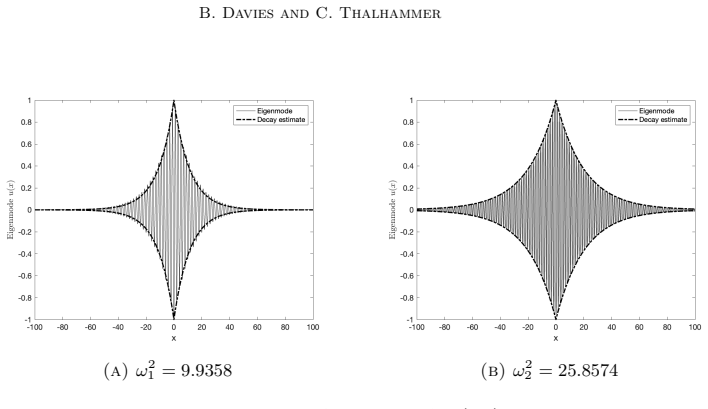
- Localised interface modes in reflection-symmetric quasicrystals persist from supercell approximants, with estimates for their eigenfrequencies and exponential decay rates.
Reading between the lines
- If the cut-off construction carries over to several variables, the same strategy would give supercell convergence for higher-dimensional quasiperiodic operators, with the continued-fraction rate replaced by a multi-dimensional Diophantine approximation error.
- The mode-matching inconsistency in the superspace proof suggests a repaired formulation: taking the lifted plane-wave frequency to be $m + n$ rather than $m + \theta n$ would make the identity consistent, and the equality of spectra would then plausibly hold as stated.
- The error bound can be read as a design rule for quasicrystal metamaterials: one can work backwards from a desired gap resolution to the required continued-fraction index, a practical step the paper leaves implicit.
- The same localised-mode argument likely applies to other symmetry-induced interfaces, such as phase-shift or anti-reflection defects, provided the defect eigenvalue is sufficiently well separated from the approximant spectrum.
Editorial analysis
A structured set of objections, weighed in public.
Referee Report
Summary. This paper develops convergence theory for two numerical strategies for spectra of one-dimensional quasiperiodic elliptic operators. For the supercell method, Theorem 3.4 asserts an explicit Hausdorff-type rate of order q_l^{-1} when the quasiperiodic slope theta is replaced by its continued-fraction approximants p_l/q_l, and the authors give a largely self-contained argument for the key localization lemma. Theorem 4.1 claims equality between the spectrum of the quasiperiodic operator A_theta and that of its superspace lift B_theta, and Section 5 applies the supercell estimates to prove existence and decay of localised interface modes. Numerical examples for Schrödinger and Helmholtz-type operators illustrate both methods.
Significance. If fully established, Theorem 3.4 would provide an explicit convergence rate for supercell approximations of quasiperiodic spectra and would rigorously justify the common practice of reading persistent gaps from supercell band diagrams; this is a useful and timely result for the metamaterials literature. The superspace equality of Theorem 4.1 would likewise put a widely used heuristic on a firm footing. The paper’s supercell arguments are mostly elementary and self-contained, and the continued-fraction construction is a clear strength. However, the superspace proof is invalid as printed, and the interface-mode theorem in Section 5 is not supported by the arguments given; these points must be repaired before the advertised claims can be accepted.
major comments (3)
- [4.1, Eq. (4.6)] Equation (4.6) does not define a lift that matches the slice used in (4.5). The mode e^{2\pi i(mx+\theta ny)} is mapped by D_\theta = \partial_x + \theta \partial_y to 2\pi i(m+\theta^2 n)e^{2\pi i(mx+\theta ny)}, whereas the generalized Fourier coefficient in (4.5) has frequency m+\theta n. Thus the claim that B_\theta acts on the Fourier coefficients of ~F exactly as A_\theta acts on the generalized Fourier coefficients of ~f is false as printed. Replacing the y-frequency \theta n by n repairs the algebraic identity, but the converse inclusion also needs a spectral theory for the non-elliptic operator B_\theta, which is not supplied by Theorem 2.7. As it stands, Theorem 4.1 is not proven.
- [5, Theorem 5.1 and Eq. (5.2)] The interface-mode theorem is not established. The condition (5.2) uses an undefined index n and has a quantifier over lambda in sigma(A_theta) that conflicts with the fixed lambda whose separation is being assumed. More substantively, “interface eigenvalue for A_{theta_{l0}}” is never defined, and the periodic operator A_{theta_{l0}} has no eigenvalues on the whole line; some truncated or defect problem must be specified. The proof then uses Theorem 3.4 to infer the existence of a limiting eigenvalue, but Theorem 3.4 only bounds distances to the spectra sigma(A_{theta_l}) and sigma(A_theta); it does not by itself produce an isolated eigenvalue of A_theta. Finally, the appeal to [1,17,47] for periodic band-gap interface modes does not automatically transfer to the quasiperiodic limit. The authors should either give a precise statement with a complete proof or clearly label this as a conjecture.
- [3.1, proof of Theorem 3.4] The proof of the upward bound is not rigorous as written. After estimating a point lambda in sigma(A_{theta_{l+2}}), the text introduces a recursion d_{n-1} \le C(1+|\lambda|+d_n) q_n^{-1} + d_n with d_n called the distance from lambda to sigma(A_{theta_n}) and d_0 = 0; if d_n is the distance for a fixed lambda, then the base case d_{l+2}=0 holds only for lambda in sigma(A_{theta_{l+2}}), and the passage to arbitrary lambda in sigma(A_theta) requires the spectral-inclusiveness argument from Proposition 3.1 (cited as “Theorem 3.1”), which is not spelled out. Likewise, the first inequality “follows from Lemma 3.5 by letting m \to \infty” needs a no-spectral-pollution statement for the sequence A_{theta_m}. These gaps are likely repairable, but they are load-bearing for the central theorem.
minor comments (5)
- [Title] The title contains spacing typos (“supersp ace”, “opera tors”); the whole manuscript should be proofread for similar artifacts.
- [3.1, end of proof of Theorem 3.4] The sentence “The claim now follows from Theorem 3.1” should presumably refer to Proposition 3.1 rather than Theorem 3.1.
- [3.1, Eq. (3.22)] The displayed inequality compares a_k(x,\theta x) with a_k(x,\theta_l), but the surrounding argument compares A_{\theta_m} and A_{\theta_l}; the first argument should be \theta_m x.
- [3.3, Figure 3.1 caption] The caption says “as the length of the periodic unit cell decreases”, but q_l increases along the sequence; the intended statement is that the unit cell becomes longer.
- [4.2] No convergence theorem is stated for the finite-difference or plane-wave discretisations used in the numerical examples; the figures are therefore heuristic illustrations rather than rigorous consequences of Theorems 3.4 and 4.1.
Circularity Check
No significant circularity: supercell and superspace convergence proofs are first-principles; self-citations are auxiliary tools, and the main caveat is a non-circular Fourier-mode error in Theorem 4.1.
full rationale
The central supercell theorem (Theorem 3.4) is derived from the spectral-theoretic approximate-eigenvector criterion (Lemma 3.2), explicit bump-function localisation, commutator estimates, and the classical continued-fraction approximation rate (Theorem 2.11). No parameter is fitted to the target spectrum and the conclusion is not assumed in the hypotheses. The tiling application uses the transfer-matrix recurrence of Kohmoto–Kadanoff–Tang [31] and the super band gap criterion of [22]; the latter is a self-citation by the first author, but it is used only to certify that certain λ lie in super band gaps, while the implication 'persistent supercell gap implies limiting gap' is exactly Theorem 3.4, so the citation is not load-bearing for the main result. The superspace section attempts a direct proof of σ(Aθ)=σ(Bθ). As printed, the proof is not correct: equation (4.6) defines ~F with y-frequency θn, while Dθ = ∂x + θ∂y sends e^{2πi(mx+θny)} to the multiplier m+θ²n, not the m+θn appearing in the reduced operator's Fourier series; the displayed 'acts like' identity therefore fails. This is a mathematical error in an omitted or invalid proof step, not a circular reduction—the claim does not follow from its own statement or from a fitted parameter. The authors do flag the related non-ellipticity of Bθ and the absence of a general Floquet theory for it, which further supports reading this as a correctness gap rather than circularity. Theorem 5.1 cites [1] together with independent references [17,47]; even if [1] is a self-citation, the isolation argument is not reduced solely to it. Overall, the derivation chain is self-contained against external benchmarks; the only issues are a minor non-load-bearing self-citation and a non-circular proof defect in the superspace theorem.
Assumptions & free parameters
assumptions (9)
- standard math Spectral theorem for self-adjoint operators (Weyl sequences characterise spectrum)
- standard math Shubin's Theorem 2.7: spectrum on CAP(R) equals spectrum on C_c^infty(R) for almost periodic elliptic operators
- standard math Shubin's Theorem 2.9: all operators in the hull H(A) share a common spectrum
- standard math Almost periodic approximation theorem (Theorem 2.2 of [44])
- domain assumption Elliptic regularity estimate ||f||_{H^k} <= C(1+|lambda|)||f||
- standard math Continued fraction error bound |theta - p_l/q_l| < 1/(q_l q_{l+1})
- domain assumption Super band gap criterion of Theorem 3.9 from [22] (Davies-Morini)
- domain assumption Periodic band-gap interface problems support only finitely many interface eigenvalues, and this persists in the quasiperiodic limit
- ad hoc to paper Well-separated interface eigenvalue condition (5.2)
Cite this review
Pith. "Pith review of Convergence of supercell and superspace methods for computing spectra of quasiperiodic operators." pith.science (2026). https://pith.science/paper/SNHUYG3S
@misc{pith2026241115906,
  author       = {Pith},
  title        = {Pith review of: Convergence of supercell and superspace methods for computing spectra of quasiperiodic operators},
  year         = {2026},
  howpublished = {\url{https://pith.science/paper/SNHUYG3S}},
  note         = {Machine review of arXiv:2411.15906}
}
read the original abstract
We study the convergence of two of the most widely used and intuitive approaches for computing the spectra of differential operators with quasiperiodic coefficients: the supercell method and the superspace method. In both cases, Floquet-Bloch theory for periodic operators can be used to compute approximations to the spectrum. We illustrate our results with examples of Schr\"odinger and Helmholtz operators.
Figures


Figures from the paper (6 more)



Reference graph
Works this paper leans on
-
[48]
Verbin Mor, Zilberberg Oded, Kraus Yaacov E, Lahini Yoav and Silberberg Yaron, ‘Observation of topological phase transitions in photonic quasicrystals’, in: Physical Review Letters110.7 (2013), p. 076403
work page 2013
- [49]
-
[50]
Xia Yiwei, Erturk Alper and Ruzzene Massimo, ‘Topological edge states in qua- siperiodic locally resonant metastructures’, in:Physical Review Applied13.1 (2020), p. 014023
work page 2020
-
[51]
Zolla F, Felbacq D and Guizal B, ‘A remarkable diffractive property of photonic quasi-crystals’, in:Optics Communications148.1-3 (1998), pp. 6–10. Bryn Davies Mathematics Institute, University of W arwick, Coventry CV4 7AL, UK Email address: bryn.davies@warwick.ac.uk Clemens Thalhammer ETH Zürich, Department of Mathematics, Rämistrasse 101, 8092 Zürich, S...
work page 1998
Reviewed August 12, 2026 · model on record in the stance chip above.
Discussion (0). Continue with ORCID to comment.