REVIEW 4 major objections 5 minor 37 references
Charge density waves and superconductivity in the electron-positive fermion gas using a simple intuitive model. Part II: Collective modes, effective interactions, superconductivity, and transport
T0 review · 4 major / 5 minor · reviewed 2026-08-12 · deepseek-v4-flash
Pith's one-line read The paper predicts that screening by positive fermions makes a two-component Coulomb gas superconduct above room temperature when the density sits near a charge-density-wave or compressibility instability, and gives the same instability a…
desk verdict A careful model study that honestly flags its own load-bearing assumption—the q^2 QMC local field factor scaling—so its striking high-Tc/CDW predictions are conditional, not established. read the letter →
The pith
A machine-rendered reading of the paper's core claim, the machinery that carries it, and where it could break.
The reading
What carries the argument
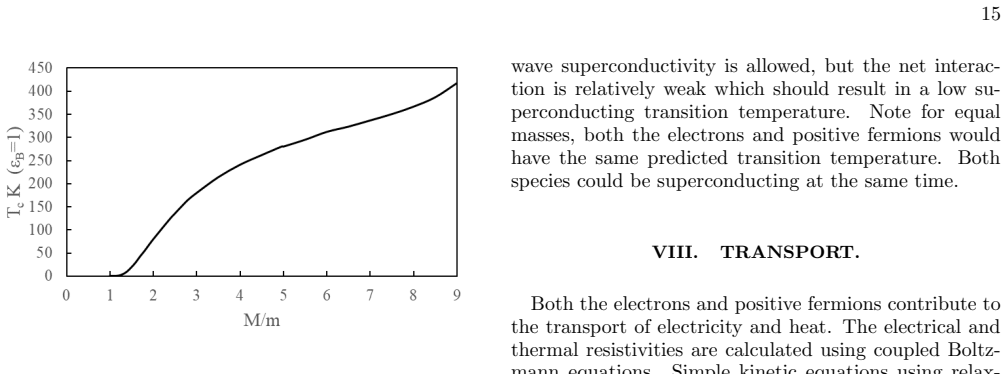
The central object is the effective two-body interaction of the two-component gas, expressed through density and spin local field factors $G_+(q)$ and $G_-(q)$ (wave-vector-dependent corrections encoding exchange and correlation beyond random-phase screening), with the electron-positive fermion correlation factor $G_{12}$ set to zero. The load-bearing term is the attractive electron-electron contribution $U_{21}=-(4\pi e^2/q^2)(1-2G_{12})^2\,v\Pi_1^0/(\varepsilon_{\rm et}\Delta)$, where $\Delta$ is the common denominator of the coupled linear-response equations. Zeros of $\Delta$ at $q=0$ mark the compressibility instability, and zeros at finite $q$ for $M/m>4.97$ mark the charge density wave; at both, $U_{21}$ diverges. The other essential input is the claim, taken from quantum Monte Carlo local field factors, that $G_+(q)$ continues to rise as $q^2$ up to almost $2k_F$ rather than saturating as in the Hubbard approximation. That $q^2$ behavior is what softens the acoustic plasmon and drives the charge density wave.
What would settle it
Run a quantum Monte Carlo calculation of the static density local field factor for a single-component fermion gas at $r_s$ between about 10 and 20 and check whether $G_+(q)$ still follows $q^2$ up to $q\approx 2k_F$; if it bends over before $2k_F$, the finite-$q$ zero of $\Delta$, the charge density wave, the large $\lambda$, and the above-room-temperature $T_c$ all collapse.
Extended reading notes
Core claim
On the paper's own terms: the additional screening from the positive fermions is a second source of electron-electron attraction. The effective electron-electron interaction separates into the uniform-background repulsive terms $V_0$ and $J\,\bm{\sigma}_1\cdot\bm{\sigma}_2$ plus the always attractive $U_{21}$, which is proportional to the density response of the positive fermions and becomes singular where the denominator $\Delta$ vanishes. Those zeros define the compressibility instability at $q=0$ and, for $M/m>4.97$, a charge density wave at finite $q$. Because $\lambda$ is a Fermi-surface average of $U_{21}$, it becomes large and eventually divergent at those densities; the McMillan estimate then gives transition temperatures above room temperature for $M/m>5$. The same $U_{21}$ enters the electron-positive fermion scattering rate, so the $T^2$ resistivity coefficient diverges at the same place. No material mapping is asserted; the model is offered as a simple, calculable system whose instabilities and enhanced interactions are the result.
Load-bearing premise
The load-bearing premise is that local field factors measured by quantum Monte Carlo at electron densities near $r_s=2$ remain valid and keep rising as $q^2$ up to nearly $2k_F$ when scaled to the effective low densities of the positive fermions, $r_s^{\rm eff}=(M/m)r_s$ up to about 20; the paper itself notes there are no quantum Monte Carlo data at that density.
Editorial extensions
If this is right
- A two-component Coulomb liquid tuned near a charge-density-wave instability should show both an anomalously large $T^2$ resistivity and high-temperature superconductivity without any phonon mechanism.
- The acoustic plasmon mode softens and terminates well below the wave vector predicted by RPA or the Hubbard approximation, which may explain why acoustic plasmons are hard to observe.
- The superconducting parameter $\lambda$ and the $T^2$ resistivity coefficient diverge together near the instabilities, so pressure, which changes $r_s$, should suppress or enhance both in tandem.
- Below mass ratio $M/m\simeq1.5$ the model permits only weak p-wave pairing; above $M/m\simeq4.97$ the incipient charge density wave makes s-wave pairing attractive over a wide wave-vector range.
- Only electron-positive fermion scattering contributes to electrical resistivity, while all three scattering channels contribute to thermal resistivity, so the Lorentz ratio should fall below the Wiedemann-Franz value.
Reading between the lines
- A testable extension is to repeat the calculation with a frequency-dependent local field factor; if the $q^2$ rise is truncated at finite frequency, both $\lambda$ and the $T^2$ coefficient would shrink, giving a direct handle on how much of the predicted $T_c$ is an artifact of the static approximation.
- The common divergence of pairing and resistivity suggests an empirical rule that could be checked against known materials: systems with a large $T^2$ resistivity tracking a nearby charge-density-wave transition are candidates for phonon-free pairing, and their $T_c$ should be pressure-sensitive in the same direction as the $T^2$ coefficient.
- The paper's stopping point at $M/m=9$ is itself a prediction: beyond that mass ratio the uniform-background assumption fails at equilibrium density, so any real system with such a mass ratio would need a different description, possibly a small-amplitude CDW coexisting with superconductivity.
Editorial analysis
A structured set of objections, weighed in public.
Referee Report
Summary. The manuscript studies a two-component Coulomb gas of electrons and heavier positive fermions using linear response theory with local field factors extracted from quantum Monte Carlo calculations of the uniform electron gas. It computes collective modes, effective interactions among electrons, positive fermions, and between the two species, and then uses these to estimate superconducting transition temperatures via a McMillan-type formula and to compute the coefficient of the T^2 electrical resistivity. The central claim is that additional screening by the positive fermions produces an attractive electron-electron term U21 in Eq. (19) that diverges at compressibility and charge density wave instabilities, leading to high superconducting T_c and enhanced T^2 resistivity. The paper is explicit about its assumptions and limitations, particularly in Appendix A, and states that quantitative predictions beyond mass ratio M/m=9 are unreliable because the density of the positive fermions corresponds to effective rs values near 20.
Significance. If the central mechanism is real, this is a conceptually simple route to high-temperature superconductivity and T^2 resistivity without phonons, driven by a two-component Coulomb gas near a charge density wave instability. The paper's strength is that it uses QMC-based local field factors rather than fitting the target results, and it is unusually candid about its own assumptions. The superconducting and transport enhancements are genuine consequences of the stated input, not of post-hoc parameter fitting. However, the quantitative claims—especially the room-temperature T_c at M/m above five—rest on an extrapolation of the electron-gas local field factor to effective densities where no QMC verification exists. The qualitative physics of a two-component gas with different masses is well motivated, but the magnitude and even the existence of the finite-q instability depend on a single empirical input whose behavior at rs_eff≈20 and q≈2kF is unverified.
major comments (4)
- [Section IV, Appendix A, Eqs. (7), (19), (26)] The load-bearing assertion is the q^2 rise of the density local field factor G+(q) up to nearly q=2kF when applied to positive fermions at effective densities rs_eff=(M/m)rs≈19.6. This behavior is taken from electron-gas QMC data near rs≈2 and extrapolated to low densities. The paper itself states in Appendix A: 'There are no quantum Monte Carlo data at this low density to verify this assumption.' The finite-q zero of Δ in Eq. (7), the divergence of λ in Eq. (26), and the high T_c in Fig. 11 all disappear if the true low-density G+ bends below q^2 before 2kF. Since no sum rule fixes G+ at q≈2kF at this density, the central high-T_c claim is not established by the evidence presented.
- [Section III, Eq. (7), Appendix A] The electron-positive fermion local field factor G12 is set to zero throughout, yet the expression for V_21^eff in Eq. (7) contains (1−2G12)^2 in both numerator and denominator. The paper acknowledges that G12 is unknown and ignores it as an assumption. If G12 has a nontrivial q dependence near the incipient charge density wave, it can shift the zeros of Δ and either weaken or eliminate the attractive enhancement. This is a second unverified input that directly controls the divergence structure on which the superconductivity claim rests.
- [Section VII, Eq. (27)] The McMillan formula (Eq. 27) is used to estimate T_c in a regime where λ becomes very large near the charge density wave, and the author states 'I am not sure of the validity of McMillan formula for the strongly coupled electron-positive fermion gas.' The room-temperature T_c prediction for M/m>5 in Fig. 11 therefore inherits both the unverified local field factor extrapolation and the questionable applicability of a weak-to-intermediate-coupling formula at large λ. A controlled test, such as an Eliashberg calculation or at least a sensitivity analysis of Eq. (27) with respect to the form of G+(q), is needed before this claim can be considered supported.
- [Section VIII, Eqs. (28)–(30)] The T^2 resistivity coefficient is computed with the Born approximation using the effective interaction V_12 in Eq. (7). The paper notes that the Born approximation overestimates the scattering cross-section by about a factor of two, but near the instability the interaction itself diverges, so the approximation error is not a fixed factor. Since the divergence in the scattering rate is the same divergence that produces the high T_c in Section VII, the transport enhancement claim shares the same fragility with respect to the extrapolated local field factor and G12=0 assumption.
minor comments (5)
- [Section II, after Eq. (4)] The text says 'Figure 1 illustrates several important points' but the discussion refers to the RPA, Hubbard approximation, and the QMC-based collective mode shown in Fig. 2; the figure number appears to be a typo.
- [Section VI, Eq. (24)] The text contains '(Eq. 24-??)' with an unresolved reference placeholder.
- [Section VIII, first paragraph] There is a typo 'electron-possitive fermion scattering' and later 'inelastic and inelastic collisions' should read 'elastic and inelastic collisions.'
- [Section VIII, Wiedemann-Franz paragraph] The name is spelled 'Weidemann-Franz'; the standard spelling is Wiedemann-Franz.
- [Section VII, Fig. 11 caption and text] The statement that 'The predicted transition temperatures of the model system are well above room temperature for mass ratios greater than five' is a strong claim that should be explicitly labeled as an extrapolation of the model, especially given the caveats in Appendix A.
Circularity Check
No specific circularity found: the CDW, pairing, and T^2 results follow from external QMC local-field-factor inputs combined with linear-response algebra; the rs_eff~20 extrapolation is openly identified as an unverified assumption, not as a fitted prediction.
full rationale
The paper's load-bearing inputs are the QMC-derived static local field factors G+ and G- (Refs. [13,20]) and the linear-response formulas that are largely re-derived in Sections III and IV. The attractive positive-fermion-mediated term U21 in Eq. (19), the divergence of the effective interactions at zeros of Delta in Eq. (7), and the growth of lambda and Tc in Eqs. (26)-(27) are algebraic consequences of those inputs. None of these quantities is obtained by fitting to the target Tc, CDW wave vector, or T^2 resistivity coefficient. In particular, the CDW and high-Tc predictions inherit their sensitivity from the assumption that the electron-gas G+(q) remains approximately proportional to q^2 up to q ~ 2 kF even at the positive-fermion effective density rs_eff = (M/m) rs ~ 20. Appendix A states this explicitly: 'There are no quantum Monte Carlo data at this low density to verify this assumption,' and asks 'Is this a real effect? Do the curves actually cross?' That is an extrapolation-validity risk, not a circularity: the input is not defined in terms of the output, and the divergent behavior follows from the stated mathematics rather than being imposed as the conclusion. The paper does contain many same-author citations, including the unpublished companion Ref. [1] and the QMC local-field-factor papers Refs. [13,20], but the essential formulas are reproduced in the text and the numerical inputs are externally anchored QMC results with stated assumptions and no fitted target quantity. No specific reduction of a prediction to its own input can be exhibited, so no circular step is reported. The score of 2 reflects only the unusually high density of same-author citations, none of which is load-bearing in a circular sense.
Assumptions & free parameters
free parameters (3)
- Local field factor density scaling =
G(q; rs=2) rescaled to rs_eff = (M/m)*rs, up to ~20
- G12 cross local field factor =
0
- Frequency dependence of local field factors =
static (omega=0)
assumptions (6)
- domain assumption Total energy is the sum of each species' uniform-background energy; the electron-positive fermion correlation energy is volume-independent.
- domain assumption Local field factors of the uniform electron gas apply to each species in the two-component gas.
- ad hoc to paper QMC local field factors at rs=2 can be scaled to effective rs > 20.
- ad hoc to paper Static, zero-frequency local field factors are sufficient for pairing and transport.
- ad hoc to paper McMillan formula (Eq. 27) estimates Tc in the strong-coupling regime.
- domain assumption Linear response remains reliable up to the instability where responses diverge.
Cite this review
Pith. "Pith review of Charge density waves and superconductivity in the electron-positive fermion gas using a simple intuitive model. Part II: Collective modes, effective interactions, superconductivity, and transport." pith.science (2026). https://pith.science/paper/P4DZVLW3
@misc{pith2026241115916,
  author       = {Pith},
  title        = {Pith review of: Charge density waves and superconductivity in the electron-positive fermion gas using a simple intuitive model. Part II: Collective modes, effective interactions, superconductivity, and transport},
  year         = {2026},
  howpublished = {\url{https://pith.science/paper/P4DZVLW3}},
  note         = {Machine review of arXiv:2411.15916}
}
abstract
Superconductivity and the normal state electrical resistivity which varies as $T^2$ are strongly enhanced near the compressibility and charge density wave instabilities in the electron-positive fermion gas. The additional screening from the positive fermions introduces an attractive term in the effective electron-electron interaction that is the basis for superconductivity. Electron-positive fermion scattering is the source of the $T^2$ term in the electrical resistivity. At an instability, both interactions are divergent. The superconducting transition temperature is estimated using the McMillan formula. The electron-positive fermion gas conducts electricity and heat. Because electron-electron and positive fermion-positive fermion scattering conserve momentum, they do not contribute to the electrical resistivity, but electron-positive fermion scattering does. All three scattering mechanisms contribute to the thermal resistivity. The simple model for the electron-positive fermion gas is physically intuitive and naturally introduces instabilities at $q=0$ when the bulk modulus becomes zero and charge density waves at finite $q$ under some circumstances. For each mass ratio $M/m$, there is a unique density $r_s$ where the energy is a minimum. For different mass ratios, the interactions are investigated at several values of $r_s$ ranging from below the energy minimum to that of the instability.
Figures


Figures from the paper (13 more)




Reference graph
Works this paper leans on
-
[1]
The neutralizing background is uniform
-
[2]
A third option is to use the Hubbard approximation which satisfies the compress- ibility sum rule at q = 0, but does not agree with the quantum Monte Carlo results at larger q. These three alternatives are compared at three different densities in Fig. 5 with V eff 21 , the result using the simple model and the current local field factors. Figure 5 shows t...
work page 1985
-
[3]
The electron-positive fermion correlation energy is constant with respect to volume and therefore does not contribute to the pressure or bulk modulus
-
[4]
The local field factors from the uniform electron gas can be used and any contribution from the electron- positive fermion interactions are ignored. (a) The local field factor from the high density electron gas at rs = 2 calculated by Quantum Monte Carlo can be scaled to the low density electron gas at rs > 20. The simple model predicts the instabilities,...
-
[5]
Simple model for the electron-positive fermion gas
Carl Kukkonen. Simple model for the electron-positive fermion gas. i. charge density waves and phase diagram. (to be published)
-
[6]
Electron- hole liquid in many-band systems
P Vashishta, P Bhattacharyya, and KS Singwi. Electron- hole liquid in many-band systems. i. ge and si under large uniaxial strain. Physical Review B, 10(12):5108, 1974
1974
-
[7]
Carl A Kukkonen and A. W. Overhauser. Electron- electron interaction in simple metals. Physical Review B, 20(2):550, 1979
1979
-
[8]
Collective modes in electron- hole liquids
G Vignale and KS Singwi. Collective modes in electron- hole liquids. Solid State Communications, 44(2):259–261, 1982
work page 1982
Show all 37 references
-
[9]
Collective modes, effective interaction and superconductivity in the electron-hole liquid,Thesis
Giovanni Vignale. Collective modes, effective interaction and superconductivity in the electron-hole liquid,Thesis. Northwestern University, 1984
1984
-
[10]
Acoustic plasmons in a two- component superconducting coulomb liquid
G Vignale and KS Singwi. Acoustic plasmons in a two- component superconducting coulomb liquid. Physical Review B, 31(1):245, 1985
1985
-
[11]
Possibility of superconductivity in the electron-hole liquid
Giovanni Vignale and Kundan S Singwi. Possibility of superconductivity in the electron-hole liquid. Physical Review B, 31(5):2729, 1985
1985
-
[12]
Superconductiv- ity in electron liquids with and without intermediaries
CF Richardson and NW Ashcroft. Superconductiv- ity in electron liquids with and without intermediaries. Physical Review B, 54(2):R764, 1996
1996
-
[13]
Electron-hole scattering and the electrical resistivity of the semimetal tis 2
Carl A Kukkonen and Pierre F Maldague. Electron-hole scattering and the electrical resistivity of the semimetal tis 2. Physical Review Letters, 37(12):782, 1976
1976
-
[14]
The electrical resis- tivity of bismuth: electron-hole scattering
CA Kukkonen and PF Maldague. The electrical resis- tivity of bismuth: electron-hole scattering. Journal of Physics F: Metal Physics, 6(11):L301, 1976
1976
-
[15]
Electron- electron scattering: Hall coefficient and magnetoresis- tance
Carl A Kukkonen and Pierre F Maldague. Electron- electron scattering: Hall coefficient and magnetoresis- tance. Physical Review B, 19(4):2394, 1979
1979
-
[16]
Electron- electron scattering and the electrical resistivity of metals
Pierre F Maldague and Carl A Kukkonen. Electron- electron scattering and the electrical resistivity of metals. Physical Review B, 19(12):6172, 1979
1979
-
[17]
QMC-consistent static spin and density local field factors for the uniform electron gas
Aaron D Kaplan and Carl A Kukkonen. QMC-consistent static spin and density local field factors for the uniform electron gas. Physical Review B, 107(20):L201120, 2023
2023
-
[18]
N. W. Ashcroft and N. D. Mermin. Solid State Physics. Holt, Rinehart and Winston, New York London, 1976
1976
-
[19]
D. Pines. Electron interaction in solids. Canadian Journal of Physics, page 1378, 1956
1956
-
[20]
Pines’ demon observed as a 3d acoustic plasmon in sr2ruo4
Ali A Husain, Edwin W Huang, Matteo Mitrano, Melinda S Rak, Samantha I Rubeck, Xuefei Guo, Hong- bin Yang, Chanchal Sow, Yoshiteru Maeno, Bruno Uchoa, et al. Pines’ demon observed as a 3d acoustic plasmon in sr2ruo4. Nature, 621(7977):66–70, 2023
2023
-
[21]
Electron-electron scattering in simple metals
Carl A Kukkonen and John W Wilkins. Electron-electron scattering in simple metals. Physical Review B, 19(12): 6075, 1979
1979
-
[22]
Effective two-body interaction in coulomb fermi liquids
G Vignale and KS Singwi. Effective two-body interaction in coulomb fermi liquids. Physical Review B, 32(4):2156, 1985
1985
-
[23]
Quantum Theory of the Electron Liquid
Gabriele Giuliani and Giovanni Vignale. Quantum Theory of the Electron Liquid. Cambridge University Press, 2005
2005
-
[24]
Quantitative electron- electron interaction using local field factors from quan- tum monte carlo calculations
Carl A Kukkonen and Kun Chen. Quantitative electron- electron interaction using local field factors from quan- tum monte carlo calculations. Physical Review B, 104 (19):195142, 2021
2021
-
[25]
Validity of the born approximation as applied to electron-electron scat- tering in metals: Implications for thermal conductivity
Carl A Kukkonen and Henrik Smith. Validity of the born approximation as applied to electron-electron scat- tering in metals: Implications for thermal conductivity. Physical Review B, 8(10):4601, 1973
1973
-
[26]
Ab initio calculations of superconducting transition tem- peratures: When going beyond rpa is essential
Camilla Pellegrini, Carl Kukkonen, and Antonio Sanna. Ab initio calculations of superconducting transition tem- peratures: When going beyond rpa is essential. Physical Review B, 108(6):064511, 2023
2023
-
[27]
Charge density waves in a quantum plasma
Zhaoyu Han, Shiwei Zhang, and Xi Dai. Charge density waves in a quantum plasma. Physical Review B, 100(15): 155132, 2019
2019
-
[28]
Quantitative spin-dependent electron- electron interaction to calculate the superconducting pa- rameters µ and λ
Carl A Kukkonen. Quantitative spin-dependent electron- electron interaction to calculate the superconducting pa- rameters µ and λ. Physical Review B, 107(10):104513, 2023
2023
-
[29]
Effective electron-electron interactions and the superconducting transition temperature, Thesis
Clifton Forrest Richardson. Effective electron-electron interactions and the superconducting transition temperature, Thesis. Cornell University, 1995
1995
-
[30]
Conditions for t 2 resistivity from electron-electron scattering
Michael W Swift and Chris G Van de Walle. Conditions for t 2 resistivity from electron-electron scattering. The European Physical Journal B, 90:1–6, 2017
2017
-
[31]
On the origin and the amplitude of t- square resistivity in fermi liquids
Kamran Behnia. On the origin and the amplitude of t- square resistivity in fermi liquids. Annalen der Physik, 534(5):2100588, 2022
2022
-
[32]
Lorentz ratio of a com- pensated metal
Songci Li and Dmitrii L Maslov. Lorentz ratio of a com- pensated metal. Physical Review B, 98(24):245134, 2018
2018
-
[33]
Role of electron-electron collisions for charge and heat transport at intermedi- ate temperatures
Woo-Ram Lee, Alexander M Finkel’stein, Karen Michaeli, and Georg Schwiete. Role of electron-electron collisions for charge and heat transport at intermedi- ate temperatures. Physical review research, 2(1):013148, 2020
2020
-
[34]
Effects of screening on the thermal re- sistivity of metals due to electron-electron scattering
Naoki Iwamoto. Effects of screening on the thermal re- sistivity of metals due to electron-electron scattering. Physical Review B, 59(15):9687, 1999
1999
-
[35]
Theory of charge-density-wave superconductors
Kazushige Machida, Tamotsu K¯ oyama, and Takeo Mat- subara. Theory of charge-density-wave superconductors. Physical Review B, 23(1):99, 1981
1981
-
[36]
Robust superconductivity intertwined with charge den- sity wave and disorder in pd-intercalated erte 3
Alan Fang, Anisha G Singh, Joshua A W Straquadine, Ian R Fisher, Steven A Kivelson, and Aharon Kapitulnik. Robust superconductivity intertwined with charge den- sity wave and disorder in pd-intercalated erte 3. Physical Review Research, 2(4):043221, 2020
2020
-
[37]
Enhanced charge density wave coherence in a light- quenched, high-temperature superconductor
S Wandel, F Boschini, EH da Silva Neto, L Shen, MX Na, S Zohar, Y Wang, SB Welch, MH Seaberg, JD Koralek, et al. Enhanced charge density wave coherence in a light- quenched, high-temperature superconductor. Science, 376(6595):860–864, 2022
2022
Reviewed August 12, 2026 · model on record in the stance chip above.
Discussion (0). Continue with ORCID to comment.