REVIEW 2 major objections 5 minor 1 cited by
Can plasma physics establish a significant bound on long range dark matter interactions?
T0 review · 2 major / 5 minor · reviewed 2026-08-12 · deepseek-v4-flash
Pith's one-line read If dark matter carries an unbroken dark electromagnetic force, colliding halos should brake each other through plasma instabilities; since no such braking is observed, the dark fine-structure constant must be below 4×10^-25.
desk verdict Plasma-instability slowdown is a genuinely new route to bounding dark U(1) and the qualitative bound is probably right, but the headline number rests on an uncalibrated simulation threshold and the paper's comparison with the concurrent PIC result is arithmetically off. read the letter →
The pith
A machine-rendered reading of the paper's core claim, the machinery that carries it, and where it could break.
The reading
What carries the argument
The load-bearing mechanism is the collisionless plasma instability of two interpenetrating, equal-mass, cold plasma slabs: the Weibel/current-filamentation instability, with wave vector perpendicular to the flow and driven by temperature anisotropy, and the oblique/two-stream instability. In simulations these instabilities generate magnetic fields that deflect particle trajectories, converting forward drift into transverse momentum, and the nonlinear saturation time sets the slowdown threshold $L \approx 10 v_{fl}/\Gamma_W$. The conversion of this threshold into a coupling bound uses the dark plasma frequency, $\omega_{pD} = \sqrt{4\pi \rho_D \alpha_D \hbar c}/m_D$, which encodes how the same physics scales with halo density, particle mass, and coupling strength. The final comparison uses the effective drag cross-section, about 5.9 cm²/g for a marginal slowdown, checked against the observed cluster constraint of 0 ± 1 cm²/g.
What would settle it
A particle-in-cell simulation of two interpenetrating dark-plasma slabs that includes a smooth density gradient and an ambient dark magnetic field aligned with the relative drift, run at parameters satisfying Eq. (3), would settle the matter: if the slabs do not lose roughly 85% of their forward velocity, the assumed instability-driven slowdown does not transfer to realistic halos and the bound collapses.
Extended reading notes
Core claim
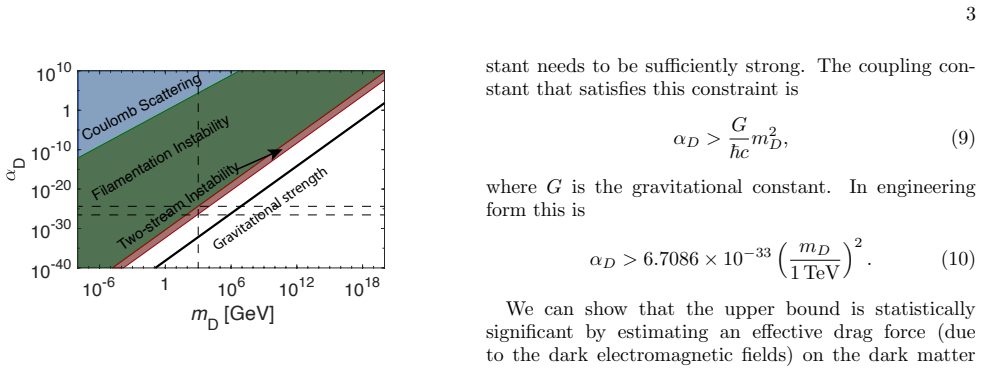
The central claim is that dark matter charged under an unbroken dark U(1) behaves as a collisionless plasma during cluster mergers, and the collective electromagnetic fields generated by the Weibel/current-filamentation and oblique/two-stream instabilities produce bulk drag, not just rare hard scattering; this is an N-to-N collective process rather than a 2-to-2 scattering process. Using particle-in-cell simulations of interpenetrating electron-positron slabs, the paper adopts the threshold that a slab of length $L \gtrsim 10 v_{fl}/\Gamma_W$ suffers significant slowdown (an 85% velocity loss in the reference run), where $\Gamma_W$ is the Weibel growth rate. Translating this threshold to a dark plasma with frequency $\omega_{pD} = \sqrt{4\pi \rho_D \alpha_D \hbar c}/m_D$, the requirement that no significant slowdown occurs gives Eq. (3): $\alpha_D < 4.2355\times10^{-25} (L/100\,\mathrm{kpc})^{-2} (\rho_D/0.01\,\mathrm{GeV/cm^3})^{-1} (m_D/1\,\mathrm{TeV})^2$. For a cold plasma the oblique/two-stream instability gives an even stronger limit, Eq. (6), $\alpha_D < 4.2355\times10^{-27} (m_D/1\,\mathrm{TeV})^2 (v_{fl}/0.1c)^2$, under the same reference parameters. The paper also expresses the marginal drag as an effective self-interaction cross-section of about 5.9 cm²/g, which it compares with the observed 0 ± 1 cm²/g from cluster collisions.
Load-bearing premise
The bound assumes that the plasma slowdown measured in simulations of colliding electron-positron slabs—85% velocity loss in a slab of length about ten instability growth lengths—applies unchanged to real dark-matter halos, which are idealized as cold step-function slabs with no background dark magnetic field.
Editorial extensions
If this is right
- If the central claim is correct, any unbroken dark U(1) with $\alpha_D$ above about $4\times10^{-25}$ at TeV-scale masses is excluded by existing cluster-merger observations.
- The plasma-instability bound supersedes the earlier Coulomb-scattering bound by roughly 29 orders of magnitude, so a wide region of previously open parameter space is closed.
- For cold dark plasmas the oblique/two-stream instability gives an even tighter bound, about $10^{-27}$ for $v_{fl}=0.1c$, so the most restrictive limit depends on the velocity dispersion of the halo plasma.
- Because the bound scales as $m_D^2$, heavier dark matter is less constrained; at 1 TeV the excluded couplings extend up to roughly 60 million times the strength at which the dark force would rival gravity, while sub-gravitational couplings remain allowed.
- The same threshold implies an effective drag cross-section of about 5.9 cm²/g for marginal slowdown, which is statistically inconsistent with the measured 0 ± 1 cm²/g from cluster collisions.
Reading between the lines
- Beyond the paper, the same collective-drag argument should apply to any long-range vector mediator coupled to dark matter, not only a symmetric dark U(1), so the bound may generalize to a broader class of hidden-sector models.
- Beyond the paper, the simulation threshold is calibrated for equal-mass electron-positron plasmas; whether asymmetric dark matter, smooth halo density profiles, or a pre-existing dark magnetic field changes the slowdown is not settled, and dedicated simulations of those cases would sharpen or weaken the bound.
- Beyond the paper, a survey of many merging clusters could turn the single comparison into a scaling test: if the bound is right, the maximum allowed coupling should vary with halo size and density as $L^{-2}\rho^{-1}m_D^2$ across the population.
Editorial analysis
A structured set of objections, weighed in public.
Referee Report
Summary. The manuscript argues that if dark matter carries an unbroken dark U(1) charge, two colliding dark-matter halos behave as counterstreaming collisionless plasmas and are subject to Weibel and oblique instabilities that brake the flow. Adopting the criterion from the authors' earlier PIC simulations [1] that a slab of length L ≳ 10 v_fl/Γ_W experiences significant slowdown, and applying it to cluster mergers with benchmark parameters L=100 kpc, ρ_D=0.01 GeV/cm³, v_fl=0.1c, and m_D=1 TeV, the paper derives α_D < 4.2355×10^-25 (Eq. 3) from the Weibel instability and α_D < 4.2355×10^-27 (Eq. 6) from the oblique instability. These are many orders of magnitude stronger than the earlier Coulomb-scattering bound (Eq. 8). The paper also uses slowdown diagnostics from simulation R1 of Ref. [1] to infer an effective σ/m ≈ 5.9 cm²/g and claims inconsistency with the Harvey et al. bound σ/m = 0 ± 1 cm²/g. The Conclusion acknowledges the assumptions of step-function density profiles and no background dark magnetic field, and it discusses a concurrent PIC study [37] that gives a weaker bound.
Significance. If the simulation-calibrated threshold were transferable to cluster mergers, the result would be a dramatic constraint on long-range dark self-interactions, many orders of magnitude stronger than existing limits, and it would essentially exclude an unbroken dark U(1) of appreciable strength at the benchmark mass. The parametric derivation is transparent, and Eq. (3) follows algebraically from Eq. (1) with the stated constants; the authors also deserve credit for explicitly stating their assumptions rather than hiding them. However, the headline number is not robust: it depends on an unvalidated factor of 10 from a single simulation campaign and disagrees with an independent PIC result by about three orders of magnitude. The astronomical-significance claim via σ/m is also not fully supported. The qualitative point that collective plasma instabilities can constrain long-range dark forces is interesting and likely correct, but the quantitative bound needs further calibration or should be presented as an order-of-magnitude estimate with explicit caveats.
major comments (2)
- [Section II, Eqs. (1)-(3), and Section III] The central bound inherits the criterion L ≈ 10 v_fl/Γ_W from the e+e− slab simulations of Ref. [1], but the paper gives no evidence that this factor of 10 or the associated slowdown magnitude are universal. In particular, the conclusion notes the assumptions of step-function density and no background dark magnetic field; if realistic density gradients or a parallel background dark B-field suppress the Weibel/current-filamentation growth, the effective required length grows and the bound weakens. The independent PIC study [37] reports α_D < 7.8×10^-22, about 2×10^3 times weaker than Eq. (3). The attempt in the Conclusion to reconcile these results by taking L 'approximately 1% smaller' is arithmetically wrong: Eq. (3) scales as L^-2, so a 1% change in L shifts the bound by only about 2%, whereas matching [37] would require L ≈ 2.3 kpc, a factor of about 43 smaller. The specific value 4×10^-25 is therefore not supported unless the transferability of the slowdown threshold is demonstrated or the uncertainty is quantified.
- [Section II, Eq. (11) and following] The statistical-significance argument is not reproducible and is partly circular. From Eq. (11) with the stated benchmark values (L=100 kpc, ρ_D=0.01 GeV/cm³, v_fl=0.1c, Δt_αB=105.4 ω_pD^-1, (v_fl−v_init)/v_fl=0.8556, and ω_pD=10c/L), I obtain σ/m ≈ 1.5×10^2 cm²/g, not the quoted 5.9 cm²/g; the intermediate calculation should be provided and checked. In addition, the two inputs Δt and Δv are taken from the same simulation R1 that defines the slowdown threshold, with no uncertainty quoted, and the collective electromagnetic drag is mapped to the hard-sphere elastic-scattering cross-section σ/m constrained in Ref. [36] without justification. The statement that the slowdown is 'statistically inconsistent' with observation is therefore not supported. This conversion is not needed for Eq. (3), but the abstract's significance claim depends on it.
minor comments (5)
- [Section II, Eq. (4)] The right-hand side of Eq. (4) should be L ω_pD/(10 v_fl), not L ω_pD/v_fl, if Γ_TS is taken to be ω_pD; as printed, the displayed equality is inconsistent with the factor 100 in Eq. (5).
- [Figure 1 caption] The caption contains a typo: 'reverence value' should read 'reference value'.
- [Front matter] The PACS numbers are left as 'xxxxxx'; they should be filled in or removed.
- [Section II, Eqs. (3) and (6)] The bounds are quoted to five significant figures even though the input criterion is an order-of-magnitude threshold; a single significant figure or an explicit uncertainty would better reflect the precision of the input.
- [Section III] The discussion of Ref. [37] should summarize the difference in simulation setup (for example, initially non-overlapping slabs and spatial-temporal growth) instead of dismissing the discrepancy with the incorrect L rescaling, and the reference should be updated with journal details if it has been published.
Circularity Check
No significant circularity: the α_D bound is a parameter translation of an independent prior PIC simulation result, not a fit to the observations being constrained.
full rationale
The paper's central bound (Eq. 3) is obtained by algebraically rearranging the slowdown condition LΓ_W/(10v_fl) < 1 (Eq. 1), substituting the cold-plasma Weibel growth rate Γ_W = ω_pD v_fl/c and the definitions of the dark plasma frequency, then inserting fiducial astrophysical parameters (L=100 kpc, ρ_D=0.01 GeV/cm^3, m_D=1 TeV). The factor 10 and the later slowdown magnitude (85% velocity loss over 105.4 ω_pD^-1) are taken verbatim from the authors' earlier PIC simulation [1], but that simulation is an externally falsifiable plasma-physics result with stated assumptions; it was not fitted to the cluster observations the paper constrains. The derived bound is therefore a translation of an independent simulation-calibrated threshold to a new physical context, not a re-importation of the conclusion into its premises. No equation is defined in terms of the target bound, no fitted parameter is renamed as a prediction, and the cited prior work does not depend on the present paper's dark-matter output. The paper's attempted reconciliation with the concurrent result [37] (claiming Eq. 3 matches α_D < 7.8×10^-22 if L is ~1% smaller) is numerically dubious, since Eq. 3 scales as L^-2 and a 1% change in L shifts the bound by ~2%, not by a factor of ~2000; however, that is a correctness or robustness concern, not circularity. Concerns about the transferability of the e± slab slowdown threshold to dark-matter halos, the step-function density assumption, and the absence of a background dark magnetic field are explicitly acknowledged in the Conclusion and are modeling limitations, not circular reasoning. Under the stated criteria, the load-bearing self-citation to [1] qualifies as independent evidence because it is an externally falsifiable simulation rather than an unverified assertion, so the circularity score is 0.
Assumptions & free parameters
free parameters (3)
- Slowdown threshold factor (10 in Eq. 1) =
10
- Benchmark halo parameters =
L = 100 kpc, ρ_D = 0.01 GeV/cm³, v_fl = 0.1 c, m_D = 1 TeV
- Simulation R1 slowdown diagnostics =
∆t_αB = 105.4 ω_pD^-1; (v_fl - v_init)/v_fl = 0.8556
assumptions (4)
- domain assumption The dimensionless dynamics of two interpenetrating collisionless e⁺e⁻ slabs transfer identically to a dark-matter plasma with dark charge, so thresholds measured in Ref [1] apply with ω_pD scaling
- domain assumption Cluster mergers are modeled as two cold step-function slabs with v_fl ≥ v_th, no density gradients, and no background dark magnetic field
- domain assumption The observed co-location of dark matter and galaxies in cluster mergers (Bullet Cluster [18], Harvey et al. σ/m = 0±1 cm²/g [36]) rules out collective plasma braking
- domain assumption OSIRIS PIC simulations in Ref [1] accurately capture the nonlinear saturation of Weibel/oblique instabilities and bulk slowdown
Cite this review
Pith. "Pith review of Can plasma physics establish a significant bound on long range dark matter interactions?." pith.science (2026). https://pith.science/paper/HM2KFZQ2
@misc{pith2026241115981,
  author       = {Pith},
  title        = {Pith review of: Can plasma physics establish a significant bound on long range dark matter interactions?},
  year         = {2026},
  howpublished = {\url{https://pith.science/paper/HM2KFZQ2}},
  note         = {Machine review of arXiv:2411.15981}
}
abstract
Dark matter has been theorized to be charged under its own "dark electromagnetism" (dark-EM). Under this hypothesis, dark matter can behave like a cold collisionless plasma of self-interacting dark matter particles, and exhibit plasma-like instabilities with observational consequences. Using the results published in [1], which studied the degree of slowdown between two interpenetrating $e^-\,e^+$ plasma clouds due to plasma instabilities, estimates of similar interactions for colliding "dark plasmas" are explored. Comparison with astronomical observations reveals strong new constraints on dark-EM with the dark electromagnetic self-interaction $\alpha_{D} < 4 \times 10^{-25}$.
Figures
Forward citations
Cited by 1 Pith paper
-
Non-linear Evolution of Dark Plasma Subhalos
Dark plasma instabilities can evaporate up to ~97% of a 10^7 M_sun subhalo's mass by first pericenter, much more than ordinary tidal stripping.
Reference graph
Works this paper leans on
-
[37]
W. DeRocco and P. Giffin, Dark plasmas in the non- linear regime: constraints from particle-in-cell simula- tions (2024), 2411.11958, URL https://arxiv.org/abs/ 2411.11958
arXiv 2024
- [1]
- [36]
-
[2]
Zwicky, Astrophys
F. Zwicky, Astrophys. J. 86, 217 (1937)
1937
- [3]
-
[4]
H. M. Lee and J. P. Ostriker, Astrophys. J. 322, 123 (1987)
work page 1987
-
[5]
Einstein, Science 84, 506 (1936)
A. Einstein, Science 84, 506 (1936)
1936
- [6]
Show all 49 references
-
[7]
Clowe, M
D. Clowe, M. Bradac, A. H. Gonzalez, M. Markevitch, S. W. Randall, C. Jones, and D. Zaritsky, Astrophys. J. 648, L109 (2006)
2006
-
[8]
Collaboration, et
P. Collaboration, et. al , Astron. Astrophys. 594 (2015)
2015
-
[9]
Jungman, M
G. Jungman, M. Kamionkowski and K. Griest, Phys. Rep. 267 (1996)
1996
-
[10]
Baudis, J
L. Baudis, J. Phys. Conf. Ser. 375 (2012)
2012
-
[11]
Ackerman, M
L. Ackerman, M. R. Buckley, S. M. Carroll, and M. Kamionkowski, Phys. Rev. D 79 (2009)
2009
-
[12]
J. L. Feng, M. Kaplinghat, H. Tu, and H. Yu, J Cosmol Astropart P 2009, 004 (2009)
2009
-
[13]
P. Ko, N. Nagata, and Y. Tang, Phys. Lett. B 773, 513 (2017)
2017
-
[14]
Agrawal, F
P. Agrawal, F. Cyr-Racine, Lisa Randall and Jakub Scholtz, J Cosmol Astropart P 2017, 022 (2017)
2017
-
[15]
M. R. Buckley and A. DiFranzo, Phys. Rev. Lett. 120, 051102 (2018)
2018
-
[16]
Kamada, M
A. Kamada, M. Kaplinghat, H. Tu, and H. Yu, Phys. Rev. Lett. 119, 111102 (2017)
2017
-
[17]
Rennan, Nature 555, 71 (2018)
B. Rennan, Nature 555, 71 (2018)
2018
-
[18]
Clowe, A
D. Clowe, A. Gonzalez and M. Markevitch, Astrophys. J. 604, 596 (2004)
2004
-
[19]
Markevitch, A
M. Markevitch, A. H. Gonzalez, D. Clowe, A. Vikhlinin, L. David, W. Forman, C. Jones, S. Murray and W. Tucker, Astrophys. J. 606, 819 (2004)
2004
-
[20]
Wayne, B
H. Wayne, B. Rennan and G. Andrei, Phys. Rev. Lett. 85, 1158 (2000). 5
2000
-
[21]
Foot, J Cosmol Astropart P 2016, 011 (2016)
R. Foot, J Cosmol Astropart P 2016, 011 (2016)
2016
-
[22]
Foot and S
R. Foot and S. Vagnozzi, J Cosmol Astropart P 2016 (2016)
2016
-
[23]
A. Bret, L. Gremillet and M. E. Dieckmann, Phys. Plas- mas 17, 120501 (2010)
2010
-
[24]
L. O. Silva, R. A. Fonseca, J. W. Tonge, J. M. Dawson, W. B. Mori and M. V. Medvedev, Astrophys. J. 596, L121 (2003)
2003
-
[25]
Y. B. Fainberg, V. D. Shapiro and V. I. Shevchenko, JETPL 30, 528 (1970)
1970
-
[26]
Bret and L
A. Bret and L. Gremillet, Plasma Phys. Control. Fusion 48 (2006)
2006
-
[27]
Bohm and E
D. Bohm and E. P. Gross, Phys. Rev. 75, 1851 (1949)
1949
-
[28]
E. S. Weibel, Phys. Rev. Lett. 2, 83 (1959)
1959
-
[29]
Boella, K
E. Boella, K. Schoeffler, N. Shukla, G. Lapenta, R. Fon- seca, L. O. Silva, arXiv:1709.05908 (2017)
2017 arXiv
-
[30]
Muggli, S.F
P. Muggli, S.F. Martins, N. Shukla, J. Vieira and L. O. Silva, arXiv:1306.4380v2 (2018)
2018 arXiv
-
[31]
Sarri, et
G. Sarri, et. al , Nat. Commun. 6, 6747 (2015)
2015
-
[32]
Shukla, J
N. Shukla, J. Vieira, P. Muggli, G. Sarri, R. Fonseca and L. O. Silva, J. Plasma Phys. 84, 905840302 (2018)
2018
-
[33]
L. O. Silva, R. A. Fonseca, J. W. Tonge, W. B. Mori and J. M. Dawson, Phys. Plasmas 9, 2458 (2002)
2002
-
[34]
Shukla, A
N. Shukla, A. Stockem, F. Fiuza and L. O. Silva, J. Plasma Phys. 78, 181 (2012)
2012
-
[35]
Heikinheimo, M
M. Heikinheimo, M. Raidal, C. Spethmann and H. Veerm¨ ae, Phys. Lett. B749, 236 (2015)
2015
-
[38]
V. B. Pathak, T. Grismayer, A. Stockem, R. A. Fon- seca, and L. O. Silva, New Journal of Physics 17, 043049 (2015), URL https://dx.doi.org/10.1088/1367-2630/ 17/4/043049
2015 doi
-
[39]
O. A. Pokhotelov and M. A. Balikhin, Annales Geophys- icae 30, 1051 (2012), URL https://angeo.copernicus. org/articles/30/1051/2012/
2012
-
[40]
Molvig, Phys
K. Molvig, Phys. Rev. Lett. 35, 1504 (1975), URL https: //link.aps.org/doi/10.1103/PhysRevLett.35.1504
1975 doi
-
[41]
Ji-Wei and P
L. Ji-Wei and P. Wen-Bing, Chinese Physics Letters 22, 1976 (2005), URL https://dx.doi.org/10.1088/ 0256-307X/22/8/043
2005
-
[42]
E. N. Parker, Phys. Rev. 109, 1874 (1958), URL https: //link.aps.org/doi/10.1103/PhysRev.109.1874
1958 doi
-
[43]
K. M. Schoeffler, N. F. Loureiro, R. A. Fon- seca, and L. O. Silva, Phys. Rev. Lett. 112, 175001 (2014), URL https://link.aps.org/doi/10. 1103/PhysRevLett.112.175001
2014
-
[44]
K. M. Schoeffler, N. F. Loureiro, R. A. Fonseca, and L. O. Silva, Physics of Plasmas 23 (2016), ISSN 1089-7674, URL http://dx.doi.org/10.1063/1.4946017
2016 doi
-
[45]
Shukla, Ph.D
N. Shukla, Ph.D. thesis, Instituto Superior T´ ecnico (2019)
2019
-
[46]
Shukla, B
N. Shukla, B. Feldstein, J. Mardon, K. Schoeffler, J. Vieira, and L. Silva, in APS Division of Plasma Physics Meeting Abstracts (2015), vol. 2015 of APS Meet- ing Abstracts, p. NP12.118
2015
-
[47]
R. A. Fonseca, L. O. Silva, J. Tonge, R. G. Hemker, J. M. Dawson and W. B. Mori, IEEE Trans. Plasma Sci. 30, 28 (2002)
2002
-
[48]
R. A. Fonseca, L. O. Silva, F. S. Tsung, V. K. Decyk, W. Lu, C. Ren,and W. B. Mori, S. Deng, S. Lee, T. Katsouleas and J. C. Adam, Lect. Notes Comput. Sci. 2331, 046401 (2002)
2002
-
[49]
R. A. Fonseca, S. F. Martins, L. O. Silva, J. W. Tonge, and F. S. Tsung and W. B. Mori, Plasma Phys. Control. Fusion 50, 124034 (2008)
2008
Reviewed August 12, 2026 · model on record in the stance chip above.
Discussion (0). Continue with ORCID to comment.