REVIEW 3 major objections 4 minor 31 references
TransCompressor: LLM-Powered Multimodal Data Compression for Smart Transportation
T0 review · 3 major / 4 minor · reviewed 2026-08-12 · deepseek-v4-flash
Pith's one-line read TransCompressor proposes that a general-purpose LLM, prompted with a sensor type and a skip-sampled sequence, can reconstruct missing transportation sensor data with no fine-tuning.
desk verdict A cleanly written proof-of-concept that GPT-4 can interpolate skip-sampled sensor data, but the compression claim is unsupported because the paper never compares against the linear-interpolation baseline the model is demonstrably performing. read the letter →
The pith
A machine-rendered reading of the paper's core claim, the machinery that carries it, and where it could break.
The reading
What carries the argument
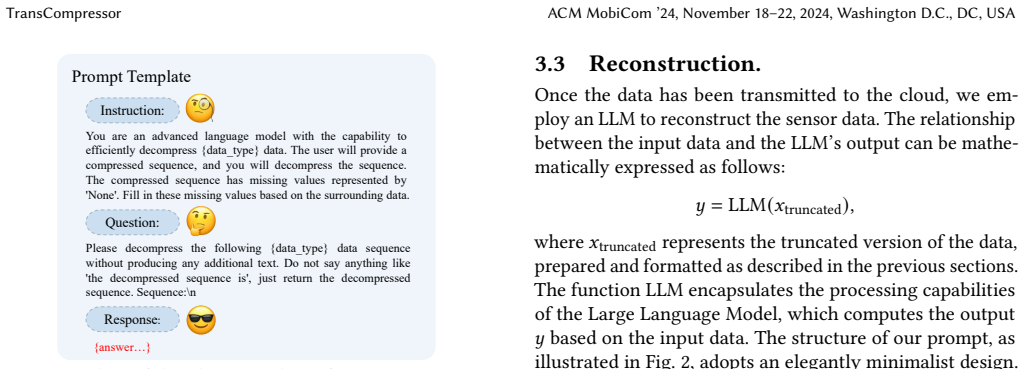
The mechanism is a three-stage pipeline. On the vehicle side, skip sampling keeps a fraction $\alpha$ of the data points; in the cloud, the retained values are rescaled to [0,1] and truncated to two decimal places to shorten the token sequence; then a minimal prompt tells GPT-4 the sensor type and asks it to replace every 'None' with a value, returning only the decompressed sequence. The load-bearing step is the prompt-driven zero-shot reconstruction, $y = \mathrm{LLM}(x_{\text{truncated}})$, with the model's interpolation behavior shown in the worked example. The same prompt template is used across all sensors and modes, so the framework's generality rests entirely on the LLM's ability to infer missing values from surrounding context.
What would settle it
Run the same skip-sampled sequences through a plain linear interpolator or any classical imputation method and compare MSE with GPT-4's reconstructions; if the LLM is not more accurate, the claim that LLMs provide knowledge-based decompression is not supported.
Extended reading notes
Core claim
TransCompressor's central claim is that LLMs can act as zero-shot data reconstructors: given a prompt that names the sensor type and a sequence in which some entries are replaced by 'None', GPT-4 fills the gaps using its general knowledge rather than any task-specific training. The paper demonstrates this on three sensor modalities and three transportation modes, and it documents one reconstruction in which the model identifies the missing positions, applies linear interpolation between neighboring known values, and returns a complete sequence. The authors interpret this as evidence of an inherent capability in LLMs to interpret transportation sensor data, and they report that reconstruction is most accurate for stable, low-variability data such as MTR readings and for larger retained fractions alpha.
Load-bearing premise
The central claim rests on the assumption that 30 self-collected 30-second segments per transportation mode, sampled at 1 Hz, are representative of real-world sensor streams, and that reporting only mean MSE, without variance or a comparison baseline, is enough to show reconstruction quality.
Editorial extensions
If this is right
- Transportation fleets could transmit a small fraction of sensor readings and reconstruct the rest in the cloud, cutting bandwidth and storage costs.
- No per-dataset training or fine-tuning is needed, so the approach could be applied to new sensor types by changing only the prompt.
- Reconstruction accuracy improves as the retained fraction alpha increases, giving operators a tunable trade-off between data volume and fidelity.
- Stable, low-variability environments such as MTR rides are reconstructed more accurately than bus or taxi rides, suggesting the technique is best suited to predictable streams.
- The same zero-shot decompression pattern could extend beyond transportation to other sensor data mentioned in the paper's outlook, such as inertial, biomedical, or wireless signals.
Reading between the lines
- The worked example shows GPT-4 using plain linear interpolation, so the paper's 'knowledge-based' story is not yet separated from a cheap baseline; a direct MSE comparison against linear interpolation on the same sequences would settle that.
- End-to-end efficiency is not established: sending readings to the cloud and paying for LLM inference may consume more energy than transmitting the full local data stream, which matters for battery-powered vehicles.
- A stress test on longer, non-stationary segments with stops, acceleration, or elevation changes would show whether the approach degrades when linear interpolation is a poor model.
Editorial analysis
A structured set of objections, weighed in public.
Referee Report
Summary. TransCompressor is a proposed compression/decompression framework for multimodal transportation sensor data (barometric pressure, speed, altitude). On the sender side, a sequence is skip-sampled at fraction α, rescaled to [0,1], and truncated to two decimal places; the resulting text, with 'None' placeholders, is sent to GPT-4 with a short prompt asking it to fill in the missing values. Reconstruction quality is evaluated with MSE for bus, taxi, and MTR data at α = 0.1–0.9. The paper claims that LLMs can serve as zero-shot data reconstructors and that the scheme improves transmission efficiency and reduces storage without fine-tuning.
Significance. The question of whether foundation models can serve as general-purpose reconstructors for sensor data is timely, and the real-world collection across three transportation modes is a reasonable starting point. The paper also documents a concrete prompt and a worked example, which aids reproducibility. However, the manuscript as written does not establish the claimed contribution: the evaluation lacks baselines, compression-cost accounting, and statistical support, and the worked example shows the model executing linear interpolation. If the central claim were supported, the framework could be relevant to edge-cloud sensor systems; with the current evidence, the results are consistent with a much weaker statement that GPT-4 can follow an interpolation instruction.
major comments (3)
- [Section 4.2, Fig. 4 and Fig. 6] The evaluation contains no comparison against any baseline. The only quantitative results are absolute MSE values, yet the central claim in Section 1 is that LLMs are effective zero-shot reconstructors. Because Fig. 6 shows that the model's output is obtained by linear interpolation between the two nearest retained values, the reported MSE could plausibly be matched by a trivial receiver-side interpolator; without this control, the LLM-specific contribution is not established.
- [Section 3.1 and Section 4.2] The paper never measures the actual communication or storage cost. Alpha is a sampling ratio, not a compression ratio: the transmitted payload is a text sequence whose token count depends on the number of decimal digits and the prompt, and GPT-4 API calls incur overhead (prompt tokens, output tokens, network round-trip). The claims of enhanced data transmission efficiency and reduced storage requirements in Section 1 are therefore unsupported by the reported metrics.
- [Section 4.1, Eq. (1), Fig. 4] The evaluation reports single MSE values with no error bars, confidence intervals, or statistical tests across the 30 segments per mode. Moreover, the text calls these 'accuracy percentages' while the y-axis of Fig. 4 is labeled MSE and Eq. (1) defines MSE as an error; this mislabeling obscures the direction and magnitude of the result. A parse-failure analysis is also absent: sequences in which the LLM produces nonconforming text are not counted or discussed.
minor comments (4)
- [Section 3.3, Fig. 2] Fig. 2 labels the prompt design 'Chain-of-thought,' but no chain-of-thought instruction appears in the prompt template; please clarify whether CoT prompting is used or whether the model's self-generated reasoning in Fig. 6 is incidental.
- [Fig. 5] The captions read 'Reconstructed (Median)' but the paper does not explain what quantity the median is taken over; please specify whether it is a median over repeated runs, segments, or something else.
- [Section 4.1] The dataset description says 30 segments of 30 seconds at 1 Hz, which is 900 samples per sensor type per mode; the abstract's 'thorough evaluation' and 'diverse sensor data types' overstates the scale, and I suggest tempering the wording.
- [Section 2.2] The related work cites time-series imputation and forecasting methods but does not position TransCompressor against standard interpolation or imputation baselines; a brief quantitative or conceptual comparison would help frame the contribution.
Circularity Check
No circularity: the paper reports an empirical evaluation with no fitted parameters and no derivation chain that reduces to its own inputs.
full rationale
TransCompressor is an empirical study, not a derivation. It subsamples sensor sequences at a swept ratio alpha, asks GPT-4 to fill missing values, and reports MSE against the original ground-truth sequences. There is no fitted parameter, no trained model, and no equation whose output is equal to its input by construction; the compression ratio is swept, not tuned, and the MSE metric is an externally defined comparison to held-out original data. The prompt instruction 'Fill in these missing values based on the surrounding data' (Figure 2) makes it unsurprising that the model performs interpolation, and the worked example in Figure 6 indeed shows linear interpolation, but that is a weakness in experimental control (no interpolation baseline), not circularity. The paper's self-citations (e.g., [27] in related work; [10-12, 26] in the conclusion as examples of future sensor domains) are contextual and non-load-bearing; no central claim is justified solely by an author's own prior result. Therefore no circular step can be exhibited, and the honest finding is no significant circularity.
Assumptions & free parameters
assumptions (3)
- domain assumption The self-collected 30-second sensor segments are representative of real transportation data for each mode.
- domain assumption GPT-4's outputs are stable enough that taking the median across runs yields a meaningful reconstruction.
- ad hoc to paper The min-max rescaling and two-decimal truncation do not lose information that would materially affect reconstruction quality.
Cite this review
Pith. "Pith review of TransCompressor: LLM-Powered Multimodal Data Compression for Smart Transportation." pith.science (2026). https://pith.science/paper/SADLZNZT
@misc{pith2026241116020,
  author       = {Pith},
  title        = {Pith review of: TransCompressor: LLM-Powered Multimodal Data Compression for Smart Transportation},
  year         = {2026},
  howpublished = {\url{https://pith.science/paper/SADLZNZT}},
  note         = {Machine review of arXiv:2411.16020}
}
read the original abstract
The incorporation of Large Language Models (LLMs) into smart transportation systems has paved the way for improving data management and operational efficiency. This study introduces TransCompressor, a novel framework that leverages LLMs for efficient compression and decompression of multimodal transportation sensor data. TransCompressor has undergone thorough evaluation with diverse sensor data types, including barometer, speed, and altitude measurements, across various transportation modes like buses, taxis, and MTRs. Comprehensive evaluation illustrates the effectiveness of TransCompressor in reconstructing transportation sensor data at different compression ratios. The results highlight that, with well-crafted prompts, LLMs can utilize their vast knowledge base to contribute to data compression processes, enhancing data storage, analysis, and retrieval in smart transportation settings.
Figures


Figures from the paper (3 more)


Reference graph
Works this paper leans on
-
[1]
Josh Achiam, Steven Adler, Sandhini Agarwal, Lama Ahmad, Ilge Akkaya, Florencia Leoni Aleman, Diogo Almeida, Janko Altenschmidt, Sam Altman, Shyamal Anadkat, et al . 2023. Gpt-4 technical report. arXiv preprint arXiv:2303.08774 (2023)
arXiv 2023
-
[2]
Ebru Arisoy, Tara N Sainath, Brian Kingsbury, and Bhuvana Ramab- hadran. 2012. Deep neural network language models. In Proceedings of the NAACL-HLT 2012 Workshop: Will We Ever Really Replace the N-gram Model? On the Future of Language Modeling for HLT
work page 2012
-
[3]
Tim Brooks, Bill Peebles, Connor Homes, Will DePue, Yufei Guo, Li Jing, David Schnurr, Joe Taylor, Troy Luhman, Eric Luhman, Clarence Ng, Ricky Wang, and Aditya Ramesh. 2024. Video generation mod- els as world simulators. (2024). https://openai.com/research/video- generation-models-as-world-simulators
work page 2024
-
[4]
Tom Brown, Benjamin Mann, Nick Ryder, Melanie Subbiah, Jared D Kaplan, Prafulla Dhariwal, Arvind Neelakantan, Pranav Shyam, Girish Sastry, Amanda Askell, et al . 2020. Language models are few-shot learners. NIPS (2020)
work page 2020
-
[5]
Yakun Chen, Xianzhi Wang, and Guandong Xu. 2023. Gatgpt: A pre- trained large language model with graph attention network for spa- tiotemporal imputation. arXiv preprint arXiv:2311.14332 (2023)
arXiv 2023
-
[6]
Aakanksha Chowdhery, Sharan Narang, Jacob Devlin, Maarten Bosma, Gaurav Mishra, Adam Roberts, Paul Barham, Hyung Won Chung, Charles Sutton, Sebastian Gehrmann, et al. 2023. Palm: Scaling lan- guage modeling with pathways. Journal of Machine Learning Research (2023)
work page 2023
-
[7]
Claude. 2024. . https://www.anthropic.com/news/claude-3-family
work page 2024
-
[8]
Di Duan, Huanqi Yang, Guohao Lan, Tianxing Li, Xiaohua Jia, and Weitao Xu. 2023. EMGSense: A Low-Effort Self-Supervised Domain Adaptation Framework for EMG Sensing. In IEEE PerCom
work page 2023
Show all 31 references
-
[9]
Nate Gruver, Marc Finzi, Shikai Qiu, and Andrew G Wilson. 2024. Large language models are zero-shot time series forecasters. NIPS (2024)
2024
-
[10]
Mingda Han, Huanqi Yang, Mingda Jia, Weitao Xu, Yanni Yang, Zhijian Huang, Jun Luo, Xiuzhen Cheng, and Pengfei Hu. 2024. Seeing the Invisible: Recovering Surveillance Video with COTS mmWave Radar. IEEE TMC (2024)
2024
-
[11]
Sijie Ji, Yaxiong Xie, and Mo Li. 2022. SiFall: Practical online fall detection with RF sensing. In ACM SenSys
2022
-
[12]
Sijie Ji, Xuanye Zhang, Yuanqing Zheng, and Mo Li. 2023. Construct 3D Hand Skeleton with Commercial WiFi. In ACM SenSys
2023
-
[13]
Sijie Ji, Xinzhe Zheng, and Chenshu Wu. 2024. HARGPT: Are LLMs Zero-Shot Human Activity Recognizers? arXiv:2403.02727 [cs.CL]
2024 arXiv
-
[14]
Ming Jin, Shiyu Wang, Lintao Ma, Zhixuan Chu, James Y Zhang, Xi- aoming Shi, Pin-Yu Chen, Yuxuan Liang, Yuan-Fang Li, Shirui Pan, et al. 2023. Time-llm: Time series forecasting by reprogramming large language models. arXiv preprint arXiv:2310.01728 (2023)
2023 arXiv
-
[15]
Yuanchun Li, Hao Wen, Weijun Wang, Xiangyu Li, Yizhen Yuan, Guo- hong Liu, Jiacheng Liu, Wenxing Xu, Xiang Wang, Yi Sun, et al. 2024. Personal llm agents: Insights and survey about the capability, efficiency and security. arXiv preprint arXiv:2401.05459 (2024)
2024 arXiv
-
[16]
Zhonghang Li, Lianghao Xia, Jiabin Tang, Yong Xu, Lei Shi, Long Xia, Dawei Yin, and Chao Huang. 2024. Urbangpt: Spatio-temporal large language models. arXiv preprint arXiv:2403.00813 (2024)
2024 arXiv
-
[17]
Chenxi Liu, Sun Yang, Qianxiong Xu, Zhishuai Li, Cheng Long, Ziyue Li, and Rui Zhao. 2024. Spatial-temporal large language model for traffic prediction. arXiv preprint arXiv:2401.10134 (2024)
2024 arXiv
-
[18]
Dong Ma, Guohao Lan, Mahbub Hassan, Wen Hu, Mushfika B Upama, Ashraf Uddin, and Moustafa Youssef. 2019. Solargest: Ubiquitous and battery-free gesture recognition using solar cells. In ACM MobiCom
2019
-
[19]
Alec Radford, Jeffrey Wu, Rewon Child, David Luan, Dario Amodei, Ilya Sutskever, et al. 2019. Language models are unsupervised multitask learners. OpenAI blog (2019)
2019
-
[20]
Yilong Ren, Yue Chen, Shuai Liu, Boyue Wang, Haiyang Yu, and Zhiy- ong Cui. 2024. TPLLM: A traffic prediction framework based on pre- trained large language models. arXiv preprint arXiv:2403.02221 (2024)
2024 arXiv
-
[21]
Hugo Touvron, Louis Martin, Kevin Stone, Peter Albert, Amjad Alma- hairi, Yasmine Babaei, Nikolay Bashlykov, Soumya Batra, Prajjwal Bhargava, Shruti Bhosale, et al. 2023. Llama 2: Open foundation and fine-tuned chat models. arXiv preprint arXiv:2307.09288 (2023)
2023 arXiv
-
[22]
Rucheng Wu, Huanqi Yang, and Weitao Xu. 2024. XSolar: A Generative Framework for Solar-based Human Gesture Sensing via Wearable Signals. In BodySys
2024
-
[23]
Jianbiao Xiao, Jiahao Liu, Huanqi Yang, Qingsong Liu, Ning Wang, Zhen Zhu, Yulong Chen, Yu Long, Liang Chang, Liang Zhou, et al
-
[24]
Weitao Xu, Huanqi Yang, Jiongzhang Chen, Chengwen Luo, Jia Zhang, Yuliang Zhao, and Wen Jung Li. 2022. Washring: An energy-efficient and highly accurate handwashing monitoring system via smart ring. IEEE TMC (2022)
2022
-
[25]
Bufang Yang, Siyang Jiang, Lilin Xu, Kaiwei Liu, Hai Li, Guoliang Xing, Hongkai Chen, Xiaofan Jiang, and Zhenyu Yan. 2024. DrHouse: An LLM-empowered Diagnostic Reasoning System through Harnessing Outcomes from Sensor Data and Expert Knowledge. arXiv preprint arXiv:2405.12541 (2024)
2024 arXiv
-
[26]
Huanqi Yang, Mingda Han, Mingda Jia, Zehua Sun, Pengfei Hu, Yu Zhang, Tao Gu, and Weitao Xu. 2023. XGait: Cross-Modal Translation via Deep Generative Sensing for RF-based Gait Recognition. In ACM SenSys
2023
-
[27]
Huanqi Yang, Sijie Ji, Rucheng Wu, and Weitao Xu. 2024. Are You Being Tracked? Discover the Power of Zero-Shot Trajectory Tracing with LLMs! arXiv preprint arXiv:2403.06201 (2024)
2024 arXiv
-
[28]
Siyao Zhang, Daocheng Fu, Wenzhe Liang, Zhao Zhang, Bin Yu, Pin- long Cai, and Baozhen Yao. 2024. Trafficgpt: Viewing, processing and interacting with traffic foundation models. Transport Policy 150 (2024), 95–105
2024
-
[29]
Gupta, and Jingbo Shang
Xiyuan Zhang, Ranak Roy Chowdhury, Rajesh K. Gupta, and Jingbo Shang. 2024. Large Language Models for Time Series: A Survey. arXiv:2402.01801 [cs.LG]
2024 arXiv
-
[30]
Hao Zhou, Taiting Lu, Yilin Liu, Shijia Zhang, Runze Liu, and Mahanth Gowda. 2023. One ring to rule them all: An open source smartring platform for finger motion analytics and healthcare applications. In ACM/IEEE IoTDI
2023
-
[2021]
IEEE JBHI (2021)
ULECGNet: An ultra-lightweight end-to-end ECG classification neural network. IEEE JBHI (2021)
2021
Reviewed August 12, 2026 · model on record in the stance chip above.
Discussion (0). Continue with ORCID to comment.