REVIEW 2 major objections 5 minor 48 references
Spin dynamics of a quasi-one-dimensional electron in the quantum limit
T0 review · 2 major / 5 minor · reviewed 2026-08-12 · deepseek-v4-flash
Pith's one-line read This paper reports a double-peak structure in the nuclear spin relaxation rate of a quantum point contact in the lowest one-dimensional subband, and attributes it to electron-electron interactions at the channel center.
desk verdict A genuinely new double-peak 1/T1 observation in a QPC, but the interaction-origin claim rests on a fitted Gaussian bump rather than a predictive calculation. read the letter →
The pith
A machine-rendered reading of the paper's core claim, the machinery that carries it, and where it could break.
The reading
What carries the argument
The central object is the effective Zeeman energy $\tilde{Z}_e = Z_e + U m$ at the QPC center, where $Z_e$ is the bare Zeeman energy and $Um$ is an interaction contribution modeled as $Um = u \exp[-(E_F-E_0)^2/\sigma^2]$ peaking near the Fermi level. The relaxation rate is computed from $T_1^{-1} = \Gamma_0 \int_{|\tilde{Z}_e|/2}^{\infty} d\epsilon\, f(\epsilon)[1-f(\epsilon)] \sqrt{\epsilon^2-(\tilde{Z}_e/2)^2}$, so a large local spin gap suppresses spin-flip processes and a smaller gap enhances them. The experiment uses a pump-probe sequence: dynamic nuclear polarization at a fixed operating point, a wait at the desired gate voltage with current off, and readout of the remaining polarization through conductance changes, with $^{75}$As RDNMR confirming the nuclear origin.
What would settle it
Measure $1/T_1$ and the local spin susceptibility in the same QPC while varying the 2DEG density or barrier curvature: the model predicts the double-peak dip follows the position and width of the fitted interaction bump, so a dip that moves against the Gaussian parameters, or a susceptibility that does not peak near $G \approx 0.7 \times 2e^2/h$, would falsify the interaction-enhanced-spin-gap explanation.
Extended reading notes
Core claim
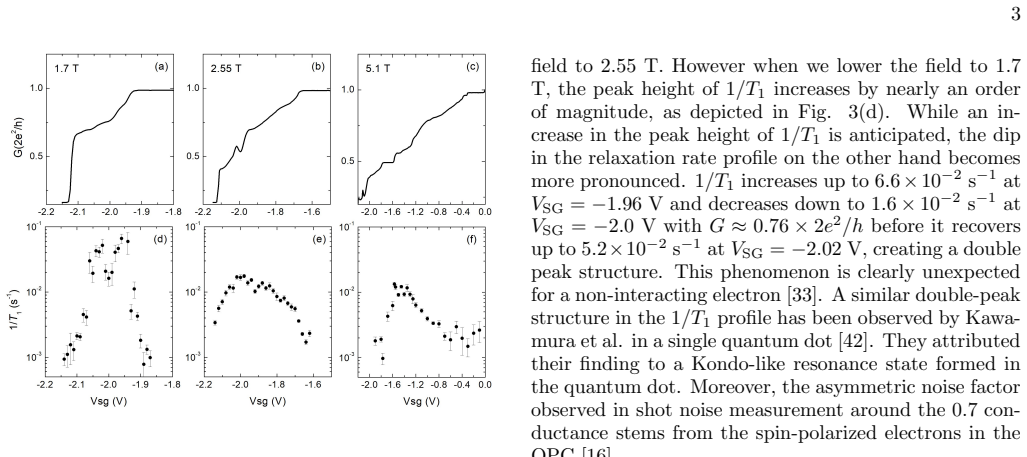
At a perpendicular field of 1.7 T, where the up- and down-spin edge channels of the lowest subband still overlap, the measured $1/T_1$ rises to $6.6\times10^{-2}\,\mathrm{s}^{-1}$, dips to $1.6\times10^{-2}\,\mathrm{s}^{-1}$ near $G\approx0.76\times2e^2/h$, and recovers to $5.2\times10^{-2}\,\mathrm{s}^{-1}$, forming a double peak. The authors reproduce this profile with a mean-field calculation in which the effective Zeeman energy is $\tilde{Z}_e = Z_e + U m$, with $Um$ a phenomenological Gaussian peak in interaction strength centered near the Fermi level. At higher fields (2.55 and 5.1 T) the bare Zeeman term dominates, the interaction bump becomes less visible, and the calculated single-peak profile matches the data. The paper concludes that enhanced electron-electron interactions at the center of the QPC, the same physics invoked for the 0.7 anomaly, are the likely origin of the observed double-peak structure.
Load-bearing premise
The explanation depends on the interaction contribution to the effective Zeeman energy having a Gaussian peak $Um = u \exp[-(E_F-E_0)^2/\sigma^2]$ whose center, width, and height are chosen by fitting the measured profiles; if the real interaction enhancement has a different shape, or if the central dip comes from another mechanism such as a Kondo-like resonance, the double-peak claim would not follow.
Editorial extensions
If this is right
- At fields where the spin channels overlap, $1/T_1$ can deviate sharply from non-interacting predictions even when the conductance profile looks similar, so $1/T_1$ distinguishes electronic states that conductance alone cannot.
- The double-peak structure is a new experimental fingerprint of the interaction-enhanced spin gap associated with the 0.7 anomaly at finite field.
- At 5.1 T, the absence of a dramatic $1/T_1$ enhancement at the half-integer plateau rules out Skyrmion formation in the short (~36 nm) constriction, while a Skyrmion-like enhancement appears at higher fields.
- The model calculation connects the measured $1/T_1$ profile to a spin susceptibility that peaks near $G \sim 0.7 \times 2e^2/h$, quantifying how the interaction term grows as the bare Zeeman energy is reduced.
Reading between the lines
- An editorial extension: because the Gaussian form of $Um$ is fitted per magnetic field, the model predicts that changing the barrier curvature or density should move the double-peak dip in a way that tracks the fitted center and width; this is testable with the same protocol.
- Beyond this paper, the same pump-probe $1/T_1$ technique could be pushed toward zero magnetic field, where the 0.7 anomaly is strongest but the spin channels are fully degenerate; a zero-field double-peak would tie the relaxation anomaly directly to the 0.7 effect rather than to its finite-field mimic.
- Another inference: if interaction enhancement is the cause, $1/T_1$ should be sensitive to the random impurity configuration that sets the QPC barrier curvature, making the relaxation profile a probe of how local disorder shapes interaction-driven spin gaps.
Editorial analysis
A structured set of objections, weighed in public.
Referee Report
Summary. This paper reports measurements of the nuclear spin relaxation rate 1/T1 in a gate-defined GaAs quantum point contact at the lowest one-dimensional subband, at perpendicular magnetic fields of 1.7, 2.55, and 5.1 T and at two electron densities. Using dynamic nuclear polarization with RDNMR verification, the authors find a double-peak structure in 1/T1 as a function of split-gate voltage at 1.7 T, whereas the higher-field profiles show single peaks. The noninteracting model of Cooper and Tripathi predicts a single peak; the double peak is attributed to an interaction-enhanced effective Zeeman energy at the QPC center, modeled in the supplement by replacing the Zeeman energy in Eq. (S2) with ~Z_e = Z_e + U m, where U m is a phenomenological Gaussian bump whose parameters are chosen separately for each magnetic field. The authors connect this to the 0.7 anomaly and interpret the result as evidence for enhanced electron-electron interactions at the QPC center.
Significance. If the interpretation is correct, the work would establish 1/T1 as a spin-sensitive probe of a quantum point contact that can detect interaction-enhanced spin gaps invisible to conductance, and the double-peak profile would be a new experimental fingerprint for the 0.7 anomaly. The experimental protocol is careful in several respects: RDNMR checks confirm the nuclear origin of the conductance changes, measurements at two densities show partial reproducibility, and the bias-cooling and dc-bias spectroscopy in the supplement provide useful device characterization. The main limitation is that the supporting calculation is not an independent derivation: the Gaussian interaction term is fitted per magnetic field, so the calculation demonstrates consistency with the assumed form rather than predicting the double peak. The absence of error bars on the 1/T1 data also leaves the statistical significance of the central dip open.
major comments (2)
- [Figs. 3(d) and 4(d)] The central experimental claim is the double-peak structure in 1/T1 at 1.7 T, which in Fig. 3(d) is defined by three adjacent points: 1/T1 = 6.6e-2 s-1 at VSG = -1.96 V, 1.6e-2 s-1 at VSG = -2.0 V, and 5.2e-2 s-1 at VSG = -2.02 V. No error bars, fit uncertainties, or repeated measurements are shown for any 1/T1 value, and the text does not specify how the exponential fits in Fig. 2(c) were used to obtain the plotted values. Because the reality of the central dip is load-bearing for the entire interpretation, the authors should provide quantitative uncertainties and state the statistical significance of the dip.
- [Supplementary IV, Eq. (S3) and Fig. S6] The theoretical support for the interaction-origin claim is a phenomenological Gaussian bump U m = u exp[-(EF-E0)^2/sigma^2] inserted into the effective Zeeman energy, with u, sigma, and E0 chosen separately for each magnetic field (u/kBT = 5, 4.5, 3; sigma/kBT = 5, 5.5, 11; E0/kBT = 9, 11, 12). Since a peaked effective Zeeman energy in Eq. (S2) generically produces a suppression of 1/T1 flanked by enhancements, the calculation shows consistency with the assumed form of U m rather than predicting the double peak from an independent microscopic model. The abstract's statement that the experiments are 'supported by theoretical calculations' therefore overstates what Eq. (S3) demonstrates. I ask the authors to either (i) provide a derivation of U m from a microscopic interaction model, or (ii) perform an out-of-sample test (for example, a temperature sweep or a density sweep not used in the fits) that distinguishes the Gaussian-bump scenario from the Kondo-like resonance invoked for a similar double-peak signature in Ref. [42]. The absence of a criterion for why B = 2.55 T does not show a double peak despite a nearly comparable fitted u/kBT = 4.5 should also be addressed.
minor comments (5)
- [Main text, 'fully open Zeeman gap' paragraph] The sentence 'Now moving on to the 1/T1 profile for the fully open Zeeman gap case shown in Fig. 3(f)...' reports 1/T1 = 0.66 s-1 at VSG = -1.8 V and attributes it to Skyrmion formation 'as we increase the magnetic field to 6.6 T,' but Fig. 3(f) is the 5.1 T trace and no 6.6 T data are shown. Please clarify whether the 6.6 T measurement exists and either display it or reconcile the text with the 5.1 T data.
- [Main text, second density] There is a typographical error in the sentence defining the dip at the higher density: '1/T1 = 2.2 x 10=2 s-1' should read 10^-2; the notation for the gate voltage is also inconsistent (Vsg vs. VSG) throughout.
- [Supplementary IV, Eq. (S2)] Eq. (S2) introduces Gamma0 about 0.5 Hz, but the plotted curves in Fig. S6 are not compared point-by-point with the experimental 1/T1 profiles; please state the normalization, the mapping from VSG to EF/kBT, and whether the same Gamma0 is used for all three fields.
- [General] The manuscript does not include a data availability statement; for an experimental claim of this subtlety, I recommend providing the key 1/T1 traces in a repository.
- [Abstract] The abstract line 'PACS numbers:' is empty; either provide the codes or remove the line.
Circularity Check
The double-peak 1/T1 'prediction' is produced by a fitted Gaussian spin-gap bump U_m, so the theoretical support is a consistency check rather than an independent derivation.
-
fitted input called prediction
[Supplementary IV, Eq. (S3) and Fig. S6; main text Eq. (1)]
"U m= u exp −(EF −E0)2 σ2 takes a phenomenological Gaussian function. We consider 1/T1 for the QPC with the Hubbard interaction given by replacing Ze in Eq. (S2) with ˜Ze in Eq. (S3). ... As U m moves away from the peak, the spin gap decreases, and the spin-flip rate increases. For this reason, 1/T1 increases on both sides of the peak of U m, resulting in the double-peak structure of 1 /T1 as in the experiment at B = 1.7 T displayed in Fig. 3(d)."
The calculated double-peak is built into the input: the non-interacting rate formula (S2) is evaluated with Z_e replaced by \tilde Z_e = Z_e + U m, and U m is chosen as a peaked Gaussian. A peaked spin gap suppresses the rate at its center and enhances it on the flanks, so inserting a Gaussian bump necessarily produces a dip flanked by peaks. The three parameters are set separately for each field (u/kBT = 5, 4.5, 3; σ/kBT = 5, 5.5, 11; E0/kBT = 9, 11, 12, Fig. S6 caption) to match the measured profiles, rather than being derived from an independent microscopic calculation or fixed before comparison.
full rationale
The experimental observation of the double-peak structure and the demonstration that it deviates from the non-interacting single-peak prediction are genuinely new and not circular. The circularity is confined to the paper's statement that the results are 'supported by theoretical calculations': the supporting calculation manufactures the double-peak by inserting a phenomenological Gaussian bump U_m into the effective Zeeman energy, with u, σ, and E0 tuned per magnetic field to reproduce the measured 1/T1 profiles. That makes the calculation an elaborated fit rather than an independent prediction of the interaction-origin claim. The alternative Kondo-like explanation is mentioned but not ruled out. The citation to Ref. [48], which shares an author with this paper, adds plausibility but is not the main circular step; even setting it aside, the fitted-Gaussian input remains the load-bearing element. Accordingly, the central claim is partially circular: the 'prediction' reduces by construction to the fitted spin-gap bump, giving a circularity score of 6.
Assumptions & free parameters
free parameters (3)
- u (interaction strength) =
u/kBT = 5 (1.7 T), 4.5 (2.55 T), 3 (5.1 T)
- sigma (Gaussian width) =
sigma/kBT = 5 (1.7 T), 5.5 (2.55 T), 11 (5.1 T)
- E0 (center of Um) =
E0/kBT = 9 (1.7 T), 11 (2.55 T), 12 (5.1 T)
assumptions (4)
- standard math 1/T1 formula Eq. (S2) from Cooper and Tripathi [33] for non-interacting electrons.
- domain assumption Hubbard model mean-field approximation gives magnetization m that peaks near G ~ 0.7 x 2e^2/h [23,48].
- domain assumption Saddle-point model for the QPC conductance barrier with \hbar\omega_x = 0.85 meV from fitting.
- domain assumption 75As RDNMR signal confirms the conductance change is nuclear in origin.
Cite this review
Pith. "Pith review of Spin dynamics of a quasi-one-dimensional electron in the quantum limit." pith.science (2026). https://pith.science/paper/HR7O6GT4
@misc{pith2026241116060,
  author       = {Pith},
  title        = {Pith review of: Spin dynamics of a quasi-one-dimensional electron in the quantum limit},
  year         = {2026},
  howpublished = {\url{https://pith.science/paper/HR7O6GT4}},
  note         = {Machine review of arXiv:2411.16060}
}
abstract
We study electron spin dynamics whose movement is restricted to the lowest one dimensional subband channel ($G \le 2e^2/h $), through nuclear spin relaxation rate measurement ($1/T_1$). We observe an unusual double-peak structure in the $1/T_1$ profile below the lowest subband level, where the up and down spin edge channel is still largely overlap. This profile significantly deviates from the behavior predicted by a non-interacting electron model, in which the only source of relaxation is through thermal fluctuations near the Fermi level. Our experimental results, supported by theoretical calculations, suggest that enhanced electron-electron interactions at the center of a quantum point contact are the likely origin of the observed double-peak structures.
Figures


Figures from the paper (1 more)

Reference graph
Works this paper leans on
-
[42]
M. Kawamura, D. Gottwald, K. Ono, T. Machida, and K. Kono, Phys. Rev. B 87, 081303 (2013)
work page 2013
-
[1]
K. D. Petersson, J. R. Petta, H. Lu, and A. C. Gossard, Phys. Rev. Lett. 105, 246804 (2010)
work page 2010
-
[2]
J. M. Elzerman, R. Hanson, L. H. Willems van Beveren, B. Witkamp, L. M. K. Vandersypen, and L. P. Kouwen- hoven, Nature 430, 431 (2004)
2004
-
[3]
R. de Picciotto, M. Reznikov, M. Heiblum, V. Umansky, G. Bunin, and D. Mahalu, Physica B: Condensed Matter 249-251, 395 (1998)
work page 1998
-
[4]
Y. Ji, Y. Chung, D. Sprinzak, M. Heiblum, D. Mahalu, and H. Shtrikman, Nature 422, 415 (2003)
2003
-
[5]
S. Baer, C. R¨ ossler, T. Ihn, K. Ensslin, C. Reichl, and W. Wegscheider, Phys. Rev. B 90, 075403 (2014)
work page 2014
-
[6]
Banerjee, M
M. Banerjee, M. Heiblum, V. Umansky, D. E. Feldman, Y. Oreg, and A. Stern, Nature 559, 205 (2018)
2018
-
[7]
H. Bartolomei, M. Kumar, R. Bisognin, A. Marguerite, J.-M. Berroir, E. Bocquillon, B. Pla¸ cais, A. Cavanna, Q. Dong, U. Gennser, Y. Jin, and G. F` eve, Science 368, 173 (2020), https://www.science.org/doi/pdf/10.1126/science.aaz5601
Show all 48 references
-
[8]
Nakamura, S
J. Nakamura, S. Fallahi, H. Sahasrabudhe, R. Rahman, S. Liang, G. C. Gardner, and M. J. Manfra, Nature Physics 15, 563 (2019)
2019
-
[9]
Nakamura, S
J. Nakamura, S. Liang, G. C. Gardner, and M. J. Manfra, Nature Physics 16, 931 (2020)
2020
-
[10]
K. J. Thomas, J. T. Nicholls, M. Y. Simmons, M. Pepper, D. R. Mace, and D. A. Ritchie, Phys. Rev. Lett. 77, 135 (1996)
1996
-
[11]
K. J. Thomas, J. T. Nicholls, N. J. Appleyard, M. Y. Simmons, M. Pepper, D. R. Mace, W. R. Tribe, and D. A. Ritchie, Phys. Rev. B 58, 4846 (1998)
1998
-
[12]
S. N. S. Nuttinck, K. Hashimoto, S. Miyashita, T. Saku, Y. Yamamoto, and Y. Hirayama, Japanese Journal of Applied Physics 39, L655 (2000)
2000
-
[13]
Kristensen, H
A. Kristensen, H. Bruus, A. E. Hansen, J. B. Jensen, P. E. Lindelof, C. J. Marckmann, J. Nyg ˚ ard, C. B. Sørensen, F. Beuscher, A. Forchel, and M. Michel, Phys. Rev. B 62, 10950 (2000)
2000
-
[14]
D. J. Reilly, T. M. Buehler, J. L. O’Brien, A. R. Hamil- ton, A. S. Dzurak, R. G. Clark, B. E. Kane, L. N. Pfeiffer, and K. W. West, Phys. Rev. Lett. 89, 246801 (2002)
2002
-
[15]
S. M. Cronenwett, H. J. Lynch, D. Goldhaber-Gordon, L. P. Kouwenhoven, C. M. Marcus, K. Hirose, N. S. Wingreen, and V. Umansky, Phys. Rev. Lett. 88, 226805 (2002)
2002
-
[16]
DiCarlo, Y
L. DiCarlo, Y. Zhang, D. T. McClure, D. J. Reilly, C. M. Marcus, L. N. Pfeiffer, and K. W. West, Phys. Rev. Lett. 97, 036810 (2006)
2006
-
[17]
Chung, S
Y. Chung, S. Jo, D.-I. Chang, H.-J. Lee, M. Zaffalon, 5 V. Umansky, and M. Heiblum, Phys. Rev. B 76, 035316 (2007)
2007
-
[18]
E. J. Koop, A. I. Lerescu, J. Liu, B. J. van Wees, D. Reuter, A. D. Wieck, and C. H. van der Wal, Journal of Superconductivity and Novel Magnetism 20, 433 (2007)
2007
-
[19]
Nakamura, M
S. Nakamura, M. Hashisaka, Y. Yamauchi, S. Kasai, T. Ono, and K. Kobayashi, Phys. Rev. B 79, 201308 (2009)
2009
-
[20]
Komijani, M
Y. Komijani, M. Csontos, I. Shorubalko, T. Ihn, K. En- sslin, Y. Meir, D. Reuter, and A. D. Wieck, Europhysics Letters 91, 67010 (2010)
2010
-
[21]
L. W. Smith, A. R. Hamilton, K. J. Thomas, M. Pepper, I. Farrer, J. P. Griffiths, G. A. C. Jones, and D. A. Ritchie, Phys. Rev. Lett. 107, 126801 (2011)
2011
-
[22]
M. J. Iqbal, R. Levy, E. J. Koop, J. B. Dekker, J. P. de Jong, J. H. M. van der Velde, D. Reuter, A. D. Wieck, R. Aguado, Y. Meir, and C. H. van der Wal, Nature 501, 79 (2013)
2013
-
[23]
Bauer, J
F. Bauer, J. Heyder, E. Schubert, D. Borowsky, D. Taubert, B. Bruognolo, D. Schuh, W. Wegscheider, J. von Delft, and S. Ludwig, Nature 501, 73 (2013)
2013
-
[24]
L. W. Smith, H. Al-Taie, F. Sfigakis, P. See, A. A. J. Lesage, B. Xu, J. P. Griffiths, H. E. Beere, G. A. C. Jones, D. A. Ritchie, M. J. Kelly, and C. G. Smith, Phys. Rev. B 90, 045426 (2014)
2014
-
[25]
L. W. Smith, H. Al-Taie, A. A. J. Lesage, F. Sfigakis, P. See, J. P. Griffiths, H. E. Beere, G. A. C. Jones, D. A. Ritchie, A. R. Hamilton, M. J. Kelly, and C. G. Smith, Phys. Rev. B 91, 235402 (2015)
2015
-
[26]
L. W. Smith, H. Al-Taie, A. A. J. Lesage, K. J. Thomas, F. Sfigakis, P. See, J. P. Griffiths, I. Farrer, G. A. C. Jones, D. A. Ritchie, M. J. Kelly, and C. G. Smith, Phys. Rev. Appl. 5, 044015 (2016)
2016
-
[27]
P. Ma, K. Delfanazari, R. K. Puddy, J. Li, M. Cao, T. Yi, J. P. Griffiths, H. E. Beere, D. A. Ritchie, M. J. Kelly, and C. G. Smith, Chip , 100095 (2024)
2024
-
[28]
T. Aono, M. Takahashi, M. H. Fauzi, and Y. Hirayama, Phys. Rev. B 102, 045305 (2020)
2020
-
[29]
D. H. Schimmel, B. Bruognolo, and J. von Delft, Phys. Rev. Lett. 119, 196401 (2017)
2017
-
[30]
Ensslin, Nature Physics 2, 587 (2006)
K. Ensslin, Nature Physics 2, 587 (2006)
2006
-
[31]
Hirayama, G
Y. Hirayama, G. Yusa, K. Hashimoto, N. Kumada, T. Ota, and K. Muraki, Semiconductor Science and Tech- nology 24, 023001 (2009)
2009
-
[32]
Hyperfine-mediated transport in a one-dimensional channel,
M. H. Fauzi and Y. Hirayama, “Hyperfine-mediated transport in a one-dimensional channel,” in Quantum Hy- brid Electronics and Materials, edited by Y. Hirayama, K. Hirakawa, and H. Yamaguchi (Springer Nature Singa- pore, Singapore, 2022) pp. 257–276
2022
-
[33]
N. R. Cooper and V. Tripathi, Phys. Rev. B 77, 245324 (2008)
2008
-
[34]
Tycko, S
R. Tycko, S. Barrett, G. Dabbagh, L. Pfeiffer, and K. West, Science 268, 1460 (1995)
1995
-
[35]
J. H. Smet, R. A. Deutschmann, F. Ertl, W. Wegschei- der, G. Abstreiter, and K. von Klitzing, Nature 415, 281 (2002)
2002
-
[36]
Hashimoto, K
K. Hashimoto, K. Muraki, T. Saku, and Y. Hirayama, Phys. Rev. Lett. 88, 176601 (2002)
2002
-
[37]
Kumada, K
N. Kumada, K. Muraki, and Y. Hirayama, Science 313, 329 (2006)
2006
-
[38]
G. P. Guo, X. J. Hao, T. Tu, Y. J. Zhao, Z. R. Lin, G. Cao, H. O. Li, C. Zhou, G. C. Guo, and H. W. Jiang, Phys. Rev. B 81, 041306 (2010)
2010
-
[39]
T. D. Rhone, L. Tiemann, and K. Muraki, Phys. Rev. B 92, 041301 (2015)
2015
-
[40]
G. Tong, B. Friess, L. Yong-Qing, Y. Shi-Shen, V. Uman- sky, K. v. Klitzing, and J. H. Smet, Chinese Physics B 24, 067302 (2015)
2015
-
[41]
Kobayashi, N
T. Kobayashi, N. Kumada, T. Ota, S. Sasaki, and Y. Hi- rayama, Phys. Rev. Lett. 107, 126807 (2011)
2011
-
[43]
M. H. Fauzi, A. Noorhidayati, M. F. Sahdan, K. Sato, K. Nagase, and Y. Hirayama, Phys. Rev. B 97, 201412 (2018)
2018
-
[44]
Shailos, J
A. Shailos, J. P. Bird, M. P. Lilly, J. L. Reno, and J. A. Simmons, Journal of Physics: Condensed Matter 18, 3277 (2006)
2006
-
[45]
R¨ ossler, S
C. R¨ ossler, S. Baer, E. de Wiljes, P.-L. Ardelt, T. Ihn, K. Ensslin, C. Reichl, and W. Wegscheider, New Journal of Physics 13, 113006 (2011)
2011
-
[46]
Tsitsishvili and Z
G. Tsitsishvili and Z. F. Ezawa, Phys. Rev. B 72, 115306 (2005)
2005
-
[47]
Chida, M
K. Chida, M. Hashisaka, Y. Yamauchi, S. Nakamura, T. Arakawa, T. Machida, K. Kobayashi, and T. Ono, Phys. Rev. B 85, 041309 (2012)
2012
-
[48]
Kawamura, K
M. Kawamura, K. Ono, P. Stano, K. Kono, and T. Aono, Phys. Rev. Lett. 115, 036601 (2015). 1 Supplementary for Spin dynamics of a quasi-one-dimensional electron in the quantum limit I. BIAS COOLING To suppress random telegraph noise [S1], we performed a bias-cooling technique d...
2015
Reviewed August 12, 2026 · model on record in the stance chip above.
Discussion (0). Continue with ORCID to comment.