REVIEW 3 major objections 6 minor 35 references
You only thermoelastically deform once: Point Absorber Detection in LIGO Test Masses with YOLO
T0 review · 3 major / 6 minor · reviewed 2026-08-12 · deepseek-v4-flash
Pith's one-line read This paper claims a transfer-learned YOLO object detector can automatically identify point absorbers in LIGO test masses from Hartmann wavefront sensor data while the detector is running, matching human experts and finding additional…
desk verdict A genuinely new and useful application of YOLO to LIGO Hartmann data; validation is qualitative, but the core result is credible and worth refereeing. read the letter →
The pith
A machine-rendered reading of the paper's core claim, the machinery that carries it, and where it could break.
The reading
What carries the argument
The carrying mechanism is You Only Look Once (YOLO), a deep convolutional neural network for real-time object detection, in its v8-n variant, pre-trained on general images and then transfer-learned on 10,000 synthetic Hartmann images. Each synthetic image is a sampled gradient field $\nabla W'(x,y)$ generated from the Hello-Vinet analytical steady-state thermal deformation model for uniform absorption plus the point-absorber model of reference [4] for each simulated defect, with Gaussian centroid noise and zero-to-five hot-pixel outliers added; the network is trained to output bounding boxes centred on point absorbers and on the central heating beam. What carries the argument is the transfer from this synthetic, equilibrium-epoch training distribution to real, transient power-up Hartmann data.
What would settle it
Run a blind test in which the algorithm scans Hartmann data from a test mass whose point absorbers have been independently mapped by a non-optical method, such as post-venting surface inspection, and require every detection at confidence above 0.8 to match an independently confirmed absorber and no non-edge detection to match an absorber-free region.
Extended reading notes
Core claim
The central discovery is that a transfer-learned YOLO v8-n object detector, trained on synthetic Hartmann gradient fields, generalises to real LIGO Hartmann data well enough to act as an automated point-absorber finder. On the recorded power-up sequences the model identifies the same point absorbers that expert scientists reported in LIGO alogs with confidence scores around 0.8–0.9, and it also flags point absorbers that humans had not logged; the authors say visual follow-up of the associated Hartmann frames convinces them these are genuine. On ring-heater tests with no active beam, where no real point absorber can appear, the model produced no false positives on two test masses and one edge-related false positive on each of the other two. The paper's claim is therefore that the object-detection approach works in situ, with human-level performance on known absorbers and a small, characterisable false-positive rate dominated by edge artifacts and anomalous vectors not represented in the training set.
Load-bearing premise
The synthetic training data, generated from steady-state thermal-equilibrium models, faithfully represents real Hartmann measurements of LIGO test masses during the power-up transient when the mirror is still heating up.
Editorial extensions
If this is right
- Point absorbers can be monitored continuously during observing runs, so changes in their number, position, or severity over weeks-to-months can be tracked automatically.
- The algorithm can be run at the detector site on live Hartmann data, giving commissioners near-real-time alerts instead of requiring offline expert review.
- The approach is not specific to LIGO: any vacuum-isolated optical system with Hartmann wavefront sensors could apply the same transfer-learned detector to its own optics.
- Future detectors operating at higher circulating power, where weaker point absorbers become problematic, could use this monitoring to catch damaging absorbers before they cause lock loss or permanent damage.
- The false positives that do occur cluster at image edges and around anomalous large vectors, and they are identifiable by their inconsistency over time, which points toward a temporal filter as a further improvement.
Reading between the lines
- Because the model was trained at thermal equilibrium but applied during the 10,000-second power-up transient, its success hints that point-absorber signatures in the gradient field are shape-dominated rather than amplitude-dominated; a model trained on explicit transient thermal simulations could detect weaker absorbers earlier in the power-up.
- The false positives caused by large edge vectors and hot pixels suggest that a simple pre-processing filter masking or regularising outlier vectors could push the false-positive rate to near zero without retraining.
- The same synthetic-to-real transfer strategy could be used to generate training data for other detector-condition monitoring tasks, such as dust on optics, coating damage, or misalignment, where labelled real data are scarce.
- A natural testable extension would be to install a deliberately characterised point absorber on a test mass and measure the model's detection confidence as a function of absorber strength, yielding a calibration curve for the weakest detectable absorber.
Editorial analysis
A structured set of objections, weighed in public.
Referee Report
Summary. The paper presents a machine-learning approach to detect point absorbers on LIGO test masses from Hartmann wavefront sensor data, using the YOLO v8-n object-detection architecture with transfer learning. The model is trained entirely on synthetic gradient fields generated from the Hello-Vinet steady-state thermal model and the Brooks point absorber model, with simulated Gaussian measurement noise and hot-pixel artifacts. The authors validate the model against archival LIGO operator logs (alogs) by comparing its detections with human-identified point absorbers in three case studies, and they assess false positives using ring-heater tests. They report that the model matches human identifications with high confidence, finds additional point absorbers that they visually confirm, and produces only occasional false positives attributable to edge artifacts and unusual vector patterns. The central claim is that this YOLO-based detector can automatically monitor point absorbers in situ during detector operation.
Significance. If the central claim holds, the paper would provide a practical tool for automated, continuous monitoring of point absorbers in gravitational-wave observatories, reducing the need for time-consuming human expert review of Hartmann data. The use of synthetic training data with known labels is a sensible approach given the scarcity of labeled real examples, and the authors make their code and videos publicly available, which supports reproducibility. The main contribution is demonstrating that object detection on gradient fields can identify thermal defects, a result that could generalize to other optical systems with Hartmann sensors. However, the real-data validation is qualitative and limited to a handful of hand-picked examples, and the mismatch between steady-state training data and the transient power-up data used for validation leaves the generalization claim insufficiently supported. The paper also explicitly acknowledges in Section V that training on transient thermal deformations may yield improved performance, which underscores the current limitation.
major comments (3)
- [IV.A] The validation on real data is purely qualitative and limited to three alogs plus one ring-heater test. The abstract claims the algorithm identifies the same point absorbers as humans 'with minimal false positives,' yet no quantitative precision, recall, or false-positive rate is reported on real data. The ring-heater test in Section IV.B reports no false positives for two optics and one false positive each for two others, but this is not a systematic evaluation. To support the central claim, the authors should provide a quantitative comparison on a larger, clearly defined set of real Hartmann frames with human labels, including a receiver-operating-characteristic or precision-recall analysis over the confidence threshold.
- [III.A.1 and IV.A] The training data are generated from the steady-state Hello-Vinet thermal solution, but the real validation uses 10,000-second sequences starting from laser power-up, during which the test mass is still heating up. Fused-silica thermal time constants are of order hours, so the temperature field is far from steady state during these sequences. The paper notes in Section V that 'training on transient thermal deformations ... may yield improved performances,' which is an admission that the current training distribution may not match the validation distribution. The authors should quantify the similarity between synthetic and real gradient-field statistics (e.g., distributions of gradient magnitudes and spatial correlations), or demonstrate that detection confidence is stable across the power-up transient. Without such evidence, the positive detections on real data could be coincidental pattern matches rather than evidence of generalization.
- [IV.A (alog #54588 and #72660)] The claim that the model identifies 'some point absorbers previously not identified by humans' is validated only by the authors' own visual inspection of the same Hartmann data (e.g., 'Our visual inspection of the associated Hartmann data convinces us that these candidate point absorbers are genuine'). This is a circular confirmation, since the same data are used both for detection and for the follow-up check. Independent confirmation—for example, through a different measurement technique, a separate expert blind review, or evidence of correlated operational impact—is needed to substantiate the claim of discovering genuinely new point absorbers.
minor comments (6)
- [Throughout] The paper inconsistently uses 'Hartman' and 'Hartmann' (e.g., Figure 1 caption and several places in the text). Please standardize to 'Hartmann'.
- [I (Introduction)] The sentence 'In the second observing run, the performance of both LIGO detectors was hindered by point absorbers [7], and they remain present in the fourth observing run [8] (Capote et al., in preparation)' is awkwardly punctuated; the parenthetical citation should be integrated more cleanly.
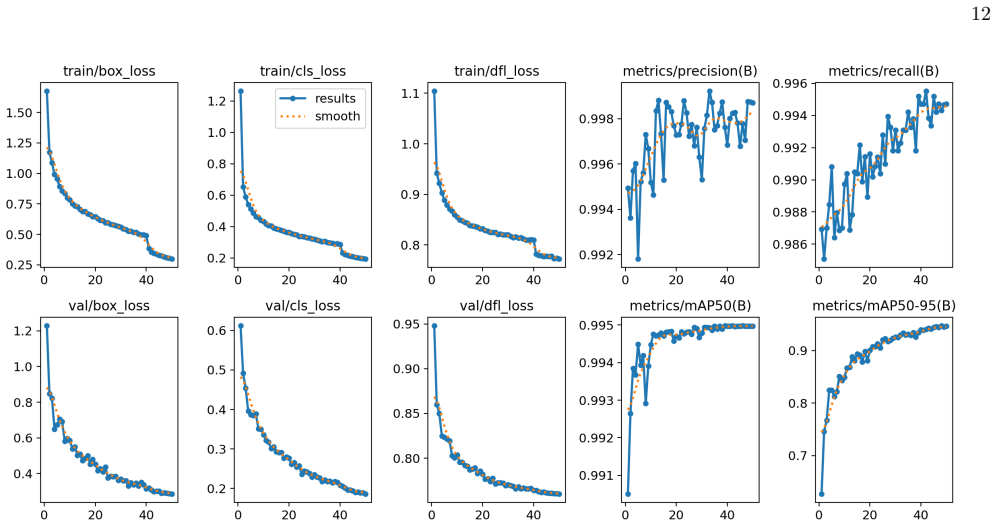
- [III.B] The statement that 'true-positive rate for point absorber detection is >0.99' refers to the synthetic test set, but the main text does not report the associated false-positive rate or the confusion matrix values in a quantitative way. The confusion matrix in Figure 9 should be summarized with numbers in the text for clarity.
- [IV.A] The videos are described as being available on Zenodo, but the paper does not explain how the 30 Hz frame rate arises from the 20-second averaged gradient fields; clarify whether each frame is a 20-second average and the video is simply an animation of successive averages.
- [IV.B] The ring-heater false-positive analysis would benefit from a more explicit statement of how many total frames were analyzed for each test mass and how the 'single vector' findings were positively identified as the cause, rather than being inferred from the static field visualization.
- [V (Discussion)] The statement that 'confidences should be taken as a relative ranking system' is helpful, but the paper could strengthen this by including a calibration plot or at least a clear warning in the main text that confidence values are not calibrated probabilities.
Circularity Check
No significant circularity: the YOLO detector is trained on independently generated synthetic fields and validated against human alog labels that were not used in training.
full rationale
The paper's central claim is that a YOLO object detector identifies point absorbers in real Hartmann wavefront sensor data. The training labels are produced synthetically: the paper states that it 'generate[s] a synthetic dataset to ensure our training data contains a diverse range of point absorbers with known locations,' using the Hello-Vinet steady-state solutions and the Brooks point-absorber model. These synthetic labels are not derived from the human alog detections used for validation; the real-data comparisons in Section IV.A are external checks against independent human reports. No fitted parameter is re-presented as a prediction, and no equation is defined in terms of the quantity it is claimed to predict. The use of the Brooks model, which has an overlapping author, is a citation of an externally published physical characterization of point absorbers, not an unverified self-referential premise. The authors' visual confirmation of previously unidentified candidates is a weakness in ground-truth independence but does not make the detection result circular, since the model outputs are not fed back into the training labels. Likewise, the mismatch between steady-state synthetic training data and 10,000 s power-up transient data is a generalization/correctness risk, not a circularity. Therefore no circular step meeting the required evidentiary standard is present.
Assumptions & free parameters
free parameters (4)
- Point absorber absorption fraction range =
5% to 10% of total beam power, uniform distribution
- Hartmann measurement noise width =
5e-7 rad Gaussian sigma
- Point absorber bounding box size =
20 px (~1.5 cm)
- Hot pixel count and vector length =
0 to 5 vectors, lengths 2 to 4 times the mean vector length
assumptions (3)
- domain assumption The Hello-Vinet uniform absorption model and the Brooks point absorber model generate Hartmann gradient fields representative of real LIGO test mass data.
- domain assumption Human identifications of point absorbers in LIGO alogs are accurate ground truth for validation.
- domain assumption Transfer learning from YOLO v8-n, which is pretrained on natural images, preserves useful features for detecting point absorbers in synthetic gradient field images.
Cite this review
Pith. "Pith review of You only thermoelastically deform once: Point Absorber Detection in LIGO Test Masses with YOLO." pith.science (2026). https://pith.science/paper/YFA2TYE7
@misc{pith2026241116104,
  author       = {Pith},
  title        = {Pith review of: You only thermoelastically deform once: Point Absorber Detection in LIGO Test Masses with YOLO},
  year         = {2026},
  howpublished = {\url{https://pith.science/paper/YFA2TYE7}},
  note         = {Machine review of arXiv:2411.16104}
}
read the original abstract
Current and future gravitational-wave observatories rely on large-scale, precision interferometers to detect the gravitational-wave signals. However, microscopic imperfections on the test masses, known as point absorbers, cause problematic heating of the optic via absorption of the high-power laser beam, which results in diminished sensitivity, lock loss, or even permanent damage. Consistent monitoring of the test masses is crucial for detecting, characterizing, and ultimately removing point absorbers. We present a machine-learning algorithm for detecting point absorbers based on the object-detection algorithm You Only Look Once (YOLO). The algorithm can perform this task in situ while the detector is in operation. We validate our algorithm by comparing it with past reports of point absorbers identified by humans at LIGO. The algorithm confidently identifies the same point absorbers as humans with minimal false positives. It also identifies some point absorbers previously not identified by humans, which we confirm with human follow-up. We highlight the potential of machine learning in commissioning efforts.
Figures


Figures from the paper (5 more)



Reference graph
Works this paper leans on
-
[1]
Generate synthetic optical path depths W ′(x, y) for test masses at thermal equilibrium with a random number of point absorbers of randomised absorp- tion levels
-
[2]
Sample the average gradients of the optical path depths ∇W ′(x, y) at predetermined points; simu- lated centroid positions similar to the aLIGO in- termediate test masses
-
[3]
Add realistic Gaussian noise to the gradient fields, simulating centroiding algorithm noise
-
[4]
Randomly choose zero to five vectors to be replaced with large vectors in random directions, simulating “hot pixel effects” (imperfections in the Hartmann sensors)
-
[5]
Store the beam, point absorber and hot pixel posi- tions as labels for training, testing, and validation
-
[6]
M. Evans, S. Gras, P. Fritschel, J. Miller, L. Barsotti, D. Martynov, A. Brooks, D. Coyne, R. Abbott, R. X. Adhikari, K. Arai, R. Bork, B. Kells, J. Rollins, N. Smith- Lefebvre, G. Vajente, H. Yamamoto, C. Adams, S. Aston, J. Betzweiser, V. Frolov, A. Mullavey, A. Pele, J. Romie, M. Thomas, K. Thorne, S. Dwyer, K. Izumi, K. Kawabe, D. Sigg, R. Derosa, A. ...
work page 2015
-
[7]
Modelling thermal deformation We utilise the analytical Hello-Vinet [2] steady-state solutions for the thermal deformation of the test masses to generate the component of W ′(x, y) from uniform ab- sorption. This simulates the thermalisation of the test masses for randomly chosen beam spot positions and laser powers. We utilise the Finesse2 package [22–25...
-
[8]
Simulating Hartmann wavefront sensor measurements These simulated optical path depths, W ′(x, y), are converted to simulated measurements of ∇W ′(x, y) with a Hartmann wavefront sensor. This is done by numeri- cally calculating the gradient and sampling it at discrete gradients across the wavefront. The positions at which the discrete gradients are taken ...
Show all 35 references
-
[9]
aug- mented
Simulating measurement noise and hot pixels Noise affects all vectors in the gradient field, causing varying degrees of distortion to their magnitude and di- rection. Sources of noise in the gradient field arise from the Hartmann centroid detection algorithm, which mea- sures ...
2022
-
[10]
cold state
and transfer learning. The algorithm’s inputs are measurements of the test mass thermal deformation from the existing Hartmann wavefront sensors [11, 12]. We structure the paper as follows. Section §II intro- duces thermal deformation, point absorbers, and the de- tection of p...
2024 arXiv
-
[11]
A. W. Goodwin-Jones, R. Cabrita, M. Korobko, M. V. Beuzekom, D. D. Brown, V. Fafone, J. V. Heijningen, A. Rocchi, M. G. Schiworski, and M. Tacca, Transverse mode control in quantum enhanced interferometers: a re- view and recommendations for a new generation, Optica 11, 273–290 (2024)
2024
-
[12]
Vinet, On special optical modes and thermal issues in advanced gravitational wave interferometric detectors, Living Reviews in Relativity 12, 5 (2009)
J.-Y. Vinet, On special optical modes and thermal issues in advanced gravitational wave interferometric detectors, Living Reviews in Relativity 12, 5 (2009)
2009
-
[13]
K. A. Strain, K. Danzmann, J. Mizuno, P. G. Nelson, A. R¨ udiger, R. Schilling, and W. Winkler, Thermal lens- ing in recycling interferometric gravitational wave detec- tors, Physics Letters A 194, 124 (1994)
1994
-
[14]
A. F. Brooks, G. Vajente, H. Yamamoto, R. Abbott, C. Adams, R. X. Adhikari, A. Ananyeva, S. Appert, K. Arai, J. S. Areeda, Y. Asali, S. M. Aston, C. Austin, A. M. Baer, M. Ball, S. W. Ballmer, S. Banagiri, D. Barker, L. Barsotti, J. Bartlett, B. K. Berger, J. Bet- zwieser, D. ...
2021
-
[15]
W. Jia, H. Yamamoto, K. Kuns, A. Effler, M. Evans, P. Fritschel, R. Abbott, C. Adams, R. X. Adhikari, A. Ananyeva, S. Appert, K. Arai, J. S. Areeda, Y. Asali, S. M. Aston, C. Austin, A. M. Baer, M. Ball, S. W. Ballmer, S. Banagiri, D. Barker, L. Barsotti, J. Bartlett, B. K. Be...
2021
-
[16]
Buikema, C
A. Buikema, C. Cahillane, G. L. Mansell, C. D. Blair, R. Abbott, C. Adams, R. X. Adhikari, A. Ananyeva, S. Appert, K. Arai, J. S. Areeda, Y. Asali, S. M. As- ton, C. Austin, A. M. Baer, M. Ball, S. W. Ballmer, S. Banagiri, D. Barker, L. Barsotti, J. Bartlett, B. K. Berger, J. ...
2020
-
[17]
Cahillane and G
C. Cahillane and G. Mansell, Review of the advanced ligo gravitational wave observatories leading to observing run four, Galaxies 10, 36 (2022), number: 1 Publisher: Multidisciplinary Digital Publishing Institute
2022
-
[18]
Lecun, Y
Y. Lecun, Y. Bengio, and G. Hinton, Deep learning (2015)
2015
-
[19]
Redmon, S
J. Redmon, S. Divvala, R. Girshick, and A. Farhadi, You only look once: Unified, real-time object detection, arXiv (2015)
2015
-
[20]
A. F. Brooks, T.-L. Kelly, P. J. Veitch, and J. Munch, Ultra-sensitive wavefront measurement using a hartmann sensor, Optics Express 15, 10370 (2007), publisher: Op- tical Society of America
2007
-
[21]
A. F. Brooks, B. Abbott, M. A. Arain, G. Ciani, A. Cole, G. Grabeel, E. Gustafson, C. Guido, M. Heintze, A. Hep- tonstall, M. Jacobson, W. Kim, E. King, A. Lynch, S. O’Connor, D. Ottaway, K. Mailand, G. Mueller, J. Munch, V. Sannibale, Z. Shao, M. Smith, P. Veitch, T. Vo, C. V...
2016
-
[22]
J. Steinlechner, Development of mirror coatings for gravitational-wave detectors, Philosophical Transactions of the Royal Society A: Mathematical, Physical and Engi- neering Sciences 376, 20170282 (2018), publisher: Royal Society
2018
-
[23]
Granata, A
M. Granata, A. Amato, L. Balzarini, M. Canepa, J. De- gallaix, D. Forest, V. Dolique, L. Mereni, C. Michel, L. Pinard, B. Sassolas, J. Teillon, and G. Cagnoli, Amor- phous optical coatings of present gravitational-wave in- terferometers, Classical and Quantum Gravity 37, 95004...
2020 arXiv
-
[24]
T. L. S. Collaboration, Advanced ligo, Classical and Quantum Gravity 32, 74001 (2015)
2015
-
[25]
E. D. Hall, Cosmic explorer: A next-generation ground- based gravitational-wave observatory, Galaxies 10, 90 (2022), number: 4
2022
-
[26]
R. C. Lawrence, Active wavefront correction in laser interferometric gravitational wave detectors, Thesis (2003), accepted: 2005-10-14T19:46:30Z
2003
-
[27]
Winkler, K
W. Winkler, K. Danzmann, A. Rudiger, and R. Schilling, Heating by optical absorption and the performance of in- terferometric gravitational-wave detectors, Physical Re- view A 44, 7022 (1991), publisher: American Physical Society
1991
-
[28]
S. Hu, L. Hu, B. Zhang, W. Gong, and K. Si, Simplify- ing the detection of optical distortions by machine learn- ing, Journal of Innovative Optical Health Sciences 13, 2040001 (2020)
2020
-
[29]
Y. He, Z. Liu, Y. Ning, J. Li, X. Xu, and Z. Jiang, Deep learning wavefront sensing method for shack-hartmann sensors with sparse sub-apertures, Optics Express 29, 17669–17682 (2021)
2021
-
[30]
H. Gu, Z. Zhao, Z. Zhang, S. Cao, J. Wu, and L. Hu, High-precision wavefront reconstruction from shack-hartmann wavefront sensor data by a deep convo- lutional neural network, Measurement Science and Tech- nology 32, 085101 (2021)
2021
-
[31]
D. D. Brown, P. Jones, S. Rowlinson, S. Leavey, A. C. Green, D. T¨ oyr¨ a, and A. Freise, Pykat: Python pack- age for modelling precision optical interferometers, Soft- wareX 12, 100613 (2020)
2020
-
[32]
Freise, G
A. Freise, G. Heinzel, H. L¨ uck, R. Schilling, B. Willke, and K. Danzmann, Frequency-domain interferometer simulation with higher-order spatial modes, Classical and Quantum Gravity 21, S1067 (2004)
2004
-
[33]
Freise, D
A. Freise, D. D. Brown, and C. Bond, Finesse, fre- quency domain interferometer simulation software, arXiv (2013)
2013
-
[34]
D. D. Brown and A. Freise, Finesse (2014)
2014
-
[35]
X. Li, C. Lv, W. Wang, G. Li, L. Yang, and J. Yang, Generalized focal loss: Towards efficient representation learning for dense object detection, IEEE Transactions on Pattern Analysis and Machine Intelligence 45, 3139 (2022)
2022
Reviewed August 12, 2026 · model on record in the stance chip above.
Discussion (0). Continue with ORCID to comment.