REVIEW 3 major objections 3 minor 39 references
Diversity of Fuzzy Dark Matter Solitons
T0 review · 3 major / 3 minor · reviewed 2026-08-12 · deepseek-v4-flash
Pith's one-line read Fuzzy dark matter soliton cores are shaped mostly by their environment, not by the soliton's own rotation.
desk verdict Honest, useful, but the headline overclaims: SMBH spin/binary gravitomagnetic effects are asserted from bare potentials, not derived. read the letter →
The pith
A machine-rendered reading of the paper's core claim, the machinery that carries it, and where it could break.
The reading
What carries the argument
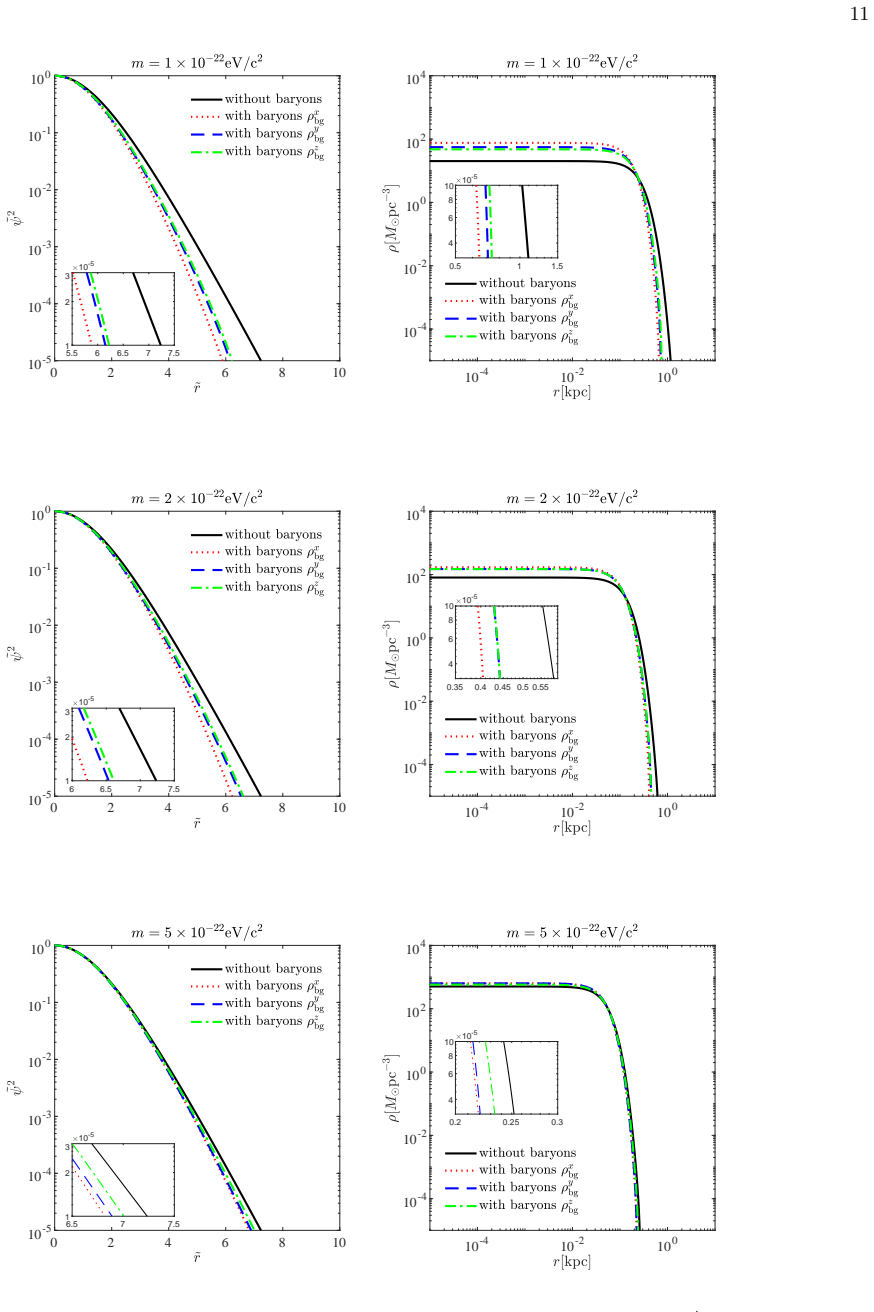
The machinery is a set of variants of the Schrödinger-Poisson system, each obtained by adding an extra potential to the Hamiltonian. The gravitomagnetic variant uses the gravitomagnetic potential term $\Phi_m = (i\hbar/m)\, \mathbf{A}_g\cdot\nabla + \frac{1}{2}\mathbf{A}_g\cdot\mathbf{A}_g$, with $\mathbf{A}_g$ built from the angular momentum of the rotating FDM soliton, a spinning black hole, or a black-hole binary; this is the object that lets the authors estimate whether rotation matters. Equilibrium profiles are computed by the shooting method on dimensionless, spherically symmetric equations, with normalization $\tilde{\psi}(0)=1$ and a scaling symmetry to map solutions to physical masses. For the soliton binary, the same shooting method is applied twice, treating first the dense small soliton in the flat large background and then the large soliton with the dense core at its center. For the ellipsoidal baryon background, three spherical averages along the $x$, $y$, and $z$ axes are iterated until the soliton mass matches the Milky Way value.
What would settle it
Solve the full cylindrical Schrödinger-Poisson system with a spinning supermassive black hole and compare the ground-state soliton profile with the spherically averaged estimate; if the gravitomagnetic potential changes the profile by much less than the gravitoelectric term inside ten Schwarzschild radii, the comparability claim is refuted. For the self-rotation claim, a falsifier would be finding realistic FDM solitons with rotation velocities large enough that $\Phi_{m1}$ becomes comparable to $\Phi$ in the equatorial plane.
Extended reading notes
Core claim
The central claim is that, for a fixed FDM particle mass, the soliton profile predicted by the bare Schrödinger-Poisson system is only one member of a family: variants of the system that include extra gravitational sources generate distinct equilibrium profiles. The gravitomagnetic field from the soliton's own angular momentum is shown to be very weak relative to the soliton's self-gravitational potential in the equatorial plane, so self-rotation cannot explain structural diversity. The gravitomagnetic field from a spinning supermassive black hole, however, yields a linear potential $\Phi_{m1}$ comparable to the black hole's Newtonian potential $\Phi_e$ inside roughly ten Schwarzschild radii, implying that black-hole spin can further compress the soliton beyond the gravitoelectric effect alone. For a soliton pair with density ratio $\gtrsim 10^4$, the high-density soliton is almost unaffected by the low-density background, while the low-density soliton shrinks substantially when the dense one sits at its center. Finally, spherically averaged Milky Way baryon profiles for the bulge, disk, and gas alter the soliton, with lighter FDM particles producing denser, more compact cores that respond more strongly.
Load-bearing premise
The load-bearing premise is that a linear gravitomagnetic vector-potential term in Eqs. (17)-(19) captures how angular momentum affects the soliton, an approximation the paper itself acknowledges is not self-consistent for a spinning black hole because the spherical calculation lacks the cylindrical symmetry of the gravitomagnetic potential.
Editorial extensions
If this is right
- In an isolated system the FDM soliton has a fixed profile, but any of the studied environmental sources generically alters it, so observations of diverse cores do not by themselves falsify the fuzzy dark matter model.
- The neglect of the soliton's self-rotation means that angular momentum of the dark matter soliton alone cannot explain core sizes; spin of a central supermassive black hole can, and should be included in soliton-core fits near galactic nuclei.
- In extreme density-ratio soliton encounters, the dense smaller soliton survives almost unchanged, so such systems can be modeled semi-analytically rather than with expensive multi-scale simulations.
- Baryonic backgrounds matter most for light FDM particles, so fits of soliton cores in baryon-rich galaxies must use the galaxy's actual baryon geometry rather than a universal profile.
Reading between the lines
- Editorial extension: the paper's ordering of effects suggests a hierarchical recipe for comparing FDM soliton models to observations: add baryons first, then a central black hole, then companions; only then consider exotic self-interactions.
- Editorial extension: if the SMBH-spin gravitomagnetic effect is confirmed by a full cylindrical solution, soliton cores around rapidly spinning black holes should be systematically denser than cores around non-spinning black holes of equal mass, a difference that gravitational lensing or stellar dynamics near the nucleus could test.
- Editorial extension: the negligible self-rotation result implies that, in galaxies with low baryon content and no central black hole, FDM solitons should be very close to the universal profile; dwarf spheroidals offer a clean test of that prediction.
Editorial analysis
A structured set of objections, weighed in public.
Referee Report
Summary. The paper studies environmental modifications of fuzzy dark matter (FDM) solitons by considering variants of the Schrödinger-Poisson system: a central supermassive black hole (gravitoelectric and gravitomagnetic), the soliton's own angular momentum, an extra dense soliton, and an ellipsoidal baryon background. The central abstract claim is that the gravitomagnetic effect of the soliton's self-angular momentum is very weak, while the other sources produce considerable effects. Sections II, IV, and V solve spherically approximated equilibrium systems with the shooting method and provide density profiles; Section III gives potential-comparison estimates for gravitomagnetic effects. The paper concludes that SMBH-spin and binary orbital gravitomagnetic potentials are comparable to the SMBH's gravitoelectric potential near the Schwarzschild radius, and that the baryon background and extreme-density-ratio soliton background can substantially alter soliton profiles.
Significance. If the claims are supported, the paper would be a useful catalogue of astrophysical 'environmental' effects that break the universality of the isolated FDM soliton profile. Its strengths are the explicit shooting-method solutions for spherical variants (Sections II, IV, V), the use of externally determined soliton-halo mass relations and baryonic profiles rather than fits to the target claim, and the honest statement of the self-consistency limitations in Section III.B. The self-rotation-negligibility estimate is robust even for the assumed rotation velocity v ~ 10^-3c. However, the headline claim about SMBH-spin and binary gravitomagnetic effects being 'considerable' is not supported by the computations actually presented, so the central claim needs substantive revision before the paper can be accepted.
major comments (3)
- [III.B, III.C, Eqs. (31)-(36), Figs. 3-4] The abstract's claim that gravitomagnetic effects from SMBH spin and binary orbital motion are 'considerable' is not supported by the calculation. Equations (31)-(32) and (35)-(36) are only bare potential comparisons; the full system (17) is never solved with these terms. Moreover, Φm1 is comparable to Φe only for n ≲ 25, whereas under the fiducial Milky Way scaling of §III.B the soliton core lies at n ~ 10^6, so the region of comparability contains a negligible fraction of the soliton mass. A locally large potential near the horizon need not produce a considerable change in the soliton profile. The paper itself concludes at the end of §III.B that the spherical approximation is insufficient and the Φm1-Lz feedback loop prevents a safe evaluation, so the headline statement should be correspondingly qualified or the cylindrical problem should be solved.
- [III, Eqs. (17)-(19)] The gravitomagnetic extension of the Schrödinger-Poisson system, Eqs. (17)-(19), is introduced without establishing that the operator replacement Φ_m = (iℏ/m) A_g·∇ + (1/2) A_g·A_g is a controlled effective description for scalar FDM in the weak-field limit. Because no solution of Eq. (17) is presented, the quantitative conclusions of Section III, including both the negligibility of self-rotation and the comparison of SMBH-spin gravitomagnetic effects, rest on this ansatz. The self-rotation conclusion itself is robust to the assumed v ~ 10^-3c, so this is a correctness-risk concern rather than a demonstrated error; please justify or explicitly caveat the approximation.
- [IV, Eq. (38), Fig. 5] The two-stage equilibrium construction for the extreme-density-ratio soliton binary is a plausible static approximation, but the sentence in §VI that 'after stage 2, two comparable solitons remain' goes beyond what is computed: Eq. (38) fixes one soliton as a static background and solves for the other, so the actual dynamical outcome of a collision is not established. A short dynamical or stability argument (or a softened conclusion) is needed before this effect can be counted as a demonstrated source of diversity.
minor comments (3)
- [Table I] The input list {0.0, 0.5, 1.0, 1.5, 2.0, 2, 5} appears to contain a typographical error; it should read 2.5 for the last case.
- [Eq. (28) and Fig. 4 caption] Eq. (28) gives Φe = -c^2/(2n), but the Fig. 4 caption writes |Φe| = c^2/n; the factor of 2 should be made consistent.
- [III.A, Eq. (25)] The step from the total shell angular momentum to the single-particle Lz in Eq. (25) assumes rigid rotation with a single velocity v; state this assumption explicitly since v is an order-of-magnitude input.
Circularity Check
No circularity found; the derivation chain is self-contained, though the headline 'considerable' SMBH-spin/binary gravitomagnetic claims rest on an acknowledged incompleteness.
full rationale
The paper's central computations are not circular. Section II solves the gravitoelectric SP variant (Eq. 10) by the shooting method with Mbh as an external input and reports profiles; the soliton-halo mass relations (Eqs. 23, 24) and Milky Way baryon fits (Eqs. 41-43) are taken from prior literature, not from the paper's own outputs. Sections IV and V again use the shooting method on stated background densities and do not fit any parameter to the conclusion that backgrounds alter soliton profiles. The Sec. III A conclusion that self-rotation is negligible does assume v ~ 10^-3c, so it is a conditional estimate rather than a parameter-free prediction, but the paper's equations explicitly exhibit the dependence and the conclusion is not imposed by fitting a target quantity. The more serious issue is Secs. III B and III C: the comparability of Phi_m1 with Phi_e is computed from bare potentials (Eqs. 31-32 and 35-36) without solving Eq. (17), and the paper explicitly acknowledges this: 'This loop reveals that our method cannot yield safely an evaluation of the potential for the gravitomagnetic field induced by the spin of a supermassive BH' and that 'Solving the cylindrical symmetric system (Eq. 17) lies beyond the scope of the present paper.' That is an admitted rigor and completeness gap, not circular reasoning, because the conclusion is not identified with the input by construction; it is an unverified extrapolation. Accordingly the circularity score is 0.
Assumptions & free parameters
free parameters (3)
- soliton rotation velocity v =
10^-3 c
- SMBH spin parameter chi =
0.5 and 1
- binary separation parameter s =
2 and 20
assumptions (6)
- domain assumption The Schrödinger-Poisson system (Eq. 1) describes FDM solitons in a non-expanding universe.
- domain assumption The gravitoelectromagnetic extension with potential Phi_m from vector potential A_g (Eqs. 17-19) captures relativistic corrections from angular momentum.
- standard math The scaling symmetry (Eqs. 11-16 and Eq. 40) can be used to rescale solutions between dimensionless and physical units.
- domain assumption Soliton-halo mass relations (Eq. 23 from Schive et al. and Eq. 24 from Chan et al.) give the physical soliton mass in the Milky Way.
- domain assumption The Milky Way baryonic density profiles in Eqs. (41)-(43) adequately represent the bulge and gas components.
- standard math The ground state of the shooting method is the solution with the smallest eigenvalue gamma.
Cite this review
Pith. "Pith review of Diversity of Fuzzy Dark Matter Solitons." pith.science (2026). https://pith.science/paper/H7QE6TOB
@misc{pith2026241116114,
  author       = {Pith},
  title        = {Pith review of: Diversity of Fuzzy Dark Matter Solitons},
  year         = {2026},
  howpublished = {\url{https://pith.science/paper/H7QE6TOB}},
  note         = {Machine review of arXiv:2411.16114}
}
read the original abstract
According to the Schr\"odinger-Poisson equations, fuzzy dark matter (FDM) can form a stable equilibrium configuration, the so-called FDM soliton. In principle, given the FDM particle mass, the profile of the FDM soliton is fixed. In practice, however, there is a great diversity of structures in the Universe. Possible causes of such diversity can lie in such sources as the gravitoelectric field due to a central supermassive black hole, the gravitomagnetic field due to the system angular momentum, an extra denser and compact FDM soliton and an ellipsoidal baryon background. We find that the effects of the gravitomagnetic field due to the soliton's self-angular momentum are very weak while those of the other sources are considerable.
Figures


Figures from the paper (4 more)



Reference graph
Works this paper leans on
-
[1]
Rotational properties of 23 SB galaxies,
V. C. Rubin, W. K. Ford, Jr., N. Thonnard and D. Burstein, “Rotational properties of 23 SB galaxies,” Astrophys. J. 261, 439 (1982)
1982
-
[2]
The Evolution of Large Scale Structure in a Universe Dominated by Cold Dark Matter,
M. Davis, G. Efstathiou, C. S. Frenk and S. D. M. White, “The Evolution of Large Scale Structure in a Universe Dominated by Cold Dark Matter,” Astrophys. J. 292, 371-394 (1985)
1985
-
[3]
A direct em- pirical proof of the existence of dark matter,
D. Clowe, M. Bradac, A. H. Gonzalez, M. Markevitch, S. W. Randall, C. Jones and D. Zaritsky, “A direct em- pirical proof of the existence of dark matter,” Astrophys. J. Lett. 648, L109-L113 (2006) [arXiv:astro-ph/0608407 [astro-ph]]
arXiv 2006
-
[4]
Planck 2018 results. VI. Cosmological parameters,
N. Aghanim et al. [Planck], “Planck 2018 results. VI. Cosmological parameters,” Astron. Astrophys. 641, A6 (2020) [erratum: Astron. Astrophys. 652, C4 (2021)] [arXiv:1807.06209 [astro-ph.CO]]
arXiv 2020
-
[5]
Modified gravity without dark mat- ter,
R. H. Sanders, “Modified gravity without dark mat- ter,” Lect. Notes Phys. 720, 375-402 (2007) [arXiv:astro- ph/0601431 [astro-ph]]
-
[6]
Dark Matter Results from First 98.7 Days of Data from the PandaX-II Exper- iment,
A. Tan et al. [PandaX-II], “Dark Matter Results from First 98.7 Days of Data from the PandaX-II Exper- iment,” Phys. Rev. Lett. 117, no.12, 121303 (2016) [arXiv:1607.07400 [hep-ex]]
arXiv 2016
-
[7]
D. S. Akerib et al. [LUX], “Improved Limits on Scattering of Weakly Interacting Massive Particles from Reanalysis of 2013 LUX Data,” Phys. Rev. Lett. 116, no.16, 161301 (2016) [arXiv:1512.03506 [astro-ph.CO]]
arXiv 2016
-
[8]
Results from a search for dark matter in the complete LUX exposure,
D. S. Akerib et al. [LUX], “Results from a search for dark matter in the complete LUX exposure,” Phys. Rev. Lett. 118, no.2, 021303 (2017) [arXiv:1608.07648 [astro- ph.CO]]
arXiv 2017
Show all 39 references
-
[9]
Primordial Black Holes as Dark Matter,
B. Carr, F. Kuhnel and M. Sandstad, “Primordial Black Holes as Dark Matter,” Phys. Rev. D 94, no.8, 083504 (2016) [arXiv:1607.06077 [astro-ph.CO]]
2016 arXiv
-
[10]
Cosmology: small scale issues revisited,
J. Primack, “Cosmology: small scale issues revisited,” New J. Phys. 11, 105029 (2009) [arXiv:0909.2247 [astro- ph.CO]]
2009 arXiv
-
[11]
Beyond ΛCDM: Problems, solu- tions, and the road ahead,
P. Bull, Y. Akrami, J. Adamek, T. Baker, E. Bellini, J. Beltran Jimenez, E. Bentivegna, S. Camera, S. Clesse and J. H. Davis, et al. “Beyond ΛCDM: Problems, solu- tions, and the road ahead,” Phys. Dark Univ. 12, 56-99 (2016) [arXiv:1512.05356 [astro-ph.CO]]
2016 arXiv
-
[12]
Cold and fuzzy dark matter,
W. Hu, R. Barkana and A. Gruzinov, “Cold and fuzzy dark matter,” Phys. Rev. Lett. 85, 1158-1161 (2000) [arXiv:astro-ph/0003365 [astro-ph]]
2000 arXiv
-
[13]
Cos- mic Structure as the Quantum Interference of a Co- herent Dark Wave,
H. Y. Schive, T. Chiueh and T. Broadhurst, “Cos- mic Structure as the Quantum Interference of a Co- herent Dark Wave,” Nature Phys. 10, 496-499 (2014) [arXiv:1406.6586 [astro-ph.GA]]
2014 arXiv
-
[14]
Understand- ing the Core-Halo Relation of Quantum Wave Dark Mat- ter from 3D Simulations,
H. Y. Schive, M. H. Liao, T. P. Woo, S. K. Wong, T. Chi- ueh, T. Broadhurst and W. Y. P. Hwang, “Understand- ing the Core-Halo Relation of Quantum Wave Dark Mat- ter from 3D Simulations,” Phys. Rev. Lett. 113, no.26, 261302 (2014) [arXiv:1407.7762 [astro-ph.GA]]
2014 arXiv
-
[15]
Recognizing Axionic Dark Matter by Compton and de Broglie Scale Modu- lation of Pulsar Timing,
I. De Martino, T. Broadhurst, S. H. Henry Tye, T. Chi- ueh, H. Y. Schive and R. Lazkoz, “Recognizing Axionic Dark Matter by Compton and de Broglie Scale Modu- lation of Pulsar Timing,” Phys. Rev. Lett. 119, no.22, 221103 (2017) [arXiv:1705.04367 [astro-ph.CO]]
2017 arXiv
-
[16]
First star- forming structures in fuzzy cosmic filaments,
P. Mocz, A. Fialkov, M. Vogelsberger, F. Becerra, M. A. Amin, S. Bose, M. Boylan-Kolchin, P. H. Cha- vanis, L. Hernquist and L. Lancaster, et al. “First star- forming structures in fuzzy cosmic filaments,” Phys. Rev. Lett. 123, no.14, 141301 (2019) [arXiv:1910.01653 [astro- ph.GA]]
2019 arXiv
-
[17]
Klein-Gordon Geon,
D. J. Kaup, “Klein-Gordon Geon,” Phys. Rev. 172 (1968), 1331-1342
1968
-
[18]
Systems of self-gravitating particles in general relativity and the concept of an equa- tion of state,
R. Ruffini and S. Bonazzola, “Systems of self-gravitating particles in general relativity and the concept of an equa- tion of state,” Phys. Rev. 187 (1969), 1767-1783
1969
-
[19]
Hybrid Proca-boson stars,
T. X. Ma, C. Liang, J. Yang and Y. Q. Wang, “Hybrid Proca-boson stars,” Phys. Rev. D 108, no.10, 104011 (2023) [arXiv:2304.08019 [gr-qc]]
2023 arXiv
-
[20]
Mass-radius relation of Newtonian self- gravitating Bose-Einstein condensates with short-range interactions: I. Analytical results,
P. H. Chavanis, “Mass-radius relation of Newtonian self- gravitating Bose-Einstein condensates with short-range interactions: I. Analytical results,” Phys. Rev. D 84, 043531 (2011) [arXiv:1103.2050 [astro-ph.CO]]
2011 arXiv
-
[21]
Mass-radius relation of Newtonian self-gravitating Bose-Einstein condensates with short-range interactions: II. Numerical results,
P. H. Chavanis and L. Delfini, “Mass-radius relation of Newtonian self-gravitating Bose-Einstein condensates with short-range interactions: II. Numerical results,” Phys. Rev. D 84, 043532 (2011) [arXiv:1103.2054 [astro- ph.CO]]
2011 arXiv
-
[22]
Evolution of the Schrodinger-Newton system for a selfgravitating scalar field,
F. S. Guzman and L. A. Urena-Lopez, “Evolution of the Schrodinger-Newton system for a selfgravitating scalar field,” Phys. Rev. D 69, 124033 (2004) [arXiv:gr- qc/0404014 [gr-qc]]
2004
-
[23]
Interference of Dark Matter Solitons and Galactic Offsets,
A. Paredes and H. Michinel, “Interference of Dark Matter Solitons and Galactic Offsets,” Phys. Dark Univ. 12, 50- 55 (2016) [arXiv:1512.05121 [astro-ph.CO]]
2016 arXiv
-
[24]
PyUltraLight: A Pseudo-Spectral Solver for Ul- tralight Dark Matter Dynamics,
F. Edwards, E. Kendall, S. Hotchkiss and R. East- 14 her, “PyUltraLight: A Pseudo-Spectral Solver for Ul- tralight Dark Matter Dynamics,” JCAP 10, 027 (2018) [arXiv:1807.04037 [astro-ph.CO]]
2018 arXiv
-
[25]
Solving the Schr¨ odinger- Poisson system using the coordinate adaptive moving mesh method,
E. Munive-Villa, J. N. Lopez-Sanchez, A. A. Avilez- Lopez and F. S. Guzman, “Solving the Schr¨ odinger- Poisson system using the coordinate adaptive moving mesh method,” Phys. Rev. D 105, no.8, 083521 (2022) [arXiv:2203.10234 [gr-qc]]
2022 arXiv
-
[26]
Fuzzy Dark Matter Soli- ton Cores around Supermassive Black Holes,
E. Y. Davies and P. Mocz, “Fuzzy Dark Matter Soli- ton Cores around Supermassive Black Holes,” Mon. Not. Roy. Astron. Soc. 492, no.4, 5721-5729 (2020) [arXiv:1908.04790 [astro-ph.GA]]
2020 arXiv
-
[27]
Relativistic Cosmology
Ellis, G. F. R., Maartens, R., & MacCallum, M. A. H. 2012, “Relativistic Cosmology”, Cambridge, UK: Cam- bridge University Press, 2012
2012
-
[28]
Beyond Schr¨ odinger-Poisson: non- relativistic effective field theory for scalar dark matter,
B. Salehian, H. Y. Zhang, M. A. Amin, D. I. Kaiser and M. H. Namjoo, “Beyond Schr¨ odinger-Poisson: non- relativistic effective field theory for scalar dark matter,” JHEP 09, 050 (2021) [arXiv:2104.10128 [astro-ph.CO]]
2021 arXiv
-
[29]
Ultralight dark matter in disk galaxies,
N. Bar, K. Blum, J. Eby and R. Sato, “Ultralight dark matter in disk galaxies,” Phys. Rev. D 99, no.10, 103020 (2019) [arXiv:1903.03402 [astro-ph.CO]]
2019 arXiv
-
[30]
Evidence for dark matter in the inner Milky Way,
F. Iocco, M. Pato and G. Bertone, “Evidence for dark matter in the inner Milky Way,” Nature Phys. 11, 245- 248 (2015) [arXiv:1502.03821 [astro-ph.GA]]
2015 arXiv
-
[31]
The Dark Matter Profiles in the Milky Way,
H. N. Lin and X. Li, “The Dark Matter Profiles in the Milky Way,” Mon. Not. Roy. Astron. Soc. 487, no.4, 5679-5684 (2019) [arXiv:1906.08419 [astro-ph.GA]]
2019 arXiv
-
[32]
p x2 + (2.5y)2 − 125pc 137pc #4 × exp
respectively, where n ≥ 1 marks that the radial distance is larger than the Schwarzschild radius of the supermassive BH. In the top subplots we set χ = 1 while in the bottom subplots, χ = 0.5. Concomitantly, the left panels used the soliton-halo mass relation from Eq. (23), wh...
2019
-
[33]
The diversity of core–halo structure in the fuzzy dark matter model,
H. Y. J. Chan, E. G. M. Ferreira, S. May, K. Hayashi and M. Chiba, “The diversity of core–halo structure in the fuzzy dark matter model,” Mon. Not. Roy. Astron. Soc. 511, no.1, 943-952 (2022) [arXiv:2110.11882 [astro- ph.CO]]
2022 arXiv
-
[34]
The mass of our Milky Way,
W. Wang, J. Han, M. Cautun, Z. Li and M. N. Ishigaki, “The mass of our Milky Way,” Sci. China Phys. Mech. Astron. 63, no.10, 109801 (2020) [arXiv:1912.02599 [astro-ph.GA]]
2020 arXiv
-
[35]
A Boxy bulge in the Milky Way. Inversion of the stellar statistics equation with 2MASS data,
M. Lopez-Corredoira, A. Cabrera-Lavers and O. E. Ger- hard, “A Boxy bulge in the Milky Way. Inversion of the stellar statistics equation with 2MASS data,” Astron. As- trophys. 439, 107 (2005) [arXiv:astro-ph/0504608 [astro- ph]]
2005 arXiv
-
[36]
Microlensing Optical Depth Revisited with Re- cent Star Counts,
Y. H. Ryu, H. Y. Chang, M. G. Park and K. W. Lee, “Microlensing Optical Depth Revisited with Re- cent Star Counts,” Astrophys. J. 689, 1078 (2008) [arXiv:0808.2539 [astro-ph]]
2008 arXiv
-
[37]
Spatial distribution of interstellar gas in the innermost 3 kpc of our Galaxy,
K. Ferriere, W. Gillard and P. Jean, “Spatial distribution of interstellar gas in the innermost 3 kpc of our Galaxy,” Astron. Astrophys. 467, 611-627 (2007) [arXiv:astro- ph/0702532 [astro-ph]]
2007
-
[38]
Mass-radius relation of self-gravitating Bose-Einstein condensates with a central black hole,
P. H. Chavanis, “Mass-radius relation of self-gravitating Bose-Einstein condensates with a central black hole,” Eur. Phys. J. Plus 134, no.7, 352 (2019) [arXiv:1909.04709 [gr-qc]]
2019 arXiv
-
[39]
Novel structures and collapse of solitons in nonminimally gravitating dark matter ha- los,
J. Chen and H. Y. Zhang, “Novel structures and collapse of solitons in nonminimally gravitating dark matter ha- los,” JCAP 10, 005 (2024) [arXiv:2407.09265 [hep-ph]]
2024 arXiv
Reviewed August 12, 2026 · model on record in the stance chip above.
Discussion (0). Continue with ORCID to comment.