REVIEW 4 major objections 4 minor 69 references
TreeFormer: Single-view Plant Skeleton Estimation via Tree-constrained Graph Generation
T0 review · 4 major / 4 minor · reviewed 2026-08-12 · deepseek-v4-flash
Pith's one-line read TreeFormer claims that a graph generator trained with a feature-suppression layer plus MST projection can output exact plant-skeleton trees from a single image, with better edge accuracy than unconstrained or post-hoc-constrained baselines.
desk verdict A clean, well-evaluated method for tree-constrained graph generation; the main fix needed is error bars for the headline numbers. read the letter →
The pith
A machine-rendered reading of the paper's core claim, the machinery that carries it, and where it could break.
The reading
What carries the argument
The selective feature suppression (SFS) layer is the load-bearing mechanism: it turns the output of Kruskal's minimum spanning tree, a discrete combinatorial operation, into a differentiable reparameterization. For every edge whose availability the MST flips, the layer overwrites the unwanted logit with $-\Lambda$, keeps the other logit, and leaves untouched edges unchanged; the training loss is the sum of the usual unconstrained edge cross-entropy and a constrained cross-entropy evaluated on the rewritten probabilities. This lets the gradient descend toward weights whose MST edges agree with the ground-truth tree.
What would settle it
Train the SFS layer on a dataset where, at many training examples, the MST projection disagrees with the ground-truth tree on a large fraction of edges; if the learned edge weights do not reduce this disagreement beyond what the unconstrained baseline achieves, the training signal is too weak. A simpler check is the paper's own train-time-only setting: if a model trained with the SFS layer but evaluated without test-time MST still outputs non-tree graphs (0 percent tree rate on grapevine), then the constraint is not fully learned by the network.
Extended reading notes
Core claim
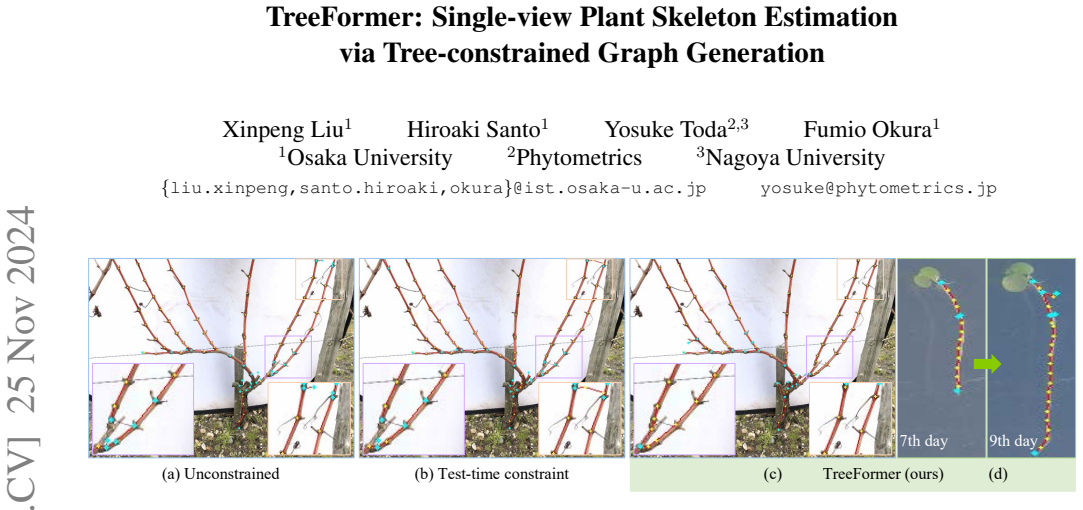
The central claim is that a non-differentiable combinatorial projection can be absorbed into neural-network training by rewriting only the logits of edges the projection would change. Concretely, the SFS layer computes the unconstrained edge probabilities, runs Kruskal's MST algorithm using non-existence probabilities as costs, and then replaces the suppressed feature of each disagreed edge with $-\Lambda$ (e.g., $\Lambda=10$) while leaving the other logit intact. Softmax then produces probabilities that match the MST output, and backpropagation flows through the surviving logit. The authors report that this training-time constraint yields 100 percent tree rate on all three test sets and beats the test-time-MST baseline on street-mover distance and TOPO scores, with the largest gains on grapevine images.
Load-bearing premise
The method assumes that backpropagating a gradient through the one surviving feature of each flipped edge is enough for the network to learn edge weights whose minimum spanning tree matches the true tree, even though that gradient ignores how edge-weight changes would change which tree is selected.
Editorial extensions
If this is right
- Training with the SFS layer instead of applying MST only at test time reduces SMD from $6.26\times10^{-6}$ to $4.78\times10^{-6}$ on synthetic trees, from $1.52\times10^{-4}$ to $8.82\times10^{-5}$ on roots, and from $1.47\times10^{-4}$ to $1.03\times10^{-4}$ on grapevine.
- Every output is guaranteed to be a tree at inference, while unconstrained RelationFormer produces trees only 36.2 percent, 35.9 percent, and 0.0 percent of the time on the three datasets even though all training graphs are trees.
- The layer is model-agnostic: attaching it to the autoregressive GGT baseline also improves SMD and TOPO scores over the same model with test-time MST.
- Because node detection and edge prediction are optimized together end-to-end, the method avoids the accumulated node-detection errors that hurt the two-stage ViNet-style baseline.
- A model trained only on grapevine images generalizes to grapevine photos with natural backgrounds and to other tree species, suggesting the learned representation is not dataset-specific.
Reading between the lines
- The same logit-suppression trick could generalize to any constraint with a fast projection oracle, such as planar graphs, bounded-degree graphs, or graphs with specified connected components, not just trees.
- The gradient is a straight-through approximation: it flows only through the surviving logit and ignores how changing edge weights would re-arrange the MST itself, so a decision-focused loss that differentiates through tree selection might be a stronger successor; the paper's Table S5, where train-time-only SFS gives 0 percent tree rate on grapevine, is consistent with that limitation.
- Part of the measured gain could come from the extra constrained loss term acting as a regularizer, so an ablation that adds an auxiliary MST-supervised head without rewriting logits would isolate the reparameterization's contribution.
- The 100 percent tree guarantee makes longitudinal tracking of root growth from time-series images straightforward, but undetected nodes remain the practical bottleneck for dense canopies.
Editorial analysis
A structured set of objections, weighed in public.
Referee Report
Summary. TreeFormer proposes a tree-constrained graph generation method for single-image plant skeleton estimation. The paper's key idea is to insert a selective feature suppression (SFS) layer into an off-the-shelf graph generator (RelationFormer). During training, raw edge probabilities are projected onto a minimum spanning tree via Kruskal's algorithm; for edges that the MST adds or removes, the corresponding logit is replaced by a large negative constant so that the projected probabilities can be trained with cross-entropy while a gradient path to the network is retained. At inference the output is again projected to a tree. The method is evaluated on a synthetic L-system dataset, real Arabidopsis root images, and the 3D2cut grapevine dataset against a re-implemented two-stage method, unconstrained RelationFormer, and a test-time-MST baseline. The paper reports lower SMD and higher TOPO scores for TreeFormer on all three datasets, with 100% tree rate.
Significance. The SFS layer is simple, model-agnostic in principle, and accompanied by public code and several useful ablations (train-time vs test-time constraint, Lambda sensitivity, and a comparison with the autoregressive GGT baseline). The paper also explicitly discloses that tree rate is trivially 100% for all constrained methods, which is the correct framing. If the reported improvements are statistically robust, the method is a practical contribution to plant phenotyping and a useful template for imposing discrete graph constraints in end-to-end training. The main qualification is that the empirical advantage over the test-time-constraint baseline is small on some metrics and is currently supported only by single-run numbers.
major comments (4)
- [Table 1, §5.5] The central empirical claim rests on Table 1, but every cell is a single point estimate from one training run with early stopping. The caption uses the word 'significantly,' yet no error bars, number of seeds, or significance tests are reported. On several load-bearing comparisons the gaps are small: on grapevine the TOPO F1 gap versus test-time constraint is 0.867 vs 0.870, and on root the SMD gap is 1.52e-4 vs 8.82e-5. With stochastic training and early stopping, these differences could plausibly be within run-to-run variance. Please report multiple seeds with standard deviations and, where possible, paired statistical tests for at least the comparison against the test-time-constraint baseline; without this, the claimed advantage of SFS over simple test-time MST is not established.
- [§3.3, Eq. (10), Table S5] The SFS layer uses a straight-through-style gradient: for edges in E+ ∪ E− it backpropagates through the kept feature while treating the MST solution as fixed, and for all other edges it backpropagates the ordinary cross-entropy gradient. This ignores how changes in edge weights would alter which tree the MST selects. The approximation is not discussed as a limitation, and Table S5 shows its reach: when the SFS layer is used only during training and MST is not applied at test time, the raw output has tree rate 0% on the grapevine dataset (56.5% on synthetic, 37.2% on root). Please state this approximation explicitly and provide evidence that it is a sufficient training signal, e.g., by comparing with a differentiable surrogate of MST or by analyzing gradient quality on a small controlled problem.
- [§4.2, Eq. (11)] For edge pairs not in E+ ∪ E−, the constrained term in Eq. (11) is identical to the unconstrained term, so the total loss gives those edges twice the weight of modified edges. This asymmetric weighting is not discussed. Please state whether this is intentional and, if so, explain its effect on the learned edge weights; if it is unintentional, the loss formulation should be adjusted.
- [§5.3, §C.1, Table S3] The two-stage baseline is a re-implementation of ViNet with per-dataset heuristic parameters (d, τm, τn) selected by best SMD. Because these parameters are tuned for each dataset, the comparison between TreeFormer and the two-stage baseline may be affected by tuning bias. Please clarify how the thresholds were selected for the other methods and whether the selection was blinded to the test set.
minor comments (4)
- [Eq. (7)] There is a typographical issue in the otherwise branch of Eq. (7), where a stray character appears where a bracket is intended; please correct the notation.
- [§5.2] The TOPO score is computed only over nodes with degree != 2, which is a modification of the Sat2Graph implementation. Please justify this choice explicitly and note how it affects comparability with previously reported TOPO numbers.
- [§5.6] The claim of 'approximately 30% improvement on edge accuracy' should be phrased as a relative reduction in SMD, not an improvement in edge accuracy, to avoid conflating the two metrics.
- [§5.4] The paper uses validation-based early stopping but does not state how many random seeds were used. Given the absence of error bars, a statement about seed variability is important.
Circularity Check
No significant circularity: the SFS layer is a training-time reparameterization, the 100% tree rate is disclosed as tautological, and all empirical claims are measured against ground-truth annotations.
full rationale
The paper's central mechanism, the selective feature suppression (SFS) layer, is explicitly a differentiable mimicry of a non-differentiable MST projection. Equations (7)-(9) define modified edge features so that the forward edge probabilities match the MST output; the statement that the resulting edge set equals the MST output when Lambda is large is a correctness property of this construction, not an empirical prediction that is then used as evidence. The method is evaluated against manually or procedurally generated ground-truth graphs on held-out test splits, so the reported SMD and TOPO improvements are not defined into existence. The 100% tree rate for constrained methods is the one tautological quantity, but the paper openly states: 'it is obvious that the tree rate becomes 100 % for constrained methods, including ours' (Sec. 5.2), and uses the metric only to measure the unconstrained model. Lambda is a hyperparameter chosen and ablated (Table S6), not a fitted parameter renamed as a prediction. The authors do cite their own prior work (e.g., Refs. [26] and [50]), but only as background in the related-work section; no load-bearing claim, uniqueness theorem, or ansatz is imported from those citations. The gradient approximation in Eq. (10) is a heuristic straight-through-style estimator, and the paper's own Table S5 shows that SFS training alone does not force tree outputs at test time (0% tree rate on grapevine), confirming that the method is not circular. Concerns about missing error bars or statistical significance in Table 1 concern evidence strength, not circularity, and are outside this pass.
Assumptions & free parameters
free parameters (1)
- Lambda (feature suppression constant) =
10
assumptions (4)
- domain assumption The plant skeleton can be represented as a single connected tree graph rooted at the crown or main root.
- domain assumption The deformable DETR node detector in RelationFormer localizes graph nodes accurately enough that errors in the final tree are dominated by edge prediction, not node detection.
- domain assumption Edge non-existence probabilities are a meaningful cost for MST projection.
- domain assumption The synthetic L-system dataset is a representative proxy for real-world plant structures.
Cite this review
Pith. "Pith review of TreeFormer: Single-view Plant Skeleton Estimation via Tree-constrained Graph Generation." pith.science (2026). https://pith.science/paper/FMJ7GAIJ
@misc{pith2026241116132,
  author       = {Pith},
  title        = {Pith review of: TreeFormer: Single-view Plant Skeleton Estimation via Tree-constrained Graph Generation},
  year         = {2026},
  howpublished = {\url{https://pith.science/paper/FMJ7GAIJ}},
  note         = {Machine review of arXiv:2411.16132}
}
read the original abstract
Accurate estimation of plant skeletal structure (e.g., branching structure) from images is essential for smart agriculture and plant science. Unlike human skeletons with fixed topology, plant skeleton estimation presents a unique challenge, i.e., estimating arbitrary tree graphs from images. While recent graph generation methods successfully infer thin structures from images, it is challenging to constrain the output graph strictly to a tree structure. To this problem, we present TreeFormer, a plant skeleton estimator via tree-constrained graph generation. Our approach combines learning-based graph generation with traditional graph algorithms to impose the constraints during the training loop. Specifically, our method projects an unconstrained graph onto a minimum spanning tree (MST) during the training loop and incorporates this prior knowledge into the gradient descent optimization by suppressing unwanted feature values. Experiments show that our method accurately estimates target plant skeletal structures for multiple domains: Synthetic tree patterns, real botanical roots, and grapevine branches. Our implementations are available at https://github.com/huntorochi/TreeFormer/.
Figures


Figures from the paper (3 more)


Reference graph
Works this paper leans on
-
[1]
Exploring long tail visual relation- ship recognition with large vocabulary
Sherif Abdelkarim, Aniket Agarwal, Panos Achlioptas, Jun Chen, Jiaji Huang, Boyang Li, Kenneth Ward Church, and Mohamed Elhoseiny. Exploring long tail visual relation- ship recognition with large vocabulary. In Proceedings of IEEE/CVF International Conference on Computer Vision (ICCV), pages 15901–15910, 2020. 2
work page 2020
-
[2]
Ef- ficient interactive annotation of segmentation datasets with polygon-RNN++
David Acuna, Huan Ling, Amlan Kar, and Sanja Fidler. Ef- ficient interactive annotation of segmentation datasets with polygon-RNN++. In Proceedings of IEEE/CVF Conference on Computer Vision and Pattern Recognition (CVPR), pages 859–868, 2018. 1, 2
work page 2018
-
[3]
Differentiable convex optimization layers
Akshay Agrawal, Brandon Amos, Shane Barratt, Stephen Boyd, Steven Diamond, and J Zico Kolter. Differentiable convex optimization layers. In Advances in Neural Informa- tion Processing Systems (NeurIPS), volume 32, 2019. 3
work page 2019
-
[4]
Spanning tree-based graph generation for molecules
Sungsoo Ahn, Binghong Chen, Tianzhe Wang, and Le Song. Spanning tree-based graph generation for molecules. In Pro- ceedings of International Conference on Learning Represen- tations (ICLR), 2022. 3, 13
work page 2022
-
[5]
Mingyao Ai, Yuan Yao, Qingwu Hu, Yue Wang, and Wei Wang. An automatic tree skeleton extraction approach based on multi-view slicing using terrestrial LiDAR scans data.Re- mote Sensing, 12(22), 2020. 2
work page 2020
-
[6]
Jimmy Lei Ba, Jamie Ryan Kiros, and Geoffrey E Hin- ton. Layer normalization. arXiv preprint arXiv:1607.06450,
-
[7]
Image-conditioned graph generation for road network extraction
Davide Belli and Thomas Kipf. Image-conditioned graph generation for road network extraction. In Proceedings of NeurIPS Workshop on Graph Representation Learning ,
-
[8]
Simon Bohlender, Ilkay ¨Oks¨uz, and A. Mukhopadhyay. A survey on shape-constraint deep learning for medical image segmentation. IEEE Reviews in Biomedical Engineering , 16:225–240, 2021. 3
work page 2021
Show all 69 references
-
[9]
A practical introduction to skeletons for the plant sciences
Alexander Bucksch. A practical introduction to skeletons for the plant sciences. Applications in Plant Sciences , 2(8):1400005, 2014. 2
2014
-
[10]
High-throughput estimation of incident light, light interception and radiation-use efficiency of thousands of plants in a phenotyping platform
Llorenc ¸ Cabrera-Bosquet, Christian Fournier, Nicolas Brichet, Claude Welcker, Beno ˆıt Suard, and Franc ¸ois Tardieu. High-throughput estimation of incident light, light interception and radiation-use efficiency of thousands of plants in a phenotyping platform. New Phytologi...
2016
-
[11]
Re- altime multi-person 2D pose estimation using part affinity fields
Zhe Cao, Tomas Simon, Shih-En Wei, and Yaser Sheikh. Re- altime multi-person 2D pose estimation using part affinity fields. In Proceedings of IEEE/CVF Conference on Com- puter Vision and Pattern Recognition (CVPR), 2017. 1, 2, 8, 12
2017
-
[12]
Skeletonization of plant point cloud data using stochastic optimization frame- work
Ayan Chaudhury and Christophe Godin. Skeletonization of plant point cloud data using stochastic optimization frame- work. Frontiers in Plant Science, 11, 2020. 2
2020
-
[13]
Recovering the unbiased scene graphs from the biased ones
Meng-Jiun Chiou, Henghui Ding, Hanshu Yan, Changhu Wang, Roger Zimmermann, and Jiashi Feng. Recovering the unbiased scene graphs from the biased ones. In Proceed- ings of ACM International Conference on Multimedia (MM), pages 1581–1590, 2021. 2
2021
-
[14]
RelTR: Relation transformer for scene graph generation
Yuren Cong, Michael Ying Yang, and Bodo Rosenhahn. RelTR: Relation transformer for scene graph generation. IEEE Transactions on Pattern Analysis and Machine Intel- ligence (PAMI), 45(9):11169–11183, 2023. 2
2023
-
[15]
AdTree: Accurate, detailed, and automatic modelling of laser-scanned trees
Shenglan Du, Roderik Lindenbergh, Hugo Ledoux, Jantien Stoter, and Liangliang Nan. AdTree: Accurate, detailed, and automatic modelling of laser-scanned trees. Remote Sensing, 11(18), 2019. 2
2019
-
[16]
Mipaal: Mixed integer program as a layer
Aaron Ferber, Bryan Wilder, Bistra Dilkina, and Milind Tambe. Mipaal: Mixed integer program as a layer. In Proceedings of AAAI Conference on Artificial Intelligence (AAAI), pages 1504–1511, 2020. 3
2020
-
[17]
Schnable, and Bedrich Benes
Mathieu Gaillard, Chenyong Miao, James c. Schnable, and Bedrich Benes. Sorghum segmentation by skeleton extrac- tion. In Proceedings of European Conference on Computer Vision (ECCV) Workshops, 2020. 1
2020
-
[18]
Towards smart pruning: ViNet, a deep-learning approach for grapevine structure estima- tion
Theophile Gentilhomme, Michael Villamizar, Jerome Corre, and Jean-Marc Odobez. Towards smart pruning: ViNet, a deep-learning approach for grapevine structure estima- tion. Computers and Electronics in Agriculture, 207:107736,
-
[19]
Learning to count leaves in rosette plants
Valerio Giuffrida, Massimo Minervini, and Sotirios Tsaf- taris. Learning to count leaves in rosette plants. In Pro- ceedings of Workshop on Computer Vision Problems in Plant Phenotyping (CVPPP), pages 1.1–1.13, 01 2015. 2
2015
-
[20]
Inverse procedural modeling of branching structures by in- ferring L-systems
Jianwei Guo, Haiyong Jiang, Bedrich Benes, Oliver Deussen, Xiaopeng Zhang, Dani Lischinski, and Hui Huang. Inverse procedural modeling of branching structures by in- ferring L-systems. ACM Transactions on Graphics (TOG) , 39(5):1–13, 2020. 6
2020
-
[21]
Additional results for the synthetic branch pattern dataset
Harshit Gupta, Kyong Hwan Jin, Ha Q Nguyen, Michael T 15 Ground truth Test-time constraintUnconstrained OursTwo-stage Figure S5. Additional results for the synthetic branch pattern dataset. 16 Ground truth Test-time constraintUnconstrained OursTwo-stage Figure S6. Additional r...
2018
-
[22]
Deep residual learning for image recognition
Kaiming He, Xiangyu Zhang, Shaoqing Ren, and Jian Sun. Deep residual learning for image recognition. InProceedings of IEEE/CVF Conference on Computer Vision and Pattern Recognition (CVPR), pages 770–778, 2016. 12
2016
-
[23]
RoadRunner: Improving the precision of road net- work inference from gps trajectories
Songtao He, Favyen Bastani, Sofiane Abbar, Mohammad Al- izadeh, Hari Balakrishnan, Sanjay Chawla, and Sam Mad- den. RoadRunner: Improving the precision of road net- work inference from gps trajectories. InProceedings of ACM SIGSPATIAL International Conference on Advances in Ge...
2018
-
[24]
Elshrif, Samuel Madden, and Mohammad Amin Sadeghi
Songtao He, Favyen Bastani, Satvat Jagwani, Mohammad Alizadeh, Hari Balakrishnan, Sanjay Chawla, Mohamed M. Elshrif, Samuel Madden, and Mohammad Amin Sadeghi. Sat2Graph: Road graph extraction through graph-tensor en- coding. In Proceedings of European Conference on Com- puter ...
2020
-
[25]
L1-medial skeleton of point cloud
Hui Huang, Shihao Wu, Daniel Cohen-Or, Minglun Gong, Hao Zhang, Guiqing Li, and Baoquan Chen. L1-medial skeleton of point cloud. ACM Transactions on Graphics (TOG), 32(4):65, 2013. 2
2013
-
[26]
Probabilistic plant modeling via multi-view image-to-image translation
Takahiro Isokane, Fumio Okura, Ayaka Ide, Yasuyuki Mat- sushita, and Yasushi Yagi. Probabilistic plant modeling via multi-view image-to-image translation. In Proceedings of IEEE/CVF Conference on Computer Vision and Pattern Recognition (CVPR), pages 2906–2915, 2018. 2
2018
-
[27]
Junc- tion tree variational autoencoder for molecular graph genera- tion
Wengong Jin, Regina Barzilay, and Tommi Jaakkola. Junc- tion tree variational autoencoder for molecular graph genera- tion. In Proceedings of International Conference on Machine Learning (ICML), pages 2323–2332, 2018. 3, 13
2018
-
[28]
Jaakkola
Wengong Jin, Regina Barzilay, and T. Jaakkola. Hierarchi- cal generation of molecular graphs using structural motifs. In Proceedings of International Conference on Machine Learn- ing (ICML), 2020. 3, 13
2020
-
[29]
Fedorov, and Sergey Sosnin
Ivan Khokhlov, Lev Krasnov, Maxim V . Fedorov, and Sergey Sosnin. Image2SMILES: Transformer-based molec- ular optical recognition engine. Chemistry-Methods, 2(1):e202100069, 2022. 1, 2
2022
-
[30]
Kingma and Max Welling
Diederik P. Kingma and Max Welling. Auto-encoding vari- ational bayes. In Yoshua Bengio and Yann LeCun, editors, Proceedings of International Conference on Learning Rep- resentations (ICLR), 2014. 2
2014
-
[31]
Auto-encoding varia- tional bayes
Diederik P Kingma and Max Welling. Auto-encoding varia- tional bayes. In Proceedings of International Conference on Learning Representations (ICLR), 2014. 3
2014
-
[32]
Variational graph auto- encoders
Thomas N Kipf and Max Welling. Variational graph auto- encoders. In Proceedings on NeurIPS Workshop on Bayesian Deep Learning, 2016. 2
2016
-
[33]
End-to-end constrained optimization learning: A survey
James Kotary, Ferdinando Fioretto, Pascal Van Hentenryck, and Bryan Wilder. End-to-end constrained optimization learning: A survey. In Proceedings of International Joint Conferences on Artificial Intelligence (IJCAI), 2021. 3 20
2021
-
[34]
On the shortest spanning subtree of a graph and the traveling salesman problem
Joseph B Kruskal. On the shortest spanning subtree of a graph and the traveling salesman problem. Proceedings of the American Mathematical Society, 7(1):48–50, 1956. 5
1956
-
[35]
SGTR: End- to-end scene graph generation with transformer
Rongjie Li, Songyang Zhang, and Xuming He. SGTR: End- to-end scene graph generation with transformer. In Proceed- ings of IEEE/CVF Conference on Computer Vision and Pat- tern Recognition (CVPR), pages 19486–19496, 2022. 1, 2
2022
-
[36]
Structured landmark detection via topology- adapting deep graph learning
Weijian Li, Yuhang Lu, Kang Zheng, Haofu Liao, Chihung Lin, Jiebo Luo, Chi-Tung Cheng, Jing Xiao, Le Lu, Chang- Fu Kuo, et al. Structured landmark detection via topology- adapting deep graph learning. In Proceedings of European Conference on Computer Vision (ECCV) , pages 266–283,
-
[37]
Joint semantic-geometric learning for polygonal building segmentation
Weijia Li, Wenqian Zhao, Huaping Zhong, Conghui He, and Dahua Lin. Joint semantic-geometric learning for polygonal building segmentation. In Proceedings of AAAI Conference on Artificial Intelligence (AAAI), pages 1958–1965, 2021. 1, 2
1958
-
[38]
Fully automatic myocardial segmentation of contrast echocardiography se- quence using random forests guided by shape model
Yuanwei Li, Chin Pang Ho, Matthieu Toulemonde, Navtej Chahal, Roxy Senior, and Meng-Xing Tang. Fully automatic myocardial segmentation of contrast echocardiography se- quence using random forests guided by shape model. IEEE Transactions on Medical Imaging , 37(5):1081–1091, 2017. 3
2017
-
[39]
Learning deep generative models of graphs
Yujia Li, Oriol Vinyals, Chris Dyer, Razvan Pascanu, and Peter Battaglia. Learning deep generative models of graphs. arXiv preprint arXiv:1803.03324, 2018. 2
2018 arXiv
-
[40]
PolyTransform: Deep polygon transformer for instance segmentation
Justin Liang, Namdar Homayounfar, Wei-Chiu Ma, Yuwen Xiong, Rui Hu, and Raquel Urtasun. PolyTransform: Deep polygon transformer for instance segmentation. In Proceed- ings of IEEE/CVF Conference on Computer Vision and Pat- tern Recognition (CVPR), pages 9128–9137, 2020. 1, 2
2020
-
[41]
Feature pyramid networks for object detection
Tsung-Yi Lin, Piotr Doll ´ar, Ross Girshick, Kaiming He, Bharath Hariharan, and Serge Belongie. Feature pyramid networks for object detection. In Proceedings of IEEE/CVF Conference on Computer Vision and Pattern Recognition (CVPR), pages 2117–2125, 2017. 12
2017
-
[42]
Mathematical models for cellular in- teractions in development I
Aristid Lindenmayer. Mathematical models for cellular in- teractions in development I. Filaments with one-sided inputs. Journal of Theoretical Biology, 18(3):280–299, 1968. 6, 11
1968
-
[43]
Fast interactive object annotation with curve-GCN
Huan Ling, Jun Gao, Amlan Kar, Wenzheng Chen, and Sanja Fidler. Fast interactive object annotation with curve-GCN. In Proceedings of IEEE/CVF Conference on Computer Vision and Pattern Recognition (CVPR) , pages 5252–5261, 2019. 1, 2
2019
-
[44]
Qi Liu, Miltiadis Allamanis, Marc Brockschmidt, and Alexander L. Gaunt. Constrained graph variational autoen- coders for molecule design. In Advances in Neural Informa- tion Processing Systems (NeurIPS), 2018. 2
2018
-
[45]
Graphdf: A discrete flow model for molecular graph generation
Youzhi Luo, Keqiang Yan, and Shuiwang Ji. Graphdf: A discrete flow model for molecular graph generation. In Pro- ceedings of International Conference on Machine Learning (ICML), 2021. 2
2021
-
[46]
Towards deep learning models resistant to adversarial attacks
Aleksander Madry, Aleksandar Makelov, Ludwig Schmidt, Dimitris Tsipras, and Adrian Vladu. Towards deep learning models resistant to adversarial attacks. In Proceedings of In- ternational Conference on Learning Representations (ICLR),
-
[47]
Automatic stem- leaf segmentation of maize shoots using three-dimensional point cloud
Teng Miao, Chao Zhu, Tongyu Xu, Tao Yang, Na Li, Yuncheng Zhou, and Hanbing Deng. Automatic stem- leaf segmentation of maize shoots using three-dimensional point cloud. Computers and Electronics in Agriculture , 187:106310, 2021. 1, 2
2021
-
[48]
On the generalized minimum spanning tree problem
Young-Soo Myung, Chang-Ho Lee, and Dong-Wan Tcha. On the generalized minimum spanning tree problem. Net- works, 26(4):231–241, 1995. 3
1995
-
[49]
Stacked hour- glass networks for human pose estimation
Alejandro Newell, Kaiyu Yang, and Jia Deng. Stacked hour- glass networks for human pose estimation. In Proceedings of European Conference on Computer Vision (ECCV), pages 11–16, 2016. 12
2016
-
[50]
3D modeling and reconstruction of plants and trees: A cross-cutting review across computer graphics, vi- sion, and plant phenotyping
Fumio Okura. 3D modeling and reconstruction of plants and trees: A cross-cutting review across computer graphics, vi- sion, and plant phenotyping. Breeding Science, 72(1):31–47,
-
[51]
Glove: Global vectors for word representation
Jeffrey Pennington, Richard Socher, and Christopher D Man- ning. Glove: Global vectors for word representation. In Proceedings of Conference on Empirical Methods in Natural Language Processing (EMNLP), pages 1532–1543, 2014. 2
2014
-
[52]
The generalized minimum spanning tree problem: An overview of formulations, solution procedures and latest advances
Petric ˘a C Pop. The generalized minimum spanning tree problem: An overview of formulations, solution procedures and latest advances. European Journal of Operational Re- search, 283(1):1–15, 2020. 3
2020
-
[53]
Improving scene graph classification by exploiting knowledge from texts
Sahand Sharifzadeh, Sina Moayed Baharlou, Martin Schmitt, Hinrich Sch ¨utze, and V olker Tresp. Improving scene graph classification by exploiting knowledge from texts. In Proceedings of AAAI Conference on Artificial In- telligence (AAAI), pages 2189–2197, 2022. 2
2022
-
[54]
An ac- curate skeleton extraction approach from 3d point clouds of maize plants
wu Sheng, Weiliang Wen, Boxiang Xiao, Xinyu Guo, Jian Jun Du, Chuanyu Wang, and Yongjian Wang. An ac- curate skeleton extraction approach from 3d point clouds of maize plants. Frontiers in Plant Science, 10:248, 2019. 1, 2
2019
-
[55]
Relation- former: A unified framework for image-to-graph generation
Suprosanna Shit, Rajat Koner, Bastian Wittmann, Johannes Paetzold, Ivan Ezhov, Hongwei Li, Jiazhen Pan, Sahand Sharifzadeh, Georgios Kaissis, V olker Tresp, et al. Relation- former: A unified framework for image-to-graph generation. In Proceedings of European Conference on Com...
2022
-
[56]
Fast minimum spanning tree for large graphs on the GPU
Vibhav Vineet, Pawan Harish, Suryakant Patidar, and PJ Narayanan. Fast minimum spanning tree for large graphs on the GPU. In Proceedings of Conference on High Perfor- mance Graphics (HPG), pages 167–171, 2009. 8
2009
-
[57]
Melding the data-decisions pipeline: Decision-focused learning for combinatorial optimization
Bryan Wilder, Bistra Dilkina, and Milind Tambe. Melding the data-decisions pipeline: Decision-focused learning for combinatorial optimization. In Proceedings of AAAI Con- ference on Artificial Intelligence (AAAI) , pages 1658–1665,
-
[58]
MVS-Pheno: A portable and low-cost phenotyping platform for maize shoots using multiview stereo 3D reconstruction
Sheng Wu, Weiliang Wen, Yongjian Wang, Jiangchuan Fan, Chuanyu Wang, Wenbo Gou, and Xinyu Guo. MVS-Pheno: A portable and low-cost phenotyping platform for maize shoots using multiview stereo 3D reconstruction. Plant Phe- nomics, 2020:1848437, 2020. 2
2020
-
[59]
Yuille, and Quoc V
Cihang Xie, Mingxing Tan, Boqing Gong, Jiang Wang, Alan L. Yuille, and Quoc V . Le. Adversarial examples improve image recognition. In Proceedings of IEEE/CVF Conference on Computer Vision and Pattern Recognition (CVPR), 2020. 3
2020
-
[60]
Knowledge and heuristic-based modeling of laser-scanned trees
Hui Xu, Nathan Gossett, and Baoquan Chen. Knowledge and heuristic-based modeling of laser-scanned trees. ACM 21 Transactions on Graphics (TOG), 26(4):19, 2007. 2
2007
-
[61]
RNGDet++: Road network graph detection by trans- former with instance segmentation and multi-scale features enhancement
Zhenhua Xu, Yuxuan Liu, Yuxiang Sun, Ming Liu, and Lujia Wang. RNGDet++: Road network graph detection by trans- former with instance segmentation and multi-scale features enhancement. IEEE Robotics and Automation Letters, pages 1–8, 2023. 1, 2
2023
-
[62]
iCurb: Imitation learning-based detection of road curbs using aerial images for autonomous driving
Zhenhua Xu, Yuxiang Sun, and Ming Liu. iCurb: Imitation learning-based detection of road curbs using aerial images for autonomous driving. IEEE Robotics and Automation Let- ters, 6:1097–1104, 2021. 1, 2
2021
-
[63]
Panoptic scene graph genera- tion
Jingkang Yang, Yi Zhe Ang, Zujin Guo, Kaiyang Zhou, Wayne Zhang, and Ziwei Liu. Panoptic scene graph genera- tion. In Proceedings of European Conference on Computer Vision (ECCV), pages 178–196, 2022. 2
2022
-
[64]
Joint optimization for compressive video sensing and reconstruction under hardware constraints
Michitaka Yoshida, Akihiko Torii, Masatoshi Okutomi, Kenta Endo, Yukinobu Sugiyama, Rin-ichiro Taniguchi, and Hajime Nagahara. Joint optimization for compressive video sensing and reconstruction under hardware constraints. In Proceedings of European Conference on Computer Visi...
2018
-
[65]
Moflow: A invertible flow model for generating molecular graphs
Chengxi Zang and Fei Wang. Moflow: A invertible flow model for generating molecular graphs. In Proceedings of ACM SIGKDD International Conference on Knowledge Dis- covery & Data Mining (KDD), pages 617–626, 2020. 2
2020
-
[66]
Deeptree: Modeling trees with situated la- tents
Xiaochen Zhou, Bosheng Li, Bedrich Benes, Songlin Fei, and S ¨oren Pirk. Deeptree: Modeling trees with situated la- tents. IEEE Transactions on Visualization and Computer Graphics, 30(8):2795–5809, 2023. 2
2023
-
[67]
Deformable DETR: Deformable transform- ers for end-to-end object detection
Xizhou Zhu, Weijie Su, Lewei Lu, Bin Li, Xiaogang Wang, and Jifeng Dai. Deformable DETR: Deformable transform- ers for end-to-end object detection. In Proceedings of In- ternational Conference on Learning Representations (ICLR),
-
[68]
Machine learning ap- proaches to improve three basic plant phenotyping tasks using three-dimensional point clouds
Illia Ziamtsov and Saket Navlakha. Machine learning ap- proaches to improve three basic plant phenotyping tasks using three-dimensional point clouds. Plant Physiology , 181(4):1425–1440, 2019. 2 22
2019
-
[2023]
1, 2, 6, 7, 11, 12, 13
Reviewed August 12, 2026 · model on record in the stance chip above.
Discussion (0). Continue with ORCID to comment.