REVIEW 5 major objections 4 minor 42 references
High-Resolution Be Aware! Improving the Self-Supervised Real-World Super-Resolution
T0 review · 5 major / 4 minor · reviewed 2026-08-12 · deepseek-v4-flash
Pith's one-line read A quality gauge and a feature-alignment regularizer let self-supervised super-resolution adapt to real-world domains without paired data.
desk verdict Plausible components undermined by a transductive evaluation that uses HR labels from the test set to pick the model; the method may work, but Table 1 doesn't show it. read the letter →
The pith
A machine-rendered reading of the paper's core claim, the machinery that carries it, and where it could break.
The reading
What carries the argument
The central mechanism is the low-resolution reconstruction network from the LWay paradigm—a degradation encoder, an image encoder, and a reconstructor—augmented by two new parts. The first is a scalar controller $s$ that multiplies the 512-dimensional degradation embedding $\mathbf{e}_d$, defined as $s = n + (1 - \mathrm{HQI})$ in pretraining and $s = n + \mathrm{HQI}$ in finetuning, where $n$ is Gaussian noise and $\mathrm{HQI} = 1 - \mathrm{LPIPS}(f_\uparrow(X^r), M(X^r))$ measures how close the super-resolved output is to a bicubic upsampling of the low-resolution input. The second is the Feature-Alignment Regularizer (FAR), which computes average- and max-pooled Gram-matrix statistics of features from a trainable image encoder and a frozen CLIP encoder, aligns their dimensions with linear layers, and penalizes the Frobenius-norm difference. FAR is trained on natural high-resolution images during pretraining, then applied to super-resolved outputs during finetuning, pulling the output distribution toward natural-image statistics.
What would settle it
Construct a synthetic dataset where low-resolution images are degraded by independent and unequal amounts of blur and noise, then finetune an off-the-shelf SR model with the controller and FAR. If two images with identical HQI but different blur-noise mixes cause the controller to produce higher LPIPS after finetuning than the off-the-shelf model, or if sweeping the scalar $s$ while holding all else fixed changes reconstruction error along an unintended degradation axis, the scalar-control assumption fails.
Extended reading notes
Core claim
The paper establishes that the low-resolution reconstruction objective can be realigned with super-resolution quality by (i) multiplying the degradation embedding with a scalar controller that tracks the LPIPS distance between the super-resolved output and the bicubic-upsampled low-resolution input, and (ii) adding a feature-alignment regularizer that enforces the Gram-matrix statistics of the super-resolved output to match those of natural high-resolution images as encoded by a frozen CLIP image encoder. The controller prevents the SR model from degrading its own output to satisfy the reconstruction loss, while the regularizer constrains the output distribution toward natural-image statistics that are invisible in the low-resolution input alone. On NTIRE20, AIM2019, and RealSR benchmarks, finetuning RealESRGAN+ and SwinIRGAN with these components yields lower LPIPS and higher NRQM than prior self-supervised finetuning baselines, with comparable or better fidelity.
Load-bearing premise
The method assumes that a single scalar—how similar the super-resolved output is to the bicubic upsampling of the low-resolution input—correctly orders images by degradation extent, and that multiplying the whole degradation embedding by this scalar changes only the amount of degradation without altering its type.
Editorial extensions
If this is right
- Any off-the-shelf SR model, GAN-based or transformer-based, can be adapted to a target real-world domain by finetuning with the reconstruction loss plus the quality-scaled controller and FAR, requiring no paired high-resolution data.
- FAR constrains the distribution of super-resolved outputs toward natural-image statistics, which should reduce over-smoothing and unnatural textures that pure reconstruction objectives produce, as reflected in higher NRQM and lower LPIPS.
- The controller's dependence on HQI makes the finetuning self-regulating: if the SR model degenerates toward bicubic interpolation, the controller increases the degradation load, preventing the model from trivializing the reconstruction objective.
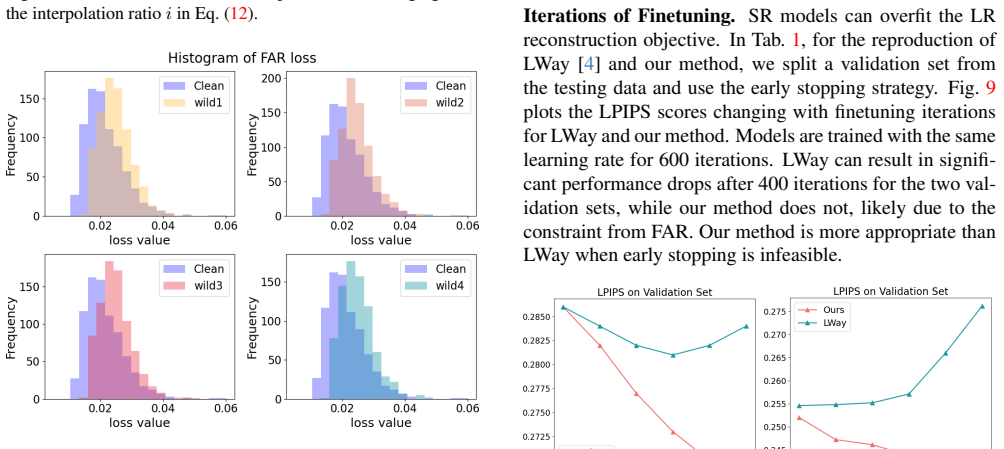
- Finetuning becomes more stable over many iterations: the paper shows LPIPS does not degrade after 600 iterations with FAR, whereas the LWay baseline overfits the reconstruction objective and suffers performance drops.
- The method operates on a whole test set with consistent degradation, making it suitable for camera-specific adaptation rather than per-image optimization.
Reading between the lines
- The HQI based on LPIPS ties the quality measure to the bicubic upsampling of the low-resolution input; a no-reference quality metric that does not depend on that reference could generalize to settings where bicubic upsampling is a poor baseline, such as heavily compressed low-resolution images.
- FAR uses CLIP as the fixed encoder, which biases the distribution constraint toward semantic features; ablations show that an SR-trained encoder (EDSR) gives higher NRQM but worse fidelity, suggesting a multi-encoder ensemble might better balance perceptual quality and fidelity.
- The controller scales the entire degradation embedding by a single scalar; a per-degradation-type adjustment (blur vs noise vs compression) could be more effective on real-world data where these degradations are independent, as the paper itself lists finer degradation adjustments as a future direction.
Editorial analysis
A structured set of objections, weighed in public.
Referee Report
Summary. The manuscript proposes two additions to the LR-reconstruction self-supervised SR framework of LWay: a controller that rescales the degradation embedding by an LPIPS-based quality indicator (HQI), and FAR, a Gram-matrix feature-alignment regularizer that encourages super-resolved outputs to match CLIP feature statistics of natural HR images. The method is applied by finetuning pretrained RealESRGAN+ and SwinIRGAN on target real-world LR test sets. Reported results on NTIRE20, AIM2019, and RealSR show improved LPIPS and NRQM over SRTTA, LWay, and the off-the-shelf models, with ablations attributing the gains to both components.
Significance. The two components are simple, intuitive, and clearly described, and the ablation structure is a sensible way to isolate their contributions. A notable strength is that the authors explicitly disclose the finetuning and early-stopping protocol, which allows the reader to assess the evidence. If the reported gains survive a clean evaluation protocol, the controller and FAR would be useful additions to test-time self-supervised SR. However, the central evidence is currently protocol-dependent, the LWay baseline is an unofficial reproduction, no code is released, and no error bars are reported, so the state-of-the-art claim is not yet established.
major comments (5)
- [Sec. 5.2, Sec. 5.3, Table 1, Fig. 9] The headline evaluations select models using ground-truth HR information in a transductive protocol. Sec. 5.2 states that finetuning runs on the whole testing set and that for LWay and Ours 'we split a validation set from the testing data and use the early stopping strategy'; Fig. 9 then selects stopping iterations by LPIPS on those validation images. Thus the final models in Table 1 are chosen with access to HR references on images drawn from the same test sets, while the SRTTA and off-the-shelf baselines are not given the same HR-guided selection. This makes the reported improvements unattainable from LR-only self-supervision and breaks the comparability of Table 1. Please provide results under a clean protocol (fixed iteration count chosen without HR, or a validation split from an independent domain) and report both early-stopped and non-early-stopped numbers.
- [Sec. 5.2] The only comparison to LWay uses an unofficial reproduction because LWay does not release source code or training data. Since Table 1's state-of-the-art claim depends on outperforming LWay, an uncontrolled reproduction can bias the comparison. Please release the reproduction details (training iterations, reconstruction-loss weights, and the exact validation schedule) and ideally use the official implementation or provide a verification check, such as reproducing LWay's published numbers on a common benchmark.
- [Tables 1-4] No repeated runs, error bars, or significance tests are reported. Several headline margins are small (e.g., NTIRE20 with RealESRGAN+: LPIPS 0.2369 vs. 0.2498 for LWay; NRQM 6.137 vs. 6.121 for the off-the-shelf model). Without seed variance or a paired test, the improvements cannot be distinguished from noise. Please report mean plus/minus standard deviation over at least three seeds and apply a paired significance test for the main comparisons.
- [Eqs. (7)-(8), Sec. 4.3] The controller's sign and the HQI ordering are assumed rather than derived. In Eq. (8), the pretraining and finetuning definitions use opposite signs of HQI, and the finetuning relation is justified only by the observation that a smaller LR/SR distance indicates more degradation in the SR output. Because LPIPS is also the primary evaluation metric, the objective and the metric are entangled; improvements in LPIPS may reflect optimization of the same distance rather than genuine perceptual quality. The paper should include a sensitivity analysis of the controller sign and evaluate with perceptual metrics not used in the loss (e.g., DISTS, NIQE, FID, or a human study). The NRQM gains mitigate this concern but do not eliminate it.
- [Table 2] The ablation table does not specify the evaluation dataset, and its baseline numbers (PSNR 26.2, SSIM 0.7889, LPIPS 0.2525, NRQM 4.511) do not match any off-the-shelf model row in Table 1 for NTIRE20, AIM2019, RealSR-Canon, or RealSR-Nikon. Please state the dataset and settings used for Table 2 and explain the discrepancy.
minor comments (4)
- [Eq. (7), Table 1, Fig. 2, Conclusion] There are several typos: 'cosince' should be 'cosine' in Eq. (7); 'KernalGAN' should be 'KernelGAN' in Table 1; the Fig. 2 caption contains 'inX' instead of 'in X'; and the conclusion uses 'fintunes' instead of 'finetunes'.
- [Sec. 5.3, LR reconstruction vs. SR performance] The interpolation experiment in Eq. (12) and Fig. 7 does not state which dataset is used, nor whether the controller s is applied during pretraining, finetuning, or both. Please add these details so the experiment can be reproduced.
- [General] No code availability statement is provided. Releasing the code and pretrained reconstruction network would substantially improve reproducibility, especially since the LWay baseline must be reimplemented.
- [Sec. 4.4, reference [30]] The motivation for FAR relies on reference [30]'s observation that self-supervised tasks degrade under distribution shift, but the connection between that observation and Gram-matrix alignment with CLIP is informal. A short explanation of why this particular alignment should reveal distribution shift would help readers evaluate the design.
Circularity Check
No significant circularity; the derivation chain is empirical and self-contained, with a protocol caveat that is not circular under the rubric.
full rationale
The paper's derivation chain does not reduce its claimed contributions to its own inputs. The controller s in Eq. (8) is defined through the external LPIPS-based HQI of Eq. (7), and the FAR regularizer in Eq. (11) aligns features to the external CLIP encoder; neither is defined in terms of the reported evaluation numbers. The reported LPIPS and NRQM gains are aligned with the training objectives by design, but that is objective alignment, not a circular derivation: no equation makes the headline metric equal to a fitted parameter or to the method's own definition. The only self-citation is reference [40], used as a related-work pointer to unsupervised SR methods, and it is not load-bearing for any argument. One non-circular caveat is worth flagging: Sec. 5.2 states that finetuning runs on the whole testing set and that for LWay and Ours a validation set is split from the testing data for early stopping (Fig. 9); this makes Table 1 transductive and weakens generalization claims, but it is an evaluation-protocol concern, not a circularity of the derivation. The core methods are empirically evaluated against external benchmarks and pretrained models, so the central claim has independent content.
Assumptions & free parameters
free parameters (3)
- FAR loss weights λpt and λft =
not reported
- Finetuning iterations and early-stopping criterion =
300-600 iterations; early stopping on validation split from test set
- Controller scaling sign for HQI in finetuning =
s = n + HQI in finetuning
assumptions (4)
- domain assumption A well-trained self-supervised task indicates distribution shift by performance drop, so FAR loss values can reveal whether SR outputs depart from natural HR distribution.
- domain assumption CLIP image encoder features on natural HR images define a valid target manifold for super-resolved images.
- domain assumption LPIPS distance between bicubic-upsampled LR and SR output is a monotone proxy for SR quality that can drive the controller.
- domain assumption The degradation embedding from a network pretrained on synthetic second-order degradation (DIV2K) generalizes to real-world degradations and remains valid when scalar-multiplied by the controller.
Cite this review
Pith. "Pith review of High-Resolution Be Aware! Improving the Self-Supervised Real-World Super-Resolution." pith.science (2026). https://pith.science/paper/U4LAYK3F
@misc{pith2026241116175,
  author       = {Pith},
  title        = {Pith review of: High-Resolution Be Aware! Improving the Self-Supervised Real-World Super-Resolution},
  year         = {2026},
  howpublished = {\url{https://pith.science/paper/U4LAYK3F}},
  note         = {Machine review of arXiv:2411.16175}
}
read the original abstract
Self-supervised learning is crucial for super-resolution because ground-truth images are usually unavailable for real-world settings. Existing methods derive self-supervision from low-resolution images by creating pseudo-pairs or by enforcing a low-resolution reconstruction objective. These methods struggle with insufficient modeling of real-world degradations and the lack of knowledge about high-resolution imagery, resulting in unnatural super-resolved results. This paper strengthens awareness of the high-resolution image to improve the self-supervised real-world super-resolution. We propose a controller to adjust the degradation modeling based on the quality of super-resolution results. We also introduce a novel feature-alignment regularizer that directly constrains the distribution of super-resolved images. Our method finetunes the off-the-shelf SR models for a target real-world domain. Experiments show that it produces natural super-resolved images with state-of-the-art perceptual performance.
Figures


Figures from the paper (5 more)


Reference graph
Works this paper leans on
-
[1]
Ntire 2017 challenge on single image super-resolution: Dataset and study
Eirikur Agustsson and Radu Timofte. Ntire 2017 challenge on single image super-resolution: Dataset and study. In Pro- ceedings of the IEEE conference on computer vision and pat- tern recognition workshops, pages 126–135, 2017. 6
2017
-
[2]
Toward real-world single image super-resolution: A new benchmark and a new model
Jianrui Cai, Hui Zeng, Hongwei Yong, Zisheng Cao, and Lei Zhang. Toward real-world single image super-resolution: A new benchmark and a new model. In Proceedings of the IEEE/CVF international conference on computer vision, pages 3086–3095, 2019. 2, 6
work page 2019
-
[3]
Real-world blind super-resolution via feature matching with implicit high- resolution priors
Chaofeng Chen, Xinyu Shi, Yipeng Qin, Xiaoming Li, Xi- aoguang Han, Tao Yang, and Shihui Guo. Real-world blind super-resolution via feature matching with implicit high- resolution priors. In Proceedings of the 30th ACM Interna- tional Conference on Multimedia , pages 1329–1338, 2022. 2
work page 2022
-
[4]
Low-res leads the way: Improving generalization for super- resolution by self-supervised learning
Haoyu Chen, Wenbo Li, Jinjin Gu, Jingjing Ren, Haoze Sun, Xueyi Zou, Zhensong Zhang, Youliang Yan, and Lei Zhu. Low-res leads the way: Improving generalization for super- resolution by self-supervised learning. In Proceedings of the IEEE/CVF Conference on Computer Vision and Pattern Recognition, pages 25857–25867, 2024. 1, 2, 3, 5, 6, 7, 8
work page 2024
-
[5]
Zero-shot im- age super-resolution with depth guided internal degradation learning
Xi Cheng, Zhenyong Fu, and Jian Yang. Zero-shot im- age super-resolution with depth guided internal degradation learning. In Computer Vision–ECCV 2020: 16th European Conference, Glasgow, UK, August 23–28, 2020, Proceed- ings, Part XVII 16, pages 265–280. Springer, 2020. 1, 3
work page 2020
-
[6]
Zeshuai Deng, Zhuokun Chen, Shuaicheng Niu, Thomas Li, Bohan Zhuang, and Mingkui Tan. Efficient test-time adapta- tion for super-resolution with second-order degradation and reconstruction. Advances in Neural Information Processing Systems, 36:74671–74701, 2023. 1, 2, 3, 6, 7
work page 2023
-
[7]
Im- age style transfer using convolutional neural networks
Leon A Gatys, Alexander S Ecker, and Matthias Bethge. Im- age style transfer using convolutional neural networks. In Proceedings of the IEEE conference on computer vision and pattern recognition, pages 2414–2423, 2016. 5
work page 2016
-
[8]
Blind super-resolution with iterative kernel correction
Jinjin Gu, Hannan Lu, Wangmeng Zuo, and Chao Dong. Blind super-resolution with iterative kernel correction. In Proceedings of the IEEE/CVF conference on computer vi- sion and pattern recognition, pages 1604–1613, 2019. 1, 2, 3, 6
work page 2019
Show all 42 references
-
[9]
Un- folding the alternating optimization for blind super resolu- tion
Yan Huang, Shang Li, Liang Wang, Tieniu Tan, et al. Un- folding the alternating optimization for blind super resolu- tion. Advances in Neural Information Processing Systems , 33:5632–5643, 2020. 2
2020
-
[10]
Dslr-quality photos on mobile devices with deep convolutional networks
Andrey Ignatov, Nikolay Kobyshev, Radu Timofte, Kenneth Vanhoey, and Luc Van Gool. Dslr-quality photos on mobile devices with deep convolutional networks. InProceedings of the IEEE international conference on computer vision, pages 3277–3285, 2017. 7
2017
-
[11]
Analyzing and improv- ing the image quality of stylegan
Tero Karras, Samuli Laine, Miika Aittala, Janne Hellsten, Jaakko Lehtinen, and Timo Aila. Analyzing and improv- ing the image quality of stylegan. In Proceedings of the IEEE/CVF conference on computer vision and pattern recognition, pages 8110–8119, 2020. 6
2020
-
[12]
Adam: A method for stochastic opti- mization
Diederik P Kingma. Adam: A method for stochastic opti- mization. arXiv preprint arXiv:1412.6980, 2014. 6
2014 arXiv
-
[13]
Photo- realistic single image super-resolution using a generative ad- versarial network
Christian Ledig, Lucas Theis, Ferenc Husz´ar, Jose Caballero, Andrew Cunningham, Alejandro Acosta, Andrew Aitken, Alykhan Tejani, Johannes Totz, Zehan Wang, et al. Photo- realistic single image super-resolution using a generative ad- versarial network. In Proceedings of the IE...
-
[14]
Swinir: Image restoration us- ing swin transformer
Jingyun Liang, Jiezhang Cao, Guolei Sun, Kai Zhang, Luc Van Gool, and Radu Timofte. Swinir: Image restoration us- ing swin transformer. InProceedings of the IEEE/CVF inter- national conference on computer vision , pages 1833–1844,
-
[15]
Enhanced deep residual networks for single image super-resolution
Bee Lim, Sanghyun Son, Heewon Kim, Seungjun Nah, and Kyoung Mu Lee. Enhanced deep residual networks for single image super-resolution. In Proceedings of the IEEE confer- ence on computer vision and pattern recognition workshops, pages 136–144, 2017. 8
2017
-
[16]
Catch missing details: Image reconstruction with frequency augmented variational autoencoder
Xinmiao Lin, Yikang Li, Jenhao Hsiao, Chiuman Ho, and Yu Kong. Catch missing details: Image reconstruction with frequency augmented variational autoencoder. In Proceed- ings of the IEEE/CVF Conference on Computer Vision and Pattern Recognition, pages 1736–1745, 2023. 2
2023
-
[17]
On bayesian adaptive video super resolution
Ce Liu and Deqing Sun. On bayesian adaptive video super resolution. IEEE transactions on pattern analysis and ma- chine intelligence, 36(2):346–360, 2013. 2
2013
-
[18]
Degae: A new pretraining paradigm for low-level vision
Yihao Liu, Jingwen He, Jinjin Gu, Xiangtao Kong, Yu Qiao, and Chao Dong. Degae: A new pretraining paradigm for low-level vision. In Proceedings of the IEEE/CVF Confer- ence on Computer Vision and Pattern Recognition , pages 23292–23303, 2023. 2
2023
-
[19]
Sgdr: Stochas- tic gradient descent with warm restarts
Ilya Loshchilov and Frank Hutter. Sgdr: Stochas- tic gradient descent with warm restarts. arXiv preprint arXiv:1608.03983, 2016. 6
2016 arXiv
-
[20]
Aim 2019 challenge on real-world image super-resolution: Methods and results
Andreas Lugmayr, Martin Danelljan, Radu Timofte, Manuel Fritsche, Shuhang Gu, Kuldeep Purohit, Praveen Kandula, Maitreya Suin, AN Rajagoapalan, Nam Hyung Joon, et al. Aim 2019 challenge on real-world image super-resolution: Methods and results. In 2019 IEEE/CVF International C...
2019
-
[21]
Ntire 2020 challenge on real-world image super-resolution: Methods and results
Andreas Lugmayr, Martin Danelljan, and Radu Timofte. Ntire 2020 challenge on real-world image super-resolution: Methods and results. In Proceedings of the IEEE/CVF Con- ference on Computer Vision and Pattern Recognition Work- shops, pages 494–495, 2020. 6
2020
-
[22]
Learning a no-reference quality metric for single-image super-resolution
Chao Ma, Chih-Yuan Yang, Xiaokang Yang, and Ming- Hsuan Yang. Learning a no-reference quality metric for single-image super-resolution. Computer Vision and Image Understanding, 158:1–16, 2017. 6
2017
-
[23]
Learning transferable visual models from natural language supervi- sion
Alec Radford, Jong Wook Kim, Chris Hallacy, Aditya Ramesh, Gabriel Goh, Sandhini Agarwal, Girish Sastry, Amanda Askell, Pamela Mishkin, Jack Clark, et al. Learning transferable visual models from natural language supervi- sion. In International conference on machine learning, ...
2021
-
[24]
Unpaired real-world super-resolution with pseudo controllable restora- 9 tion
Andr ´es Romero, Luc Van Gool, and Radu Timofte. Unpaired real-world super-resolution with pseudo controllable restora- 9 tion. In Proceedings of the IEEE/CVF Conference on Com- puter Vision and Pattern Recognition, pages 798–807, 2022. 2
2022
-
[25]
zero-shot
Assaf Shocher, Nadav Cohen, and Michal Irani. “zero-shot” super-resolution using deep internal learning. In Proceed- ings of the IEEE conference on computer vision and pattern recognition, pages 3118–3126, 2018. 1, 2, 3, 6
2018
-
[26]
Very deep convo- lutional networks for large-scale image recognition
Karen Simonyan and Andrew Zisserman. Very deep convo- lutional networks for large-scale image recognition. arXiv preprint arXiv:1409.1556, 2014. 8
2014 arXiv
-
[27]
Meta- transfer learning for zero-shot super-resolution
Jae Woong Soh, Sunwoo Cho, and Nam Ik Cho. Meta- transfer learning for zero-shot super-resolution. In Proceed- ings of the IEEE/CVF conference on computer vision and pattern recognition, pages 3516–3525, 2020. 1, 2, 3
2020
-
[28]
A+: Adjusted anchored neighborhood regression for fast super- resolution
Radu Timofte, Vincent De Smet, and Luc Van Gool. A+: Adjusted anchored neighborhood regression for fast super- resolution. In Computer Vision–ACCV 2014: 12th Asian Conference on Computer Vision, Singapore, Singapore, November 1-5, 2014, Revised Selected Papers, Part IV 12 , pa...
2014
-
[29]
Ntire 2018 chal- lenge on single image super-resolution: Methods and results
Radu Timofte, Shuhang Gu, and Jiqing Wu. Ntire 2018 chal- lenge on single image super-resolution: Methods and results. In 2018 IEEE/CVF Conference on Computer Vision and Pat- tern Recognition Workshops (CVPRW) , pages 965–96511,
2018
-
[30]
Convolu- tional visual prompt for robust visual perception
Yun-Yun Tsai, Chengzhi Mao, and Junfeng Yang. Convolu- tional visual prompt for robust visual perception. Advances in Neural Information Processing Systems, 36:27897–27921,
-
[31]
Exploiting diffusion prior for real-world image super-resolution
Jianyi Wang, Zongsheng Yue, Shangchen Zhou, Kelvin CK Chan, and Chen Change Loy. Exploiting diffusion prior for real-world image super-resolution. International Journal of Computer Vision, pages 1–21, 2024. 2
2024
-
[32]
Real-esrgan: Training real-world blind super-resolution with pure synthetic data
Xintao Wang, Liangbin Xie, Chao Dong, and Ying Shan. Real-esrgan: Training real-world blind super-resolution with pure synthetic data. In Proceedings of the IEEE/CVF inter- national conference on computer vision , pages 1905–1914,
1905
-
[33]
Unsupervised real-world image super resolution via domain-distance aware training
Yunxuan Wei, Shuhang Gu, Yawei Li, Radu Timofte, Long- cun Jin, and Hengjie Song. Unsupervised real-world image super resolution via domain-distance aware training. In Pro- ceedings of the IEEE/CVF conference on computer vision and pattern recognition, pages 13385–13394, 2021. 2
2021
-
[34]
Image super-resolution as sparse representation of raw image patches
Jianchao Yang, John Wright, Thomas Huang, and Yi Ma. Image super-resolution as sparse representation of raw image patches. In 2008 IEEE conference on computer vision and pattern recognition, pages 1–8. IEEE, 2008. 2
2008
-
[35]
Deep unfold- ing network for image super-resolution
Kai Zhang, Luc Van Gool, and Radu Timofte. Deep unfold- ing network for image super-resolution. In Proceedings of the IEEE/CVF conference on computer vision and pattern recognition, pages 3217–3226, 2020. 2
2020
-
[36]
Designing a practical degradation model for deep blind image super-resolution
Kai Zhang, Jingyun Liang, Luc Van Gool, and Radu Timo- fte. Designing a practical degradation model for deep blind image super-resolution. In Proceedings of the IEEE/CVF International Conference on Computer Vision, pages 4791– 4800, 2021. 2
2021
-
[37]
The unreasonable effectiveness of deep features as a perceptual metric
Richard Zhang, Phillip Isola, Alexei A Efros, Eli Shecht- man, and Oliver Wang. The unreasonable effectiveness of deep features as a perceptual metric. In Proceedings of the IEEE conference on computer vision and pattern recogni- tion, pages 586–595, 2018. 5, 6
2018
-
[38]
Crafting training degradation distribution for the accuracy-generalization trade-off in real- world super-resolution
Ruofan Zhang, Jinjin Gu, Haoyu Chen, Chao Dong, Yulun Zhang, and Wenming Yang. Crafting training degradation distribution for the accuracy-generalization trade-off in real- world super-resolution. In International conference on ma- chine learning, pages 41078–41091. PMLR, 2023. 2, 3
2023
-
[39]
Real-world image super-resolution as multi-task learning
Wenlong Zhang, Xiaohui Li, Guangyuan Shi, Xiangyu Chen, Yu Qiao, Xiaoyun Zhang, Xiao-Ming Wu, and Chao Dong. Real-world image super-resolution as multi-task learning. Advances in Neural Information Processing Systems , 36,
-
[40]
Pairwise dis- tance distillation for unsupervised real-world image super- resolution
Yuehan Zhang, Seungjun Lee, and Angela Yao. Pairwise dis- tance distillation for unsupervised real-world image super- resolution. arXiv preprint arXiv:2407.07302, 2024. 2
2024 arXiv
-
[41]
Joint sub-bands learning with clique structures for wavelet domain super-resolution
Zhisheng Zhong, Tiancheng Shen, Yibo Yang, Zhouchen Lin, and Chao Zhang. Joint sub-bands learning with clique structures for wavelet domain super-resolution. Advances in neural information processing systems, 31, 2018. 2
2018
-
[42]
Guided frequency separation network for real-world super- resolution
Yuanbo Zhou, Wei Deng, Tong Tong, and Qinquan Gao. Guided frequency separation network for real-world super- resolution. In Proceedings of the IEEE/CVF Conference on Computer Vision and Pattern Recognition Workshops, pages 428–429, 2020. 2 10
2020
Reviewed August 12, 2026 · model on record in the stance chip above.
Discussion (0). Continue with ORCID to comment.