REVIEW 4 major objections 7 minor 49 references
Neural Network-based High-index Saddle Dynamics Method for Searching Saddle Points and Solution Landscape
T0 review · 4 major / 7 minor · reviewed 2026-08-12 · deepseek-v4-flash
Pith's one-line read NN-HiSD: a neural-network surrogate makes high-index saddle-point search possible without explicit energy functions.
desk verdict Useful extension of HiSD to data-only energies via NN surrogates, with a clean but conditional proximity theorem; the unverified C^3 surrogate assumption and thin experimental validation mean the practical claims outrun the evidence. read the letter →
The pith
A machine-rendered reading of the paper's core claim, the machinery that carries it, and where it could break.
The reading
What carries the argument
The load-bearing device is the decomposition $E_{\mathrm{NN}}=E+E_\delta$ with the three error bounds (Hessian Lipschitz constant, Hessian norm, and gradient norm all at most $\varepsilon$), combined with the fixed-point map $g(x)=x-(\nabla^2 E_{\mathrm{NN}}(x^*))^{-1}\nabla E_{\mathrm{NN}}(x)$ used to prove existence and closeness of the surrogate saddle. On the algorithmic side, the machinery is the HiSD update $\dot{x}=\beta(I-2\sum_{i=1}^k v_i v_i^\top)F(x)$ and $\dot{v}_i=-\gamma(I-v_i v_i^\top-2\sum_{j<i}v_j v_j^\top)G(x)v_i$, which orients motion along the $k$ unstable directions and is run entirely on the surrogate using automatic differentiation, with optional heavy-ball or Nesterov momentum. The same machinery builds solution landscapes by downward and upward searches between saddles of adjacent index.
What would settle it
Take one of the trained surrogates used in the numerical sections, evaluate $\nabla E_\delta$ and $\nabla^2 E_\delta$ at the reported saddle point and its neighborhood against a high-accuracy reference, and check whether $\|\nabla E_\delta\|\le\varepsilon$ and $\|\nabla^2 E_\delta\|\le\varepsilon$ hold with the $\varepsilon$ required by condition (3.3). If the gradient or Hessian error exceeds that bound, or the surrogate Hessian has a different number of negative eigenvalues than the true Hessian, the predicted $4\varepsilon/\mu$ closeness and the convergence guarantee do not apply.
Extended reading notes
Core claim
The central claim is that replacing an explicit energy $E$ by a trained surrogate $E_{\mathrm{NN}}=E+E_\delta$ does not break saddle-point search, provided $E_\delta$ is uniformly small in gradient and Hessian on a neighborhood of the saddle. Under that assumption (Assumption 3.3), Theorem 3.7 shows via a contraction-mapping argument that the surrogate has a critical point $x^*_{\mathrm{NN}}$ within distance $4\varepsilon/\mu$ of the true saddle $x^*$, with the same Morse index; Theorem 3.8 then shows the discrete NN-HiSD iteration converges to $x^*_{\mathrm{NN}}$ at rate $(1-2/(\tilde{\kappa}+3))^n$, where $\tilde{\kappa}=(L+\varepsilon)/(\mu-\varepsilon)$, so a well-trained surrogate leaves the convergence speed essentially unchanged. The paper also proves the analogous result for the heavy-ball accelerated variant. The numerical sections support the claim on toy potentials, the Müller-Brown potential, a 7D Rosenbrock function, alanine dipeptide free-energy data, and a 119-map ribosomal assembly dataset.
Load-bearing premise
The whole proximity and convergence argument rests on Assumption 3.3: the trained network must approximate the energy with gradient and Hessian errors uniformly bounded by $\varepsilon$ in a neighborhood of the saddle, plus a Hessian Lipschitz bound. The paper takes value-only training on sampled points, together with the universal approximation theorem and adequate training, to be sufficient for this third-derivative-level accuracy.
Editorial extensions
If this is right
- For any system where energy values (and optionally gradients) can be sampled, NN-HiSD yields saddle points whose error is proportional to the surrogate's local gradient and Hessian error, so training quality directly controls landscape accuracy.
- The convergence-rate bound is essentially unchanged from exact-energy HiSD, and Corollary 3.9 extends the accelerated rate to the heavy-ball variant; the Nesterov variant is validated numerically.
- Since the surrogate is a smooth tanh network, automatic differentiation supplies exact Hessian-vector products, removing the dimer finite-difference step in the classical HiSD implementation.
- The alanine dipeptide and ribosomal-assembly experiments show construction of full solution landscapes, including index-2 saddles and the connections between saddles and minima, from noisy data alone.
Reading between the lines
- Inference: the proved bound is controlled by gradient and Hessian error rather than value error, so adding derivative information to the training loss should be the standard practice; the theory predicts this is what makes $4\varepsilon/\mu$ small.
- Inference: the ribosomal experiment's transition states that were 'not observed in the experiments' are a testable prediction: cryo-EM or molecular-dynamics follow-up could check whether those states appear as real conformational intermediates.
- Inference: the same surrogate-plus-dynamics recipe could extend to non-gradient systems by fitting the force field directly, which the paper lists as future work; the convergence proof would then need a different fixed-point argument.
- Inference: the bound suggests a practical stopping criterion: train until the estimated gradient and Hessian error in the region of interest is below the desired saddle-location tolerance times $\mu/4$.
Editorial analysis
A structured set of objections, weighed in public.
Referee Report
Summary. The paper proposes NN-HiSD, a surrogate-based variant of the high-index saddle dynamics method in which a neural network replaces the explicit energy function. The method uses automatic differentiation for gradient and Hessian information, optionally adds heavy-ball or Nesterov momentum, and is intended to locate saddle points and construct solution landscapes for systems with no closed-form energy. The main theoretical result (Theorems 3.7 and 3.8) shows, under an assumption that the surrogate is C^3-close to the true energy, that a nearby surrogate saddle exists and that NN-HiSD converges locally to it at a rate inherited from the known HiSD convergence theory. Numerical experiments cover toy potentials, the Müller-Brown potential, a modified Rosenbrock function, the alanine dipeptide free-energy landscape, and a ribosomal assembly pseudo-energy landscape.
Significance. If the main theorem's hypothesis can be verified, the paper would provide a clean and useful conditional guarantee for neural-network-based saddle search: a perturbation argument bounds the surrogate saddle displacement by O(epsilon/mu), and the local convergence proof correctly reduces to the established HiSD theorem. The momentum-accelerated variants and the use of automatic differentiation in place of a dimer method are natural and well-motivated. However, the paper's central practical claim depends on Assumption 3.3, which is never checked, and the data-driven experiments lack uncertainty quantification and independent validation. The theoretical skeleton is sound, but the manuscript currently overstates the reliability of the method for systems without explicit energies.
major comments (4)
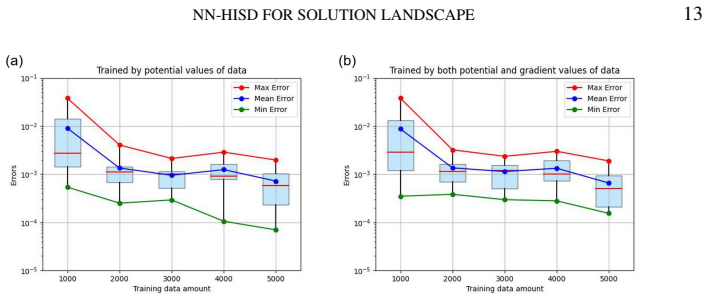
- [Section 3, Assumption 3.3 and Remark 3.4] Assumption 3.3 is the sole bridge between the trained network and the quantitative guarantees, but it is never checked in any experiment. The loss in Eq. (2.3) is a value-matching loss with an optional gradient term, so it does not control the Hessian errors and Hessian-Lipschitz constants required by parts (i)-(iii). Remark 3.4 invokes the universal approximation theorem and 'thorough training', but that theorem is a density statement and does not imply that a particular network trained on finitely many samples has uniform C^3 accuracy on U(x*,delta). Consequently, the bound ||x*_NN - x*|| <= 4epsilon/mu in Theorem 3.7 and the rate in Theorem 3.8 are not connected to any measurable training quantity. The authors should either measure epsilon (gradient, Hessian, and Hessian-Lipschitz errors in the relevant region) for each experiment, or add a training scheme with explicit derivative penalties and report the resulting epsilon; otherwise the claim after Theorem 3.8 that convergence velocity 'predominantly remains unaltered' is unsupported.
- [Section 4.5] The claim that S1 and S3 are 'new potential conformational states' is not supported by the presented results. Theorems 3.7 and 3.8 are local statements: they guarantee closeness to a true saddle only when Assumption 3.3 holds in a neighborhood of that saddle and when the dynamics starts nearby. They do not exclude spurious critical points of the surrogate elsewhere, and the surrogate is trained on only 119 data points with no train/test error reported and no comparison to an independent method. Before presenting S1 and S3 as new biological findings, the authors should validate them by independent means, for example additional MD or cryo-EM analysis, or at least a repeated-training stability check showing that the states persist across network initializations.
- [Sections 4.4-4.5] The data-driven experiments report no error bars, no repeated-training statistics, and no held-out validation of the surrogate. Table 1 reports single runs for each noise level, and the alanine and ribosome landscapes are each based on one trained network; the ribosome case uses 119 points, making overfitting a serious concern. Since the central claim is 'effectiveness and reliability' for systems without explicit energies, the manuscript should provide repeated-training or bootstrap errors, distance-to-reference comparisons for known states, and a discussion of the surrogate error on held-out data.
- [Section 3, Theorems 3.7-3.8; Section 4] The theorem statements and the convergence plots concern convergence to the surrogate saddle x*_NN, not to the original saddle x*. The final error to the true saddle is ||x(n)-x*|| <= ||x(n)-x*_NN|| + ||x*_NN-x*||, where the second term is only bounded by 4epsilon/mu under Assumption 3.3. The experiments plot ||x(n)-x*_NN|| (for example Fig. 8) and compare with known saddle coordinates in Tables 1-2, but they never measure or report epsilon, so the paper does not establish a quantified accuracy of the NN-HiSD landscape with respect to the original energy.
minor comments (7)
- [Section 3, Eq. (3.6)] The expression for D has a typographical error: it should read D = 4epsilon/(mu + sqrt(mu^2 - 32Mepsilon)), not D = 4epsilon/mu + sqrt(mu^2 - 32Mepsilon).
- [Section 1] The organization paragraph does not match the actual section numbering: the convergence analysis is in Section 3 and the numerical experiments in Section 4, not the other way around.
- [Abstract] There are minor grammatical issues in the abstract, such as 'to approximates' and 'a neural network-based surrogate model to approximates the energy function'; these should be corrected.
- [Code and Data Availability] Stating that data and code are 'available from the corresponding author upon reasonable request' is not sufficient for reproducibility; the authors should provide a repository with scripts, trained models, and data-processing steps.
- [Section 4.1] The abbreviation ADAD is used without definition; the text should state explicitly that it denotes applying automatic differentiation twice to compute the Hessian.
- [Section 4.2, Fig. 6(b)] The gradient-correction experiment is not fully reproducible because the penalty coefficient lambda_2 and the exact training protocol for the additional 5000 epochs are not specified.
- [Section 4.4] The sentence 'We calculate all possible critical points of the alanine dipeptide model' is too strong without a completeness argument; the downward/upward search procedure is heuristic, so it should be rephrased as 'all critical points found by our search procedure'.
Circularity Check
No circularity: the convergence and proximity theorems are conditional perturbation results whose inputs (surrogate accuracy epsilon) are not fitted to the outputs (saddle positions), and the imported HiSD convergence lemmas are independent prior theorems.
full rationale
The paper's central theoretical claim, Theorems 3.7 and 3.8, is a conditional perturbation statement. Under Assumption 3.3, where the surrogate is written as E_NN = E + E_delta with uniform bounds on the gradient, Hessian, and Hessian Lipschitz error, the proof constructs g(x) = x - (Hess E_NN(x*))^{-1} grad E_NN(x) and uses the Banach fixed-point theorem to show the existence of a surrogate saddle x*_NN with ||x*_NN - x*|| <= 4 epsilon / mu. This is a genuine stability argument: epsilon is a hypothesis about approximation quality, not a parameter fitted to the saddle locations that are later reported. The convergence result in Theorem 3.8 then applies Lemma 3.6 from reference [26] to the surrogate E_NN; the cited lemma is a published, parameter-free convergence theorem whose stated assumptions (Assumption 3.1 and 3.2 on the energy function) do not include the NN-HiSD target result. Similarly, Corollary 3.9 invokes Theorem 4.6 from [27]. Although those references share an author with the present paper, they are independent analytical results, not self-referential assertions, so their use does not constitute circularity. The numerical experiments train surrogates on energy values and then run HiSD on the trained surrogate; the computed saddle points are downstream outputs, not fitted inputs. The main weakness identified by a skeptical reading is Remark 3.4, which claims Assumption 3.3 is 'easily satisfied' via universal approximation and 'thorough training.' This is an unverified sufficiency claim: value-based L2 training does not by itself control Hessian errors or guarantee C^3 approximation, so the quantitative bounds in Theorem 3.7 and 3.8 may not be connected to a measured quantity in practice. That is a correctness and verification gap, not a circularity. No equation in the paper reduces by construction to its own input, and no fitted parameter is renamed as a prediction. Therefore the appropriate circularity score is 0.
Assumptions & free parameters
free parameters (5)
- HiSD step size beta_n =
0.05 (2D toy), 3e-4 (Muller-Brown), 1e-4 (Rosenbrock, alanine)
- Momentum coefficient gamma and Nesterov restart interval =
gamma = 0.8; restarts every 5, 15, 20, 40, or 500 steps
- Neural network architecture and training hyperparameters =
3-5 hidden layers x 128/256 neurons; 5k-40k points; 5k-30k epochs; lr = 0.001
- Gradient penalty coefficient lambda_2 =
not stated
- Ribosome regularization coefficient =
4e-3
assumptions (7)
- standard math Banach fixed-point theorem
- standard math Universal approximation theorem [5]
- domain assumption Assumption 3.1: true energy is regular near an index-k saddle with Hessian Lipschitz bound and spectral gap
- domain assumption Assumption 3.2: eigenvectors v_i are exact eigenvectors of the Hessian at each iterate
- ad hoc to paper Assumption 3.3: surrogate ENN = E + E_delta has small gradient and Hessian errors bounded by epsilon
- standard math Lemma 3.6 (HiSD convergence theorem from [26])
- standard math Theorem 4.6 in [27] (heavy-ball convergence)
Cite this review
Pith. "Pith review of Neural Network-based High-index Saddle Dynamics Method for Searching Saddle Points and Solution Landscape." pith.science (2026). https://pith.science/paper/SWR3KMVV
@misc{pith2026241116200,
  author       = {Pith},
  title        = {Pith review of: Neural Network-based High-index Saddle Dynamics Method for Searching Saddle Points and Solution Landscape},
  year         = {2026},
  howpublished = {\url{https://pith.science/paper/SWR3KMVV}},
  note         = {Machine review of arXiv:2411.16200}
}
read the original abstract
The high-index saddle dynamics (HiSD) method is a powerful approach for computing saddle points and solution landscape. However, its practical applicability is constrained by the need for the explicit energy function expression. To overcome this challenge, we propose a neural network-based high-index saddle dynamics (NN-HiSD) method. It utilizes neural network-based surrogate model to approximates the energy function, allowing the use of the HiSD method in the cases where the energy function is either unavailable or computationally expensive. We further enhance the efficiency of the NN-HiSD method by incorporating momentum acceleration techniques, specifically Nesterov's acceleration and the heavy-ball method. We also provide a rigorous convergence analysis of the NN-HiSD method. We conduct numerical experiments on systems with and without explicit energy functions, specifically including the alanine dipeptide model and bacterial ribosomal assembly intermediates for the latter, demonstrating the effectiveness and reliability of the proposed method.
Figures


Figures from the paper (9 more)




Reference graph
Works this paper leans on
-
[27]
Y . Luo, X. Z heng, and L. Zhang, Accelerated high-index saddle dynamics method for searching high-index saddle points, arXiv.2310.04656, (2023)
work page Pith review arXiv 2023
-
[26]
Y . Luo, X. Z heng, X. C heng, and L. Zhang, Convergence analysis of discrete high-index saddle dynamics , This manuscript is for review purposes only. NN-HISD FOR SOLUTION LANDSCAPE 19 SIAM Journal on Numerical Analysis, 60 (2022), pp. 2731–2750
work page 2022
-
[1]
A. B aydin, B. P earlmutter, A. R adul, and J. S iskind, Automatic differentiation in machine learning: A survey, Journal of Machine Learning Research, 18 (2018), pp. 1–43
work page 2018
-
[2]
S. B onfanti and W. Kob, Methods to locate saddle points in complex landscapes , The Journal of Chemical Physics, 147 (2017), p. 204104
work page 2017
-
[3]
R. B urton, G. H uang, M. D augherty, T. C alderone, and T. Oas, The energy landscape of a fast-folding protein mapped by Ala Gly substitutions, Nature structural biology, 4 (1997), pp. 305–10
work page 1997
- [4]
-
[5]
G. C ybenko, Approximation by superpositions of a sigmoidal function, Mathematics of Control, Signals and Systems, 2 (1989), pp. 303–314
work page 1989
-
[6]
H. D aneshmand, J. Kohler, A. Lucchi, and T. Hofmann, Escaping saddles with stochastic gradients, in Inter- national Conference on Machine Learning, PMLR, 2018, pp. 1155–1164
work page 2018
Show all 49 references
-
[7]
Y . N. Dauphin, R. Pascanu, C. G ulcehre, K. C ho, S. G anguli, and Y . Bengio, Identifying and attacking the saddle point problem in high-dimensional non-convex optimization, in Advances in Neural Information Processing Systems, vol. 27, Curran Associates, Inc., 2014
2014
-
[8]
J. H. D a vis, Y . Z. Tan, B. Carragher, C. S. Potter, D. Lyumkis, and J. Williamson, Modular assembly of the bacterial large ribosomal subunit, Cell, 167 (2016), pp. 1610–1622.e15
2016
-
[9]
W. E and E. Vanden-Eijnden, Transition-path theory and path-finding algorithms for the study of rare events., Annual review of physical chemistry, 61 (2010), pp. 391–420
2010
-
[10]
W. E and X. Zhou, The gentlest ascent dynamics, Nonlinearity, 24 (2011), p. 1831
2011
-
[11]
F ukumizu, S
K. F ukumizu, S. Yamaguchi, Y .ichi Mototake, and M. Tanaka, Semi-flat minima and saddle points by embed- ding neural networks to overparameterization, arXiv, abs/1906.04868 (2019)
2019 arXiv
-
[12]
G ould, C
N. G ould, C. O rtner, and D. Packwood, A dimer-type saddle search algorithm with preconditioning and linesearch, Mathematics of Computation, 85 (2016), pp. 2939–2966
2016
-
[13]
S. G u, H. Wang, and X. Zhou, Active learning for saddle point calculation, Journal of Scientific Computing, 93 (2022)
2022
-
[14]
Y . Han, Y . Hu, P. Z hang, and L. Zhang, Transition pathways between defect patterns in confined nematic liquid crystals, Journal of Computational Physics, 396 (2019), pp. 1–11
2019
-
[15]
Y . Han, J. Y in, Y . Hu, A. M ajumdar, and L. Zhang, Solution landscapes of the simplified Ericksen–Leslie model and its comparisonwith the reduced Landau–de Gennes model, Proceedings of the Royal Society A: Mathematical, Physical and Engineering Sciences, 477 (2021), p. 20210458
2021
-
[16]
Y . Han, J. Yin, P. Zhang, A. Majumdar, and L. Zhang, Solution landscape of a reduced Landau–de Gennes model on a hexagon, Nonlinearity, 34 (2021), pp. 2048–2069
2021
-
[17]
H eidrich and W
D. H eidrich and W. Quapp, Saddle points of index 2 on potential energy surfaces and their role in theoretical reactivity investigations, Theoretica Chimica Acta, 70 (1986), pp. 89–98
1986
-
[18]
H enkelman and H
G. H enkelman and H. J´onsson, A dimer method for finding saddle points on high dimensional potential sur- faces using only first derivatives, The Journal of Chemical Physics, 111 (1999), pp. 7010–7022
1999
-
[19]
H ornik, Approximation capabilities of multilayer feedforward networks , Neural Networks, 4 (1991), pp
K. H ornik, Approximation capabilities of multilayer feedforward networks , Neural Networks, 4 (1991), pp. 251–257
1991
-
[20]
H ornik, M
K. H ornik, M. S tinchcombe, and H. White, Multilayer feedforward networks are universal approximators , Neural Networks, 2 (1989), pp. 359–366
1989
-
[21]
C. J in, P. Netrapalli, and M. I. Jordan, Accelerated gradient descent escapes saddle points faster than gradi- ent descent, in Conference On Learning Theory, PMLR, 2018, pp. 1042–1085
2018
-
[22]
K ingma and J
D. K ingma and J. Ba, Adam: A method for stochastic optimization , International Conference on Learning Representations, (2014)
2014
-
[23]
A. V . Kny azev, Toward the optimal preconditioned eigensolver: Locally optimal block preconditioned conju- gate gradient method, SIAM Journal on Scientific Computing, 23 (2001), pp. 517–541
2001
-
[24]
Li and J
Y . Li and J. Zhou, A minimax method for finding multiple critical points and its applications to semilinear pdes, SIAM Journal on Scientific Computing, 23 (2001), pp. 840–865
2001
-
[25]
L ongsine and S
D. L ongsine and S. McCormick, Simultaneous rayleigh-quotient minimization methods for ax =λbx, Linear Algebra and its Applications, 34 (1980), pp. 195–234
1980
-
[28]
M ehta, Finding all the stationary points of a potential-energy landscape via numerical polynomial- homotopy-continuation method, Physical Review E, 84 (2011), p
D. M ehta, Finding all the stationary points of a potential-energy landscape via numerical polynomial- homotopy-continuation method, Physical Review E, 84 (2011), p. 025702
2011
-
[29]
M ilnor, Morse Theory
J. M ilnor, Morse Theory. (AM-51), Volume 51, Princeton University Press, Princeton, 1963
1963
-
[30]
Mironov, Y
V . Mironov, Y . Alexeev, V . K. Mulligan, and D. Fedorov, A systematic study of minima in alanine dipeptide, Journal of Computational Chemistry, 40 (2019), pp. 297 – 309
2019
-
[31]
Nesterov, A method for solving the convex programming problem with convergence rate o(1/k2), Proceed- ings of the USSR Academy of Sciences, 269 (1983), pp
Y . Nesterov, A method for solving the convex programming problem with convergence rate o(1/k2), Proceed- ings of the USSR Academy of Sciences, 269 (1983), pp. 543–547
1983
-
[32]
O’D onoghue and E
B. O’D onoghue and E. Candes, Adaptive restart for accelerated gradient schemes, Foundations of Computa- tional Mathematics, 15 (2015), pp. 715–732
2015
-
[33]
J. C. P hillips, R. B raun, W. Wang, J. G umbart, E. Tajkhorshid, E. V illa, C. C hipot, R. D. S keel, L. K al´e, and K. Schulten, Scalable molecular dynamics with NAMD , Journal of Computational Chemistry, 26 (2005), pp. 1781–1802
2005
-
[34]
P oly ak, Some methods of speeding up the convergence of iteration methods , Ussr Computational Mathe- matics and Mathematical Physics, 4 (1964), pp
B. P oly ak, Some methods of speeding up the convergence of iteration methods , Ussr Computational Mathe- matics and Mathematical Physics, 4 (1964), pp. 1–17
1964
-
[35]
https: //pytorch.org/docs/stable/generated/torch.optim.lr scheduler.StepLR.html, 2023
P yTorch, Steplr−pytorch 2.3 documentation . https: //pytorch.org/docs/stable/generated/torch.optim.lr scheduler.StepLR.html, 2023
2023
-
[36]
W. R en, E. Vanden-Eijnden, P. Maragakis, and W. E, Transition pathways in complex systems: Application of the finite-temperature string method to the alanine dipeptide , The Journal of Chemical Physics, 123 (2005), p. 134109
2005
-
[37]
S amanta, M
A. S amanta, M. E. T uckerman, T.-Q. Y u, and W. E, Microscopic mechanisms of equilibrium melting of a solid, Science, 346 (2014), pp. 729–732
2014
-
[38]
B. S hi, Y . Han, J. Yin, A. Majumdar, and L. Zhang, Hierarchies of critical points of a Landau-de Gennes free energy on three-dimensional cuboids, Nonlinearity, 36 (2023), pp. 2631–2654
2023
-
[39]
B. S hi, Y . Han, and L. Zhang, Nematic liquid crystals in a rectangular confinement: Solution landscape, and bifurcation, SIAM Journal on Applied Mathematics, 82 (2022), pp. 1808–1828
2022
-
[40]
W ang, L
W. W ang, L. Zhang, and P. Zhang, Modelling and computation of liquid crystals, Acta Numerica, 30 (2021), pp. 765–851
2021
-
[41]
Wang and J
Y . Wang and J. Li, Phase field modeling of defects and deformation , Acta Materialia, 58 (2010), pp. 1212– 1235
2010
-
[42]
Z. W u, E. Chen, S. Zhang, Y . Ma, and Y . Mao, Visualizing conformational space of functional biomolecular complexes by deep manifold learning, International Journal of Molecular Sciences, 23 (2022)
2022
-
[43]
J. Y in, Z. Huang, Y . Cai, Q. Du, and L. Zhang, Revealing excited states of rotational Bose–Einstein conden- sates, The Innovation, 5 (2024), p. 100546
2024
-
[44]
J. Y in, K. Jiang, A.-C. Shi, P. Zhang, and L. Zhang, Transition pathways connecting crystals and quasicrys- tals, Proceedings of the National Academy of Sciences, 118 (2021)
2021
-
[45]
J. Y in, Y . Wang, J. Z. Y . Chen, P. Zhang, and L. Zhang, Construction of a pathway map on a complicated energy landscape, Physical Review Letters, 124 (2020), p. 090601
2020
-
[46]
J. Y in, B. Y u, and L. Zhang, Searching the solution landscape by generalized high-index saddle dynamics , Science China Mathematics, 64 (2020), pp. 1801–1816
2020
-
[47]
J. Y in, L. Zhang, and P. Zhang, High-index optimization-based shrinking dimer method for finding high-index saddle points, SIAM Journal on Scientific Computing, 41 (2019), pp. A3576–A3595
2019
-
[48]
Z hang, L.-Q
L. Z hang, L.-Q. Chen, and Q. Du, Morphology of critical nuclei in solid-state phase transformations, Physical Review Letters, 98 (2007), p. 265703
2007
-
[49]
Z hou, L
T. Z hou, L. Z hang, P. Zhang, A.-C. S hi, and K. Jiang, Nucleation and phase transition of decagonal qua- sicrystals, The Journal of Chemical Physics, 161 (2024), p. 164503. This manuscript is for review purposes only
2024
Reviewed August 12, 2026 · model on record in the stance chip above.
Discussion (0). Continue with ORCID to comment.