REVIEW 5 major objections 5 minor 18 references
Iterative Gradient Descent Decoding for Real Number LDPC Codes
T0 review · 5 major / 5 minor · reviewed 2026-08-12 · deepseek-v4-flash
Pith's one-line read This paper shows that a real-number LDPC code from the IEEE 802.11 standard can be decoded by an additive gradient-descent rule, outperforming binary GDBF at rates 1/2 and 2/3 and matching it at 3/4.
desk verdict New decoder idea, but the headline performance claim rests on a SER-vs-BER mismatch and a broken while-loop; worth major revision, not acceptance as is. read the letter →
The pith
A machine-rendered reading of the paper's core claim, the machinery that carries it, and where it could break.
The reading
What carries the argument
The load-bearing mechanism is the GDSU update rule built from a modified local energy. The decoder computes the syndrome $s = Hx$, binarizes each syndrome component to $+1$ for an unsatisfied check and $-1$ for a satisfied check, and forms for each symbol $k$ a local energy $E_k^{\mathrm{bin}}$ plus a column-agreement term $\beta_k |D_k|$, where $D_k$ is the sum of the signs of the syndromes that contain symbol $k$. The active set is the set of symbols maximizing this local energy; the magnitude of each update is the smallest nonzero syndrome among the checks touching that symbol, and its sign is the majority vote of those syndrome signs (or the received symbol's sign if all checks are satisfied). Iterating these additive corrections until the $\ell^1$ norm of the syndrome is zero or a maximum iteration count is reached performs approximate gradient descent on the objective $F^{\mathrm{bin}}(x) = \tfrac{1}{2}\|r\|_\infty^2$. On the encoding side, the parity-check matrix is kept in approximate lower triangular form with the diagonal entries set to $-1$, giving a two-stage purely additive encoder.
What would settle it
For the same set of transmitted frames, convert each decoded real-number frame back to its bit representation and compute the resulting bit error rate; if the real-number decoder's apparent two-order-of-magnitude advantage over GDBF disappears under this bit-level comparison, the central 'outperforms' claim is a metric artifact rather than a genuine decoding improvement.
Extended reading notes
Core claim
The central claim is that a real-number parity code with a QC-LDPC parity-check matrix from the IEEE 802.11 standard can be decoded by an approximate gradient-descent rule that updates symbol values rather than flipping bits. The decoder, GDSU, defines an energy function over binarized syndrome violations, selects the active symbol set as the maximum of a local gradient, and corrects each active symbol by the minimum nonzero syndrome magnitude in its parity checks, with direction given by a majority vote of syndrome signs. In Monte Carlo simulations over a binary symmetric channel with amplitude errors added to flipped symbols, GDSU outperforms the binary GDBF decoder by two orders of magnitude at rate 1/2 and one order at rate 2/3, and gives roughly equal performance at rate 3/4. The authors attribute the gap at higher rate to the unoptimized default values $\beta_i = t_i = 1$, pointing to parameter tuning as future work.
Load-bearing premise
The paper compares symbol error rate for the real-number decoder directly against bit error rate for the binary decoder, so the claimed gains assume these two metrics are measuring the same thing.
Editorial extensions
If this is right
- If the claim holds, real-number LDPC codes from WiFi and similar standards can be decoded with the same arithmetic units used for signal processing, avoiding bit-level XOR operations.
- The two-order-of-magnitude improvement at rate 1/2 suggests real-number codes are especially attractive at low code rates for applications such as fault-tolerant computation.
- The comparable performance at rate 3/4 indicates the approach does not degrade catastrophically at higher rates even with default parameters.
- Because the decoder uses only $\ell^1$-norm syndrome checks and additive updates, it is amenable to fixed-point implementation with $p + \lceil d_c \rceil + 1$ bits of precision, as shown in the paper.
- The parameters $\beta$ and $t$ are code-dependent and were left at 1; tuning them is expected to change the rate-3/4 comparison.
Reading between the lines
- The reported gain at rate 1/2 may shrink when symbol error rate is converted to bit error rate, because a single real-symbol error can corrupt multiple bits; the paper compares SER against BER directly.
- A natural next test is to apply the same GDSU update to 5G NR base matrices, which share the quasi-cyclic structure of the 802.11 codes studied here.
- Tuning $\beta$ and $t$ per rate could change the rate-3/4 result from 'similar' to 'better'; this is testable with the paper's own simulator.
- The decoder's ability to correct both amplitude and sign of errors, whereas binary bit-flipping can only flip a bit, likely explains the low-rate gains; this suggests the real-number decoder uses information the binary channel model discards.
Editorial analysis
A structured set of objections, weighed in public.
Referee Report
Summary. The paper proposes Gradient Descent Symbol Update (GDSU), an iterative decoding algorithm for real-number QC-LDPC codes whose parity-check matrices are derived from IEEE 802.11 LDPC codes by replacing the +1 diagonal entries of the parity part with -1. The decoder uses an energy function inspired by binary GDBF, selects an active symbol set, and applies corrections whose magnitude is the smallest nonzero syndrome value and whose direction is given by a majority vote of syndrome signs. Monte Carlo simulations compare GDSU against binary GDBF for rates 1/2, 2/3, and 3/4, and the abstract claims that GDSU outperforms GDBF at rates 1/2 and 2/3 with similar performance at 3/4.
Significance. If the central claim were established, the paper would offer a practical decoder for a class of real-number LDPC codes using only additions, comparisons, and a maximum finder, which could be attractive for fixed-point DSP implementations and fault-tolerant computation. The idea is timely and the encoding construction is simple. However, the current manuscript does not establish the claim: the derivation of the update rule from the energy function is not valid, the algorithm as printed cannot reproduce the reported simulations, and the headline performance gain rests on comparing symbol error rate for multi-bit real symbols with bit error rate for binary symbols without the required normalization. There is no code, no stated fixed-point precision, and no detailed channel model, so the empirical results are not independently checkable. The contribution is therefore not yet ready for publication.
major comments (5)
- [Section III, Eqs. (3)-(6)] The paper states that Eq. (4) is the partial derivative ∂F_bin/∂s_k, but the displayed expression contains a Kronecker delta that selects the maximum of E_bin_k + β_k|D_k| and is zero otherwise. This is not a derivative; it is an ad-hoc active-set selection rule. Moreover, Eq. (6) defines the actual update as δ_k = t_k MajV(k)|s_j|, which does not follow from minimizing F_bin in any gradient-descent sense: there is no step along the negative gradient, and the sign and magnitude are chosen by a separate heuristic. The term 'gradient descent' is therefore not justified by the derivation. The authors should either provide a correct derivation or present the algorithm as a heuristic and evaluate it on that basis.
- [Algorithm 1, line 4] The while condition reads '(i ≤ Imax) and ∥s∥_{l1} = 0'. As written, the loop body executes only when the syndrome is already zero, i.e., when x is a valid codeword and no correction is needed. The intended condition is almost certainly ∥s∥_{l1} ≠ 0. Even if this is a typographical error, it blocks reproducibility, because the algorithm printed in the paper would never correct a nonzero syndrome. Please correct the condition and, if possible, provide pseudocode that matches the simulator exactly.
- [Section IV, SER vs. BER comparison] The central claim that GDSU 'outperforms' GDBF is based on plotting symbol error rate for the real-number decoder against bit error rate for the binary GDBF decoder. These metrics are not commensurable when a symbol carries multiple bits: a symbol error occurs if any of its p bits is wrong, while a bit error counts one bit disagreement. The paper never reports p, never defines how a fixed-point symbol is mapped to bits, and never reports a bit-level metric for the real decoder or an information-rate-matched binary baseline. Under these conditions, a large SER advantage can be an artifact of the metric rather than a genuine decoding gain. Please report FER for both systems, or convert the real decoder output to BER at a stated precision p and match the binary code rate and blocklength.
- [Section IV, channel and simulation model] The channel model is described as adding 'amplitude errors with α probability', but the amplitude distribution, its variance, and the fixed-point word length p are not specified. Earlier in the paper the error model is said to have Gaussian and rounding components, yet the simulations use a binary-symmetric-channel-like setup. Without a precise error model and quantization parameters, the Monte Carlo results for up to 100 million frames cannot be reproduced or interpreted. Please specify the error amplitude distribution, the signal constellation, p, and the GDBF parameters (e.g., threshold rule, maximum iterations) used in the comparison.
- [Section IV, parameter setting] The parameters β_i and t_i are stated to be 'code dependent' in Section III but are simply set to 1 in Section IV, and the conclusion acknowledges that they have not been properly investigated. The reported outperformance is therefore a statement about one unoptimized operating point, not a general property of the decoder. At minimum, a sensitivity study over β and t is needed to show that the claimed gains are not specific to this single choice.
minor comments (5)
- [Section II-A] There is a spelling error: 'Quasy-Cyclic' should be 'Quasi-Cyclic'.
- [Section III, Eq. (3a)] The notation (x_k - y_k)_bin is not defined for real-valued symbols; please specify how binarization is performed in the real-number setting.
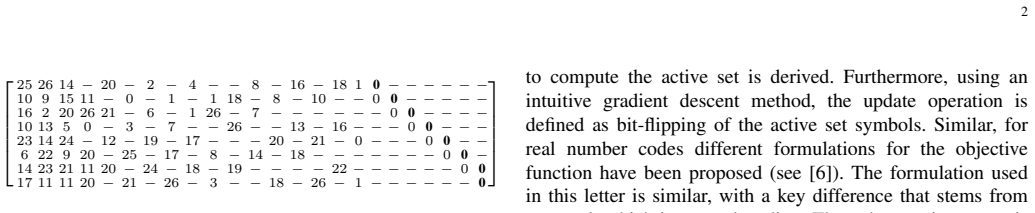
- [Figure 1] The base matrix in Figure 1 appears garbled from formatting; the entries are not legible as a matrix, which makes the construction hard to follow.
- [Section IV, Table I] The complexity table compares ADD and XOR operations but does not account for the additional precision bits (p + ⌈log2 dc⌉) mentioned in the text; please clarify whether the comparison is at equal throughput or equal precision.
- [References] Reference [14] is cited as '7.7gbps encoder design...' with incomplete author information; please verify the citation format.
Circularity Check
No significant circularity: GDSU is derived from an explicit energy function and compared against an external GDBF baseline with fixed parameters, not fitted inputs.
full rationale
The paper's central contribution is an iterative gradient descent decoder (GDSU) for real-number LDPC codes. The energy function in Eqs. (3)-(4) and the update rule in Eq. (6) are derived from the stated objective of exact decoding, and the parameters beta and t are fixed to 1 rather than fitted to the data. The performance evaluation compares GDSU against the external GDBF baseline [16] over IEEE 802.11 code matrices. No load-bearing step reduces by construction to its inputs: the decoder is not defined in terms of the measured SER/BER outcomes, no fitted parameter is renamed as a prediction, and the prior-work citations (Wadayama's GDBF, real-number code constructions) are independent external results. Two non-circularity concerns exist: the SER-versus-BER comparison is a metric-commensurability risk, and Algorithm 1's while-loop condition appears inverted; these affect correctness and reproducibility but do not constitute circular reasoning. The derivation chain is self-contained, so the circularity score is 0.
Assumptions & free parameters
free parameters (2)
- beta_i =
1
- t_k =
1
assumptions (3)
- standard math Approximate lower triangular form can be obtained for any parity check matrix by row/column permutations
- ad hoc to paper Substituting -1 for 1 on the diagonal of the parity part yields a real-number code with the intended error-correction capability
- domain assumption The proposed energy function and update rule (Eqs. (3)-(6)) guide the decoder toward the transmitted codeword
Cite this review
Pith. "Pith review of Iterative Gradient Descent Decoding for Real Number LDPC Codes." pith.science (2026). https://pith.science/paper/F4ODVO6T
@misc{pith2026241116203,
  author       = {Pith},
  title        = {Pith review of: Iterative Gradient Descent Decoding for Real Number LDPC Codes},
  year         = {2026},
  howpublished = {\url{https://pith.science/paper/F4ODVO6T}},
  note         = {Machine review of arXiv:2411.16203}
}
abstract
This paper proposes a new iterative gradient descent decoding method for real number parity codes. The proposed decoder, named Gradient Descent Symbol Update (GDSU), is used for a class of low-density parity-check (LDPC) real-number codes that can be defined with parity check matrices which are similar to those of the binary LDPC from communication standards such as WiFi (IEEE 802.11), 5G. These codes have a simple and efficient two stage encoding that is especially appealing for the real number field. The Gradient optimization based decoding has been a relatively simple and fast decoding technique for codes over finite fields. We show that the GDSU decoder outperforms the gradient descent bit-flipping (GDBF) decoder for rates $1/2$, $2/3$, and has similar decoding performance for the $3/4$ rate of the IEEE 802.11 codes standard.
Figures


Reference graph
Works this paper leans on
-
[1]
Extending checksum-based abft to tolerate soft errors online in iterative methods,
L. Chen, D. Tao, P. Wu, and Z. Chen, “Extending checksum-based abft to tolerate soft errors online in iterative methods,” in 2014 20th IEEE International Conference on Parallel and Distributed Systems (ICPADS), 2014, pp. 344–351
work page 2014
-
[2]
Coding for distributed multi-agent reinforcement learning,
B. Wang, J. Xie, and N. Atanasov, “Coding for distributed multi-agent reinforcement learning,” in 2021 IEEE International Conference on Robotics and Automation (ICRA) , 2021, pp. 10 625–10 631
work page 2021
-
[3]
Exploiting burst-sparsity in massive mimo with partial channel support information,
A. Liu, V . K. N. Lau, and W. Dai, “Exploiting burst-sparsity in massive mimo with partial channel support information,” IEEE Transactions on Wireless Communications, vol. 15, no. 11, pp. 7820–7830, 2016
work page 2016
-
[4]
Distributed source-channel coding based on real-field bch codes,
M. Vaezi and F. Labeau, “Distributed source-channel coding based on real-field bch codes,” IEEE Transactions on Signal Processing , vol. 62, no. 5, pp. 1171–1184, 2014
work page 2014
-
[5]
Tensor product dft codes vs standard dft codes,
G. Redinbo, “Tensor product dft codes vs standard dft codes,” IEEE Transactions on Computers , vol. 68, no. 11, pp. 1678–1688, nov 2019
work page 2019
-
[6]
Robust turbo analog error correcting codes based on analog crc verification,
A. Zanko, A. Leshem, and E. Zehavi, “Robust turbo analog error correcting codes based on analog crc verification,” IEEE Transactions on Signal Processing , vol. 64, no. 3, pp. 757–770, 2016
work page 2016
-
[7]
Class of majority decodable real-number codes,
J. Shiu and J.-L. Wu, “Class of majority decodable real-number codes,” IEEE Transactions on Communications , vol. 44, no. 3, pp. 281–283, 1996
work page 1996
-
[8]
Decoding real-number convolutional codes: change de- tection, kalman estimation,
G. Redinbo, “Decoding real-number convolutional codes: change de- tection, kalman estimation,” IEEE Transactions on Information Theory , vol. 43, no. 6, pp. 1864–1876, 1997
work page 1997
Show all 18 references
-
[9]
The capacity of low-density parity- check codes under message-passing decoding,
T. J. Richardson and R. L. Urbanke, “The capacity of low-density parity- check codes under message-passing decoding,” IEEE Transactions on Information Theory , vol. 47, no. 2, pp. 599–618, 2001
2001
-
[10]
Design of capacity- approaching irregular low-density parity-check codes,
T. Richardson, M. Shokrollahi, and R. Urbanke, “Design of capacity- approaching irregular low-density parity-check codes,” IEEE Trans. on Information Theory , vol. 47, no. 2, pp. 619–637, 2001
2001
-
[11]
The renaissance of gallager’s low- density parity-check codes,
T. Richardson and R. Urbanke, “The renaissance of gallager’s low- density parity-check codes,” IEEE Communications Magazine , vol. 41, no. 8, pp. 126–131, Aug 2003
2003
-
[12]
Quasicyclic low-density parity-check codes from circulant permutation matrices,
M. P. C. Fossorier, “Quasicyclic low-density parity-check codes from circulant permutation matrices,” IEEE Transactions on Information Theory, vol. 50, no. 8, pp. 1788–1793, Aug 2004
2004
-
[13]
Efficient encoding of low-density parity- check codes,
T. Richardson and R. Urbanke, “Efficient encoding of low-density parity- check codes,” Information Theory, IEEE Transactions on , vol. 47, pp. 638 – 656, 03 2001
2001
-
[14]
7.7gbps encoder design for ieee 802.11n/ac qc-ldpc codes,
Y . Jung, C. Chung, J. Kim, and Y . Jung, “7.7gbps encoder design for ieee 802.11n/ac qc-ldpc codes,” pp. 215–218, 2012
2012
-
[15]
Low-density parity-check codes,
R. Gallager, “Low-density parity-check codes,” IRE Transactions on Information Theory , vol. 8, no. 1, pp. 21–28, 1962
1962
-
[16]
Gradient descent bit flipping algorithms for decoding ldpc codes,
T. Wadayama, K. Nakamura, M. Yagita, Y . Funahashi, S. Usami, and I. Takumi, “Gradient descent bit flipping algorithms for decoding ldpc codes,” in 2008 International Symposium on Information Theory and Its Applications, 2008, pp. 1–6
2008
-
[17]
Real-number codes for fault-tolerant matrix operations on processor arrays,
V . Nair and J. Abraham, “Real-number codes for fault-tolerant matrix operations on processor arrays,” IEEE Transactions on Computers , vol. 39, no. 4, pp. 426–435, 1990
1990
-
[18]
Designing checksums for detecting errors in fast unitary transforms,
G. R. Redinbo, “Designing checksums for detecting errors in fast unitary transforms,” IEEE Transactions on Computers , vol. 67, no. 4, pp. 566– 572, 2018
2018
Reviewed August 12, 2026 · model on record in the stance chip above.
Discussion (0). Continue with ORCID to comment.