REVIEW 4 major objections 6 minor 42 references
Can Encrypted Images Still Train Neural Networks? Investigating Image Information and Random Vortex Transformation
T0 review · 4 major / 6 minor · reviewed 2026-08-12 · deepseek-v4-flash
Pith's one-line read Swapping any two pixels weakly reduces a distance-weighted measure of image information, and vortex encryption built on this lets neural nets train on scrambled images with under 6.5% accuracy loss.
desk verdict The vortex scramble is a real empirical trick, but the theory is a tautology and the information measure does not actually measure image content. read the letter →
The pith
A machine-rendered reading of the paper's core claim, the machinery that carries it, and where it could break.
The reading
What carries the argument
The load-bearing object is the neighbor-information pair: the distance-decay function $m_{\mathrm{neig}}(P_{ij},P_{st}) = 1 - 1/(1+e^{6-18\tilde d(P_{ij},P_{st})})$, which depends only on the normalized pixel distance $\tilde d$, and the post-transformation residual rule $m^*_{\mathrm{neig}}(P_{i'j'},P_{s't'}) = [1 - (m_{\mathrm{neig}}(P_{ij},P_{st}) - m_{\mathrm{neig}}(P_{i'j'},P_{s't'}))]\,m_{\mathrm{neig}}(P_{ij},P_{st})$. Substituting this rule into the sum over pixel pairs turns a two-pixel swap into a sum of squared differences $(\gamma_1-\gamma_2)^2$, which is what forces the total information to fall or stay flat. The Random Vortex Transformation is then the coordinate map in Eq. (17), whose bounded random twist $f$ makes large displacement of nearby pixels unlikely, so the encrypted image's neighbor-information sum stays close to the original.
What would settle it
Take a single-color image and swap any two pixel positions. The image is unchanged visually and to a classifier, but the framework's neighbor-information rule depends only on pixel coordinates, so the reported remaining-information fraction $\Upsilon$ will generally drop below 100%. A measure that reports information loss where no observable change occurs would falsify the claim that $\Upsilon$ captures image information content or predicts trainability.
Extended reading notes
Core claim
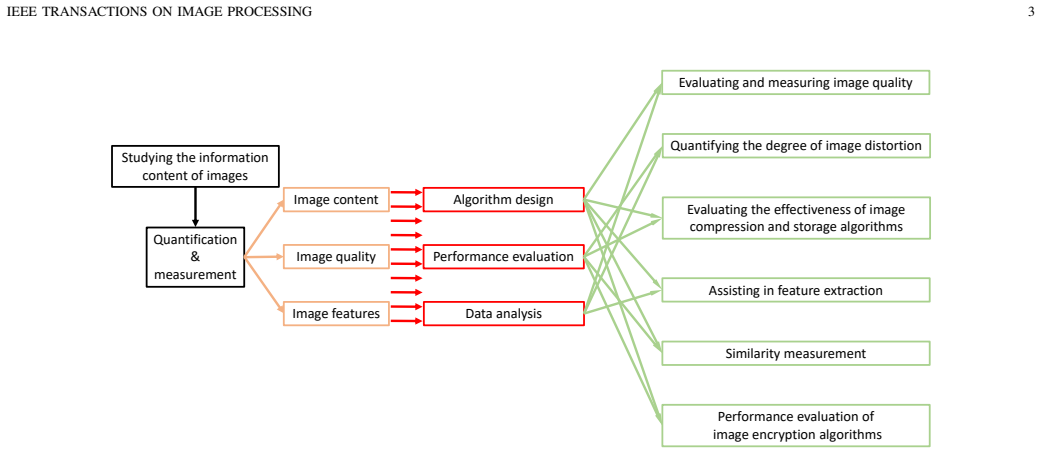
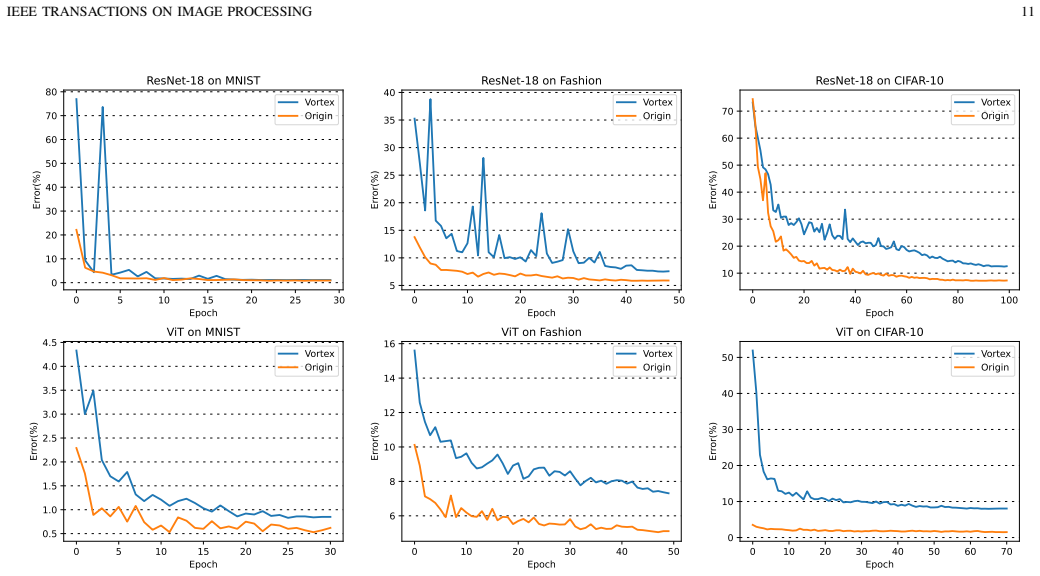
The central claim is that image information content has a well-defined, measurable form: for each pixel, sum a Z-shaped function $1 - 1/(1+e^{6-18\tilde d})$ of its normalized distance to every other pixel, and call the total the image's information content. With one additional rule for how much neighbor information survives a pixel move, the paper proves Theorem III.1, that swapping any two pixels weakly decreases the total. It then constructs the Random Vortex Transformation, $i' = d\cos(\theta+(R-d)f(d))$, $j' = d\sin(\theta+(R-d)f(d))$, with a bounded-derivative random $f$, to encrypt images while keeping each pixel near its old position. The experimental claim is that deep networks trained on such encrypted images stay within 0.3% to 6.5% of original-data accuracy, and that the computed remaining-information fractions ($\Upsilon \approx 90$--97% for vortex, $\approx 67$% for random permutation) correlate with the measured accuracy losses.
Load-bearing premise
The whole framework hinges on the untested claim that the paper's formula for 'remaining neighbor information' after a pixel move — $m^*_{\mathrm{neig}} = [1 - (m_{\mathrm{old}} - m_{\mathrm{new}})]\,m_{\mathrm{old}}$ — actually describes how much information survives; if that rule is arbitrary, the theorem and the correlation with accuracy loss collapse.
Editorial extensions
If this is right
- Any transformation that displaces pixels only mildly, in the sense of keeping normalized distances small, will produce encrypted images that deep classifiers can still learn, giving a design rule for encryption-then-training systems.
- Random permutation is the negative control: it collapses accuracy to 29%--56% and $\Upsilon$ to about 67%, confirming that preserved neighbor relationships, not raw pixel values, are what carry trainable information.
- Because RVT does not require decryption for use, it fills a gap that homomorphic encryption cannot, which is training nonlinear models such as ResNet and ViT on protected data.
- Stacking several vortex transformations is cheap and degrades $\Upsilon$ slowly, so the scheme can be strengthened by composition without leaving the accuracy budget.
Reading between the lines
- The paper's neighbor-information function never looks at pixel intensities, only at coordinates; as a result $\Upsilon$ measures rearrangement of the grid, and any claim that it captures semantic content would need independent calibration.
- The evidence for a positive correlation between information loss and accuracy loss is limited to two transformation types per dataset; sweeping vortex strength continuously would test whether $\Upsilon$ orders transformations monotonically by learnability.
- If $\Upsilon$ is accepted, it offers a cheap pre-training screen: compute the information-retention rate of any candidate encryption transform and predict its accuracy budget before running a single epoch.
- The paper's security claim is human-perceptual rather than cryptographic; translating it into an adversary model (how many random vortex parameters must be guessed to undo the transform) is left open and would be needed to use RVT in real privacy settings.
Editorial analysis
A structured set of objections, weighed in public.
Referee Report
Summary. The paper proposes a framework for measuring image information content based on pairwise pixel-neighbor information, defines a remaining-information ratio Υ, proves a "principle of verisimilitude" theorem stating that swapping any two pixels decreases or preserves total information, and introduces Random Vortex Transformation (RVT), a coordinate-based encryption method meant to preserve neighbor information while making images unrecognizable to humans. Experiments train ResNet-18 and ViT on MNIST, Fashion-MNIST, and CIFAR-10 under original, vortex-encrypted, and randomly permuted data, reporting small accuracy drops for RVT and a claimed positive correlation between information loss and accuracy loss.
Significance. If the framework were valid, it would offer a theoretical basis for training on encrypted images and a general tool for image quality and encryption evaluation. The empirical observation that models can train on vortex-transformed images with modest accuracy loss is interesting, and the authors provide code and a random-permutation baseline. However, the central theoretical result is manufactured by the definition in Eq. (6), the information measure ignores pixel values, and the claimed accuracy-information correlation is contradicted by the paper's own Table I. Because these issues affect the main claims rather than presentation, the paper's significance is not established.
major comments (4)
- [Section III-A, Eq. (6)] Equation (6) defines the post-transformation neighbor information as m*_neig = [1 - (m_neig(old) - m_neig(new))] * m_neig(old) without derivation from Eq. (4), from a limiting argument, or from any standard information measure. In the proof of Theorem III.1, Eqs. (9)-(11), this specific algebraic form is exactly what expands into the squared term (γ1 - γ2)^2, so the theorem's conclusion that information decreases or remains unchanged is an artifact of the definition. Since every Υ value in Table I is computed using Eq. (6), the empirical validation is circular.
- [Section III-A, Eqs. (4)-(5)] The function m_neig(Pij, Pst) depends only on normalized Euclidean distance between coordinates and does not depend on pixel values. Consequently, M_neig(Pij) in Eq. (5) is identical for all images of the same size. Because Section V-B2 explicitly discards the pixel-value term Mpix, the reported Υ measures only coordinate displacement, not image content. Indeed, applying Eq. (5) directly to a transformed image without the modification in Eq. (6) would yield Υ = 100% for any permutation, so the reported information loss is entirely an artifact of Eq. (6).
- [Table I and Section V-B2] The claimed positive correlation between information-loss rate and accuracy-loss rate is not supported by the paper's own numbers. For ResNet-18, MNIST has information loss 4.75% and accuracy loss 0.31%; Fashion-MNIST has information loss 9.96% and accuracy loss 1.27%; but CIFAR-10 has the smallest information loss (2.62%) and the largest accuracy loss (5.24%). The same inversion occurs for ViT. Thus the statement that the decrease in accuracy is "roughly proportional" to the loss of information content is contradicted by Table I.
- [Section III-B, Principle of Verisimilitude] The "Principle of Verisimilitude" is introduced as a requirement in Section III-A and treated as a premise rather than a proven consequence. Theorem III.1 proves only a monotonicity property of the quantity defined by Eq. (6); it does not show that the original image has maximal information content in any independent sense. The conclusion is therefore an input to the framework, not a result derived from it.
minor comments (6)
- [Section V-A2] The text says CIFAR-10 images are "much smaller than the images in CIFAR-10" when it appears to mean much smaller than the ImageNet images in the original ResNet-18 implementation.
- [Section V-B1] The bullet states that MNIST-Vortex accuracy is only "0%" lower than Origin, while Table I reports decreases of 0.31% and 0.32%; the exact values should be used.
- [Eqs. (20)-(22)] Equations (20)-(22) use (i′, j′) for the vortex center, but Eq. (17) defines (i′, j′) as the transformed coordinates; this notational conflict should be resolved, for example by using (i0, j0) for the center.
- [Eq. (17)] The paper does not specify whether the coordinate map defined by Eq. (17) is injective or bijective; if two pixels can map to the same location, the transformation is not a permutation and its relation to Theorem III.1 is unclear.
- [Experimental results] The reported accuracies and Υ values appear to come from single runs without error bars or multiple seeds; at least a statement of variance or repeated trials is needed to support the claimed accuracy differences.
- [Section V-A1] The MNIST dataset is described as handwritten digits from 1 to 10, but the standard labels are 0 to 9.
Circularity Check
Theorem III.1's decrease is manufactured by Eq. (6), an unvalidated transformation-dependent definition; the measure is content-blind, so the claimed correlation with accuracy is not independent evidence for the information framework.
-
self definitional
[Section III-A, Eq. (6) and Section III-B, Theorem III.1]
"Principle of verisimilitude: After various transformations, an image may make the objects within it more easily recognizable. However, we still regard the original image as having the highest information content because it is the most verisimilar. ... m∗neig(Pi′j′, Ps′t′) = [1 − (mneig(Pij, Pst) − mneig(Pi′j′, Ps′t′))] ×mneig(Pij, Pst). (6)"
The theorem's claimed decrease is produced by Eq. (6). In the proof, the post-swap terms are expanded as (1+γ1−γ2)(1−γ1)+(1+γ2−γ1)(1−γ2) = (2−γ1−γ2)−(γ1−γ2)^2, so the inequality '≤ Mneig(Pi1j1)+Mneig(Pi2j2)' is an algebraic consequence of the definition chosen in Eq. (6), not a discovered property of image information. Eq. (6) is never derived from Eq. (4) or from any standard information measure, and the 'principle of verisimilitude' it is used to prove was already assumed as a design requirement in Section III-A. The derivation therefore reduces to its own input by construction.
-
fitted input called prediction
[Section V-B2, Table I]
"The last row of Table I displays the remaining information content Υ(·) after the image undergoes transformations. Comparing random vortex transformations and random permutations, the decrease in accuracy is roughly proportional to the loss rate of information content."
The 'loss rate of information content' in Table I is computed with Eq. (6), the same unvalidated definition that already forces the theorem's decrease. Accuracy loss is an external experimental measurement, but the information loss is not: it is a quantity engineered so that any coordinate swap changing distance profiles yields a positive loss. Calling the observed proportionality 'further supporting the validity of the proposed image information content measurement framework' is therefore not independent confirmation; the support relation is already baked into the measure used to compute the information-loss side of the comparison.
1 more flagged steps
-
other
[Section III-A, Eqs. (4)-(7)]
"mneig(Pij, Pst) = 1 − 1/(1 + e^{6−18 d̃(Pij,Pst)}). (4) ... Mneig(Pij) = Σ_{s,t} mneig(Pij, Pst). (5)"
This measure depends only on pixel coordinates: d(·,·) is Euclidean distance between positions and dmax depends only on image dimensions, while pixel values never enter Eq. (4) or Eq. (5). Consequently, for images of the same size, M(P) = Σ_{i,j} Mneig(Pij) is identical before any transformation, and the only way Υ(P*) in Eq. (7) departs from 100% is through the transformation-dependent redefinition m*neig in Eq. (6). Thus the framework does not actually measure image content; the theorem and the reported correlation are properties of an arbitrary post-transform redefinition rather than of the image information.
full rationale
The paper's central theoretical result, Theorem III.1, is circular: the 'decrease or unchanged' conclusion is an algebraic identity following from Eq. (6), where the post-swap neighbor information is defined by multiplying the old value by [1 − (old − new)]. The proof then expands this into the squared difference (γ1−γ2)^2 and presents it as a discovered law. Eq. (6) is asserted without derivation from Eq. (4), from a limiting argument, or from any standard information measure; the 'Principle of Verisimilitude' that the theorem supposedly proves is already listed as a requirement before the theorem is stated. The experimental validation is similarly non-independent: the Υ values in Table I are computed with the same Eq. (6), so the claimed proportionality between information loss and accuracy loss is not an external check of the framework. Moreover, Eqs. (4)-(5) are content-blind, depending only on coordinate distances, which confirms that the measure's behavior is driven entirely by the transformation-dependent redefinition. The Random Vortex Transformation itself has real empirical content: the accuracy results on MNIST, Fashion, and CIFAR-10 are external measurements and show that vortex-encrypted images remain trainable. But the paper's information-theoretic justification for that phenomenon is circular, so the score is high but not maximal.
Assumptions & free parameters
free parameters (3)
- logistic kernel shift 6 =
6
- logistic kernel steepness 18 =
18
- number of superposed vortex transforms =
4 or 5
assumptions (5)
- domain assumption An image's information content is the sum of independent pixel information and pairwise neighbor information (Eqs. 1-2).
- ad hoc to paper mneig(Pij,Pst) = 1 - 1/(1+exp(6-18 d_tilde)) measures information between two pixels.
- ad hoc to paper Post-transform information is given by Eq. (6), m* = [1-(mneig_old - mneig_new)] * mneig_old.
- ad hoc to paper Principle of verisimilitude: the original image always has maximal information content.
- domain assumption Preserving neighbor information (as defined by this kernel) is sufficient for neural networks to recognize objects.
Cite this review
Pith. "Pith review of Can Encrypted Images Still Train Neural Networks? Investigating Image Information and Random Vortex Transformation." pith.science (2026). https://pith.science/paper/JEH3SYRW
@misc{pith2026241116207,
  author       = {Pith},
  title        = {Pith review of: Can Encrypted Images Still Train Neural Networks? Investigating Image Information and Random Vortex Transformation},
  year         = {2026},
  howpublished = {\url{https://pith.science/paper/JEH3SYRW}},
  note         = {Machine review of arXiv:2411.16207}
}
read the original abstract
Vision is one of the essential sources through which humans acquire information. In this paper, we establish a novel framework for measuring image information content to evaluate the variation in information content during image transformations. Within this framework, we design a nonlinear function to calculate the neighboring information content of pixels at different distances, and then use this information to measure the overall information content of the image. Hence, we define a function to represent the variation in information content during image transformations. Additionally, we utilize this framework to prove the conclusion that swapping the positions of any two pixels reduces the image's information content. Furthermore, based on the aforementioned framework, we propose a novel image encryption algorithm called Random Vortex Transformation. This algorithm encrypts the image using random functions while preserving the neighboring information of the pixels. The encrypted images are difficult for the human eye to distinguish, yet they allow for direct training of the encrypted images using machine learning methods. Experimental verification demonstrates that training on the encrypted dataset using ResNet and Vision Transformers only results in a decrease in accuracy ranging from 0.3\% to 6.5\% compared to the original data, while ensuring the security of the data. Furthermore, there is a positive correlation between the rate of information loss in the images and the rate of accuracy loss, further supporting the validity of the proposed image information content measurement framework.
Figures


Figures from the paper (7 more)



Reference graph
Works this paper leans on
-
[35]
Learnable privacy-preserving anonymiza- tion for pedestrian images,
J. Zhang, M. Ye, and Y . Yang, “Learnable privacy-preserving anonymiza- tion for pedestrian images,” in MM ’22: The 30th ACM International Conference on Multimedia, Lisboa, Portugal, October 10 - 14, 2022 , 2022, pp. 7300–7308
work page 2022
-
[1]
Gradient-based learning applied to document recognition,
Y . LeCun, L. Bottou, Y . Bengio, and P. Haffner, “Gradient-based learning applied to document recognition,” Proc. IEEE, vol. 86, no. 11, pp. 2278– 2324, 1998
1998
-
[2]
Imagenet classification with deep convolutional neural networks,
A. Krizhevsky, I. Sutskever, and G. E. Hinton, “Imagenet classification with deep convolutional neural networks,” in Advances in Neural In- formation Processing Systems 25: 26th Annual Conference on Neural Information Processing Systems 2012. Proceedings of a meeting held December 3-6, 2012, Lake Tahoe, Nevada, United States , 2012, pp. 1106–1114
work page 2012
-
[3]
Very deep convolutional networks for large-scale image recognition,
K. Simonyan and A. Zisserman, “Very deep convolutional networks for large-scale image recognition,” in 3rd International Conference on Learning Representations, ICLR 2015, San Diego, CA, USA, May 7-9, 2015, Conference Track Proceedings , 2015
work page 2015
-
[4]
Deep residual learning for image recognition,
K. He, X. Zhang, S. Ren, and J. Sun, “Deep residual learning for image recognition,” in 2016 IEEE Conference on Computer Vision and Pattern Recognition, CVPR 2016, Las Vegas, NV , USA, June 27-30, 2016, 2016, pp. 770–778
work page 2016
-
[5]
An image is worth 16x16 words: Trans- formers for image recognition at scale,
A. Dosovitskiy, L. Beyer, A. Kolesnikov, D. Weissenborn, X. Zhai, T. Unterthiner, M. Dehghani, M. Minderer, G. Heigold, S. Gelly, J. Uszkoreit, and N. Houlsby, “An image is worth 16x16 words: Trans- formers for image recognition at scale,” in 9th International Conference on Learning Representations, ICLR 2021, Virtual Event, Austria, May 3-7, 2021, 2021
work page 2021
-
[6]
Attention is all you need,
A. Vaswani, N. Shazeer, N. Parmar, J. Uszkoreit, L. Jones, A. N. Gomez, L. Kaiser, and I. Polosukhin, “Attention is all you need,” in Advances in Neural Information Processing Systems 30: Annual Conference on Neural Information Processing Systems 2017, December 4-9, 2017, Long Beach, CA, USA , 2017, pp. 5998–6008
2017
-
[7]
End-to-end object detection with transformers,
N. Carion, F. Massa, G. Synnaeve, N. Usunier, A. Kirillov, and S. Zagoruyko, “End-to-end object detection with transformers,” in Computer Vision - ECCV 2020 - 16th European Conference, Glasgow, UK, August 23-28, 2020, Proceedings, Part I , 2020, pp. 213–229
work page 2020
Show all 42 references
-
[8]
Swin transformer: Hierarchical vision transformer using shifted windows,
Z. Liu, Y . Lin, Y . Cao, H. Hu, Y . Wei, Z. Zhang, S. Lin, and B. Guo, “Swin transformer: Hierarchical vision transformer using shifted windows,” in 2021 IEEE/CVF International Conference on Computer Vision, ICCV 2021, Montreal, QC, Canada, October 10-17, 2021 , 2021, pp. 9992–10 002
2021
-
[9]
Estimating information from image colors: An application to digital cameras and natural scenes,
I. Mar ´ın-Franch and D. H. Foster, “Estimating information from image colors: An application to digital cameras and natural scenes,” IEEE Trans. Pattern Anal. Mach. Intell. , vol. 35, no. 1, pp. 78–91, 2013
2013
-
[10]
From global to local: Multi-patch and multi-scale contrastive similarity learning for unsupervised defocus blur detection,
J. Li, B. Liang, X. Lu, M. Li, G. Lu, and Y . Xu, “From global to local: Multi-patch and multi-scale contrastive similarity learning for unsupervised defocus blur detection,” IEEE Trans. Image Process. , vol. 32, pp. 1158–1169, 2023
2023
-
[11]
Domain adaptation for underwater image enhancement,
Z. Wang, L. Shen, M. Xu, M. Yu, K. Wang, and Y . Lin, “Domain adaptation for underwater image enhancement,” IEEE Trans. Image Process., vol. 32, pp. 1442–1457, 2023
2023
-
[12]
CONVIQT: contrastive video quality estimator,
P. C. Madhusudana, N. Birkbeck, Y . Wang, B. Adsumilli, and A. C. Bovik, “CONVIQT: contrastive video quality estimator,” IEEE Trans. Image Process., vol. 32, pp. 5138–5152, 2023
2023
-
[13]
Doing more with moir´e pattern detection in digital photos,
C. Yang, Z. Yang, Y . Ke, T. Chen, M. Grzegorzek, and J. See, “Doing more with moir´e pattern detection in digital photos,” IEEE Trans. Image Process., vol. 32, pp. 694–708, 2023
2023
-
[14]
Sharpformer: Learning local feature preserving global representations for image deblurring,
Q. Yan, D. Gong, P. Wang, Z. Zhang, Y . Zhang, and J. Q. Shi, “Sharpformer: Learning local feature preserving global representations for image deblurring,” IEEE Trans. Image Process. , vol. 32, pp. 2857– 2866, 2023
2023
-
[15]
Lossless recompression of JPEG images using transform domain intra prediction,
C. Sun, X. Fan, and D. Zhao, “Lossless recompression of JPEG images using transform domain intra prediction,” IEEE Trans. Image Process. , vol. 32, pp. 88–99, 2023
2023
-
[16]
Secure outsourced SIFT: accurate and efficient privacy-preserving image SIFT feature extraction,
X. Liu, X. Zhao, Z. Xia, Q. Feng, P. Yu, and J. Weng, “Secure outsourced SIFT: accurate and efficient privacy-preserving image SIFT feature extraction,” IEEE Trans. Image Process., vol. 32, pp. 4635–4648, 2023
2023
-
[17]
Applied cryptography: Protocols, algorthms, and source code in c.-2nd,
S. Bruce, “Applied cryptography: Protocols, algorthms, and source code in c.-2nd,” 1996
1996
-
[18]
Schneier, Applied cryptography: protocols, algorithms, and source code in C
B. Schneier, Applied cryptography: protocols, algorithms, and source code in C . john wiley & sons, 2007
2007
-
[19]
Synchronization in chaotic systems,
L. M. Pecora and T. L. Carroll, “Synchronization in chaotic systems,” Physical review letters, vol. 64, no. 8, p. 821, 1990
1990
-
[20]
Reliable detection of LSB steganography in color and grayscale images,
J. J. Fridrich, M. Goljan, and R. Du, “Reliable detection of LSB steganography in color and grayscale images,” in Proceedings of the 4th workshop on Multimedia & Security: New Challenges, MM&Sec 2001, Ottawa, Ontario, Canada, October 5, 2001 . ACM, 2001, pp. 27–30
2001
-
[21]
Deepedn: A deep-learning-based image encryption and decryption network for internet of medical things,
Y . Ding, G. Wu, D. Chen, N. Zhang, L. Gong, M. Cao, and Z. Qin, “Deepedn: A deep-learning-based image encryption and decryption network for internet of medical things,” IEEE Internet Things J. , vol. 8, no. 3, pp. 1504–1518, 2021
2021
-
[22]
Generating any number of initial offset-boosted coexisting chua’s double-scroll at- tractors via piecewise-nonlinear memristor,
S. Zhang, C. Li, J. Zheng, X. Wang, Z. Zeng, and X. Peng, “Generating any number of initial offset-boosted coexisting chua’s double-scroll at- tractors via piecewise-nonlinear memristor,” IEEE Trans. Ind. Electron., vol. 69, no. 7, pp. 7202–7212, 2022
2022
-
[23]
Grayscale and colored image encryption model using a novel fused magic cube,
N. Rani, S. R. Sharma, and V . Mishra, “Grayscale and colored image encryption model using a novel fused magic cube,”Nonlinear Dynamics, vol. 108, no. 2, pp. 1773–1796, 2022
2022
-
[24]
ANN for time series under the fr ´echet distance,
A. Driemel and I. Psarros, “ANN for time series under the fr ´echet distance,” in Algorithms and Data Structures - 17th International Symposium, WADS 2021, Virtual Event, August 9-11, 2021, Proceedings, vol. 12808, 2021, pp. 315–328
2021
-
[25]
Tight bounds for approximate near neighbor searching for time series under the fr´echet distance,
K. Bringmann, A. Driemel, A. Nusser, and I. Psarros, “Tight bounds for approximate near neighbor searching for time series under the fr´echet distance,” in Proceedings of the 2022 ACM-SIAM Symposium on Discrete Algorithms, SODA 2022, Virtual Conference / Alexandria, VA, USA, J...
2022
-
[26]
Curve simplification and clustering under fr´echet distance,
S. Cheng and H. Huang, “Curve simplification and clustering under fr´echet distance,” in Proceedings of the 2023 ACM-SIAM Symposium on Discrete Algorithms, SODA 2023, Florence, Italy, January 22-25, 2023, 2023, pp. 1414–1432
2023
-
[27]
Crafting training degradation distribution for the accuracy-generalization trade-off in real-world super-resolution,
R. Zhang, J. Gu, H. Chen, C. Dong, Y . Zhang, and W. Yang, “Crafting training degradation distribution for the accuracy-generalization trade-off in real-world super-resolution,” in International Conference on Machine Learning, ICML 2023, 23-29 July 2023, Honolulu, Hawaii, USA ...
2023
-
[28]
On aliased resizing and surprising subtleties in GAN evaluation,
G. Parmar, R. Zhang, and J. Zhu, “On aliased resizing and surprising subtleties in GAN evaluation,” in IEEE/CVF Conference on Computer Vision and Pattern Recognition, CVPR 2022, New Orleans, LA, USA, June 18-24, 2022 , 2022, pp. 11 400–11 410
2022
-
[29]
Visual DNA: representing and comparing images using distributions of neuron ac- tivations,
B. Ramtoula, M. Gadd, P. Newman, and D. D. Martini, “Visual DNA: representing and comparing images using distributions of neuron ac- tivations,” in IEEE/CVF Conference on Computer Vision and Pattern Recognition, CVPR 2023, Vancouver, BC, Canada, June 17-24, 2023 , 2023, pp. 11...
2023
-
[30]
Color image encryption and authentication using dynamic DNA encoding and hyper chaotic system,
J. Bhat and A. H. Moon, “Color image encryption and authentication using dynamic DNA encoding and hyper chaotic system,” Expert Syst. Appl., vol. 206, p. 117861, 2022
2022
-
[31]
A new fractional-order chaos system of hopfield neural network and its application in image encryption,
S. Xu, X. Wang, and X. Ye, “A new fractional-order chaos system of hopfield neural network and its application in image encryption,” Chaos, Solitons & Fractals , vol. 157, p. 111889, 2022
2022
-
[32]
Novel image encryption scheme based on chaotic signals with finite-precision error,
S. Zhou, X. Wang, and Y . Zhang, “Novel image encryption scheme based on chaotic signals with finite-precision error,” Inf. Sci., vol. 621, pp. 782–798, 2023
2023
-
[33]
On data banks and privacy homomorphisms,
R. L. Rivest, L. Adleman, M. L. Dertouzos et al., “On data banks and privacy homomorphisms,” Foundations of secure computation , vol. 4, no. 11, pp. 169–180, 1978
1978
-
[34]
Gentry, A fully homomorphic encryption scheme , 2009
C. Gentry, A fully homomorphic encryption scheme , 2009
2009
-
[36]
Fashion-mnist: a novel image dataset for benchmarking machine learning algorithms,
H. Xiao, K. Rasul, and R. V ollgraf, “Fashion-mnist: a novel image dataset for benchmarking machine learning algorithms,” CoRR, vol. abs/1708.07747, 2017
2017 arXiv
-
[37]
Learning multiple layers of features from tiny images,
A. Krizhevsky, G. Hinton et al. , “Learning multiple layers of features from tiny images,” 2009
2009
-
[38]
Communication-efficient learning of deep networks from decentralized data,
B. McMahan, E. Moore, D. Ramage, S. Hampson, and B. A. y Arcas, “Communication-efficient learning of deep networks from decentralized data,” in Proceedings of the 20th International Conference on Artificial Intelligence and Statistics, AISTATS 2017, 20-22 April 2017, Fort Laud...
2017
-
[39]
Deep leakage from gradients,
L. Zhu, Z. Liu, and S. Han, “Deep leakage from gradients,” in Advances in Neural Information Processing Systems 32: Annual Conference on Neural Information Processing Systems 2019, NeurIPS 2019, December 8-14, 2019, Vancouver, BC, Canada , 2019, pp. 14 747–14 756
2019
-
[40]
Automatic transformation search against deep leakage from gradients,
W. Gao, X. Zhang, S. Guo, T. Zhang, T. Xiang, H. Qiu, Y . Wen, and Y . Liu, “Automatic transformation search against deep leakage from gradients,” IEEE Trans. Pattern Anal. Mach. Intell. , vol. 45, no. 9, pp. 10 650–10 668, 2023
2023
-
[41]
Using highly compressed gradients in federated learning for data reconstruction attacks,
H. Yang, M. Ge, K. Xiang, and J. Li, “Using highly compressed gradients in federated learning for data reconstruction attacks,” IEEE Trans. Inf. Forensics Secur., vol. 18, pp. 818–830, 2023. Xiao-Kai Cao received his Master degree in math- ematics in 2020 from Guizhou Universi...
2023
-
[2010]
He has authored or coauthored more than 120 research papers in international conferences and journals
He is currently a Professor with the College of Mathematics and Informatics, South China Agricul- tural University, Guangzhou, China. He has authored or coauthored more than 120 research papers in international conferences and journals. His research interests include cryptogra...
Reviewed August 12, 2026 · model on record in the stance chip above.
Discussion (0). Continue with ORCID to comment.