REVIEW 3 major objections 5 minor 41 references
Deep Learning for Motion Classification in Ankle Exoskeletons Using Surface EMG and IMU Signals
T0 review · 3 major / 5 minor · reviewed 2026-08-12 · deepseek-v4-flash
Pith's one-line read A convolutional network fusing EMG and IMU signals classifies five daily-living motions with 96.5±0.8% accuracy.
desk verdict Useful public dataset and fabric-electrode integration, but the 96.5% accuracy is measured on seen subjects' whole trials and does not support the real-time or new-user claims as reported. read the letter →
The pith
A machine-rendered reading of the paper's core claim, the machinery that carries it, and where it could break.
The reading
What carries the argument
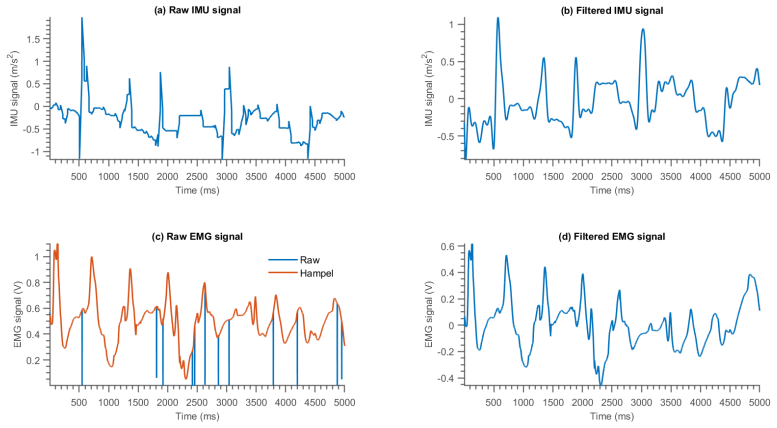
The machinery is a one-dimensional convolutional network that operates directly on a five-second, 1000 Hz multi-channel recording: eight surface-EMG channels (tibialis anterior, gastrocnemius medial and lateral, and soleus, bilaterally) plus three IMUs (left shank, right shank, right foot), synchronised by upsampling the IMU stream. The network stacks three 1D convolution, batch-normalisation, ReLU, and max-pooling stages followed by dropout and a fully connected softmax layer (21,655 trainable parameters), and is trained with cross-entropy loss and the ADAM optimiser. The same input pipeline feeds a two-layer LSTM for comparison. This shared, time-aligned representation is what lets the paper attribute differences in accuracy to model architecture and sensor modality rather than to preprocessing.
What would settle it
Run a leave-one-subject-out evaluation and stream the sensors continuously, requiring a classification decision every 200 ms instead of over a whole five-second trial. If a new subject's per-decision accuracy stays near the 69% seen without fine-tuning, or if sliding-window accuracy falls below 80% on continuous data, the paper's real-time deployability claim is contradicted; if ten calibration samples per class fails to reproduce the 89.7% fine-tuned accuracy on a larger, more diverse subject pool, the transfer-learning claim is weakened.
Extended reading notes
Core claim
The central discovery is that fusing kinematic (IMU) and muscular (sEMG) signals into one multi-channel CNN input supports higher motion-classification accuracy than either signal type alone, or than an LSTM on the same inputs, for a realistic set of daily-living movements. With all channels, the CNN classifies five movement classes with 96.5±0.8% accuracy; EMG-only and IMU-only versions reach 93.9±1.6% and 93.3±1.6%, and a single-leg version reaches 92.9±1.6%. The remaining misclassifications concentrate between directionally mirrored actions: turning left versus turning right, and walking forwards versus walking backwards. When the model is pre-trained on two subjects and fine-tuned with ten samples per class from a third subject, accuracy reaches 89.7±3.7%; without fine-tuning it is 69.0±7.6%. Zeroing all channels of one sensor at test time, simulating a failed sensor, still leaves accuracy above 80%, with the foot IMU the most important single sensor at 82.8±2.9%.
Load-bearing premise
The headline accuracy comes from a random 80/20 split of trials in which the same three people contribute to both training and testing, so the claim assumes this predicts performance for a new user in real time; the paper's own unseen-subject test drops to 69.0±7.6% before fine-tuning.
Editorial extensions
If this is right
- If the accuracy holds in real use, a CNN can support an ankle exoskeleton through the five motions needed to navigate a barrier-free environment, with misclassifications mostly between directionally mirrored movements that an exoskeleton could handle cautiously.
- A new user could be fitted in minutes: ten labelled samples per class are enough to fine-tune the pre-trained model to 89.7±3.7% accuracy, making per-person retraining unnecessary.
- Sensor redundancy is a safety feature: with any single IMU or one leg's EMG silenced, classification accuracy remains above 80%, so the device can stay safe until the failed sensor is replaced.
- Because EMG-only and IMU-only models both reach roughly 93-94%, users with weak or degraded muscle signals could still be served by the IMU channel alone.
- The released dataset and code give other groups a public benchmark for five-class daily-living motion classification with synchronised EMG and IMU signals.
Reading between the lines
- The 96.5% figure is trial-level, not decision-level: the model sees a complete five-second recording, so a continuous real-time controller would need a sliding-window variant, and the paper does not report per-decision latency; that measurement is the next test.
- With only three young healthy participants, the transfer-learning result shows feasibility, not population generality; the open question is whether ten samples per class still suffice for older adults, people with gait impairment, or day-to-day variations in electrode placement.
- Silencing a sensor to zero is an extreme but clean test; realistic failures may be partial, intermittent, or noisy, which could degrade performance differently than the paper's zero-signal simulation.
Editorial analysis
A structured set of objections, weighed in public.
Referee Report
Summary. The paper proposes a deep-learning pipeline for classifying five lower-limb locomotion tasks (turn left/right, pick up object, walk forwards/backwards) from eight surface EMG channels and three IMUs, for potential real-time ankle exoskeleton control. The authors compare CNNs and LSTMs on IMU-only, EMG-only, and fused data; report a best CNN accuracy of 96.5±0.8% on an 80/20 random split of 1,504 trials from three subjects; assess transfer learning by pre-training on two subjects and fine-tuning on the third; and simulate sensor failure by zeroing test channels. They release the dataset and code. The abstract claims real-time prediction and new-user generalization with only ten calibration samples per class.
Significance. The dataset release and reproducible processing code are useful community contributions, and the comparison of textile-electrode EMG with IMU fusion for multi-class locomotion is a relevant step for exoskeleton control. If the headline results were reproduced under a subject-independent split and with causal sliding-window inputs, the system would be an important benchmark. The transfer-learning idea is promising and the sensor-failure analysis is a pragmatic safety check. However, the current evaluation does not support the abstract's real-time or new-user claims: the 96.5% figure is an offline, trial-level, same-subject result, and the paper's own cross-subject accuracy before fine-tuning is 69.0±7.6%. The contribution is therefore a well-executed offline benchmark with a valuable dataset, rather than a demonstrated deployment-ready controller.
major comments (3)
- [Methods, Machine learning models; Results, Motion classification using deep learning; Transfer learning for model…] The headline accuracy of 96.5±0.8% is obtained from an 80/20 random split of individual trials, so trials from all three subjects appear in both training and test sets. This estimates how well the network labels a complete, pre-segmented 5-second trial from a subject it has already trained on; it does not estimate performance for a new user or for real-time control. The paper's own transfer-learning experiment quantifies the gap: training on two subjects and testing on the third without fine-tuning yields only 69.0±7.6% accuracy. To support the abstract's claims of 'real-time prediction' and generalization to new users, the authors should report a subject-independent split (e.g., leave-one-subject-out) and a causal sliding-window evaluation with prediction latency, or clearly restrict the claims to offline same-subject classification.
- [Transfer learning for model deployment; Figure 4] There is a factual inconsistency about the calibration cost. The text and abstract state that fine-tuning used '10 samples per category' (and 'ten samples per class'), while the caption of Figure 4(a) says the model was 'fine-tuned using 50 samples'. This directly affects the central transfer-learning claim and must be corrected in the manuscript.
- [Human subject study; Transfer learning for model deployment] The study includes only three subjects, and the transfer-learning evaluation is performed on a single held-out subject. The reported standard deviations are computed over five random seeds, not over subjects, so they do not capture between-subject variability. The Discussion's statement that 'the transfer learning results indicate good generalizability' is stronger than the evidence supports; the authors should report per-subject results and clearly acknowledge that the target-subject sample size is n=1.
minor comments (5)
- [Figure 4(a) caption] The caption contains a typo: 'transfer leaning' should be 'transfer learning'.
- [Table 3] The layer names are written 'Cov-1D' instead of 'Conv-1D' throughout the table.
- [Statistical analysis, Eq. (2)] Equation (2) defines accuracy as TC/(TC+FC) without explaining how TC and FC are computed for a multi-class problem; rewriting it as the fraction of correctly classified samples over the total number of samples would avoid ambiguity.
- [Abstract; Discussion; Methods] The terminology for the electrodes is inconsistent: the abstract refers to 'towel electrodes', while the Methods and Discussion describe a graphene/PEDOT:PSS textile composite; using one consistent term (e.g., 'textile electrodes') would improve clarity.
- [Figure 1(a)] The electrode schematic is reproduced from reference [25]; the authors should confirm that reproduction permission is obtained or that the figure is original.
Circularity Check
No significant circularity: the headline accuracies are measured on held-out test data, and the self-citations are ancillary rather than load-bearing.
full rationale
The paper's central empirical claims are the CNN and LSTM classification accuracies (96.5 +/- 0.8% and 87.5 +/- 2.9%) on a dataset of five motion tasks. These figures are obtained by training on an 80% random trial-level split and evaluating on the held-out 20%, as stated in the Machine learning models section: 'The dataset, consisting of recordings and labels, was randomly split into training (80%) and testing (20%) sets.' The accuracy therefore is a measured performance on held-out samples, not a quantity derived from an input assumption or from the cited references. The self-citations present in the paper are to the authors' own prior work on textile towel electrodes [25] and to a review of motion intention prediction [19], and the CNN architecture is 'adapted from a motion classification model by Tang et al. [25]'. These citations support the hardware and architecture choices, but the classification result does not depend for its numerical value on the correctness of those citations: the 96.5% figure would stand or fall with the data and the trained model, not with the cited prior work. The transfer-learning result (89.7 +/- 3.7% after fine-tuning with 10 samples per class) is likewise an empirical measurement on a held-out subject. There is no self-definitional step in which a variable is defined in terms of the quantity it is supposed to predict, no fitted parameter is renamed as a prediction, and no uniqueness claim is imported from the authors' prior work. It is also worth distinguishing validity concerns from circularity: the evaluation uses complete 5-second trials and a trial-level rather than subject-level split, so it does not by itself establish real-time or new-user performance, and the paper's own cross-subject result (69.0 +/- 7.6% without fine-tuning) confirms that gap. Those are limitations of the evaluation protocol, not circular reasoning. Since every headline quantitative result is measured against held-out data and the self-citations are not load-bearing, the analysis finds no circularity.
Assumptions & free parameters
free parameters (5)
- Training epochs =
15
- Batch size =
50
- LSTM hidden units per layer =
100
- Dropout rate =
0.2
- CNN kernel sizes and strides =
Not reported (adapted from Tang et al. [25])
assumptions (5)
- domain assumption Random trial-level 80/20 split produces independent training and test samples for estimating generalization.
- domain assumption A 5-second whole-trial window is a valid input for real-time motion prediction.
- domain assumption Zeroing all channels of a sensor faithfully simulates sensor failure.
- domain assumption Three young healthy subjects are sufficient to support generalizability claims for the target elderly and patient populations.
- domain assumption Upsampling IMU data by a factor of 40 with linear interpolation preserves temporal alignment with EMG.
Cite this review
Pith. "Pith review of Deep Learning for Motion Classification in Ankle Exoskeletons Using Surface EMG and IMU Signals." pith.science (2026). https://pith.science/paper/R6LU7WD3
@misc{pith2026241116273,
  author       = {Pith},
  title        = {Pith review of: Deep Learning for Motion Classification in Ankle Exoskeletons Using Surface EMG and IMU Signals},
  year         = {2026},
  howpublished = {\url{https://pith.science/paper/R6LU7WD3}},
  note         = {Machine review of arXiv:2411.16273}
}
abstract
Ankle exoskeletons have garnered considerable interest for their potential to enhance mobility and reduce fall risks, particularly among the aging population. The efficacy of these devices relies on accurate real-time prediction of the user's intended movements through sensor-based inputs. This paper presents a novel motion prediction framework that integrates three Inertial Measurement Units (IMUs) and eight surface Electromyography (sEMG) sensors to capture both kinematic and muscular activity data. A comprehensive set of activities, representative of everyday movements in barrier-free environments, was recorded for the purpose. Our findings reveal that Convolutional Neural Networks (CNNs) slightly outperform Long Short-Term Memory (LSTM) networks on a dataset of five motion tasks, achieving classification accuracies of $96.5 \pm 0.8 \%$ and $87.5 \pm 2.9 \%$, respectively. Furthermore, we demonstrate the system's proficiency in transfer learning, enabling accurate motion classification for new subjects using just ten samples per class for finetuning. The robustness of the model is demonstrated by its resilience to sensor failures resulting in absent signals, maintaining reliable performance in real-world scenarios. These results underscore the potential of deep learning algorithms to enhance the functionality and safety of ankle exoskeletons, ultimately improving their usability in daily life.
Figures


Figures from the paper (2 more)

Reference graph
Works this paper leans on
-
[1]
Danan Gu, Kirill Andreev, and Matthew E. Dupre. Major trends in population growth around the world. China CDC Weekly, 3(28):604–613, 2021. ISSN 2096-7071. doi: 10.46234/ccdcw2021.160. URL http://dx.doi.org/10.46234/ccdcw2021.160
-
[2]
Philipp Mahlknecht, Stefan Kiechl, Bastiaan R. Bloem, Johann Willeit, Christoph Scherfler, Arno Gasperi, Gregorio Rungger, Werner Poewe, and Klaus Seppi. Prevalence and burden of gait disor- ders in elderly men and women aged 60–97 years: A population-based study.PLoS ONE, 8(7):e69627, July 2013. ISSN 1932-6203. doi: 10.1371/journal.pone.0069627. URLhttp:...
-
[3]
Florence, Gwen Bergen, Adam Atherly, Elizabeth Burns, Judy Stevens, and Cynthia Drake
Curtis S. Florence, Gwen Bergen, Adam Atherly, Elizabeth Burns, Judy Stevens, and Cynthia Drake. Medical costs of fatal and nonfatal falls in older adults.Journal of the American Geriatrics Society, 66 (4):693–698, March 2018. ISSN 1532-5415. doi: 10.1111/jgs.15304. URLhttp://dx.doi.org/10.1111 /jgs.15304. 10
-
[4]
The human cost of falls 2013; UK Health Security Agency — ukhsa.blog.gov.uk.https://ukhsa.blog .gov.uk/2014/07/17/the-human-cost-of-falls/. [Accessed 24-10-2024]
work page 2013
-
[5]
Martin Grimmer, Robert Riener, Conor James Walsh, and André Seyfarth. Mobility related physical and functional losses due to aging and disease - a motivation for lower limb exoskeletons.Journal of NeuroEngineering and Rehabilitation, 16(1), January 2019. ISSN 1743-0003. doi: 10.1186/s12984-018-0 458-8. URL http://dx.doi.org/10.1186/s12984-018-0458-8
-
[6]
Michael Raitor, Sandra Waugh Ruggles, Scott L. Delp, C. Karen Liu, and Steven H. Collins. Lower- limb exoskeletons appeal to both clinicians and older adults, especially for fall prevention and joint pain reduction. IEEE Transactions on Neural Systems and Rehabilitation Engineering, 32:1577–1585, 2024. doi: 10.1109/TNSRE.2024.3381979
arXiv 2024
-
[7]
Wearable ankle robots in post-stroke rehabilitation of gait: A systematic review
Bin Shi, Xiaofeng Chen, Zan Yue, Shuai Yin, Qipeng Weng, Xue Zhang, Jing Wang, and Weina Wen. Wearable ankle robots in post-stroke rehabilitation of gait: A systematic review. Frontiers in Neurorobotics, 13, August 2019. ISSN 1662-5218. doi: 10.3389/fnbot.2019.00063. URL http://dx.doi.org/10.3389/fnbot.2019.00063
arXiv 2019
-
[8]
Ghaith J. Androwis, Brian M. Sandroff, Peter Niewrzol, Farris Fakhoury, Glenn R. Wylie, Guang Yue, and John DeLuca. A pilot randomized controlled trial of robotic exoskeleton-assisted exercise rehabili- tation in multiple sclerosis.Multiple Sclerosis and Related Disorders, 51:102936, June 2021. ISSN 2211-
work page 2021
Show all 41 references
-
[9]
Effectiveness of robotic exoskeletons for improving gait in children with cerebral palsy: A systematic review
Markus Hunt, Laure Everaert, Mathew Brown, Luiza Muraru, Eleni Hatzidimitriadou, and Kaat Desloovere. Effectiveness of robotic exoskeletons for improving gait in children with cerebral palsy: A systematic review. Gait & Posture , 98:343–354, October 2022. ISSN 0966-6362. d...
2022 doi
-
[10]
Cho, Kinam Kim, Shaojun Ma, and Jun Ueda
Yong K. Cho, Kinam Kim, Shaojun Ma, and Jun Ueda. A robotic wearable exoskeleton for construction worker’s safety and health. InConstruction Research Congress 2018, volume 2013, page 19–28. American Society of Civil Engineers, March 2018. doi: 10.1061/9780784481288.003. URLhtt...
2018 doi
-
[11]
Development and testing of a wearable passive lower-limb support exoskeleton to support industrial workers.Biocybernetics and Biomedical Engineering, 41(1):221–238, January 2021
Zefeng Yan, Bin Han, Zihao Du, Tiantian Huang, Ou Bai, and Ansi Peng. Development and testing of a wearable passive lower-limb support exoskeleton to support industrial workers.Biocybernetics and Biomedical Engineering, 41(1):221–238, January 2021. ISSN 0208-5216. doi: 10.1016...
2021 doi
-
[12]
Design and control of a wearable lower-body exoskeleton for squatting and walking assistance in manual handling works
Fatai Sado, Hwa Jen Yap, Raja Ariffin Raja Ghazilla, and Norhafizan Ahmad. Design and control of a wearable lower-body exoskeleton for squatting and walking assistance in manual handling works. Mechatronics, 63:102272, November 2019. ISSN 0957-4158. doi: 10.1016/j.mechatronics...
2019
-
[13]
A semi-activeexoskeletonbasedonemgsreducesmusclefatiguewhensquatting
Zhuo Wang, Xinyu Wu, Yu Zhang, Chunjie Chen, Shoubin Liu, Yida Liu, Ansi Peng, and Yue Ma. A semi-activeexoskeletonbasedonemgsreducesmusclefatiguewhensquatting. Frontiers in Neurorobotics, 15, April 2021. ISSN 1662-5218. doi: 10.3389/fnbot.2021.625479. URL http://dx.doi.org/10...
2021
-
[14]
A hip active assisted exoskeleton that assists the semi-squat lifting
Wei Wei, Shijia Zha, Yuxuan Xia, Jihua Gu, and Xichuan Lin. A hip active assisted exoskeleton that assists the semi-squat lifting. Applied Sciences, 10(7):2424, April 2020. ISSN 2076-3417. doi: 10.3390/app10072424. URL http://dx.doi.org/10.3390/app10072424
2020 doi
-
[15]
Sensors and actuation technologies in exoskeletons: A review.Sensors, 22(3):884, January 2022
Monica Tiboni, Alberto Borboni, Fabien Vérité, Chiara Bregoli, and Cinzia Amici. Sensors and actuation technologies in exoskeletons: A review.Sensors, 22(3):884, January 2022. ISSN 1424-8220. doi: 10.339 0/s22030884. URL http://dx.doi.org/10.3390/s22030884
2022 doi
-
[16]
Grabowski
Ettore Etenzi, Riccardo Borzuola, and Alena M. Grabowski. Passive-elastic knee-ankle exoskeleton reduces the metabolic cost of walking. Journal of NeuroEngineering and Rehabilitation, 17(1), July
-
[17]
Kochenderfer, Scott L
Patrick Slade, Mykel J. Kochenderfer, Scott L. Delp, and Steven H. Collins. Personalizing exoskeleton assistance while walking in the real world.Nature, 610(7931):277–282, October 2022. ISSN 1476-4687. doi: 10.1038/s41586-022-05191-1. URL http://dx.doi.org/10.1038/s41586-022-05191-1
2022 doi
-
[18]
A wearable exoskeleton suit for motion assistance to paralysed patients.Journal of Orthopaedic Translation, 11:7–18, October 2017
Bing Chen, Chun-Hao Zhong, Xuan Zhao, Hao Ma, Xiao Guan, Xi Li, Feng-Yan Liang, Jack Chun Yiu Cheng, Ling Qin, Sheung-Wai Law, and Wei-Hsin Liao. A wearable exoskeleton suit for motion assistance to paralysed patients.Journal of Orthopaedic Translation, 11:7–18, October 2017. ...
2017 doi
-
[19]
Virk, Shuo Gao, and Luigi G
Chenyu Tang, Zhenyu Xu, Edoardo Occhipinti, Wentian Yi, Muzi Xu, Sanjeev Kumar, Gurvinder S. Virk, Shuo Gao, and Luigi G. Occhipinti. From brain to movement: Wearables-based motion intention prediction across the human nervous system.Nano Energy, 115:108712, October 2023. ISSN...
2023
-
[20]
Sensors and algorithms for locomotion intention detection of lower limb exoskeletons.Medical Engineering & Physics, 113:103960, March 2023
Duojin Wang, Xiaoping Gu, and Hongliu Yu. Sensors and algorithms for locomotion intention detection of lower limb exoskeletons.Medical Engineering & Physics, 113:103960, March 2023. ISSN 1350-
2023
-
[21]
A compre- hensive survey on support vector machine classification: Applications, challenges and trends.Neuro- computing, 408:189–215, September 2020
Jair Cervantes, Farid Garcia-Lamont, Lisbeth Rodríguez-Mazahua, and Asdrubal Lopez. A compre- hensive survey on support vector machine classification: Applications, challenges and trends.Neuro- computing, 408:189–215, September 2020. ISSN 0925-2312. doi: 10.1016/j.neucom.2019....
2020 doi
-
[22]
A cnn-lstm model for six human ankle movements classification on different loads.Frontiers in Human Neuroscience, 17, March 2023
Min Li, Jiale Wang, Shiqi Yang, Jun Xie, Guanghua Xu, and Shan Luo. A cnn-lstm model for six human ankle movements classification on different loads.Frontiers in Human Neuroscience, 17, March 2023. ISSN 1662-5161. doi: 10.3389/fnhum.2023.1101938. URL http://dx.doi.org/10.3389/...
2023
-
[23]
A cnn-lstm hybrid model for ankle joint motion recognition method based on semg
Hao-Ran Cheng, Guang-Zhong Cao, Cai-Hong Li, Aibin Zhu, and Xiaodong Zhang. A cnn-lstm hybrid model for ankle joint motion recognition method based on semg. In2020 17th International Conference on Ubiquitous Robots (UR), pages 339–344, 2020. doi: 10.1109/UR49135.2020.9144698
2020
-
[24]
Soft wearable flexible bioelectronics integrated with an ankle-foot exoskeleton for estimation of metabolic costs and physical effort.npj Flexible Electronics, 7(1), January 2023
Jihoon Kim, Prakyath Kantharaju, Hoon Yi, Michael Jacobson, Hyungkeun Jeong, Hojoong Kim, Jin- woo Lee, Jared Matthews, Nathan Zavanelli, Hyeonseok Kim, Heejin Jeong, Myunghee Kim, and Woon- Hong Yeo. Soft wearable flexible bioelectronics integrated with an ankle-foot exoskele...
2023 doi
-
[25]
Occhipinti
Chenyu Tang, Wentian Yi, Sanjeev Kumar, Gurvinder Singh Virk, and Luigi G. Occhipinti. Emg-based human motion analysis: A novel approach using towel electrodes and transfer learning.IEEE Sensors Journal, 24(6):9115–9123, 2024. doi: 10.1109/JSEN.2024.3354307
2024
-
[26]
Lichtwark, Anthony G
Adrian Lai, Glen A. Lichtwark, Anthony G. Schache, Yi-Chung Lin, Nicholas A. T. Brown, and Marcus G. Pandy. In vivo behavior of the human soleus muscle with increasing walking and run- ning speeds. Journal of Applied Physiology, 118(10):1266–1275, May 2015. ISSN 1522-1601. doi...
2015
-
[27]
Yong-wook Kim, Tea-heon Kim, Mi-na Yang, Ye-seul Yon, and Ji-hye Lee. Comparison of activities of tibialis anterior, peroneus longus, and tibialis posterior muscles according to lunge squats and bulgarian split squats in a healthy population.Journal of KEMA, 1(1):26–30, Decemb...
2017 doi
-
[28]
Recognition of lower limb movements baesd on electromyogra- phy (emg) texture maps
Xiaxi Si, Yuehong Dai, and Junyao Wang. Recognition of lower limb movements baesd on electromyogra- phy (emg) texture maps. In2022 IEEE 5th International Conference on Electronics Technology (ICET), pages 1091–1095, 2022. doi: 10.1109/ICET55676.2022.9824410. 12
2022
-
[29]
Model-based analysis of muscle strength and emg-force relation with respect to different patterns of motor unit loss.Neural Plasticity, 2021:1–9, June 2021
Chengjun Huang, Maoqi Chen, Yingchun Zhang, Sheng Li, and Ping Zhou. Model-based analysis of muscle strength and emg-force relation with respect to different patterns of motor unit loss.Neural Plasticity, 2021:1–9, June 2021. ISSN 2090-5904. doi: 10.1155/2021/5513224. URLhttp:...
2021 doi
-
[30]
Ulysse Cote-Allard, Cheikh Latyr Fall, Alexandre Drouin, Alexandre Campeau-Lecours, Clement Gos- selin, Kyrre Glette, Francois Laviolette, and Benoit Gosselin. Deep learning for electromyographic hand gesture signal classification using transfer learning.IEEE Transactions on N...
2019
-
[31]
semg-based lower limb motion prediction using cnn-lstm with improved pca optimization algorithm.Journal of Bionic En- gineering, 20(2):612–627, October 2022
Meng Zhu, Xiaorong Guan, Zhong Li, Long He, Zheng Wang, and Keshu Cai. semg-based lower limb motion prediction using cnn-lstm with improved pca optimization algorithm.Journal of Bionic En- gineering, 20(2):612–627, October 2022. ISSN 2543-2141. doi: 10.1007/s42235-022-00280-3....
2022 doi
-
[32]
EmotiBit.com — emotibit.com.https://www.emotibit.com/
EmotiBit. EmotiBit.com — emotibit.com.https://www.emotibit.com/. [Accessed 26-08-2024]
2024
-
[33]
https://github.com/EmotiBit/ofxEmotiBit/rele ases
Releases · EmotiBit/ofxEmotiBit — github.com. https://github.com/EmotiBit/ofxEmotiBit/rele ases. [Accessed 24-10-2024]
2024
-
[34]
[Accessed 24-10-2024]
Recommendations for sensor locations in lower leg or foot muscles — seniam.org.http://seniam.org /lowerleg_location.htm. [Accessed 24-10-2024]
2024
-
[35]
Arjunan, and Dinesh K
Susmit Bhowmik, Beth Jelfs, Sridhar P. Arjunan, and Dinesh K. Kumar. Outlier removal in facial surface electromyography through hampel filtering technique. In2017 IEEE Life Sciences Conference (LSC), pages 258–261, 2017. doi: 10.1109/LSC.2017.8268192
2017
-
[36]
De Luca, L
Carlo J. De Luca, L. Donald Gilmore, Mikhail Kuznetsov, and Serge H. Roy. Filtering the surface emg signal: Movement artifact and baseline noise contamination.Journal of Biomechanics, 43(8):1573–1579, May 2010. ISSN 0021-9290. doi: 10.1016/j.jbiomech.2010.01.027. URL http://dx...
2010 doi
-
[37]
[Accessed 24-10-2024]
Long short-term memory neural networks.https://uk.mathworks.com/help/deeplearning/ug/long -short-term-memory-networks.html. [Accessed 24-10-2024]
2024
-
[38]
Hicks, Inga Strümke, Vajira Thambawita, Malek Hammou, Michael A
Steven A. Hicks, Inga Strümke, Vajira Thambawita, Malek Hammou, Michael A. Riegler, Pål Halvorsen, and Sravanthi Parasa. On evaluation metrics for medical applications of artificial intelligence.Scientific Reports, 12(1), April 2022. ISSN 2045-2322. doi: 10.1038/s41598-022-099...
2022 doi
-
[348]
URL http://dx.doi.org/10.1016/j.msard.2021.102936
doi: 10.1016/j.msard.2021.102936. URL http://dx.doi.org/10.1016/j.msard.2021.102936
2021
-
[2020]
doi: 10.1186/s12984-020-00719-w
ISSN 1743-0003. doi: 10.1186/s12984-020-00719-w. URL http://dx.doi.org/10.1186/s1298 4-020-00719-w. 11
-
[4533]
URL http://dx.doi.org/10.1016/j.medengphy.202 3.103960
doi: 10.1016/j.medengphy.2023.103960. URL http://dx.doi.org/10.1016/j.medengphy.202 3.103960
2023
Reviewed August 12, 2026 · model on record in the stance chip above.
Discussion (0). Continue with ORCID to comment.