REVIEW 3 major objections 5 minor 57 references
Even Sparser Graph Transformers
T0 review · 3 major / 5 minor · reviewed 2026-08-12 · deepseek-v4-flash
Pith's one-line read A narrow graph transformer can be trained first to map the attention edges a wide graph transformer needs, and that map can be used to prune the graph before the expensive model is trained.
desk verdict A genuinely useful two-stage sparsification method whose empirical case is stronger than its theory; the abstract overstates the theoretical backing. read the letter →
The pith
A machine-rendered reading of the paper's core claim, the machinery that carries it, and where it could break.
The reading
What carries the argument
The carrying object is the attention score estimator: a deliberately narrow (width 4 or 8), single-head graph transformer whose only job is to produce per-layer attention scores over a graph augmented with graph edges, expander edges, and self-loops. Two small modifications make its scores more transferable: the value vectors are normalized (with one learnable global scale per head) so that attention scores reflect actual contribution, and the softmax temperature is annealed from 1.0 down to 0.05 to sharpen the scores. The scores are converted into a sparse attention pattern by weighted reservoir sampling, where each node keeps a fixed number of neighbors per layer using weights proportional to the estimated attention scores; resampling each epoch lets the model spread probability across equally informative neighbors. The theoretical engine is the Johnson-Lindenstrauss lemma, used to show that low-dimensional query/key maps can preserve the dot products that determine attention up to $\varepsilon$, together with a matrix-Bernstein analysis of entrywise sampling that gives the $O(n\log n/\varepsilon^2)$ sample bound for spectral approximation.
What would settle it
Train a width-4 and a width-256 network with the same architecture on a graph small enough to run both, and measure the average Jaccard overlap between their top-10 attention neighbors per node; if the overlap is no better than sampling from a uniform distribution, the consistency claim fails. A second check is to compare Spexphormer's accuracy when sparsification uses the narrow network's scores versus the wide network's own scores; a large accuracy gap would mean the estimated scores are not faithful enough for the method's promise.
Extended reading notes
Core claim
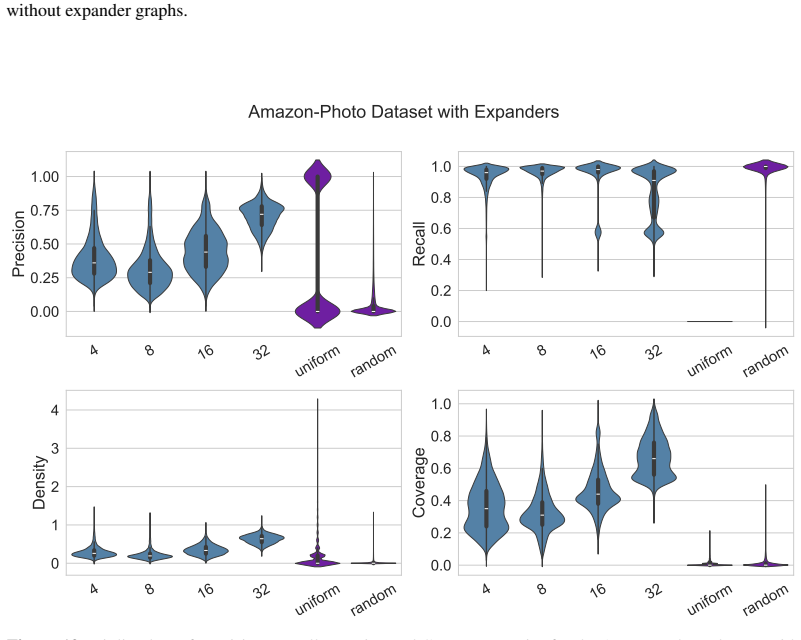
The central claim is that attention scores in graph transformers are stable across different network widths, and that this stability is a usable resource rather than a curiosity. Empirically, the paper measures distributions of attention scores for networks of widths 4 through 64 on two datasets, using energy distance and precision/recall/density/coverage, and finds that even a width-4 network's per-node attention distributions are far closer to a width-64 network's than uniform or random baselines are. Theoretically, the paper proves that for a wide network with bounded hidden-state norms and weight operator norms, there exists a narrow network whose attention scores satisfy $\hat a_{ij}/a_{ij}=1+O(\varepsilon)$ for every edge, with query/key width $d=O(\log n/\varepsilon^2)$; the construction multiplies the wide network's query and key maps by a random Johnson-Lindenstrauss projection. For sparsification, the paper proves that sampling $O(n\log n/\varepsilon^2)$ entries of the attention matrix per layer yields a sparse matrix within $\varepsilon$ spectral norm of the full attention matrix, and that the same guarantee survives when sampling is driven by a narrow network's scores provided those scores do not seriously under-estimate the true ones. The resulting method, Spexphormer, does per-layer weighted reservoir sampling to build a fixed-degree directed attention graph, which makes attention computable with dense batched matrix multiplications and enables memory-controlled batching that preserves task-relevant edges.
Load-bearing premise
The whole procedure relies on a narrow network trained from scratch by gradient descent actually learning attention scores close to those of a much wider network, but the theory only shows that such a narrow network exists, not that training finds it.
Editorial extensions
If this is right
- Graph transformers can be trained on graphs with millions of nodes within a few gigabytes of GPU memory, since the wide model only ever sees a fixed-degree sparse graph.
- High-degree expander augmentations become affordable: the cheap estimator can be trained on them, and the final network keeps only the expander edges that actually receive attention.
- Per-epoch resampling lets the final model hedge among equally informative neighbors, avoiding the brittleness of always keeping only the top-scored edges.
- The same estimated attention scores can be reused to train several final networks of different widths and depths without retraining the estimator.
- Because each layer can have its own fixed degree, the model can spend more edges where attention is diffuse (typically the first layer) and fewer where attention is sharp (later layers).
Reading between the lines
- We infer that the estimator's edge sets could be produced once as a preprocessing step for a dataset and then reused by any downstream model, making attention-based sparsification a commodity rather than part of each training run.
- The theory only proves existence of a narrow network via random projection, so we infer the empirical consistency result is the load-bearing part; a natural stress test is widths far beyond 64, where the paper provides no measurements.
- We infer that the same width-consistency mechanism may transfer to non-graph token sets whose representations are low-rank or clustered, since the JL argument itself only needs bounded norms and a union bound over pairs.
Editorial analysis
A structured set of objections, weighed in public.
Referee Report
Summary. The paper proposes Spexphormer, a two-stage procedure for scaling graph transformers. In the first stage, a narrow network (width 4 or 8) is trained on the full augmented graph, and its per-layer attention scores are used to sample a fixed number of neighbors per node via reservoir sampling. In the second stage, a wider network is trained on this sparsified, layer-wise graph. The paper claims, empirically and with theoretical backing, that attention scores are consistent across network widths, and it provides two theoretical results: Theorem E.4, an existence result showing that a network with low-dimensional Q/K projections can approximate the attention scores of a wide network, and Theorem E.5/Proposition E.7, sampling bounds for approximating an attention matrix from sampled entries. Experiments cover twelve medium-sized graphs and three large graphs, with ablations and memory comparisons.
Significance. If the attention-consistency premise holds, Spexphormer offers a practical route to train graph transformers on large graphs with drastically reduced memory: the narrow estimator identifies important edges, and the wide network trains on a sparse pattern with regular degree, enabling efficient dense matrix operations and batching. The paper's strengths include a reproducible open-source implementation, extensive ablations (Table 4, Figures 5-8), a careful comparison against many baselines, and a direct memory-reduction demonstration (Figure 4, Table 3). The theoretical results are clearly stated and the paper is honest about their scope in Section 4.1, noting that the existence theorem does not guarantee that SGD finds the constructed weights. The main weakness is that the central claim, that a trained narrow network's attention scores can stand in for a wide network's, is only partially supported: the theory covers an existence construction, and the empirical study uses distributional metrics on two datasets.
major comments (3)
- [§4.1, Theorem E.4] The theoretical result constructs a network whose Q/K weight matrices are random Johnson-Lindenstrauss projections of the wide network's weights, while all other weight matrices remain unchanged; it is an existence result for a partially narrow network, not a statement about the fully narrow width-4/8 estimator trained from scratch by SGD that the method actually uses. The paper explicitly concedes this at the end of Section E.1, but the abstract's phrase 'with theoretical backing' is not supported by this theorem. This gap is load-bearing because the two-stage procedure's first stage must produce reliable attention scores from a narrow network trained via gradient descent, and no argument links the trained estimator to the constructed solution.
- [§E.2, Proposition E.7] The sampling guarantee depends on the per-entry condition |A'_ij| >= |A_ij|/alpha for every edge, a condition that is neither proved for trained narrow networks nor verified empirically. The experiments in Section 5.1 measure distributional distances (energy distance, PRDC) across per-node attention distributions; these metrics can be small even when the two networks disagree on which specific edges receive high attention, which is precisely the information used for sparsification. The ablation in Table 4 shows that attention-based sampling beats uniform sampling, but this does not quantify the per-entry condition. Please either add a direct edge-level agreement metric (e.g., overlap of top-k edges) or explicitly frame the sampling bound as conditional on an unverified assumption.
- [§5.1 / §5.2] The empirical evidence for the core attention-consistency claim is limited to two small datasets (Actor and Photo) with 100 runs each, measuring distributional similarity rather than the edge-level agreement that the sparsification step requires. While the competitive results on twelve medium and three large graphs in Section 5.2 and the ablation in Table 4 are encouraging, they do not directly establish that narrow and wide networks rank edges similarly. A direct comparison of top-k edge sets between narrow and wide networks, or additional attention-consistency measurements on at least one larger or heterophilic dataset, would substantially strengthen the paper's central claim.
minor comments (5)
- [Appendix F.1] The energy distance formula is written as 2E[X − Y] − E[X − X′] − E[Y − Y′]; the absolute value signs are missing and should read 2E[|X − Y|] − E[|X − X′|] − E[|Y − Y′|].
- [Algorithm 1] The input notation 'a(ℓ) i,NH (i)' is difficult to parse; please define it explicitly as the vector of attention scores from node i to all neighbors in layer ℓ.
- [Figure 4] The caption should clarify that the memory value for Exphormer with degree 30 on ogbn-arxiv is a lower bound, since the configuration could not fit into the 40GB GPU device.
- [Appendix G] There is a typo: 'Unline' should be 'Unlike' in the last sentence of the first paragraph.
- [Section 3] The attention equation uses 'Ej ⊙ Kj' without defining the shapes or the intended element-wise product; please specify the dimensions of Ej and Kj and clarify the operation.
Circularity Check
No significant circularity: the core transfer claim rests on independent experiments, and the theory is stated as existence and sampling bounds with explicit assumptions.
full rationale
The paper's two-stage procedure trains a narrow network and then uses its attention scores to sparsify before training a wider network; the wide network's scores are never used as training targets for the narrow network, so no prediction is fitted by construction. Theorem E.4 is an existence result: it constructs cW_Q and cW_K as JL projections of the wide network's weights ("we can define cW_Q = M_QK W_Q and cW_K = M_QK W_K") and the authors explicitly concede that "this does not mean that training with a gradient-based algorithm will necessarily lead to the introduced weights." The practical claim is therefore supported by the independent experiments in Section 5.1 (energy distance and PRDC on Actor and Photo), not by the theorem alone. Proposition E.7 is an explicit conditional bound: it assumes |A'_ij| >= (1/alpha)|A_ij| and does not claim this holds automatically for a trained narrow network. The only self-citations (Shirzad et al. 2023 for Exphormer background and Shirzad et al. 2024 for further compressibility scenarios) are not load-bearing: the paper states "This is an existence claim; we will justify experimentally that in practice, training a narrow network does approximate attention scores well," and then supplies that experimental justification. No equation in the paper reduces to its own input by definition, and no fitted parameter is renamed as a prediction. The identified gaps are correctness risks about the link between existence and trained optimization, not circularity.
Assumptions & free parameters
free parameters (4)
- V-normalization scale s =
learned
- Temperature schedule (lambda, gamma) =
lambda=5, gamma=0.95 or 0.99
- Per-layer sampling degree deg_l =
varies per dataset/layer, e.g., [5,5,5,5], [12,5,5,5]
- Expander degree =
30 to 200 for estimator
assumptions (4)
- standard math JLT lemma: for d=O(log n / eps^2), there is a random projection preserving dot products up to eps.
- domain assumption Bounded norm assumptions: for all layers and nodes, ||h||_2 <= sqrt(alpha) and operator norms ||W|| <= beta.
- domain assumption Attention matrix A satisfies row-stochastic, max column sum K, and column sparsity ell.
- ad hoc to paper No serious underestimation: A'_ij >= A_ij / alpha for a large constant alpha.
Cite this review
Pith. "Pith review of Even Sparser Graph Transformers." pith.science (2026). https://pith.science/paper/NI53VVUD
@misc{pith2026241116278,
  author       = {Pith},
  title        = {Pith review of: Even Sparser Graph Transformers},
  year         = {2026},
  howpublished = {\url{https://pith.science/paper/NI53VVUD}},
  note         = {Machine review of arXiv:2411.16278}
}
read the original abstract
Graph Transformers excel in long-range dependency modeling, but generally require quadratic memory complexity in the number of nodes in an input graph, and hence have trouble scaling to large graphs. Sparse attention variants such as Exphormer can help, but may require high-degree augmentations to the input graph for good performance, and do not attempt to sparsify an already-dense input graph. As the learned attention mechanisms tend to use few of these edges, such high-degree connections may be unnecessary. We show (empirically and with theoretical backing) that attention scores on graphs are usually quite consistent across network widths, and use this observation to propose a two-stage procedure, which we call Spexphormer: first, train a narrow network on the full augmented graph. Next, use only the active connections to train a wider network on a much sparser graph. We establish theoretical conditions when a narrow network's attention scores can match those of a wide network, and show that Spexphormer achieves good performance with drastically reduced memory requirements on various graph datasets.
Figures


Figures from the paper (19 more)




Reference graph
Works this paper leans on
-
[1]
Abadi, M., Agarwal, A., Barham, P., Brevdo, E., Chen, Z., Citro, C., Corrado, G. S., Davis, A., Dean, J., Devin, M., Ghemawat, S., Goodfellow, I., Harp, A., Irving, G., Isard, M., Jia, Y., Jozefowicz, R., Kaiser, L., Kudlur, M., Levenberg, J., Man\' e , D., Monga, R., Moore, S., Murray, D., Olah, C., Schuster, M., Shlens, J., Steiner, B., Sutskever, I., T...
2015
-
[2]
Achlioptas, D., Karnin, Z. S., and Liberty, E. (2013). Near-optimal entrywise sampling for data matrices. Advances in Neural Information Processing Systems , 26
work page 2013
-
[3]
Chen, J., Gao, K., Li, G., and He, K. (2022a). Nagphormer: Neighborhood aggregation graph transformer for node classification in large graphs. CoRR , abs/2206.04910
arXiv 2022
-
[4]
Chen, Y., Zeng, Q., Hakkani - Tur, D., Jin, D., Ji, H., and Yang, Y. (2022b). Sketching as a tool for understanding and accelerating self-attention for long sequences. In Carpuat, M., de Marneffe, M., and Ru \' z, I. V. M., editors, Proceedings of the 2022 Conference of the North American Chapter of the Association for Computational Linguistics: Human Lan...
work page 2022
-
[5]
M., Likhosherstov, V., Dohan, D., Song, X., Gane, A., Sarl \' o s, T., Hawkins, P., Davis, J
Choromanski, K. M., Likhosherstov, V., Dohan, D., Song, X., Gane, A., Sarl \' o s, T., Hawkins, P., Davis, J. Q., Mohiuddin, A., Kaiser, L., Belanger, D. B., Colwell, L. J., and Weller, A. (2021). Rethinking attention with performers. In ICLR
work page 2021
-
[6]
Cram \'e r, H. (1928). On the composition of elementary errors: First paper: Mathematical deductions. Scandinavian Actuarial Journal , 1928(1):13--74
work page 1928
-
[7]
Deng, C., Yue, Z., and Zhang, Z. (2024). Polynormer: Polynomial-expressive graph transformer in linear time. arXiv preprint arXiv:2403.01232
arXiv 2024
-
[8]
Devlin, J., Chang, M.-W., Lee, K., and Toutanova, K. (2018). Bert: Pre-training of deep bidirectional transformers for language understanding. arXiv preprint arXiv:1810.04805
arXiv 2018
Show all 57 references
-
[9]
Di Giovanni, F., Giusti, L., Barbero, F., Luise, G., Lio, P., and Bronstein, M. M. (2023a). On over-squashing in message passing neural networks: The impact of width, depth, and topology. In International Conference on Machine Learning , pages 7865--7885. PMLR
2023
-
[10]
K., Bronstein, M
Di Giovanni, F., Rusch, T. K., Bronstein, M. M., Deac, A., Lackenby, M., Mishra, S., and Veli c kovi \'c , P. (2023b). How does over-squashing affect the power of gnns? arXiv preprint arXiv:2306.03589
2023 arXiv
-
[11]
Dosovitskiy, A., Beyer, L., Kolesnikov, A., Weissenborn, D., Zhai, X., Unterthiner, T., Dehghani, M., Minderer, M., Heigold, G., Gelly, S., et al. (2020). An image is worth 16x16 words: Transformers for image recognition at scale. arXiv preprint arXiv:2010.11929
2020 arXiv
-
[12]
Dwivedi, V. P. and Bresson, X. (2020). A generalization of transformer networks to graphs. CoRR , abs/2012.09699
2020 arXiv
-
[13]
Efraimidis, P. S. and Spirakis, P. G. (2006). Weighted random sampling with a reservoir. Information processing letters , 97(5):181--185
2006
-
[14]
\.I ., Bronstein, M., and Levie, R
Finkelshtein, B., Ceylan, \.I . \.I ., Bronstein, M., and Levie, R. (2024). Learning on large graphs using intersecting communities. arXiv preprint arXiv:2405.20724
2024 arXiv
-
[15]
J., Morris, C., Velingker, A., and Geerts, F
Franks, B. J., Morris, C., Velingker, A., and Geerts, F. (2024). Weisfeiler-leman at the margin: When more expressivity matters. arXiv preprint arXiv:2402.07568
2024 arXiv
-
[16]
Frasca, F., Rossi, E., Eynard, D., Chamberlain, B., Bronstein, M., and Monti, F. (2020). Sign: Scalable inception graph neural networks. arXiv preprint arXiv:2004.11198
2020 arXiv
-
[17]
Hamilton, W., Ying, Z., and Leskovec, J. (2017). Inductive representation learning on large graphs. Advances in neural information processing systems , 30
2017
-
[18]
Hu, W., Fey, M., Ren, H., Nakata, M., Dong, Y., and Leskovec, J. (2021). OGB-LSC: A large-scale challenge for machine learning on graphs. CoRR , abs/2103.09430
2021 arXiv
-
[19]
Johnson, W. B. (1984). Extensions of lipshitz mapping into hilbert space. In Conference modern analysis and probability, 1984 , pages 189--206
1984
-
[20]
and Shakhnarovich, G
Kakade, S. and Shakhnarovich, G. (2009). Lecture notes in large scale learning. https://home.ttic.edu/ gregory/courses/LargeScaleLearning/lectures/jl.pdf
2009
-
[21]
Kipf, T. N. and Welling, M. (2016). Semi-supervised classification with graph convolutional networks. arXiv preprint arXiv:1609.02907
2016 arXiv
-
[22]
B., and Goldstein, T
Kong, K., Chen, J., Kirchenbauer, J., Ni, R., Bruss, C. B., and Goldstein, T. (2023). Goat: A global transformer on large-scale graphs. In International Conference on Machine Learning , pages 17375--17390. PMLR
2023
-
[23]
L., L \'e tourneau, V., and Tossou, P
Kreuzer, D., Beaini, D., Hamilton, W. L., L \'e tourneau, V., and Tossou, P. (2021). Rethinking graph transformers with spectral attention. arXiv preprint arXiv:2106.03893
2021 arXiv
-
[24]
Li, X., Zhu, R., Cheng, Y., Shan, C., Luo, S., Li, D., and Qian, W. (2022). Finding global homophily in graph neural networks when meeting heterophily. In International Conference on Machine Learning , pages 13242--13256. PMLR
2022
-
[25]
L., Gupta, V., Bhalerao, O., and Lim, S
Lim, D., Hohne, F., Li, X., Huang, S. L., Gupta, V., Bhalerao, O., and Lim, S. N. (2021). Large scale learning on non-homophilous graphs: New benchmarks and strong simple methods. Advances in Neural Information Processing Systems , 34:20887--20902
2021
-
[26]
Liu, X., Yan, M., Deng, L., Li, G., Ye, X., and Fan, D. (2021). Sampling methods for efficient training of graph convolutional networks: A survey. IEEE/CAA Journal of Automatica Sinica , 9(2):205--234
2021
-
[27]
and Cangea, C
Mernyei, P. and Cangea, C. (2020). Wiki-cs: A wikipedia-based benchmark for graph neural networks. arXiv preprint arXiv:2007.02901
2020 arXiv
-
[28]
Mialon, G., Chen, D., Selosse, M., and Mairal, J. (2021). Graphit: Encoding graph structure in transformers. CoRR , abs/2106.05667
2021 arXiv
-
[29]
M \"u ller, L., Galkin, M., Morris, C., and Ramp \'a s ek, L. (2023). Attending to graph transformers. arXiv preprint arXiv:2302.04181
2023 arXiv
-
[30]
F., Oh, S
Naeem, M. F., Oh, S. J., Uh, Y., Choi, Y., and Yoo, J. (2020). Reliable fidelity and diversity metrics for generative models. In International Conference on Machine Learning , pages 7176--7185. PMLR
2020
-
[31]
Paszke, A., Gross, S., Massa, F., Lerer, A., Bradbury, J., Chanan, G., Killeen, T., Lin, Z., Gimelshein, N., Antiga, L., et al. (2019). Pytorch: An imperative style, high-performance deep learning library. Advances in neural information processing systems , 32
2019
-
[32]
C.-C., Lei, Y., and Yang, B
Pei, H., Wei, B., Chang, K. C.-C., Lei, Y., and Yang, B. (2020). Geom-gcn: Geometric graph convolutional networks. arXiv preprint arXiv:2002.05287
2020 arXiv
-
[33]
Platonov, O., Kuznedelev, D., Diskin, M., Babenko, A., and Prokhorenkova, L. (2023). A critical look at the evaluation of GNNs under heterophily: Are we really making progress? arXiv preprint arXiv:2302.11640
2023 arXiv
-
[34]
Prabhu, A., Varma, G., and Namboodiri, A. M. (2018). Deep expander networks: Efficient deep networks from graph theory. In Ferrari, V., Hebert, M., Sminchisescu, C., and Weiss, Y., editors, Computer Vision - ECCV 2018 - 15th European Conference, Munich, Germany, September 8-14...
2018
-
[35]
P., Luu, A
Ramp \'a s ek, L., Galkin, M., Dwivedi, V. P., Luu, A. T., Wolf, G., and Beaini, D. (2022). Recipe for a general, powerful, scalable graph transformer. Advances in Neural Information Processing Systems , 35:14501--14515
2022
-
[36]
Rizzo, M. L. and Sz \'e kely, G. J. (2016). Energy distance. wiley interdisciplinary reviews: Computational statistics , 8(1):27--38
2016
-
[37]
K., Bronstein, M
Rusch, T. K., Bronstein, M. M., and Mishra, S. (2023). A survey on oversmoothing in graph neural networks. arXiv preprint arXiv:2303.10993
2023 arXiv
-
[38]
S., Bachem, O., Lucic, M., Bousquet, O., and Gelly, S
Sajjadi, M. S., Bachem, O., Lucic, M., Bousquet, O., and Gelly, S. (2018). Assessing generative models via precision and recall. Advances in neural information processing systems , 31
2018
-
[39]
Sejdinovic, D., Sriperumbudur, B., Gretton, A., and Fukumizu, K. (2013). Equivalence of distance-based and RKHS -based statistics in hypothesis testing. The Annals of Statistics , 41(5):2263 -- 2291
2013
-
[40]
Shchur, O., Mumme, M., Bojchevski, A., and G \"u nnemann, S. (2018). Pitfalls of graph neural network evaluation. arXiv preprint arXiv:1811.05868
2018 arXiv
-
[41]
P., and Sutherland, D
Shirzad, H., Lin, H., Venkatachalam, B., Velingker, A., Woodruff, D. P., and Sutherland, D. J. (2024). A theory for compressibility of graph transformers for transductive learning. In Machine Learning and Compression Workshop at NeurIPS . arXiv preprint arXiv:2411.13028
2024 arXiv
-
[42]
J., and Sinop, A
Shirzad, H., Velingker, A., Venkatachalam, B., Sutherland, D. J., and Sinop, A. K. (2023). Exphormer: Sparse transformers for graphs. In ICML
2023
-
[43]
Székely, G. J. and Rizzo, M. L. (2013). Energy statistics: A class of statistics based on distances. Journal of Statistical Planning and Inference , 143(8):1249--1272
2013
-
[44]
and Zabovsky, M
Takac, L. and Zabovsky, M. (2012). Data analysis in public social networks. In International scientific conference and international workshop present day trends of innovations , volume 1
2012
-
[45]
Tay, Y., Dehghani, M., Bahri, D., and Metzler, D. (2020). Efficient transformers: A survey. arXiv preprint arXiv:2009.06732
2020 arXiv
-
[46]
P., Dong, X., and Bronstein, M
Topping, J., Di Giovanni, F., Chamberlain, B. P., Dong, X., and Bronstein, M. M. (2021). Understanding over-squashing and bottlenecks on graphs via curvature. arXiv preprint arXiv:2111.14522
2021 arXiv
-
[47]
N., Kaiser, L., and Polosukhin, I
Vaswani, A., Shazeer, N., Parmar, N., Uszkoreit, J., Jones, L., Gomez, A. N., Kaiser, L., and Polosukhin, I. (2017). Attention is all you need. In NeurIPS , pages 5998--6008
2017
-
[48]
Veli c kovi \'c , P., Cucurull, G., Casanova, A., Romero, A., Lio, P., and Bengio, Y. (2018). Graph attention networks. In ICLR
2018
-
[49]
Wu, F., Souza, A., Zhang, T., Fifty, C., Yu, T., and Weinberger, K. (2019). Simplifying graph convolutional networks. In International conference on machine learning , pages 6861--6871. PMLR
2019
-
[50]
Wu, Q., Yang, C., Zhao, W., He, Y., Wipf, D., and Yan, J. (2023). Difformer: Scalable (graph) transformers induced by energy constrained diffusion. arXiv preprint arXiv:2301.09474
2023 arXiv
-
[51]
P., and Yan, J
Wu, Q., Zhao, W., Li, Z., Wipf, D. P., and Yan, J. (2022). Nodeformer: A scalable graph structure learning transformer for node classification. NeurIPS , 35:27387--27401
2022
-
[52]
Wu, Q., Zhao, W., Yang, C., Zhang, H., Nie, F., Jiang, H., Bian, Y., and Yan, J. (2024). Simplifying and empowering transformers for large-graph representations. Advances in Neural Information Processing Systems , 36
2024
-
[53]
Ying, C., Cai, T., Luo, S., Zheng, S., Ke, G., He, D., Shen, Y., and Liu, T.-Y. (2021). Do transformers really perform bad for graph representation? ArXiv , abs/2106.05234
2021 arXiv
-
[54]
A., Ainslie, J., Alberti, C., Ontanon, S., Pham, P., Ravula, A., Wang, Q., Yang, L., et al
Zaheer, M., Guruganesh, G., Dubey, K. A., Ainslie, J., Alberti, C., Ontanon, S., Pham, P., Ravula, A., Wang, Q., Yang, L., et al. (2020). Big bird: Transformers for longer sequences. Advances in neural information processing systems , 33:17283--17297
2020
-
[55]
Zeng, H., Zhou, H., Srivastava, A., Kannan, R., and Prasanna, V. K. (2020). Graphsaint: Graph sampling based inductive learning method. In 8th International Conference on Learning Representations, ICLR 2020, Addis Ababa, Ethiopia, April 26-30, 2020 . OpenReview.net
2020
-
[56]
Zhang, J., Zhang, H., Xia, C., and Sun, L. (2020). Graph- B ert: Only attention is needed for learning graph representations. arXiv preprint arXiv:2001.05140
2020 arXiv
-
[57]
Zhao, J., Li, C., Wen, Q., Wang, Y., Liu, Y., Sun, H., Xie, X., and Ye, Y. (2021). Gophormer: Ego-graph transformer for node classification. CoRR , abs/2110.13094
2021 arXiv
Reviewed August 12, 2026 · model on record in the stance chip above.
Discussion (0). Continue with ORCID to comment.