REVIEW 3 major objections 4 minor 67 references
Giant Electron-Phonon Coupling Induced Band-Gap Renormalization in Anharmonic Silver Chalcohalide Antiperovskites
T0 review · 3 major / 4 minor · reviewed 2026-08-12 · deepseek-v4-flash
Pith's one-line read Electron-phonon coupling collapses silver chalcohalide antiperovskite band gaps by 20–60% near room temperature, reconciling theory with experiment.
desk verdict Likely right about the mechanism, but the record 20-60% renormalization needs much better convergence evidence than ten configurations and one k-point. read the letter →
The pith
A machine-rendered reading of the paper's core claim, the machinery that carries it, and where it could break.
The reading
What carries the argument
The machinery is a two-part decomposition of the temperature-dependent band gap, $\Delta E_g(T) = \Delta E_g^S(T) + \Delta E_g^L(T)$. The short-wavelength part $\Delta E_g^S$ is obtained by averaging HSEsol+SOC band gaps over N = 10 configurations from a 40-atom AIMD supercell at a single k-point; the long-wavelength part $\Delta E_g^L$ is computed with anharmonic Fröhlich theory using temperature-renormalized LO phonon frequencies and polaron parameters. The mechanism is pinned down by frozen-phonon analysis of the fifteen $\Gamma$ phonon modes, which shows that low-energy polar modes produce the largest band-gap reduction per unit distortion, and by a 45-orbital Wannier tight-binding model that attributes the conduction-band lowering to enhanced Ag–S s-orbital hybridization (larger off-diagonal hopping and smaller diagonal energy difference).
What would settle it
Measure the optical absorption edge of a single-crystal or well-characterized film of Ag3SBr from 0 to 400 K and extract $E_g(T)$; the paper predicts a drop from about 1.8 eV at 0 K to roughly 1.0–1.1 eV at 300–400 K. An observed drop of less than ~0.3 eV over that range would falsify the giant-renormalization claim. Alternatively, recompute $\Delta E_g^S$ with 100 AIMD snapshots instead of 10 in the same 40-atom supercell and functional; if the averaged gap moves by more than 0.1 eV, the stated convergence is wrong.
Extended reading notes
Core claim
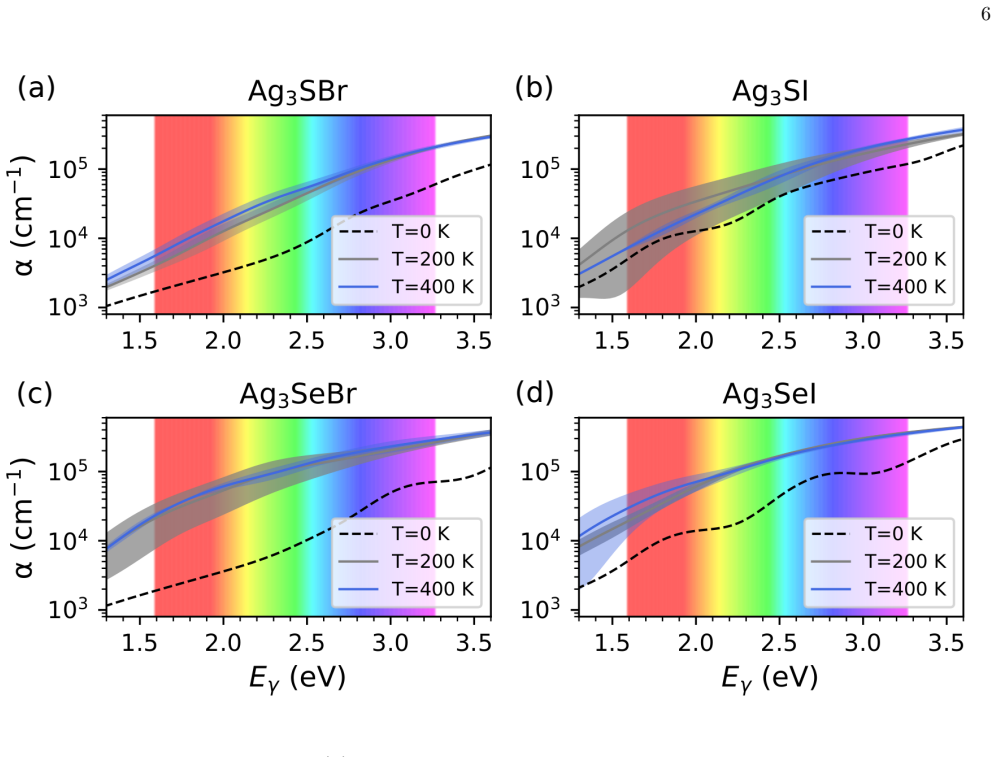
The central claim is that the long-standing theory–experiment discrepancy in the band gaps of Ag3SBr, Ag3SI, Ag3SeBr, and Ag3SeI is caused by electron–phonon coupling, not by deficiencies in the underlying electronic-structure method. Using HSEsol+SOC band gaps averaged over ab initio molecular dynamics configurations plus an anharmonic Fröhlich correction, the authors find that near room temperature the band gap shrinks by roughly 20–60% relative to its T = 0 K value; for Ag3SBr, for instance, $E_g$ falls from 1.8 eV at 0 K to about 1.0–1.1 eV at 200–400 K, matching the measured 1.0 eV. The authors identify the microscopic mechanism with frozen-phonon distortions and a 45-orbital Wannier tight-binding model: a low-energy polar optical phonon (~10 meV) distorts the lattice so that one Ag–S distance shortens while the other two lengthen, increasing the hopping matrix element $\langle \mathrm{Ag}\, s | H | \mathrm{S}\, s \rangle$ and lowering the bonding $\sigma$ state of the conduction band. Because the valence-band maximum at M is barely affected, the indirect gap closes mostly through the conduction-band edge. The paper further reports that the same electron–phonon coupling enhances visible-light absorption by nearly an order of magnitude at finite temperature.
Load-bearing premise
The short-wavelength correction, which contributes about 80–90% of the total band-gap reduction, is computed by averaging HSEsol+SOC band gaps over only ten atomic configurations drawn from a single 40-atom supercell AIMD trajectory and evaluated at one k-point; if those ten snapshots do not represent the anharmonic thermal distribution (or if the k-point misses the gap extremum in distorted cells), the quantitative 20–60% renormalization is not established.
Editorial extensions
If this is right
- The previously unexplained 60–80% theory–experiment gap in these materials is accounted for by electron–phonon coupling, so future DFT studies of CAP can use the finite-temperature $E_g$ as the reference rather than the static gap.
- CAP becomes a benchmark system for giant band-gap renormalization, roughly twice the previously reported record (molecular crystals, 15–20%), making them a testbed for anharmonic electron–phonon physics.
- Thermal enhancement of visible-light absorption by up to an order of magnitude suggests that CAP-based devices should be characterized and optimized at operating temperatures, not at 0 K.
- Since the responsible phonons are polar and inversion-symmetry-breaking, electric fields or resonant photoexcitation of these modes could in principle tune the band gap dynamically, an avenue the paper proposes for future devices.
Reading between the lines
- A direct test of the numerical conjecture would be to recompute $\Delta E_g^S$ with 100 AIMD snapshots (or a denser k-point grid) in the same 40-atom supercell; the Methods-stated 0.1 eV accuracy is keyed to N = 10, and a larger sample would either confirm or revise the reported magnitudes.
- The paper's proposed fingerprint for giant renormalization—centrosymmetric crystals with low-energy polar phonons and delocalized orbitals—could be scanned across existing phonon databases to predict other materials with similarly large temperature-driven band-gap changes.
- The frozen-phonon mechanism implies that a static polar distortion (e.g., induced by an electric field) should lower the conduction band even at T = 0 K; measuring the band gap of CAP under a DC field would be a clean, testable consequence.
- The single-k-point sampling of the short-wavelength correction may miss indirect-gap extrema in thermally distorted supercells; a dedicated study comparing Γ-only and full-BZ sampling would clarify whether the 20–60% range is robust.
Editorial analysis
A structured set of objections, weighed in public.
Referee Report
Summary. The paper argues that finite-temperature electron-phonon coupling (EPC) in the anharmonic silver chalcohalide antiperovskites Ag3XY (X = S, Se; Y = Br, I) produces a giant band-gap renormalization of 20–60% near room temperature, relative to the zero-temperature HSEsol+SOC gap. The total correction is split into a short-wavelength term from AIMD configuration averaging and a long-wavelength term from Fröhlich theory with anharmonic phonons. The authors find that the short-wavelength term dominates, identify low-energy optical polar phonons as the main driver, and support this with frozen-phonon calculations, a Wannier-based tight-binding model, and a proposed orbital-hybridization mechanism. The corrected gaps are compared with experimental gaps, and the optical absorption coefficient is shown to increase strongly with temperature. The central claim is that this resolves a long-standing 60–80% theory–experiment discrepancy and sets a record for relative band-gap renormalization.
Significance. If the quantitative claim holds, the paper identifies a new class of materials with extremely strong electron-phonon coupling, explains a long-standing discrepancy, and provides a concrete microscopic mechanism (inversion-symmetry-breaking polar phonons enhancing Ag–S s-orbital hybridization and lowering the conduction band). The study combines several independent approaches—static hybrid DFT, AIMD, anharmonic phonon calculations, Fröhlich theory, and a tight-binding model—and the mechanistic picture is internally consistent with the frozen-phonon and tight-binding results. A notable strength is that the reported corrections are not fitted to the experimental gaps; the experiment is used as a benchmark. However, the headline quantitative result rests on a single computational channel (the short-wavelength correction), whose convergence evidence is deferred to the supplementary material and which is computed at one k-point with only ten configurations. The paper is therefore significant if the convergence and sampling concerns are resolved.
major comments (3)
- [Methods: Short-wavelength phonon band-gap correction]
- [Table I and Fig. 3]
- [Results: 'EPC mechanisms in CAP' and Fig. 5]
minor comments (4)
- [Methods: Short-wavelength phonon band-gap correction]
- [Fig. 5 caption]
- [Results: optical absorption]
- [Eq. (11)]
Circularity Check
No significant circularity: the band-gap renormalization is computed from AIMD configurational averaging and anharmonic Fröhlich theory, with experimental gaps used only as comparison benchmarks.
full rationale
The central derivation is self-contained and not equivalent to its inputs by construction. The temperature-dependent gap is computed as Eg(T) = Eg(0) + ΔES_g(T) + ΔEL_g(T), where ΔES_g is a direct average of HSEsol+SOC band gaps over AIMD-generated configurations (Eq. 3 and Methods Eq. 10), and ΔEL_g follows the Fröhlich expression (Eq. 5) with masses, dielectric constants, and temperature-renormalized LO phonon frequencies all obtained from DFT-based calculations. No parameter is fitted to the experimental gaps; the experimental values enter only as comparison benchmarks. The only fitted curve in the paper is explicitly labeled 'a power law function ... fitted to the ΔES_g data ... as a guide to the eye' (Fig. 2b), and it is not used to produce the reported 20–60% reductions. Self-citations to the authors' prior work (refs. [17] and [27]) concern phase stability and experimental synthesis/characterization; for the two main compounds the cubic Pm3m phase is experimentally established, and the anharmonic phonon calculations used for the Fröhlich correction are described in the present Methods. The manuscript's own stated limitations—N=10 configurations, single k-point sampling, the 0.1 eV accuracy claim deferred to the Supplementary Discussion, neglect of thermal expansion, and comparison of 400 K theory with 300 K experiment—are numerical and interpretive caveats rather than definitional or fitted circularity. Therefore no circular step is present.
Assumptions & free parameters
free parameters (1)
- Power-law fit coefficients for Delta-Eg^S(T) guide curves =
not reported
assumptions (5)
- domain assumption DFT with PBEsol and HSEsol+SOC accurately describes the electronic structure and anharmonic lattice dynamics of CAP.
- domain assumption The cubic Pm-3m phase is the relevant phase at finite temperatures even though the harmonic phonon spectrum has imaginary branches.
- domain assumption PBEsol AIMD trajectories sample the thermal distribution faithfully, and averaging 10 configurations at a single k-point gives a band-gap correction accurate to 0.1 eV.
- domain assumption The Frohlich formula in Eq. (5), with averaged LO frequency, parabolic effective masses, and temperature-dependent dielectric constants, correctly captures the long-wavelength contribution.
- domain assumption Thermal expansion contributes negligibly to the gap renormalization, and if it were included the effect would only be larger.
Cite this review
Pith. "Pith review of Giant Electron-Phonon Coupling Induced Band-Gap Renormalization in Anharmonic Silver Chalcohalide Antiperovskites." pith.science (2026). https://pith.science/paper/UEIZRPGZ
@misc{pith2026241116279,
  author       = {Pith},
  title        = {Pith review of: Giant Electron-Phonon Coupling Induced Band-Gap Renormalization in Anharmonic Silver Chalcohalide Antiperovskites},
  year         = {2026},
  howpublished = {\url{https://pith.science/paper/UEIZRPGZ}},
  note         = {Machine review of arXiv:2411.16279}
}
abstract
Silver chalcohalide antiperovskites (CAP), Ag$_{3}$XY (X = S, Se; Y = Br, I), are a family of highly anharmonic inorganic compounds with great potential for energy applications. However, a substantial and unresolved discrepancy exists between the optoelectronic properties predicted by theoretical first-principles methods and those measured experimentally at room temperature, hindering the fundamental understanding and rational engineering of CAP. In this work, we employ density functional theory, tight-binding calculations, and anharmonic Fr\"ohlich theory to investigate the optoelectronic properties of CAP at finite temperatures. Near room temperature, we observe a giant band-gap ($E_{g}$) reduction of approximately $20$-$60$\% relative to the value calculated at $T = 0$ K, bringing the estimated $E_{g}$ into excellent agreement with experimental measurements. This relative $T$-induced band-gap renormalization is roughly twice the largest value previously reported in the literature for similar temperature ranges. Low-energy optical polar phonon modes, which break inversion symmetry and promote the overlap between silver and chalcogen $s$ electronic orbitals in the conduction band, are identified as the primary contributors to this giant $E_{g}$ reduction. Furthermore, when considering temperature effects, the optical absorption coefficient of CAP increases by nearly an order of magnitude for visible light frequencies. These insights not only bridge a crucial gap between theory and experiment but also open pathways for future technologies where temperature, electric fields, or light dynamically tailor optoelectronic behavior, positioning CAP as a versatile platform for next-generation energy applications.
Figures


Figures from the paper (3 more)


Reference graph
Works this paper leans on
-
[1]
Electron-phonon interactions from first prin- ciples
Giustino, F. Electron-phonon interactions from first prin- ciples. Rev. Mod. Phys. 89, 015003 (2017)
work page 2017
-
[2]
Lin, Z., Zhigilei, L.V. and Celli, V. Electron-phonon cou- pling and electron heat capacity of metals under con- ditions of strong electron-phonon nonequilibrium. Phys. 12 Rev. B 77, 075133 (2008)
work page 2008
-
[3]
Bohnen, K.-P., Heid, R. and Renker, B. Phonon disper- sion and electron-phonon coupling in MgB 2 and AlB 2. Phys. Rev. Lett. 86, 5771 (2001)
work page 2001
-
[4]
Monserrat, B., Park, J.-S. and Walsh, A. Role of electron- phonon coupling and thermal expansion on band gaps, carrier mobility, and interfacial offsets in kesterite thin- film solar cells. Appl. Phys. Lett. 112, 193903 (2018)
work page 2018
-
[5]
Monserrat, B. and Vanderbilt, D. Temperature depen- dence of the bulk Rashba splitting in the bismuth tel- lurohalides. Phys. Rev. Mater. 1, 054201 (2017)
work page 2017
-
[6]
Varshni, Y. P. Temperature dependence of the energy gap in semiconductors. Physica 34, 149 (1967)
work page 1967
-
[7]
O’Donnell, K. P. and Chen, X. Temperature dependence of semiconductor band gaps. Appl. Phys. Lett. 58, 2924 (1991)
work page 1991
-
[8]
Ponc´ e, S., Gillet, Y., Janssen, J.L., Marini, A., Ver- straete, M. and Gonze, X. Temperature dependence of the electronic structure of semiconductors and insulators. J. Chem. Phys. 143, 102813 (2015)
work page 2015
Show all 67 references
-
[9]
and Duan, Y
Park, J., Saidi, W.A., Chorpening, B. and Duan, Y. Applicability of Allen-Heine-Cardona theory on MO x metal oxides and ABO 3 perovskites: Toward high- temperature optoelectronic applications. Chem. Mater. 34, 6108 (2022)
2022
-
[10]
and Cohen, M
Giustino, F., Louie, S.G. and Cohen, M. L. Electron- phonon renormalization of the direct band gap of dia- mond. Phys. Rev. Lett. 105, 265501 (2010)
2010
-
[11]
and Needs, R.J
Monserrat, B., Drummond, N.D. and Needs, R.J. Anhar- monic vibrational properties in periodic systems: energy, electron-phonon coupling, and stress. Phys. Rev. B 87, 144302 (2013)
2013
-
[12]
and Wiktor, J
Liu, Y., Monserrat, B. and Wiktor, J. Strong electron- phonon coupling and bipolarons in Sb 2S3. Phys. Rev. Mater. 7, 085401 (2023)
2023
-
[13]
and Needs, R.J
Monserrat, B., Engel, E.A. and Needs, R.J. Giant electron-phonon interactions in molecular crystals and the importance of nonquadratic coupling. Phys. Rev. B 92, 140302 (2015)
2015
-
[14]
and Marini, A
Villegas, C.E.P., Rocha, A.R. and Marini, A. Anoma- lous temperature dependence of the band gap in black phosphorus. Nano Lett. 16, 5095 (2016)
2016
-
[15]
and Monserrat, B
Saidi, W.A., Ponc´ e, S. and Monserrat, B. Temperature dependence of the energy levels of methylammonium lead iodide perovskite from first-principles. J. Phys. Chem. Lett. 7, 5247 (2016)
2016
-
[16]
and Bertrand, Y
Artus, L. and Bertrand, Y. Anomalous temperature de- pendence of fundamental gap of AgGaS 2 and AgGaSe 2 chalcopyrite compounds. Sol. Stat. Commun. 61, 733 (1987)
1987
-
[17]
and Cazorla, C
Ben ´ ıtez, P., L´ opez, C., Liu, C., Ca˜ no, I., Tamarit, J.-Ll., Saucedo, E. and Cazorla, C. Crystal structure prediction and phase stability in highly anharmonic silver-based chalcohalide anti-perovskites. arXiv:2406.04966 (2024)
2024 arXiv
-
[18]
and Yamamoto, O
Takahashi, T. and Yamamoto, O. The Ag/Ag 3SI/I2 solid-electrolyte cell. Electrochim. Acta 11, 779 (1966)
1966
-
[19]
Superionics: crystal structures and conduction processes
Hull, S. Superionics: crystal structures and conduction processes. Rep. Prog. Phys. 67, 1233 (2004)
2004
-
[20]
and Kanashiro, T
Wakamura, K., Miura, F., Kojima, A. and Kanashiro, T. Observation of anomalously increasing phonon damping constant in the β phase of the fast-ionic conductor Ag3SI. Phys. Rev. B 41, 2758 (1990)
1990
-
[21]
Treatment of anharmonic thermal vibration by using transformation of scattering vector
Sakuma, T. Treatment of anharmonic thermal vibration by using transformation of scattering vector. J. Phys. Soc. Jpn. 54, 4188 (1985)
1985
-
[22]
and Hoshino, H
Kawamura, J., Shimoji, M. and Hoshino, H. The ionic conductivity and thermoelectric power of the superionic conductor Ag3SBr. J. Phys. Soc. Jpn. 50, 194 (1981)
1981
-
[23]
and Sinistri, C
Magistris, A., Pezzati, E. and Sinistri, C. Thermoelec- tric properties of high-conductivity solid electrolytes. Z. Naturforsch. 27a, 1379 (1972)
1972
-
[24]
Metal chalcohalides: Next generation photo- voltaic materials? Sol
Palazon, F. Metal chalcohalides: Next generation photo- voltaic materials? Sol. RRL 6, 2100829 (2022)
2022
-
[25]
P., Green, M
Ghorpade, U.V., Suryawanshi, M. P., Green, M. A., Wu, T., Hao, X. and Ryan, K. M. Emerging chalcohalide materials for energy applications. Chem. Rev. 123, 327 (2023)
2023
-
[26]
S., Mertens, S., Lal, Melchor, A., Carranza, G., Calbo, J., Righetto, M., Sessolo, M., Herz, L
Sebasti´ a-Luna, L., Rodkey, N., Mirza, A. S., Mertens, S., Lal, Melchor, A., Carranza, G., Calbo, J., Righetto, M., Sessolo, M., Herz, L. M., Vandewal, K., Ort ´ ı, E., Morales-Masis, M., Bolink, H. J. and Palazon, F. Chal- cohalide antiperovskite thin films with visible ligh...
2023
-
[27]
W., Ben ´ ıtez, P., L´ opez-´Alvarez, C., Asensi, J.-M., Payno, D., Puigdollers, J., Placidi, M., Ca- zorla, C., Agrawal, R
Ca˜ no, I., Turnley, J. W., Ben ´ ıtez, P., L´ opez-´Alvarez, C., Asensi, J.-M., Payno, D., Puigdollers, J., Placidi, M., Ca- zorla, C., Agrawal, R. and Saucedo, E. Novel synthesis of semiconductor chalcohalide anti-perovskites by low- temperature molecular precursor ink depos...
2024
-
[28]
and Xiao, Z
Liu, Z., Mi, R., Ji, G., Liu, Y., Fu, P., Hu, S., Xia, B. and Xiao, Z. Bandgap engineering and thermodynamic stability of oxyhalide and chalcohalide antiperovskites. Ceram. Int. 47, 32634 (2021)
2021
-
[29]
V., Vydrov, O
Krukau, A. V., Vydrov, O. A., Izmaylov, A. F., Scuseria, G. E. Influence of the exchange screening parameter on the performance of screened hybrid functionals. J. Chem. Phys. 125, 224106 (2006)
2006
-
[30]
and Hoshino, S
Sakuma, T. and Hoshino, S. The phase transition and the structures of superionic conductor Ag 3SBr. J. Phys. Soc. Jpn. 49, 678 (1980)
1980
-
[31]
and Sakuma, T
Hoshino, S., Fujishita, H., Takashige, M. and Sakuma, T. Phase transition of Ag 3SX (X= I, Br). Solid State Ion. 3, 35 (1981)
1981
-
[32]
and Yoshiasa, A
Cho, N., Kikkawa, S., Kanamaru, F. and Yoshiasa, A. Structural refinement of Ag 3SI by single crystal X-ray diffraction method. Solid State Ion. 68, 57 (1994)
1994
-
[33]
and Carbogno, C
Zacharias, M., Scheffler, M. and Carbogno, C.. Fully an- harmonic nonperturbative theory of vibronically renor- malized electronic band structures. Phys. Rev. B 102, 045126 (2020)
2020
-
[34]
Chen, S., Parker, I. J. and Monserrat, B. Tempera- ture effects in topological insulators of transition metal dichalcogenide monolayers. Phys. Rev. B 109, 155125 (2024)
2024
-
[35]
L., Marini, A., Ver- straete, M
Ponc´ e, S., Gillet, Y., Janssen, J. L., Marini, A., Ver- straete, M. and Gonze, X. Temperature dependence of the electronic structure of semiconductors and insulators. J. Chem. Phys. 143, 102813 (2015)
2015
-
[36]
and Giustino, F
Zacharias, M. and Giustino, F. Theory of the special dis- placement method for electronic structure calculations at finite temperature. Phys. Rev. Res. 2, 013357 (2020)
2020
-
[37]
M., Abreu, J
Melo, P. M., Abreu, J. C., Guster, B., Giantomassi, M., Zanolli, Z., Gonze, X. and Verstraete, M. J. High- throughput analysis of Fr¨ ohlich-type polaron models.npj Comput. Mater. 9, 147 (2023). 13
2023
-
[38]
C., Tang, G., Geng, W
Wang, V., Xu, N., Liu, J. C., Tang, G., Geng, W. T. V ASPKIT: A user-friendly interface facilitating high- throughput computing and analysis using V ASP code. Comput. Phys. Commun. 267, 108033 (2021)
2021
-
[39]
Cohen, R. E. Origin of ferroelectricity in perovskite ox- ides. Nature 358, 136 (1992)
1992
-
[40]
and Rabe, K
Zhong, W., Vanderbilt, D. and Rabe, K. M. Phase tran- sitions in BaTiO 3 from first principles. Phys. Rev. B 73, 1861 (1994)
1994
-
[41]
P., Hautier, G
Jain, A., Ong, S. P., Hautier, G. et al. The Materials Project: A materials genome approach to accelerating materials innovation. APL Mater. 1, 011002 (2013)
2013
-
[42]
https://github.com/atztogo/phonondb
-
[43]
F., Fennier, C
Berger, R. F., Fennier, C. J. and Neaton, J. B. Band gap and edge engineering via ferroic distortion and anisotropic strain: The case of SrTiO 3. Phys. Rev. Lett. 107, 146804 (2011)
2011
-
[44]
S.H. Wemple. Polarization fluctuations and the optical- absorption edge in BaTiO3. Phys. Rev. B 2, 2679 (1970)
1970
-
[45]
Evarestov, R. A. and Bandura, A. V. First-principles calculations on the four phases of BaTiO 3. J. Comput. Chem. 33, 1123 (2012)
2012
-
[46]
C., Guennou, M., Toulouse, C., Cazayous, M., Gillet, Y., Gonze, X
Weber, M. C., Guennou, M., Toulouse, C., Cazayous, M., Gillet, Y., Gonze, X. Kreisel, J. Temperature evolution of the band gap in BiFeO 3 traced by resonant Raman scattering. Phys. Rev. B 93, 125204 (2016)
2016
-
[47]
and ´I˜ niguez-Gonz´ alez, J
Cazorla, C. and ´I˜ niguez-Gonz´ alez, J. Insights into the phase diagram of bismuth ferrite from quasiharmonic free-energy calculations. Phys. Rev. B 88, 214430 (2013)
2013
-
[48]
Kennes, D., Wilner, E., Reichman, D. et al. Transient superconductivity from electronic squeezing of optically pumped phonons. Nat. Phys. 13, 479 (2017)
2017
-
[49]
and Kurz, H
Dekorsky, T., K¨ utt, W., Pfeifer, T. and Kurz, H. Coher- ent control of LO-phonon dynamics in opaque semicon- ductors by femtosecond laser pulses. Europhys. Lett. 23, 223 (1993)
1993
-
[50]
Pomarico, E., Mitrano, M., Bromberger, H. et al. En- hanced electron-phonon coupling in graphene with pe- riodically distorted lattice. Phys. Rev. B 95, 024304 (2017)
2017
-
[51]
Qi, Y., Liu, S., Lindenberg, A. M. and Rappe, A. M. Ul- trafast electric field pulse control of giant temperature change in ferroelectrics. Phys. Rev. Lett. 120, 055901 (2018)
2018
-
[52]
and Mon- serrat, B
Peng, B., Hu, Y., Murakami, S., Zhang, T. and Mon- serrat, B. Topological phonons in oxide perovskites con- trolled by light. Sci. Adv. 6, eabd1618 (2020)
2020
-
[53]
and Cazorla, C
Rurali, R., Escorihuela-Sayalero, C., Tamari, J.-Ll., ´I˜ niguez-Gonz´ alez, J. and Cazorla, C. Giant photocaloric effects across a vast temperature range in ferroelectric perovskites. Phys. Rev. Lett. 133, 116401 (2024)
2024
-
[54]
and Furthm¨ uller, J
Kresse, G. and Furthm¨ uller, J. Efficient iterative schemes for ab initio total-energy calculations using a plane-wave basis set. Phys. Rev. B 54, 11169 (1996)
1996
-
[55]
Bl¨ ochl, P. E. Projector augmented-wave method. Phys. Rev. B 50, 17953 (1994)
1994
-
[56]
and Boronat, J
Cazorla, C. and Boronat, J. Simulation and understand- ing of atomic and molecular quantum crystals. Rev. Mod. Phys. 89, 035003 (2017)
2017
-
[57]
P., Ruzsinszky, A., Csonka, G
Perdew, J. P., Ruzsinszky, A., Csonka, G. I.et al. Restor- ing the density-gradient expansion for exchange in solids and surfaces. Phys. Rev. Lett. 100, 136406 (2008)
2008
-
[58]
and Laurence, D
Blaha, P., Karlheinz, S., Fabien, T., Laskowski, R., Georg, M. and Laurence, D. M. WIEN2k: An APW+lo program for calculating the properties of solids. The Journal of Chemical Physics 152, 074101 (2020)
2020
-
[59]
Perdew, J. P. and Wang, Y. Accurate and simple ana- lytic representation of the electron-gas correlation energy. Phys. Rev. B 45, 13244 (1992)
1992
-
[60]
David, J. S. Planewaves, pseudopotentials and the LAPW method. Springer New York, NY (2006)
2006
-
[61]
and Trickey, S
Blaha, P., Schwarz, K., Sorantin, P. and Trickey, S. B. Full-potential, linearized augmented plane wave pro- grams for crystalline systems. Comput. Phys. Commun. 59, 399 (1990)
1990
-
[62]
and Vanderbilt, D
Marzari, N. and Vanderbilt, D. Maximally localized gen- eralized Wannier functions for composite energy bands. Phys. Rev. B 56, 12847 (1997)
1997
-
[63]
Wei, K., Rosner, H., Pickett, W. E. and Scalettar, R. T. Insulating ferromagnetism in La 4Ba2Cu2O10: An ab initio Wannier function analysis. Phys. Rev. Lett. 89, 167204 (2002)
2002
-
[64]
and Wei, K
Wei-Guo, Y., Volja, D. and Wei, K. . Orbital ordering in LaMnO3: Electron-electron versus electron-lattice inter- actions. Phys. Rev. Lett. 96, 116405 (2006)
2006
-
[65]
and Ku, W
Ruoshi, J., Lang, Z.-J., Berlijn, T. and Ku, W. Variation of carrier density in semimetals via short-range correla- tion: A case study with nickelate NdNiO 2. Phys. Rev. B 108, 155126 (2023)
2023
-
[66]
and Tanaka, I
Togo, A. and Tanaka, I. First principles phonon calcula- tions in materials science. Scr. Mater 108, 1 (2015)
2015
-
[67]
and Tanaka, I
Carreras, A., Togo, A. and Tanaka, I. DynaPhoPy: A code for extracting phonon quasiparticles from molecular dynamics simulations. Comput. Phys. Commun. 221, 221 (2017)
2017
Reviewed August 12, 2026 · model on record in the stance chip above.
Discussion (0). Continue with ORCID to comment.